Base Lift Cylinder for Field Drainage Pump Station Equipment
Q345D structural steel with protective rubber boot and immersion-grade epoxy coating. Purpose-built for adjusting pump base height reliably in the permanently humid, splash-wet environment inside field drainage pump stations.
Why Pump Station Floor-Level Cylinders Corrode Faster Than Anything Outdoors
Inside a field drainage pump station, the base lift cylinder occupies the lowest position on the equipment. It mounts at or near floor level where it adjusts the vertical alignment of the pump assembly relative to the discharge piping. This is exactly where standing water, condensation runoff, and drainage water splash collect throughout the year. During flood events that occur at least once per monsoon season in most Korean and Southeast Asian lowland rice regions, the cylinder may sit partially or fully submerged in turbid drainage water for hours or even days at a time.
Many pump station engineers assume the enclosed building protects equipment from corrosion. The opposite is true. The enclosure traps humidity near 100 percent saturation with no wind to dry surfaces and no direct sun to raise the temperature above the dew point. Condensation forms on every cool metal surface every night, and this wet film never fully evaporates because the indoor humidity never drops low enough. The result is a permanent moisture attack on any carbon steel hydraulic cylinder that accelerates rod pitting and seal degradation 3 to 5 times faster than equivalent outdoor exposure where surfaces periodically dry between rain events.
A full stainless steel cylinder solves the corrosion problem but costs significantly more. For pump stations where loads are moderate and the budget for outfitting dozens of stations across a drainage district adds up quickly, a protected Q345D base lift cylinder with a rubber boot and immersion-grade epoxy offers the practical balance between cost and durability. The boot shields the rod and seal from direct water contact, the epoxy protects the body, and the Q345D provides structural strength with low-temperature toughness down to -20 C for unheated winter maintenance.
Our pump station cylinder is a double acting hydraulic cylinder in a welded Q345D configuration with an accordion-fold rubber boot covering the full rod travel, immersion-grade two-layer epoxy body coating, and water-resistant NBR seals compounded for low moisture absorption. The boot creates a dry micro-environment around the rod and seal area even when the rest of the cylinder body is splashed, fogged with condensation, or partially submerged during flood events.
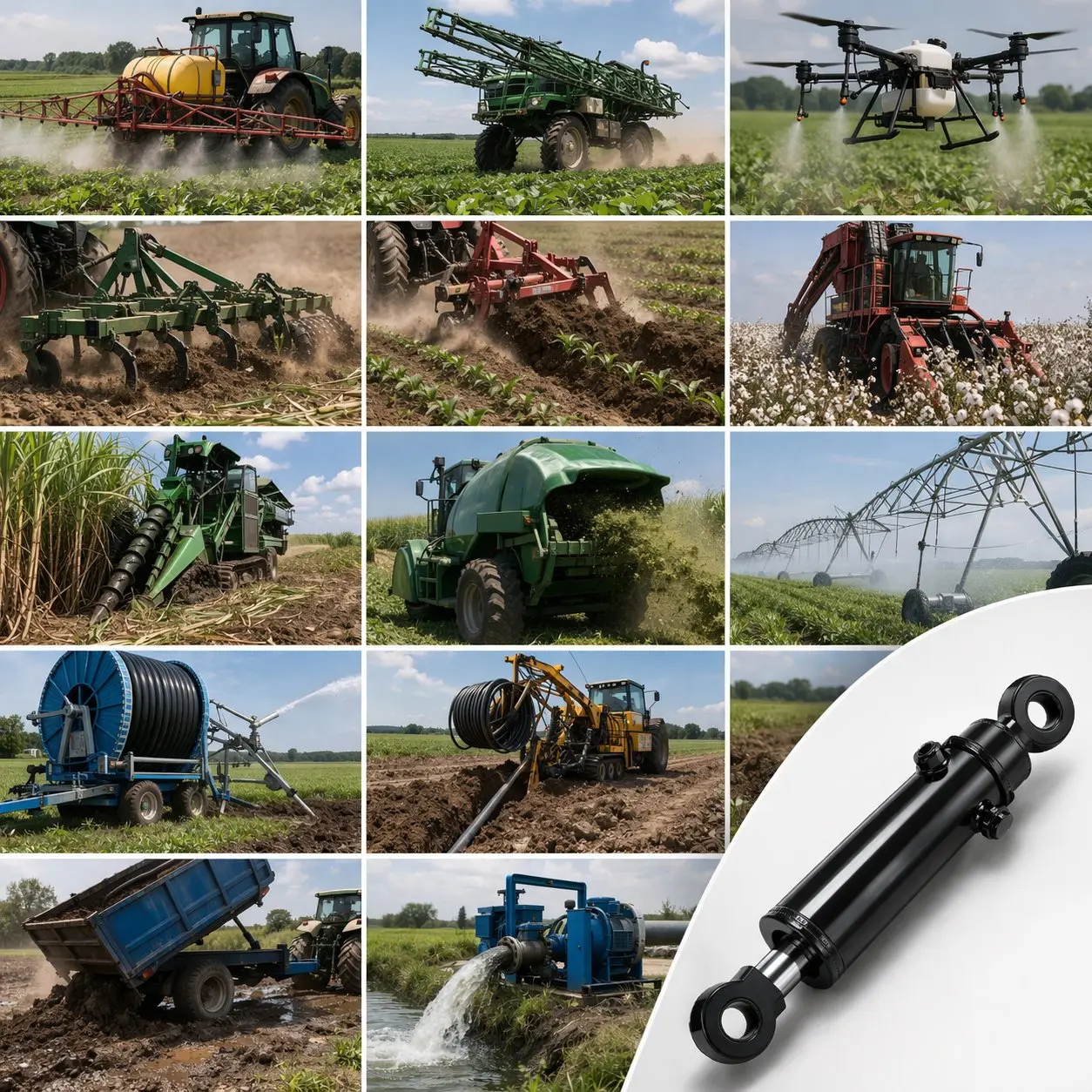
Technical Specifications
| Specification | Available Range |
|---|---|
| Bore Diameter | 40 mm – 80 mm |
| Rod Diameter | 25 mm – 50 mm |
| Stroke Length | 80 mm – 400 mm |
| Working Pressure | Up to 16 MPa (2,320 PSI) |
| Action Type | Double Acting |
| Structure | Welded Piston Cylinder |
| Body Material | Q345D Low-Alloy Structural Steel |
| Piston Rod | Q345D, Hard Chrome 20+ micron |
| Body Coating | Immersion-Grade Two-Layer Epoxy (Zinc Primer + Topcoat) |
| Rod Protection | Accordion Rubber Boot + PU Wiper Ring |
| Piston Seal | PU + PTFE Anti-Extrusion Ring |
| Rod Seal | Water-Resistant NBR (FKM upgrade available) |
| Mounting | Clevis, Pin Eye, Flange, Custom Bracket |
| Port Thread | BSP / NPT / Metric |
| Operating Temperature | -25 C to +80 C |
| Environment Rating | Enclosed High Humidity / Water Splash / Periodic Flood Submersion |
Protective Boot vs. No Boot: Three Years of Tracked Comparison on Matched Cylinders
To quantify the protective value of the rubber boot, we tracked rod surface condition on matched pairs of cylinders—one with our integrated boot and one without—installed on identical pump assemblies in the same station over three consecutive operating seasons. Both units used the same Q345D body, 20+ micron chrome rod, and water-resistant NBR seals. The only difference was the boot. The results demonstrate why moisture exclusion at the rod gland is not optional equipment for pump station service.
| Condition Assessed | After Season 1 | After Season 2 | After Season 3 |
|---|---|---|---|
| Exposed Rod (no boot) | |||
| Rod Surface | Micro-scratches under magnification | Pitting visible, dull finish | Heavy pitting, chrome breached to base metal |
| Seal Condition | Lip intact, minor wear | Lip grooved by pitted rod, dripping | Seal destroyed, continuous oil weep |
| Holding Drift (30 min) | Below 1 mm | 2 – 5 mm | 10+ mm (unsafe for pump alignment) |
| Boot-Protected Rod (our design) | |||
| Rod Surface | Chrome unchanged | Minor discoloration, still smooth | Light discoloration, zero pitting |
| Seal Condition | Like new | Lip intact, normal wear | Lip intact, no leakage |
| Holding Drift (30 min) | Below 0.3 mm | Below 0.5 mm | Below 0.8 mm |
After three seasons, the exposed unit required full replacement—the pitted rod had destroyed the seal, internal leakage made holding drift unacceptable, and body coating had peeled from the barrel. The boot-protected unit remained fully functional with the rod in serviceable condition. The only maintenance was a boot swap at the end of season three: a five-minute field task costing less than one percent of a full cylinder replacement.
How This Cylinder Controls Pump Alignment in Drainage Stations
The base lift cylinder mounts vertically between the pump station floor slab and the pump base plate. When the pump requires realignment—due to foundation settlement, piping thermal expansion, or maintenance repositioning after an overhaul—the technician pressurizes the unit to raise or lower the pump assembly by the required amount. The adjustment range is typically 20 to 80 mm, though some installations require up to 150 mm of travel for pump units that are fully removed and reinstalled during major service intervals.
Once the target height is reached, the control valve closes and the base lift cylinder holds the pump weight at the set position while mounting bolts or shims are installed to lock the alignment permanently. During this critical holding period, the unit must resist the combined weight of the pump, motor, and coupling assembly—ranging from 200 kg for small drainage pumps to over 2,000 kg for large axial-flow units. Internal leakage during holding would allow the pump to settle before bolts are torqued, resulting in shaft misalignment that causes vibration, bearing wear, and premature mechanical seal failure during operation.
In some modern pump station designs, the cylinder remains actively pressurized during operation to provide continuous alignment compensation under the thermal growth and vibration that occur during pumping cycles. Our precision piston seal with PTFE anti-extrusion ring maintains holding drift below 0.5 mm over 30-minute intervals even under moderate pump vibration, adequate for both static bolt-up alignment and active dynamic holding applications.
Six Design Features Purpose-Built for Pump Station Service
Accordion Rubber Protective Boot
The boot encloses the entire rod travel zone, reducing direct moisture contact on the chrome surface by 80 to 90 percent even in 100% humidity environments. The accordion-fold design compresses smoothly during rod extension and expands during retraction without binding or creating pressure traps. Made from ozone-resistant rubber that withstands years of indoor humidity cycling without cracking. Field-replaceable in under five minutes with no specialized tools, and priced at less than one percent of a full cylinder replacement.
Immersion-Grade Two-Layer Epoxy Body Coating
Standard single-layer paint peels within weeks of continuous wet contact at floor level. Our zinc-rich primer plus immersion-grade epoxy topcoat system is formulated for direct water immersion and maintains adhesion through months of standing water, seasonal flooding, and the constant humidity that strips inferior coatings off barrel surfaces. The zinc underlayer provides sacrificial cathodic protection at any scratch or chip location, stopping under-coating corrosion spread.
Water-Resistant NBR Seal Compound
Standard industrial-grade NBR absorbs 5 to 15 percent of its volume in water when continuously exposed, causing swelling that distorts the seal lip profile and increases friction. Our water-immersion-rated NBR compound absorbs below 2 percent by volume after 1,000 hours at 40 C, maintaining original dimensions and sealing force throughout permanently humid conditions. For stations handling chemically contaminated drainage water or acid sulfate soil runoff, we offer an FKM (Viton) seal upgrade that provides complete chemical inertness alongside water resistance.
Q345D Low-Alloy Steel with Cold-Weather Toughness
Many pump stations in Korea, Japan, and northern China remain unheated during winter. When a technician deploys the cylinder for cold-weather maintenance at temperatures below -10 C, the material must retain ductility to prevent brittle fracture under the pump assembly weight. Q345D provides 345 MPa yield strength with certified Charpy impact toughness at -20 C, ensuring safe operation during the cold-season pump maintenance windows.
Heavy Chrome Rod (20+ Micron)
Even inside the boot enclosure, some condensation occurs during temperature changes. The 20+ micron chrome layer provides a deep corrosion buffer that withstands this residual moisture contact for years without developing the micro-pitting that damages the seal contact surface. The thicker chrome also provides greater scratch resistance if the boot is briefly removed during inspections.
Precision Bore (Ra 0.2) with Holding-Grade Piston Seal
Pump alignment requires the base lift cylinder to hold the full pump weight with minimal drift while bolts are installed. The bore is honed to Ra 0.2 with roundness within 0.01 mm, providing uniform seal contact that keeps internal leakage below 0.3 ml per minute at working pressure. The PTFE anti-extrusion ring prevents seal deformation under sustained gravity load, maintaining position accuracy within 0.5 mm over extended holding periods.
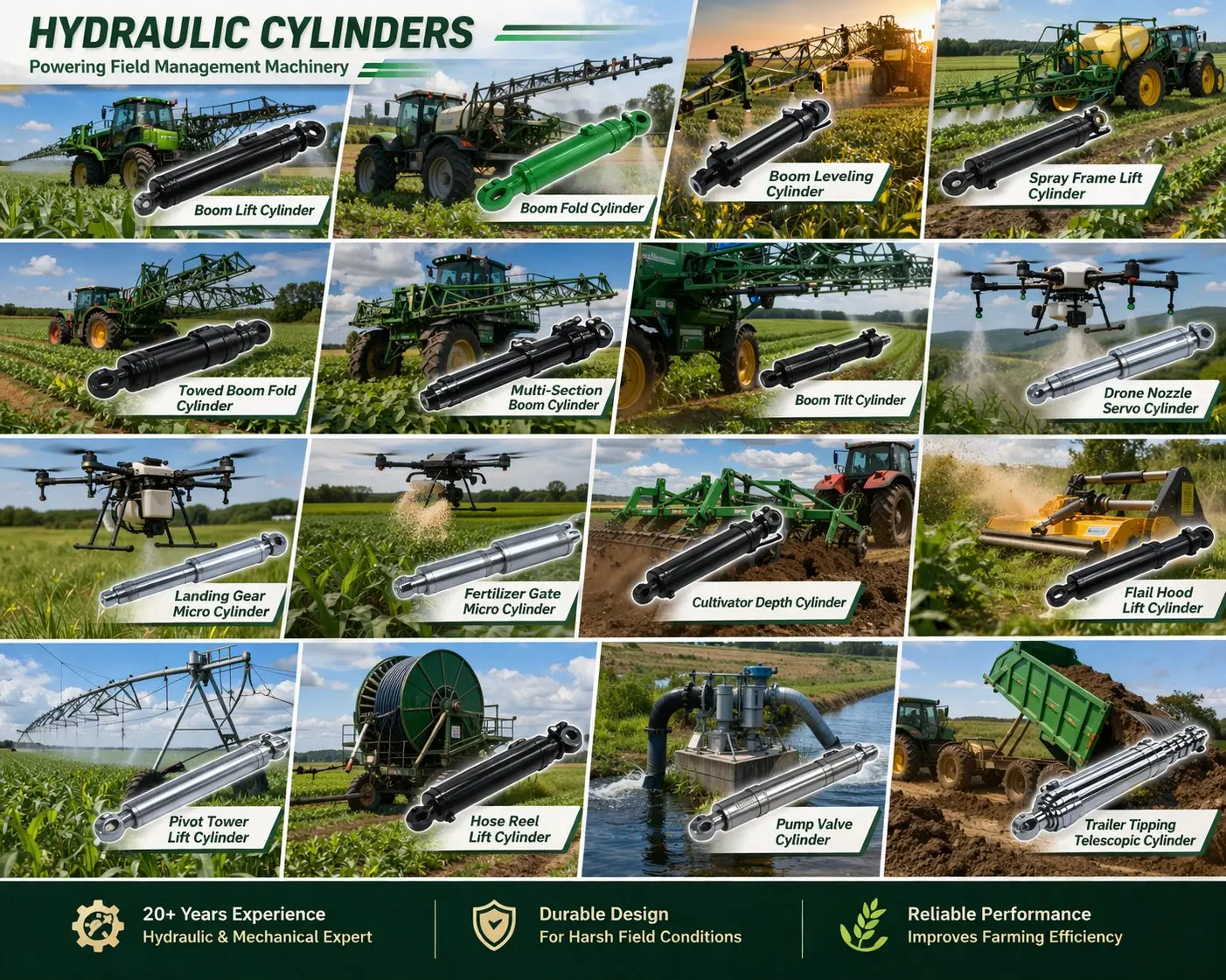
Application Scenarios
Drainage Pump Base Height Adjustment: The primary application. Aligning pump inlet to discharge piping inside enclosed pump stations where trapped humidity and periodic flooding create the most aggressive indoor corrosion environment on the farm. The boot-protected base lift cylinder maintains full adjustment capability for the 15 to 20 year design life of a modern pump station.
Pump Motor Mount Alignment: Motor-to-pump coupling alignment in enclosed pump houses requires the same humidity-resistant double acting hydraulic cylinder design. Motor mount cylinders face identical condensation, splash, and flood exposure at floor level.
Sluice Gate Actuator Mounting: Sluice gate operating mechanisms inside drainage structures use positioning cylinders for mechanical advantage adjustment. The wet environment inside sluice gate chambers matches or exceeds pump station humidity levels, making the boot protection equally valuable.
Water Treatment Plant Equipment Positioning: Municipal water treatment facilities have similar enclosed wet environments for equipment that requires periodic height or position adjustment.
Aquaculture Pump Station Equipment: Fish farm and shrimp farm pump stations combine high humidity with nutrient-rich water that accelerates biological fouling and corrosion on unprotected steel. The FKM seal upgrade option makes our cylinder well suited to agricultural machinery hydraulic cylinder applications in aquaculture water management systems.
Manufacturing and Quality Control
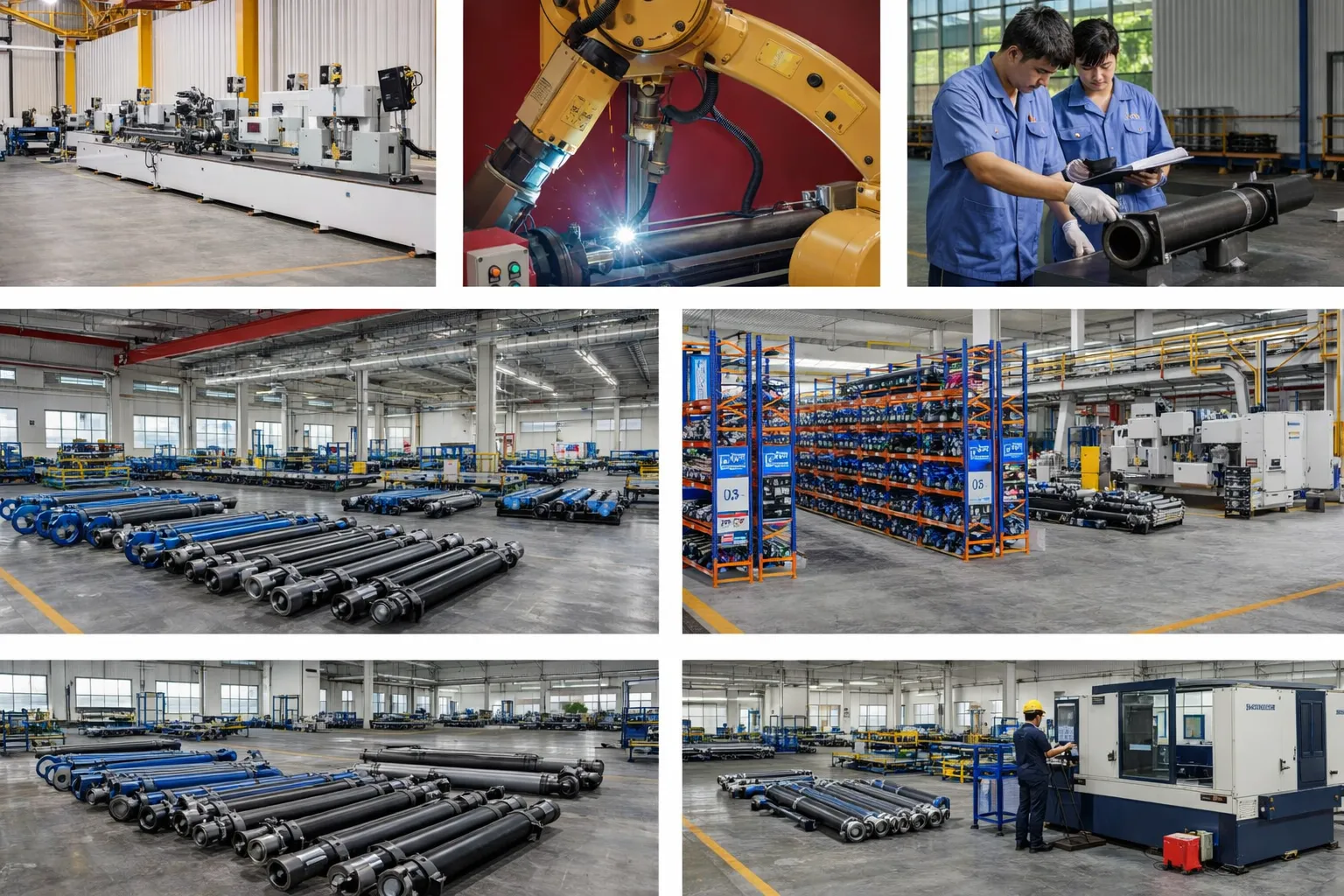
Every base lift cylinder is manufactured in-house in our ISO 9001 certified facility with dedicated process controls for humidity-resistant construction. Q345D tube and rod stock verified by spectrometer on each incoming batch with Charpy impact testing at -20 C. Bores CNC bored and honed to Ra 0.2 in single-setup runs for batch consistency. Rods ground to h7 tolerance and hard chrome plated to 20+ micron with thickness verified by eddy current gauge on every rod. MIG welded by certified operators with visual weld inspection on all units. Body surfaces abrasive-blasted to Sa 2.5, zinc-primed, and immersion-grade epoxy top-coated with dry film thickness verified at four points per cylinder. Water-resistant NBR seal compounds verified by manufacturer certificate confirming water absorption below 2% at 1,000 hours / 40 C. Boot fit-tested on every unit for full-stroke compression clearance and end-clamp seal integrity. 100% pressure tested at 1.5 times rated pressure for three minutes. Serial numbered with ten-year traceability to material heat, seal lot, chrome batch, and test data. Material certificates, pressure test reports, and seal data sheets included as standard.
Standard Farm Cylinder vs. Our Pump Station Base Lift Cylinder
| Pump Station Service Metric | Standard Farm Cylinder | Our Base Lift Cylinder |
|---|---|---|
| Rod Surface Protection | Exposed (no boot or wiper) | Boot + PU wiper dual protection |
| Rod Life in 100% Humidity | 6 – 12 months before pitting | 3 – 5 years confirmed |
| Body Coating (standing water) | Peels in weeks | Intact for years (immersion rated) |
| Seal Water Absorption (1,000 hr) | 5 – 15% (swelling, friction) | Below 2% (dimensionally stable) |
| Annual Maintenance Required | Repaint, inspect, replace seals | Visual inspection + boot check only |
| Total Cost of Ownership (5 yr) | 3-5 replacements + annual labor | 1 cylinder + 1 boot swap |
Customer Case Studies
Pyeongtaek City, Gyeonggi-do, South Korea
Customer: Han River basin drainage authority managing 8 pump stations for 3,200 hectares of lowland rice paddy water management
How They Found Us: District maintenance engineer searched for “pump station hydraulic cylinder humidity corrosion resistant” on Google in February 2025.
Results: Replaced 24 corroded cylinders across all 8 stations with boot-protected Q345D units. After three years of service including four monsoon flood events, zero rod pitting detected on any unit during annual inspections. Previous unprotected cylinders required replacement every 8 to 12 months. The authority’s annual cylinder maintenance budget dropped by 78%.
“We were replacing cylinders twice a year at every station. Three years with the booted units and we have not replaced a single one. The boot costs almost nothing but it multiplied our cylinder life by four.” – Mr. Lee, District Maintenance Chief, December 2025
Saga Prefecture, Japan
Customer: Ariake Sea coastal drainage cooperative operating 6 tidal pump stations managing 4,500 hectares of reclaimed land
How They Found Us: Found our hydraulic cylinders for agricultural machinery through a Google search in April 2025 after experiencing salt-air accelerated corrosion in coastal stations.
Results: Coastal stations combine tidal humidity with salt-laden air. The boot-protected cylinders survived two monsoon seasons including a typhoon event where three stations were fully submerged for 36 hours. Post-flood inspection showed zero rod corrosion on all booted units while unprotected equipment throughout the stations required extensive repair.
“After the typhoon flooding, everything carbon steel in the station needed attention except the booted cylinders. They came through 36 hours of submersion looking the same as the day we installed them.” – Mr. Inoue, Cooperative Equipment Manager, November 2025
Pathum Thani Province, Thailand
Customer: Central Thailand Royal Irrigation Department managing 15 pump stations across the Chao Phraya delta flood management network
How They Found Us: Engineering team contacted us directly after web search in November 2024 seeking alternatives to annual cylinder replacements at their stations.
Results: Tropical humidity means 95 to 100% RH year-round with no cold-season relief. Previous standard cylinders corroded to failure in 3 to 4 months. Boot-protected Q345D units completed 18 months through two monsoon flood events with zero rod corrosion. The department estimates annual savings of approximately 65% on cylinder procurement and installation labor across the 15-station network.
“Full stainless was ideal but the cost for 15 stations was prohibitive. The boot-protected Q345D gave us roughly 80% of the stainless corrosion protection at about 40% of the price. For our budget, that is the practical answer.” – Mr. Somchai, Regional Engineering Director, March 2025
West Java Province, Indonesia
Customer: Provincial rice paddy irrigation authority operating drainage stations across 4,000 hectares in the Citarum River basin
How They Found Us: Equipment manager discovered our products through a search for “corrosion resistant hydraulic cylinder pump station tropical” in September 2024.
Results: Year-round tropical monsoon climate with flooding several times per year. Previous unprotected units lasted an average of 3 to 4 months before rod corrosion caused seal failure. Boot-protected cylinders completed 14 months of continuous service with zero rod damage. The authority plans to standardize the booted configuration across all stations during their next budget cycle.
“Our cylinders used to rust through in a single monsoon season. Fourteen months with zero corrosion is a result we have never achieved with any previous supplier.” – Mr. Hartono, Provincial Equipment Director, January 2025
Edirne Province, Turkey
Customer: Drainage pump station equipment OEM building complete packages for Turkish rice-growing regions and export to the Balkans and Central Asia
How They Found Us: Met at the Konya Agriculture and Machinery Fair in September 2024. Engineering discussion began at the booth, sample evaluation started November 2024.
Results: OEM conducted a 12-month accelerated humidity chamber test at 95% RH with periodic water spray simulation. The boot-protected unit showed zero rod corrosion after the full 12-month test. The unprotected reference sample showed visible pitting at month 3. The OEM adopted our base lift cylinder as standard equipment on all pump station packages. Current annual production order is 180 units plus associated valve actuator cylinders.
“The boot is a low-cost addition that fundamentally changes the corrosion economics. Our export customers in Bulgaria and Uzbekistan cannot source replacement parts easily, so the cylinder has to last. This one does.” – Mr. Ozturk, Engineering Manager, June 2025
Related Products and Spare Parts
A base lift cylinder is one component in a complete hydraulic actuation system. We also manufacture and supply the following related products and replacement parts that work seamlessly with our pump station cylinders to form a complete, maintainable hydraulic power and control solution.
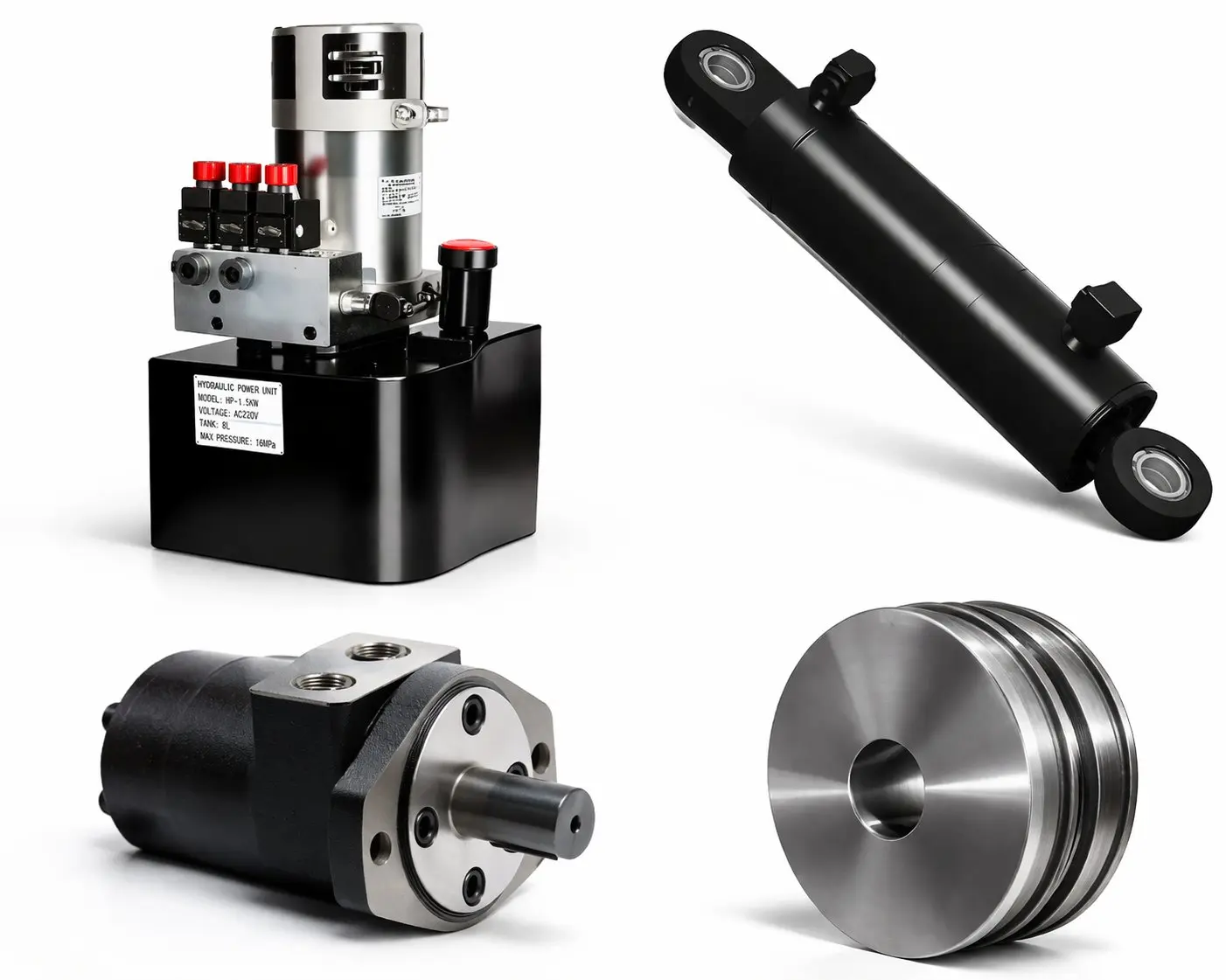
Hydraulic Power Unit: Compact self-contained units designed to drive cylinders and other actuators in pump stations. Available in single-phase and three-phase electric motor configurations (0.75 to 7.5 kW) with reservoir sizes from 5 to 60 liters. Pump station power units feature epoxy-coated reservoirs for humidity resistance and are pre-matched to our cylinder bore and pressure specifications for plug-and-play installation. Diesel-driven units available for remote stations without reliable power supply.
Hydraulic Pump: Gear pumps and vane pumps for cylinder drive circuits in pump station applications. Flow rates from 2 to 40 liters per minute, selected to match the speed and force requirements of base lift, valve actuator, and sluice gate operating systems. SAE, DIN, and metric flange mounting options.
Hydraulic Motor: Low-speed, high-torque motors for auxiliary drive applications in drainage and irrigation systems. Suitable for powering gate valve mechanisms, screen cleaning systems, and other rotary actuators alongside cylinder installations. Orbital and gear motor types from 50 to 500 cc displacement.
Replacement Piston Rod: Factory-matched replacement piston rods for all our cylinder models. Same Q345D material grade, chrome thickness, surface finish, and dimensional tolerance as the original production rod. Drop-in replacement that restores full performance when rod reconditioning after extended service is not economical. Supplied with a new rod seal kit for complete rod-end rebuild.
Replacement Cylinder Barrel: Precision-honed replacement barrels for field rebuild. Same Q345D material, bore finish (Ra 0.2), seal groove dimensions, and port thread specifications as original production. Supplied pre-coated with immersion-grade epoxy. Complete rebuild kit including barrel, piston seal, wear ring, and O-rings available as a single part number for streamlined ordering.
All related products and spare parts are available to order alongside new hydraulic cylinders for sale or separately for existing installations. Our engineering team provides system-matched recommendations that consider the complete hydraulic circuit to ensure all components work together for optimal performance and longevity.
Frequently Asked Questions
Why choose a boot-protected Q345D cylinder instead of full stainless steel for pump stations?
What bore size is typical for a pump station base lift cylinder?
Can I order replacement piston rods, barrels, and boots separately for field rebuild?
What is the lead time and do you ship to Southeast Asia?
Protect the Rod. Protect the Budget. A Boot Does Both.
Share your pump station layout, pump weight, and drainage water conditions. We will recommend a boot-protected base lift cylinder with matched power unit and deliver a complete system quotation within 48 hours.