Multi-Section Boom Fold Cylinder for Self-Propelled Sprayers
27SiMn alloy steel thick-wall barrel with reinforcement ribs. Engineered for the cyclic fatigue and high-speed vibration of multi-segment boom folding operations.
Folding a 36-Meter Boom Looks Simple From the Cab. Inside the Cylinder, It Is Anything But.
From the operator seat of a self-propelled sprayer, folding the boom for road transport takes about twenty seconds. Press a button, and the 36-meter span collapses into three or four neatly stacked sections against the machine body. What the operator does not see is the mechanical violence happening inside the fold cylinders during those twenty seconds. Each section weighs 200 to 400 kilograms and swings through an arc of 90 to 180 degrees. The cylinder controlling each hinge joint must accelerate that mass at the start of the fold, control its velocity through the arc, and decelerate it to a smooth stop at the end position, all while the sprayer frame pitches and sways on uneven terrain.
At operating speed in the field, the folded boom unfolds to full span and locks. During spraying at 20 to 30 km/h, terrain undulations and wind gusts transmit high-frequency vibrations through the boom structure directly into the fold joint and its hydraulic cylinder. Every bump in the field sends a resonant pulse through the boom that cycles the fold cylinder piston in micro-movements of a few millimeters, hundreds of times per minute. This continuous micro-cycling at moderate pressure is what kills standard cylinders from barrel fatigue and seal degradation long before their rated service life is reached.
Our multi-section boom fold cylinder is built from 27SiMn manganese-silicon alloy steel with a thick-wall barrel design and optional external reinforcement ribs at the weld zones. It is a double acting hydraulic cylinder in a welded piston configuration, specifically engineered to survive the cyclic fatigue environment of high-speed boom folding on self-propelled sprayers covering 300 to 500 hectares per day across Korea, Japan, and mainland Asia.
Barrel Fatigue: The Silent Failure That Grounds Your Sprayer
Most cylinder failures get noticed immediately: a bent rod, a leaking seal, a broken mount. Barrel fatigue is different. It develops invisibly inside the cylinder wall, starting as microscopic cracks at stress concentration points near weld joints. These cracks grow a tiny amount with each pressure cycle. By the time oil starts seeping through the barrel wall at the weld seam, the crack has been propagating for weeks or months. The cylinder is beyond repair and must be replaced entirely.
Self-propelled sprayer boom fold cylinders are uniquely vulnerable to barrel fatigue because of the combination of three factors that do not occur together in most other agricultural cylinder applications:
Factor 1: Extremely High Cycle Count
A boom fold cylinder on a self-propelled sprayer cycles through full fold and unfold at least 6 to 10 times per working day (moving between fields, folding for road transport, unfolding at each field entry). On top of that, the micro-vibration cycling during spraying adds thousands of small pressure pulses per hour. Over a 1,000-hour spraying season, the total pressure cycle count can exceed 2 million. Standard carbon steel barrels with as-welded joints typically develop visible fatigue cracks at 300,000 to 500,000 cycles.
Factor 2: Dynamic Load Amplification
When a 300 kg boom section swings through its folding arc, the angular momentum generates dynamic forces at the cylinder rod that exceed the static weight of the section by 2 to 3 times during acceleration and deceleration phases. If the sprayer hits a bump during folding, the resulting inertial spike can reach 4 to 5 times static load. These amplified forces translate directly into pressure spikes inside the barrel that push the stress level into the fatigue-damage zone with every fold cycle.
Factor 3: Weld Joint Stress Concentration
The barrel-to-end-cap weld is the weakest point in any welded cylinder. Residual welding stresses, geometric discontinuities at the weld toe, and potential micro-defects in the heat-affected zone all act as stress concentrators that initiate fatigue cracks at lower cycle counts than the base metal would tolerate. In standard cylinders, these welds are left in the as-welded condition. In our boom fold cylinders, every weld undergoes post-weld stress relief heat treatment and the weld toe is ground to a smooth profile to reduce the stress concentration factor by up to 40%.
Our countermeasures work together: 27SiMn alloy steel provides a higher fatigue endurance limit than carbon steel. Thick-wall barrel construction reduces the stress amplitude at any given pressure. Post-weld stress relief removes residual stresses that would otherwise act as crack initiators. And optional external reinforcement ribs at the weld zones distribute load over a larger area, further reducing the peak stress that drives fatigue crack propagation.
How a Multi-Section Boom Fold Cylinder Operates
A self-propelled sprayer boom is divided into three to five hinged sections. Each hinge joint has a dedicated fold cylinder that swings its section from the extended (working) position to the folded (transport) position and back. The outermost sections fold first, stacking inboard toward the machine body, followed by the inner sections.
When the operator commands a fold, a sequencing valve directs oil to the outermost cylinder first. The cylinder retracts, pulling the outer boom section inward through its hinge arc. Flow control valves regulate the folding speed to prevent the section from swinging too fast and overshooting the stop position. At the end of travel, the cylinder reaches its fully retracted stroke and locks the section in the folded position. The sequencing valve then directs oil to the next cylinder inboard, repeating the process for each section.
Unfolding reverses the sequence: inner sections extend first, followed by outer sections. The cylinder must push each section outward against wind resistance, gravity (if the hinge axis is not perfectly horizontal), and the friction of the hinge bearings. At full extension, the cylinder locks the section in the working position and holds it rigid against aerodynamic and terrain-induced forces during spraying operations.
During spraying, the fold cylinders are locked at full extension, but they are not static. Terrain vibrations cause the boom sections to oscillate around their hinge points, and these oscillations translate into rapid micro-pressure cycles in the locked cylinder. This continuous low-amplitude fatigue loading is what distinguishes boom fold duty from simple extend-retract applications and is the primary driver of barrel fatigue failure.
Technical Specifications
| Specification | Available Range |
|---|---|
| Bore Diameter | 50 mm – 100 mm |
| Rod Diameter | 28 mm – 63 mm |
| Stroke Length | 150 mm – 800 mm |
| Working Pressure | Up to 20 MPa (2,900 PSI) |
| Action Type | Double Acting |
| Structure | Welded Piston Cylinder, Thick-Wall, Optional Reinforcement Ribs |
| Body Material | 27SiMn Alloy Steel (Quenched and Tempered) |
| Piston Rod | 27SiMn, Hard Chrome 20+ micron |
| Body Finish | Epoxy Paint / Powder Coat |
| Piston Seal | Fatigue-Rated PU + PTFE Wear Ring |
| Rod Seal | NBR + PTFE Back-up Ring |
| Dust Seal | PU Wiper Ring |
| Mounting | Clevis, Trunnion with Reinforced Bushing, Pin Eye, Custom |
| Port Thread | BSP / NPT / Metric / SAE |
| Operating Temperature | -25 C to +85 C |
| Environment Rating | High-Speed Vibration / Cyclic Fatigue |
Seven Engineering Features for High-Cycle Boom Fold Duty
27SiMn Thick-Wall Barrel
The barrel wall thickness exceeds standard hydraulic cylinder specifications by 25 to 40 percent for any given bore diameter. This extra material reduces the hoop stress amplitude under cyclic pressure loading, directly extending the number of fatigue cycles the barrel can absorb before crack initiation. The 27SiMn alloy composition adds silicon for enhanced fatigue resistance compared to plain carbon steel, providing a higher endurance limit that keeps the barrel safely below the crack-growth threshold even at multi-million cycle counts.
Post-Weld Stress Relief on All Joints
Every barrel-to-cap weld undergoes stress relief heat treatment at 550 to 600 C after welding. This reduces residual welding stresses to below 30 percent of the material yield strength, removing the primary crack-initiation driver at weld joints. Additionally, the weld toe is mechanically ground to a smooth radius that reduces the geometric stress concentration factor. Together, these steps roughly triple the fatigue life of the weld joint compared to as-welded condition.
Optional External Reinforcement Ribs
For the most demanding applications (booms wider than 30 meters, operating speeds above 25 km/h), we offer external reinforcement ribs welded around the barrel at the weld-zone locations. These ribs increase the local section modulus of the barrel at the highest-stress region, distributing the cyclic load over a larger area and further reducing the peak stress that drives fatigue propagation. The ribs add approximately 8 to 12 mm to the barrel outside diameter at the reinforced zone but do not affect mounting dimensions or stroke length.
Fatigue-Rated Seal Compounds
Standard polyurethane seals harden and crack under the thermal cycling that results from continuous micro-movement at moderate pressure. Our piston seals use a fatigue-rated PU compound with enhanced elastic recovery that maintains its lip geometry through millions of micro-stroke cycles without developing the compression set that causes standard seals to lose contact with the bore surface. PTFE wear rings on the piston prevent metal-to-metal contact during the lateral loading that occurs when boom vibration pushes the piston sideways against the bore wall.
Reinforced Trunnion Mounts with Bronze Bushings
The trunnion mounts on boom fold cylinders carry the full weight and dynamic load of the boom section they control. Standard cast trunnion ears crack at the root after one or two seasons of high-cycle loading. Our trunnion ears are forged from alloy steel and welded to the barrel with full-penetration welds that are stress-relieved along with the barrel-to-cap joints. Phosphor bronze bushings in the trunnion bores absorb impact loads and self-lubricate, extending the trunnion bearing life to match the cylinder barrel life of five or more seasons.
Precision Bore for Consistent Fold Speed
Fold speed consistency between the left and right boom halves depends on matched cylinder bore diameters. If the bore on one side is 0.05 mm larger than the other, that cylinder extends faster at the same oil flow rate, causing the boom to unfold unevenly. We hold bore tolerances to plus or minus 0.01 mm within matched pairs, ensuring symmetric fold and unfold timing across the boom width. Bore surface finish is honed to Ra 0.2 for consistent seal performance.
Vibration-Resistant Port Connections
Boom vibration loosens hydraulic fittings over time. Every port on our fold cylinders is CNC-machined after welding with tight thread tolerances and a lead-in chamfer that protects the O-ring during assembly. Port bosses are reinforced with extra weld material to resist the fatigue loading transmitted through connected hoses. We recommend ORFS (O-Ring Face Seal) fittings for this application and design our port geometry to accept them.
Application Scenarios
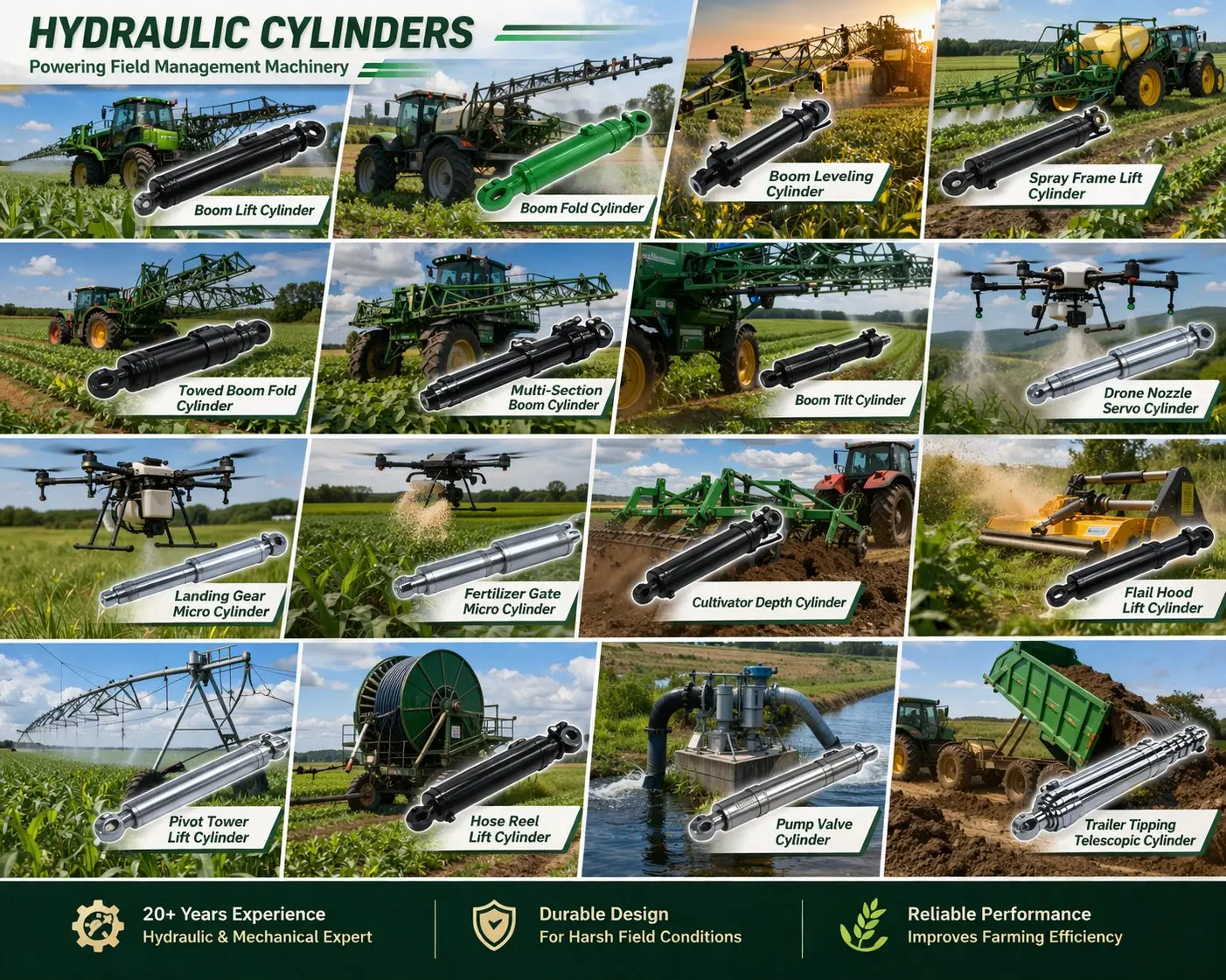
Self-Propelled Crop Sprayers (24 m to 48 m Boom): The primary application. Each boom hinge on machines from major global sprayer brands uses a dedicated fold cylinder. Our matched-pair production ensures symmetric folding behavior across the full boom width. The thick-wall barrel and stress-relieved welds handle the vibration environment of high-speed spraying at 20 to 30 km/h.
Trailed Sprayers with Folding Booms: Trailed sprayers with 18 to 28 meter booms generate similar fold loads and vibration fatigue, especially when towed at speed over rough headlands. The same fatigue-resistant barrel and seal design applies directly to these machines.
Liquid Fertilizer Applicator Booms: UAN and liquid fertilizer boom applicators share identical fold mechanisms with crop sprayers. The added chemical corrosion from fertilizer splash can be addressed with our optional epoxy body coating and FKM seal upgrade on the same welded hydraulic cylinder platform.
Aerial Application Equipment Ground Booms: Ground-based aerial application rigs with wide folding booms used in orchard and vineyard spraying face similar fatigue challenges from fold cycling and vibration during transport between blocks.
Municipal and Highway Vegetation Management Sprayers: Roadside spraying vehicles with articulated folding booms operate at highway speeds, generating even higher vibration loads than agricultural sprayers. The reinforcement rib option is particularly valuable for these high-speed applications.
Manufacturing and Quality Control
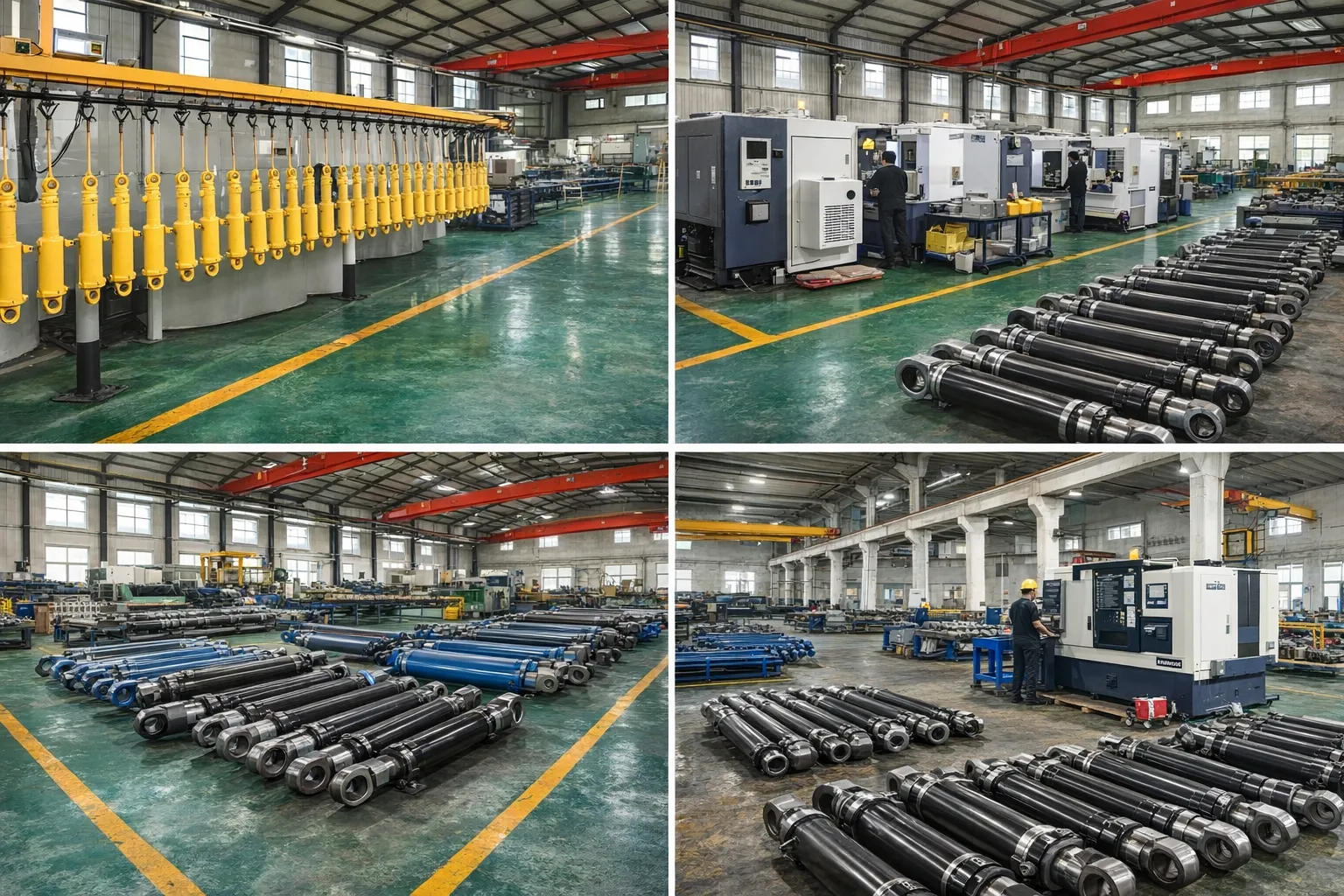
Material: 27SiMn tube and bar stock sourced from qualified mills with full material certificates. Incoming verification by spectrometer and hardness test on every batch. Wall thickness measured ultrasonically at multiple points along each tube length before release to machining.
Machining: Bores CNC bored and honed to Ra 0.2. Rods ground to h7 tolerance and chrome plated to 20+ micron. Matched pairs machined in the same setup to ensure bore diameter consistency within plus or minus 0.01 mm between left and right units.
Welding and heat treatment: Pre-heated to 150 to 200 C before welding. MIG welded with matched filler wire. Post-weld stress relief at 550 to 600 C with thermocouple-monitored furnace profiles retained for traceability. Weld toe ground to smooth radius on all fatigue-critical joints. Reinforcement ribs (when specified) welded and stress-relieved in the same furnace cycle.
Assembly and testing: Clean-room assembly with filtered oil flush. 100% pressure tested at 1.5 times rated pressure for three minutes. Full stroke cycling test at rated pressure for minimum five cycles to verify smooth operation and fold speed consistency. Serial numbered with ten-year traceability. ISO 9001 certified. Material and test certificates included with every shipment.
Standard Fold Cylinder vs. Our Multi-Section Boom Fold Cylinder
| Fatigue-Relevant Metric | Standard Fold Cylinder | Our Boom Fold Cylinder |
|---|---|---|
| Barrel Material | S45C Carbon Steel | 27SiMn Alloy Steel (Q&T) |
| Barrel Wall Thickness vs. Standard | Standard (1.0x) | 1.25x to 1.40x (thick-wall) |
| Weld Fatigue Life | 300,000 – 500,000 cycles | 2,000,000+ cycles (stress-relieved) |
| Trunnion Mount | Cast ears, steel-on-steel bearing | Forged ears, phosphor bronze bushing |
| Seal Compound | Standard PU (hardens under micro-cycling) | Fatigue-rated PU (elastic recovery maintained) |
| Reinforcement Ribs | Not available | Optional at weld zones |
| Matched-Pair Bore Tolerance | +/- 0.03 – 0.05 mm | +/- 0.01 mm |
| Typical Service Life Before Barrel Fatigue | 1 – 3 seasons | 6 – 10 seasons |
Customer Case Studies
Dangjin City, Chungcheongnam-do, South Korea
Customer: Rice farming cooperative operating 8 self-propelled sprayers with 28 m and 36 m booms across 2,400 hectares of paddy
Challenge: Barrel weld cracks on boom fold cylinders appeared after 2 seasons, causing oil leaks that forced mid-season cylinder replacements. The cooperative replaced 5 to 7 fold cylinders per year at significant cost and downtime.
How They Found Us: Equipment manager searched for “sprayer boom fold cylinder fatigue resistant” on Google in November 2024.
Results: All 8 machines were refitted before the 2025 rice spraying season. Through two full campaigns (spring and summer 2025), zero barrel fatigue incidents occurred. Annual fold cylinder replacement costs dropped to zero from an average of approximately 4,200 USD per year.
“We used to budget for boom cylinder replacements as a normal annual expense. After two seasons with zero failures, that budget line is gone. The stress-relieved welds and thick walls make a clear difference.” – Mr. Song, Equipment Manager, December 2025
Gimpo City, Gyeonggi-do, South Korea
Customer: Self-propelled sprayer OEM building machines for the Korean domestic market and Southeast Asian export
Challenge: Warranty claims on boom fold cylinders accounted for 18% of total machine warranty costs. Previous carbon steel cylinder supplier could not meet the fatigue life required for 36 m booms operating at 25 km/h.
How They Found Us: Met at the Korea Agricultural Machinery Show in Cheonan, March 2025. Requested engineering evaluation samples in April 2025.
Results: After a 50,000-cycle bench endurance test at 120% rated pressure, our cylinders showed no detectable crack initiation at any weld joint. The OEM approved our cylinder for series production on their 2026 model year sprayers. Fold cylinder warranty claims on pilot machines dropped from 18% to under 1%. Current order is 120 matched pairs per quarter.
“Fold cylinder warranty was our single biggest quality problem. This switch solved it. The 27SiMn alloy with stress-relieved welds passed our endurance test with margin to spare. No other supplier we tested came close.” – Mr. Kwon, VP Engineering, August 2025
Niigata Prefecture, Japan
Customer: Agricultural services company operating a fleet of 12 self-propelled sprayers for contract rice pest management across the Echigo Plain
Challenge: The fleet averages 800 to 1,000 operating hours per machine per season, with 8 to 12 boom fold cycles per day. Original European OEM fold cylinders developed barrel cracks after 2 to 3 seasons, and replacements from the OEM were expensive and had long lead times.
How They Found Us: Found our hydraulic cylinders for agricultural machinery pages through a Google search in January 2025. Requested samples matched to European OEM dimensions.
Results: We reverse-engineered the OEM cylinder dimensions and supplied 24 matched pairs (one set per machine). After the full 2025 season (approximately 900 hours per machine, 9,000+ fold cycles), zero barrels showed any sign of fatigue. The company estimates annual savings of approximately 30,000 USD on fold cylinder procurement compared to OEM replacement pricing.
“European OEM replacement cylinders cost three times what these cost, and they last half as long. After a full season at our intensity level with no failures, we have no reason to go back to OEM parts.” – Mr. Aoki, Fleet Director, November 2025
Khon Kaen Province, Thailand
Customer: Agricultural machinery dealer distributing self-propelled sprayers across the Thai rice belt
Challenge: Thai operators run sprayers year-round with minimal off-season downtime, accumulating 1,500+ hours annually. Standard fold cylinders from the sprayer manufacturer lasted an average of 1.5 seasons before barrel cracks appeared.
How They Found Us: Discovered our website while searching for aftermarket sprayer cylinder options in September 2024. Placed a trial order for 10 matched pairs in November 2024.
Results: Trial units have completed over 18 months of continuous service (estimated 2,200+ hours) with no barrel fatigue detected during scheduled inspections. The dealer now stocks our cylinders as their standard aftermarket replacement and has expanded to ordering fold cylinders for five different sprayer models.
“In Thailand there is no winter break for sprayers. They work all year. Cylinders that last 1.5 seasons elsewhere last less than a year here. Yours have gone past 18 months and counting. That is a first for us.” – Mr. Wichai, Aftermarket Sales Director, May 2025
Konya Province, Turkey
Customer: Self-propelled sprayer OEM building machines for the Turkish domestic and Central Asian export markets
Challenge: Their 28 m and 32 m boom models experienced trunnion ear cracking on fold cylinders, particularly on machines exported to Kazakhstan where rough terrain and high-speed road transport amplified fold joint loads.
How They Found Us: Met at the Agritechnica trade fair in Hanover, November 2024. Requested samples with forged trunnion ears and bronze bushings.
Results: After an 8-month field trial across Turkish and Kazakh conditions, zero trunnion failures were recorded. The OEM standardized our cylinder on their export-grade sprayer models. Annual warranty cost reduction for fold cylinder issues exceeded 40%. Current blanket order is 200 matched pairs per year.
“The Kazakh market demanded a solution for trunnion cracking. Forged ears with bronze bushings solved it completely. Our export customers have stopped complaining, and that is the best feedback an OEM can get.” – Mr. Ozturk, Export Engineering Manager, July 2025
Frequently Asked Questions
What causes barrel fatigue cracks in sprayer boom fold cylinders?
Can your fold cylinders replace OEM units on major self-propelled sprayer brands?
Why do fold cylinders need to be ordered as matched pairs?
What is the lead time for boom fold cylinders?
How can I tell if my boom fold cylinder barrel is developing fatigue cracks?
Do you deliver boom fold cylinders to Korea, Japan, and Southeast Asia?
What maintenance should boom fold cylinders receive between spraying seasons?
Your Boom Folds Thousands of Times a Season. The Cylinder Should Keep Up.
Send us your sprayer model, boom width, and current fold cylinder dimensions. We will propose a fatigue-rated matched pair and deliver a quotation within 48 hours.
Editor: Cxm