Flying Shear Cylinder for Rolling Mill
Engineered for extreme high-speed reciprocating environments, delivering servo-level sealing precision and absolute structural immunity to high-frequency fatigue in continuous metallurgy lines.
Product Overview & Core Industrial Value
In the unforgiving environment of modern continuous hot and cold rolling mills, the production line simply cannot afford to stop. As red-hot steel billets, thick plates, or rapidly moving wire rods travel down the run-out tables at velocities frequently exceeding twenty meters per second, dividing this endless ribbon of steel into precise commercial lengths requires mechanical actuation of phenomenal speed and exactness. The automated mechanism responsible for this violent yet perfectly synchronized task is the high-speed flying shear. The absolute heart of this massive kinetic operation, providing the driving force for acceleration and cutting, is the flying shear cylinder.
Standard commercial fluid power solutions are entirely inadequate for this brutal application. The immense kinetic energy involved, combined with the necessity for the shear blades to exactly match the horizontal speed of the moving metal before initiating the vertical cut, places extraordinary stress on the actuator. A standard hydraulic cylinder would literally tear its own tie-rods apart under the intense pressure spikes and continuous deceleration shocks. A failure here does not just mean a bad cut; it results in a catastrophic pile-up of high-speed metal, leading to massive safety hazards, severely damaged mill equipment, and hundreds of thousands of dollars lost in unscheduled production downtime.

Our purpose-built flying shear hydraulic cylinder represents the apex of dynamic fluid control and structural integrity. As an experienced global hydraulic cylinder manufacturer, we have spent two decades analyzing the physics of these extreme high-frequency fatigue environments. By utilizing highly specialized welded alloy structures, we eliminate the micro-flexing that destroys traditional actuators. This unwavering structural rigidity ensures that the volumetric fluid displacement translates completely into immediate mechanical motion, allowing your automated control system to perfectly synchronize the cut. Integrating our advanced hydraulic parts into your facility guarantees uninterrupted operational stability, heavily reduced scrap rates, and maximized metallurgical yield.
Comprehensive Technical Parameters
Precision engineering at extreme velocities demands absolute transparency in specifications. The exact geometric tolerances, material science selections, and fluid dynamic capabilities of our high-speed shearing solutions are outlined below. These parameters represent our baseline for metallurgical reliability, though every unit is meticulously customized to match your facility’s specific line speed and tonnage requirements.
| Engineering Parameter | Specification Details & Customization Matrix |
|---|---|
| Industry Sector | Metallurgy / Heavy Metal Forming & Processing |
| Equipment Category | Continuous Rolling Mill (Hot Strip, Wire Rod, Billet Caster) |
| Subsystem Action | High-Speed Flying Shear / Dynamic Cut-to-Length |
| Actuator Designation | Flying shear cylinder |
| Hydraulic Action Mode | Double acting hydraulic cylinder for forced retraction |
| Internal Structure Type | High-Speed Servo Cylinder with highly responsive fluid ports |
| Manufacturing Construction | Heavy-Wall Welded Assembly (Eliminates tie-rod elongation) |
| Core Material System | High-Strength Forged Alloy Steel (Stress-relieved 42CrMo) |
| Surface Treatment | Thick Hard Chrome Plating (HV850+) against abrasive scale |
| Operational Environment | High-Speed Reciprocating / Extreme Radiant Heat / Heavy Dust |
| Prevented Failure Mode | High-Frequency Fatigue Fracture & Dynamic Seal Blowout |
| Recommended Configuration | Servo-Level Sealing Technology & Advanced Internal Cushioning |
Operational Mechanics: Mastering High-Speed Fluid Dynamics
To truly appreciate the sophistication of a high-performance shearing actuator, one must look at the exact physics occurring within the rolling mill. The metal strand is moving constantly. The shear mechanism cannot act like a standard static press, which requires the material to halt. Instead, the actuator must propel the heavy mechanical shear carriage forward to precisely match the velocity of the metal strand, execute a tremendously powerful downward cutting stroke, and immediately retract the blade and return the carriage to its home position—all typically within a timeframe of less than half a second.
This remarkably complex and violent sequence is driven by a state-of-the-art proportional servo valve directing high-pressure fluid directly into our specialized double acting hydraulic cylinder. Unlike a basic single acting hydraulic cylinder, which must rely on gravity, weight, or mechanical springs for the return stroke (which would be entirely useless and far too slow for this cycle rate), the double-acting design allows pressurized hydraulic fluid to actively force both the extension and the rapid retraction of the hydraulic cylinder piston. The massive fluid flow rates required to achieve these velocities generate immense internal fluid friction and heat. Therefore, our internal porting is aerodynamically optimized to minimize fluid turbulence, preventing cavitation that could tear the internal metal surfaces apart.
Perhaps the most critical phase of the high-speed stroke is the deceleration. When a massive steel piston and connected shear carriage is traveling at high velocity, simply commanding the hydraulic valve to close will result in a hydraulic shockwave (a severe water hammer effect) so violent it can rip the heavy mounting trunnions completely off the machine frame. Our custom units feature highly sophisticated, dynamically adjusting hydraulic cushioning at both ends of the stroke. As the piston approaches the end cap, a precisely machined spear enters a deceleration chamber, gradually throttling the escaping fluid. This converts the lethal kinetic energy into harmless heat rather than destructive mechanical shock, safeguarding all adjacent mechanical components.

Seamless Equipment Replacement & OEM Cross-Referencing
Procurement managers and maintenance directors in the metallurgical sector frequently grapple with the exorbitant pricing and unacceptable lead times associated with legacy European and American OEM equipment. When a primary shear actuator goes down, waiting six to eight months for a replacement part from overseas is a catastrophic business proposition. Our specialized engineering division excels at reverse-engineering and manufacturing perfect drop-in dimensional replacements designed specifically for heavy industry.
We routinely supply high-performance hydraulic rams and fully integrated cylinder assemblies that seamlessly replace units originally manufactured by major international brands such as Bosch Rexroth, Parker Hannifin, Eaton Vickers, Moog, SMS Group, Danieli, and Primetals. (Please note: The explicit mention of these corporate brand names is provided strictly for the purpose of equipment compatibility reference and technical cross-referencing for plant maintenance engineers. We operate entirely independently and hold no trademark affiliations, sponsorships, or endorsements with these respective entities.)
By transitioning to our independently engineered alternatives, steel plants not only circumvent global supply chain bottlenecks but also benefit from a highly attractive overall hydraulic cylinder price footprint. We deliver superior sealing architecture and fatigue resistance without the inflated brand premium, allowing your facility to allocate maintenance budgets far more effectively while actively upgrading production line performance.
Five Core Technical Advantages for Metallurgical Dominance
Surviving the brutal, non-stop operational tempo of a high-speed continuous rolling mill requires highly intentional, robust design interventions. We have analyzed vast amounts of forensic field failure data to integrate five distinct, uncompromising technical advantages into every flying shear hydraulic cylinder we construct.
1. Servo-Level Sealing Technology
Standard polyurethane seals generate immense breakaway friction at high velocities, rapidly melting and leading to catastrophic fluid loss. We utilize a proprietary configuration of ultra-low friction PTFE (Teflon) blended stepped seals backed by elastomeric energizers. This servo-level architecture virtually eliminates stick-slip hysteresis, allowing for instantaneous micro-adjustments and surviving continuous high-speed cycles.
2. High-Rigidity Welded Alloy Construction
The primary failure mode in heavy shear applications is structural fatigue fracture. Tie-rods stretch and warp under repetitive shock loads. Our solution is a heavy-wall welded construction, machined from premium forged high-tensile alloy steel. This monolithic, tie-rod-free design distributes high-frequency fatigue stress evenly across the barrel body, exponentially increasing the physical lifespan of the actuator.
3. Thermal Stability & Heat Dissipation
High-speed fluid bypass generates severe internal heat, compounding the radiant heat from the red-hot steel being processed inches away. We engineer our gland and end-cap geometries to maximize surface area for thermal dissipation. Furthermore, by utilizing high-temperature FKM (Viton) compounds for all static seals, we guarantee seal integrity even when ambient equipment temperatures soar.
4. Aggressive Contamination Defense
A rolling mill atmosphere is completely saturated with abrasive iron oxide scale and metallic dust. If this dust enters the cylinder, it destroys the primary seals instantly. We deploy an aggressive multi-stage defense mechanism: an extraordinarily thick layer of hard chrome plating combined with dual-lip metallic scrapers that physically sheer hardened slag off the retracting rod.
5. Advanced Internal Displacement Feedback
Achieving perfect cut synchronization requires the central plant PLC to know the exact position of the blade down to the micrometer at all times. We deep-bore the main piston rod to internally house high-shock resistant absolute position sensors. Housed safely inside the solid steel structure, the sensor is completely isolated from external mechanical impacts and vibration.
Autonomous Manufacturing & Relentless Quality Control
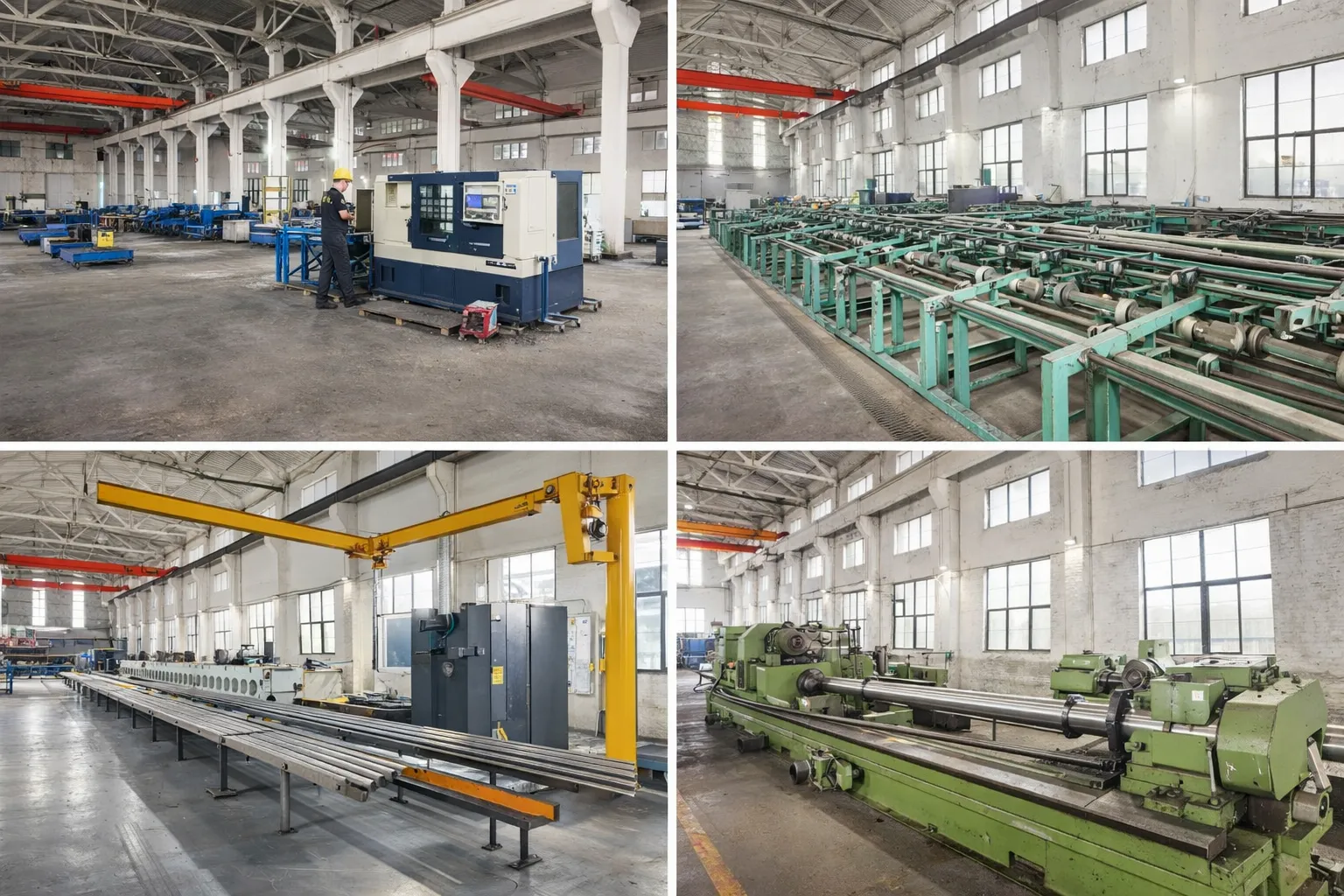
You cannot guarantee heavy-duty performance if you outsource critical production steps. We maintain total vertical integration across our entire manufacturing workflow. From the initial ultrasonic flaw detection of the raw steel forgings to the multi-axis CNC deep-hole boring, skiving, and roller burnishing of the internal barrel surfaces, every process is controlled strictly in-house. Our precision honing techniques achieve an internal surface finish of Ra 0.1µm—so incredibly smooth that it functions identically to a mirror, reducing dynamic seal wear to an absolute fraction of commercial industry standards.
The assembly of these high-tier fluid power components occurs strictly within positive-pressure, climate-controlled cleanroom environments. The smallest microscopic particle embedded during assembly will inevitably score the cylinder walls under high-pressure operation. Following assembly, 100% of our flying shear units are routed to our computerized dynamic test benches. We do not just perform static pressure holding tests; we simulate the exact high-speed reciprocating cycles of your rolling mill, actively monitoring friction profiles, servo response times, and cushion engagement before dispatch.
This uncompromising dedication to testing is exactly why leading global industries trust our dedicated departments for both new custom manufacturing and fixing hydraulic cylinders that have failed prematurely from other suppliers. Every cylinder is permanently etched with a unique traceability code, providing your maintenance engineers with immediate access to mill certificates, weld inspection logs, and exact sealing dimensions years down the line.
Broader Industry Applications & Engineering Scope
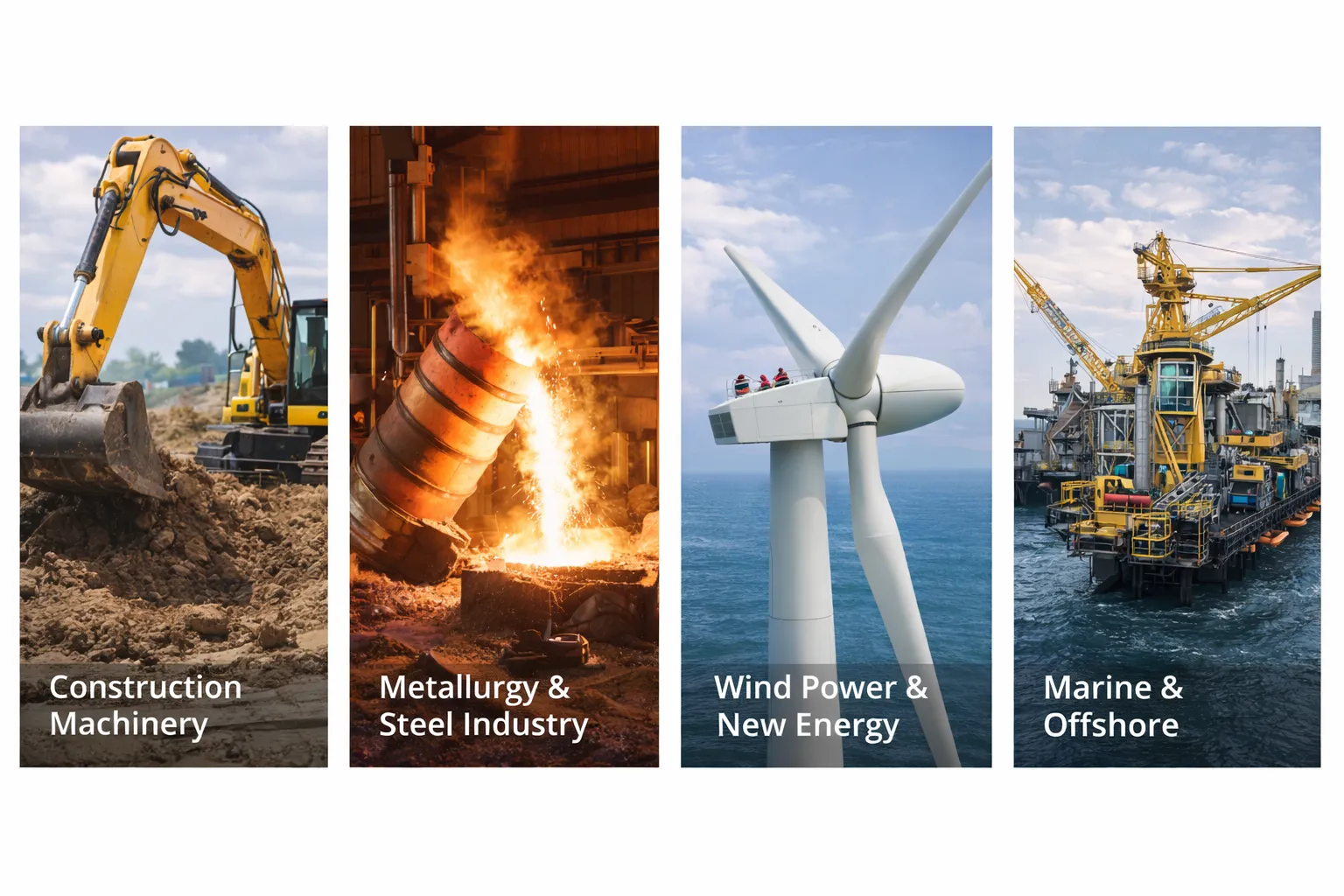
The heavy-duty engineering philosophy required to build a reliable metallurgical actuator scales remarkably well into other punishing industrial sectors. While our expertise shines brightly in heavy steelworks, our fluid power systems are highly sought after across multiple demanding domains. Explore our dedicated category for the metallurgical and iron industry to see our full heavy-duty lineup, or browse our main hydraulic cylinder catalog.
- Mining & Mineral Processing: Actuators operating in deep-shaft mines or massive rock crushers face extreme abrasive particulate and heavy shock loads. Discover our specialized, highly resilient designs for the mining industry.
- Earthmoving & Heavy Machinery: Large excavators and front-end loaders require boom and bucket cylinders that will not buckle under immense breakout forces. View our structural solutions for the construction machinery industry.
- Material Handling & Port Logistics: Megamax port container cranes and automated straddle carriers utilize our fail-safe lift cylinder designs to ensure massive container weights are handled with absolute safety and multi-axis synchronicity.
- Plastics & Rubber Injection: Delivering precise, high-tonnage mold clamping force requires large-bore custom actuators that lock perfectly without drifting under immense continuous pressure.
Comparative Analysis: Standard Commercial vs. High-Performance Servo Cylinders
When evaluating capital expenditure for plant upgrades, engineers must clearly distinguish between visually similar components that perform radically differently under kinetic load. The following table sharply outlines why a standard fluid actuator will rapidly fail if applied to a high-speed metallurgical shear.
| Crucial Performance Metric | Ordinary Industrial Actuator | Our Flying Shear Cylinder |
|---|---|---|
| Structural Fatigue Resistance | Standard tie-rod design prone to stretching and early thread micro-cracking | Monolithic welded alloy steel ensures millions of uninterrupted cycle reversals |
| High-Speed Friction Profile | Standard polyurethane melts rapidly under high-velocity dry friction | PTFE servo seals dissipate heat and glide smoothly at extreme stroke speeds |
| End-Stroke Deceleration | Basic rubber bumpers or rigid stops causing severe mechanical shock | Advanced dynamic hydraulic throttling prevents destructive water hammer effects |
| Abrasive Particulate Defense | Soft polymer wipers ingest sharp metallic scale easily, scoring the rod | Aggressive dual metallic scrapers eject hardened iron oxide scale safely |
| Positional Response Speed | Sluggish reaction time; high hysteresis leading to inaccurate cut lengths | Zero hysteresis; instant translation of PLC commands to physical motion |
Verified Field Success: 5 Real-World B2B Case Studies
Bold engineering claims must be validated by real-world survival. Our footprint is highly concentrated in the aggressive steel manufacturing hubs of South Korea and surrounding East Asian countries. Below are five extensively documented cases where our bespoke fluid power solutions completely resolved critical operational bottlenecks for massive industrial clients.
Case 1: Eradicating Fatigue Fracture in a Tier-1 Hot Strip Mill
Location: Pohang, South Korea | Client: Major Integrated Steelworks
The Challenge: The primary crank shear mechanism experienced catastrophic tie-rod failures every three to four months due to the violent shock loads of cutting high-tensile hot slabs.
Contact & Implementation: Their engineering procurement team located us via an organic Google search looking for robust metallurgical actuators. We reverse-engineered their setup and deployed a massive, custom-welded flying shear cylinder forged from heavy-duty 42CrMo.
The Result: Installed in August 2024. The unit has surpassed 18 months of continuous high-frequency fatigue operation without a single micro-fracture or fluid leak.
“The structural integrity of this new actuator is simply phenomenal. We have completely eliminated the quarterly maintenance shutdowns that were costing us severely. An incredible upgrade.” — Chief Reliability Engineer.
Case 2: Resolving Seal Melt in High-Speed Billet Shearing
Location: Osaka, Japan | Client: High-Yield Precision Minimill
The Challenge: Upgrading their line speed caused the standard NBR seals in their existing cylinder to physically melt and blow out due to extreme frictional heat generation at higher reciprocation speeds.
Contact & Implementation: Contacted our technical desk directly through our website for an emergency solution. We designed a high-speed unit incorporating our proprietary PTFE stepped-seals and advanced fluid porting for optimal internal cooling.
The Result: Commissioned in early 2025. The actuator effortlessly handles the 30% increase in cycle speed while maintaining a cool, completely dry external rod profile.
“Their mastery of high-speed tribology and sealing chemistry allowed us to safely push our production limits further than the original machine builders deemed possible.” — Mill Operations Director.
Case 3: Curing Hysteresis in a Wire Rod Automation Upgrade
Location: Kaohsiung, Taiwan | Client: Premium Export Wire Rod Manufacturer
The Challenge: Their automated cut-to-length shear was producing highly inconsistent billet lengths, leading to downstream packaging issues. The root cause was stick-slip hysteresis in the aging hydraulic actuator.
Contact & Implementation: Met our engineers at an international metallurgical expo. We supplied a heavily customized servo cylinder with an internally integrated magnetostrictive absolute position sensor.
The Result: Installed in October 2024. The instantaneous, zero-hysteresis response narrowed their cut length deviation tolerance from ±25mm down to a perfect ±2mm.
“The electronic integration and mechanical response are flawless. The shear blade strikes exactly when the PLC commands it, every single time, without exception.” — Automation Lead.
Case 4: Emergency OEM Drop-in Replacement
Location: Incheon, South Korea | Client: Specialized Cold Bar Mill
The Challenge: A catastrophic failure of an obsolete European shear cylinder halted the line. The original manufacturer quoted an unacceptable 24-week lead time for a replacement unit.
Contact & Implementation: They urgently emailed our rapid-response team with old 2D schematics. We translated the obsolete design into modern 3D CAD, enhancing the internal structure while perfectly matching the external mounting dimensions to secure a much better hydraulic cylinder price.
The Result: Delivered via air freight in just 5 weeks. It dropped into the existing framework flawlessly, saving the client millions in prevented downtime.
“Incredible manufacturing agility. They engineered a drastically superior replacement that bolted right into our system in record time.” — Plant Maintenance Manager.
Case 5: Overcoming Abrasive Airborne Scale
Location: Rayong, Thailand | Client: Heavy Section Steel Producer
The Challenge: Their pendulum shear area was incredibly dirty, thick with flying iron oxide dust. This abrasive scale was chewing through standard wiper seals and gouging the rods deeply within weeks.
Contact & Implementation: They reached out via our website after seeing our contamination defense profiles. We outfitted their new cylinders with aggressively hardened chrome and specialized brass metallic scrapers.
The Result: Deployed in December 2025. Visual inspections confirm the rod remains pristine and free of scoring, drastically extending the service life of the primary pressure seals.
“Finally, an actuator that can actually survive the brutal reality of our cutting floor. The metallic scrapers have paid for the entire upgrade multiple times over.” — Senior Mechanical Technician.
B2B Technical FAQ: Expert Insights for Procurement
Specifying critical mechanical components for a steel mill requires absolute technical clarity. Below are the most frequent inquiries our engineering team addresses from international procurement and maintenance directors.
1. What is the typical lead time for a custom flying shear unit?
2. Are your integrated sensors compatible with our existing Siemens PLCs?
3. What specific hydraulic fluids are compatible with your high-speed seals?
4. Do you supply spare seal kits and replacement rods for onsite maintenance?
5. How do you ensure the cylinder will not suffer from destructive water hammer deceleration?
6. Can you assist with diagnosing failures on our current OEM cylinders?
Secure Maximum Uptime for Your Continuous Mill
Do not allow catastrophic fatigue failures or sluggish servo responses to dictate your facility’s production yield. Partner with an expert manufacturer that intimately comprehends the violent kinetics, the aggressive contamination, and the uncompromising precision required in modern metallurgy.
Whether you require a direct dimensional drop-in replacement to bypass unacceptable OEM lead times, a complete structural upgrade to eliminate chronic breakdowns, or a reliable long-term partner for specialized heavy-duty fluid power components across South Korea and the globe, we are positioned to deliver. Provide our technical team with your operating pressures, speed requirements, and structural dimensions, and we will architect a flawless solution.
Editor: Cxm