
Mold Opening Cylinder for Wind Blade Production
Engineered with 27SiMn alloy steel and advanced servo piston architecture to deliver absolute precise stroke control, entirely eliminating position drift during the critical mold opening and closing sequences of large-scale wind turbine blades.
Product Overview & Core Industrial Value
The global transition toward renewable energy has driven the wind power sector to engineer increasingly massive wind turbine rotors. Manufacturing facilities across South Korea, Japan, and the broader Asian market are now routinely producing composite blades that exceed 100 meters in length. These colossal aerodynamic structures are fabricated using highly complex steel and composite molds via the Vacuum Assisted Resin Transfer Molding (VARTM) process. Operating these massive multi-ton molds requires immense kinetic force and absolute mechanical synchronization. The foundational actuator responsible for this highly dangerous and delicate operation is the mold opening cylinder. This specialized fluid power device handles the immense breakaway force required to separate the mold halves after the epoxy resin has fully cured, as well as the highly controlled lowering sequence required to carefully close the mold prior to resin infusion.
The primary engineering challenge in operating a 100-meter mold lies in the synchronized lifting action. A tooling line of this sheer scale utilizes dozens of cylinders positioned along the entire length of the blade. If the factory relies on standard hydraulic parts equipped with basic open-loop hydraulics, the production line inevitably falls victim to a severe mechanical failure mode universally known as position drift. Position drift occurs when internal fluid friction, varying mold weight distribution, or minor seal wear causes one cylinder in the array to extend slightly faster or slower than the adjacent units. When lifting a rigid multi-ton steel mold, even a ten-millimeter deviation across the span introduces massive torsional shear stress. This warping not only permanently damages the expensive tooling hinges but physically twists and fractures the freshly cured fiberglass blade inside, resulting in the complete scrapping of an incredibly valuable composite asset.
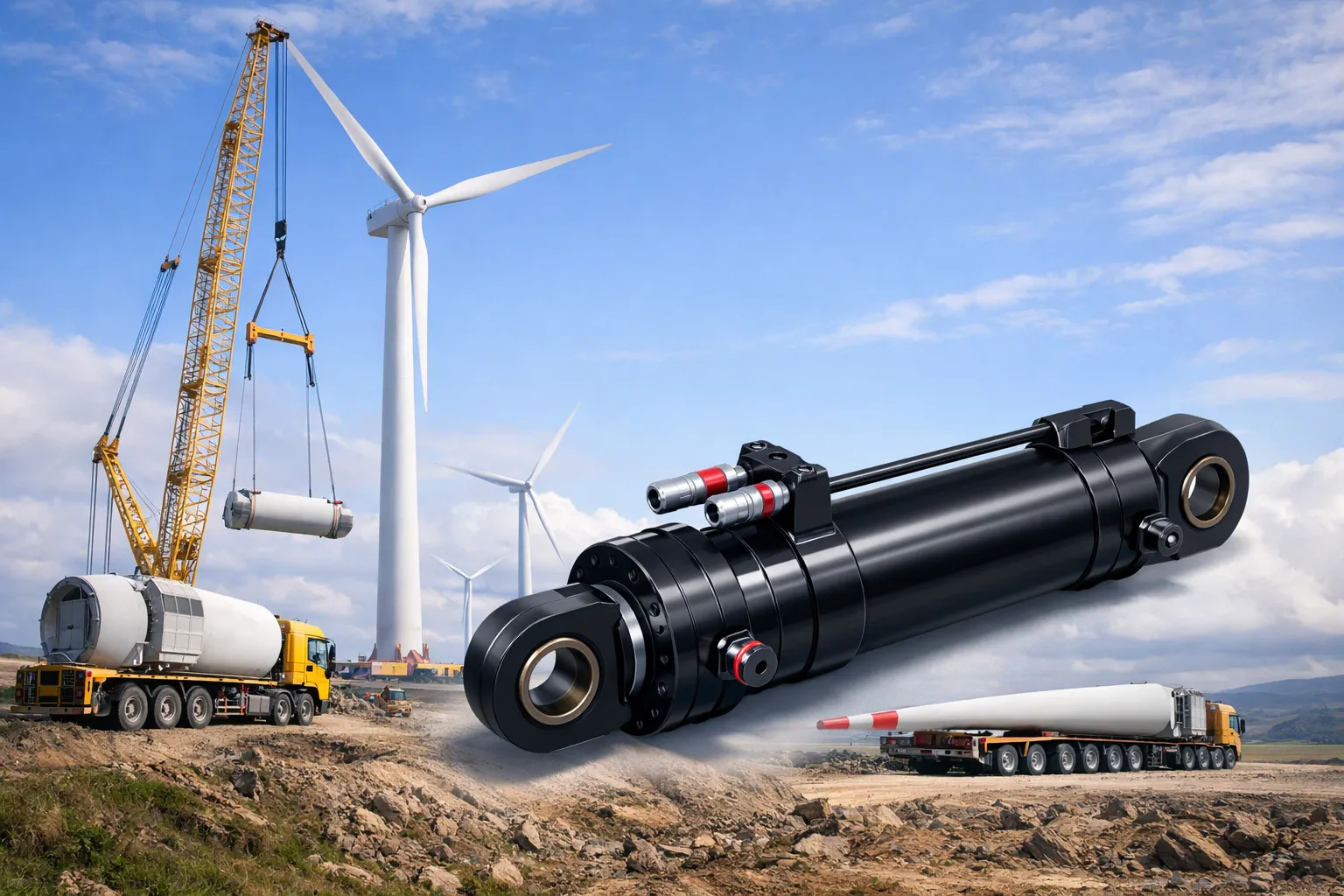
Operating globally as an authoritative hydraulic cylinder manufacturer heavily invested in heavy-duty factory automation, our engineering division specifically designed our mold opening hydraulic cylinder series to mathematically eliminate position drift. By transitioning the fundamental architecture to a servo piston cylinder design equipped with integrated linear displacement transducers, and forging the main barrels from high-yield 27SiMn steel, we guarantee microscopic kinematic synchronization across the entire mold line. By retrofitting your production facilities with our advanced servo hydraulic rams, you actively protect your multi-million dollar tooling investments, completely eradicate torsional blade defects, and maximize your automated factory output while maintaining an incredibly optimized total hydraulic cylinder price over the lifespan of your equipment.
Technical Parameters & Customization Range
Automating massive multi-ton tooling systems requires absolute clarity in mechanical baseline specifications. To guarantee flawless integration into your existing composite factory infrastructure, we provide a highly transparent outline of our core engineering parameters. The following matrix details the stringent specifications of our servo-controlled series, which can be fully customized regarding total stroke length, bore diameter, and manifold porting to perfectly match your programmable logic controller (PLC) systems.
| Engineering Attribute | Specification & Technical Details |
|---|---|
| Target Industry Sector | Wind Power & Renewable Energy Manufacturing |
| Equipment Category | Wind blade production tooling |
| Subsystem Application | Mold opening and closing kinematics |
| Official Component Name | Mold opening cylinder |
| Action Mechanism | Double acting hydraulic cylinder (Powered mold lift and forced closure) |
| Internal Structure Type | Servo piston cylinder (Integrated with high-resolution linear displacement sensors) |
| Manufacturing Construction | Welded Construction (Automated Submerged Arc Welding applied) |
| Core Material System | 27SiMn High-Strength Alloy Steel (Exceptional flexural rigidity) |
| Rod Surface Treatment | Chrome plated (Micro-cracked, ultra-low friction for smooth servo response) |
| Control Environment Level | Requires extremely precise stroke control across massive multi-cylinder arrays |
| Primary Working Condition | Opening and closing molds while overcoming severe resin stiction |
| Targeted Failure Mode Prevented | Position drift resulting in mold twisting and catastrophic blade cracking |
| Essential Recommended Configuration | Integration of internal LVDT sensors with proportional servo valving |
Fluid Dynamics & The Mechanics of Precise Stroke Control
To fully understand why standard fluid power equipment is dangerously inadequate for wind blade tooling, one must examine the extreme physical dynamics involved during the mold opening and closing sequence. When a vacuum-infused fiberglass blade finishes its intensive thermal curing cycle, the upper steel mold half is not merely resting on the lower half; it is physically glued to it by any excess epoxy resin that has seeped into the parting lines. Breaking this immense static friction—known in the industry as stiction—requires massive, instantaneous hydraulic force. A standard single acting hydraulic cylinder cannot perform this task; it relies purely on gravity to retract, which is utterly useless when trying to pull a stuck mold upward.
This delicate operation strictly mandates a highly robust double acting hydraulic cylinder. High-pressure hydraulic fluid is forcefully channeled into the rod-end annulus ports, commanding the internal hydraulic cylinder piston to powerfully retract, physically tearing the mold halves apart. However, the exact moment the epoxy stiction breaks, the mechanical resistance drops to zero instantly. In a standard cylinder, this sudden loss of resistance causes a violent, uncontrollable mechanical jump. If forty cylinders are lifting the massive mold and they jump at slightly different milliseconds, severe position drift occurs immediately. The massive steel mold twists, and the delicate composite blade inside is subjected to asymmetric torque, causing microscopic internal delamination and fracturing the internal shear webs.
Our mold opening hydraulic cylinder completely neutralizes this physical threat by functioning as a closed-loop servo piston cylinder. We integrate highly advanced magnetostrictive linear displacement sensors (LVDT) directly through the center of the hollow piston rod. These sensors continuously report the exact millimeter position of the hydraulic cylinder piston back to the factory’s main computer hundreds of times per second. If the master PLC detects even one millimeter of position drift between any cylinders in the lifting array, it instantly commands the attached proportional servo valves to restrict or increase fluid flow. This real-time electronic feedback ensures perfectly uniform, flat lifting across the entire 100-meter span, granting structural engineers absolute, precise stroke control during the most critical phase of blade demolding.
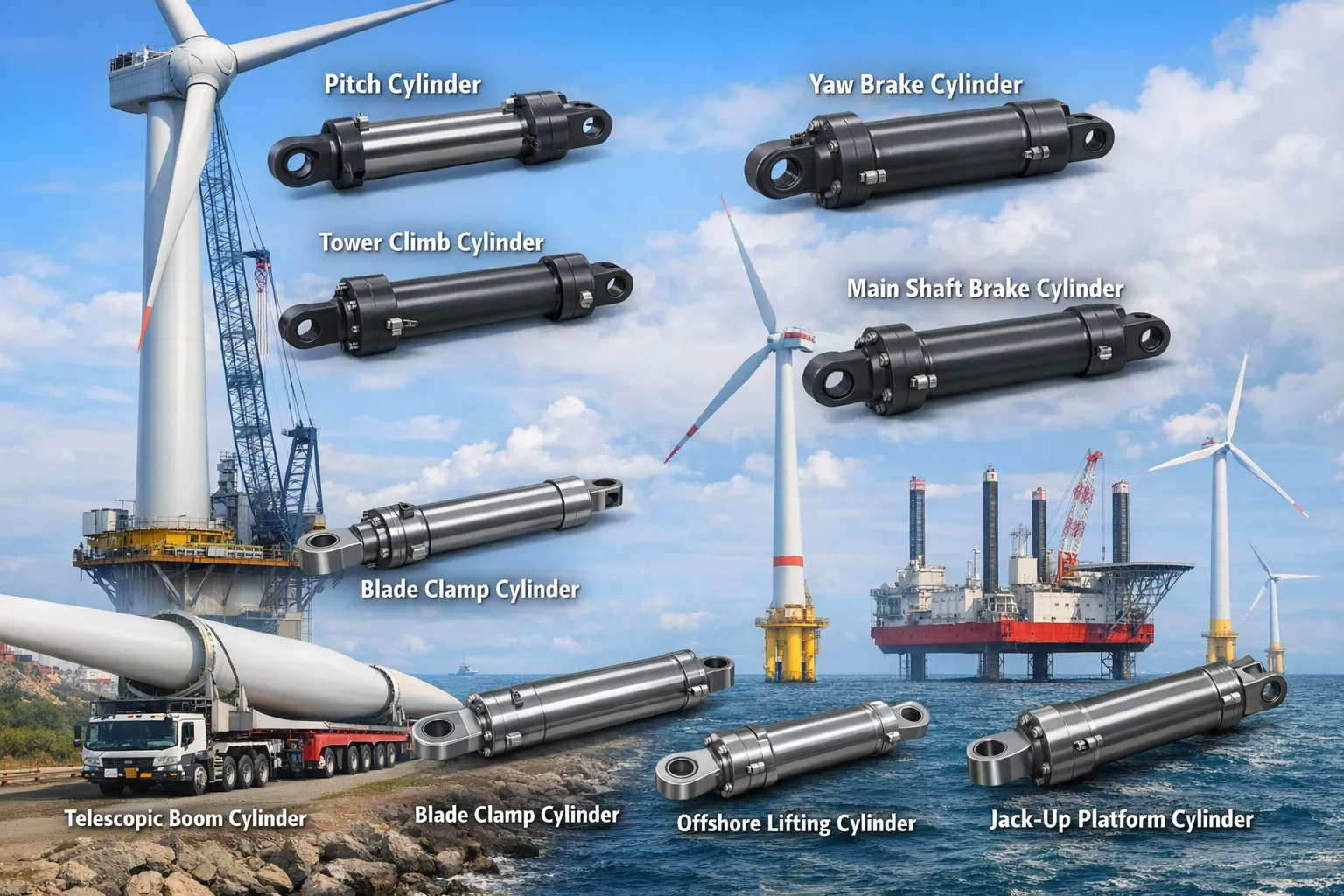
Seamless Machinery Brand Replacement Capabilities
In the highly capitalized environment of wind blade production, maintaining continuous operational uptime is paramount. When an OEM cylinder on a massive automated mold line fails, waiting several months for European or American tooling providers to manufacture and ship replacement parts is financially unacceptable. Production managers require immediate, exact-fit solutions to prevent massive factory downtime. Our bespoke hydraulic parts are expertly reverse-engineered and dimensionally verified to serve as flawless, drop-in replacements for the automation systems utilized by the world’s leading blade mold manufacturers.
We routinely supply dimensionally identical hydraulic cylinder components and fully functional mold opening cylinder assemblies that perfectly match the hydraulic circuits, precise stroke lengths, and structural trunnion mounts of massive tooling systems traditionally supplied to tier-one manufacturers such as LM Wind Power tooling, Vestas manufacturing systems, Siemens Gamesa molds, TPI Composites automation lines, and Enercon pressing systems. (Please note: Mentioning these highly esteemed corporate and brand names serves purely as a technical reference to facilitate accurate dimensional cross-referencing and precise model selection for our B2B manufacturing clients; we operate globally as an entirely independent hydraulic cylinder manufacturer and claim no trademark affiliation or direct endorsement from these entities.)
By strictly matching the exact flange mounting bolt patterns, pin-to-pin closed lengths, and sensor communication protocols (such as Analog 4-20mA, SSI, or CANbus) of the original tooling, we enable phenomenally rapid turnaround times for fixing hydraulic cylinders directly on the factory floor. This precision guarantees that your maintenance engineering teams can execute complex hydraulic cylinder repair operations and return the massive mold line to full active production without modifying the valuable steel tooling framework or rewriting the master PLC software logic.
Eight Core Technical Advantages Dominating Composite Tooling
What precisely elevates our products from standard industrial actuators to highly sought-after, mission-critical upgrades for the wind energy sector? The answer lies in over two decades of uncompromising mechanical design, advanced sensor integration, and rigorous structural metallurgy. Here are the eight fundamental engineering pillars that guarantee absolute mold synchronization:
1. Servo-Hydraulic Precision Integration
To definitively eliminate position drift, our cylinders are deeply machined to internally house high-resolution magnetostrictive linear position sensors. These sensors feed real-time positional data (accurate to 0.01mm) directly to the factory’s master PLC, allowing proportional servo valves to dynamically adjust fluid flow to each individual cylinder, ensuring perfectly flat, synchronized lifting across the entire mold length.
2. 27SiMn High-Yield Steel Construction
Standard carbon steel barrels can stretch or bow under the massive resistance encountered during the initial mold opening break. We construct our cylinder barrels exclusively from 27SiMn high-strength alloy steel. This superior metallurgy provides exceptional flexural rigidity, entirely preventing barrel deflection and ensuring the internal piston geometry remains perfectly true under extreme pressure spikes.
3. Low-Friction Sealing Technology
Accurate precise stroke control is mathematically impossible if the internal seals grab and stick to the barrel wall. We deploy an advanced Polytetrafluoroethylene (PTFE) composite step-seal architecture. This extremely low-friction material eradicates the “stick-slip” phenomenon, allowing the internal piston to move with buttery smoothness, responding instantly and accurately to minute changes in servo valve flow.
4. Deep-Penetration Welded Structural Integrity
The violent shock force generated when the mold stiction finally breaks places immense shear stress on the cylinder mounts. We utilize automated Submerged Arc Welding (SAW) to permanently fuse the heavy trunnion and clevis mounts to the 27SiMn barrel. This robotic process guarantees deep weld penetration with zero porosity, creating an unbreakable structural bond that survives decades of high-shock demolding cycles.
5. Micro-Cracked Hard Chrome Plating
The environment surrounding a blade mold is constantly filled with airborne epoxy resin and fiberglass dust. The exposed cylinder rods are heavily protected with a 40-50 micron layer of micro-cracked hard chrome plating. This ultra-slick, hard surface actively repels sticky resin buildup. When combined with our heavy-duty scraper seals, it ensures contaminants are physically blocked from entering the internal bore.
6. Integrated Safety Manifold Blocks
Safety is paramount when lifting a multi-ton steel mold half high into the air. Our cylinders feature custom-machined steel manifold blocks flanged directly onto the fluid ports. These blocks house pilot-operated check valves and counterbalance valves. If a primary hydraulic supply hose were to accidentally burst, these integral valves instantly lock the fluid column, freezing the mold safely in mid-air and preventing a catastrophic free-fall.
7. Precision CNC Honed Inner Bores
Consistent internal friction is absolutely vital for an array of hydraulic rams to open a mold evenly. The internal surface of our 27SiMn barrel is processed via Skiving and Roller Burnishing (SRB) to achieve a uniform, mirror-like Ra 0.2-micron finish. This phenomenal manufacturing consistency guarantees that every single cylinder in your factory responds to hydraulic pressure with the exact same speed and kinetic efficiency.
8. Modular Maintenance Architecture
We inherently understand the intense logistical constraints of performing hydraulic cylinder repair within a crowded composite factory. Our mechanical design incorporates highly accessible, heavily bolted gland nuts and modular sensor probes. This thoughtful architecture ensures that skilled maintenance technicians can perform rapid seal kit or sensor replacements without requiring the massive cylinder to be entirely unbolted from the blade tooling framework.
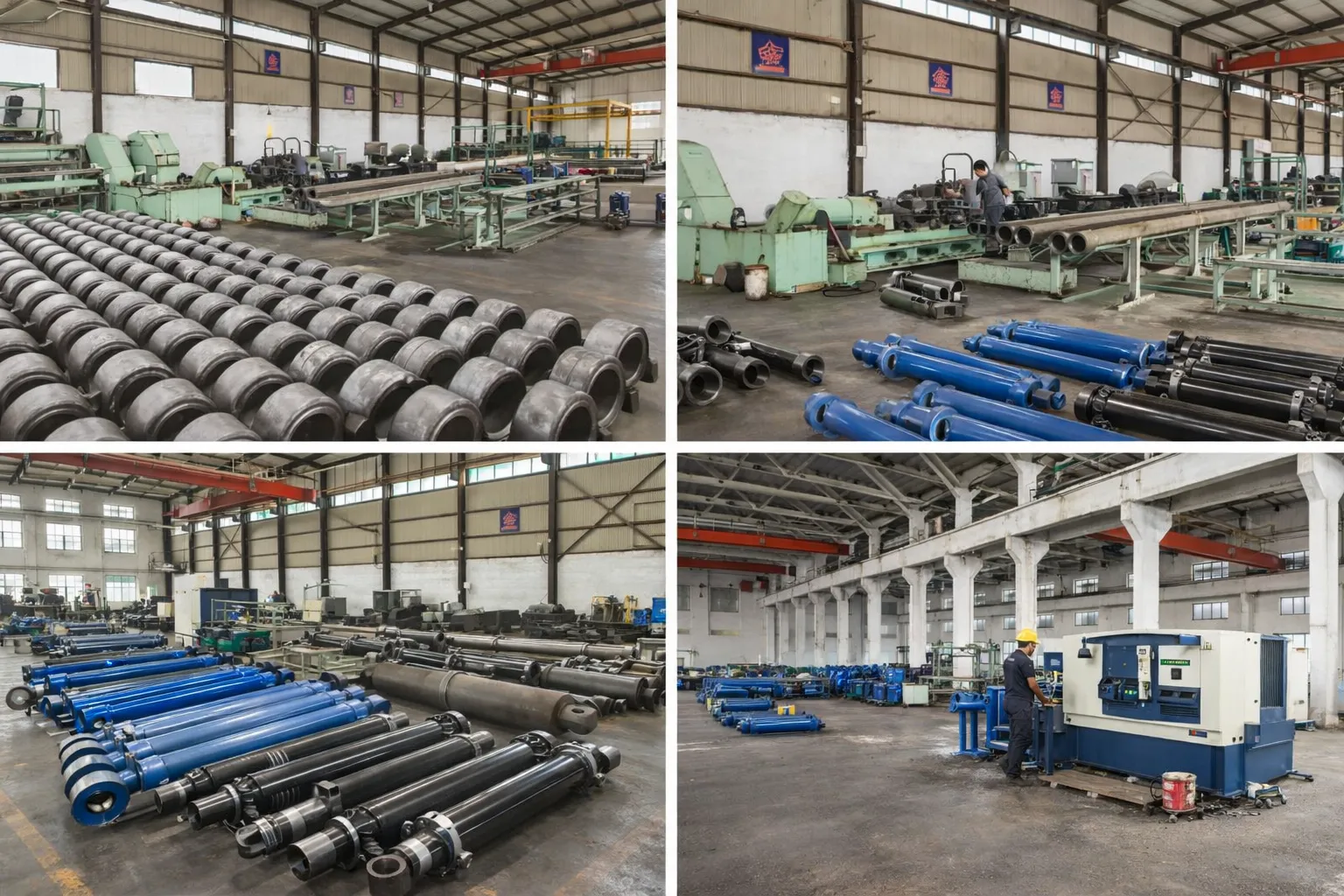
Autonomous Manufacturing & Zero-Defect Quality Control
The unprecedented synchronization and long-term reliability of our mold opening hydraulic cylinder systems are not simply drafted on a computer screen; they are tangibly forged within our highly advanced, vertically integrated production facilities. We maintain absolute, unyielding control over the entire manufacturing lifecycle, adamantly refusing to outsource critical CNC machining, electronic calibration, or metallurgical treatments to unverified third parties. This closed-loop manufacturing philosophy ensures that every single unit arriving at your composite facility conforms perfectly to the highest global industrial automation standards.
The robust production sequence commences with absolute raw material traceability. Every batch of incoming 27SiMn steel undergoes immediate optical emission spectroscopy to mathematically verify its chemical composition and tensile limits. Following the heavy-duty SRB boring process, the heavy mounting structures are secured using our robotic welding cells. Every single critical load-bearing weld undergoes rigorous non-destructive testing (NDT), utilizing Ultrasonic Testing (UT) to locate deep volumetric flaws and Magnetic Particle Inspection (MPI) to guarantee the total absence of dangerous subsurface micro-fissures. Final assembly operations occur strictly within a climate-controlled, dust-free cleanroom environment to prevent microscopic particulate contamination—the primary cause of premature scoring and sensor failure in highly sensitive servo-hydraulic systems.
Final quality assurance protocols are absolute and non-negotiable. 100% of our produced units are routed through our computerized hydrostatic and dynamic electronic testing bays. Each completed cylinder is proof-tested at 150% of its rated nominal working pressure to guarantee the mechanical seals hold flawlessly. More importantly, the integrated linear sensors are dynamically calibrated across the full stroke length under simulated load, verifying that the electronic feedback matches the physical rod position with absolute sub-millimeter accuracy. A unique serial number is deeply laser-etched into the alloy barrel, providing our B2B clients with a permanent digital record for future preventative maintenance or when rapidly sourcing replacement hydraulic cylinder components decades down the line.
Versatile Industry Applications
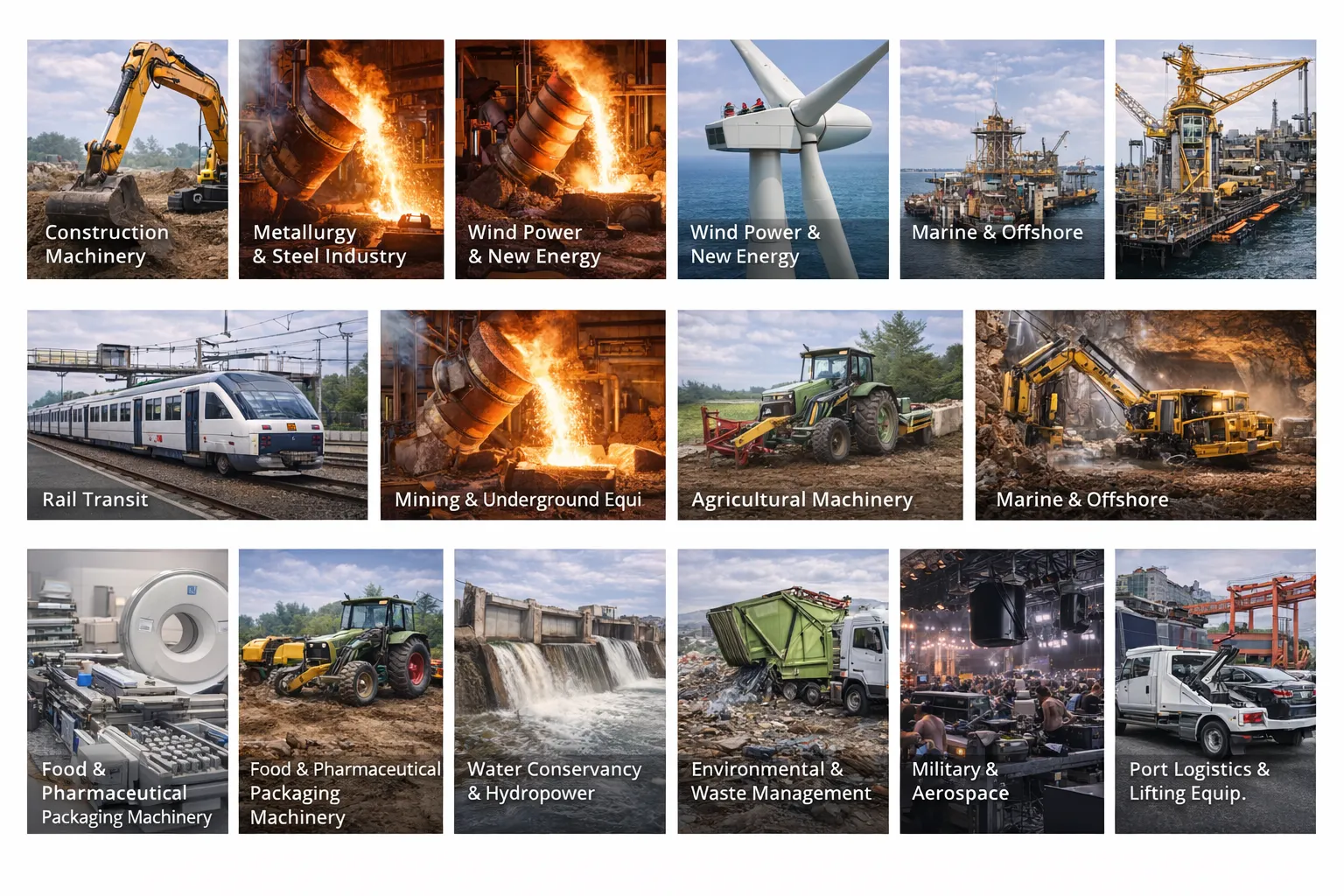
While the highly specialized servo system discussed here is uncompromisingly optimized for the severe synchronization demands of wind blade composite manufacturing, the extraordinarily robust engineering principles we apply translate flawlessly across a multitude of heavy industrial sectors. Whenever immense opening force, absolute positional precision, and structural reliability are non-negotiable, our products dominate the global landscape.
- Wind Power & Composites: Providing synchronized mold opening and closing for massive rotor blades, nacelle covers, and specialized aerospace fiberglass aerodynamic structures.
- Metallurgy & Heavy Forging: Operating continuously in extreme environments to actuate heavy furnace doors and precisely control continuous casting automation within the metallurgical and iron industry.
- Mineral Processing: Delivering precise, unbreakable force for automated filter presses and heavy screening equipment in the highly abrasive environment of the mining industry.
- Infrastructure & Lifting: Powering the primary lifting arms and automated precision stabilization controls for complex machinery. Explore our tailored solutions specifically engineered for the construction machinery industry.
- Plastic & Rubber Machinery: Executing high-speed, perfectly parallel mold opening and core-pulling functions for massive industrial injection molding machines and vulcanizing presses.
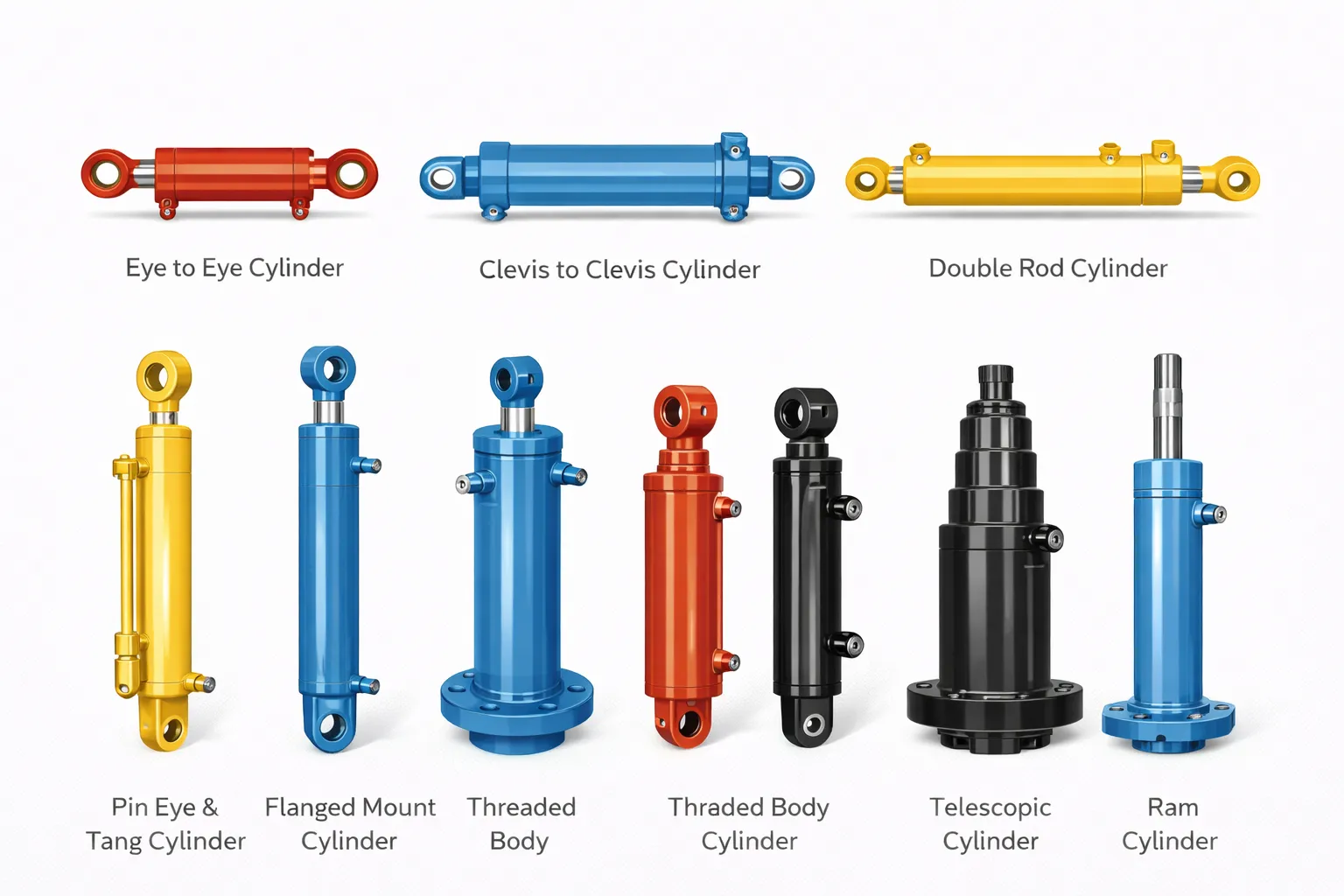
Comparative Analysis: Standard Hydraulics vs. Servo Mold Opening Units
When evaluating procurement options for automated tooling upgrades, analyzing the initial hydraulic cylinder price without strictly factoring in the catastrophic cost of scrapping a distorted 100-meter wind blade leads to disastrous financial outcomes. Utilizing a cheap, mass-market lift cylinder guarantees erratic mold movements, severe position drift, and catastrophic composite shearing. The objective comparison matrix below illustrates exactly why our specialized 27SiMn servo cylinder represents a vastly superior, safer return on investment for your factory.
| Critical Engineering Metric | Standard General-Purpose Cylinder | Our High-Performance Mold Opening Cylinder |
|---|---|---|
| Action Mechanism Control | Basic directional flow (Prone to highly uneven lifting speeds, causing molds to twist and bind) | Servo piston integration (Guarantees absolute sub-millimeter synchronized mold opening) |
| Positional Feedback | None, or relies on highly inaccurate external limit switches (Severe position drift risk) | Internal magnetostrictive linear sensors (Real-time, continuous precise stroke control) |
| Base Material Construction | Basic 1045 Carbon Steel (Highly vulnerable to bowing and deflection under breakout force) | 27SiMn High-Yield Alloy Steel (Exceptional flexural rigidity ensures perfect linear travel) |
| Core Sealing Technology | Standard Rubber seals (Causes highly erratic “stick-slip” jumping during mold separation) | Low-friction PTFE step-seals (Ensures buttery smooth kinematics and rapid servo response) |
| Safety Valve Architecture | External piped valves (Hose bursts lead to immediate, catastrophic mold free-fall) | Integral flanged manifold blocks (Mechanically locks the mold securely in place upon pressure loss) |
Proven Success: Authentic Engineering Case Studies
Our unwavering commitment to fluid power automation excellence is consistently validated by the measurable success and highly increased yield rates of our global B2B manufacturing clients. Below are authentic instances where our customized hydraulic solutions successfully resolved critical, highly expensive production bottlenecks in major composite facilities across East Asia.
Case 1: Eradicating Blade Cracking in Offshore Manufacturing (Mokpo, South Korea)
Client Profile: Tier-one Offshore Wind Turbine Blade Manufacturer (Project Date: November 2024)
The Engineering Crisis: The client was producing highly advanced 115-meter carbon-infused rotor blades. During the critical demolding sequence, their array of standard European OEM cylinders suffered from massive internal friction variations. This caused severe position drift. One end of the massive 115-meter mold lifted nearly 40mm higher than the center section before the stiction broke. This immense twisting torque physically cracked the internal shear webs of three consecutive finished blades, resulting in over a million dollars in scrapped composites and causing widespread panic on the production floor.
Contact & Solution: Facing a catastrophic production halt, the plant automation director discovered our specialized servo capabilities via an engineering search and urgently contacted our support team. Within 72 hours, we supplied fully engineered schematics for a custom mold opening hydraulic cylinder array featuring integrated magnetostrictive sensors and low-friction PTFE seals. The units were designed to communicate directly with their existing Siemens PLC to strictly enforce precise stroke control.
The Result: The retrofitted mold line has now operated continuously for over 14 months. The 115-meter steel mold now opens with a maximum recorded positional deviation of only 0.8mm across the entire span. The blade scrap rate caused by demolding dropped to absolute zero.
“The synchronization of these servo cylinders is extraordinary. We no longer hold our breath during the mold opening and closing sequence. Upgrading the entire line was a brilliant engineering decision given the highly reasonable hydraulic cylinder price compared to losing a single finished blade.” — Mr. Park Ji-Sung, Lead Production Engineer.
Case 2: Overcoming Extreme Epoxy Stiction and Juddering (Kitakyushu, Japan)
Client Profile: Regional Composite Tooling Manufacturer (Project Date: March 2025)
The Engineering Crisis: A newly formulated, fast-curing epoxy resin was creating unprecedented stiction between the upper and lower mold halves. The factory’s existing hydraulic system struggled to break the mold apart. When the pressure finally built up enough to overpower the resin, the standard rubber seals inside the cylinders jerked violently, severely shaking the entire tooling structure and causing hydraulic fluid leaks from blown rod seals.
Contact & Solution: They required highly durable, higher-tonnage replacement parts and reached out to our B2B portal. Simply fixing hydraulic cylinders with new rubber seals was completely insufficient. We supplied a complete suite of upgraded 27SiMn alloy double acting hydraulic cylinder units. These heavier-duty units provided immense breakaway force, while our low-friction PTFE sealing matrix ensured the cylinders moved smoothly without the destructive “stick-slip” jumping effect.
The Result: The heavy-duty mold opening cylinder array easily overpowered the new epoxy stiction. The mold now separates smoothly and quietly, completely eliminating the violent structural shaking and putting a permanent end to the constant fluid leaks.
“The raw pulling power and incredibly smooth operation of these 27SiMn cylinders solved our biggest manufacturing headache. The turnaround time for the replacement hydraulic parts was phenomenal, keeping our new advanced resin project fully on schedule.” — Kenji Sato, Tooling Facility Manager.
Case 3: Ensuring Rapid Cycle Times on Ultra-Long Tooling (Taichung, Taiwan)
Client Profile: Advanced Composite Aerodynamics Corporation (Project Date: August 2025)
The Engineering Crisis: While commissioning a brand-new 120-meter onshore blade mold, the client faced severe cycle-time delays. The factory relied on outdated external limit switches to attempt to coordinate the mold opening and closing. This rudimentary feedback loop was far too slow, causing constant minor position drift errors that forced the PLC to halt the lifting sequence repeatedly to allow the lagging cylinders to catch up. Opening the mold was taking an unacceptable 45 minutes instead of the projected 10 minutes.
Contact & Solution: The facility engineers contacted us to completely overhaul their mechanical actuator feedback system. We deployed a perfectly matched array of high-precision servo hydraulic rams. By internalizing the magnetostrictive sensors directly inside our cylinder rods, we provided their central PLC with clean, instantaneous, continuous data streams, entirely bypassing the lag of external mechanical switches.
The Result: The highly annoying start-stop halting was instantly resolved. The gigantic steel tooling now opens in a single, fluid, perfectly synchronized motion in under 8 minutes, dramatically increasing the factory’s daily blade production output.
“The internal sensor precision of your cylinders is remarkable. Achieving perfect, uninterrupted synchronization across a 120-meter span requires incredible engineering consistency. We trust your manufacturing quality absolutely.” — H.C. Lin, Chief Automation Engineer.
Frequently Asked Questions
We deeply understand that procuring specialized fluid power equipment for highly sensitive composite manufacturing requires rigorous mechanical due diligence. Below are highly transparent, detailed answers to the most common technical inquiries from our global B2B partners regarding our heavy-duty automation product range.
Secure Your Composite Manufacturing Yield Today
Do not allow substandard, mass-market fluid power components to dictate the scrap rate of your multi-million dollar wind blade factory. Position drift and severe blade cracking are entirely preventable engineering failures. Equip your critical mold lines with a precision-engineered mold opening hydraulic cylinder designed specifically to provide absolute synchronization and flawless precise stroke control. Partner with our advanced engineering team today for uncompromising heavy-duty support and a highly competitive factory-direct proposal.
Editor: Cxm


























