Lift Hydraulic Cylinder for Cart — Pallet Truck Lift Cylinder
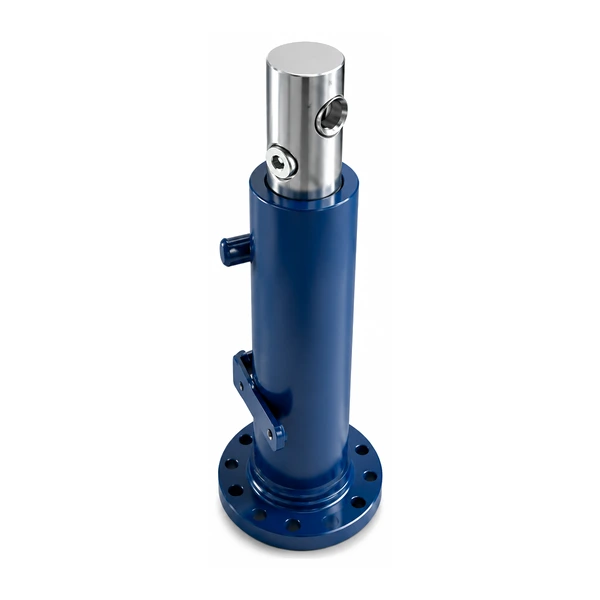
Lift Hydraulic Cylinder for Cart — The Compact Heart of Every Pallet Truck
Hand pallet trucks are the most numerous piece of material handling equipment in the world. There are an estimated 5–8 million in active use globally, and every single one relies on one hydraulic cylinder — the lift cylinder for cart — to raise the forks off the ground. No electric motor, no engine, no external power source. The operator pumps the handle, a built-in foot pump pressurises a few cubic centimetres of oil per stroke, and this compact cylinder converts that manual input into the force required to lift 2,000–3,000 kg of loaded pallet just high enough to clear the floor.
Korea Ever-Power produces 4 models of this cylinder with bores from Φ40 to Φ45, strokes from 120 to 155 mm, and working pressures from 18 to 25 MPa. Despite being the smallest and lightest cylinder in the entire forklift hydraulic cylinder catalogue, it operates at the highest pressure per unit bore area — a direct consequence of the physics of generating high force from a small piston driven by a manual pump.
Complete Specifications — 4 Pallet Truck Lift Cylinder Models
Four models cover standard-duty, heavy-duty, and compact pallet truck platforms. Note the two port types: M12×1.5 metric threaded ports connect to threaded hydraulic lines; Φ6 push-in ports accept 6 mm OD nylon tube connections common on lightweight pallet truck pump assemblies.
| Drawing Number | Bore (D) | Rod (d) | Stroke (S) | Install Dist (L) | Pressure | Ports | Weight |
|---|---|---|---|---|---|---|---|
| AIMBN156-620000-001 | Φ45 | Φ40 | 125 | 313 | 18 MPa | M12×1.5 | 6.5 kg |
| AIMBJ150-620000-000 | Φ40 | Φ35 | 155 | 354.7 | 22 MPa | Φ6 push-in | 6.5 kg |
| AIMBA200-620000-000 | Φ45 | Φ40 | 155 | 355 | 20 MPa | Φ6 push-in | 6.5 kg |
| EPT18H-301-00 | Φ40 | Φ35 | 120 | 233 | 25 MPa | M12×1.5 | 3.6 kg |
All dimensions in mm. Installation distance (L) measured at full retraction. Φ6 push-in ports accept 6 mm OD nylon or polyamide tubing — push the tube into the port fitting until it clicks; pull the release ring to disconnect. M12×1.5 ports accept standard metric hydraulic fittings with bonded seals. EPT18H is the ultra-compact model for semi-electric pallet trucks with reduced frame height.
From Handle Pump to Lifted Pallet — The Complete Hydraulic Cycle
The hand pallet truck is one of the simplest closed-loop hydraulic systems in existence. Understanding how the lift cylinder operates within this system is essential for diagnosing problems and selecting the correct replacement.
Pump Stroke
The operator pushes the handle down (or presses the foot pedal). This drives a small plunger pump that displaces 2–5 cc of hydraulic oil per stroke through a one-way valve into the lift cylinder bore.
Cylinder Extends
The oil enters the bore below the piston, building pressure until the force on the piston exceeds the load weight. The piston rod extends upward, lifting the fork linkage. Multiple pump strokes accumulate oil volume until the forks reach operating height.
Load Holding
The steel ball check valve inside the cylinder blocks the oil return path. The load weight pushes down on the piston, but the trapped oil column cannot escape — the forks hold position for hours or days without any additional pumping.
Controlled Lowering
The operator activates the release lever (typically on the handle). This opens a needle valve that bypasses the check valve, creating a metered return path to the oil reservoir. The load weight pushes the oil back through the needle valve, and the forks descend at a controlled speed.
For a Φ45 bore cylinder with 155 mm stroke: the oil volume required is π × (22.5)² × 155 = 246,740 mm³ ≈ 247 cc. At 3 cc per pump stroke, full extension requires approximately 82 handle pumps. At 5 cc per stroke, approximately 49 pumps. This is why operators prefer the minimum number of pump strokes — every extra pump is physical effort — and why correct cylinder selection (matching bore to pump displacement) directly affects operator fatigue.
8 Components — The Simplest Cylinder, the Highest Reliability
Where the forklift tilt cylinder contains 25 parts and the short lift cylinder has 27, the cart lift cylinder achieves its function with just 8 components. This minimalist construction is not a cost-cutting measure — it is a reliability strategy. Hand pallet trucks operate in the harshest ground-level environments (wet floors, chemical spills, debris, temperature extremes) with minimal maintenance attention. Fewer parts mean fewer failure modes, fewer seals to leak, and a faster field rebuild when service is eventually needed.
| # | Component | Function |
|---|---|---|
| 1 | Cylinder Housing Assy | Pressure vessel, mounting base, port housing |
| 2 | U-Ring | Primary rod seal — prevents oil leakage past the rod |
| 3 | Back-Ring | Anti-extrusion support for the U-Ring under high pressure |
| 4 | Dust Wiper | Prevents floor debris from entering the rod seal zone |
| 5 | Piston Rod | Load-bearing member, chrome-plated Φ35 or Φ40 |
| 6 | Steel Ball ◆ | Integrated check valve seat — holds load against return flow |
| 7 | Du Bush | PTFE-lined rod guide bearing — eliminates metal-to-metal contact |
| 8 | O-Ring | Static seal between housing sections |
◆ Component unique to the cart lift cylinder — replaces the spring-loaded check valve assembly found in forklift mast cylinders with a simpler, more robust steel ball design.
The Steel Ball Check Valve — Load Holding in a Single Component
The steel ball (item 6) is the most critical single component in the cart lift cylinder — and it weighs less than 5 grams. This hardened steel sphere sits in a precision-machined conical seat at the base of the cylinder bore. When the pump delivers oil into the cylinder, the oil pressure lifts the ball off its seat, flows past it, and enters the bore space below the piston. When the pump stroke ends, the oil pressure equalises and the ball drops back onto its seat under its own weight plus the pressure of the oil column above it — sealing the bore and trapping the oil that holds the load.
Why a ball instead of a poppet valve?
A spring-loaded poppet check valve (the type used in forklift mast cylinders) requires a spring, a poppet, a guide, and a retainer — 4 parts. The steel ball check valve achieves the same function with 1 part. The ball is self-centring on the conical seat, requires no spring (gravity and oil pressure provide the seating force), and has no moving parts that can fatigue or break. For a cylinder that may sit loaded for days without maintenance attention, this single-part reliability is essential.
The most common failure mode
When a hand pallet truck gradually lowers on its own (the forks sink over minutes or hours), the cause is almost always a contaminated ball seat. A single particle of metal swarf, rust, or floor debris lodged between the steel ball and its seat creates a leak path that allows oil to bleed past the check valve under load pressure. The fix is simple: disassemble, clean the ball and seat, inspect for pitting, and reassemble. If the seat shows visible pitting or scoring, replace the cylinder housing assembly.
Why the Smallest Cylinder Operates at the Highest Pressure
The EPT18H model, with its Φ40 bore and 3.6 kg weight, operates at 25 MPa — higher than any forklift mast cylinder in the Korea Ever-Power range. This seems counterintuitive: how can the smallest, lightest cylinder handle the highest pressure? The answer is that force equals pressure multiplied by area. A small bore requires higher pressure to generate the same force as a large bore.
| Cylinder | Bore | Pressure | Lift Force (kN) | Equiv. Mass (kg) |
|---|---|---|---|---|
| Cart — EPT18H | Φ40 | 25 MPa | 31.4 | 3,204 |
| Cart — AIMBA200 | Φ45 | 20 MPa | 31.8 | 3,242 |
| Forklift Lift — Φ56 | Φ56 | 18.1 MPa | 44.6 | 4,546 |
| Forklift Tilt — Φ100 | Φ100 | 18.1 MPa | 142.1 | 14,485 |
Both cart cylinder models produce approximately 31–32 kN of lift force — enough to raise 3,200 kg — despite vastly different bore and pressure combinations. The EPT18H achieves this in a 3.6 kg package by running at higher pressure, which requires heavier wall thickness relative to bore diameter but saves on overall size and weight. The cart cylinder's rod-to-bore ratio (0.875–0.889) is the highest in the product range, providing the column stability needed to handle high pressure in a compact package.
Pallet Truck Type Compatibility
Standard Hand Pallet Trucks (2,000–2,500 kg)
The most common pallet truck type in warehouses worldwide. Fork length 1,150 mm, fork width 540–685 mm. Uses the AIMBN156 or AIMBA200 models (Φ45 bore) with 125–155 mm stroke. The 18–20 MPa pressure rating matches the standard pump assembly found on most commercial-grade hand pallet trucks.
Heavy-Duty Pallet Trucks (3,000–5,000 kg)
Reinforced pallet trucks for heavy loads — double steel rollers, thicker forks, wider pump assemblies. Uses the AIMBJ150 model (Φ40/22 MPa) or AIMBA200 (Φ45/20 MPa). The higher pressure rating provides the additional force margin needed for loads exceeding 2,500 kg, while the larger rod diameter (Φ35–Φ40) handles the increased column loading from heavier pallets.
Semi-Electric and Low-Profile Trucks
Compact pallet trucks with electric drive but manual hydraulic lift, and ultra-low-profile trucks designed to enter pallets with only 51 mm ground clearance. The EPT18H model (Φ40 bore, 120 mm stroke, 233 mm installation distance, 3.6 kg) fits the restricted frame space of these compact machines. Its 25 MPa rating compensates for the smaller bore area, delivering equivalent lift force in a 45% lighter and 34% shorter package than the standard models.
Cart Lift Cylinder — Frequently Asked Questions
Explore the Full Forklift Cylinder Range
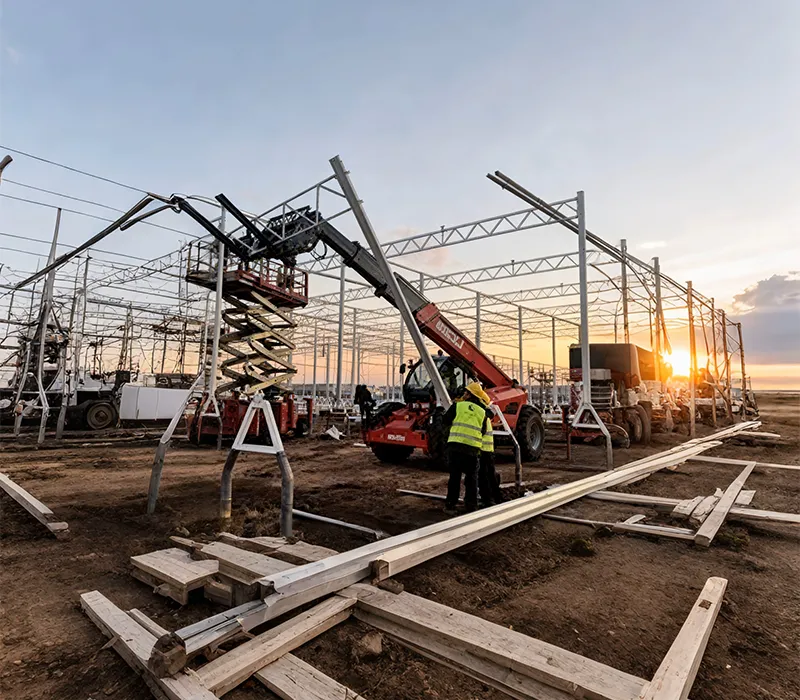
Additional information
| Editor | Cxm |
|---|
Related products
-
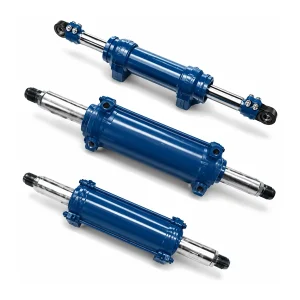
LS-HCZD30N-03 Forklift Truck Steering Cylinder
-
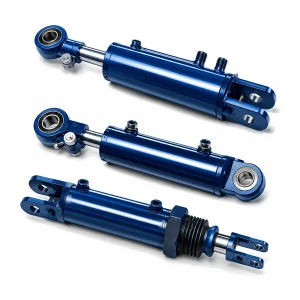
20176B-02000 Forklift Truck Support Hydraulic Cylinder
-
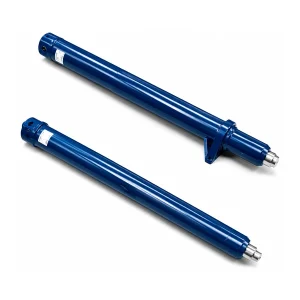
Custom Hydraulic Lift Cylinder — OEM Lift Cylinder with Integrated Check Valve and Sprocket for Forklifts
-
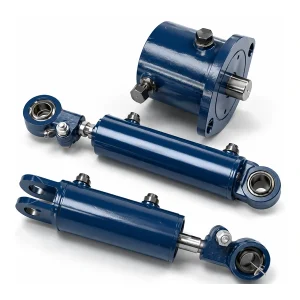
Heavy-Duty Hydraulic Tilt Cylinder for Industrial Vehicles
-
Forklift Short Lifting Hydraulic Cylinder — Free-Lift Cylinder with Integrated Check Valve and Sprocket System
-
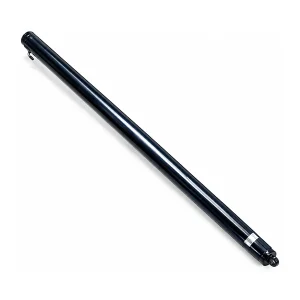
Forklift Lifting Hydraulic Cylinder — Single-Acting Mast Lift Cylinder
-
Forklift Tilt Hydraulic Cylinder — Double-Acting Mast Tilt Cylinder for 1.5–10 Ton Forklifts
-
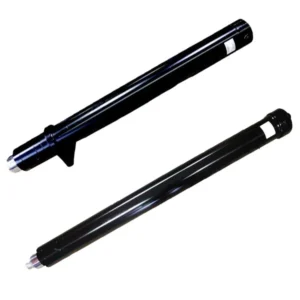
Forklift Short Lifting Hydraulic Cylinder