Cotton Topper Boom Lift Cylinder for Mechanical Topping Machines
Q345D structural steel with low-friction seals for high-frequency micro-adjustment. Designed for the relentless small movements cotton topping demands across every row, every pass.
Three Problems Cotton Topper Operators Report Every Season, All Caused by the Same Cylinder
Talk to any mechanical cotton topping crew and the same complaints come up year after year. The topping height drifts during a pass, leaving some plants cut too short and others barely touched. The boom arm starts moving in jerky increments instead of smooth, continuous adjustments. And by mid-season, there is a slow oil drip at the rod seal that worsens with every working day until the crew finally stops to replace the cylinder or the seal kit.
All three problems trace back to the same root cause: the hydraulic cylinder controlling the topper boom arm was not designed for the specific operating pattern of cotton topping. A topping machine does not simply lower the boom to a set height and hold it there. It makes hundreds of small vertical adjustments per minute as the boom tracks the uneven canopy surface across the row. The cylinder piston oscillates in rapid micro-strokes of 2 to 15 mm under moderate pressure, and the seals never get the lubrication benefit of a full-length stroke. This micro-cycling pattern wears standard seals down far faster than their rated hour limit, causing the height drift, jerky motion, and leakage that operators have learned to accept as normal.
Our cotton topper boom lift cylinder is built to handle exactly this operating pattern. It is a double acting hydraulic cylinder made from Q345D low-alloy structural steel with low-friction polyurethane seals designed for high-frequency micro-movement, a precision-honed bore that minimizes breakaway pressure, and a dust protection system that keeps the fine cotton fiber dust and field debris out of the seal zone. The result is a cylinder that maintains smooth, precise boom height control through the entire topping season without the progressive seal degradation that plagues standard units.
Why Micro-Movement Destroys Standard Seals and How Our Design Prevents It
Standard hydraulic cylinder seals are tested and rated for full-stroke service. In full-stroke operation, the seal lip sweeps the entire bore length on each cycle, distributing wear evenly and replenishing the oil film across the full seal contact zone. This is not how a cotton topper boom cylinder operates.
During topping, the piston oscillates in small, rapid movements. The same narrow band of the seal lip slides back and forth over the same narrow section of the bore, thousands of times per hour. Three problems develop simultaneously in this operating pattern:
Oil film starvation: The oil film in the micro-stroke zone breaks down because it is not refreshed by a full-stroke wash. Without adequate lubrication, friction between the seal lip and bore surface increases, generating heat that accelerates seal aging.
Localized seal lip wear: The same narrow band of the seal lip carries all the wear. Instead of wearing evenly across the full lip width, a groove develops in the contact zone that deepens with every cycle. Once the groove is deep enough, oil bypasses the seal and internal leakage begins.
Compression set at elevated temperature: The heat generated by friction causes the seal material to lose its elastic recovery in the loaded zone. The seal lip no longer springs back to full contact pressure when the load direction changes, creating a leak path that worsens progressively.
Our seal design addresses all three mechanisms. The piston seal uses a low-friction polyurethane compound with a hardened lip profile that distributes contact pressure over a wider band, reducing peak stress per unit area. The seal pre-load is reduced compared to standard seals, which lowers sliding friction and heat generation. A PTFE-bronze composite wear ring on the piston carries the lateral loads that push the piston against the bore wall, preventing metal-to-metal contact that would score the bore surface and create additional leak paths. The bore finish of Ra 0.2 or finer provides an oil-retaining micro-texture that helps maintain the lubricating film in the micro-stroke zone longer than a rougher finish would.
How a Cotton Topper Boom Lift Cylinder Operates
A mechanical cotton topping machine uses a boom arm that carries the cutting blades or spinning discs. The boom mounts to the machine frame through a pivot joint, and the cotton topper boom lift cylinder connects between the frame and the boom arm to control the vertical position of the cutting head relative to the crop canopy.
The operator sets a target topping height, typically 80 to 120 cm above the ground depending on the cotton variety and growth stage. As the machine moves down the row at 5 to 10 km/h, the boom must track the canopy surface, which varies in height due to plant-to-plant growth differences, row-end transitions, and terrain undulation. An agricultural hydraulic cylinder with a proportional valve makes continuous small adjustments, extending to lower the boom over tall plants and retracting to raise it over shorter sections.
These adjustments happen rapidly. A typical cotton field with moderate canopy variation requires the boom cylinder piston to make 100 to 300 micro-movements per minute during active topping. The total stroke travel per hour of operation may only be 3 to 5 meters, but it is distributed across thousands of individual cycles of 2 to 15 mm each. This constant micro-sliding under working pressure is the defining characteristic of this application and the reason why standard seals fail prematurely.
Technical Specifications
| Specification | Available Range |
|---|---|
| Bore Diameter | 40 mm – 80 mm |
| Rod Diameter | 22 mm – 50 mm |
| Stroke Length | 100 mm – 500 mm |
| Working Pressure | Up to 16 MPa (2,320 PSI) |
| Action Type | Double Acting |
| Structure | Welded Piston Cylinder |
| Body Material | Q345D Low-Alloy Structural Steel |
| Piston Rod | Q345D, Hard Chrome 20+ micron |
| Body Finish | Black Oxide + Epoxy Paint |
| Piston Seal | Low-Friction PU (Micro-Cycle Grade) |
| Rod Seal | NBR + PTFE Back-up Ring |
| Dust Seal | PU Wiper + Optional Simple Protection Boot |
| Mounting | Clevis, Pin Eye, Lug Mount, Custom |
| Port Thread | BSP / NPT / Metric |
| Operating Temperature | -15 C to +85 C |
| Environment Rating | High-Frequency Micro-Movement / Cotton Dust |
Six Engineering Advantages for Cotton Topping Duty
Low-Friction Micro-Cycle Piston Seal
Specially formulated PU with reduced pre-load and hardened lip profile. Tested past 1,000,000 micro-cycles with less than 5% increase in internal leakage. Standard PU seals show measurable degradation by 250,000 micro-cycles under the same test conditions.
Ultra-Low Breakaway Pressure
Breakaway pressure below 0.25 MPa. This enables the proportional valve to modulate boom height in increments as small as 1 to 2 mm, which is the resolution required to track individual plant height variations during high-speed topping passes.
Cotton Dust Protection
Cotton topping generates a constant cloud of fine plant fiber, leaf debris, and soil dust. A polyurethane wiper ring at the rod gland intercepts this material before it reaches the primary rod seal. For operations in the dustiest conditions, an optional simple rubber boot provides additional protection over the exposed rod section.
Ra 0.2 Bore Finish with Oil-Retention Texture
The bore is honed to Ra 0.2 or finer with a controlled cross-hatch pattern that retains a thin oil film in the micro-stroke zone. This oil film bridges the gap between full-stroke lubrication events and significantly extends the period before oil film starvation begins affecting seal life.
Q345D Body and Rod for Structural Integrity
Q345D low-alloy steel provides 345 MPa yield strength and excellent weldability. The material accepts chrome plating adhesion more consistently than plain carbon steel, ensuring the chrome layer remains intact under the micro-vibration environment of topping operations.
Compact Body for Tight Boom Assemblies
Cotton topper boom arms leave limited space for hydraulic components. Our welded body eliminates external tie rods, producing the smallest possible outside diameter for any given bore size. This ensures the cylinder fits within the boom arm envelope without interfering with cutting blades, guards, or drive mechanisms.
Application Scenarios
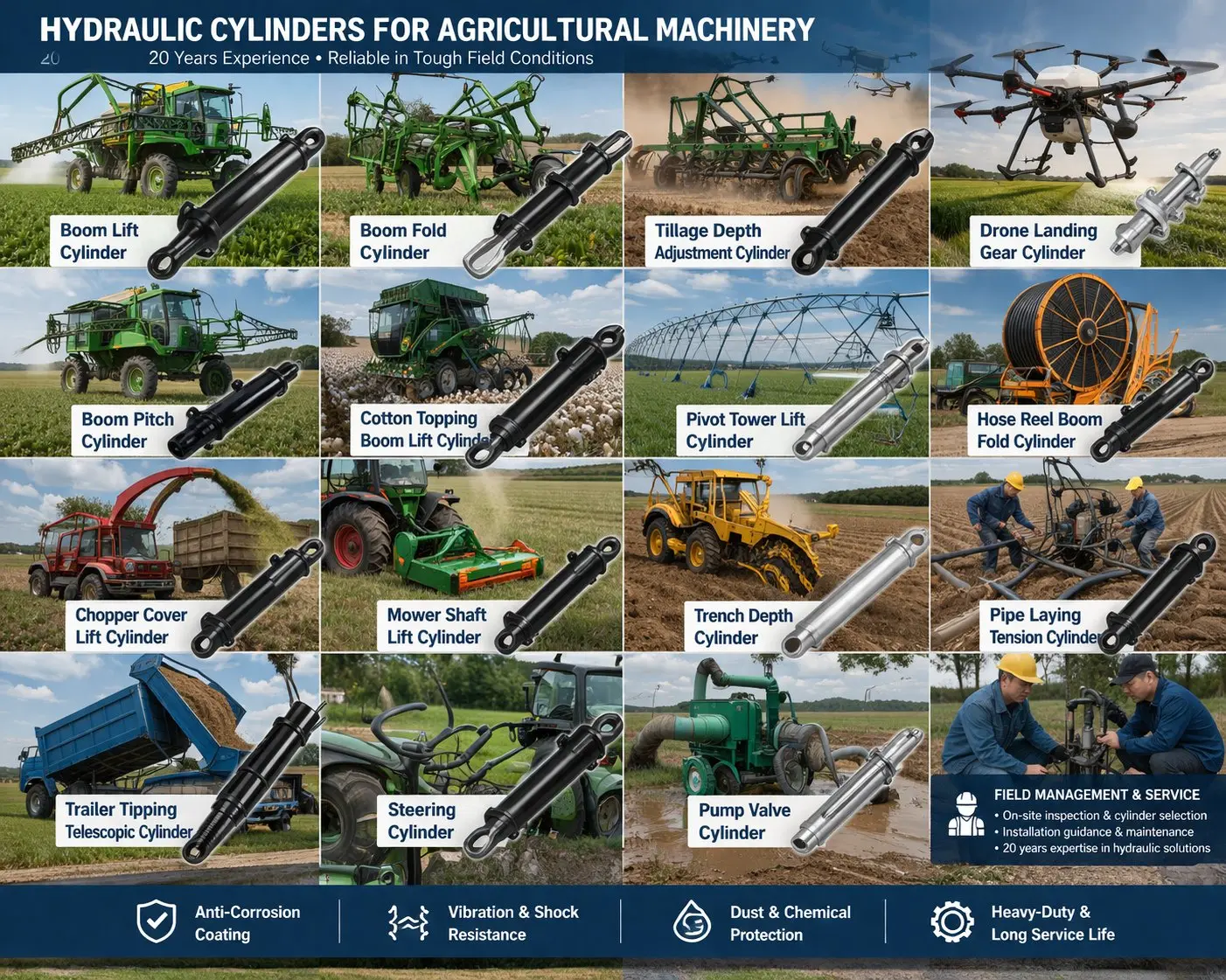
Mechanical Cotton Topping Machines: The primary application. Both tractor-mounted and self-propelled toppers use boom lift cylinders for canopy tracking. Our low-friction seal and ultra-low breakaway pressure enable the fine height resolution needed for uniform topping across varying plant heights.
Cotton Defoliator Boom Height Control: Chemical defoliation spray booms on cotton fields require similar micro-adjustment capability to maintain consistent spray height above the canopy. The same cylinder specifications apply, with the optional addition of chemical-resistant FKM seals for defoliant exposure.
Tobacco Topping Machines: Mechanical tobacco toppers operate at similar speeds and require the same micro-adjustment resolution for uniform flower removal. The duty cycle and dust environment are comparable to cotton topping. As a specialized hydraulic cylinder for agricultural machinery, it adapts directly to these machines.
Hedge and Row Crop Trimming Equipment: Mechanical trimmers for vineyard hedging, tea bush shaping, and row crop canopy management use boom lift cylinders with similar micro-movement requirements.
Precision Sensor-Guided Boom Systems: Any boom arm controlled by ultrasonic or optical sensors for automatic canopy tracking requires a cylinder with very low breakaway pressure and smooth response. Our design meets the response speed and resolution needed for sensor-guided closed-loop height control.

Manufacturing and Quality Control
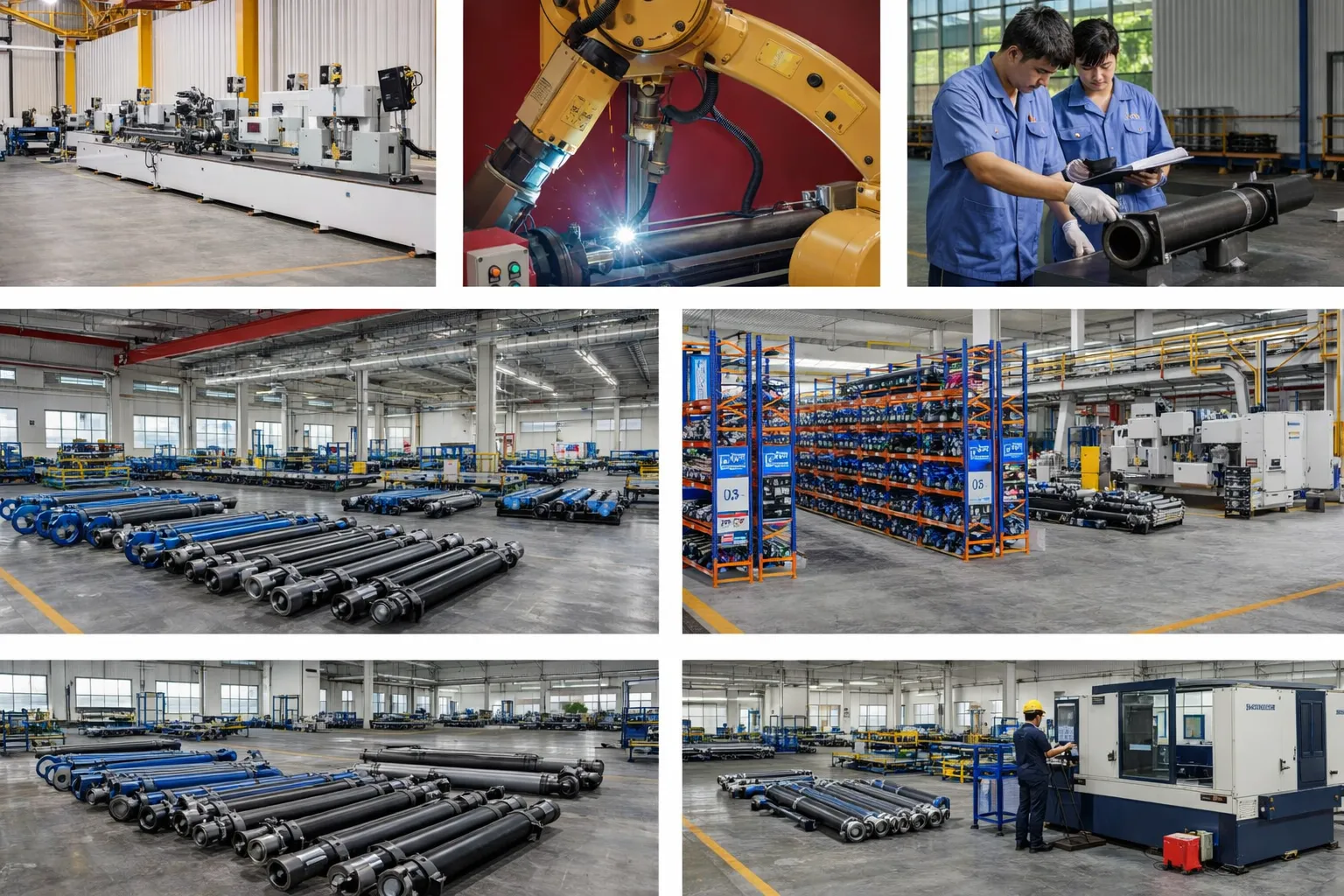
Every cylinder is manufactured in our own ISO 9001 certified facility from raw Q345D steel through final testing. Material incoming verification by spectrometer on every batch. Bores honed to Ra 0.2 in single-setup runs for batch consistency. Rods ground to h7 and chrome plated to 20+ micron. MIG welded by certified operators with visual and sampling-based magnetic particle inspection. Seals sourced from single manufacturing lots per order to ensure uniform friction characteristics across all units in a batch. 100% pressure tested at 1.5 times rated pressure for three minutes with breakaway pressure measurement recorded for each individual unit. Unique serial numbers with ten-year traceability to material, seals, and test data. Material test reports and pressure certificates included as standard.
Standard Boom Cylinder vs. Our Cotton Topper Boom Lift Cylinder
| Topping-Relevant Metric | Standard Boom Cylinder | Our Topper Boom Cylinder |
|---|---|---|
| Seal Life Under Micro-Cycle Duty | 250,000 cycles | 1,000,000+ cycles |
| Breakaway Pressure | 0.6 – 1.2 MPa | Below 0.25 MPa |
| Minimum Controllable Movement | 5 – 8 mm | 1 – 2 mm |
| Bore Finish | Ra 0.4 – 0.8 | Ra 0.2 (oil-retaining texture) |
| Dust Protection | Basic rubber wiper | PU wiper + optional boot |
| Height Drift Over 1-Hour Continuous Topping | 3 – 8 mm (progressive) | Less than 0.5 mm |
Customer Case Studies
Frequently Asked Questions
Why do cotton topper boom cylinders need low-friction seals?
What cylinder bore size is typical for a cotton topper boom arm?
Can I use this cylinder for other canopy-tracking applications besides cotton topping?
What is the lead time for cotton topper boom lift cylinders?
Do you ship to cotton-producing regions in Asia and the Middle East?
Uniform Topping Starts With a Cylinder That Responds to Every Plant
Share your topper model, boom configuration, and operating conditions. We will recommend the right low-friction cylinder and deliver a quotation within 48 hours.
Editor: Cxm