Windlass Brake Cylinder for Marine Mooring Systems
Engineered with ultra-durable 42CrMo alloy steel and advanced ceramic rod technology to deliver unyielding anchor chain tensioning and completely eliminate fluid leakage in severe offshore salt spray environments.
Product Overview: The Core of Vessel Security
In the unforgiving environment of offshore operations and commercial shipping, a vessel’s anchoring system is its ultimate lifeline. When a massive bulk carrier or an offshore platform drops anchor, the kinetic energy and mechanical tension transferred through the anchor chain are staggering. The deck windlass must control this violent payout and securely lock the heavy chain to hold the vessel in position against aggressive ocean currents, tidal shifts, and gale-force winds. At the absolute mechanical center of this critical safety architecture is the windlass brake cylinder. This specialized linear fluid power actuator is exclusively responsible for engaging and disengaging the heavy-duty friction brake bands located on the windlass drum. If this particular component fails or loses internal holding pressure, the anchor chain can run out uncontrollably into the sea, leading to catastrophic deck equipment damage or the total loss of the vessel’s positioning.
Through decades of analyzing marine equipment degradation, it has become evident that standard commercial actuators simply cannot survive on a ship’s exposed forecastle deck. They are relentlessly bombarded by highly corrosive atmospheric salt spray and continuously subjected to extreme mechanical shock loads every time the anchor chain jerks against the hull. The most prevalent and dangerous failure mode in these harsh conditions is fluid leakage. When a standard hydraulic cylinder operating the drum brake develops a leak—either internally across the piston seals or externally past the rod wiper seals—it immediately loses its mechanical clamping force. The brake slips under tension, and the entire anchoring operation becomes critically compromised.
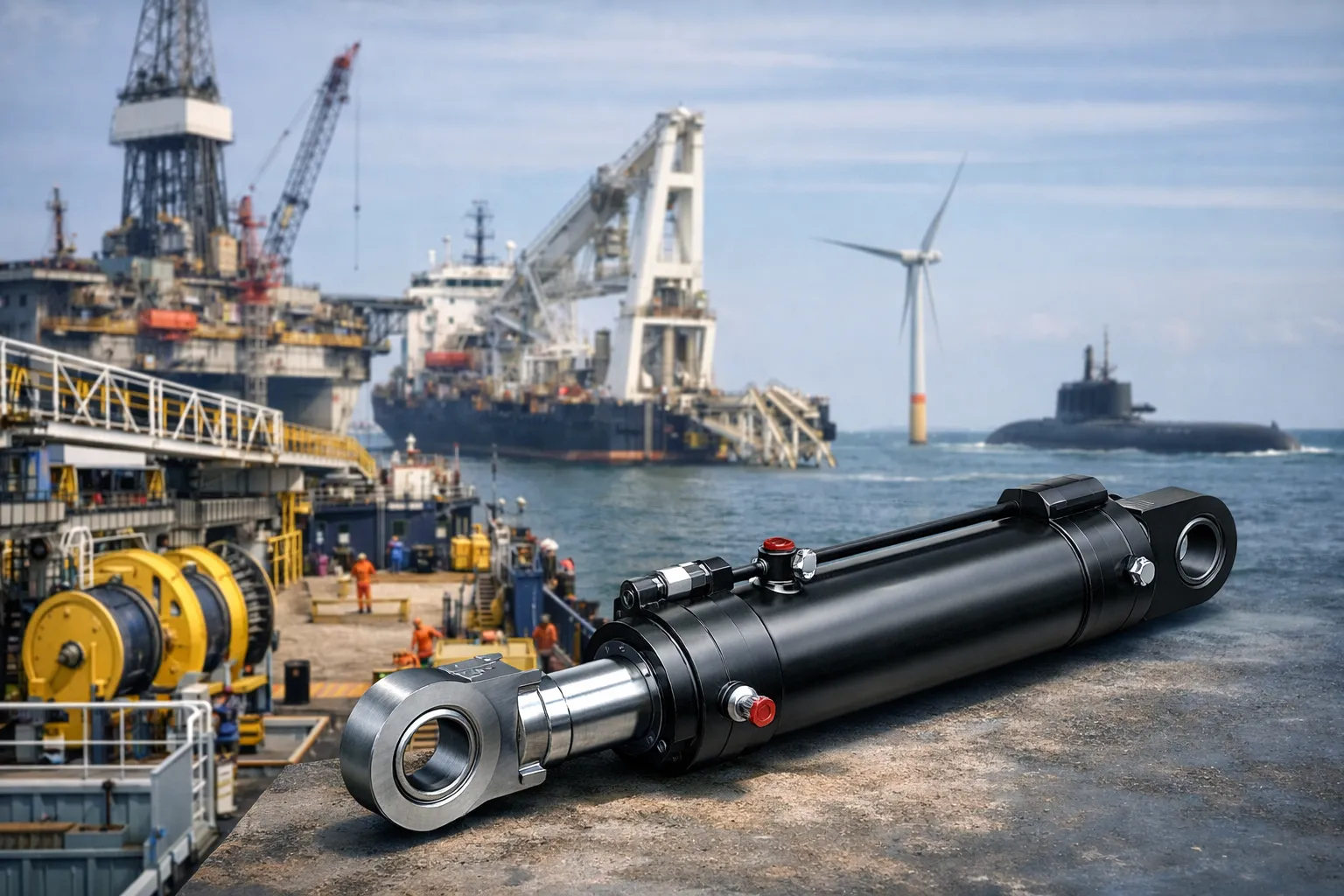
As a dedicated hydraulic cylinder manufacturer, we have fundamentally re-engineered the windlass brake hydraulic cylinder to eliminate these exact operational vulnerabilities. By utilizing ultra-high-strength 42CrMo alloy steel for the structural pressure vessels, we provide an actuator capable of absorbing massive impact forces without any geometric deformation. Furthermore, we employ a sophisticated ceramic-coated rod paired with specialized heavy nickel plating on the exterior housing to completely neutralize salt spray corrosion. Whether you are outfitting a new commercial fleet or executing an urgent hydraulic cylinder repair during a dry-docking session, our custom solutions deliver uncompromising reliability. We provide shipyard procurement officers and fleet technical directors with world-class hydraulic parts that carefully balance exceptional operational longevity with a highly competitive hydraulic cylinder price.
Comprehensive Technical Parameters
Maritime engineering leaves absolutely no room for ambiguity. Every cylinder we manufacture is built to rigorous specifications specifically tailored for the harsh realities of offshore anchoring systems. The detailed table below outlines our customizable parameters and baseline performance metrics for these critical deck components.
| Parameter Category | Engineering Specification | Operational Significance |
|---|---|---|
| Target Industry | Marine & Offshore Engineering | Specifically certified for deck machinery and open-ocean atmospheric exposure. |
| Equipment Category | Mooring Systems / Anchor Windlass | Integrates directly into the vessel’s primary tensioning and mooring architecture. |
| Cylinder Designation | Windlass Brake Cylinder | Dedicated linear actuator for engaging and releasing the heavy friction brake band. |
| Action Mode | Double acting hydraulic cylingder | Provides active, hydraulically powered force for both positive braking and rapid release. |
| Structure Type | Heavy-Duty Piston Cylinder | Generates massive linear thrust over a highly compact stroke length format. |
| Manufacturing Method | Deep-Penetration Welded Construction | Eliminates dangerous tie-rod stretching and potential loosening under heavy vibration. |
| Material System | High-Tensile 42CrMo Alloy Steel | Offers exceptional physical yield strength to endure violent anchor chain shock loads. |
| Surface Treatment | Ceramic Coated Rod + Nickel Plated Body | Creates an impenetrable protective barrier against galvanic corrosion and abrasive sand wear. |
| Environmental Rating | Continuous Salt Spray + High Impact Shock | Engineered exclusively to survive the harshest, unshielded weather decks on the ocean. |
| Primary Workload | Anchor Chain Tensioning & Securing | Maintains the totally secure grip of the friction brake band on the windlass drum. |
| Targeted Failure Mode | Fluid Leakage (Internal & External) | Advanced PTFE sealing matrix prevents pressure loss, permanently eradicating brake slippage. |
Fluid Mechanics: How the Windlass Brake Cylinder Operates
Understanding the internal mechanical execution of this system is absolutely vital for maritime safety. When examining the specific fluid dynamics and mechanical kinematics, one realizes that this is not a basic lifting component. Unlike a standard lift cylinder that smoothly and predictably elevates a fixed load on a cargo deck crane, the brake actuator operates in high-tension, highly unpredictable, high-stakes scenarios. It is fundamentally engineered as a double acting hydraulic cylingder, which means that the hydraulic fluid pressure is actively utilized to both aggressively apply the mechanical brake and rapidly pull it back for release. When the ship’s operator initiates the anchoring sequence or needs to firmly secure the deployed anchor chain, a heavy-duty directional control valve on the deck’s hydraulic power unit (HPU) shifts position.
High-pressure hydraulic oil is immediately forced through the piping and into the extend chamber of the cylinder. This dense fluid acts directly upon the massive surface area of the precision-machined internal hydraulic cylinder piston. Because output force equals fluid pressure multiplied by the piston’s surface area, the system generates immense linear thrust. This thrust pushes the heavy piston rod outward, engaging a mechanical lever linkage that forcefully tightens the heavy friction brake band around the rotating steel drum of the windlass. Once the desired chain tension is achieved, the directional valve closes, and the hydraulic system locks the fluid in place. At this exact moment, the integrity of our zero-leakage seals becomes the most critical factor on the ship. If even a few microscopic drops of fluid bypass the piston or rod seals, the holding pressure slowly decays, the brake band loosens, and the massive weight of the suspended anchor can pull the chain out uncontrollably into the ocean.
Conversely, when it is time to weigh anchor or pay out additional chain to adjust positioning, high-pressure fluid is pumped into the retract chamber while the fluid in the extend chamber safely vents back to the reservoir tank. The cylinder swiftly and forcefully retracts, disengaging the brake band and allowing the windlass drum to rotate freely on its axis. If a single acting hydraulic cylingder were used in this application, relying only on a mechanical spring to return the brake to the open position, it would pose a severe safety hazard; those springs frequently rust, snap, or jam in the harsh marine air. Our specialized ceramic rod coating ensures that this powered retraction is perfectly smooth every single time. Standard chrome-plated rods often develop rust pits from salt spray, which act like sandpaper and tear the polymer seals during retraction. Our ceramic armor ensures the rod glides frictionlessly through the wiper seals, preserving the internal hydraulic cylinder components for years of uninterrupted, heavy-duty service.
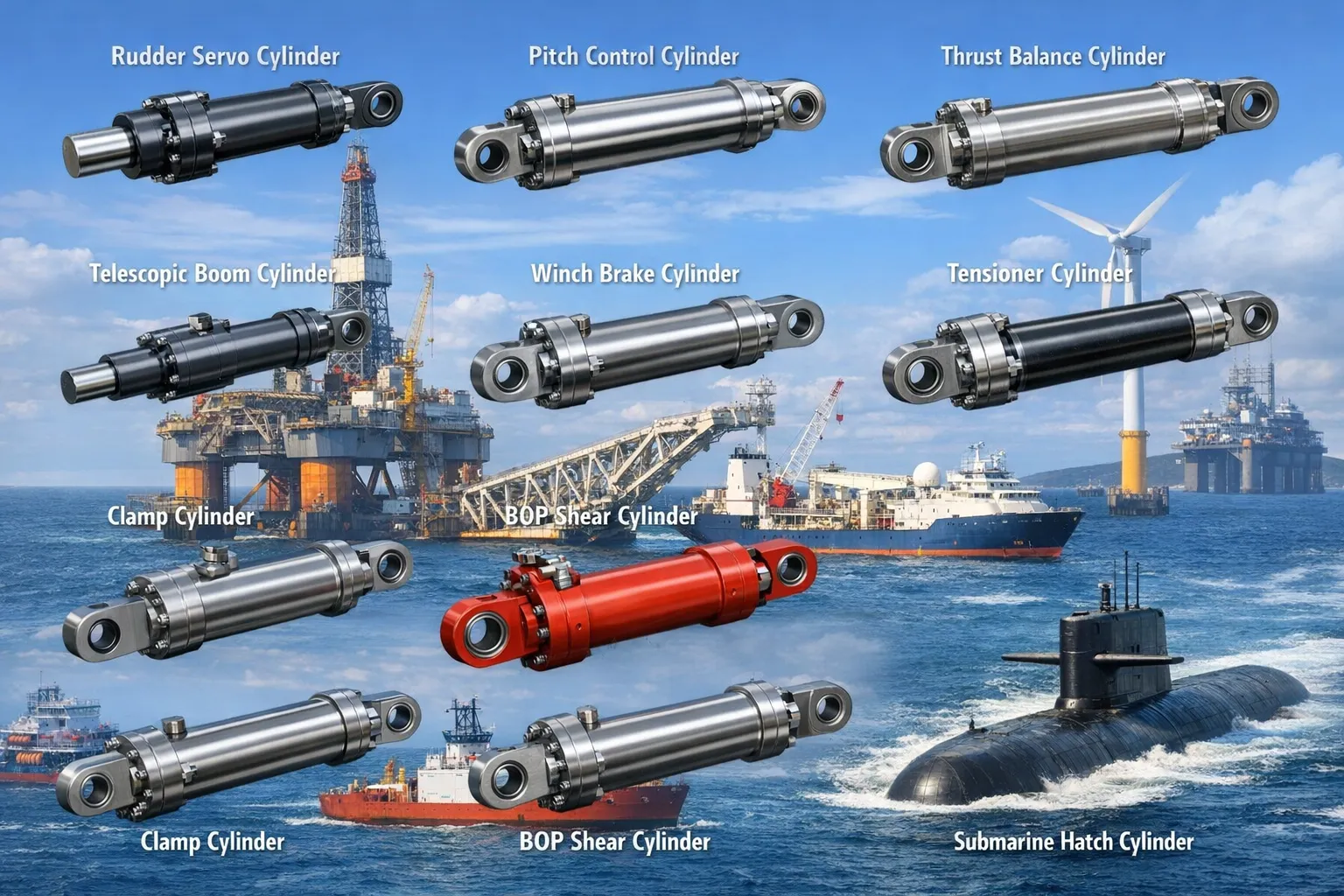
Seamless Integration and Global OEM Brand Compatibility
During a vessel’s tightly scheduled dry-docking period or following an unexpected offshore breakdown, waiting months for an original OEM replacement part from Europe is commercially unviable and results in massive off-hire penalties. Our engineering department specializes in high-precision dimensional reverse-engineering to provide highly upgraded, drop-in replacement units. We routinely supply custom-manufactured windlass brake actuators that are perfectly compatible with the mounting footprints, pin eye diameters, and fluid port thread specifications of major maritime deck machinery systems worldwide.
Our actuators can perfectly replace failing equipment on anchoring systems originally manufactured by industry giants such as MacGregor, Rolls-Royce (Kongsberg Maritime), Fukushima Ltd., Kawasaki Heavy Industries, Mitsubishi Heavy Industries, and Hatlapa. By upgrading to our 42CrMo ceramic-coated units, fleet operators permanently solve chronic deck leakage issues while maintaining exact system geometry. This means that fixing hydraulic cylinders on deck requires absolutely no structural welding, cutting, or modification to the existing winch foundation steelwork.
(Disclaimer: The brand names mentioned above are the registered trademarks of their respective corporate owners. They are referenced here strictly for the purpose of technical sizing, dimensional cross-referencing, and mechanical compatibility to aid marine engineers and procurement officers. We operate as an independent hydraulic cylinder manufacturer, and our provision of high-performance aftermarket upgrades does not imply official affiliation with or endorsement by these entities.)
7 Core Technical Advantages of Our Windlass Cylinders
Surviving the violent environment of a ship’s forecastle requires metallurgy and tribology that goes far beyond standard industrial specifications. Our windlass brake cylinder is structurally optimized to deliver flawless reliability through seven critical engineering pillars:
1. 42CrMo High-Tensile Metallurgy
Anchor chains frequently experience violent snatch loads due to wave heave and tidal pulling. We forge our primary pressure-bearing structural components from 42CrMo alloy steel. This provides an immensely high yield strength and fatigue resistance, preventing the cylinder body from bulging, stretching, or fracturing under extreme hydraulic pressure spikes.
2. Ceramic-Coated Piston Rod
The constant assault of corrosive salt spray devours standard hard chrome plating rapidly. We utilize advanced High-Velocity Oxygen Fuel (HVOF) plasma ceramic spraying on the rod. This creates a non-porous, ultra-hard shield that is chemically inert to seawater, guaranteeing the rod remains flawlessly smooth and rust-free for its entire operational lifespan.
3. Advanced Nickel Plated Housing
While the rod receives thick ceramic armor, the external steel barrel and mounting flanges undergo a heavy-duty electroless nickel plating process. This provides exceptional external corrosion resistance against the aggressive marine atmosphere, preventing structural degradation far better than basic marine epoxy paint that easily chips.
4. Zero-Leakage Sealing Matrix
To combat the primary and most dangerous failure mode of fluid leakage, we install a multi-lip, shock-resistant polyurethane and PTFE (Teflon) sealing system. This specialized matrix is engineered to handle rapid pressure variations without extrusion, ensuring the brake maintains its absolute hydraulic lock indefinitely.
5. Monolithic Welded Construction
Traditional tie-rod cylinders inevitably stretch, bend, and vibrate loose when subjected to the severe mechanical vibration of heavy deck machinery. Our deep-penetration welded design creates a rigid, monolithic structure that maintains perfect geometric concentricity and structural integrity regardless of the applied shock load.
6. Integrated Shock Absorption Cushioning
The rapid, forceful engagement of the windlass brake can send destructive kinetic shockwaves back through the entire hydraulic system. We meticulously integrate precision hydraulic cushioning at the end of the stroke to decelerate the piston smoothly, protecting both the cylinder internals and the vessel’s primary hydraulic power unit.
7. Heavy-Duty Spherical Bearings
Deck machinery steel frames physically flex and twist under heavy anchor loads, which introduces dangerous lateral side-loading forces directly to the extended piston rod. We install marine-grade, self-lubricating spherical plain bearings in the mounting clevis eyes to actively absorb mechanical misalignment, completely preventing internal rod galling and seal tearing.
Autonomous Manufacturing & Total Quality Traceability
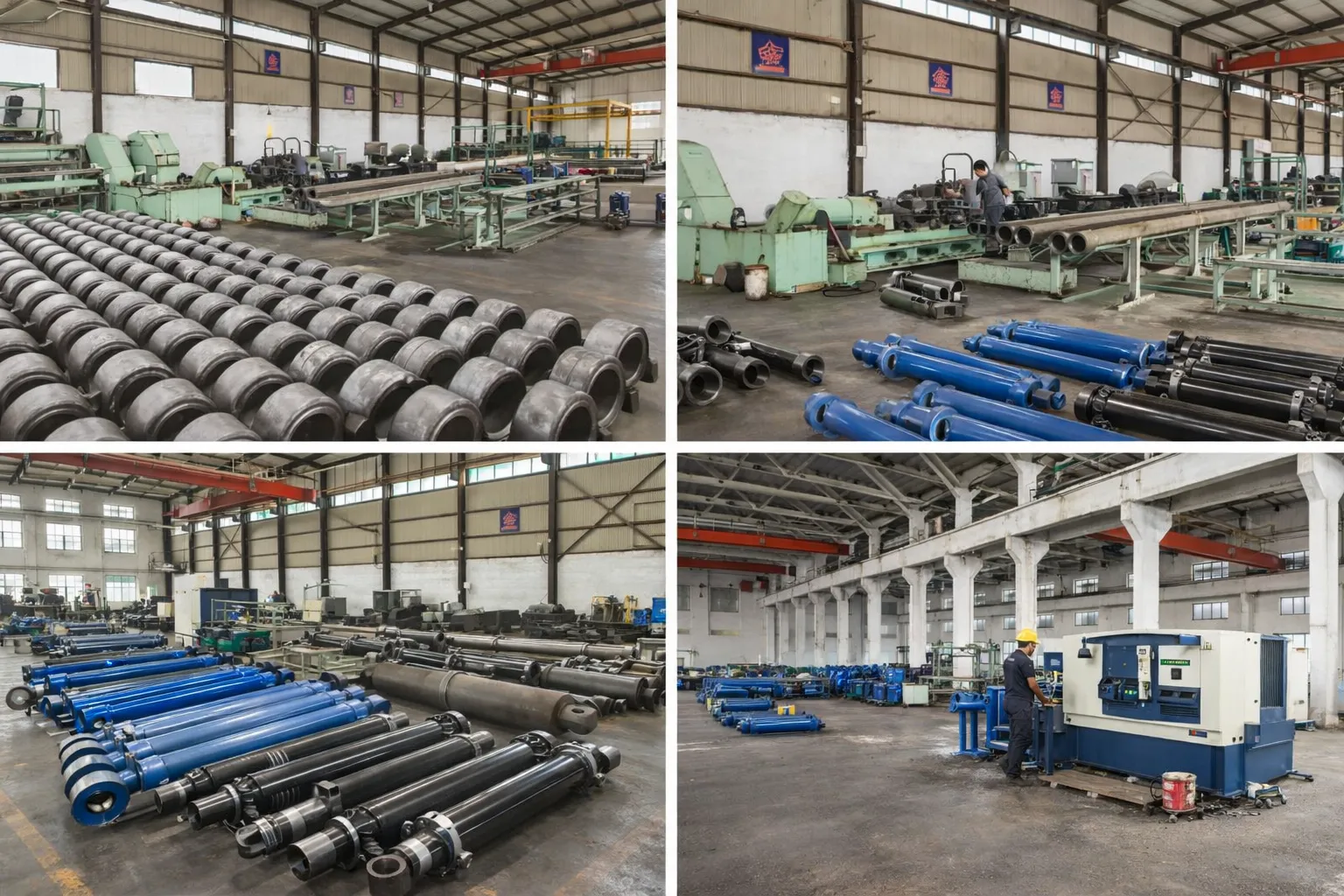
When human lives and multi-million-dollar maritime assets rely entirely on the gripping force of a single anchor chain, the manufacturing quality of the brake cylinder cannot be outsourced, assumed, or taken lightly. We operate a fully integrated, state-of-the-art production facility where every single stage of fabrication is under our direct metallurgical and mechanical control.
The rigorous manufacturing protocol begins with the thorough inspection of all raw 42CrMo steel billets using Optical Emission Spectrometry (OES) to verify the exact chemical alloy composition. Once approved, our multi-axis CNC lathes and deep-hole milling centers machine the steel barrels and the hydraulic cylinder components to micron-level H7 tolerances. This dimensional perfection is absolutely vital for supporting our zero-leakage guarantee. The critical structural trunnion and end-cap welds are executed by automated robotic systems utilizing Submerged Arc Welding (SAW) with inert gas shielding to ensure deep, uniform penetration. Crucially, 100% of these structural welds undergo rigorous Non-Destructive Testing (NDT), specifically utilizing ultrasonic flaw detection equipment, to verify the complete absence of any internal micro-cracks or hazardous voids.
Before any windlass brake hydraulic cylinder is approved for dispatch to a shipyard, it undergoes a punishing Factory Acceptance Test (FAT). We subject the assembled units to prolonged static hydrostatic pressure holds at 1.5 times their maximum rated operating pressure. During this phase, we utilize highly sensitive digital pressure decay sensors to empirically confirm absolute zero internal and external fluid leakage. Every completed cylinder is permanently serialized, providing our B2B clients with complete lifecycle traceability, comprehensive Material Test Reports (MTRs), and exhaustive testing documentation, fully satisfying the stringent requirements of major maritime classification societies worldwide.
Broad Industrial Capabilities Beyond Maritime Engineering
The specialized engineering required to survive continuous atmospheric salt spray and massive, unpredictable shock loads on a ship’s deck translates directly into extraordinary reliability for other heavy-duty industrial sectors. The highly robust design principles embedded in our hydraulic rams are actively sought after across multiple demanding terrestrial environments.
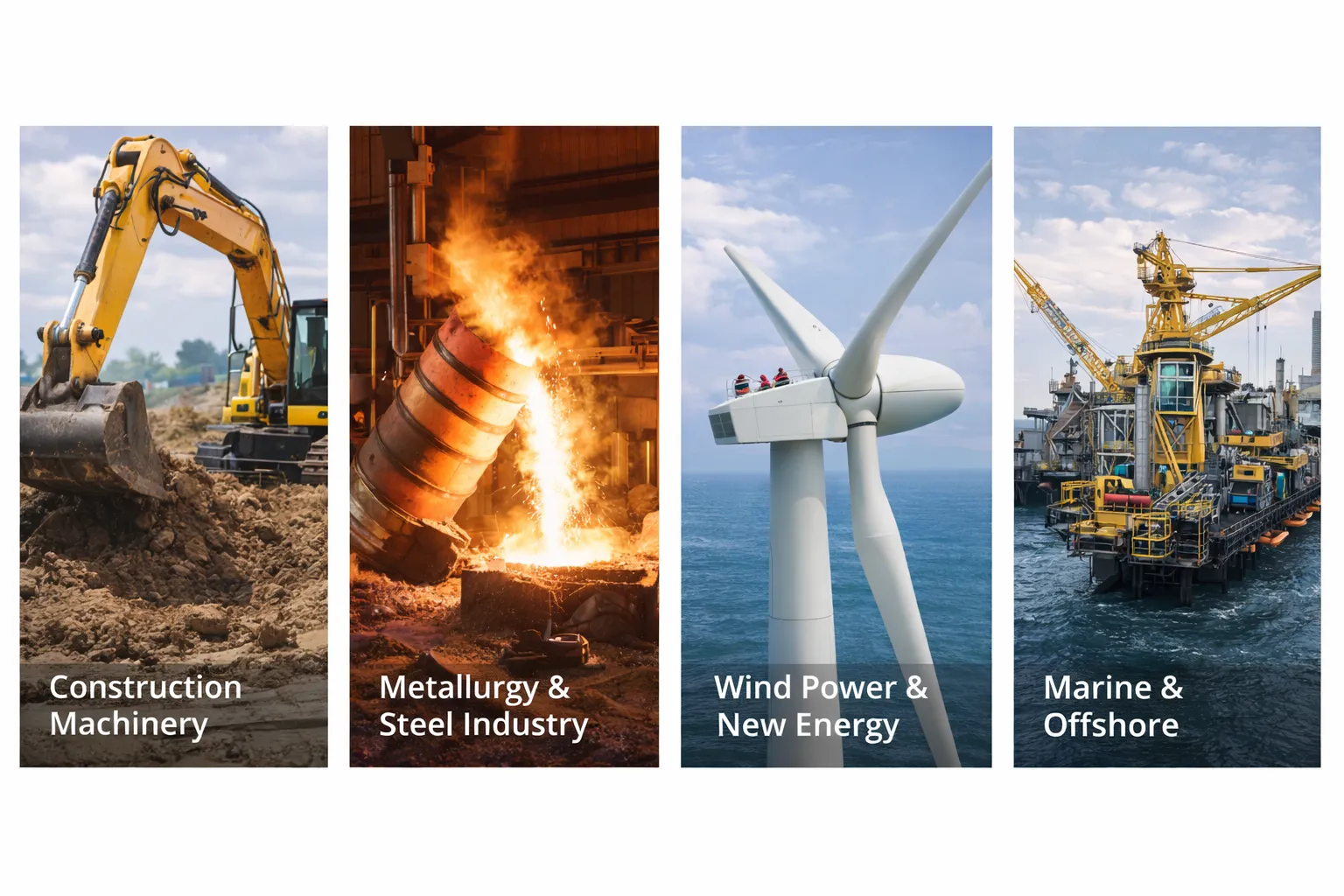
Heavy Metallurgy & Steel Works
In environments completely dominated by extreme radiant heat and abrasive flying slag, our robust, heat-resistant actuators operate furnace doors and continuous casting equipment safely. Learn more about our specialized solutions for the metallurgical and iron industry.
Subterranean Mining & Tunneling
Underground mining equipment faces massive lateral shock loads, severe vibration, and heavy rock dust contamination. Our heavy-walled welded structures power crushers, loaders, and tunnel borers reliably. Explore our heavy-duty applications in the mining industry.
Earthmoving & Heavy Construction
From massive excavator lifting booms to articulating dump truck steering systems, mobile machinery requires components that simply will not fail under heavy, shifting payloads. Discover our ruggedized parts built for the construction machinery industry.
Offshore Renewable Energy
Massive offshore wind turbines utilize our heavily protected, ceramic-coated pitch and yaw brake cylinders to securely lock the turbine blades safely in place during violent typhoons or routine maintenance.
Plastics & Rubber Injection Molding
High-tonnage industrial injection molding machines require absolute micro-precision and immense clamping force. Our high-pressure, ultra-low-friction internal designs ensure flawless, repeatable, high-speed manufacturing cycles.
Port Logistics & Material Handling
Heavy-duty ship-to-shore gantry cranes, automated straddle carriers, and container lifters utilize our highly responsive, pressure-tested cylinders for safe, reliable, and highly efficient global cargo movement.
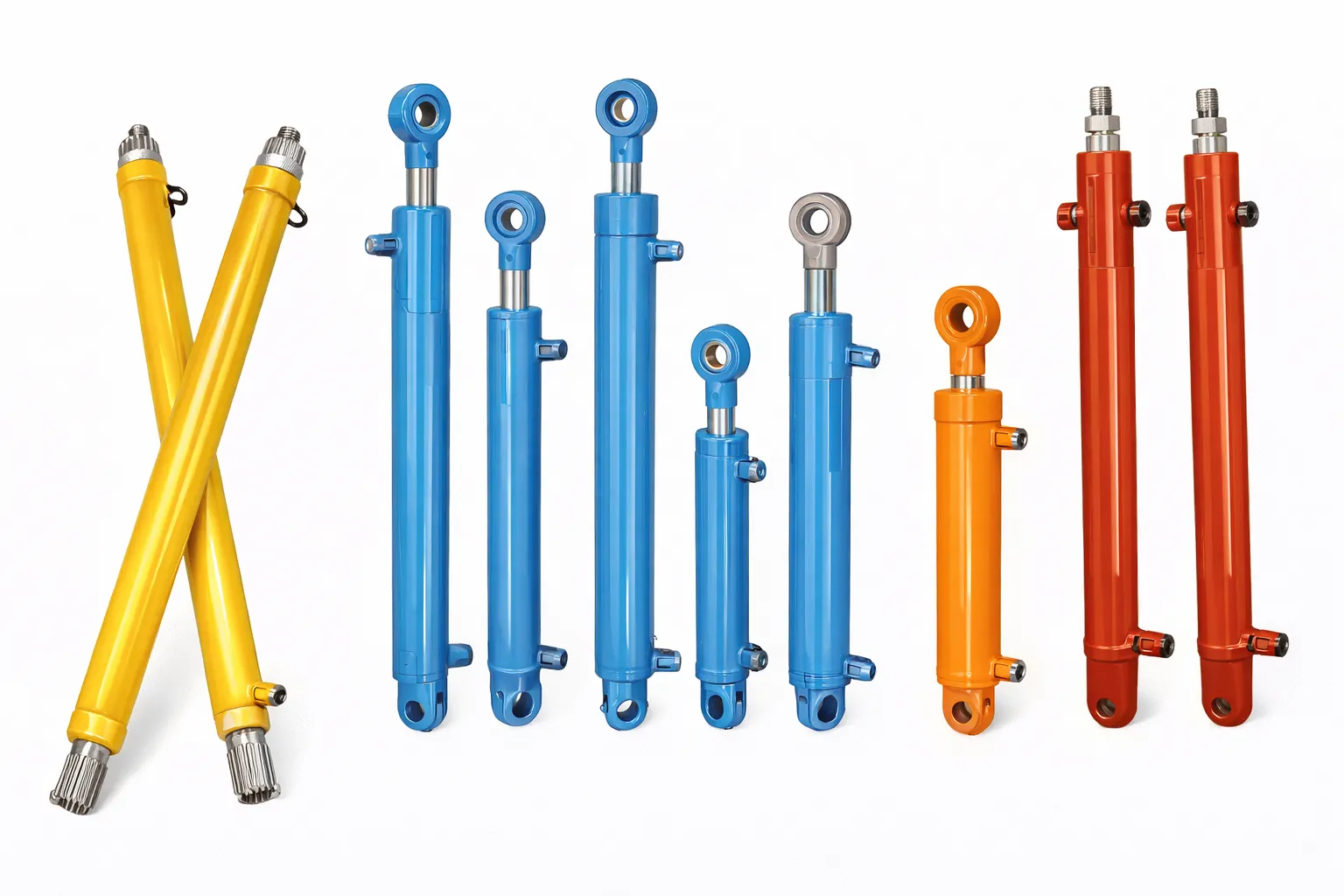
Comparative Analysis: Standard Hydraulics vs. High-Performance Offshore Actuators
For engineering procurement managers, evaluating the initial hydraulic cylinder price is only one small part of the complex financial equation. Understanding the true total cost of ownership—factoring in dry-dock downtime, frequent replacement costs, and severe safety risks—clearly reveals why upgrading to our specialized marine engineering is the most mathematically sound investment.
| Feature / Performance Metric | Ordinary Commercial Cylinders | Our Windlass Brake Hydraulic Cylinder |
|---|---|---|
| Rod Surface Protection | Standard Hard Chrome (Pits, cracks, and flakes rapidly under salt spray) | Advanced Ceramic Coating (Impervious, ultra-hard marine salt corrosion barrier) |
| Structural Body Material | Standard Carbon Steel (Prone to bending, bulging, and stretching) | High-Tensile 42CrMo Alloy (Massive yield strength for violent shock loads) |
| Exterior Body Defense | Basic Industrial Marine Paint (Chips easily, exposes raw steel to rust) | Heavy-Duty Nickel Plating (Exceptional metallurgical atmospheric defense) |
| Leakage Prevention Integrity | Standard NBR Seals (Prone to extrusion under high impact and heat) | Shock-Resistant PTFE Matrix (Empirically guarantees absolute zero leakage) |
| Maintenance Frequency | Very High (Constant resealing due to pitted rods tearing polymer seals) | Extremely Minimal (Designed for continuous multi-year deployment) |
Proven Reliability: East Asian Maritime Case Studies
Theoretical engineering specifications matter very little without proven, real-world ocean combat records. Our customized marine actuators are deeply trusted by premier fleet operators and massive shipbuilding conglomerates, particularly within the heavily trafficked shipping corridors of East Asia. Here are three documented examples of our rapid problem-solving interventions.
Case Study 1: Eradicating Dangerous Brake Slippage for a Bulk Carrier Fleet
Location & Client: Busan, South Korea – A major international dry bulk shipping operator.
The Challenge: The operator faced highly dangerous situations where their 120,000 DWT vessels were slowly dragging anchor during heavy winter swells. Investigations revealed that the original OEM windlass cylinders were suffering from severe internal leakage. The internal seals were degrading rapidly due to immense shock load pressure spikes, causing the mechanical brake bands to slowly lose their clamping force.
The Solution: The fleet technical manager contacted us via our website seeking an urgent, permanent upgrade. We engineered heavy-duty double acting hydraulic cylingder replacements utilizing 42CrMo steel and our specialized, shock-resistant PTFE seal matrix to absorb the extreme pressure spikes without extruding.
Result & Client Feedback: The retrofit was completed across multiple vessels in November 2024. The fleet has experienced zero brake slippage since installation.
Case Study 2: Defeating Aggressive Salt Spray on Offshore Support Vessels
Location & Client: Yokohama, Japan – Offshore Platform Supply Vessel (PSV) Operator.
The Challenge: Operating continuously in harsh, unsheltered coastal environments, the standard chrome-plated rods on the vessel’s anchoring equipment were severely pitted by salt spray corrosion within just 14 months. This rough, rusted surface repeatedly tore the wiper seals during retraction, leading to highly problematic external fluid leaks onto the deck and requiring constant hydraulic cylinder repair.
The Solution: We provided custom windlass brake cylinder units featuring our advanced plasma-sprayed ceramic-coated rods and heavy nickel-plated housings. This exact combination presented an impenetrable physical barrier against galvanic and atmospheric corrosion.
Result & Client Feedback: The new actuators drastically extended the maintenance lifecycle, completely stopping the leaks.
Case Study 3: Rapid Shipyard Supply for New Build Ro-Ro Ferries
Location & Client: Ulsan, South Korea – A premier commercial shipbuilding facility.
The Challenge: The shipyard was facing entirely unacceptable lead times (over 20 weeks) from traditional European suppliers for critical deck machinery actuators. This delay was severely threatening the final delivery schedule and commissioning of three new Ro-Ro passenger ferries.
The Solution: Leveraging our highly agile, vertically integrated manufacturing plant, we produced and delivered the required heavy-duty welded cylinders. They were fully pressure tested, painted, and certified within just 7 weeks.
Result & Client Feedback: The shipyard met its vessel commissioning deadlines without compromising one fraction on component quality or safety.
Frequently Asked Questions (FAQ)
Selecting the correct deck machinery components is a critical technical and financial decision. Below, our engineering experts thoroughly address the most common inquiries from marine architects, dry-docking supervisors, and fleet managers regarding our windlass brake actuators.
Secure Your Vessel with Uncompromising Holding Power
Do not allow vulnerable, standard-grade actuators to jeopardize the structural safety of your anchoring operations. Upgrade today to a precision-engineered windlass brake hydraulic cylinder specifically designed to conquer aggressive salt spray corrosion, effortlessly withstand violent anchor shock loads, and permanently guarantee zero-leakage performance.
Editor: Cxm