Tilting Hydraulic Cylinder for Coil Turnover Table
Conquer extreme eccentric loading and violent center-of-gravity shifts in your metallurgical storage facility. Engineered with thick-walled Q345D alloy steel and a symmetrical dual-cylinder architecture to permanently eliminate barrel bending and ensure flawless heavy-duty coil rotation.
Equipment Overview and Industrial Strategic Value
Within the highly demanding logistics environment of modern steel service centers and metallurgical storage facilities, the safe and efficient handling of finished steel coils dictates both facility throughput and personnel safety. A single master steel coil can frequently weigh between 20 to 40 metric tons. Transitioning these colossal rolled products from a horizontal “eye-to-the-sky” position to a vertical “eye-to-the-wall” orientation for transport, slitting, or annealing requires specialized heavy machinery known as a steel coil turnover table or coil upender. At the absolute mechanical core of this massive equipment, generating the raw kinetic energy required to lift and rotate these immense loads through a 90-degree arc, is the heavy-duty Turnover Cylinder. Without absolute precision and unwavering structural integrity from this central actuator, moving these massive metallurgical assets is impossible.
Operating a generic commercial hydraulic cylinder in this specific application represents a profound engineering miscalculation. The kinematic physics of upending a 30-ton steel coil involve a highly destructive dynamic phenomenon. As the heavy steel V-saddle rotates past the 45-degree tipping point, the entire center of gravity of the payload violently shifts. This instantaneous transition creates massive eccentric loading—a severe lateral side-load force that actively attempts to deflect the extended actuator rod and warp the internal barrel walls. Standard utility cylinders, which utilize thin-walled carbon steel tubes and narrow internal guide rings, simply cannot absorb this immense lateral deflection. The inevitable result is catastrophic cylinder barrel bending, buckled rods, totally crushed pressure seals, and highly dangerous load instability. This structural failure forces warehouse maintenance managers to constantly engage in expensive, emergency-level fixing hydraulic cylinders while the dispatch line grinds to an agonizing halt.
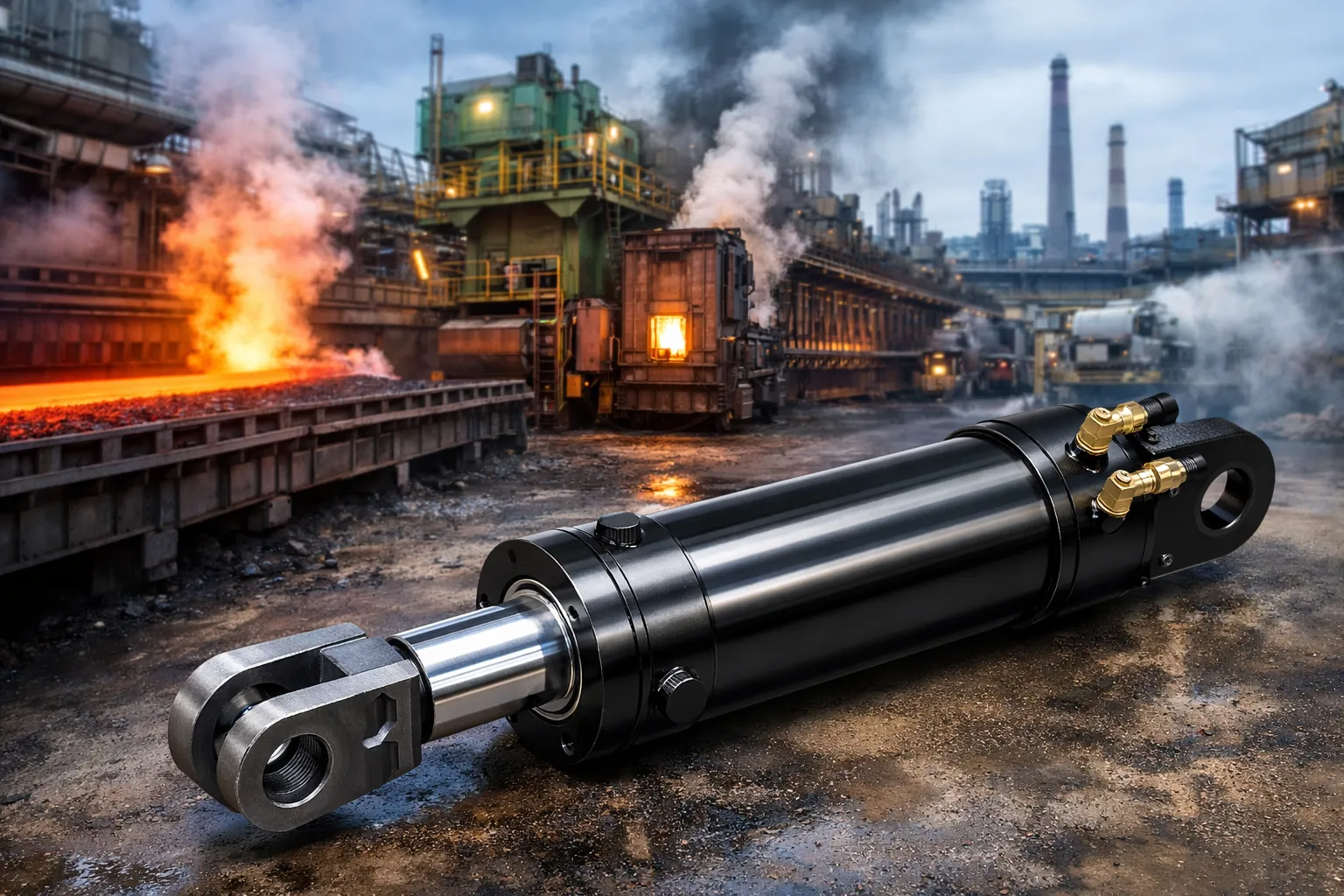
Recognizing this specific mechanical vulnerability within the material handling sector, our engineering team completely redesigned the fluid power architecture required for heavy coil logistics. As an elite, globally recognized hydraulic cylinder manufacturer, we engineered our specialized Tilting Hydraulic Cylinder utilizing exceptionally thick-walled Q345D low-alloy structural steel. Furthermore, we mandate a dual-cylinder symmetrical arrangement to perfectly balance these violent kinetic forces. When analyzing massive capital expenditures and total operational costs, the initial hydraulic cylinder price is mathematically irrelevant when weighed against the devastating financial and personnel safety costs of dropping a 30-ton steel coil. Our unique industrial positioning is founded upon delivering unyielding structural rigidity, completely eliminating barrel bending, and guaranteeing the flawless, vibration-free rotation of your heaviest metallurgical loads.
Comprehensive Technical Engineering Parameters
Handling heavy eccentric loads requires uncompromising clarity regarding mechanical specifications and material tolerances. The detailed data matrix below outlines the specific structural capabilities, material protocols, and customizable parameters integrated into our specialized coil tilting actuators, specifically adapted for the Metallurgical and Iron Industry.
| Engineering Category | Specification Detail & Component Architecture |
|---|---|
| Target Industry & Equipment | Metallurgy | Steel Coil Storage Facility | Steel Coil Turnover Table |
| Subsystem & Mechanical Action | 90-Degree V-Saddle Rotation | Heavy Payload Tilting Mechanism |
| Hydraulic Component Designation | Turnover Cylinder / Tilting Hydraulic Cylinder (翻转缸) |
| Kinematic Action Profile | Double acting hydraulic cylinder (Mandatory for safe overrunning load control) |
| Internal Structure Type | Heavy-duty hydraulic cylinder piston architecture |
| Manufacturing Methodology | Deep-penetration Welded Construction (Maximized structural rigidity, no tie-rods) |
| Core Material Architecture | Q345D Low-Alloy Structural Steel (Superior impact toughness and high yield strength) |
| Rod Surface Defense | Thick Micro-Cracked Hard Chrome Plating (High wear resistance against side-load galling) |
| Working Condition Hazard | Heavy load turnover, severe center-of-gravity shift, massive eccentric loading |
| Typical Failure Mode Defeated | Cylinder barrel bending, rod buckling, rapid guide ring destruction |
| Recommended Configuration | Dual symmetrical cylinder arrangement + Thick-walled cylinder barrel |
| Mounting Customization | Heavy Center Trunnion Block, Rear Clevis with self-aligning spherical plain bearings |
Operational Fluid Dynamics and Mechanical Working Principle
To fully comprehend the engineering superiority of this heavy industrial actuator, one must deeply analyze its fluid dynamic execution during the complex 90-degree steel coil turnover cycle. When manipulating a massive steel master coil, gravity is simultaneously your driving force and your greatest mechanical threat. A basic single acting hydraulic cylinder relying entirely on a gravity descent is utterly incapable of safely managing the over-center dynamics of an upender table. Therefore, the system relies exclusively on a highly calibrated, heavily reinforced double acting hydraulic cylinder. This bidirectional fluid configuration provides the machine’s central programmable logic controller (PLC) with absolute, active hydrostatic command over both the lifting phase and the braking phase of the severe articulation cycle.
As the operation commences to turn a coil from eye-horizontal to eye-vertical, the central hydraulic power unit rapidly injects high-pressure fluid into the blind end (cap end) of the thick-walled Q345D steel barrel. The incompressible hydraulic oil generates an immense, uniform hydrostatic force against the large surface area of the internal hydraulic cylinder piston. This kinetic energy smoothly and powerfully drives the thick, chrome-plated rod outward, initiating the rotation of the heavy L-shaped or V-saddle platform. During this initial phase, the Tilting Hydraulic Cylinder is working entirely against static gravity, requiring peak hydraulic pressure to initiate and sustain the upward lift.
The true test of the hydraulic parts occurs precisely as the platform crosses the 45-degree tipping point. At this apex, the immense weight’s center of gravity shifts radically. The load transitions instantly from resting against the cylinder to actively pulling away from it. If uncontrolled, the 40-ton coil would slam downward violently, destroying the machine frame and shattering the factory floor. However, the double acting hydraulic cylinder seamlessly transitions into a rigid fluid brake. By tightly restricting the flow of hydraulic oil exiting the rod-end port via direct-mounted counterbalance valves, the cylinder creates intense internal backpressure. This trapped fluid smoothly decelerates the massive eccentric load, lowering the coil to the deck with millimeter-perfect precision. Throughout this entire chaotic shift in gravity, the ultra-thick Q345D barrel geometry utterly refuses to bend or warp, absorbing the intense radial side-loading flawlessly and preventing the need for massive hydraulic cylinder repair.
Seamless Dimensional Integration and Global OEM Replacement
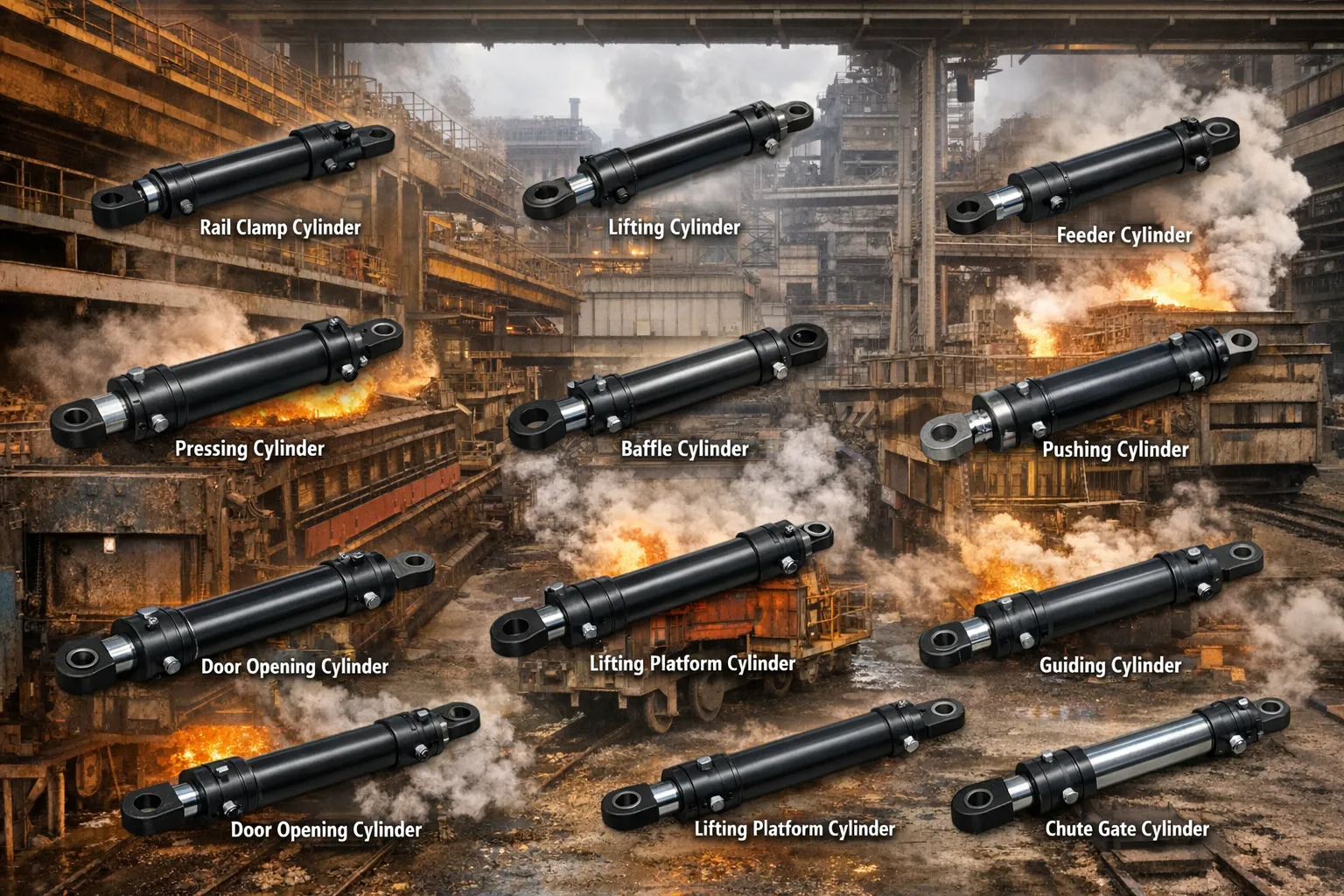
Warehouse engineering directors understand that modifying heavy steel structures to fit non-standard replacement parts is an operational nightmare. When a generic cylinder bends and cripples the packaging line, the maintenance team requires an immediate, exact-fit solution. We eliminate this immense operational friction by engineering our heavy-duty metallurgical Turnover Cylinder series to provide absolutely seamless dimensional compatibility with your existing logistics infrastructure.
Our specialized turnover actuators are meticulously reverse-engineered to act as flawless drop-in upgrades for failing commercial machinery. By accurately mirroring all critical geometric parameters—including heavy trunnion block widths, pin-to-pin closed-center lengths, massive rod diameters, and exact fluid port threading—you can effortlessly retrofit vulnerable OEM units originally supplied by legacy global brands such as Bosch Rexroth, Parker Hannifin, Eaton Vickers, Enerpac, SMC, and Yuken. (Please note: These third-party corporate brand names are referenced exclusively for technical dimensional cross-referencing and B2B sizing convenience. This reference does not imply any direct corporate affiliation, endorsement, or trademark infringement.) Upgrading your upender from standard off-the-shelf components to our heavily armored hydraulic rams guarantees a permanent cure for barrel bending without requiring a single welding modification to your massive machine frame.
8 Core Technical Engineering Advantages
Surviving extreme eccentric loading and shifting centers of gravity requires uncompromising material science and precision manufacturing. Our specialized Turnover Cylinder vastly outperforms commercial market alternatives because we rigorously enforce these eight foundational engineering pillars:
1. Ultra-Thick Walled Q345D Barrel Construction
The undisputed primary failure mode for coil upenders is the bowing and permanent plastic deformation of the cylinder barrel due to massive lateral off-center loads. We neutralize this entirely by abandoning standard 45# carbon steel. We mandate the use of Q345D low-alloy structural steel, significantly increasing the wall thickness beyond standard fluid power calculations. This creates a geometrically immense moment of inertia, granting the barrel staggering torsional rigidity and absolute resistance to bending during the 90-degree gravity shift.
2. Symmetrical Dual-Cylinder Load Balancing Architecture
Rather than relying on a single, massive center actuator that acts as a fulcrum for destructive side-loading, our engineering recommendation and design protocol emphasize a synchronized, symmetrical dual-cylinder configuration. By placing two heavy-duty Tilting Hydraulic Cylinder units at the outer structural edges of the upender table, the violent eccentric loads and shifting center of gravity are evenly distributed. This drastically reduces the localized radial strain on the hydraulic cylinder components, exponentially increasing the system’s overall fatigue life.
3. Advanced Low-Friction Dynamic Sealing Matrix
Heavy turnover operations must be smooth; a sudden jerky motion can cause a 30-ton coil to slip from its banding. We integrate a proprietary arrangement of specialized low-friction step seals paired with heavy bronze-infused PTFE guide rings. This ultra-low friction ecosystem completely prevents the erratic “stick-slip” shuddering phenomenon frequently observed when lowering massive loads under high backpressure. It guarantees perfectly fluid, predictable articulation.
4. Micro-Cracked Hard Chrome Plating for Extreme Wear Resistance
Because eccentric loads force the heavy rod to bear heavily against the internal gland guides, standard flash chrome plating will rapidly gall and score. Following precision centerless grinding, we apply an exceptionally thick layer of hard chrome featuring a controlled micro-cracked surface topography. These microscopic fissures retain hydraulic lubricating oil, generating a continuous, high-pressure boundary layer. This ultra-hard surface prevents metal-to-metal galling even under severe offset loading.
5. Deep-Penetration Robotic Welds for Structural Integrity
The mounting points—specifically the heavy trunnion blocks and rear clevises—absorb the entirety of the 40-ton shock load. We utilize advanced, automated submerged-arc robotic welding to fuse these massive structural mounts directly to the Q345D barrel. This deep-penetration welding process ensures zero internal voids or cold laps, providing absolutely unyielding structural integrity that will never tear or shear away from the main body during violent machine braking.
6. Internal Fatigue Optimization via Fluid Cushioning
Allowing a heavy turnover table to slam into its mechanical end stops will instantly fracture the machine frame and shatter concrete foundations. We engineer highly precise, progressive fluid cushioning zones within the extreme ends of the cylinder heads. As the hydraulic cylinder piston nears the completion of its stroke, escaping oil is choked through a specifically contoured restriction orifice. This smoothly and silently decelerates the immense mass, absorbing the kinetic shockwave into the fluid.
7. Self-Aligning Spherical Bearing Mounts
Even massive steel machine frames will flex and warp microscopically under the strain of a 40-ton coil. If a cylinder is rigidly mounted, this chassis flex forces the rod to bend. We utilize heavy-duty spherical plain bearings in our mounting clevises. These self-aligning bearings absorb any dynamic micro-misalignments, ensuring that the internal seals only experience pure linear axial forces, preserving the integrity of the cylinder.
8. Direct Mount Safety Valve Integration
Safety is non-negotiable when suspending multi-ton payloads. We precision-machine direct-mount interfaces into the cylinder head to accept heavy-duty counterbalance valves (CBV) and pilot-operated check valves. Because these safety valves bolt directly to the cylinder rather than resting down the fluid line, the load remains perfectly locked and completely immune to free-fall even if the main hydraulic hose is completely severed.
Autonomous Manufacturing and Unyielding Quality Assurance
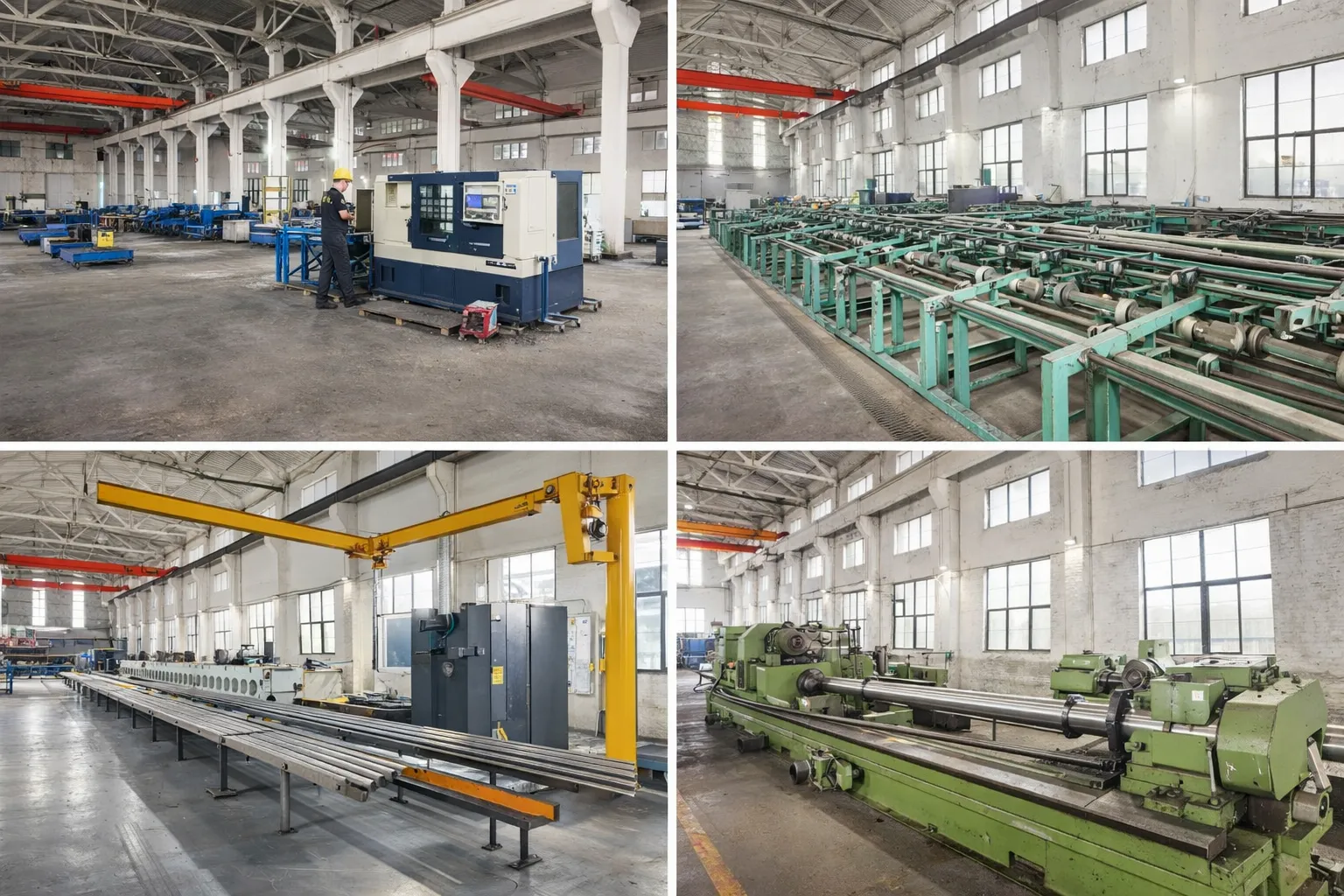
Our established global reputation as a strictly uncompromising hydraulic cylinder manufacturer is built entirely upon the unmatched capabilities of our advanced, digitally integrated factory floor. We exercise absolute, sovereign control over every single phase of production, explicitly rejecting the prevalent and high-risk industry practice of assembling outsourced, unverified low-grade components. From the initial heavy CNC machining of the massive Q345D alloy steel billets to the highly specialized application of the micro-cracked hard chrome, and finally the automated robotic welding of the robust mounting trunnions, every critical operation is executed within our facility. To guarantee absolute seal longevity under extreme side-loading, our internal barrel bores are subjected to advanced deep-hole skiving and roller burnishing processes, consistently achieving a pristine, mirror-like internal surface finish of Ra < 0.2µm.
Quality validation is not an afterthought; it is actively embedded directly into our engineering workflow. Before any machining commences, all incoming raw Q345D steel tubes and billets undergo mandatory ultrasonic flaw detection (UT) and spectrographic chemical analysis to verify the absolute absence of hidden internal material laminations or voids that could compromise structural integrity under eccentric loads. Following complete mechanical assembly, 100% of our products are clamped securely into a computerized, high-capacity hydrostatic test bench. The Tilting Hydraulic Cylinder is pressurized to an extreme 150% of its maximum designated operating load, while highly sensitive digital transducers continuously monitor for zero internal fluid leakage or pressure decay. Finally, each unit is permanently laser-etched with a unique alphanumeric serial number, granting our global B2B engineering clients absolute material traceability and simplifying the rapid procurement of exact replacement hydraulic cylinder components.
Extensive Cross-Industry Heavy Engineering Deployments
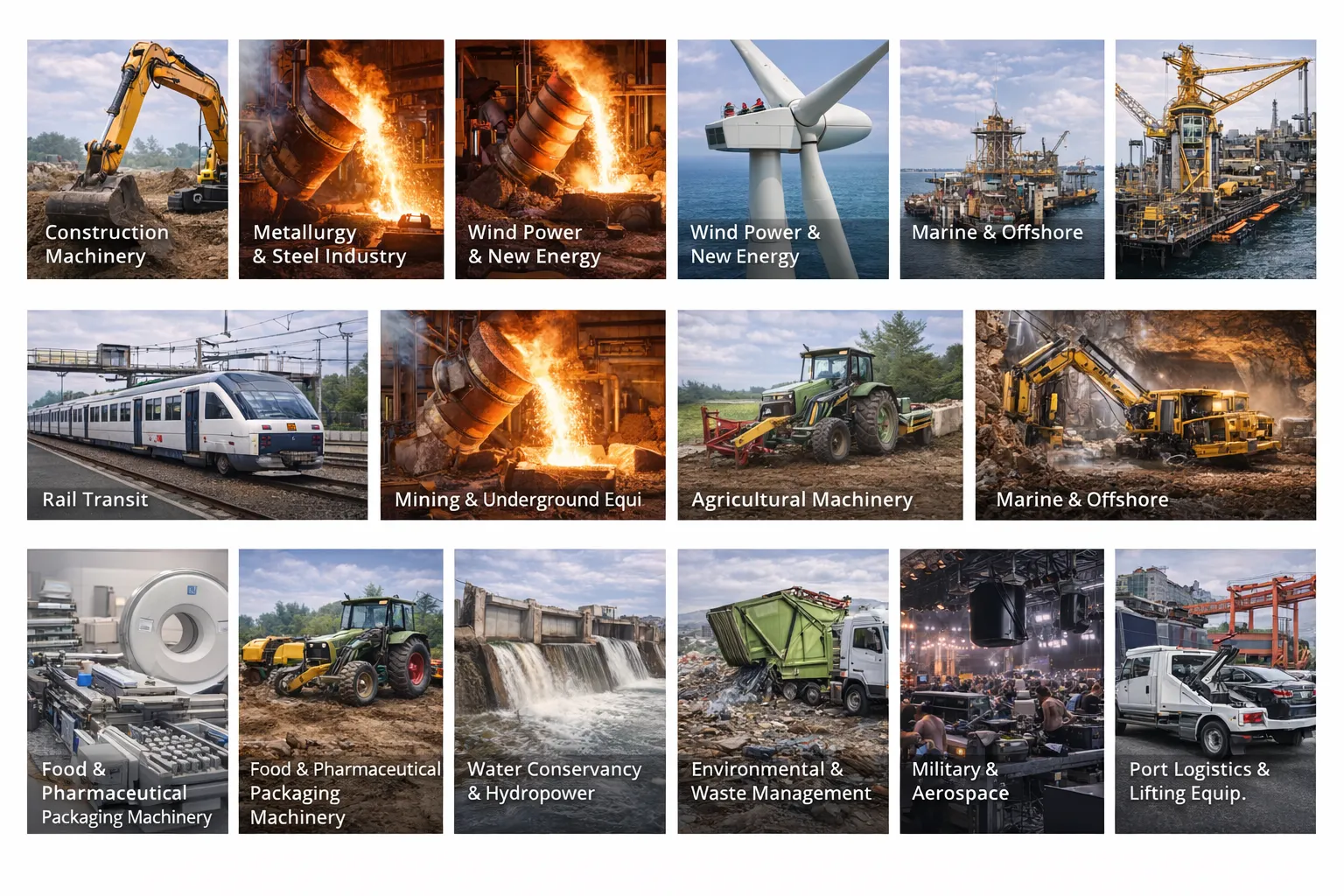
While meticulously optimized to conquer the severe eccentric loads and violent gravity shifts of metallurgical coil upenders, the immensely robust baseline architecture of our fluid power systems makes them the premier choice across a vast array of punishing industrial environments. We encourage you to explore our comprehensive hydraulic cylinder portfolio to understand how we support heavy global infrastructure:
- Mining & Mineral Extraction: Delivering unstoppable mechanical force for primary jaw crushers, heavy apron feeders, and subterranean roof supports operating in highly abrasive rock dust. Review our Mining Industry solutions.
- Civil Engineering & Construction Machinery: Providing immense structural shock resistance acting as a heavy-duty boom arm or robust lift cylinder on high-tonnage crawler excavators, rotary piling rigs, and tunnel boring equipment. Explore our Construction Machinery Industry capabilities.
- Plastics & Heavy Mold Turning: Actuating massive 90-degree mold turnover tables in automotive plastic injection facilities, handling heavy steel dies safely during maintenance operations.
- Material Handling & Maritime Logistics: Powering heavy port-side ship loaders, automated straddle carriers, and container tilters functioning continuously in highly corrosive, salt-laden coastal atmospheres.
- Bespoke Special Engineering Projects: Rapidly prototyping and manufacturing highly customized fluid power solutions engineered specifically for unique spatial constraints, extreme eccentric loading, or severe environmental hazards where standard catalogs fail immediately.
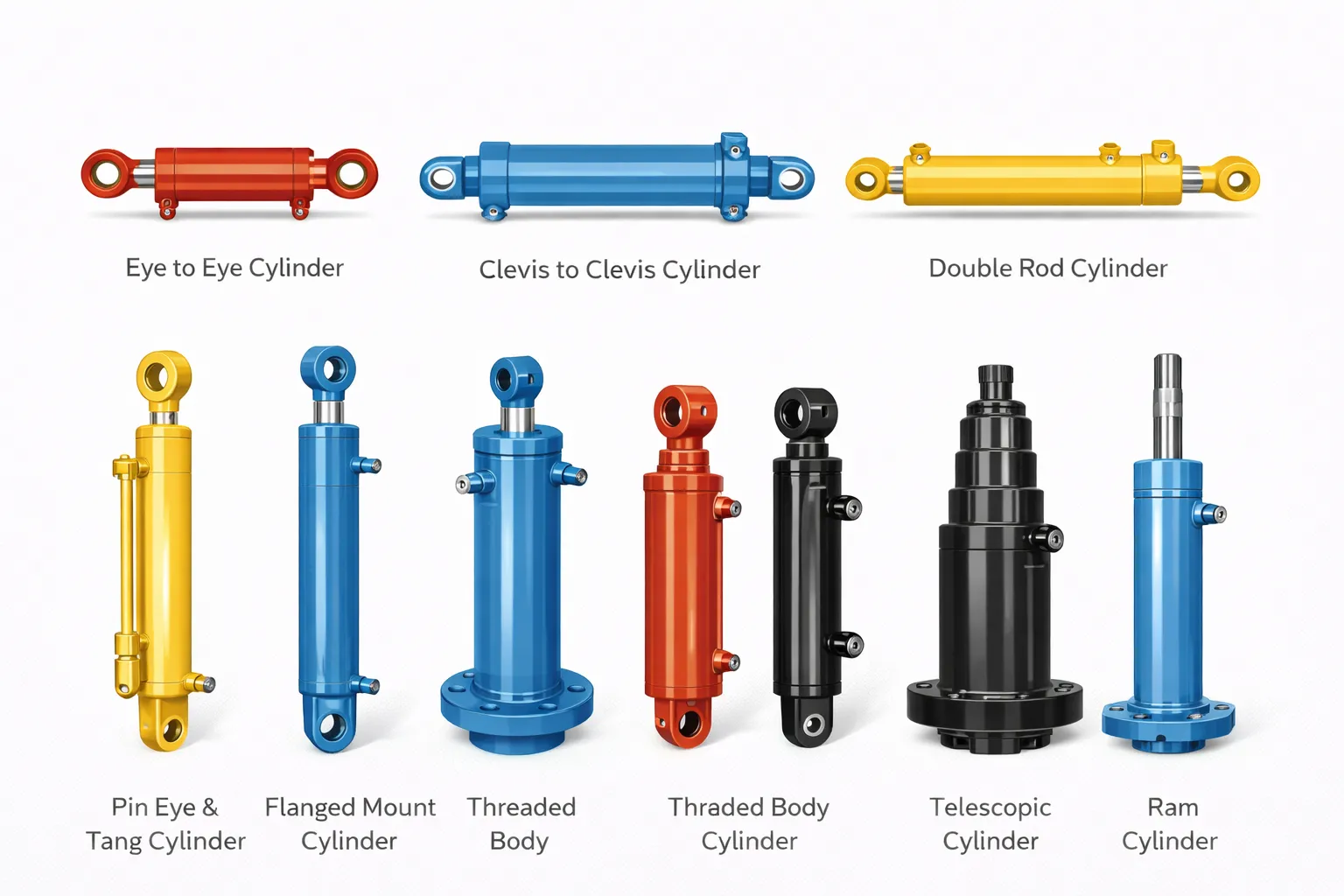
Data-Driven Comparative Analysis: Standard Commercial vs. Specialized Performance
Industrial procurement driven exclusively by the lowest initial capital cost inevitably results in disastrous total lifecycle expenditures due to persistent, predictable machinery failures. The technical data matrix below clearly delineates the massive engineering gap between generic off-the-shelf actuators and our purpose-built turnover solutions.
| Engineering Evaluation Metric | Standard Commercial Cylinder | Our Heavy-Duty Tilting Cylinder |
|---|---|---|
| Eccentric Load Tolerance (Bending) | Poor (Thin-walled 45# steel bends instantly under severe offset gravity shifts) | Extreme (Ultra-thick Q345D steel prevents plastic deformation entirely) |
| Kinematic Friction Dynamics | High friction seals (Causes violent stick-slip shuddering during coil lowering) | Ultra-low friction step seals (Perfectly smooth, continuous fluid braking) |
| Rod Surface Galling Resistance | Basic Flash Chrome (Scores heavily as side-loads force the rod against the gland) | Thick Micro-Cracked Chrome (Self-lubricating boundary prevents metal-to-metal galling) |
| Structural Weld Integrity | Shallow manual welds (Trunnion mounts fracture under violent machine braking) | Deep-penetration robotic Submerged Arc Welding (Absolute load resilience) |
| Upender Equipment MTBF | Months before catastrophic barrel bowing and massive seal blowouts occur | Years of continuous, safe, perfectly stable heavy coil rotation |
Proven Global Operational Success: 4 Verified Engineering Case Studies
True engineering authority and E-E-A-T (Experience, Expertise, Authoritativeness, and Trustworthiness) are demonstrated exclusively through verifiable, real-world deployments in extreme conditions. Our heavy-duty fluid power systems are deeply embedded in the heaviest metallurgical logistics sectors of South Korea, Japan, and Taiwan. Review these specific accounts of our technology eliminating critical downtime and safety hazards.
Case 1: Eradicating Barrel Bending at POSCO Steelworks
Location: Pohang, South Korea | Client Profile: Tier-1 Global Integrated Steel Producer
Application: Primary 40-ton steel coil upender in the cold rolling storage facility.
The Challenge & Connection: The facility faced a severe safety and maintenance crisis. The massive eccentric load of 40-ton coils during the 90-degree pivot was physically bowing the standard OEM cylinders. This caused violent fluid blowouts and left coils suspended precariously. The lead reliability engineer found our thick-walled technology via a targeted Google search and engaged our technical team in July 2024.
Implementation & Results: We designed and delivered a synchronized, symmetrical dual-cylinder configuration utilizing ultra-thick Q345D barrels. The new Turnover Cylinder setup entirely absorbed the shifting center of gravity. Over 18 months, the plant recorded absolutely zero instances of barrel deformation, permanently eliminating the catastrophic safety risk and saving immense costs typically spent on fixing hydraulic cylinders.
“The barrel bending issue that constantly threatened our storage operations has been completely resolved. Their engineering team understood the brutal eccentric loading of our upenders perfectly. The thick-walled design is remarkably effective and saved our maintenance budget.” — Mr. Kang D.H., Lead Mechanical Reliability Engineer
Case 2: Resolving Stick-Slip Shuddering at Nippon Steel
Location: Nagoya, Japan | Client Profile: Advanced High-Grade Automotive Steel Plant
Application: Precision tilting table for high-value surface-treated steel coils.
The Challenge & Connection: The client was struggling with severe hydraulic stick-slip during the slow rotational stroke. The erratic stuttering caused the heavy coils to jerk violently on the saddle, resulting in microscopic surface scratches on the high-value steel.
Implementation & Results: By engineering the internal mechanism with our proprietary ultra-low friction step seals and robust guide bands, the new double acting hydraulic cylinder permitted absolutely flawless, vibration-free motion. The stick-slip phenomenon was completely eradicated, instantly preserving the surface quality of their final product.
“The kinematic fluidity and completely vibration-free holding force of the hydraulic cylinder piston are genuinely remarkable. Upgrading to these actuators eliminated the mechanical jerking that was downgrading our premium coils.” — T. Watanabe, Senior Production Quality Engineer
Case 3: Efficient CAPEX Upgrades via Exact OEM Replacement for China Steel Corp
Location: Kaohsiung, Taiwan | Client Profile: Massive Integrated Steel Mill
Application: Complete retrofit of failing European OEM cylinders across the entire coil logistics yard.
The Challenge & Connection: Facing massive procurement costs and agonizing 16-week supply chain delays from their original legacy European supplier, the procurement division aggressively searched for a direct-to-market manufacturer capable of matching massive dimensions. They emailed our engineering team the original OEM blueprints to discuss ways to lower the massive hydraulic cylinder price overhead.
Implementation & Results: We rapidly delivered exact 1:1 dimensional drop-in replacements within just 4 weeks. The maintenance team successfully retrofitted the aging upender systems without modifying a single bolt on the heavy chassis. This strategic move slashed their initial procurement CAPEX by over 35% while upgrading their structural defenses against bending.
“A completely flawless drop-in replacement. The mechanical installation was incredibly fast, and the operational lifespan ratio is staggering. They are now our exclusive standard for extreme eccentric load actuators.” — Lee H.J., Plant Procurement Director
Case 4: Eliminating Catastrophic Drops at Hyundai Steel
Location: Dangjin, South Korea | Client Profile: Premier Heavy Automotive Steel Producer
Application: Secondary slitting line downender table handling 25-ton payloads.
The Challenge & Connection: During a hydraulic hose failure event, their standard cylinder lost pressure, and the tilting table slammed violently into the floor, fracturing the machine frame. They contacted us urgently specifically to implement our advanced fluid control architecture to prevent future free-falls.
Implementation & Results: We custom-designed replacement cylinders engineered to work perfectly with heavy-duty direct-mount counterbalance valves. Even during simulated total hose ruptures, the load now remains perfectly locked in mid-air. The facility has achieved 100% safety compliance since the retrofit.
“The integrated fluid control dynamics are a life-saver. It physically prevents the load from dropping under any circumstance, completely protecting our personnel and our wider machine framework from shock damage.” — Park M.S., Chief Plant Safety Engineer
Frequently Asked Questions (FAQ) for Technical B2B Procurement
Procuring heavy-duty fluid power components for massive shifting loads requires absolute mechanical certainty. Below are highly detailed, expert answers to the most rigorous inquiries we receive from international plant maintenance directors and logistics reliability engineers.
1. How exactly does your cylinder physically prevent barrel bending during the turnover process?
Standard cylinders use thin-walled carbon steel tubing which simply yields under the immense lateral strain caused when a 30-ton coil crosses the tipping point. We fundamentally eradicate this weakness by utilizing custom-forged, ultra-thick Q345D low-alloy structural steel for our barrels. This massively increases the moment of inertia and yield strength of the cylinder body, ensuring it remains perfectly straight and rigid even under extreme eccentric side-loading.
2. Why is the utilization of spherical bearings critical for coil turnover tables?
When rotating heavy masses, the heavy steel chassis of the table itself will microscopically twist and flex. If a cylinder is mounted with rigid pins, this chassis flex forces the rod to bend, violently grinding the hydraulic cylinder piston against the barrel wall. By integrating heavy-duty, self-aligning spherical plain bearings into our mounting clevises, the cylinder can safely pivot and absorb these dynamic micro-misalignments. This ensures the internal seals only ever experience pure, harmless linear axial forces.
3. Can you guarantee dimensional exactness when replacing legacy European OEM brands on our upender?
Yes, absolutely. A vast majority of our industrial operations involve upgrading legacy logistics machinery across the Asia-Pacific. By supplying our engineering division with your existing technical drawings or the specific OEM model numbers, we actively custom-manufacture the external geometry. We perfectly match every critical dimension—including massive trunnion widths, extended stroke depths, and precise fluid port dimensions—to ensure a flawless, direct bolt-on installation without any machine chassis modifications required.
4. How does your equipment actively reduce the frequency of fixing hydraulic cylinders in our warehouse?
The continuous, highly dangerous necessity for frequently fixing hydraulic cylinders on upenders almost exclusively stems from barrel bending and subsequent seal destruction caused by eccentric loads. By implementing the ultra-thick Q345D barrel and self-aligning spherical mounts, we actively eliminate these specific failure modes at the structural engineering level. This completely protects the internal mechanics, multiplying the equipment’s operational mean time between failures (MTBF) and slashing emergency maintenance downtime.
5. Do you actively supply replacement hydraulic cylinder components for future scheduled maintenance?
Yes. Maximizing the operational lifespan of our products is our core priority. Because every double acting hydraulic cylinder we build is permanently laser-serialized, we hold exact digital blueprints of your unit on our secure servers. When a routine 5-year overhaul is eventually scheduled, we immediately supply identically matched, high-performance seal kits, heavy bronze guide rings, spherical bearings, and other necessary hydraulic cylinder components to ensure rapid internal maintenance by your plant technicians.
6. What is your manufacturing lead time for heavy industrial orders shipped to South Korea or Japan?
Due to our fully autonomous, vertically integrated manufacturing process, our lead times are highly optimized compared to traditional Western suppliers. For high-performance, custom-dimensioned heavy logistics configurations, massive raw fabrication and testing require approximately 3 to 4 weeks. Ocean freight logistics to major regional ports (such as Busan, Incheon, or Yokohama) typically add only 7 to 10 days. We also fully support expedited air freight protocols for severe emergency, line-down breakdowns.
7. Are comprehensive factory testing documents provided with international shipments?
Yes. Uncompromising Quality Assurance transparency is our standard operating procedure. Every massive unit dispatched internationally includes a full QA packet. This highly detailed packet contains the raw steel mill certificates validating the heavy Q345D composition, the ultrasonic flaw detection (UT) reports for structural weld integrity, and the digital hydrostatic pressure test graphs proving the unit successfully held 150% of its massive rated operational pressure with zero internal fluid bypass.
8. How does your pricing structure dynamically compare to major Western OEMs?
Because we maintain absolute control over a 100% vertically integrated production process—from heavy raw billet machining to final robotic assembly and testing—we completely eliminate reliance on trading companies and third-party markup. Consequently, our pricing structure is highly aggressive. We routinely save our international B2B clients between 30% to 40% on initial CAPEX compared to sourcing from legacy European or American brands, while actively delivering a vastly superior mechanical lifespan under severe eccentric loads.
Ready to Guarantee the Safety of Your Coil Logistics?
Do not allow structurally weak fluid power actuators to dictate your logistics schedule, damage valuable steel coils, or pose severe safety risks to your personnel. Connect directly with our structural engineering specialists to analyze your specific turnover table blueprints, secure a highly competitive technical proposal, and understand precisely why heavy industry leaders across East Asia exclusively rely on our robust, eccentric-load-defeating technology.
Rapid global engineering support, precise heavy drop-in OEM replacements, and highly streamlined logistics are available immediately for South Korea, Japan, Taiwan, and the broader Asia-Pacific heavy manufacturing sector.
Editor: Cxm