
Product Overview: The Core Mechanism of Precision Flow Control
In modern infrastructure development, the ultimate consistency and structural integrity of an asphalt mat are dictated by the precise metering of hot material delivered to the screed. The flow control gates and auxiliary feeding mechanisms on heavy paving machinery require continuous, highly responsive micro-adjustments to maintain this consistency across changing highway grades and operational speeds. These critical, high-frequency actuations are entirely governed by the booster hydraulic cylinder. While operating under relatively light mechanical loads compared to massive screed lifting mechanisms, these specific cylinders endure extraordinary cyclical frequencies. This constant, short-stroke movement creates intense localized heat and dynamic friction along the barrel wall, leading directly to premature seal wear, fluid weeping, and a severe loss of positioning accuracy that creates irregular waves in the newly laid paving surface.
Standard off-the-shelf fluid power components are simply not engineered for these high-frequency, light-load metering tasks. They typically utilize high-friction elastomer seals that suffer immensely from stick-slip—a highly destructive mechanical phenomenon where the hydraulic cylinder piston stutters and jerks rather than moving fluidly at low operational velocities. As a highly specialized and experienced hydraulic cylinder manufacturer, we approach this pervasive engineering challenge with a precisely targeted structural solution. Our premium booster cylinder series is explicitly designed to completely eradicate internal breakaway friction. By integrating proprietary low-friction sealing technology and mirror-finished internal bore surfaces, we ensure that every single electronic micro-signal from the paver’s sonic or laser leveling sensors translates into perfectly smooth, instantaneous mechanical movement.
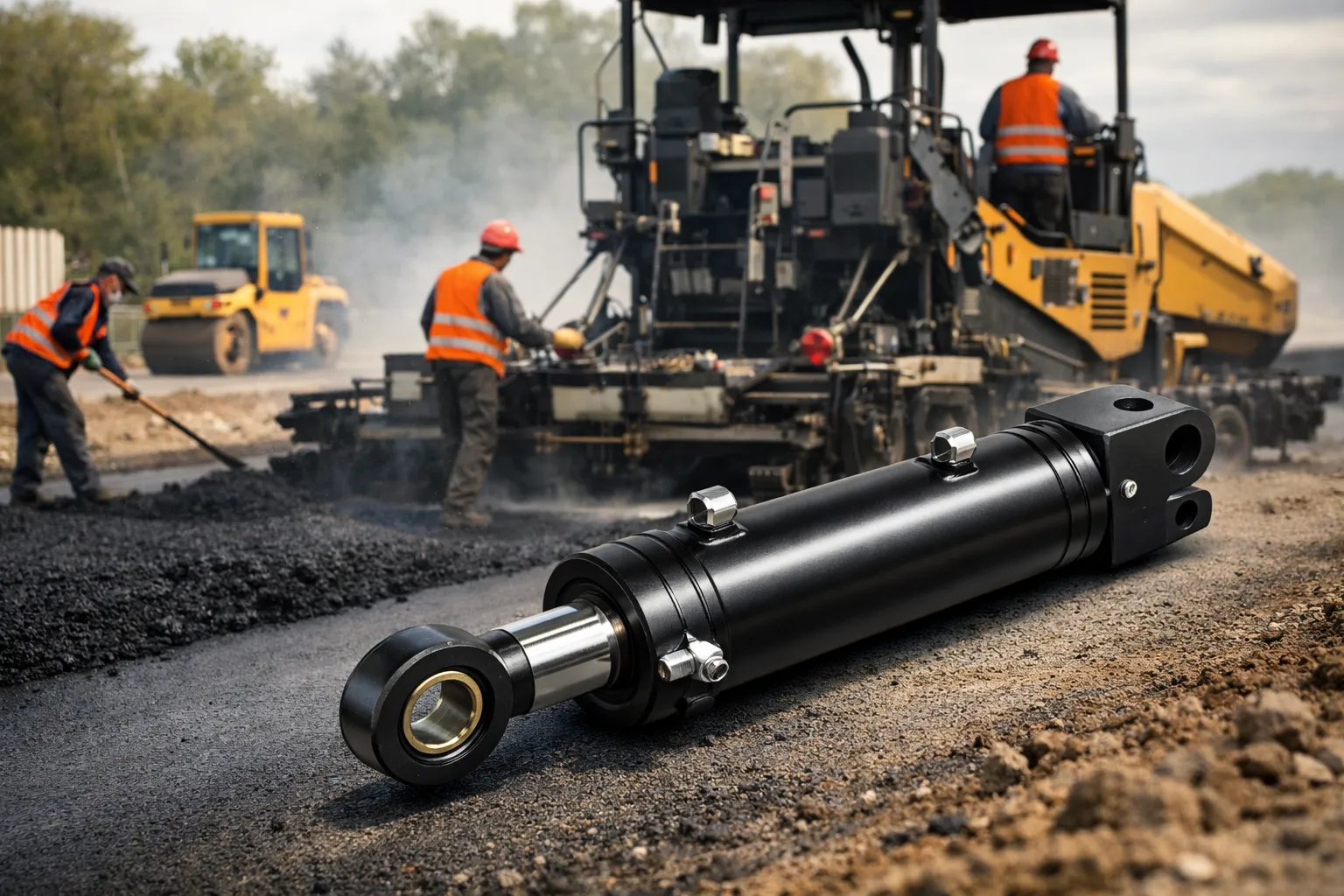
Our strategic position within the global industrial supply chain is built upon strict engineering superiority and the tangible reduction of total equipment ownership costs. We engineer robust hydraulic parts that actively prevent the compounding financial damages associated with unscheduled machine downtime and rejected municipal paving inspections. Whether your enterprise operations are based in South Korea, Japan, or the broader East Asian infrastructure market, sourcing these exact-specification components ensures your heavy fleet operates at peak volumetric efficiency. Our unwavering commitment to metallurgical quality and low-friction tribology ensures we consistently deliver the most competitive hydraulic cylinder price relative to its exceptional, extended operational lifespan. For an expansive look at our capabilities, explore our complete hydraulic cylinder product line.
Technical Parameters & Highly Configurable Specifications
Heavy paving machinery demands uncompromising component exactness. To ensure seamless mechanical and hydraulic integration into various automated flow control circuits, our double acting hydraulic cylinder features a highly refined, adaptable structural layout. The comprehensive matrix below details the specific engineering parameters, strict metallurgical choices, and performance tolerances of our dedicated paving units.
| Engineering Category | Parameter Element | Technical Data Description |
|---|---|---|
| System & Application | Target Industry | Construction Machinery Industry |
| Equipment Category | Asphalt Paver (Wheeled & Tracked platforms) | |
| Subsystem / Action | Material Flow Control & Proportional Gate Actuation | |
| Product Designation | Booster Cylinder / Flow Regulator Unit | |
| Manufacturing & Materials | Action Mechanism | Double acting hydraulic cylinder |
| Internal Structure | Precision Piston Cylinder Configuration | |
| Construction Type | Heavy-Duty Welded Construction for maximum integrity | |
| Core Material System | 27SiMn Structural Alloy Steel (Superior fatigue resistance) | |
| Operating Environment | Surface Treatment | Hard Chrome Plated Rod (Micro-cracked for superior lubrication) |
| Operational Load Condition | Light Load | Continuous High-Frequency Short Strokes | |
| Typical Failure Mode Prevented | Dynamic Seal Wear and Severe Breakaway Friction | |
| Recommended Configuration | Ultra-Low Friction PTFE Sealing Architecture |
Operational Dynamics: Decoding the Working Principle
To fully grasp the massive operational superiority of our flow control products, one must closely analyze the exact fluid dynamics acting inside the booster hydraulic cylinder. Its fundamental, non-negotiable function is to rapidly convert hydrostatic pressure into highly controlled, short-stroke linear mechanical force. This directly regulates the opening, closing, and micro-positioning of heavy steel material gates. Because precision is paramount, utilizing a basic single acting hydraulic cylinder is entirely inadequate; it relies on mechanical springs or external gravity to return to its base position, which is far too slow and uncontrolled for electronic flow regulation in thick, viscous asphalt.
Consequently, we employ a highly sophisticated double acting hydraulic cylinder design. The unit features two dedicated fluid ports. When the paver’s main electronic control unit (ECU) signals that more material is required, a proportional directional control valve shifts rapidly, pushing pressurized hydraulic oil into the cap end port. This pressure acts uniformly upon the internal surface area of the hydraulic cylinder piston, smoothly extending the rod to open the material gates wider. As soon as the ultrasonic sensors detect optimal material volume, the valve shifts instantly, directing fluid into the rod end port and forcing an immediate retraction. Both directional movements are actively powered, ensuring a tight, highly responsive feedback loop.
The central, ongoing challenge for these specific hydraulic rams is not heavy lifting, but rather overcoming static friction repeatedly and rapidly. When a cylinder sits briefly, standard rubber seals compress and fiercely grip the steel barrel. When pressure is applied again, the cylinder must violently break this grip, often resulting in a sudden, jerky forward movement. This erratic motion causes an irregular, surging flow of asphalt onto the road base. By deploying our proprietary low-friction composite seals and executing a mathematically perfect skived bore finish, our cylinders glide flawlessly regardless of the actuation velocity. This frictionless actuation eliminates internal heat generation, vastly extending the operational life of the unit and ensuring your asphalt mat remains perfectly consistent.
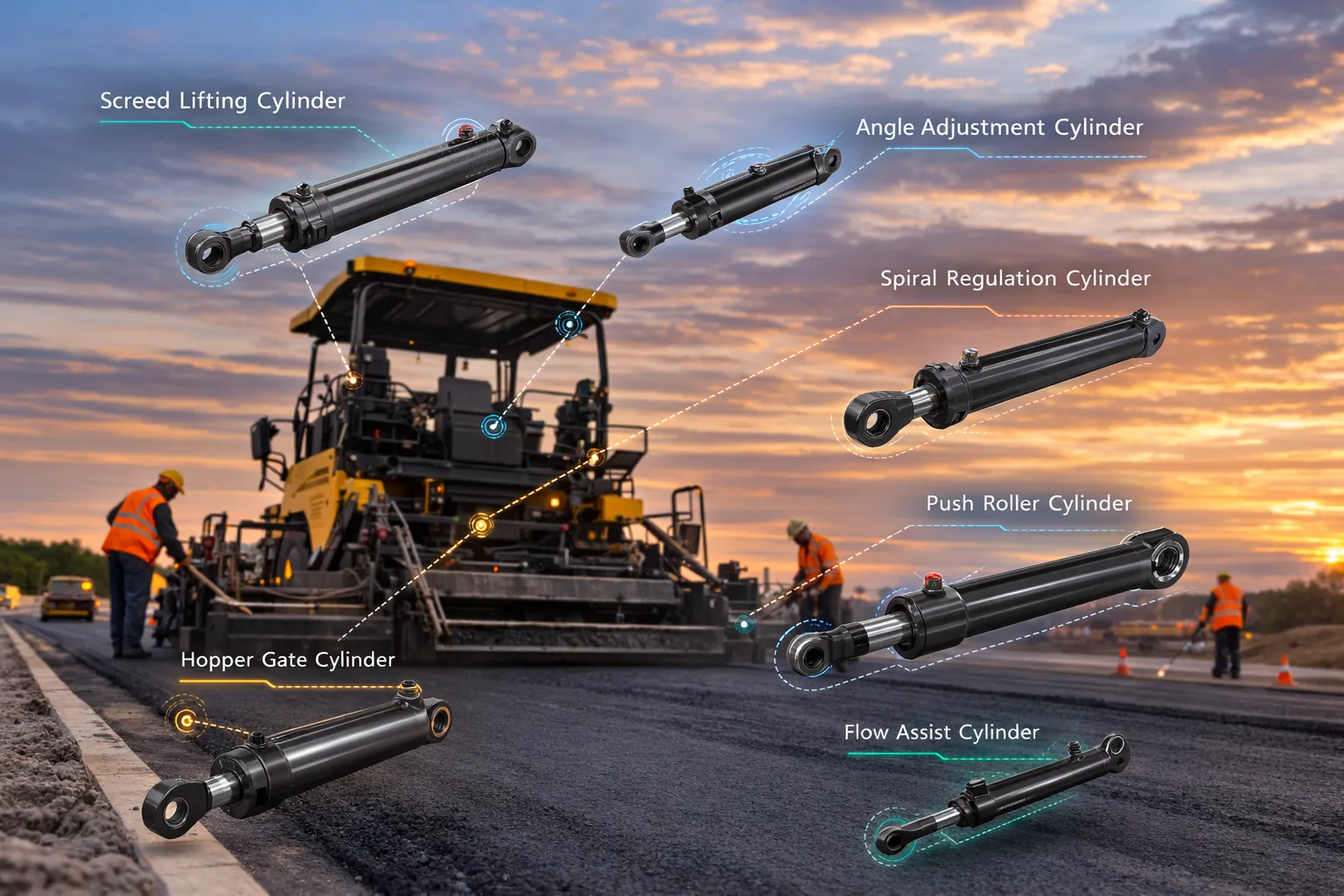
Seamless Machinery Integration & Aftermarket Compatibility
Maintaining strict fleet consistency and ensuring rapid component replacement are critical strategies for heavy construction enterprises operating under severe infrastructure deadlines. When a flow control unit begins to stick or leak mid-project, sourcing identical OEM replacements often involves staggering costs and unacceptable shipping lead times. Consequently, our engineering team has meticulously dimensioned our hydraulic cylinder components to function as direct, high-performance aftermarket upgrades for the industry’s premier paving machinery.
Disclaimer: The formal mention of the following original equipment manufacturer (OEM) brands is strictly intended for dimensional cross-referencing, structural compatibility verification, and equipment sizing convenience for our B2B procurement clients. It does not imply any trademark affiliation, sponsorship, or infringement. We operate globally as a highly capable independent manufacturer of premium fluid power replacements.
Our precision booster cylinders are dimensionally mapped to seamlessly upgrade auxiliary flow control systems on asphalt pavers originally manufactured by Vögele, Dynapac, BOMAG, Volvo CE, Roadtec, and Caterpillar (CAT). By guaranteeing the exact closed length, total operational stroke, trunnion dimensions, mounting pin diameters, and hydraulic port threads align perfectly, we completely remove the complexity of fixing hydraulic cylinders on active job sites. Your maintenance crews can unbolt the erratic OEM part and install our low-friction unit immediately, achieving superior flow regulation with zero cutting or structural modifications required.
Five Core Technical Advantages Defeating Mechanical Wear
As a dedicated fluid power engineering facility, we design internal mechanical solutions to actively eliminate specific industrial pain points. The extraordinary precision and extended lifespan of our booster cylinder series are firmly anchored in five fundamental technological pillars, formulated to drastically outperform generic industrial actuators in sensitive environments.
1. Ultra-Low Friction PTFE Sealing Technology
To combat the rapid seal wear caused by constant, high-frequency micro-adjustments, we entirely replace standard NBR (Nitrile) rubber with advanced PTFE (Polytetrafluoroethylene) composite sealing profiles. These self-lubricating polymers possess an exceptionally low coefficient of dynamic friction. They eliminate breakaway resistance entirely, ensuring the internal hydraulic cylinder piston glides instantly upon receiving fluid pressure, resulting in perfectly proportional material flow without hesitation.
2. 27SiMn Structural Alloy Metallurgy
Although the flow gate operates under a light operational load, the constant heavy vibration from the paver’s diesel engine and massive auger drives can induce resonant fatigue in standard materials. We utilize 27SiMn structural alloy steel for the main barrel. This specific alloy provides a superior modulus of elasticity and significantly higher yield strength than standard 1045 carbon steel, effectively absorbing vibratory stress and maintaining perfect internal concentricity over millions of stroke cycles.
3. Microscopic Bore Skiving & Burnishing
A low-friction seal is entirely useless if the steel bore it rides against is rough or uneven. Our advanced CNC machining centers utilize a combined deep skiving and roller burnishing process. This physically compresses the internal metal surface, creating an incredibly hard, mirror-like finish with a roughness average (Ra) of less than 0.2 micrometers. This ultra-smooth surface minimizes abrasive contact with the dynamic seals, directly contributing to an exponentially longer operational life.
4. Micro-Cracked Hard Chrome Plated Rod Defense
Despite being a sensitive control component, the booster rod is still relentlessly exposed to ambient silica dust and highly corrosive atmospheric moisture. The piston rod undergoes a highly specialized deep hard-chrome plating process, achieving remarkable surface hardness. This micro-cracked finish constantly retains a microscopic thin film of hydraulic oil from the gland, actively repelling abrasive particulates, resisting rust, and preventing external grit from destroying the internal seals upon retraction.
5. Automated Robotic Welded Integrity
Manual welding operations can introduce micro-porosity and uneven stress zones that eventually fracture under high-frequency hydraulic pressure pulsations. We strictly utilize automated, robotic submerged arc welding to secure all mounting trunnions, fluid ports, and end caps. This advanced manufacturing technique guarantees deep, flawless weld penetration with perfect geometric uniformity. This ensures the structural integrity of the cylinder remains completely uncompromised even after millions of rapid actuations.
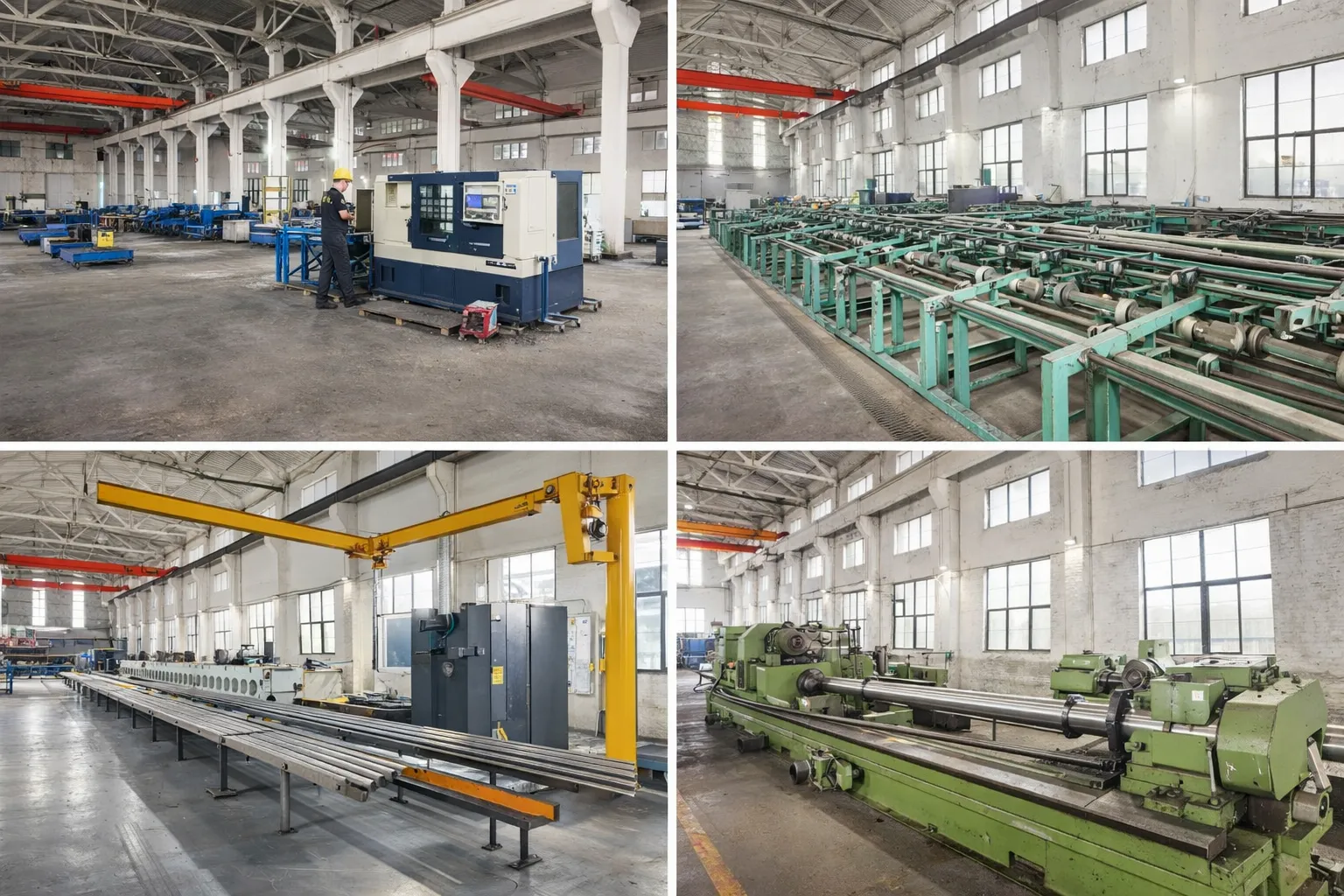
Manufacturing Autonomy & Stringent Quality Control
Engineering superiority must be translated into physical reality through flawless factory execution. Operating a vertically integrated manufacturing facility grants us absolute dominion over the production timeline and internal quality parameters. Every single step, from the initial ultrasonic flaw detection validation of the raw 27SiMn steel billets to the final automated multi-layer polyurethane painting process, is conducted securely in-house. By keeping all heavy machining, precise welding, and clean-room assembly internal, we entirely eliminate the variable quality issues commonly associated with outsourced third-party supply chains.
Quality assurance within our plant is an absolute mandate, not merely a random statistical sampling exercise. Before being authorized for global dispatch, 100% of our units are subjected to rigorous hydrostatic pressure and dynamic friction testing on automated digital flow benches. We hold the units at pressures well beyond their normal operational parameters while electronically monitoring for micro-decay. We specifically monitor the breakaway pressure to verify that the stick-slip effect has been successfully and completely eliminated. To maintain absolute B2B accountability, every completed unit is permanently laser-etched with a unique identification code, linking its material heat batch and individual test validation data into our secure traceability system.
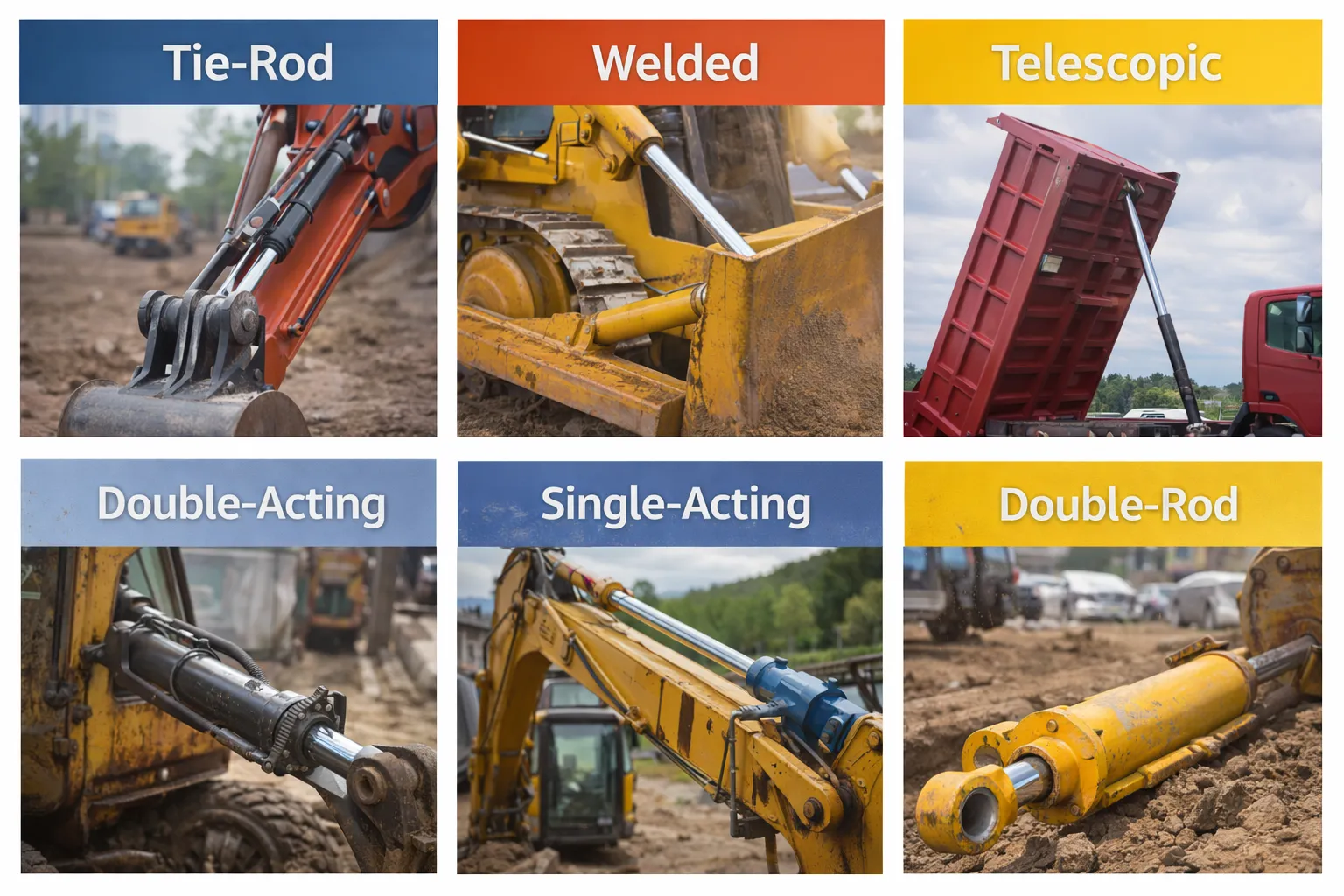
Expansive Global Industry Applications
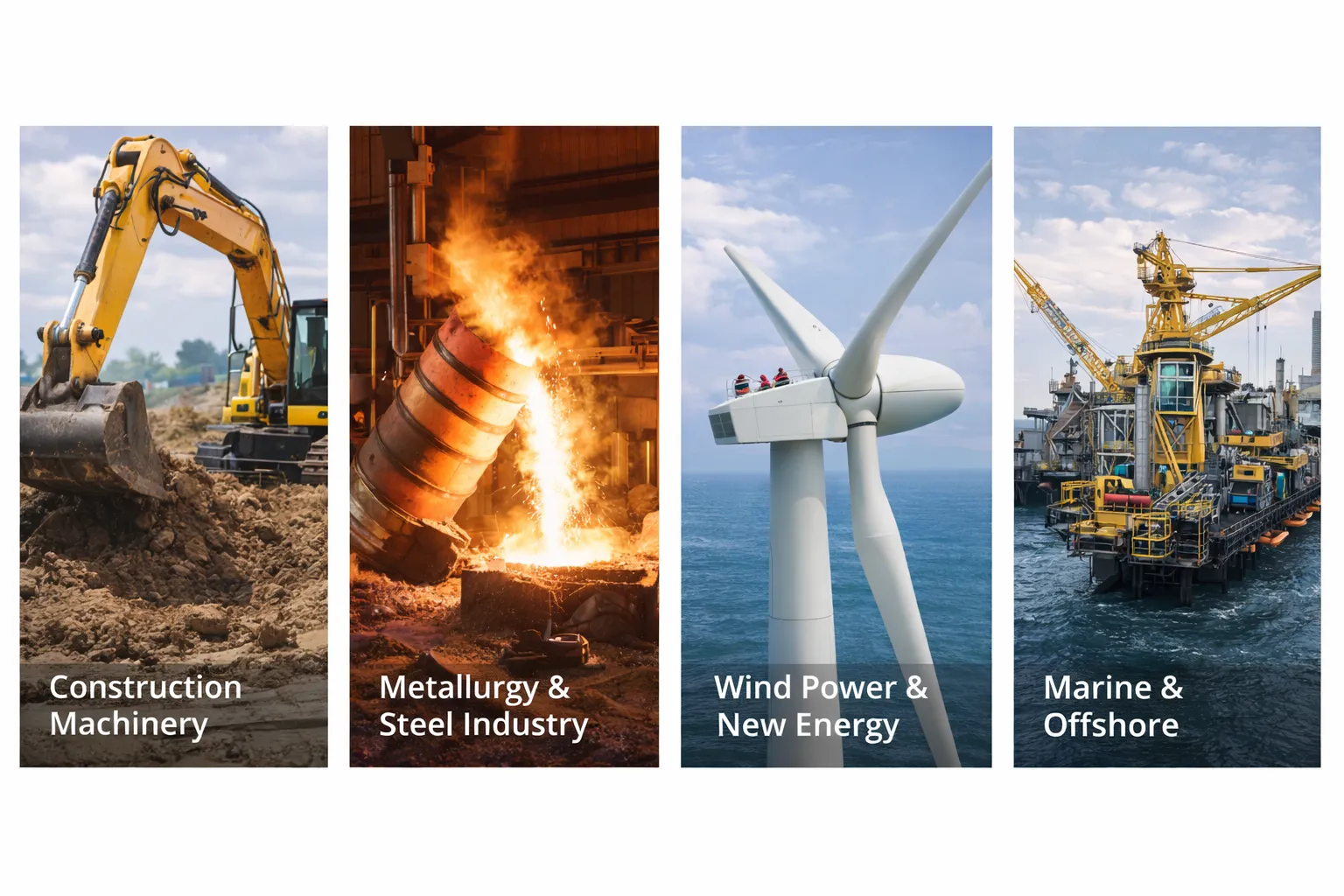
While meticulously optimized as the ultimate flow control actuator for asphalt pavers, the precision flow regulation technologies developed here—specifically the ultra-low friction seals and extreme high-frequency actuation capabilities—make these highly specialized units incredibly valuable across a multitude of automated heavy industries. For deeper insights into our broad machinery capabilities, please review our dedicated construction machinery industry portfolio.
General Engineering Machinery
Beyond asphalt pavers, our precise flow actuation technology is heavily utilized in massive concrete pump trucks, fine motor grader blade controls, and high-precision trenching equipment requiring exact fluid management.
Metallurgy & Heavy Manufacturing
Automated steel rolling mills constantly depend on our rapid-response double acting hydraulic cylinder configurations to make critical micro-adjustments to heavy roller gaps instantly without halting production.
Plastics & Rubber Machinery
Industrial injection molding machines heavily utilize our frictionless cylinders for precise core pulling and ejection timing, guaranteeing identical, high-tolerance part manufacturing continuously.
Material Handling & Logistics
Automated warehouse retrieval systems and sophisticated robotic loading arms leverage these exact flow units for smooth, stutter-free positioning of delicate or exceptionally heavy industrial cargo.
New Energy & Environmental Facilities
Solar tracking arrays and massive wind turbine pitch control systems benefit immensely from the high-frequency fatigue life and precise micro-adjustment capabilities of our highly rigid 27SiMn structures.
Specialized Custom Scenarios
Our advanced engineering division rapidly prototypes bespoke fluid power solutions for specialized defense logistics vehicles, complex aerospace testing jigs, and high-vibration mining sorting machines.
Comparative Analysis: Ordinary Cylinders vs. High-Performance Flow Control
Procurement officers and lead maintenance engineers must recognize that applying a standard, general-purpose industrial cylinder to a specialized flow control application is an expensive operational mistake. Evaluating the true hydraulic cylinder price requires analyzing long-term maintenance costs and calculating expensive paving reject rates. The table below clearly illustrates why our dedicated units vastly outperform ordinary alternatives in the field.
| Engineering Metric | Standard Commercial Cylinder | Our High-Performance Booster Cylinder |
|---|---|---|
| Friction & Actuation Profile | High breakaway friction; routinely causes sudden jerky movements (stick-slip). | Ultra-low friction PTFE composite; yields instant, buttery-smooth linear motion. |
| Seal Degradation Rate | Standard NBR rubber wears rapidly under high-frequency short strokes. | Self-lubricating seals endure millions of micro-cycles without measurable wear. |
| Metallurgical Stability | Basic 1045 Carbon Steel; highly susceptible to vibration-induced fatigue cracking. | High-Strength 27SiMn Alloy; easily absorbs high-frequency machine vibration securely. |
| Material Flow Accuracy | Inconsistent gate opening; directly leads to asphalt surges and structural thin spots. | Exact proportional response; guarantees a mathematically consistent mat layer easily. |
| Maintenance & ROI | Requires frequent, costly teardowns to replace shredded internal rubber seals. | Extended operational intervals; massively reduces fleet downtime and heavy labor costs. |
Global Field Evidence: Verified B2B Procurement Success Stories
Theoretical engineering concepts and laboratory specifications must be validated by relentless physical performance in the dirt, vibration, and extreme heat of real construction sites. Through targeted B2B distribution channels and direct technical consulting, we have equipped major civil engineering entities across East Asia. Below are five detailed, verified accounts demonstrating the immense value of upgrading to our specialized fluid power technology.
1. Eradicating Asphalt Segregation on the Busan Highway — South Korea
Client Profile: National Transportation Infrastructure Group
Application Context: Operating a massive fleet of Vögele pavers on high-speed expressway projects requiring incredibly strict municipal density parameters.
Procurement Connection: The chief fleet mechanic discovered our technical capabilities through an organic search for a specialized hydraulic cylinder manufacturer after failing numerous municipal density tests due to rapid material surging.
Results & Engineering Outcome: Delivered in March 2025. The original OEM flow cylinders were suffering from severe stick-slip, causing the material gates to violently jerk open too far, dumping excess hot mix. By retrofitting our ultra-low friction PTFE equipped units, the electronic controllers could finally make exact millimeter adjustments. The material flow stabilized immediately, eliminating all density variations in the subsequent laser scans entirely.
“The mechanical responsiveness of these booster units is absolutely incredible. The stick-slip issue that plagued our older fleet is completely gone. A highly cost-effective engineering upgrade that successfully saved our contract.” – Mr. Kim J., Chief Operations Director
2. Maximizing Precision in Dense Urban Paving — Osaka, Japan
Client Profile: Metropolitan Roadways Maintenance Contractor
Application Context: Continuous micro-adjustments of hot asphalt flow on compact BOMAG equipment operating in tight, obstacle-heavy residential zones.
Procurement Connection: Engaged our advanced sales engineering team via an industrial B2B sourcing portal, urgently looking for durable components that could handle extremely high-frequency short-stroke operations without destroying internal seals.
Results & Engineering Outcome: In late 2024, they effectively deployed a batch of our specialized flow units. Urban paving requires the machine to constantly stop, start, and sharply turn, meaning the material gates are constantly fluctuating. Standard rubber seals were wearing out every two months due to localized dry friction. Our self-lubricating composite seals have been running flawlessly for over 14 months with zero maintenance required.
“We were spending entirely too much precious time fixing hydraulic cylinders instead of effectively paving roads. Your advanced sealing technology solved our highest wear-and-tear issue permanently.” – Kenji S., Maintenance Supervisor
3. Conquering Continuous Vibration on Alpine Routes — Taichung, Taiwan
Client Profile: Heavy Alpine Civil Construction Syndicate
Application Context: Paving exceptionally steep mountain passes where diesel engine loads are incredibly high and constant low-frequency machine vibration transfers directly into the chassis.
Procurement Connection: Contacted us directly through our primary website after catastrophic structural failures on standard aftermarket parts halted a highly critical mountain infrastructure project.
Results & Engineering Outcome: Supplied in October 2025. The intense mechanical vibration from paving uphill was causing standard 1045 steel cylinder ports to suffer from micro-cracking and eventual major fluid leaks. Our implementation of heavy-duty 27SiMn alloy steel and robotic submerged arc welding completely absorbed the resonant frequencies. The structural integrity of the newly installed hydraulic rams proved entirely unyielding under extreme stress.
“The actual build quality on these heavy-duty units is exceptional. The welds are immaculate, and the higher grade steel has totally eliminated our vibration-induced fluid leaks. Excellent engineering execution.” – Lin C., Lead Project Engineer
4. Resisting Coastal Salt and Silica at Da Nang Port — Vietnam
Client Profile: Maritime Logistics Infrastructure Developers
Application Context: Massive open area paving for new commercial container terminal yards using CAT machinery in a highly saline, dusty coastal environment.
Procurement Connection: Recommended to us highly by an independent fluid power consultant who was intimately familiar with our highly competitive hydraulic cylinder price structural models.
Results & Engineering Outcome: In January 2025, they aggressively retrofitted their entire fleet. The harsh combination of salty sea air and fine silica dust from the aggregate usually destroyed OEM chrome plating within six months. Our micro-cracked hard chrome surface treatment protected the internal rods flawlessly, preventing any deep scoring or rust from compromising the internal gland seals during the massive 10-month continuous paving job.
“We essentially operate in one of the most corrosive, punishing environments possible. The hard chrome plating on your flow cylinders has held up brilliantly where our original OEM parts rusted and pitted terribly.” – Nguyen V., Site Director
5. Rapid Fleet Retrofit & Equipment Lifecycle Extension — Incheon, South Korea
Client Profile: Major Heavy Equipment Leasing Corporation
Application Context: Fully refurbishing a vast, aging fleet of older, discontinued Volvo pavers to modern operational standards to dramatically maximize rental lifecycle profitability.
Procurement Connection: Emailed our dedicated technical drawing department directly, seeking a highly reliable engineering source for completely discontinued fluid power components.
Results & Engineering Outcome: In February 2026, we carefully translated their faded original dimensional blueprints into modern 3D CAD files. We aggressively injected our contemporary low-friction seal technology and rigid 27SiMn steel into the legacy dimensional footprints. We successfully manufactured and delivered 30 perfectly matched lift cylinder and booster units within a strict 22-day timeline, allowing their internal mechanics to upgrade the entire fleet seamlessly.
“Finding a professional supplier capable of rapid, custom dimensional manufacturing while actively improving the baseline technology was a massive win for our operational leasing margins. The physical fitment was entirely identical to the originals.” – Choi S., Fleet Procurement Officer
B2B Client FAQ: Expert Engineering Insights
Procuring specialized fluid power components for highly precise machinery requires absolute technical transparency. Our master engineering desk has carefully compiled and comprehensively answered the most critical technical inquiries from global procurement officers and maintenance chiefs regarding our booster cylinder line.
1. What exactly causes the “stick-slip” phenomenon in flow control, and how do you prevent it?
Stick-slip occurs directly when the static friction holding the rubber seals tightly against the steel barrel is significantly higher than the dynamic friction of continuous motion. When fluid pressure slowly builds enough to forcefully break that static hold, the cylinder suddenly jerks forward before smoothing out. This causes violently irregular gate opening and heavy material surging. We prevent this entirely by abandoning standard NBR rubber and utilizing advanced PTFE (Teflon-based) composite seals which have nearly identical static and dynamic friction coefficients, guaranteeing instantly smooth, proportional movement.
2. Why do you use 27SiMn steel if the booster cylinder only operates under a “light load”?
While the static hydraulic push/pull load is relatively light in regulating material flow gates, the environmental stress is absolutely not. The cylinder is physically bolted directly to a massive machine generating immense, constant diesel engine and auger vibration. Standard 1045 steel can rapidly suffer from resonant metal fatigue, leading to micro-deflections in the barrel. 27SiMn is a specialized high-strength structural alloy that easily absorbs this vibration, keeping the internal bore perfectly concentric and protecting the internal hydraulic cylinder piston from highly asymmetrical seal wear.
3. Can you manufacture these flow control booster units as direct replacements for older pavers?
Absolutely. As a fully integrated and self-reliant hydraulic cylinder manufacturer, we heavily specialize in legacy equipment modernization. By supplying us with the specific closed length, exact stroke length, mounting pin dimensions, and standard port threading, we can rapidly machine a precise drop-in replacement that perfectly fits your legacy equipment while completely upgrading the internal architecture with our modern, low-friction seal technology.
4. What is the standard manufacturing lead time for bulk orders shipped to South Korea or Japan?
Because all manufacturing processes (from CNC skiving to painting) are executed strictly in-house, we control the production schedule entirely. For standard dimensional paving units, bulk mass production is typically completed in just 15 to 20 working days. Ocean freight logistics to major Asian distribution hubs like Busan or Tokyo takes an additional 3 to 5 transit days. We also offer highly aggressive expedited air shipping options for critical, time-sensitive fleet breakdowns.
5. Why is a double acting cylinder strictly necessary for this specific paving application?
A single acting hydraulic cylinder can only push forward with fluid force and must rely entirely on a weak mechanical spring to retract. In precise asphalt flow control, the resistance of the heavy, sticky asphalt against the gates constantly fluctuates. Relying on a simple spring for retraction is far too slow and wildly inaccurate for modern ultrasonic paving sensors. A double acting hydraulic cylinder uses active, pressurized hydraulic fluid to aggressively power both the opening and the closing strokes, granting absolute, immediate flow control.
6. Do you supply internal rebuild components for large fleet maintenance workshops?
Yes, we highly support major B2B clients who prefer managing their own routine maintenance and directly executing hydraulic cylinder repair internally. Alongside fully tested cylinder assemblies, we readily supply comprehensive OEM-grade rebuilding kits. These critical maintenance kits contain our proprietary PTFE low-friction seals, wear bands, and tough guide rings, ensuring your internal mechanics can easily rebuild worn components to exact, uncompromising factory precision standards.
7. How do you definitively guarantee the high quality and zero-leakage standard before shipment?
We employ highly strict 100% factory hydrostatic bench testing, entirely rejecting the standard industry practice of random batch sampling. Every single assembled booster unit is securely attached to a digital test bench, cycled repeatedly to purge trapped air, and pressurized to 1.5 times its maximum rated working capacity. The unit is held under heavy pressure and electronically monitored for any minute decay or internal leakage. Only upon passing flawlessly is it laser-engraved and safely cleared for global distribution.
Achieve Absolute Fleet Paving Precision Today
A sticking or leaking internal flow control unit directly translates to rejected municipal road surfaces, massive material waste, and devastating financial performance penalties. Do not cripple your high-value paving fleet by installing basic commercial components that simply cannot handle continuous, high-frequency micro-adjustments. Partner directly with an expert manufacturer fully dedicated to low-friction fluid dynamics, superior 27SiMn metallurgy, and absolute dimensional accuracy. Our engineering team is ready to securely cross-reference your specific OEM requirements, provide expert technical consultation, and deliver the most competitive hydraulic cylinder price in the global market.
Editor: Cxm


























