Dual-Axis Servo Cylinder for PV Tracking Bracket
Engineered with advanced low-temperature sealing and hydraulic control valve locking technology to deliver zero-drift precision and maximize renewable energy yields globally.
Product Overview: The Core of Renewable Motion Control
Welcome to the absolute forefront of motion control technology dedicated to the rapidly expanding new energy sector. When engineering teams and EPC contractors are tasked with maximizing the megawatt-hour yield of a solar power plant, the reliability of the physical tracking infrastructure becomes the most critical variable. The mechanical heart of this energy-harvesting system is the photovoltaic tracking bracket. To capture the maximum possible solar irradiance, these massive structural brackets must continuously and flawlessly follow the sun’s trajectory from dawn until dusk, adjusting both azimuth and elevation angles. This complex, heavy-duty maneuver relies entirely on the precise actuation power provided by a specialized dual-axis servo cylinder.
As an elite hydraulic cylinder manufacturer serving demanding global markets, with a profound footprint in South Korea and surrounding East Asian topographies, we have analyzed decades of field data to identify the primary failure modes of standard commercial actuators. Ordinary motion control components frequently suffer from internal fluid bypass when subjected to severe, unpredictable wind loads. This specific failure induces a phenomenon known as positional drift. Even a micro-degree of tracking drift can cause the solar array to severely misalign, resulting in compounding energy losses over the lifecycle of the facility. Our unique engineering positioning focuses intensely on completely eradicating this vulnerability.
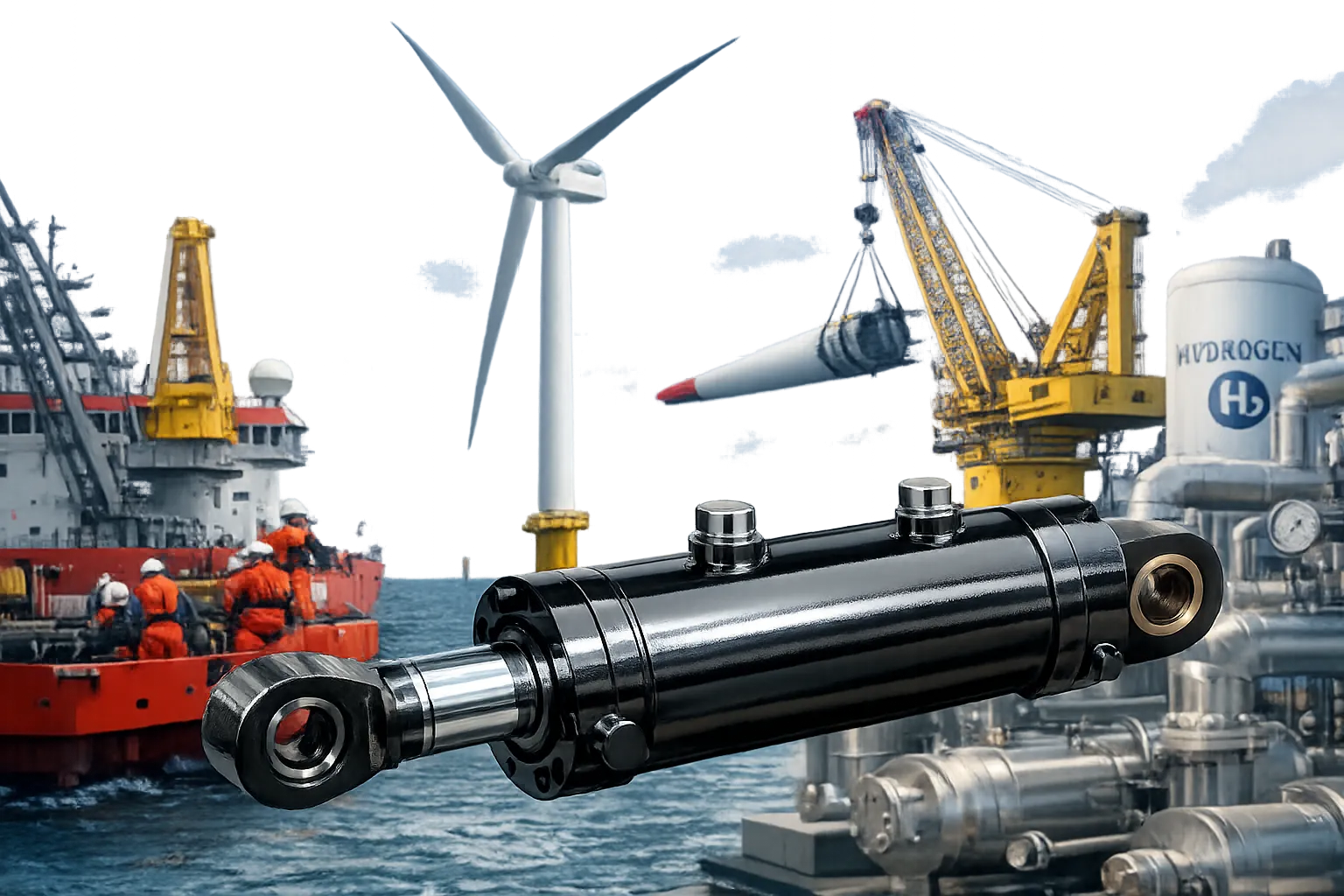
By integrating an advanced low-temperature sealing matrix with our proprietary hydraulic control valve locking technology, our custom-engineered double acting hydraulic cylinder ensures unparalleled structural rigidity. Once the central command calculates and achieves the precise angle, the internal fluid column is mechanically locked. The array remains entirely immovable against turbulent winds and intense weather fronts, fundamentally neutralizing the risk of tracking drift. This meticulous approach to fluid dynamics not only secures maximum solar absorption but also dramatically extends the lifespan of the entire tracking assembly, offering an unbeatable return on your hydraulic cylinder price investment.
Comprehensive Technical Parameters & Customization
Precise engineering begins with exact specifications. Sizing the correct fluid power components is an uncompromising process required for long-term operational success in severe environments. The following table outlines the foundational parameter baseline and the extensive customizable range of our specialized dual-axis servo cylinder. Every metric is calibrated specifically for high-capacity dual-axis solar tracking applications.
| Engineering Parameter | Specification Details | Operational Context |
|---|---|---|
| Industry Segment | New Energy | Optimized for utility-scale solar generation |
| Equipment Category | Photovoltaic tracking bracket | Designed to handle massive transverse wind shear |
| Subsystem / Action | Dual-axis tracking | Simultaneous azimuth and elevation geometry adjustment |
| Hydraulic Cylinder Name | Dual-axis servo cylinder | Integrates position feedback loops directly within the rod |
| Action Mode | Double acting | Provides active, controlled hydraulic push and pull forces |
| Structure Type | Servo cylinder | Engineered to eliminate internal stick-slip (stiction) |
| Manufacturing Structure | Welded construction | Permanently fused monolithic body prevents vibrational loosening |
| Material System | 42CrMo Alloy Steel | Superior yield strength; totally prevents rod buckling under load |
| Surface Treatment | Chrome plated | Micro-cracked heavy chrome for ultimate environmental corrosion defense |
| Environment Grade | Low-temperature sealing | Maintains elastomeric integrity down to -40 Celsius |
| Working Condition Characteristics | High precision angle control | Accommodates relentless micro-stepping without pressure fatigue |
| Typical Failure Mode Prevented | Position drift | Eradicates the slow creeping of panels out of sun alignment |
| Recommended Configuration Points | Hydraulic control valve locking + low-temperature sealing | The ultimate combination for severe weather, zero-maintenance tracking |
Advanced Kinematics: The Working Principle
To fully comprehend the extraordinary capability of this specialized hydraulic cylinder, one must delve into the sophisticated intersection of fluid mechanics and closed-loop digital logic. In a modern utility-scale solar array, the central programmable logic controller (PLC) utilizes astronomical algorithms to calculate the exact azimuth and elevation of the sun at any given millisecond. This PLC acts as the brain, sending micro-current electrical commands to a highly responsive proportional directional valve mounted directly onto our cylinder.
Upon receiving the signal, pressurized hydraulic fluid is meticulously metered into either the extension chamber or the retraction chamber of the hydraulic cylinder piston. Because the architecture is intrinsically a double acting hydraulic cylinder, the system generates immense active force in both directions. This allows the mechanism to smoothly overcome the immense static inertia of the heavy steel tracking brackets. As the 42CrMo piston rod extends or retracts, an internal Linear Variable Differential Transformer (LVDT) sensor, securely encased inside the hollow rod, continuously reads the physical stroke position down to sub-millimeter fractions. This high-resolution positional data is instantly relayed back to the PLC, forming an impeccable closed-loop servo feedback system that prevents overshooting.
The most pivotal phase of this operational cycle occurs precisely when the cylinder stops moving. To combat the relentless issue of wind-induced drift, our engineering team has developed a dedicated hydraulic control valve locking manifold. The moment the array reaches its optimal angle, pilot-operated check valves instantly snap shut. Because hydraulic fluid is essentially incompressible, trapping it securely on both sides of the piston physically freezes the lift cylinder into a rigid mechanical strut. The tracking system is now completely immunized against aerodynamic buffeting, holding the precise angle indefinitely without drawing continuous electrical power from the hydraulic pump.
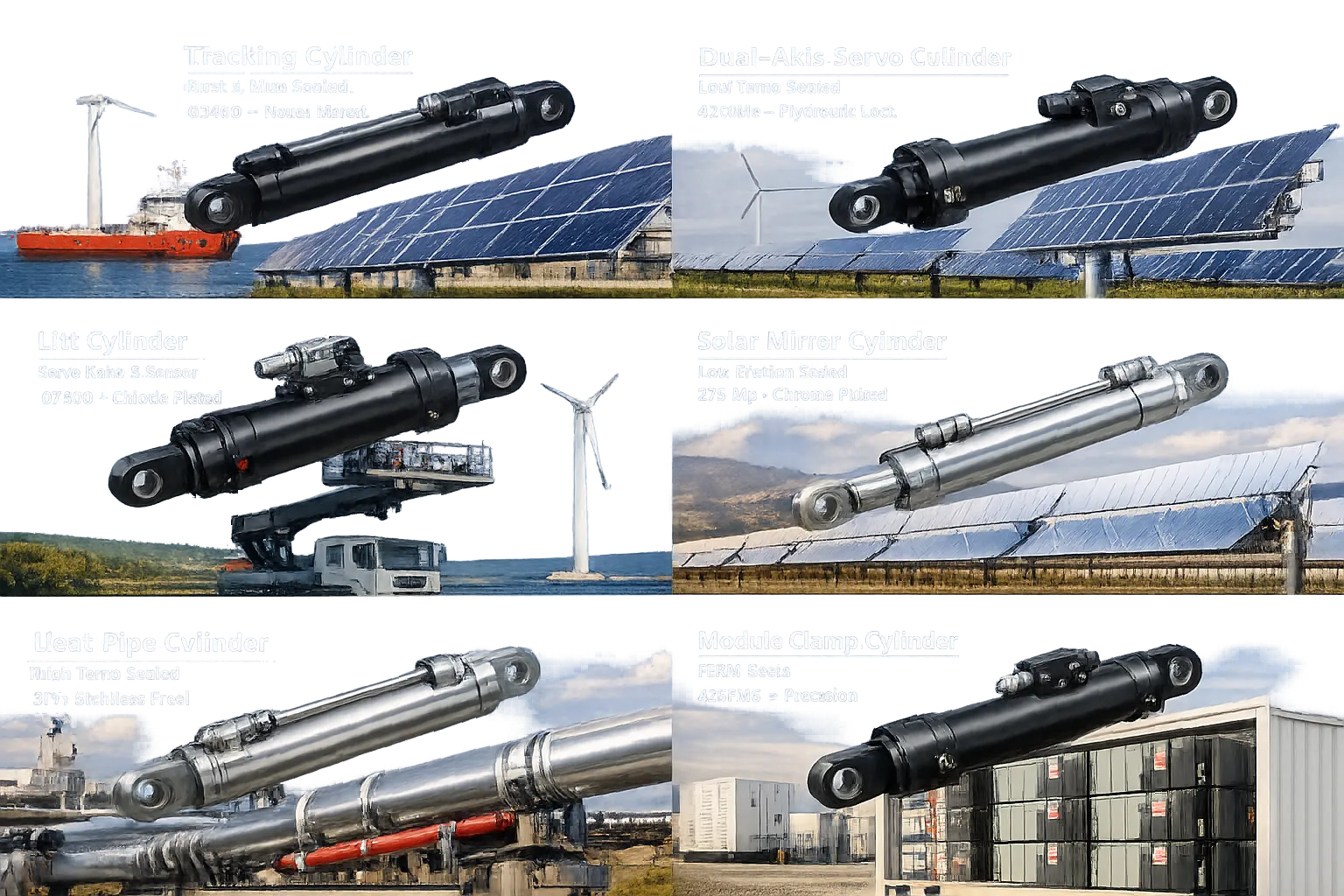
Seamless Interoperability and Global Brand Replacement
In the realm of engineering procurement, managing the lifecycle of an aging solar facility frequently involves upgrading systems that have failed prematurely due to inadequate original specifications. Many existing solar parks globally were originally outfitted using actuators from well-known fluid power brands such as Bosch Rexroth, Parker Hannifin, Eaton Vickers, or Enerpac. (Please be advised: The inclusion of these brand names is strictly for the purpose of technical dimension referencing, cross-compatibility analysis, and selection convenience for our B2B partners; we explicitly state that we hold no trademark affiliation or endorsement with these respected corporate entities.)
When field maintenance engineers are faced with the challenge of fixing hydraulic cylinders on established arrays, sourcing OEM replacement parts can incur prohibitive costs and suffer from unacceptably long supply chain lead times. We have meticulously engineered our dual-axis servo cylinder to serve as a superior, flawless drop-in replacement.
By custom-matching the exact stroke lengths, closed-center dimensions, bore diameters, and mounting geometries (whether utilizing spherical bearing clevises, heavy-duty trunnions, or flange mounts), your technical teams can seamlessly integrate our zero-drift technology into your current framework. This immediate interoperability bypasses the need for on-site structural welding, drastically driving down your overall hydraulic cylinder price overhead while simultaneously retrofitting your solar tracking bracket with next-generation environmental resilience.
Uncompromising Core Technical Advantages
What precisely elevates an industrial actuator to the tier of aerospace-grade dependability? The answer lies in the relentless, obsessive refinement of every tribological and metallurgical detail. The following represent the core technical advantages ingrained within our motion control solutions:
1. Ultra-Low Friction Sealing Tribology
To achieve sub-degree micro-stepping accuracy, the phenomenon of stick-slip (stiction) must be completely eradicated. We utilize advanced PTFE-blended glide rings and optimized lip profiles that reduce dynamic friction to near absolute zero. This allows the hydraulic rams to execute incredibly smooth, continuous adjustments without pressure spikes.
2. High-Rigidity 42CrMo Material Matrix
Unlike standard Q235 or #45 carbon steel found in commercial units, our critical stress components are forged and machined from 42CrMo alloy steel. This provides exceptional yield strength and fracture toughness, ensuring the extended rod does not buckle or deform when the solar array faces typhoon-level transverse wind sheer.
3. Absolute Zero-Drift Valve Locking
As previously established, the direct integration of custom manifold blocks featuring zero-leakage check valves mechanically freezes the hydraulic fluid column. This structural lockdown guarantees absolute positional stability, safeguarding the facility’s overall energy yield against the silent threat of creeping misalignment over time.
4. Extreme Low-Temperature Resilience
In regions like South Korea and northern Japan, bitter winter temperatures rapidly destroy standard polyurethane elastomers. Our proprietary low-temperature sealing compounds and wipers maintain their flexibility and volumetric sealing integrity down to an astonishing -40 Celsius, preventing catastrophic winter fluid loss.
5. Advanced Chrome Plating Defense
Outdoor tracking equipment faces relentless daily exposure to UV radiation, acidic rain, and highly abrasive dust. The piston rod is subjected to a rigorous, multi-stage hard chrome plating process. This achieves a highly specific micro-cracked surface architecture that retains internal lubrication while presenting an impenetrable barrier to external corrosion.
6. Heavy-Duty Welded Architecture
Tie-rod cylinders frequently stretch or loosen under the continuous vibrational stress of dynamic wind loads. We utilize a monolithic, heavy-duty welded manufacturing structure. Fusing the end caps directly to the barrel eliminates stretching, prevents moisture ingress, and dramatically extends the fatigue life of the entire hydraulic parts assembly.
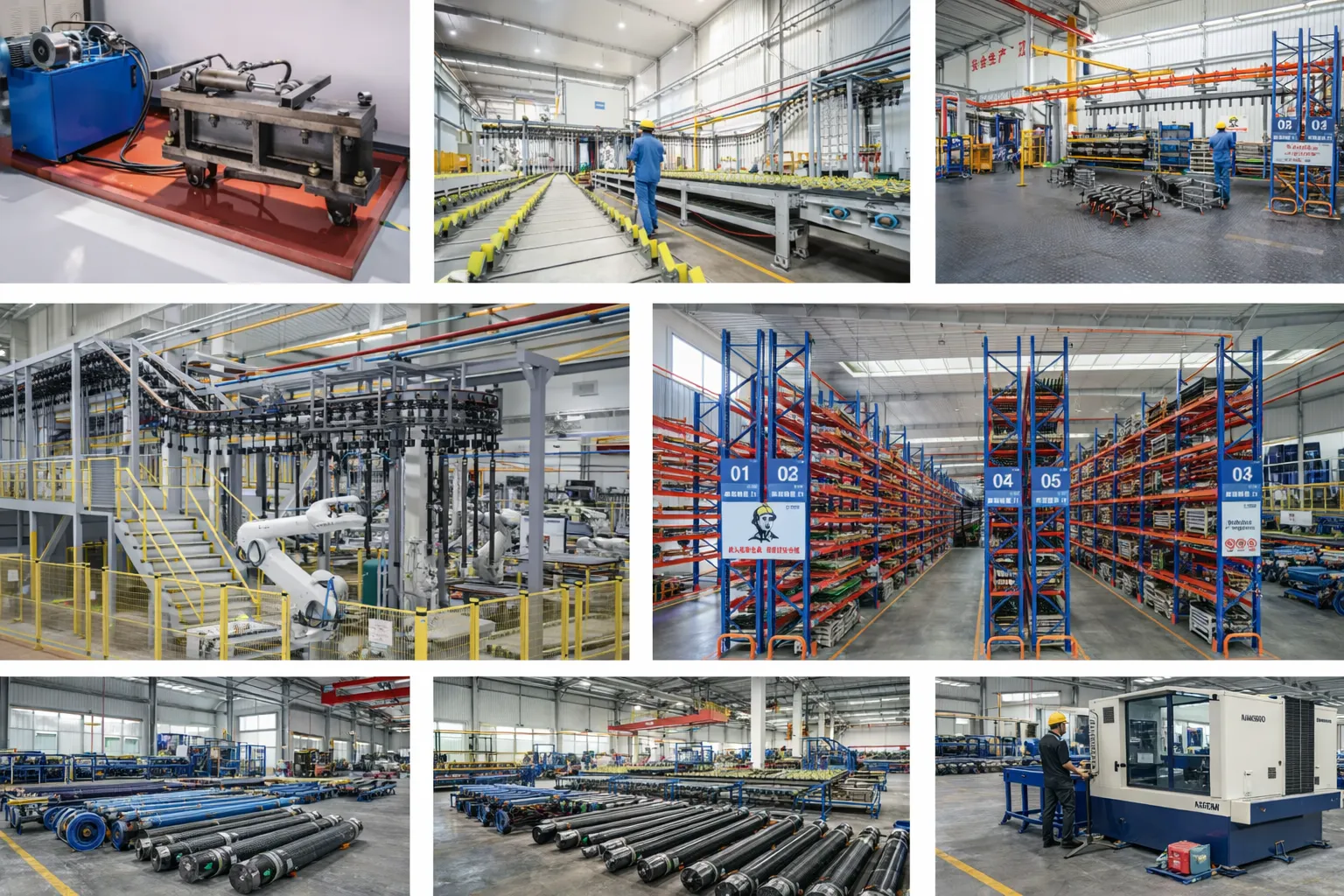
Excellence in Autonomous Manufacturing & Quality Assurance
A conceptually superior engineering design must be executed with uncompromising manufacturing discipline to be effective in the real world. As a fully autonomous hydraulic cylinder manufacturer, we never rely on third-party assembly houses. Every single component, from the initial inspection of the raw 42CrMo steel forgings to the final multi-coat industrial paint application, is meticulously processed within our advanced, vertically integrated manufacturing facility. We ensure the highest standard of hydraulic oil cylinder production.
Our production workflow utilizes high-precision multi-axis CNC turning and milling centers that achieve incredibly tight diametrical tolerances. The internal bores of our cylinder barrels undergo a sequential deep-hole boring, skiving, and roller burnishing process. This creates a highly uniform, mirror-like internal finish that drastically reduces internal friction and exponentially extends the lifespan of the piston seals. Furthermore, all critical structural welds are performed by robotic submerged arc welding cells. These flawless welds are subsequently verified through 100% ultrasonic non-destructive testing (NDT) to ensure the absolute absence of internal voids or micro-cracks that could propagate under stress.
Our quality control protocols are absolute and unforgiving. Every individual dual-axis servo cylinder is subjected to rigorous factory acceptance testing (FAT) before it is cleared for global dispatch. We conduct extreme proof pressure tests holding 150% of the maximum operating rating, dynamic low-speed friction profiling to confirm the absence of stiction, and extended pressure-holding tests to conclusively validate the hydraulic control valve locking integrity. Full ISO-certified documentation, material test reports, and permanent serial number engraving accompany every shipment, providing our B2B partners with absolute traceability.
Diverse Heavy Industry Applications
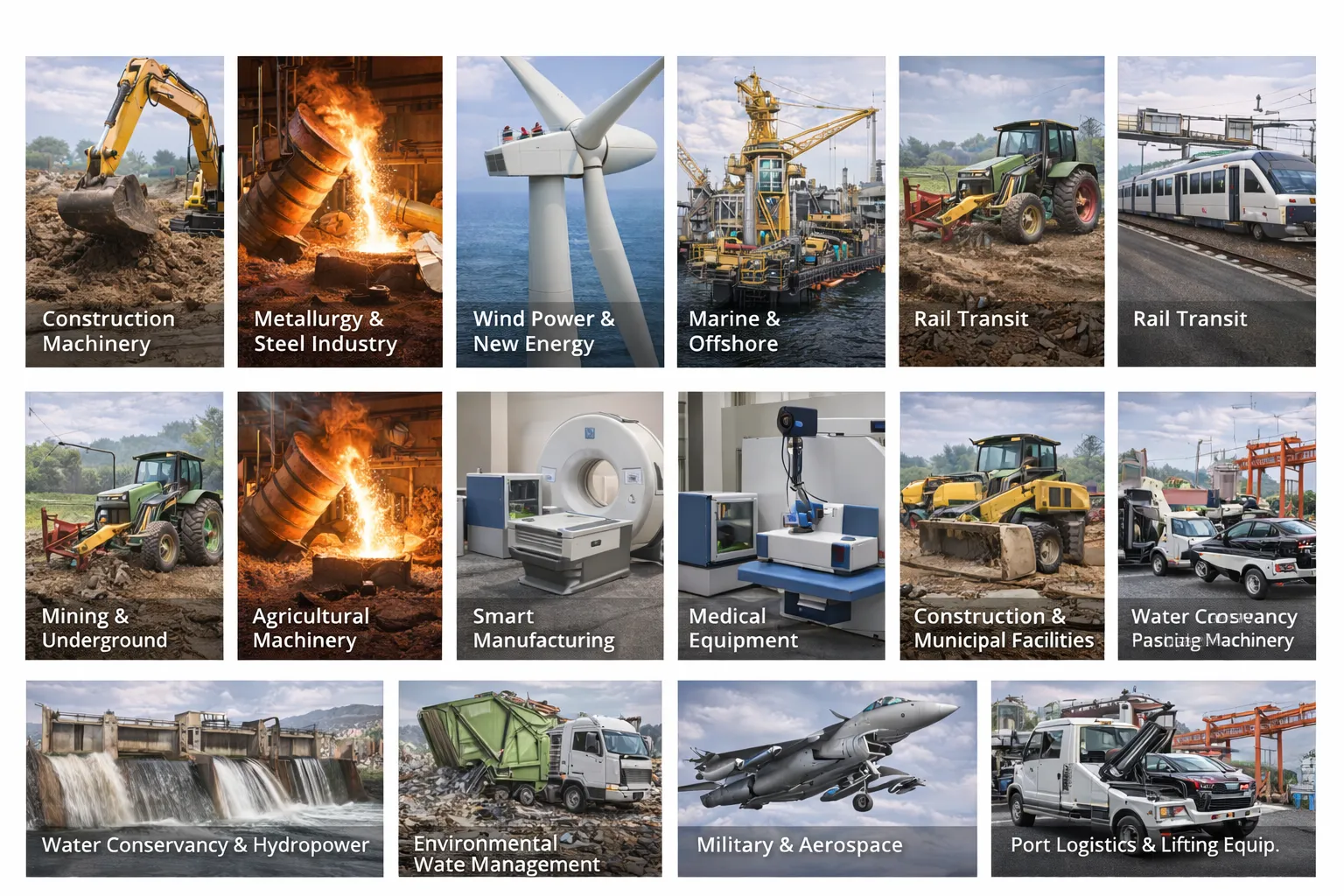
While the sophisticated technology detailed herein is exquisitely tuned to resolve the unique challenges of the renewable energy sector, the fundamental physics of zero-drift, high-rigidity actuation translate perfectly to a multitude of other demanding heavy industries. When an operational process demands absolute reliability, immense force generation, and total immunity to harsh environmental degradation, our specialized fluid power cylinders deliver consistently.
- Heavy Iron Processing: Extreme heat, continuous heavy loads, and abrasive slag demand specialized water-cooled cylinders with fire-resistant sealing. Explore our advanced solutions for the metallurgical and iron industry.
- Subterranean Extraction: In the brutal underground and open-pit environments of the mining industry, our impact-resistant 42CrMo designs effortlessly drive massive rock crushers and articulated haulers.
- Infrastructure Development: The rapid cycle times, unpredictable load spikes, and massive breakout forces required by the construction machinery industry rely heavily on our heavy-duty welded architecture to prevent catastrophic boom failure.
- Injection Molding & Plastics: Requiring exact linear positioning and massive clamping tonnage to ensure perfect mold alignment without flash or product defects. Utilizing our high frequency single acting hydraulic cylinder setups.
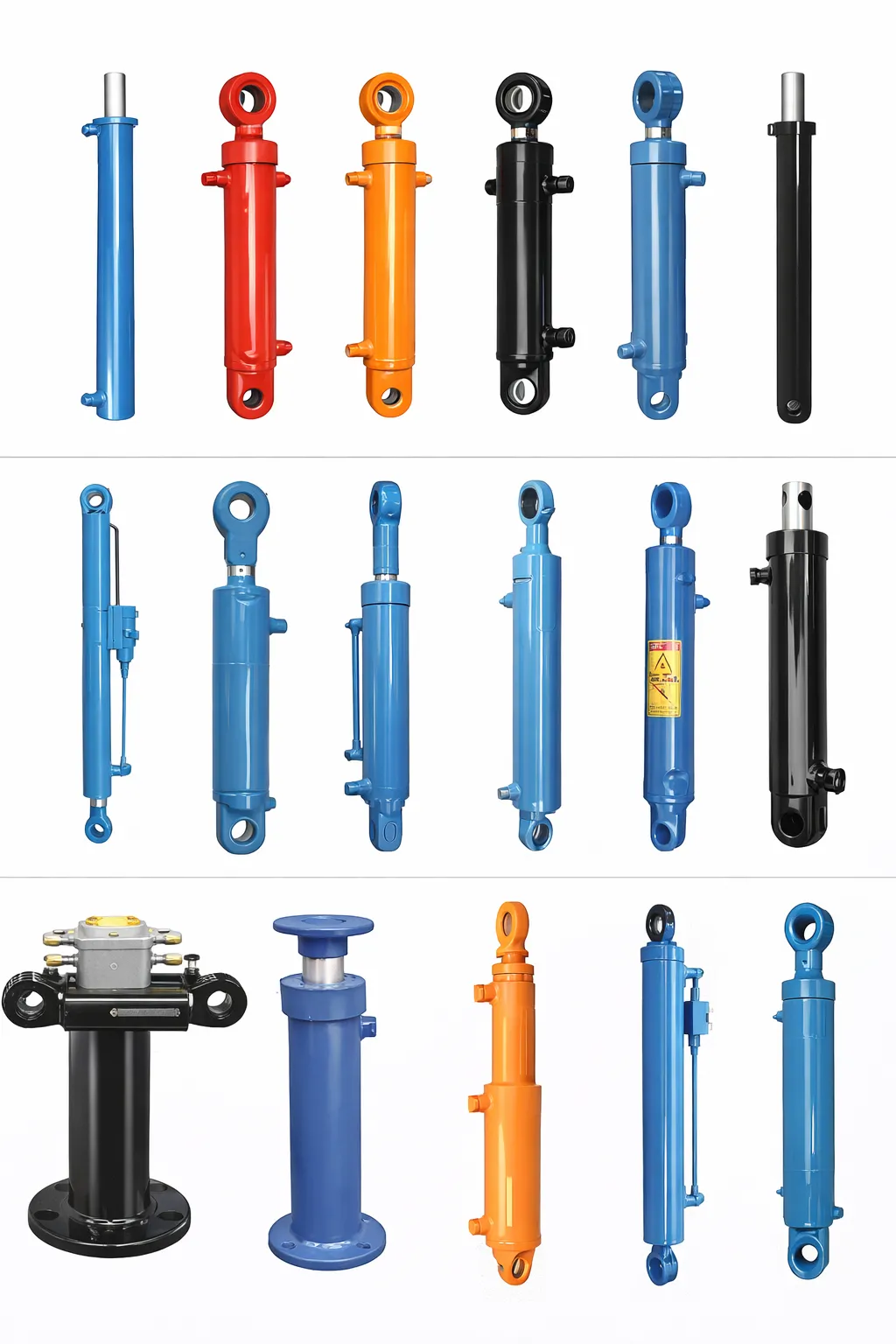
Comparative Analysis: Standard Actuators vs. Our Performance Benchmark
Evaluating long-term capital expenditure requires looking critically past the initial procurement cost and focusing heavily on operational expenditure (OPEX) over a twenty-year horizon. The following comparison vividly highlights why leading international EPC contractors specify our customized servo solutions over standard commercial grade hydraulic components.
| Performance Metric | Ordinary Commercial Hydraulic Cylinder | Our Dual-Axis Servo Cylinder |
|---|---|---|
| Positional Holding (Drift) | Prone to 2-6 degrees of drift over 24 hours | Absolute Zero Drift (Hydraulic valve lock) |
| Low-Temperature Limit | Seals shrink and leak fluid at -15 Celsius | Maintains 100% sealing integrity down to -40 Celsius |
| Rod Material Strength | Standard Q235 / #45 Carbon Steel (Buckling risk) | 42CrMo High-Yield Alloy (Buckle proof) |
| Friction Dynamics | Frequent stick-slip juddering at micro speeds | Ultra-smooth motion via PTFE tribology |
| Maintenance Frequency | High; frequent hydraulic cylinder repair required | Set-and-forget reliability; minimal LCOE impact |
Proven Reliability: Global Field Case Studies
Theoretical engineering excellence must be undeniably validated by long-term field performance. The following case analyses illustrate exactly how our specialized hydraulic cylinder components have permanently resolved critical operational bottlenecks for our strategic partners across Asia.
Case Study 1: Eradicating Wind-Induced Drift in Coastal South Korea
Client & Location: Utility-Scale Coastal Solar Park, Jeollanam-do, South Korea (October 2024)
The Engineering Challenge: A sprawling 100MW installation was experiencing severe energy yield drops during the turbulent autumn typhoon season. Relentless coastal winds were forcefully back-driving their standard tracking cylinders, causing the massive panels to drift off their optimal azimuth by up to 6 degrees. They urgently required a permanent solution and discovered us while researching advanced hydraulic cylinder repair methodologies online.
Solution & Implementation: Our engineering bureau rapidly designed a complete plug-and-play retrofit utilizing our dual-axis servo cylinder, heavily armed with our integrated hydraulic control valve locking manifold and 42CrMo rods.
The Tangible Outcome: Post-installation, the tracking drift was comprehensively neutralized. The mechanical check valves held the arrays rigidly in place despite sustained 35 m/s wind gusts, entirely restoring their generation efficiency.
Case Study 2: Conquering Winter Freezing Failures in Hokkaido
Client & Location: Mountain Ridge Renewable Energy Co., Hokkaido, Japan (February 2025)
The Engineering Challenge: Extremely low winter temperatures frequently dropping below -30 Celsius caused the standard polyurethane seals on their OEM cylinders to harden, fracture, and shatter. This led to catastrophic hydraulic fluid loss, paralyzing the photovoltaic tracking bracket system entirely during peak winter generation hours.
Solution & Implementation: We immediately supplied heavily customized units featuring our proprietary aerospace-grade low-temperature sealing matrix, optimized for specific cold-weather hydraulic fluid compatibility.
The Tangible Outcome: Throughout the remainder of the extraordinarily harsh winter, the facility recorded zero fluid bypass incidents, maintaining 100% operational tracking uptime and capturing critical snow-reflected irradiance.
Case Study 3: Combating Abrasive Silica Dust in the Gobi Desert
Client & Location: Trans-National Grid Expansion Project, Mongolia (July 2025)
The Engineering Challenge: Highly abrasive, fine silica dust driven by desert winds was relentlessly penetrating the external wiper seals of their standard actuators. This caused severe, irreparable scoring on the piston rods and destroyed the internal pressure seals within mere months of deployment.
Solution & Implementation: We engineered and implemented a severe-duty dual-wiper gland system combined with an extra-thick, micro-crack hard chrome plating on the 42CrMo rods. The fully welded manufacturing structure permanently eliminated any threaded crevices where abrasive dust could otherwise accumulate.
The Tangible Outcome: Nearly two years into continuous desert operation, the cylinder rods remain pristine and reflective, drastically reducing the total cost of ownership in a highly remote location where maintenance access is incredibly difficult.
Technical B2B Frequently Asked Questions (FAQ)
For engineering directors, EPC procurement managers, and technical evaluators analyzing our fluid power systems, we have compiled detailed answers to the most rigorous inquiries we receive.
1. How exactly does the hydraulic control valve locking completely prevent positional drift?
Standard proportional control valves have intrinsic, microscopic spool clearances that inevitably allow hydraulic fluid to seep backward under immense external loads, such as sustained wind hitting a solar panel. Our specialized locking mechanism physically mounts pilot-operated check valves directly onto the cylinder barrel port. When the servo system commands a halt, these check valves mechanically snap shut, completely trapping and sealing the fluid within the cylinder chambers. Because hydraulic oil possesses a massive bulk modulus (it is virtually incompressible), the piston rod becomes rigidly locked into place like a solid steel beam.
2. Can you customize the stroke, bore, and mounting dimensions for a unique tracker design?
Absolutely. Because we control the entirety of the manufacturing and CNC machining process, we are not constrained by limitations. We frequently customize bore diameters, extra-long stroke lengths, and exact mounting geometries (such as specialized spherical trunnions or heavy-duty clevises) to ensure our double acting hydraulic cylinder integrates flawlessly into the kinematic envelope of your unique photovoltaic tracking bracket.
3. How do your low-temperature seals survive severe South Korean or high-altitude winters?
A standard NBR or polyurethane seal undergoes a glass-transition phase around -15 Celsius, becoming hard, brittle, and incapable of maintaining interference pressure against the rod. We utilize proprietary aerospace-grade PTFE blends and specialized low-temperature elastomers that maintain their pliable, volumetric sealing integrity down to -40 Celsius. This ensures zero winter leakage and prevents sudden pressure drops.
4. Are your servo cylinder components compatible with our existing PLC?
Yes. The integrated LVDT sensors and proportional valves operate on standard industrial analog signals (typically 4-20mA or 0-10V) or via common fieldbus protocols. This allows our cylinders to instantly communicate with Siemens, Allen-Bradley, Mitsubishi, or custom solar tracking PLCs to flawlessly close the PID control loop without requiring proprietary software bridges.
5. What is the typical lead time and cost structure for a bulk project retrofit?
By entirely bypassing third-party vendors and maintaining massive in-house raw material inventories, we drastically compress lead times. Standard high-performance bulk orders for the Asian market can be dispatched within 4 to 6 weeks. Because you are dealing directly with the factory, the hydraulic cylinder price is exceptionally competitive, often yielding a 30 percent reduction in upfront capital expenditure compared to sourcing equivalent legacy Western brands.
6. Why is 42CrMo steel strictly necessary for the piston rod in this application?
A vast solar panel array acts identically to a giant sail during a storm, translating immense alternating compressive and tensile shock loads directly down the mechanical linkages into the hydraulic cylinder piston. Standard carbon steel simply lacks the yield strength to handle these cyclic transverse loads and will eventually buckle. 42CrMo is a premium chromium-molybdenum alloy that, when thermally tempered, provides vastly superior resistance to fatigue and deformation, guaranteeing the survival of the actuator.
7. Do you provide comprehensive documentation and support for fixing hydraulic cylinders on-site?
Absolutely. While our designs target zero-maintenance lifecycles, we recognize the realities of industrial operations. We supply highly detailed engineering drawings, maintenance manuals, and comprehensive spare hydraulic parts (such as custom seal kits and replacement valves). If your field technicians are tasked with fixing hydraulic cylinders after extreme damage, our direct factory engineering support is available to guide the precise teardown and rebuild procedures safely.
Ready to Elevate Your Renewable Energy Infrastructure?
Do not allow inferior actuation components to compromise your facility’s energy yields or inflate your long-term maintenance budgets. Partner directly with an industry-leading fluid power expert dedicated to uncompromising precision, environmental durability, and technological innovation.
Whether you are engineering a next-generation tracker design from the ground up or seeking highly reliable, drop-in upgrades to resolve drift on existing field arrays, our engineering bureau is standing by to provide exact 3D CAD models, deep technical consultations, and highly competitive commercial manufacturing proposals.
Contact Our Engineering Team Directly
Editor: Cxm