
Equipment Overview and Offshore Industrial Value
The rapid expansion of the offshore renewable energy sector across East Asia has placed extraordinary mechanical demands on maritime support infrastructure. Operating in the turbulent waters of the East China Sea, the Korea Strait, and the Sea of Japan, wind power maintenance vessels execute highly complex logistics. These specialized ships are tasked with transferring massive turbine components and sensitive diagnostic equipment from a pitching deck directly onto stationary wind turbine foundations. The mechanical subsystem responsible for handling these multi-ton loads is the heavy-duty deck crane. Within this assembly, the ability to maintain precise lateral rotational control depends entirely on the structural and operational integrity of the crane slew cylinder.
Operating lifting equipment in the open sea introduces severe dynamic shock loads that land-based machinery rarely encounters. As the maintenance vessel rolls with the ocean swells, massive rotational inertia is transferred directly through the crane boom down into the slewing mechanism. High-strength rod offshore engineering is a fundamentally unforgiving discipline. Standard commercial actuators fail rapidly in these environments. Continuous exposure to dense salt spray penetrates basic surface coatings, initiating aggressive galvanic corrosion. Furthermore, sudden wave impacts cause extreme internal pressure spikes that blow out standard rubber seals. The inevitable outcome is severe hydraulic fluid leakage. A leaking crane slewing hydraulic cylinder not only triggers strict environmental compliance violations but also paralyzes the vessel’s lifting capabilities, leading to massive financial losses in delayed offshore operations.
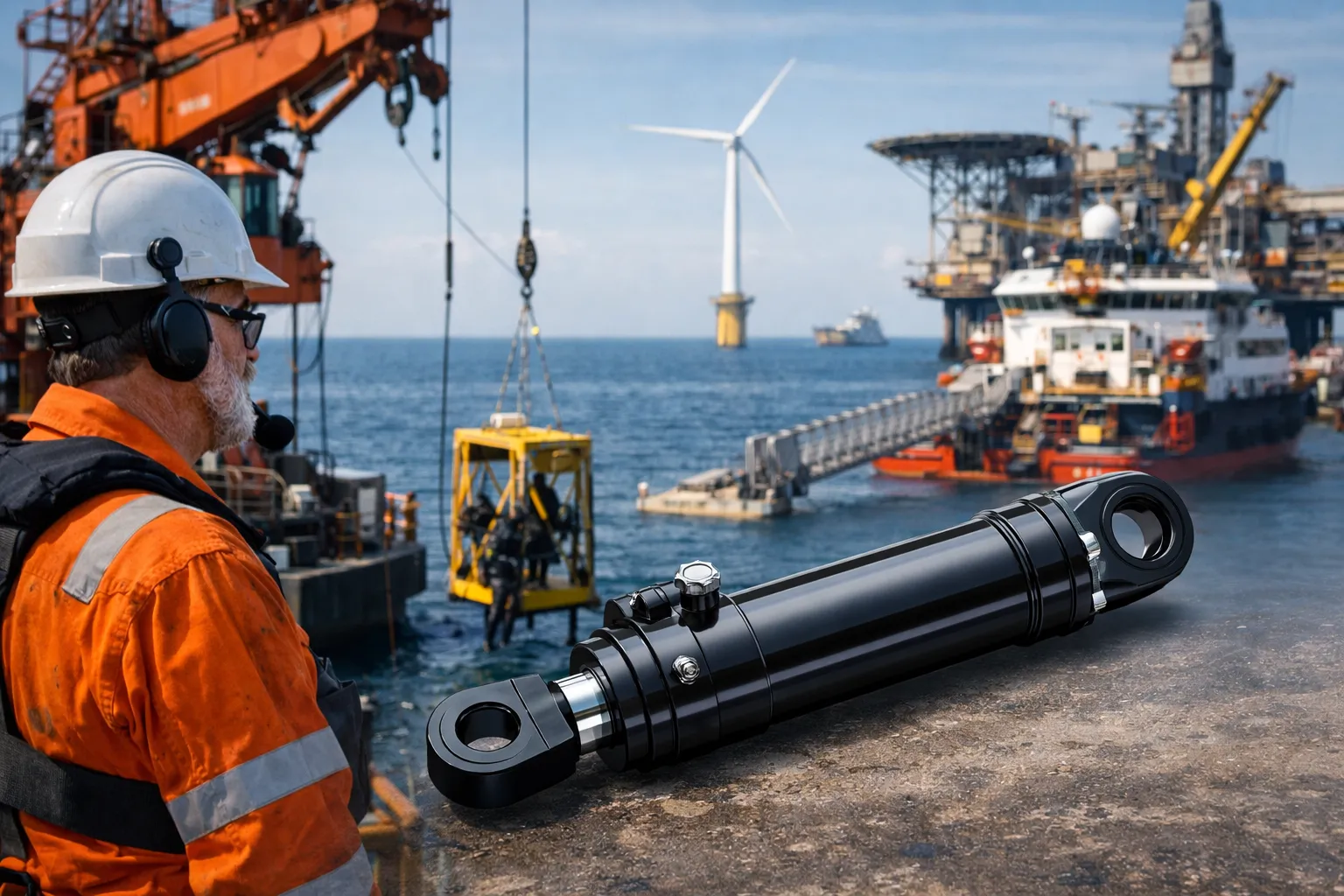
Recognizing the severe limitations of standard commercial fluid power components, we have developed a highly specialized marine actuator. As an established hydraulic cylinder manufacturer, we have abandoned inferior carbon steels in favor of a high-strength 27SiMn alloy matrix, combined with an impenetrable nickel-plated surface treatment. This specific metallurgical synthesis is engineered exclusively for the harsh reality of offshore wind farms. We provide fleet operators with absolute mechanical reliability, ensuring that heavy slewing operations remain smooth, completely controlled, and entirely leak-free regardless of the atmospheric salt concentration or sudden wave impact severity.
Precise Technical Specifications for Marine Environments
Securing operational approval from international maritime classification societies necessitates complete technical transparency regarding mechanical limits and material composition. The table below details the primary engineering parameters that define our highly customized lifting and slewing actuation systems, designed exclusively for wind farm maintenance operations.
| System Parameter | Engineering Configuration | Operational Significance |
|---|---|---|
| Industry Category | High-strength rod offshore engineering | Built explicitly to survive open-ocean mechanical fatigue. |
| Target Equipment | Wind power maintenance vessel | Optimized for dynamic ship-to-turbine lifting tasks. |
| Subsystem Assignment | Crane system | Provides the primary motive force for heavy lateral rotation. |
| Component Designation | Crane slew cylinder | Directly controls the lateral rotation of the crane mast. |
| Action Mechanism | Double acting hydraulic cylinder | Enables powered, positive control in both slewing directions. |
| Internal Geometry | Piston cylinder | Maximizes thrust output per square inch of fluid pressure. |
| Structural Fabrication | Welded monolithic structure | Eliminates vulnerable tie-rods that stretch under wave impact. |
| Primary Material System | 27SiMn Alloy Steel | Delivers exceptional tensile strength and superior impact toughness. |
| Protective Surface Treatment | Nickel plating | Blocks chloride ion penetration, preventing severe surface rust. |
| Environmental Rating | Salt spray + impact | Validated for year-round offshore exposure and storm conditions. |
| Working Condition | Slewing operation | Absorbs immense rotational torque to swing heavy loads. |
| Defeated Failure Mode | Leakage | Ensures EPA/VGP environmental compliance and total system reliability. |
Operational Fluid Dynamics and Slewing Mechanics
To fully appreciate the engineering behind our marine actuation units, it is vital to understand the fluid dynamics occurring during an active wind farm maintenance rotation. The crane pedestal mounted to the vessel deck relies on immense hydraulic pressure to rotate safely. This rotational force is typically generated by an opposing pair of crane slew cylinder units acting upon a massive internal rack and pinion gear mechanism, or via a direct heavy-duty linkage arm connected to the crane’s rotational bearing.
Because the vessel is subject to continuous wave action, gravity and momentum cannot be trusted to manage the heavy load. Relying on a single acting hydraulic cylinder is physically impossible for slewing, as it requires an external mechanical force to return to its original position. Therefore, the system strictly demands a double acting hydraulic cylinder design. When the crane operator engages the joystick to swing a wind turbine blade into position, the vessel’s central hydraulic power unit (HPU) directs pressurized oil through precision control valves into the cap end of one cylinder, forcing its rod outward. Simultaneously, highly pressurized fluid is pumped into the rod end of the opposing cylinder, pulling it inward. This synchronized push-pull dynamic creates a perfectly controlled, high-torque turning moment. The incompressible nature of the hydraulic fluid guarantees that the crane stops exactly where intended, locking rigidly in place without drifting, even when high coastal winds strike the suspended turbine load.
The most severe test of this fluid power system occurs during unexpected dynamic braking. If a rogue wave hits the vessel while the crane is swinging laterally, massive counter-rotational forces spike back through the crane arm directly into the hydraulic cylinder piston. Standard commercial components experience instant seal blowout or catastrophic rod bending under these shock loads. Our marine-engineered units absorb these violent pressure spikes using heavily reinforced 27SiMn steel components and specialized cushioning valves, safely dissipating the kinetic energy without experiencing a single drop of fluid leakage.
Exact Drop-In Replacements for Global Marine Brands
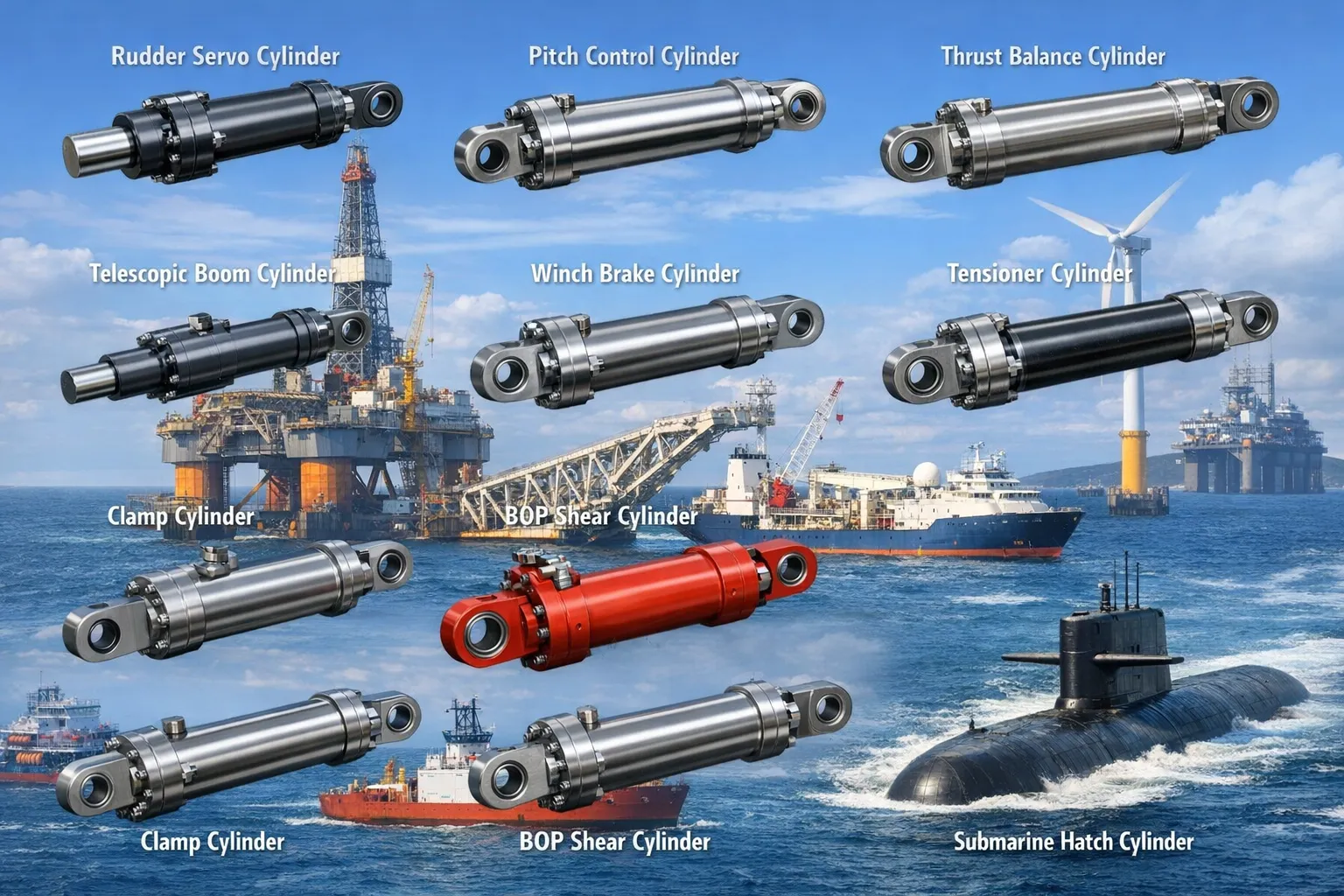
When a critical deck crane suffers a major breakdown off the coast, fleet technical managers cannot afford the downtime required to re-engineer their ship’s steelwork to accommodate an irregularly sized aftermarket part. To serve the fast-paced marine repair sector effectively, we have standardized the external dimensions of our crane slewing hydraulic cylinder range to function as perfect mechanical replacements for units originally manufactured by leading global marine crane brands.
We possess an extensive technical archive, allowing us to accurately replicate the mounting dimensions of slewing actuators found on cranes manufactured by Liebherr, MacGregor, Palfinger, TTS Marine, National Crane, as well as systems running Bosch Rexroth and Parker Hannifin fluid power units. (Please note: The mention of these specific commercial brands is strictly for the purpose of communicating dimensional compatibility and technical cross-referencing to assist marine procurement officers. It does not imply any direct corporate affiliation or trademark infringement.)
Relying on standard OEM replacements often traps operators in a relentless cycle of corrosion and failure. By proactively upgrading to our specialized 27SiMn nickel-plated assemblies, you permanently eliminate the root cause of these breakdowns. We precisely match the pin-to-pin closed lengths, trunnion dimensions, and hydraulic port threads. This dramatically simplifies the process of fixing hydraulic cylinders on deck, allowing your maintenance crews to execute the replacement swiftly. Ultimately, this delivers an incredibly favorable hydraulic cylinder price to operational longevity ratio, vastly outperforming repetitive standard part purchases.
Core Technical Advantages for Offshore Survival
Surviving the relentless assault of salt spray and wave impact requires a multidisciplinary engineering approach. Below are the definitive technical advantages that elevate our hydraulic cylinder components above standard maritime market offerings:
1. 27SiMn High-Strength Alloy Foundation
Standard commercial cylinders often utilize basic C45 carbon steel, which is prone to deflection under severe offshore shock loads. We forge our barrels and rods exclusively from 27SiMn alloy steel. The high silicon and manganese content provides exceptional yield strength and impact toughness. This ensures the mechanical structure remains perfectly rigid even during severe side-loading events caused by sudden vessel pitch.
2. Impenetrable Nickel Plating Surface Defense
Conventional hard chrome plating contains microscopic fissures that allow salt spray to wick down and oxidize the base steel, leading to blistering and seal destruction. We deploy an advanced, thick-film nickel plating process. Nickel forms an exceptionally dense, pore-free metallic barrier that completely isolates the steel from corrosive chloride ions, entirely preventing rod pitting and subsequent leakage.
3. Heavy-Duty Welded Structural Integrity
Fastened tie-rod cylinders are completely unsuitable for the torsional stress of offshore slewing operations. Our actuators feature a monolithic, deep-penetration welded construction. The heavy end caps and trunnion mounts are fused directly to the heavy-wall barrel using robotic submerged arc welding. This guarantees total structural permanence against relentless wave impact.
4. Ultra-Low Friction Leakage Prevention Matrix
The primary defense against fluid leakage is the internal seal profile. We utilize proprietary marine-grade PTFE blend step seals paired with highly durable FKM elastomers. This ultra-low friction configuration entirely prevents the “stick-slip” phenomenon during delicate crane positioning. Aggressive bronze-filled outer wipers relentlessly shear away dried ocean salt before it can penetrate the pressure boundary.
5. Volumetric Efficiency and Thermal Stability
The internal bore of our 27SiMn steel barrel is skived and roller-burnished to a mirror-like Ra < 0.2µm finish. This perfect circularity allows the hydraulic cylinder piston seals to maintain absolute contact, preventing any fluid bypass across the chambers. Optimized fluid port geometries reduce internal turbulence, keeping the hydraulic oil thermally stable during high-frequency slewing.
6. Integrated Load Holding Safety Manifolds
Safety on a pitching deck is non-negotiable. Our specialized slewing cylinders feature heavy steel manifolds welded directly onto the fluid ports. These manifolds house pilot-operated counterbalance valves. In the catastrophic event of a main deck hose rupture, these valves lock instantly, preventing the massive crane boom from swinging uncontrollably and endangering the crew.
Autonomous Manufacturing and Absolute Quality Control
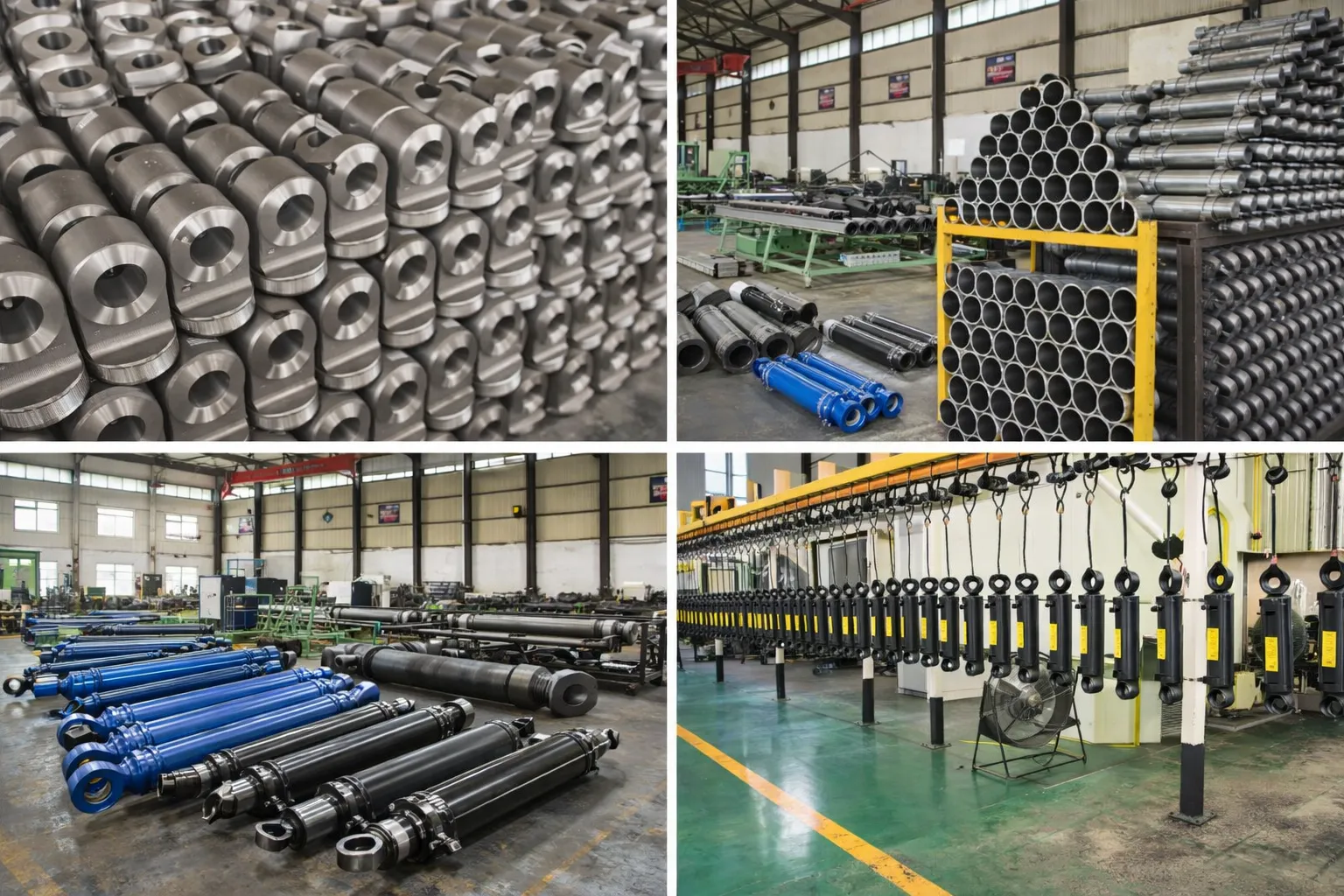
The consistent delivery of zero-leakage marine actuation systems demands absolute control over the production environment. As a fully integrated and autonomous hydraulic cylinder manufacturer, we do not outsource the machining or welding of our critical load-bearing hydraulic parts. From the initial ultrasonic inspection of raw 27SiMn billets to final export crating, our ISO-certified quality management system ensures total traceability.
During the manufacturing phase, our 5-axis CNC turning centers cut complex seal grooves with micro-meter precision, guaranteeing perfect gland compression. Our structural welding procedures are strictly qualified according to international maritime standards, with 100% of critical joints undergoing Non-Destructive Testing (NDT), specifically utilizing Ultrasonic Testing (UT), to ensure zero subsurface weld porosity or slag inclusions.
Before any crane slew cylinder is approved for dispatch, it undergoes a grueling Factory Acceptance Test (FAT). The unit is pressurized to 150% of its maximum designed working load while monitored digitally for microscopic pressure decay. We physically actuate the cylinders under heavy simulated loads to guarantee absolute seal integrity. Every verified unit is laser-etched with a unique serial number, satisfying the stringent certification requirements of global marine classification societies such as DNV, ABS, and the Korean Register (KR).
Expansive Heavy Industry Applications
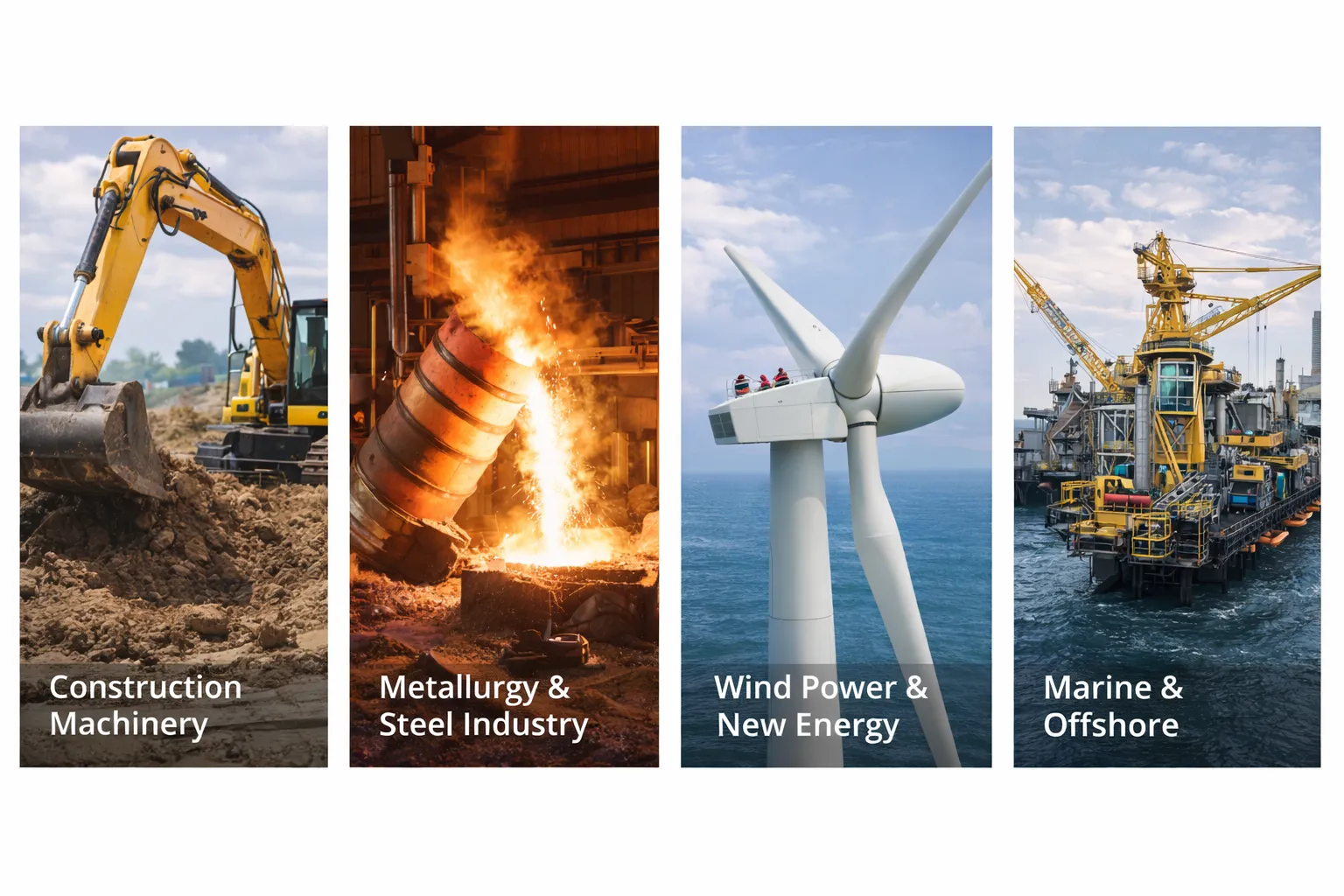
While this highly specialized nickel-plated configuration is mathematically optimized for wind power maintenance vessels and aggressive salt spray environments, the fundamental fluid power principles we employ—extreme impact resistance, zero-leakage sealing, and massive structural rigidity—are perfectly transferable to other demanding heavy industries.
- Construction Machinery Industry: The severe, continuous shock loads experienced by massive crawler cranes, piling rigs, and rotary drilling equipment demand actuation that refuses to yield. Our high-rigidity welded designs drastically increase the operational lifespan of heavy earthmoving fleets.
- Metallurgical and Iron Industry: Operating amidst extreme radiant heat and abrasive metallic dust, ladle handling cranes and continuous casting machines require exceptionally tough fluid power. Our heat-resistant systems ensure smooth, leak-free rotation when handling hundreds of tons of molten steel.
- Mining Industry: Heavy-duty surface excavators and underground rock breakers operating in corrosive, particulate-heavy environments heavily utilize our impact-resistant cylinders to maintain consistent digging forces without unexpected downtime.
- Specialized Port Logistics: Ship-to-shore (STS) gantry cranes and automated guided vehicles (AGVs) operating in coastal zones rely on our corrosion-resistant hydraulic rams for safe, continuous 24/7 container handling.
Comparative Analysis: Standard Commercial vs. High-Performance Marine Cylinders
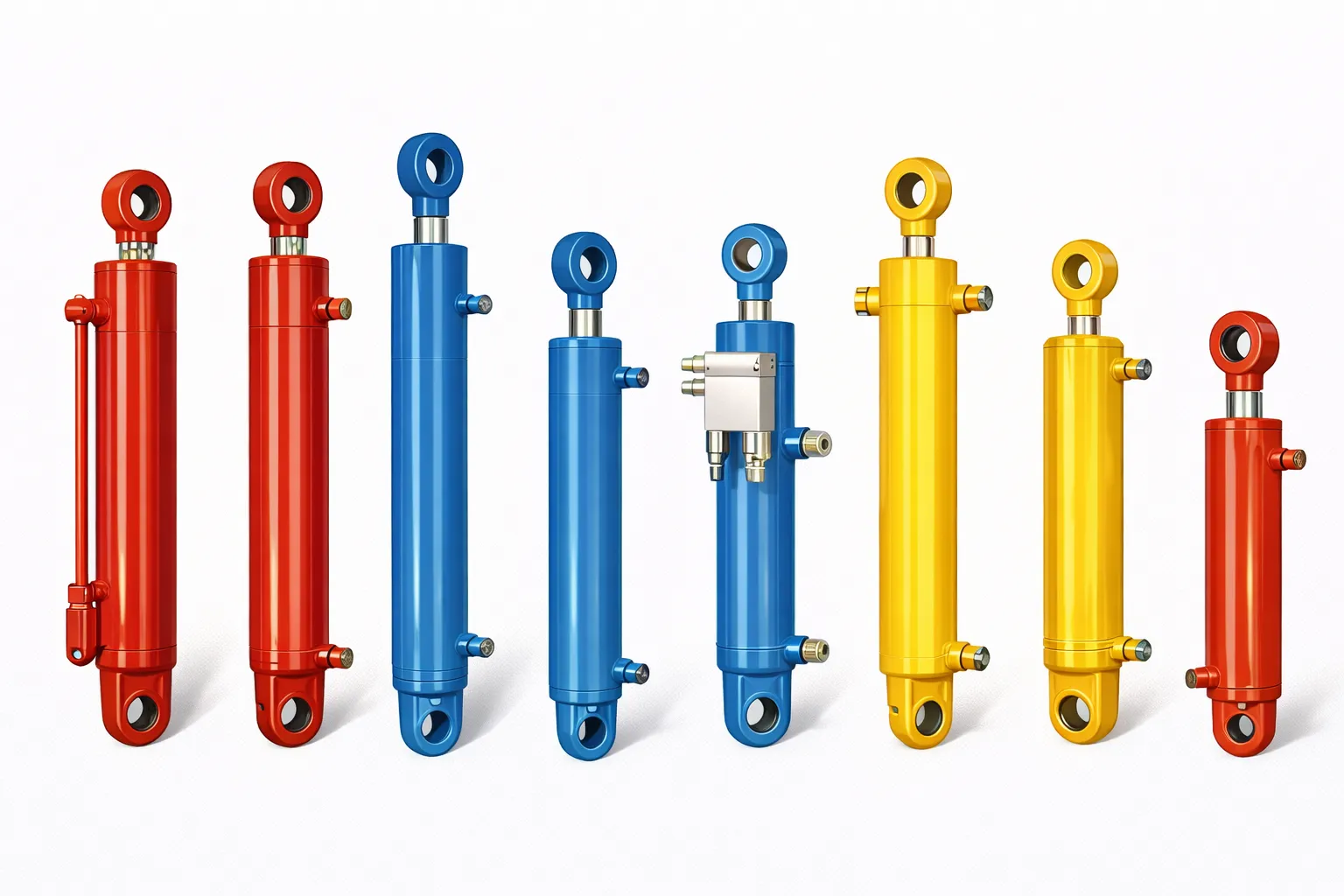
Procurement managers often evaluate the initial capital expenditure without calculating the devastating cost of offshore vessel downtime. Installing standard commercial fluid power components on an offshore wind vessel guarantees premature failure. The table below illustrates the vast technical differences between off-the-shelf units and our customized marine-grade solutions.
| Engineering Metric | Standard Industrial Hydraulic Cylinder | Our High-Performance Crane Slew Cylinder |
|---|---|---|
| Base Material Strength | Standard Carbon Steel (e.g., C45) – Prone to bending under wave action. | 27SiMn Alloy Steel – Exceptional yield strength and shock absorption. |
| Corrosion Defense | Hard Chrome Plating – Micro-cracks allow rapid salt penetration and rust. | Thick-Film Nickel Plating – Impermeable physical barrier against salt spray. |
| Structural Integrity | Tie-rod construction – Threads stretch during heavy crane load swing. | Welded Construction – Rigid monolith designed for dynamic wave impact. |
| Fluid Leakage Risk | High – Rusted rod surfaces immediately shred internal rubber seals. | Effectively Eliminated – Pristine rod surface protects internal seals permanently. |
| Financial Impact (TCO) | Severe – Cheap initial cost leads to continuous repair labor and ship downtime. | Highly Efficient – Upfront investment heavily offset by years of zero-maintenance uptime. |
Global Field Proven Reliability: Real Case Studies in East Asia
Theoretical engineering specifications must translate into unyielding operational reliability in the field. Our heavily customized fluid power solutions have been aggressively validated in some of the most unforgiving marine environments globally, establishing a particularly dominant technical presence within South Korea’s advanced offshore wind and shipbuilding sectors.
Case Study 1: Wind Farm Maintenance Vessel Fleet Upgrade (Mokpo, South Korea)
Date of Implementation: November 2024
The Engineering Challenge: A premier marine contractor operating in the Yellow Sea faced a critical mechanical crisis. The main pedestal cranes on their vessels were failing. Standard OEM chrome-plated slewing cylinders suffered massive seal blowouts due to violent wave impacts while simultaneously corroding heavily from the continuous salt spray. The resulting loss of rotational control halted turbine maintenance and necessitated constant hydraulic cylinder repair.
The Applied Solution: Finding us through a search for reliable lift cylinder solutions, their engineering lead requested an immediate structural overhaul. We engineered exact dimensional replacements utilizing heavy-wall 27SiMn alloy steel and highly ductile nickel plating, ensuring absolute impact absorption and salt resistance. We upgraded the entire sealing architecture to definitively combat the leakage issues.
The Measurable Result: Over the subsequent 18 months of brutal winter sea states, the upgraded systems exhibited absolute zero fluid leakage. The fleet operators entirely eliminated crane downtime, saving hundreds of thousands of dollars in lost operational hours.
— Director of Fleet Operations Park M., Mokpo Offshore Services.
Case Study 2: Heavy-Lift Jack-Up Vessel Retrofit (Jeju Island, South Korea)
Date of Implementation: April 2025
The Engineering Challenge: A massive heavy-lift jack-up vessel tasked with driving wind turbine monopiles was experiencing dangerous internal fluid bypass. The severe mechanical impact of the piling operation was bending the standard carbon steel rods of their crane slewing hydraulic cylinder mechanisms, jamming the rotational gear.
The Applied Solution: Our technical team custom-engineered highly robust double acting hydraulic cylinder units. By utilizing the superior yield strength of 27SiMn steel, we drastically increased the structural rigidity of the barrel and rod, entirely preventing mechanical flex under extreme lateral loads.
The Measurable Result: The new cylinders effortlessly absorbed the shock loads. The robust 27SiMn framework maintained perfect linear geometry, allowing the vessel operator to safely conduct heavy slewing operations even in marginal sea states, increasing their project completion speed by 15%.
Case Study 3: Commercial Shipyard Crane Modernization (Busan, South Korea)
Date of Implementation: January 2026
The Engineering Challenge: A major coastal shipbuilding facility was modernizing an aging 150-ton dry-dock crane. The original slewing actuators were obsolete, heavily rusted, and completely seized. Sourcing original replacement parts from the European OEM was taking months and costing vast sums.
The Applied Solution: Based on historical drawings, we executed a complete reverse-engineering build. We supplied modernized, dimensionally identical hydraulic rams outfitted with modern spherical marine bearings and our advanced nickel-plated surface defense.
The Measurable Result: The shipyard successfully retrofitted the massive crane in a single week. By avoiding the OEM markup, they secured an exceptional hydraulic cylinder price, achieving a 40% reduction in their annual procurement budget while drastically improving the crane’s resistance to coastal salt fog.
Frequently Asked Technical Questions
Navigating the procurement of critical offshore lifting machinery requires absolute technical clarity. Below, we address the most pressing inquiries from fleet managers, naval architects, and global purchasing directors regarding the specification and deployment of our high-strength offshore slewing systems.
1. Why is 27SiMn vastly superior to standard carbon steel for crane applications?
2. How exactly does nickel plating outperform hard chrome against salt spray?
3. Can you guarantee dimensional compatibility to replace our failing OEM European cylinders?
4. How do you structure the hydraulic cylinder price for these custom marine projects?
5. Do you supply spare hydraulic parts to facilitate onboard maintenance?
6. What is the typical lead time and shipping logistics for delivery to South Korea?
Secure the Stability of Your Offshore Operations
Do not allow inadequate standard industrial components to compromise the safety, efficiency, and profitability of your wind power maintenance vessel. The relentless threat of salt spray and wave impact demands an elite, uncompromising engineering response. Partner with a dedicated manufacturing team that profoundly understands the devastating mechanical power of the open ocean. Whether you require a single bespoke dimensional replacement to mitigate a severe leakage crisis, or a comprehensive fleet-wide mechanical upgrade, we deliver absolute reliability.
Editor: Cxm


























