High-Performance Pitch Cylinder for Marine Propulsion Systems
Engineered with duplex stainless steel and advanced FFKM sealing technology to deliver absolute zero internal leakage and precise pitch angle adjustment in the most demanding offshore environments.
Product Overview & Industrial Value
Over the past two decades of diagnosing, designing, and optimizing marine fluid power systems, it has become fundamentally clear that a vessel’s maneuverability, fuel efficiency, and operational safety rest heavily on the reliability of its Controllable Pitch Propeller (CPP) system. At the mechanical core of this highly sophisticated propulsion architecture operates the pitch cylinder. This specialized linear actuator is tasked with executing continuous, precise pitch angle adjustments of the massive propeller blades. By dynamically altering this angle, a ship can instantaneously change its thrust vector—transitioning from full ahead to full astern—without ever needing to alter the rotational speed or direction of the main engine.
However, operating deep within a submerged propeller hub exposes these components to some of the most unforgiving working conditions in industrial engineering. The environment is characterized by relentless hydrodynamic vibration, extreme pressures, and the constant, highly destructive threat of saltwater ingress. When seawater inevitably mixes with internal lubricating fluids, it creates a highly abrasive and chemically aggressive oil-water emulsion. Standard fluid power equipment degrades rapidly under these conditions. As an elite hydraulic cylinder manufacturer, we have observed that the most critical and dangerous typical failure mode in these systems is internal leakage. Once a pitch hydraulic cylinder develops internal leakage across its piston seals, it loses its holding pressure. This results in “pitch drift”—a scenario where the propeller blades fail to maintain their commanded angle against the ocean’s resistance, leading to a catastrophic loss of navigational control and severe drops in propulsion efficiency.
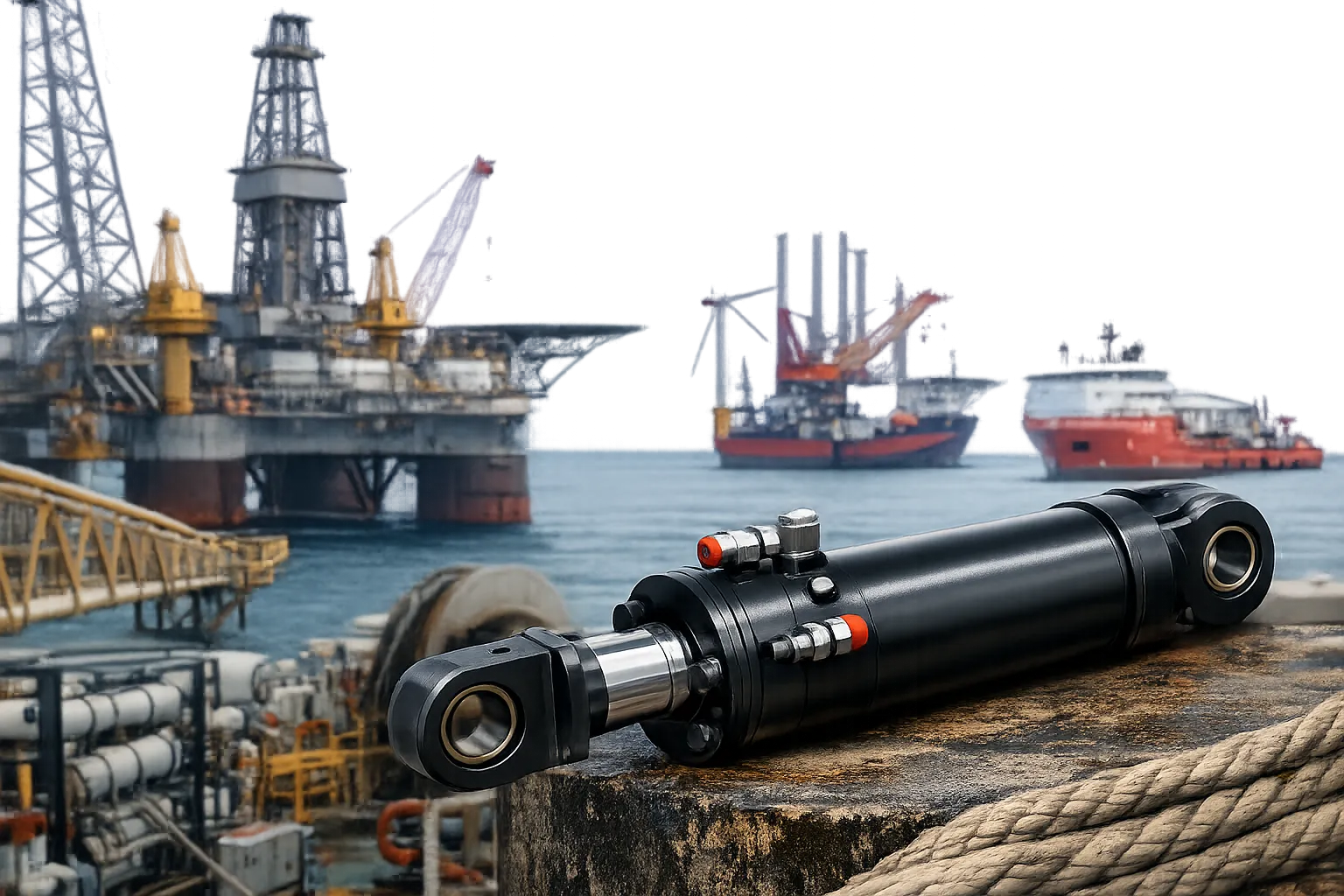
Our custom-engineered solutions are specifically designed to eradicate this exact failure mode. By forging our cylinders from premium duplex stainless steel and utilizing advanced HVOF ceramic spraying surface treatments, we create a robust, heavy-duty welded housing that is virtually immune to pitting and galvanic corrosion. More crucially, by integrating aerospace-grade FFKM (Perfluoroelastomer) sealing matrices, we deliver a double acting hydraulic cylingder that guarantees absolute zero internal leakage. We provide shipyards and fleet operators across South Korea, Japan, and the broader Asian maritime sector with a product that matches the exactitude of premium European OEMs, but with a highly optimized hydraulic cylinder price. Investing in our precision hydraulic parts drastically extends maintenance intervals, ensuring your vessels remain profitable and safe on the open ocean.
Comprehensive Technical Parameters
Precision engineering demands absolute transparency in specifications. Because every vessel’s hub architecture and thrust requirements are unique, we offer extensive customization within our rigorous baseline parameters. The table below outlines the specific configuration envelope for our marine-grade pitch control actuators.
| Parameter Category | Specification / Details | Engineering Significance |
|---|---|---|
| Target Industry | Marine and Offshore Industry | Engineered specifically for deep-sea and commercial shipping environments. |
| Equipment Category | Marine Propulsion Systems | Designed to integrate into high-torque, rotating drive lines. |
| Subsystem / Action | Controllable Pitch Propeller (CPP) System | Executes dynamic, continuous pitch angle adjustment. |
| Cylinder Designation | Pitch Cylinder / Hub Servo Actuator | The primary prime mover for blade articulation. |
| Action Mode | Double acting hydraulic cylingder | Provides rigid, pressurized holding force in both extend and retract directions. |
| Structure Type | High-Precision Servo Cylinder | Compatible with LVDT internal position feedback loops. |
| Manufacturing Structure | Heavy-Duty Welded Construction | Eliminates the fatigue and stretching inherent in tie-rod designs under load. |
| Material System | Duplex Stainless Steel (e.g., 2205) | Offers massive yield strength and exceptionally high pitting resistance (PREN). |
| Surface Treatment | Ceramic Spraying + Micro-Polishing | Creates a zero-porosity, ultra-hard armor to prevent galvanic corrosion. |
| Environmental Rating | Saltwater + Oil-Water Mixture Exposure | Rated for continuous submersion and internal fluid contamination survival. |
| Typical Failure Mode Handled | Internal Leakage & Pitch Drift | Guarantees the propeller blades remain absolutely locked at the commanded angle. |
| Recommended Configuration | FFKM (Perfluoroelastomer) Seals | Provides the ultimate chemical inertness, preventing seal degradation. |
Fluid Dynamics: The Mechanics of Pitch Control
To truly appreciate the robustness required of this equipment, one must understand the intricate fluid dynamics governing its operation. Unlike a standard lift cylinder used on a deck crane to move a load against gravity, the pitch control unit functions as a high-fidelity servo-mechanism embedded within the rotational axis of the propeller hub. When the captain on the bridge commands a modification to the ship’s speed or thrust direction, an electronic signal triggers a highly responsive proportional directional control valve.
This valve precisely directs high-pressure hydraulic fluid—pumped from the main power unit and routed through an Oil Distribution (OD) box down the hollow propeller shaft—into either the extending or retracting chamber of the pitch cylinder. Operating strictly as a double acting hydraulic cylingder, the pressurized fluid acts upon the surface area of the hydraulic cylinder piston, generating immense linear force. As the fluid fills one chamber, it forces the heavy-duty piston rod to travel linearly, while fluid in the opposing chamber is vented back to the reservoir.
This linear displacement of the piston rod is mechanically coupled to a crosshead, yoke, or sliding block assembly located inside the hub. The crosshead engages with eccentric pins fixed to the base of each individual propeller blade. Therefore, the linear stroke of the cylinder is directly translated into rotational motion, smoothly twisting all the blades simultaneously on their own axes to achieve the exact pitch angle adjustment. Because the blades are constantly fighting massive hydrodynamic resistance from the ocean water, the cylinder must act as a rigid hydraulic lock once the desired angle is reached. This underscores the absolute necessity of our FFKM sealing matrix; if even a microscopic volume of fluid bypasses the piston—causing internal leakage—the hydraulic lock collapses, the blades flutter or drift, and thrust efficiency is instantly compromised.
Seamless Integration and OEM Brand Replacement
Fleet managers and naval architects frequently encounter exorbitant costs and unacceptable lead times when attempting to source original OEM replacement hydraulic parts during scheduled dry-docking or emergency repairs. We recognized this industry bottleneck and structured our engineering capabilities to provide a superior alternative. Our technical team specializes in reverse-engineering, dimensional profiling, and manufacturing highly reliable drop-in replacements.
Our custom pitch hydraulic cylinder units are meticulously designed to be dimensionally and operationally compatible with Controllable Pitch Propeller systems originally manufactured by global maritime brands. We routinely supply exact-fit actuator solutions for systems designed by Wärtsilä, Rolls-Royce (Kongsberg Maritime), Schottel, Kawasaki Heavy Industries, Brunvoll, Bosch Rexroth, and Parker Hannifin. By matching the precise mounting trunnions, flange dimensions, and fluid port locations, we ensure that integrating our upgraded cylinders requires absolutely zero structural modifications to your existing hub.
(Note: The brand names mentioned above are the registered trademarks of their respective corporate owners. They are referenced herein strictly for the convenience of technical selection, dimensional cross-referencing, and compatibility matching to assist engineers engaged in fixing hydraulic cylinders. We are an independent hydraulic cylinder manufacturer and our provision of upgraded aftermarket solutions does not constitute trademark infringement or official affiliation with these entities.)
8 Core Technical Engineering Advantages
What elevates our marine actuators above standard commercial fluid power components? It is the culmination of targeted metallurgical science, advanced tribology, and uncompromising manufacturing tolerances. Our heavy-duty cylinders deliver unparalleled performance across eight critical parameters:
1. Eradication of Internal Leakage
Internal fluid bypass is the definitive failure mode in pitch systems. By utilizing aerospace-grade FFKM (Perfluoroelastomer) seals, we guarantee an impenetrable fluid barrier. FFKM maintains its elastomeric memory and resists chemical degradation even when submerged in highly corrosive oil-water mixtures, ensuring zero pitch drift.
2. Duplex Stainless Steel Architecture
Standard marine-grade austenitic steel (like 316L) is insufficient against prolonged chloride attacks. We forge our critical components from duplex stainless steel. Its dual-phase microstructure delivers a dramatically higher yield strength and an exceptional Pitting Resistance Equivalent Number (PREN), defending against stress corrosion cracking.
3. Advanced Ceramic Spraying Armor
Hard chrome plating develops micro-cracks under marine stress, inviting sub-surface rust. We utilize High-Velocity Oxygen Fuel (HVOF) plasma ceramic spraying. This proprietary process creates a non-porous, ultra-hard armor that completely isolates the steel rod from seawater and effortlessly repels abrasive marine particulates.
4. Servo-Grade Friction Control
Dynamic positioning requires instantaneous response without hesitation. By diamond-polishing our ceramic rods to an exceptional surface roughness (Ra ≤ 0.2 µm) and integrating custom PTFE guide bands, we eliminate the stick-slip (stiction) phenomenon, ensuring perfectly smooth linear articulation for micro-pitch adjustments.
5. Heavy-Duty Welded Integrity
Marine environments subject equipment to immense rotational vibration. Unlike tie-rod cylinders that can stretch or loosen, our deep-penetration, heavy-duty welded structure maintains absolute geometric rigidity. This monolithic design effortlessly absorbs high-frequency shock loads transmitted back from the propeller blades.
6. Optimized Thermal Stability
Internal hydraulic friction generates intense heat, while the surrounding seawater acts as a rapid coolant. Our thermodynamic engineering ensures uniform heat dissipation and manages thermal expansion differentials, preventing localized hot spots that could degrade fluid viscosity or warp critical sealing tolerances.
7. Finite Element Analysis (FEA) Lifespan
Through rigorous computerized FEA modeling during the design phase, we optimize cylinder wall thicknesses and transition radii to eliminate stress concentrations at mounting flanges. This substantially extends the fatigue life of the cylinder, allowing it to easily survive millions of high-pressure load cycles.
8. Integrated LVDT Position Feedback
To close the electronic control loop for precise navigation, we engineer hollow piston rods capable of safely housing Linear Variable Differential Transformers (LVDT). We hermetically seal and protect these sensitive electronic sensors from the violent external subsea environment, ensuring real-time stroke tracking.
Independent Manufacturing Excellence & Total Traceability
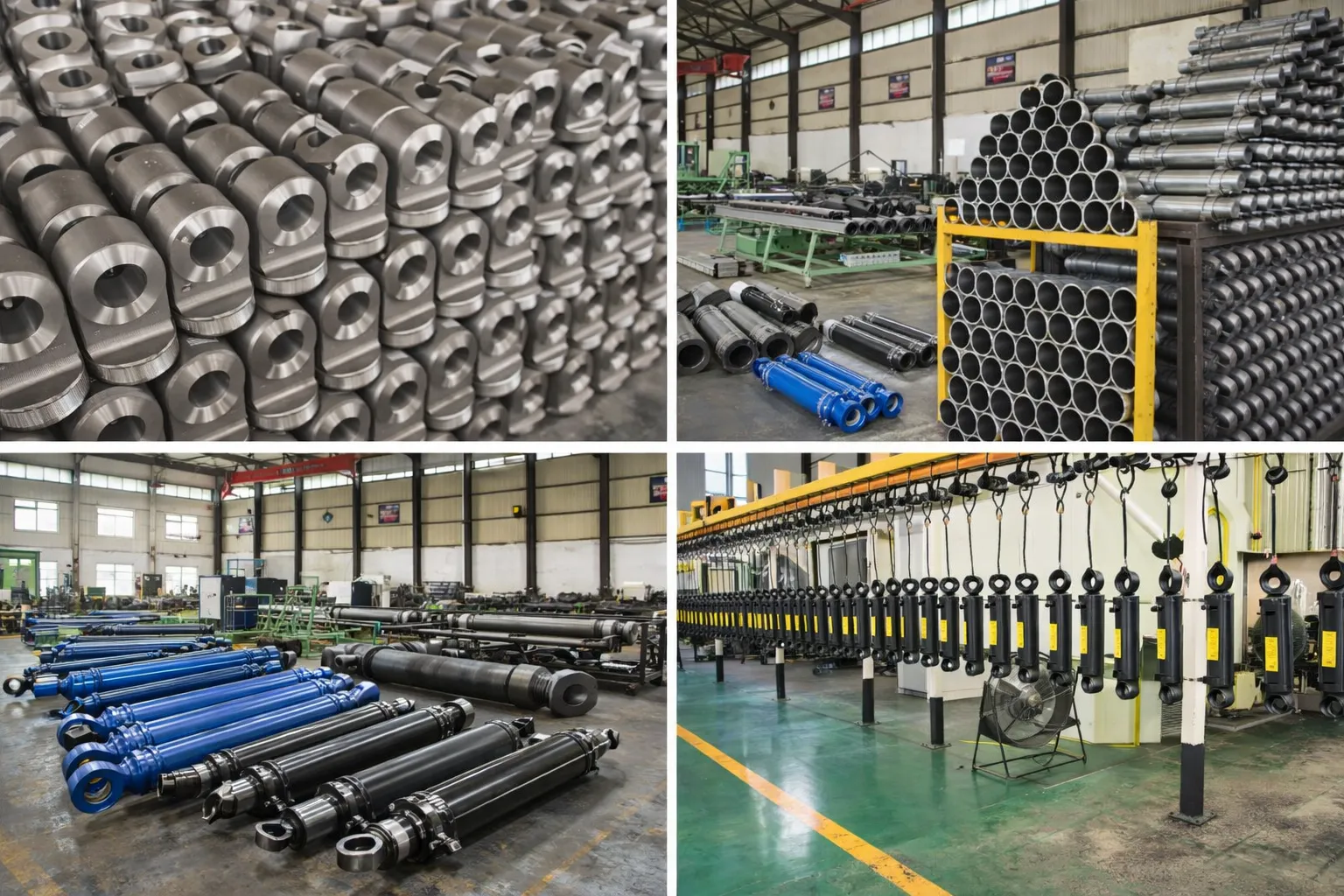
Producing highly reliable fluid power components for the offshore sector leaves zero margin for error or outsourced ambiguity. To maintain our reputation as a globally trusted manufacturer, we operate a fully vertically integrated production facility. We exert absolute control over the manufacturing lifecycle, ensuring that quality is machined into the product at every stage, not merely inspected at the end.
The production protocol initiates with stringent metallurgical verification. Every billet of incoming duplex stainless steel is subjected to optical emission spectrometry (OES) to confirm its exact chemical composition, ensuring the chromium and molybdenum content strictly meets marine classification standards. Following this, our multi-axis CNC turning and milling centers machine the cylinder bore and the hydraulic cylinder components to micrometer-level diametrical tolerances. This absolute precision is non-negotiable for achieving servo-grade performance and totally eliminating internal leakage.
The heavy-duty structural welds are performed by automated robotic systems utilizing inert gas shielding, ensuring uniform, deep bead penetration. Crucially, 100% of these structural welds undergo extensive Non-Destructive Testing (NDT), including Ultrasonic and Magnetic Particle inspections, to verify the absence of microscopic voids. Before any pitch cylinder leaves our facility, it undergoes an exhausting factory acceptance test (FAT) protocol. Units are subjected to static hydrostatic holds at 1.5 times their maximum rated pressure, while precision digital decay sensors monitor for any internal fluid bypass. We provide full material test reports (MTRs) and frequently coordinate with international classification societies (such as DNV, ABS, or the Korean Register) to certify our cylinders for specific offshore deployments.
Broad Spectrum Heavy-Duty Industrial Applications
While the duplex stainless steel pitch control actuator is highly specialized for marine propulsion, the foundational engineering principles we have perfected—combating immense lateral loads, severe contamination, and continuous duty cycles—translate seamlessly across multiple severe-duty industrial sectors. The demand for reliable, leak-free, high-force linear motion is universal.
Marine & Offshore Logistics
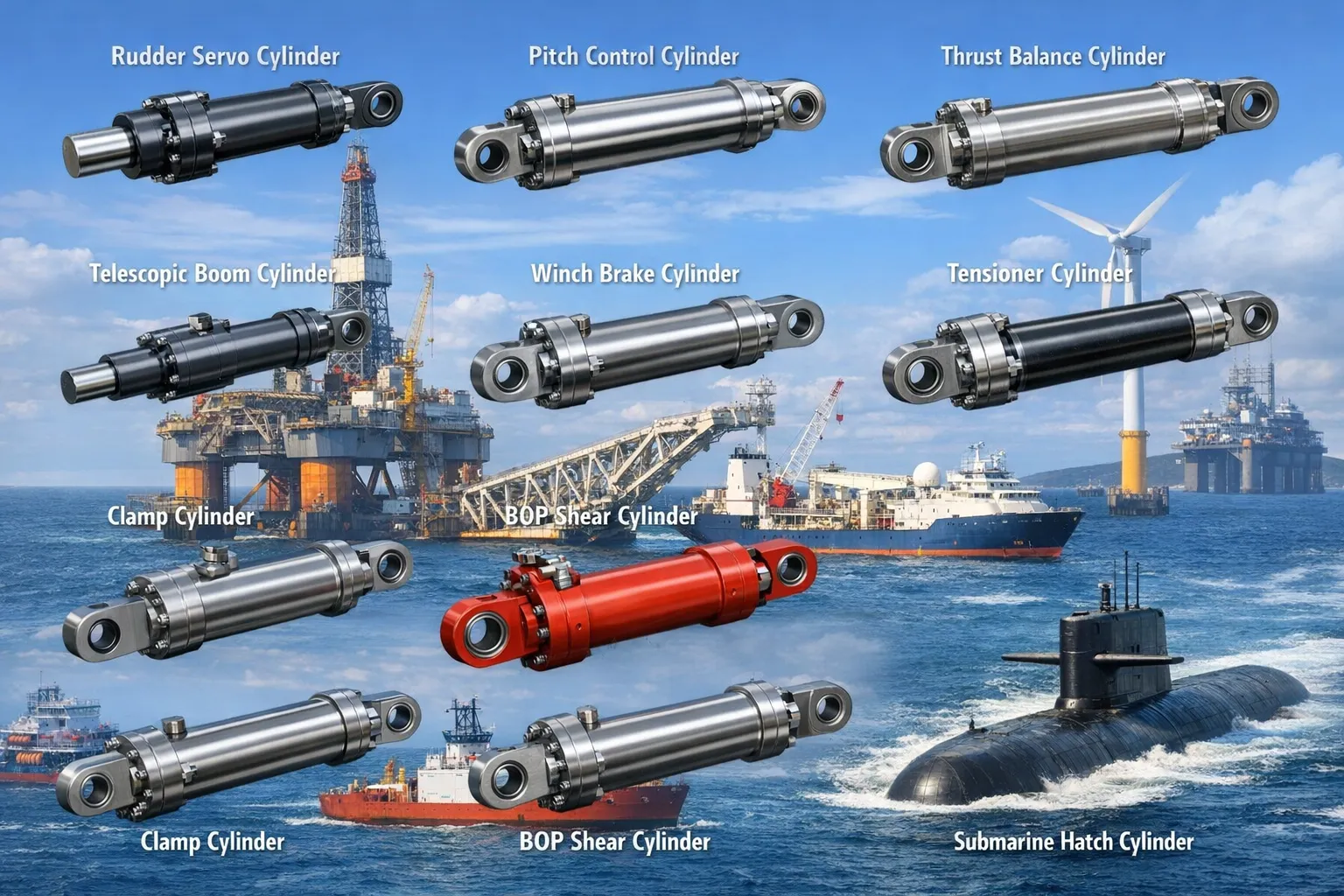
Beyond CPP hubs, our highly durable hydraulic rams are the preferred choice for steering gears, stabilizing fins, subsea valve actuation, and offshore active heave compensation equipment where saltwater corrosion is a constant threat.
Metallurgy & Heavy Manufacturing
In environments characterized by extreme radiant heat and highly abrasive metallic dust, our ceramic-coated cylinders reliably actuate furnace doors and continuous casting machinery. Explore our metallurgical and iron industry solutions.
Mining & Subterranean Excavation
Underground mining requires actuators that can withstand massive lateral shock loads and constant vibration without buckling. Our welded structures power rock crushers and tunnel borers. View our mining industry capabilities.
Heavy Construction Machinery
For earthmoving equipment operating in harsh environments, reliability is paramount. From massive excavator booms to articulating dump trucks, our units prevent load dropping. Review our construction machinery industry applications.
New Energy & Wind Power
Similar to marine propellers, massive offshore wind turbines rely critically on pitch control cylinders to adjust blade angles, optimizing aerodynamic efficiency and preventing over-speeding during severe storms.
Plastics & Rubber Machinery
High-speed injection molding machines demand rapid, highly accurate servo-hydraulic clamping strokes to maintain strict production tolerances. Our low-friction designs provide the necessary micro-precision.
Comparative Analysis: Standard Actuators vs. Our High-Performance Solution
When evaluating heavy machinery, procurement teams must weigh the initial hydraulic cylinder price against the long-term total cost of ownership. The comparative matrix below clearly demonstrates why investing in application-specific marine engineering dramatically reduces operational expenditures and costly dry-docking fees over the vessel’s lifespan.
| Feature / Performance Metric | Standard Commercial Marine Cylinders | Our High-Performance Pitch Cylinder |
|---|---|---|
| Structural Design | Tie-rod assembly (Prone to stretching and loosening under dynamic loads) | Heavy-duty integrated welded structure (Absolute rigidity) |
| Material & Metallurgy | Standard carbon steel or 316L (Vulnerable to chloride attack) | Premium Duplex stainless steel (Extreme yield strength and PREN) |
| Rod Surface Protection | Hard chrome plating (High risk of micro-cracking and sub-surface rust) | Plasma-sprayed ceramic armor (Zero porosity, impenetrable shield) |
| Sealing Technology | Standard NBR / Polyurethane (Swells and degrades in oil-water mix) | FFKM Perfluoroelastomer (Maximum chemical resistance and stability) |
| Pitch Drift Risk (Internal Leakage) | High probability due to inevitable gradual seal wear and fluid bypass | Completely eliminated; absolute pressure lock guarantees blade position |
| Maintenance Lifecycle | High frequency (Requires regular dry-docking for resealing and repair) | Minimal (Designed for extended multi-year operational cycles) |
Proven Success in the Field: East Asian Case Studies
Theoretical specifications only prove their worth in the high-stakes reality of the open ocean. Our highly customized actuators are extensively trusted by leading maritime operators and shipyards across South Korea, Japan, and the wider Asia-Pacific region. Below are documented cases demonstrating our problem-solving capabilities.
Case Study 1: Eradicating Pitch Drift for a Commercial Container Fleet
Location & Client: Busan, South Korea – A major international commercial freight operator.
The Challenge: The operator was experiencing severe maneuvering inefficiencies due to critical internal leakage in their existing controllable pitch propeller system on a 14,000 TEU vessel. Their conventional OEM cylinders were failing every 18 months due to oil-water emulsion, leading to continuous blade angle drift and a noticeable 4% drop in fuel efficiency.
The Solution: The fleet technical director found us via a search for competitive hydraulic cylinder price versus performance ratios and reached out through our portal. We engineered four fully customized pitch hydraulic cylinder units manufactured from duplex stainless steel, utilizing FFKM seals to prevent the emulsion degradation that caused the previous failures.
Result & Client Feedback: Installed in October 2024, the vessel has logged over 10,000 operational hours with zero internal bypass.
Case Study 2: Offshore Support Vessel Azimuth Thruster Retrofit
Location & Client: Yokohama, Japan – Offshore Dynamic Positioning (DP) Support Fleet.
The Challenge: Operating in harsh, continuous saltwater immersion environments, the vessel suffered from extreme galvanic corrosion and pitting on the rods of their double acting steering and pitch systems. This caused stick-slip friction, severely impacting the DP system’s ability to hold station. The European OEM replacement lead time was quoted at over six months.
The Solution: We rapidly reverse-engineered and manufactured a replacement pitch cylinder featuring a heavy-duty welded structure and advanced HVOF ceramic spraying. The ceramic coating offered a non-porous, impenetrable shield against the highly corrosive saltwater, while the polished bore (Ra ≤ 0.2 µm) eliminated the stiction.
Result & Client Feedback: The vessel returned to active DP service safely ahead of schedule.
Case Study 3: Extending Lifespan for Coastal Ferries
Location & Client: Fukuoka, Japan – High-Frequency Coastal Passenger Ferry Operator.
The Challenge: The ferry performs dozens of rapid docking maneuvers daily, demanding continuous, violent pitch adjustments. Standard actuators were suffering from rapid seal degradation and structural fatigue at the mounting flanges, leading to a constant need for fixing hydraulic cylinders at local ports to prevent fluid leaks into the harbor.
The Solution: We supplied our heavy-duty welded pitch cylinder units designed with reinforced mounting points optimized via Finite Element Analysis (FEA). We implemented custom PTFE guide rings to handle the high-frequency lateral loads.
Result & Client Feedback: The ferry operator achieved a dramatic reduction in operational downtime.

Frequently Asked Questions (FAQ)
Procuring critical marine fluid power components requires absolute clarity. Below, our technical engineering specialists provide detailed responses to the most common inquiries we receive from naval architects, fleet procurement directors, and marine engineers.
Ready to Optimize Your Vessel’s Propulsion Reliability?
Do not let compromised actuators and the constant threat of internal leakage dictate your maintenance schedule or cause catastrophic vessel downtime. Partner with an expert manufacturer to engineer a custom pitch cylinder that guarantees precise pitch angle adjustment and unparalleled durability in the harshest saltwater environments.
Provide our team with your dimensional requirements or operational challenges, and we will deliver a comprehensive technical proposal designed to permanently upgrade your propulsion system.
Editor: Cxm