Lifting Arm Cylinder for Catenary Vehicle
Purpose-built for severe outdoor railway operations. Engineered with Q345D structural steel and massively reinforced ear mounts to definitively neutralize lateral wind loads and eliminate structural wear during high-altitude elevation.
Product Overview: The Core of High-Altitude Railway Maintenance
The operational continuity of electrified high-speed and metropolitan rail networks depends completely on the meticulous upkeep of the overhead catenary wire system. To service these high-voltage lines suspended meters above the track bed, transit authorities deploy highly specialized catenary maintenance vehicles. These heavy-duty railcars are equipped with extendable aerial booms that elevate technical crews, heavy tools, and massive copper cabling spools directly to the power lines. The absolute mechanical heart of this critical lifting operation—the single component that provides the raw upward thrust and ensures spatial stability for the human crew—is the lifting arm cylinder. Operating these elevated work platforms in outdoor environments, particularly along the exposed coastal and mountainous railway corridors of South Korea and broader East Asia, introduces a highly dangerous environmental variable: severe lateral wind loads.
When a standard commercial hydraulic cylinder is deployed to elevate a platform carrying personnel, the wind pushing sideways against the steel basket creates immense mechanical leverage. This aerodynamic force translates directly down the boom structure into massive twisting stresses concentrated at the cylinder’s mounting points. In generic mass-market actuators, this specific combination of heavy vertical lifting and severe lateral twisting leads directly to rapid, catastrophic wear on the ear mounts (the clevis brackets) and the trunnion pins. As these metal mounting points slowly grind against each other and wear down, the pinholes elongate and become ovalized. This introduces dangerous mechanical play into the joint, causing the elevated platform to violently sway and wobble in the wind, posing a severe fall hazard to the railway technicians working adjacent to live high-voltage lines.
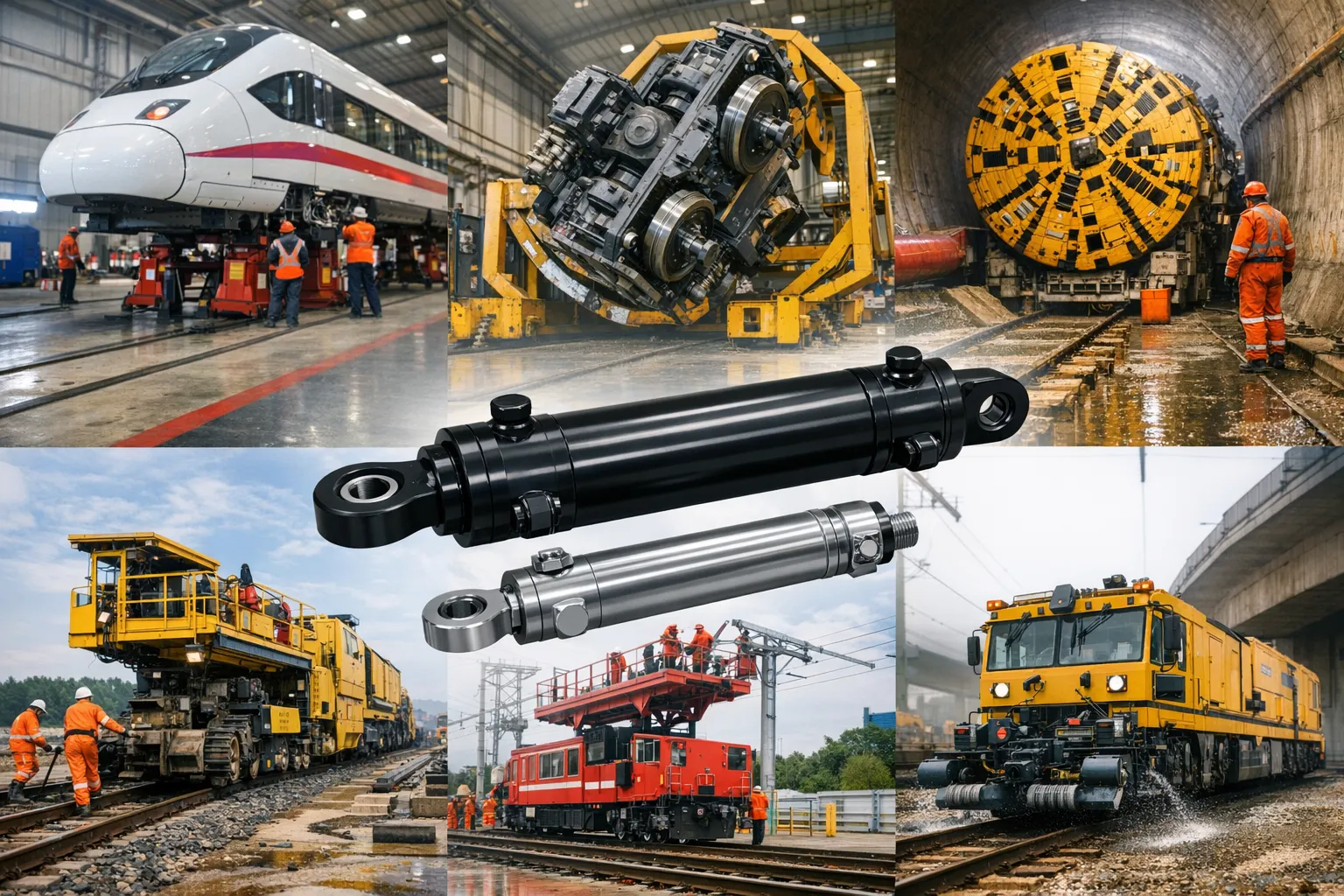
To permanently eradicate this life-threatening failure mode, our manufacturing facility has completely re-engineered the aerial elevation actuator. Operating as a globally trusted hydraulic cylinder manufacturer, we have heavily fortified the structural anchoring of the unit. By integrating massively reinforced ear mounts fitted with oversized, heavy-duty composite spherical bearings, and utilizing Q345D low-temperature structural steel for the main barrel, our lifting arm hydraulic cylinder safely absorbs and neutralizes severe outdoor wind loads without experiencing any mounting hole deformation. This meticulous engineering ensures that the aerial platform remains perfectly rigid and completely safe for technicians, even during harsh weather maintenance windows, significantly reducing the fleet’s necessity for emergency hydraulic cylinder repair and avoiding catastrophic boom collapse.
Comprehensive Technical Parameters
Integrating a specialized life-safety actuator into the hydraulic manifold of a complex railway maintenance vehicle requires absolute adherence to rigorous mechanical specifications. The following table details the baseline structural parameters, specialized metallurgical choices, and specific operational capabilities of our dedicated aerial elevation series.
| Engineering Specification | Material Data & Functional Configuration |
|---|---|
| Target Industry Sector | Rail Transit / Railway Infrastructure Upkeep |
| Specific Equipment Category | Catenary Maintenance Vehicle |
| Subsystem Integration | Aerial Lifting System / Scissor & Boom Lifts |
| Component Designation | Lifting Arm Cylinder |
| Hydraulic Action Mode | Double acting hydraulic cylinder with load-holding valving |
| Structural Base Type | Heavy-Wall Piston Type Linear Actuator |
| Manufacturing Architecture | 100% Fully Welded Construction for peak anti-vibration rigidity |
| Core Material System | Q345D Low-Alloy Structural Steel (Guaranteed low-temp toughness) |
| Rod Surface Treatment | Deep Hard Chrome Plated (Thickness: 30-50µm) |
| Environmental Operating Grade | Severe: Outdoor Weather + Heavy Lateral Wind Load |
| Critical Mechanical Function | Personnel and Equipment Lifting Operation |
| Primary Failure Mode Prevented | Ear Mount Wear / Clevis Hole Elongation |
| Core Engineering Configuration | Heavily Reinforced Ear Mounts with Spherical Bearings |
| Integrated Safety Valving | Direct-flange Counterbalance & Pilot-Operated Check Valves |
Operational Fluid Dynamics: Ensuring Aerial Stability
To fully appreciate the critical safety mechanisms built into our specialized aerial actuators, one must deeply understand the fluid dynamics governing high-altitude elevation. When the catenary vehicle operator initiates a lift command, the onboard hydraulic power unit pumps pressurized, anti-wear synthetic fluid into the base port (cap end) of the cylinder housing. This highly pressurized fluid exerts a tremendous, mathematically calculated hydrostatic force against the entire rear surface area of the internal hydraulic cylinder piston. Overcoming the immense static weight of the heavy steel scissor mechanism or telescopic boom, alongside the payload of the technicians and their cabling equipment, the hard-chromed rod extends smoothly upward. In this primary phase, the unit acts as an ultra-reliable, high-thrust lift cylinder.
In an application where human life is suspended high in the air, utilizing a single acting hydraulic cylinder is completely unacceptable. A single-acting design uses fluid to push the load up, but relies purely on gravity to bleed the fluid back into the reservoir and lower the platform. Gravity-return systems are highly dangerous in high-wind environments; if the boom experiences mechanical binding at the pivot pins or is pushed upward by a severe wind draft, a single-acting system cannot forcefully pull the platform down to safety. We strictly employ a double acting hydraulic cylinder architecture. This system utilizes powered fluid pressure to forcefully drive both the extension and the retraction strokes. This active, two-way fluid control guarantees that the platform responds instantly and predictably to the operator’s commands, completely unaffected by external weather forces.
The ultimate danger in aerial operations is sudden fluid pressure loss due to a ruptured hose on the vehicle chassis. If a hose bursts, gravity will instantly pull the platform down. To physically prevent this catastrophic scenario, our lifting arm hydraulic cylinder features highly specialized load-holding counterbalance valves directly flanged into the steel barrel. These valves mechanically lock the high-pressure fluid inside the cylinder chamber. Even if the main hydraulic lines are completely severed, the fluid remains trapped, turning the fluid column into a solid, unyielding structural pillar that keeps the boom safely suspended in mid-air until emergency rescue procedures can be initiated. The reinforced ear mounts serve as the vital anchor point, safely transferring these immense fluid-locking forces and lateral wind stresses directly into the vehicle’s heavy chassis without warping or shearing.
Seamless Dimensional Replacement for Railway Fleets
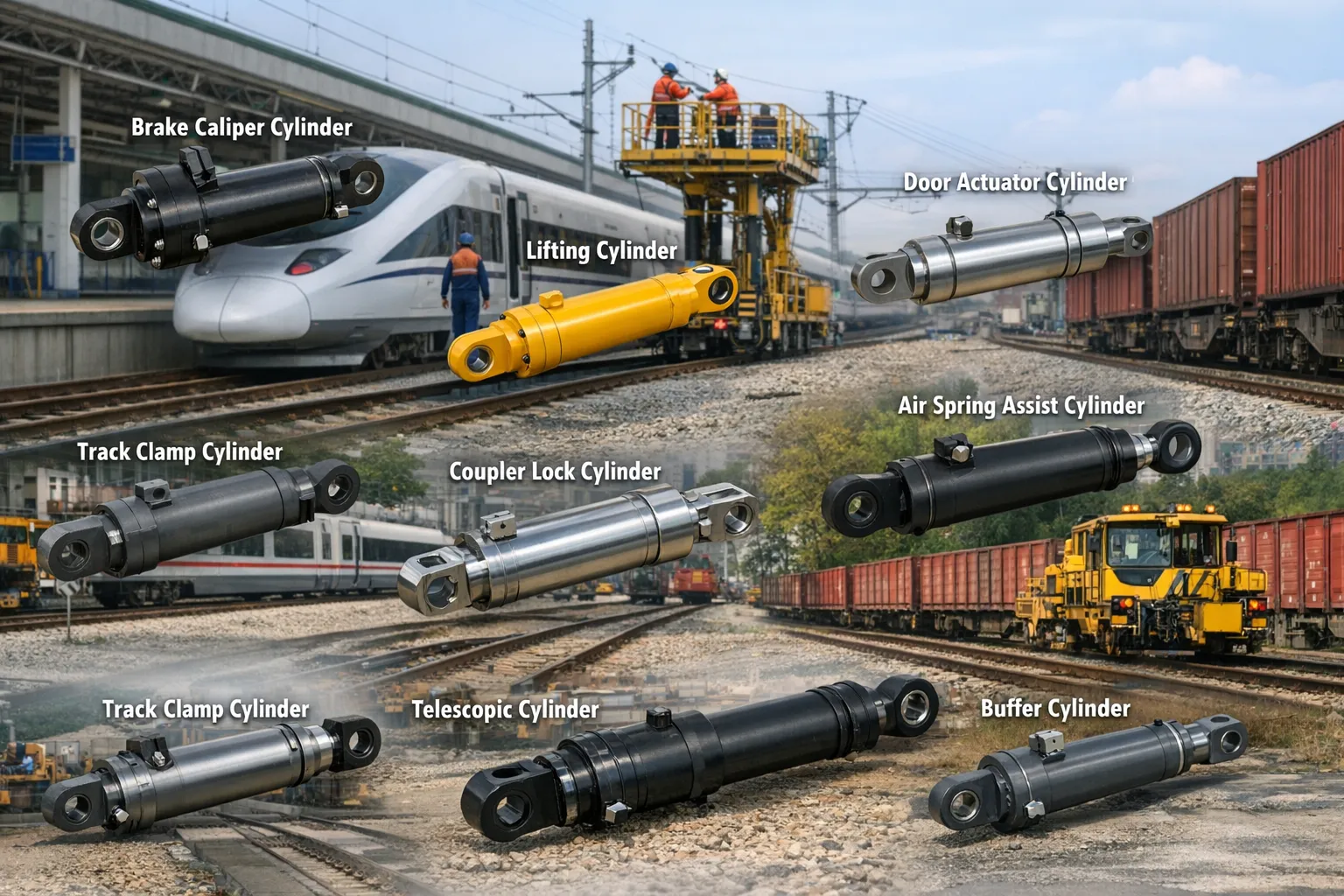
Procurement directors managing massive rolling stock and maintenance fleets constantly battle long-term supply chain inefficiencies. When the factory-installed lifting actuators on an aging catenary vehicle begin to exhibit dangerous mechanical play in the mounting ears, replacing them directly through the original European or American equipment manufacturer is often highly problematic. OEMs frequently dictate unacceptable production lead times and demand a drastically inflated hydraulic cylinder price. Furthermore, attempting localized fixing hydraulic cylinders routines by welding new ears onto fatigued, thin-walled factory cylinders is a severe violation of heavy-lifting safety protocols and will fail catastrophic structural audits.
We provide a highly robust, engineered alternative. As a highly agile manufacturing facility, we specialize in the reverse-engineering of bespoke hydraulic parts to act as exact dimensional drop-in replacements for legacy machinery. By analyzing your existing structural blueprints or measuring a physical sample, our engineering department flawlessly matches the closed pin-to-pin dimensions, stroke lengths, internal counterbalance valve portings, and the specific geometries of your mounting brackets. We regularly produce heavily upgraded replacements for overhead line vehicles originally manufactured by global brands such as Plasser & Theurer, Robel, Geismar, Zephir, and Harsco Rail. Your mechanics receive a fortified, wind-resistant actuator that bolts directly into the existing boom structure without requiring any chassis modification or custom welding. This approach allows fleets to obtain superior hydraulic cylinder components directly from the source.
Legal Trademark Disclaimer: The brand names, specific maintenance vehicle models, and registered trademarks mentioned above are the exclusive intellectual property of their respective global corporate owners. We reference these entities strictly for technical cross-referencing, dimensional compatibility analysis, and to assist fleet mechanics in accurate component selection. We operate as an independent manufacturing factory of premium aftermarket replacement units and maintain no formal affiliation or sponsorship with these corporations. Our products are engineered specifically to correct the structural vulnerabilities found in mass-produced factory units.
Core Technological Advancements: Conquering Wind Load and Weather
Elevating personnel in an outdoor transit environment demands an uncompromising approach to metallurgical strength and environmental defense. The distinct longevity of our lifting arm cylinder stems from a focused engineering effort to defeat aerodynamic side-loads and atmospheric corrosion. Here are the core technical advantages integrated into our platform:
-
1. Massively Reinforced Ear Mounts with Spherical Bearings
This is our primary defense against wind load. Standard mounting ears are cast or made from thin plate steel, which quickly deforms and ovals out under side-stress. We utilize massively thick, forged alloy steel for our base and rod ear mounts. We deeply TIG weld these oversized mounts directly to the Q345D barrel. Additionally, we press-fit heavy-duty, self-lubricating spherical plain bearings into the eyelets. These specialized bearings absorb the twisting torsion and allow the cylinder to articulate smoothly, entirely eliminating the metal-on-metal grinding that destroys standard mounting holes.
-
2. Q345D Low-Temperature Structural Steel Matrix
Railway maintenance does not stop for winter storms. Standard 1045 carbon steel becomes dangerously brittle in freezing temperatures, posing a catastrophic fracture risk if sudden shock loads occur during a winter lift. We forge our structural barrels entirely from Q345D low-alloy steel. The “D” certification guarantees that the steel maintains its high impact toughness and structural ductility even when operating in severe -20°C environments, ensuring absolute lifting safety year-round.
-
3. Extreme Outdoor Atmospheric Defense (Micro-Cracked Chrome)
Actuators mounted externally on vehicles face relentless exposure to acid rain, freezing sleet, and highly corrosive coastal salt fogs. If the cylinder rod rusts, the abrasive oxidation will instantly shred the internal wiper seals upon retraction. We subject our Q345D alloy rods to a specialized, extra-thick micro-cracked hard chrome plating process. The microscopic crack network in the chrome traps a micro-layer of hydraulic oil as the rod retracts, providing a permanent, self-renewing barrier against rust and ensuring a frictionless surface for the pressure seals.
-
4. 100% Fully Welded Anti-Vibration Rigidity
When the maintenance vehicle travels at high speeds along the rail tracks, the undercarriage and booms endure massive kinetic vibration. Hydraulic rams built with threaded tie-rods will inevitably vibrate loose over time, leading to catastrophic high-pressure fluid loss. We employ automated Submerged Arc Welding (SAW) to permanently fuse the heavy reinforced ear mounts and end caps directly to the barrel, creating an unyielding, unified pressure vessel completely immune to transit vibration.
-
5. Advanced Ultra-Low Friction Sealing Matrix
Smooth, predictable elevation is critical when working near active power lines. Standard rubber seals can cause “stick-slip” juddering during slow lifting. We utilize an advanced matrix of aerospace-grade PTFE (Polytetrafluoroethylene) step seals mixed with high-resilience elastomeric energizers. This guarantees perfectly smooth, millimeter-precise vertical actuation without any mechanical hesitation, ensuring operator comfort and safety.
-
6. Direct-Flange Load Holding Safety Valving
The foundation of aerial safety is redundancy. We integrate highly precise counterbalance valves directly into the steel housing of the cylinder. If the vehicle’s pump fails or a main hose is accidentally severed, these internal steel valves instantly slam shut, mechanically trapping the pressurized fluid inside the barrel and physically preventing the aerial boom from dropping.
Autonomous Manufacturing Mastery & Quality Traceability
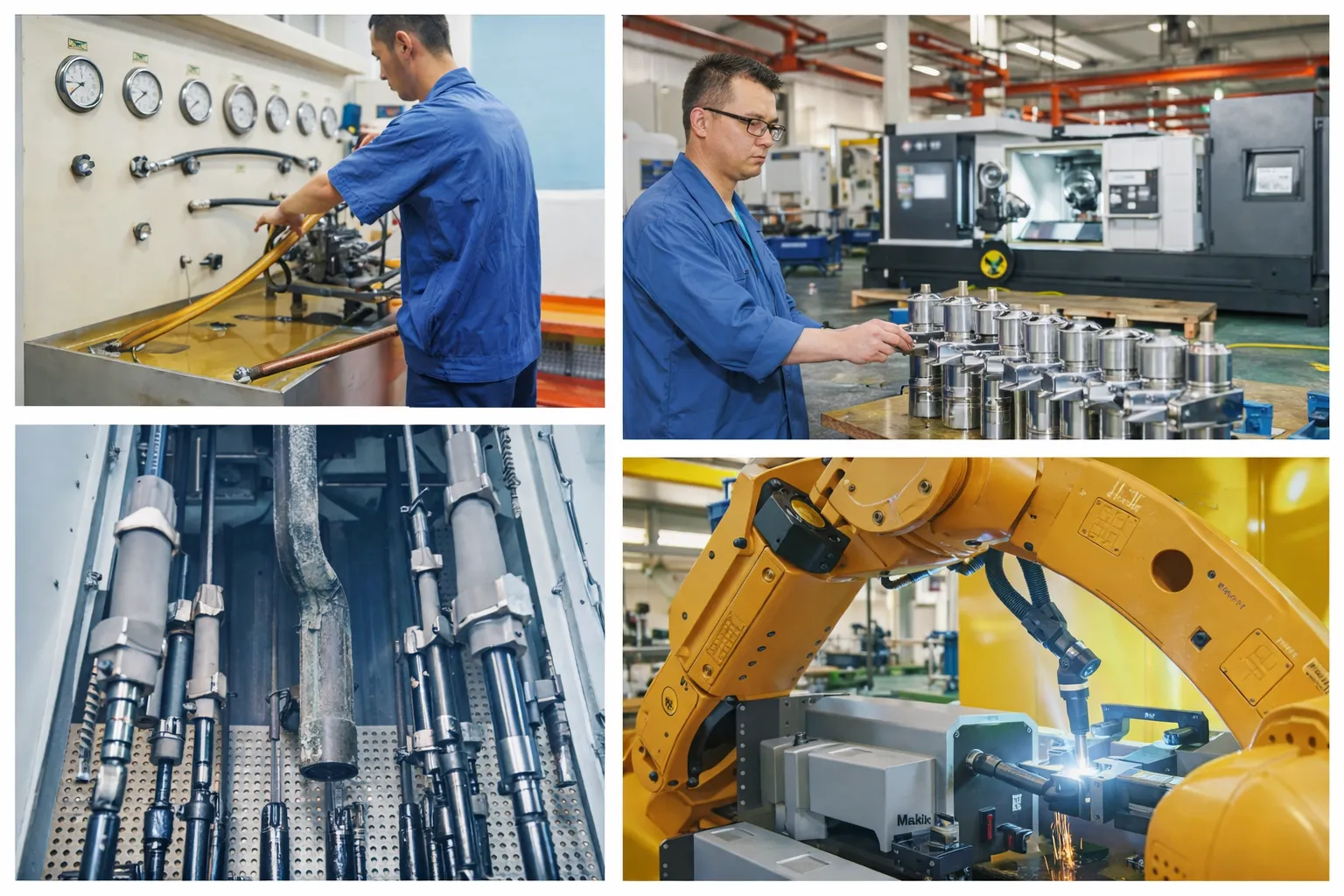
Forging life-safety lifting equipment requires an absolute rejection of outsourced, fragmented assembly lines. As an authoritative and fully integrated facility, we maintain 100% sovereign control over the entire production lifecycle. Every raw billet of Q345D steel delivered to our factory is immediately quarantined and verified using optical emission spectrometry. This strict metallurgical validation confirms the exact alloy composition, ensuring the steel mathematically meets our high-yield requirements before any CNC machining commences.
The internal bores of our lifting barrels are subjected to highly precise CNC skiving and roller burnishing. This process intensely compresses the internal steel grain, creating an exceptionally hard, mirror-like finish (Ra ≤ 0.2µm). This flawless surface drastically reduces dynamic friction against the high-pressure seals, effectively doubling their operational lifecycle. Furthermore, every structural load-bearing weld connecting the reinforced ear mounts to the main barrel is rigorously analyzed using Ultrasonic Non-Destructive Testing (NDT) to guarantee perfect, deep joint penetration without any sub-surface slag voids.
Our quality assurance testing is absolute. We do not rely on random batch sampling. Every single lifting arm hydraulic cylinder is secured into our high-capacity testing rigs and statically pressurized to 1.5 times its designated maximum working pressure. We hold this severe pressure to mathematically verify zero internal fluid bypass across the piston and zero external weeping. Upon passing, a permanent alphanumeric serial number is laser-etched onto the barrel. Decades into the future, your fleet mechanics can reference this number, allowing us to instantly pull the exact CAD blueprints, seal profiles, and steel heat records, making future hydraulic cylinder repair routines incredibly fast and accurate.
Versatile Heavy-Duty Elevation Applications
The extreme metallurgical strength, integrated counterbalance safety, and heavily reinforced mounting architecture required to elevate personnel near high-voltage lines result in an exceptionally robust fluid power platform. Our wind-resistant design excels in other severe-duty industrial sectors where heavy lifting and environmental exposure intersect:
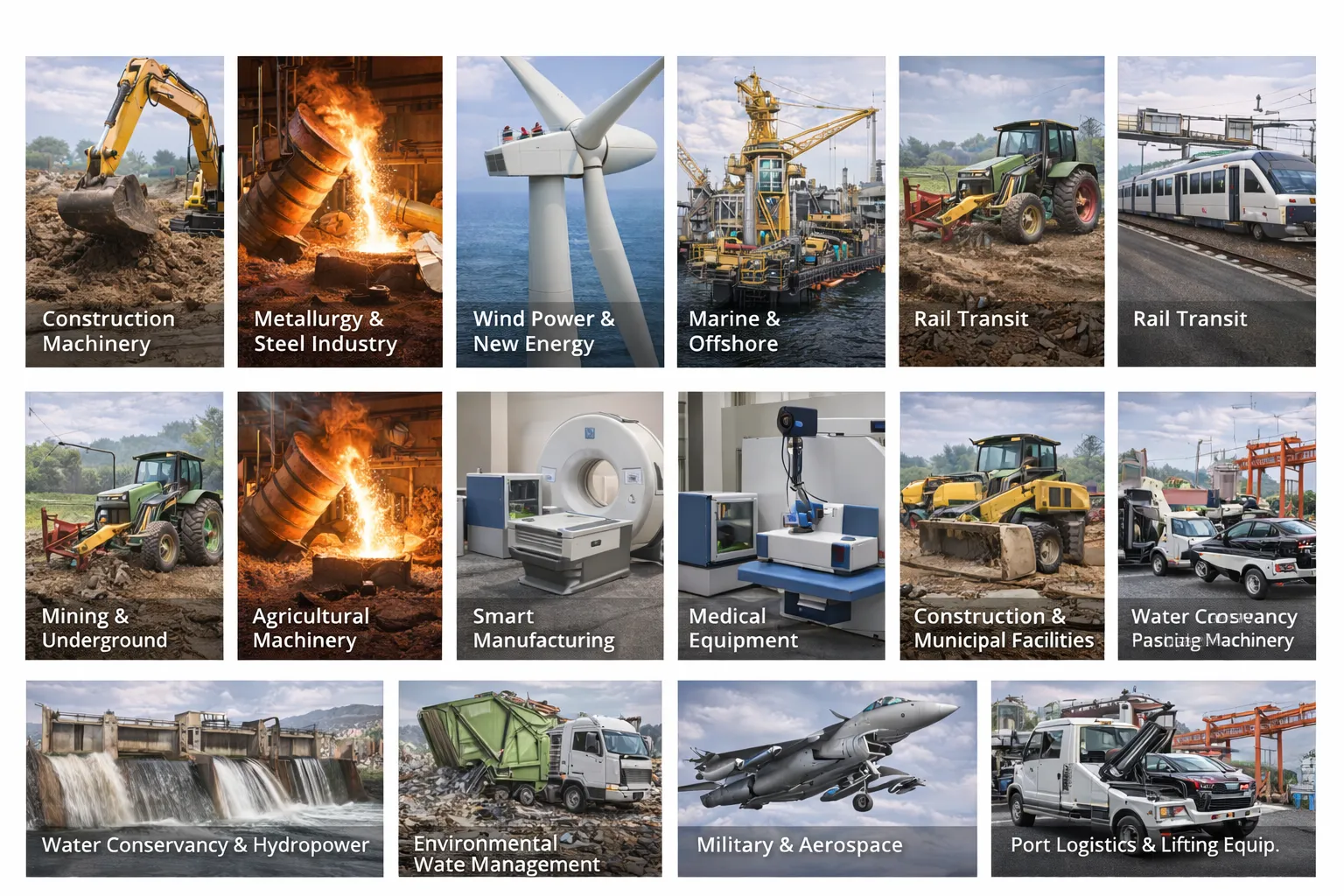
- Construction Machinery Industry: Mobile crane outriggers, heavy articulated man-lifts, and large-scale boom trucks heavily utilize these reinforced actuators to provide unyielding vertical stability and resist twisting loads when operating on uneven, muddy construction sites.
- Wind Power and New Energy: Specialized maintenance platforms used for servicing towering wind turbine blades rely on our Q345D steel cylinders to resist the massive offshore or high-altitude wind gusts that threaten to destabilize the work baskets.
- Marine and Offshore Sector: Shipboard deck cranes and offshore oil rig access platforms employ our heavily chrome-plated cylinders, trusting the reinforced ear mounts to survive the violent, continuous swaying of the ocean swells while completely resisting saltwater corrosion.
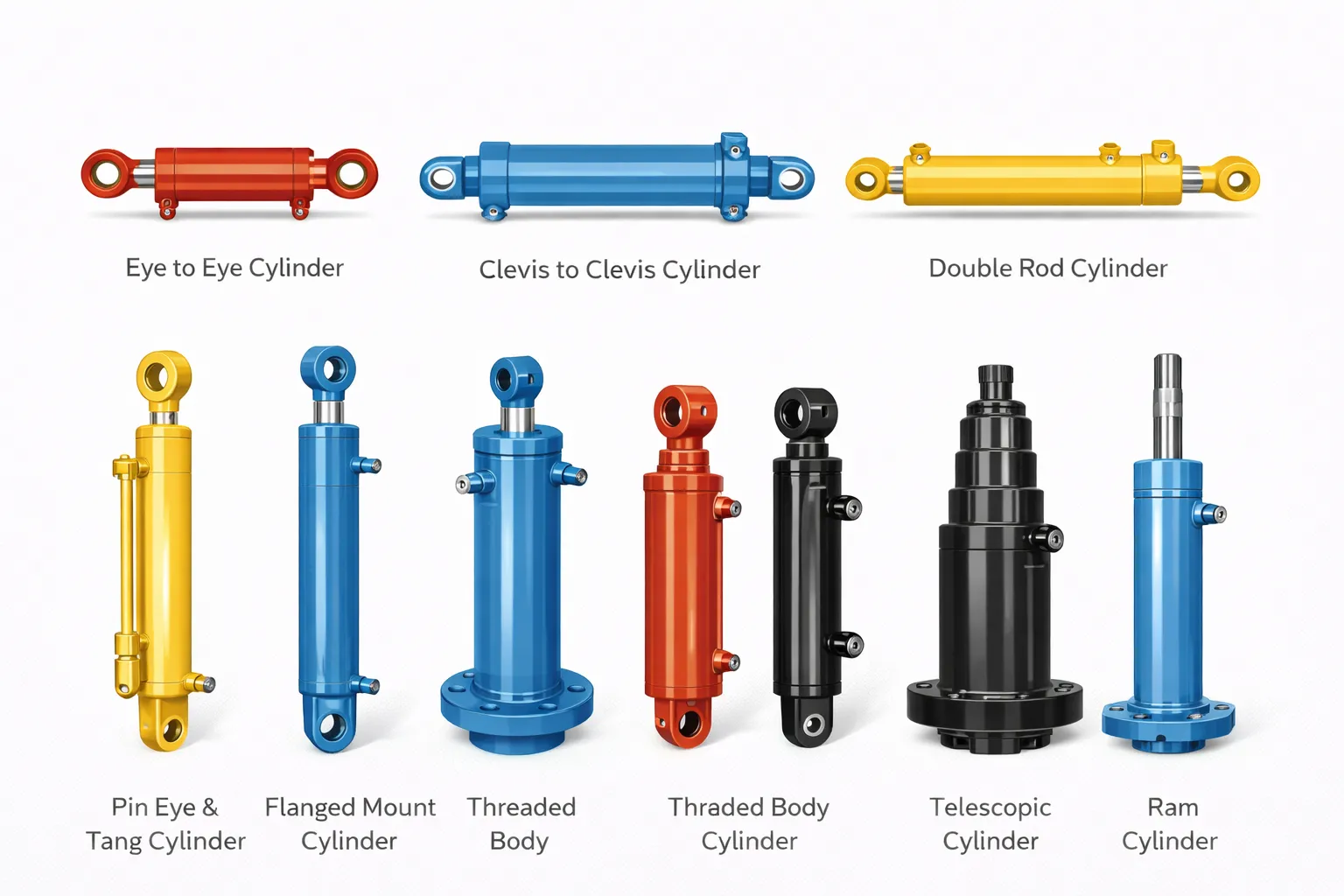
Comparative Analysis: Standard Commercial Actuator vs. Our Lifting Arm Cylinder
Attempting to minimize upfront capital expenditure by installing standard catalog cylinders into an elevated life-safety application is a profound engineering miscalculation. The initial savings rapidly evaporate due to structural failure, vehicle downtime, and extreme safety liabilities. The comparative table below outlines the critical differences.
| Engineering Metric | Standard Commercial Cylinder | Our Specialized Lifting Arm Cylinder |
|---|---|---|
| Mounting Architecture | Thin, rigid steel clevises (Rapidly stretches, ovalizes, and snaps under wind load) | Oversized Reinforced Ear Mounts with Spherical Bearings (Absorbs twisting torque) |
| Base Metallurgy | Standard 1045 Carbon Steel (Becomes brittle and poses fracture risk in sub-zero winters) | Q345D Structural Steel (Maintains immense ductility and strength down to -20°C) |
| Load Holding Safety | Relies on external vehicle valves (Hose rupture causes immediate platform free-fall) | Integrated Flange Counterbalance Valves (Mechanically locks the load in place upon failure) |
| Structural Fastening | Threaded Tie-Rods (Vibrates loose during fast rail transit, dumping fluid) | 100% Fully Welded construction (Creates an unyielding, vibration-proof pressure vessel) |
| Long-Term Economics | Constant fleet downtime and extremely high ongoing hydraulic cylinder repair costs. | Maximizes vehicle uptime, vastly improves safety, and delivers massive Return on Investment. |
Real-World Case Studies: Securing Asian Infrastructure Safety
The functional superiority of our specialized fluid power engineering is continually validated by our clients in the field. Below are specific accounts of how our technical interventions solved critical maintenance failures for major railway operators across East Asia.
Case Study 1: National High-Speed Rail Operator (South Korea)
Location: Seoul to Busan Corridor | Application: High-Altitude Catenary Tensioning
The Engineering Crisis: A leading national rail maintenance consortium was experiencing a terrifying safety crisis during their high-altitude catenary inspections. Strong valley crosswinds were violently twisting the elevated platforms. The lateral torque tore at the rigid mounting clevises of their factory-installed cylinders. Within eight months, the mounting ears were severely galled and ovalized, creating massive mechanical play that caused the platform to sway up to half a meter while suspended near 25kV power lines.
Consultation & Solution: The chief fleet safety officer found our specialized manufacturing portfolio via a B2B engineering search for heavy-duty hydraulic parts. We re-engineered their entire boom lift actuation system. We manufactured a batch of customized lifting arm cylinder units featuring massively reinforced ear mounts integrated with self-aligning spherical bearings to absorb the wind-induced twisting entirely.
Operational Result: The new units were retrofitted directly into the existing boom structures. Over the next two years, ultrasonic and physical inspections revealed absolutely zero wear or ovalization on the mounting points. The platform swaying was completely eliminated, restoring total confidence and safety for the linemen.
“The integration of the spherical bearings in your reinforced ear mounts completely solved our wind-sway issues. The original equipment was literally tearing itself apart. Your custom double acting hydraulic cylinder design handles the lateral stress flawlessly, and the direct engineering support made the upgrade seamless.” — Mr. Park, Lead Fleet Safety Director.
Case Study 2: Mountainous Region Transit Authority (Japan)
Location: Hokkaido | Application: Heavy Winter Track Sweeping and Line Repair
The Engineering Crisis: Operating in extreme winter conditions, this authority was plagued by equipment fracturing. The standard carbon steel lifting cylinders on their repair vehicles became incredibly brittle at -15°C. A sudden mechanical jolt while lifting a heavy spool of copper wire caused the base of the cylinder to crack catastrophically, instantly dropping the boom.
The Solution: We replaced the failing units with our highly specialized, cold-weather rated Q345D steel actuators. By guaranteeing the metallurgical ductility down to -20°C, we provided an unbreakable structural foundation. We also upgraded the chrome plating to resist the heavy track de-icing chemicals used in the region.
Operational Result: The authority eradicated their cold-weather fracture issues entirely. The fleet remained fully operational throughout the harshest winter storms, allowing for critical emergency power line repairs without fearing equipment failure.
Case Study 3: Metro Line Electrification Contractor (Taiwan)
Location: Taipei | Application: Elevated Scissor Lifts (Typhoon Season Operations)
The Engineering Crisis: A contractor utilizing European-built scissor lifts for overhead wiring found the OEM replacement cylinders impossibly expensive and burdened with a five-month lead time, halting their construction schedule during a critical expansion phase.
The Solution: Operating as a direct manufacturer, we took their OEM dimensional blueprints and produced exact geometric replicas. We upgraded the internal seals to our low-friction PTFE matrix and implemented the reinforced mounting ears to deal with the notorious Taiwanese coastal wind gusts.
Operational Result: We delivered the upgraded cylinders in under 30 days via ocean freight. The contractor bolted them directly into the scissor mechanisms, saving months of downtime and massively reducing their overall procurement budget.
Expert Technical FAQ for Engineering Procurement
Specifying life-safety lifting equipment requires rigorous technical due diligence. Below, we provide comprehensive answers to the most frequent inquiries raised by fleet mechanical engineers and B2B procurement managers regarding our elevation solutions.
1. Exactly how do spherical bearings in the ear mounts prevent wind-load damage?
Standard mounting ears use a simple cylindrical hole and a rigid steel pin. When wind hits the elevated platform, the structure twists slightly. Because the pin is rigid, this twisting creates immense binding force that gouges and ovalizes the hole. A spherical bearing operates like a human ball-and-socket joint. It allows the hydraulic cylinder to safely tilt and pivot a few degrees in any direction. This micro-flexibility entirely absorbs the twisting torque of the wind, ensuring the mounting pin remains perfectly seated and eliminating structural wear.
2. Why is a Double-Acting cylinder safer than a Single-Acting design for platform descent?
A single acting hydraulic cylinder relies entirely on the gravitational weight of the platform to push the fluid out and lower the boom. In harsh outdoor conditions, mechanical pivot joints on the boom can rust or freeze, causing the mechanism to bind. Gravity isn’t strong enough to un-jam it, leaving the crew stranded. A double-acting design actively pumps high-pressure fluid into the rod end. This immense mechanical pulling power easily forces the platform down through any mechanical binding, guaranteeing the crew can always return safely to the ground.
3. Can you match the exact mounting dimensions of our existing European maintenance vehicles?
Absolutely. Producing bespoke, drop-in replacements for aging OEM fleets is our primary expertise. By providing us with the original manufacturer part numbers, precise dimensional blueprints, or a physical sample, we will manufacture the new lifting arm cylinder to identically match your specific closed pin-to-pin dimensions, heavy trunnion mounts, and hydraulic port threads, guaranteeing a zero-modification installation for your depot mechanics.
4. How does the counterbalance valve prevent the platform from falling if a hose breaks?
The counterbalance valve is physically bolted or welded directly to the steel barrel of the cylinder. It acts as a one-way mechanical check valve. Fluid can enter easily to raise the platform, but the valve mechanically locks shut to prevent fluid from escaping. The only way it opens is if the vehicle’s pump actively supplies a separate “pilot” pressure signal to unlock it. Therefore, if a main hydraulic hose severs, the pilot pressure is lost, the valve instantly slams shut, and the platform remains safely suspended in mid-air.
5. What specific variables determine the final procurement hydraulic cylinder price for a fleet upgrade?
Because we operate autonomously and supply directly from our factory floor to the fleet contractor, we completely bypass third-party distributor markups. The final hydraulic cylinder price is strictly determined by the physical dimensions (total weight of the Q345D steel), the complexity of the machined spherical ear mounts, the integration of specific counterbalance valving, and the total order volume. We consistently deliver vastly superior engineering at a highly competitive, factory-direct budget point.
6. Can our depot technicians perform standard fixing hydraulic cylinders routines on these welded units?
Yes. While the primary barrel and rear ear mounts are deeply welded to survive severe vibration, the front sealing gland (the rod head) is intentionally designed for mechanical accessibility. Using heavy-duty spanners, your on-site mechanics can unthread or unbolt the head to extract the internal hydraulic cylinder piston, allowing them to quickly inspect the bore and replace the dynamic seals. This engineering enables highly efficient hydraulic cylinder repair routines right in your own maintenance depot.
7. What are the standard manufacturing lead times for shipping to South Korea or East Asia?
For a batch of highly customized, heavily reinforced Q345D lifting units, standard autonomous production requires 25 to 35 working days, highly dependent on current factory workload and specific bearing availability. Because we retain 100% control over the machining, welding, and pressure testing, we can frequently expedite orders to resolve severe fleet breakdowns. Fast ocean freight routing to major transit hubs like Busan, Incheon, or Keelung is highly streamlined.
Ensure Uncompromising Safety for Your Elevated Maintenance Crews
Do not allow standard, inadequate fluid power components to compromise the structural integrity of your high-voltage maintenance vehicles. When elevating personnel into severe wind environments, failure is not an option. Partner with a specialized hydraulic cylinder manufacturer capable of engineering absolute rigidity, metallurgical strength, and wind-load resilience into every actuator.
Editor: Cxm