Marine Luffing Hydraulic Cylinder for Deck Crane
Heavy-duty double acting hydraulic cylinder engineered for cargo crane luffing systems — built to withstand saltwater corrosion, shock loads, and years of continuous offshore service.
Product Overview
When a cargo crane lifts a 30-ton steel coil in the middle of the East China Sea, there is exactly one component controlling the boom angle under wind gusts, wave-induced roll, and sudden load swings: the luffing hydraulic cylinder. Fail here, and the entire lifting operation stops — or worse, becomes dangerous.
This is the component we build. Our marine luffing cylinder is a welded, double acting piston cylinder specifically designed for deck crane boom luffing systems on cargo vessels, offshore supply ships, and floating production platforms. Every unit leaves our facility with nickel-plated rod surfaces, 42CrMo forged steel internals, and salt-spray-rated seals that maintain full stroke precision even after thousands of hours in open-ocean conditions.
As a dedicated hydraulic cylinder manufacturer, we have supplied luffing cylinders for deck cranes operating across South Korea, Japan, Southeast Asia, and beyond. Whether you are building new vessels in Busan or retrofitting aging cranes in Ulsan, our engineering team can match your exact mounting geometry, stroke length, and pressure rating — typically within 3 to 4 weeks from order confirmation.
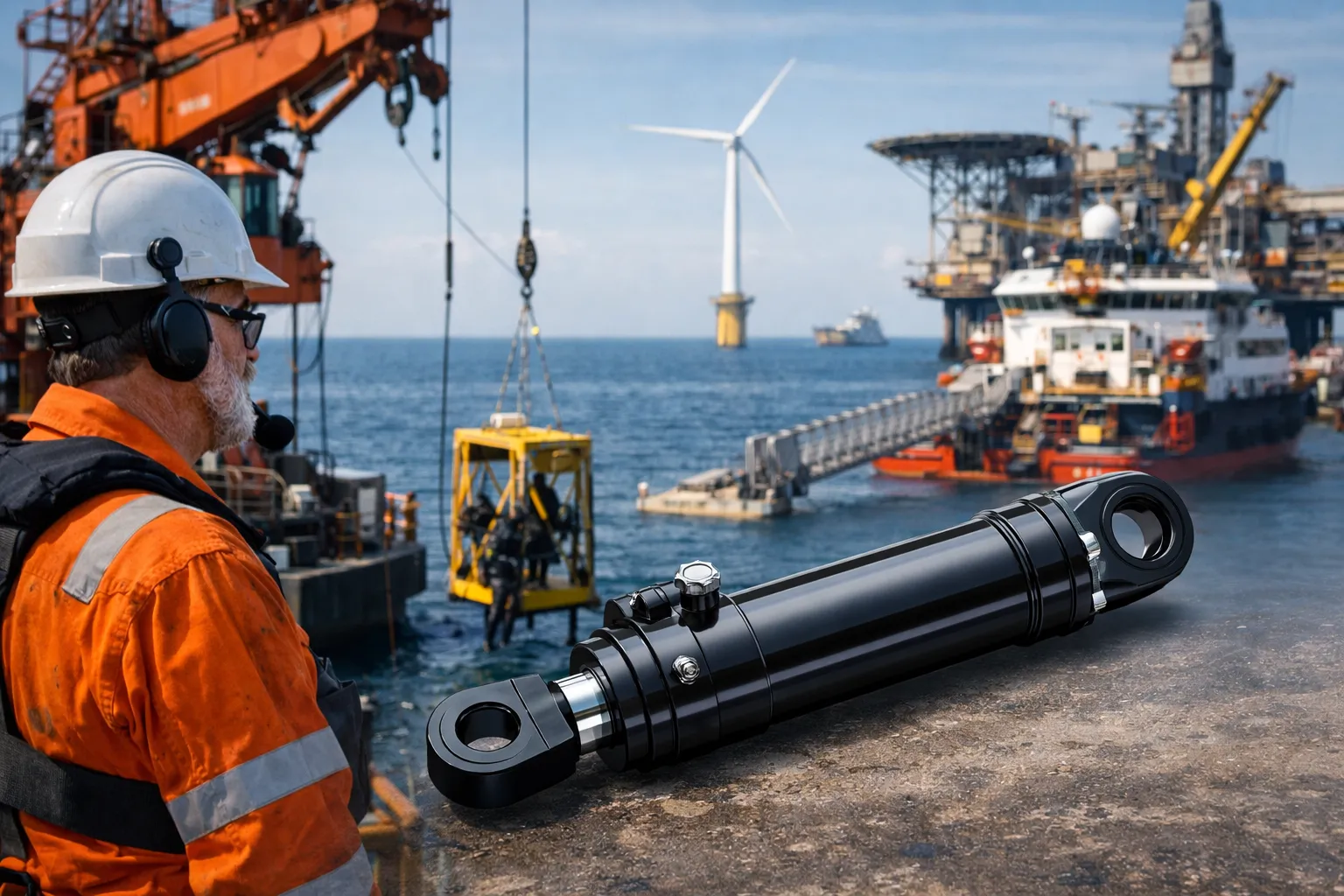
What separates our product from generic hydraulic oil cylinders on the market is straightforward: we do not produce general-purpose units and hope they survive at sea. Every dimension, seal material, surface treatment, and test protocol is chosen specifically for the salt fog, mechanical shock, and cyclic fatigue that deck crane luffing systems experience daily. That focus is why repeat orders account for over 60% of our marine cylinder business.
Technical Specifications
Below are the customizable parameter ranges for our marine luffing hydraulic cylinder. All values can be tailored to your crane design and classification society requirements.
Basic Specifications
| Parameter | Customizable Range |
|---|---|
| Bore Diameter | 100 mm – 500 mm |
| Rod Diameter | 70 mm – 360 mm |
| Stroke Length | 500 mm – 5000 mm |
| Operating Pressure | 16 MPa – 35 MPa |
| Test Pressure | 1.5x rated pressure |
| Action Type | Double acting |
| Structure Type | Welded piston cylinder |
| Retracted Length | Customized per project |
Mounting Options
| Mounting Style | Description |
|---|---|
| Clevis / Trunnion | Standard for boom luffing; allows angular movement during crane operation |
| Flange Mount | Fixed mounting for space-constrained installations |
| Pin Eye / Spherical Bearing | Absorbs misalignment; recommended for high-shock marine environments |
| Custom Geometry | Designed to match existing crane mounting dimensions |
Materials and Surface Treatment
| Component | Material / Treatment |
|---|---|
| Cylinder Tube | Honed seamless steel tube, H8 tolerance; optional stainless steel liner |
| Piston Rod | 42CrMo forged steel, induction hardened, nickel plating (60-80 micron) |
| Piston | Ductile cast iron or forged steel with bronze wear rings |
| Seals | Hallite / Parker marine-grade polyurethane and PTFE compound seals |
| End Caps / Glands | Welded construction; optional bolt-on gland for field serviceability |
| External Coating | Marine epoxy primer + polyurethane topcoat (ISO 12944 C5-M) |
Environmental Adaptability
| Condition | Rating |
|---|---|
| Salt Spray Resistance | 1000+ hours (ASTM B117) |
| Operating Temperature | -25 C to +80 C |
| Shock / Vibration | Designed for DNV GL / ABS marine shock load profiles |
| Environmental Rating | Salt fog + mechanical impact (marine offshore grade) |
| IP Protection | IP66 external sealing available on request |
How the Luffing Hydraulic Cylinder Works
A deck crane luffing system adjusts the boom angle to position loads precisely over the cargo hold or quayside. The luffing cylinder is the actuator responsible for this movement, and its working principle is based on differential-area hydraulic force generation in a double acting hydraulic cylinder configuration.
During boom raising (luffing up), pressurized hydraulic fluid enters the cap-end port of the cylinder. This fluid acts on the full piston area, generating the push force needed to lift the boom and whatever load is suspended from the hoist. Because luffing-up is the high-force demand phase — the cylinder must overcome gravity, wind loads, and dynamic inertia simultaneously — the bore side is always the drive port.
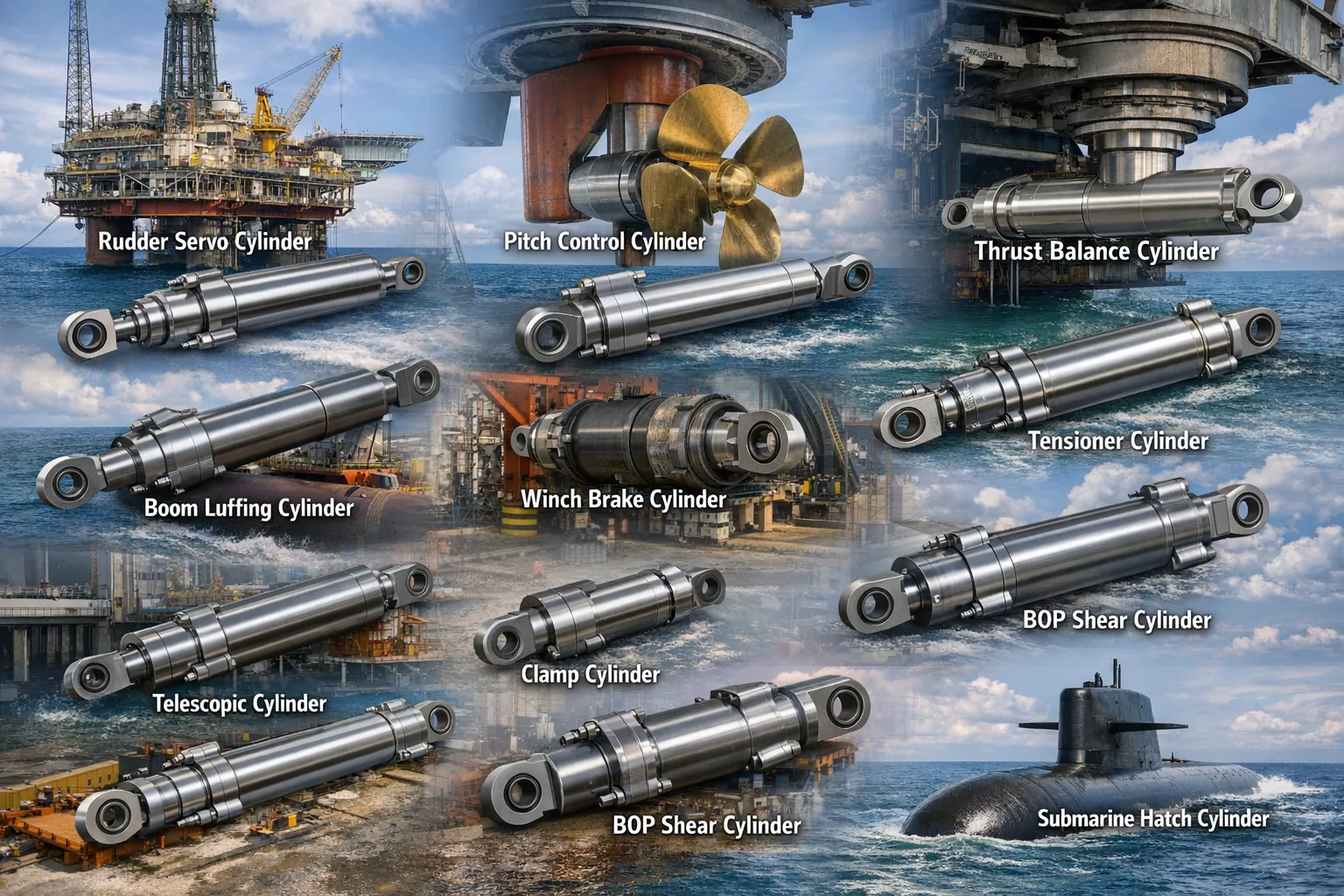
During boom lowering (luffing down), fluid is directed to the rod-end port. The annular area (piston area minus rod area) produces a controlled retraction force. A counterbalance valve in the hydraulic circuit prevents the boom from free-falling under its own weight, maintaining smooth and predictable descent regardless of sea state.
In practice, the cylinder rarely operates at static load. Waves cause the vessel to roll and pitch, which introduces lateral forces and oscillating loads into the hydraulic cylinder piston and rod assembly. This is precisely why our marine luffing cylinders use spherical bearing mounts, oversized rod diameters, and hardened guide rings — to absorb side-loading without accelerating seal or bearing wear.
The internal cushioning system at both ends of stroke decelerates the piston as it approaches its travel limit, preventing metal-to-metal impact that would otherwise damage end caps and generate dangerous pressure spikes in the circuit.
Compatible Replacement for Major Crane Brands
Note: Brand names mentioned below are used solely for cross-reference and selection convenience. They are registered trademarks of their respective owners and are not affiliated with our products.
Our marine luffing hydraulic cylinder is engineered as a direct dimensional and performance replacement for luffing cylinders used in the following deck crane systems:
- Liebherr CBB and CBW series marine cranes
- MacGregor (Cargotec) deck cranes and offshore cranes
- Huisman offshore and heavy-lift cranes
- Palfinger Marine PK and PKR deck crane systems
- ZPMC port and deck machinery
- Dongyang and KukDong marine cranes (commonly used in Korean shipyards)
- TTS (now Nekkar) cargo handling cranes
For each replacement project, we request the original cylinder drawing or at minimum the bore, rod, stroke, pressure rating, and mounting dimensions. Our engineering team will verify fit and prepare a GA drawing for your approval before production begins. This process typically takes 2 to 3 working days.
Explore our full range of custom hydraulic cylinders to find the right solution for your application.
Core Technical Advantages
Ultra-Low Friction Sealing System
We use a multi-lip, stepped seal arrangement combining PTFE guide rings with polyurethane dynamic seals. This reduces breakaway pressure by up to 30% compared to single-lip designs, which translates directly into smoother luffing motion and less heat generation during rapid cycling. Lower friction also means less rod and bore surface wear over time — a critical factor when you need 10,000+ operating hours between hydraulic cylinder repair intervals.
High-Rigidity Cylinder Body and Piston Rod
The cylinder tube is produced from cold-drawn seamless steel, honed to H8 internal tolerance, with wall thicknesses calculated for a 4:1 safety factor at maximum rated pressure. The piston rod is forged from 42CrMo alloy steel, quenched and tempered to 28-32 HRC core hardness, then induction hardened on the surface to 55+ HRC. This combination resists rod bending — the single most common failure mode in marine luffing applications — even under severe side-loading from vessel motion.
Nickel Plating for Saltwater Environments
Unlike standard hard chrome plating that can develop micro-cracks and allow corrosion to undermine the layer from within, our electroless nickel plating provides a dense, uniform, porosity-free barrier. The 60-80 micron nickel layer passes 1000+ hours of ASTM B117 salt spray testing, making it ideal for open-deck installations where direct seawater contact is unavoidable.
Thermal Stability Under Continuous Duty
Deck cranes in port operations may cycle continuously for 8 to 12 hours during cargo discharge. Our seal compounds and hydraulic fluid compatibility are rated for continuous operation at oil temperatures up to 80 C without degradation. Internal clearances are calculated to account for thermal expansion of the piston and tube, preventing seizure or excessive leakage during prolonged high-temperature operation.
Fatigue Life Optimization
Every weld joint on the cylinder body undergoes 100% ultrasonic examination. Critical stress points — particularly the cap-end weld and trunnion attachment zones — are designed with full-penetration welds and smooth radius transitions that minimize stress concentration. The result is a fatigue life that meets or exceeds classification society requirements for 20-year vessel design life.
Integrated Cushioning for Shock Absorption
Built-in adjustable cushions at both stroke ends decelerate the piston progressively, absorbing kinetic energy that would otherwise create damaging pressure peaks. This is particularly important on deck cranes where sudden load release or emergency stops can generate shock pressures 3 to 5 times the normal operating level.
Precision Bore Geometry for Consistent Seal Life
Internal bore surfaces are honed to Ra 0.2-0.4 micrometers with cross-hatch angles maintained at 20-30 degrees. This specific surface finish retains a micro-thin oil film that lubricates the seal during every stroke cycle, preventing dry-running wear. The result: seal life consistently reaches 8,000 to 12,000 operating hours in marine service conditions.
Modular Port and Sensor Configuration
Port sizes, locations, and orientations are fully customizable. We can integrate pressure sensor bosses, position transducer mounting provisions, and load-holding valve interfaces directly into the cylinder body, reducing external piping and potential leak points on the installed system.
Manufacturing Process and Quality Control
Full In-House Manufacturing
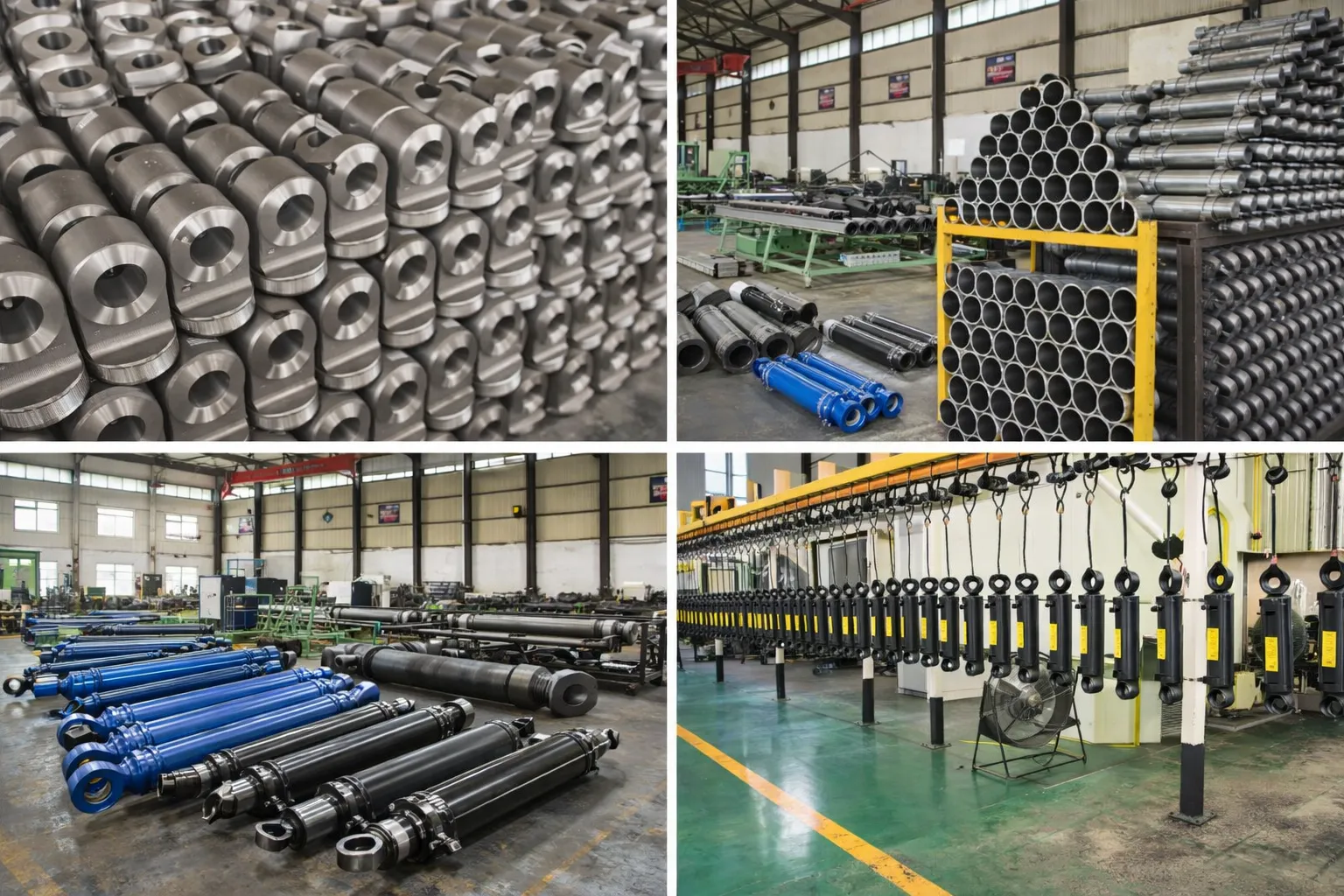
From raw material incoming inspection to final painting and packing, every production step is performed in our own facility. This includes CNC machining of all steel components, deep-hole boring, internal honing, induction hardening, nickel plating, welding, seal assembly, and functional testing. No outsourced processes means complete control over lead times, tolerances, and traceability.
100% Factory Testing — Every Unit
Before any cylinder leaves the plant, it undergoes a standardized test protocol that includes: static pressure hold test at 1.5x rated pressure for a minimum of 5 minutes; stroke function test at rated pressure to verify smooth extension and retraction; external leakage check at all ports, welds, and seal interfaces; internal leakage measurement to confirm it is within acceptable limits per ISO 10100; and dimensional verification of stroke, mounting centers, and port positions. Test certificates with unique serial numbers are provided with every shipment.
Certifications and Traceability
Our manufacturing system is certified to ISO 9001:2015. Material certificates (EN 10204 3.1) are provided for all major components including cylinder tubes, piston rods, and seal kits. On request, we can supply documentation packages suitable for classification society review by DNV GL, Lloyd’s Register, ABS, BV, or CCS. Full material and production traceability — from steel heat number through to final test report — is maintained for every cylinder we produce.
Weld Quality Assurance
All structural welds are performed by certified welders (EN ISO 9606 / AWS D1.1) using pre-qualified welding procedures. Non-destructive testing includes 100% ultrasonic examination on pressure-bearing welds and magnetic particle inspection on trunnion and clevis welds. Weld repair procedures are documented and traceable.
Typical Industry Applications
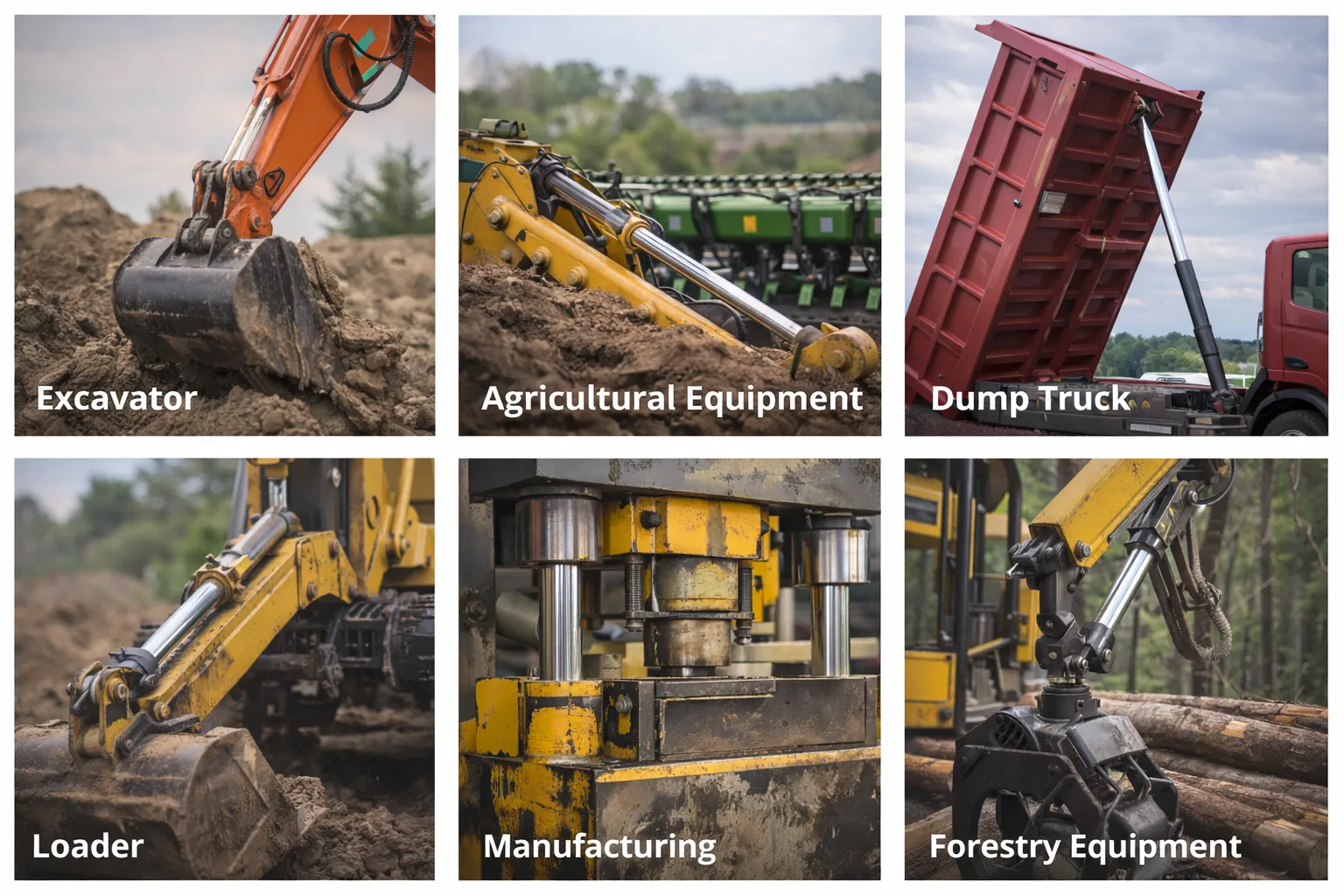
While this page focuses on the marine deck crane luffing application, our hydraulic cylinder engineering capabilities extend across a wide range of heavy industries. Here are the sectors where our cylinders are performing right now:
Marine and Offshore Equipment
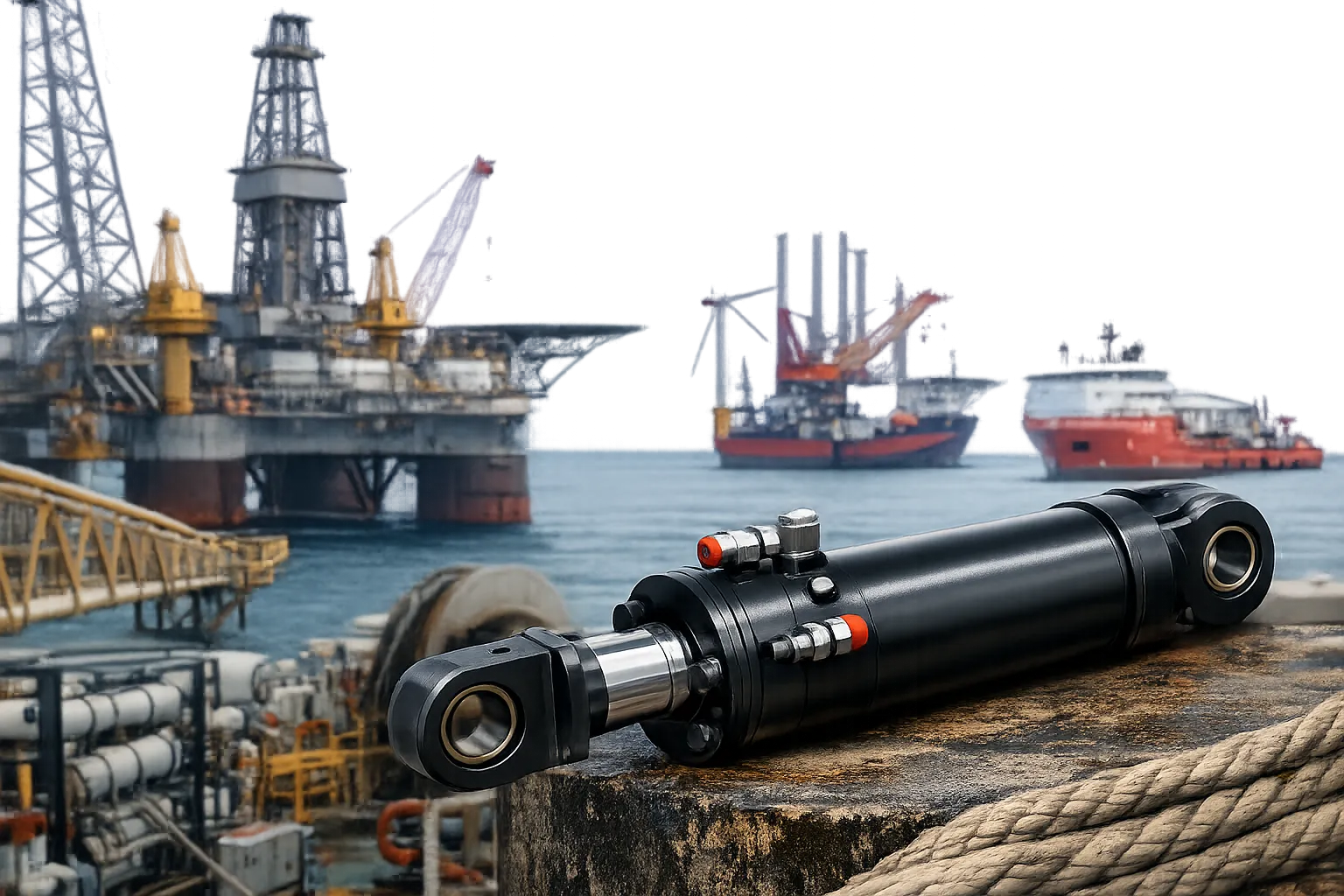
Deck crane luffing and telescoping, offshore pedestal crane boom systems, anchor handling winch cylinders, ramp and hatch cover actuators, and dynamic positioning thruster steering cylinders. The salt fog resistance and shock load capacity of our marine cylinders make them a go-to choice for Korean shipbuilders and offshore vessel operators.
Construction Machinery
Excavator boom and arm cylinders, mobile crane outrigger and luffing cylinders, tunnel boring machine thrust and steering cylinders, and concrete pump boom actuators. See our range of construction machinery hydraulic cylinders for more information.
Metallurgical and Heavy Manufacturing
Steel rolling mill cylinders, continuous casting mold oscillation actuators, ladle tilting cylinders, and scrap press compaction rams. These applications demand heat resistance, extreme force capacity, and high cycle durability — all areas where our manufacturing process delivers. Learn more about our metallurgical industry solutions.
Mining Equipment
Dragline boom hoist cylinders, shovel crowd and hoist actuators, haul truck suspension and steering cylinders, and underground roof support hydraulic rams. Mining conditions push cylinders to their absolute limits with abrasive dust, impact loads, and 24/7 operation schedules.
Material Handling and Logistics Automation
Container stacker lift cylinders, reach stacker telescoping arm cylinders, automated warehouse shuttle actuators, and ship-to-shore crane luffing and boom systems. Port and logistics clients value our fast turnaround and ability to match OEM dimensions precisely.
Renewable Energy and Environmental Equipment
Wind turbine pitch and yaw adjustment cylinders, solar tracker actuators, waste-to-energy plant feed cylinders, and water treatment gate actuators. Growing markets in Asia-Pacific are driving increased demand for reliable, corrosion-resistant hydraulic parts in these applications.
Special and Custom Applications
Test rig load cylinders, press brake actuators, dam gate cylinders, theater stage lift systems, and amusement ride motion platforms. If it moves under hydraulic power and requires precision, we can design and manufacture the cylinder for it.
Standard Hydraulic Cylinder vs. Our Marine Luffing Cylinder
Not all cylinders are created equal. Here is a direct comparison between a typical industrial-grade hydraulic cylinder and our purpose-built marine luffing unit:
| Feature | Standard Industrial Cylinder | Our Marine Luffing Cylinder |
|---|---|---|
| Rod Surface Treatment | Hard chrome plating (20-30 micron) | Electroless nickel plating (60-80 micron) |
| Salt Spray Rating | 200-500 hours typical | 1000+ hours (ASTM B117) |
| Rod Material | CK45 / S45C carbon steel | 42CrMo alloy steel, Q&T + induction hardened |
| Seal System | NBR standard seals | Marine-grade PU + PTFE compound seals |
| Shock Load Tolerance | Not specifically rated | Designed per DNV GL / ABS marine shock profiles |
| External Coating | Standard industrial paint | ISO 12944 C5-M marine epoxy + PU topcoat |
| Weld Inspection | Visual inspection | 100% UT + MPI on all structural welds |
| Design Life Target | 5-10 years general industrial use | 20+ years marine vessel service life |
| Typical Seal Life | 3,000-5,000 hours | 8,000-12,000 hours |
| Classification Documentation | Not available | Full documentation for DNV, ABS, LR, BV, CCS |
Real-World Project Case Studies
Case 1 — Bulk Carrier Fleet Retrofit, South Korea
Client: A mid-sized Korean shipping company operating 12 Handymax bulk carriers out of Busan.
Challenge: The fleet’s existing deck crane luffing cylinders (originally supplied with MacGregor cranes) were reaching end-of-life after 14 years of service. The original manufacturer quoted a 16-week lead time and a unit price that exceeded the client’s maintenance budget by roughly 40%.
How they found us: The fleet maintenance manager discovered our website while searching for alternative hydraulic cylinder suppliers in late 2023. He contacted us through our online inquiry form, attaching the original cylinder GA drawing and a photo of the corroded rod surface.
Solution: We reverse-engineered the cylinder from the drawing and photographs, confirmed dimensions with the client, and delivered 24 replacement cylinders in 3 batches over 10 weeks — coordinated with the fleet’s scheduled dry-docking rotations.
Result: All 12 vessels are now operating with our replacement luffing cylinders. After 18 months in service, zero seal leaks and zero unplanned maintenance events have been reported. The client has since placed an additional order for hatch cover cylinders on the same fleet.
“We were skeptical about switching from the OEM supplier, but the quality and response time exceeded our expectations. The cylinders have been running perfectly through two monsoon seasons.” — Fleet Maintenance Manager, Busan
Case 2 — Offshore Supply Vessel Crane Upgrade, Japan
Client: A Japanese offshore services company based in Imabari, operating PSVs (Platform Supply Vessels) in Southeast Asian waters.
Challenge: The 25-ton deck crane luffing cylinders on two of their vessels were suffering from recurring rod corrosion and premature seal failure — approximately every 3,000 hours rather than the expected 8,000-hour service interval. Root cause: the original cylinders used standard hard chrome plating, which was insufficient for continuous tropical saltwater exposure.
How they found us: A recommendation from their hydraulic system integrator in Singapore, who had previously sourced hydraulic oil cylinders from us for a port crane project. They contacted our sales team by email in February 2024.
Solution: We replaced the chrome-plated rods with nickel-plated 42CrMo rods and upgraded the seal package to marine-grade PTFE compound seals. Mounting dimensions remained identical to the original design for drop-in installation during scheduled port calls.
Result: After 12 months of operation in the Gulf of Thailand and offshore Myanmar, the new cylinders have shown zero rod pitting and zero seal replacements. The client estimates annual maintenance cost savings of approximately USD 18,000 per vessel.
“The nickel plating solution was the right call. We should have done this from the beginning. Cylinder performance has been flawless.” — Technical Superintendent, Imabari
Case 3 — Floating Dock Crane Installation, Vietnam
Client: A Vietnamese shipyard in Vung Tau building floating dry docks for Southeast Asian port authorities.
Challenge: The shipyard needed 8 sets of luffing cylinders for 40-ton overhead cranes installed on two floating docks. The cylinders had to meet BV (Bureau Veritas) classification requirements and survive a highly corrosive tropical coastal environment with afternoon rain and salt spray almost daily.
How they found us: The shipyard’s procurement team found us through a sourcing platform, then visited our manufacturing facility in March 2024 for a factory audit before placing the order.
Solution: We produced the cylinders with full BV material certification, C5-M coating system, and supplied a complete documentation package including welding procedure qualifications, NDT reports, and test certificates.
Result: The floating docks were delivered on schedule in Q3 2024. Post-commissioning inspection confirmed full compliance with BV requirements, and crane performance testing achieved rated capacity without issue.
“The documentation package was thorough and the BV surveyor approved everything on the first review. That saved us weeks of back-and-forth.” — Project Engineer, Vung Tau Shipyard
Case 4 — Port Container Crane Overhaul, Indonesia
Client: A terminal operator managing a mid-sized container port on the northern coast of Java.
Challenge: Three ship-to-shore (STS) cranes required boom luffing cylinder replacement after 11 years of continuous service. The cranes operated 20 hours per day on average, and the existing cylinders had developed visible external corrosion and internal bypass leakage exceeding acceptable limits.
How they found us: Their maintenance contractor in Surabaya had purchased hydraulic cylinders from us for a mobile crane fleet earlier that year, and recommended our marine cylinder line for the port crane application. First contact was made by WhatsApp in June 2024.
Solution: We manufactured 6 luffing cylinders (2 per crane), matched to the original European OEM specifications. Each cylinder was individually tested at 1.5x rated pressure and shipped with full test documentation.
Result: Installation was completed during a planned 5-day operational pause. All three cranes returned to full service on schedule with zero rework. The terminal manager reported smoother luffing operation and reduced hydraulic oil temperature compared to the worn-out original cylinders.
“Fast delivery and everything fit perfectly. We are already planning to order the hoist cylinders from the same supplier next year.” — Maintenance Contractor, Surabaya
Case 5 — Research Vessel A-Frame Cylinder, South Korea
Client: A government-funded oceanographic research institute operating a 2,500-ton research vessel out of Incheon.
Challenge: The A-frame crane used for deploying deep-sea research equipment needed a new pair of luffing cylinders. The original units were 20 years old, spare parts were no longer available, and the manufacturer had exited the marine business. Requirements included operation in sub-zero temperatures (North Pacific winter research cruises) and compatibility with biodegradable hydraulic fluid (vessel environmental policy).
How they found us: The institute’s chief engineer attended a marine equipment exhibition in Busan in October 2023 where he saw our product display. He followed up with our sales engineer after the event.
Solution: We designed the cylinders with low-temperature seal compounds rated to -35 C and verified compatibility with the vessel’s HEES (Hydraulic Environmentally Acceptable) fluid. Full documentation was prepared in both English and Korean to meet the institute’s reporting requirements.
Result: The cylinders were installed during a dry-docking period in Incheon in early 2025. They have since completed two winter research cruises in the North Pacific without any operational issues. Internal leakage remains well within specification even at -20 C ambient conditions.
“Finding a manufacturer who could handle the cold-weather and eco-fluid requirements at the same time was not easy. This team delivered exactly what we needed.” — Chief Engineer, Oceanographic Research Vessel
Frequently Asked Questions
What is the typical lead time for a custom marine luffing cylinder?
Can you supply cylinders with classification society approval (DNV, ABS, LR, BV)?
How do your cylinders handle the shock loads common in deck crane operations?
What information do you need from me to provide a quotation?
Why choose nickel plating over hard chrome for the piston rod?
Do you supply seal kits and spare parts for ongoing maintenance?
Can you match the exact dimensions of my existing OEM cylinder for a direct replacement?
What is your minimum order quantity?
How do you handle warranty and after-sales support?
Can I visit your factory before placing an order?
Ready to Get Started?
Whether you need a single replacement luffing cylinder or a batch order for a new-build project, our engineering team is ready to review your requirements and deliver a detailed quotation within 48 hours.
Send us your cylinder drawing, critical dimensions, or simply describe your crane model — and we will take it from there.