
Bending Roll Cylinder for Rolling Mill
Engineered specifically to conquer extreme heavy offset loads and guarantee absolute precision in bending roll gap control for continuous metallurgical operations.
Product Overview & Core Industrial Value
In the intensely demanding environment of modern metallurgy, achieving perfect dimensional accuracy and strip flatness is not an option; it is an absolute necessity. Whether operating a continuous hot strip mill, a high-speed cold rolling mill, or a heavy plate facility, the mechanical separation forces generated during metal reduction are immense. These extreme vertical forces inherently cause the heavy steel work rolls to deflect or bow outward. If left uncompensated, this deflection leads to severe profile defects, commonly referred to in the industry as positive strip crown or edge drop. The primary defense against this critical quality flaw is the highly specialized bending roll cylinder.
As a seasoned and globally recognized hydraulic cylinder manufacturer, we have spent two decades analyzing the precise failure modes of fluid power components in steel and aluminum plants. We understand that a standard commercial hydraulic cylinder cannot survive the brutal realities of a rolling mill. These actuators are subjected to radiant heat, continuous high-frequency vibration, abrasive airborne iron scale, and highly acidic synthetic rolling emulsions. However, the most destructive force they face is severe eccentric loading. Because the mill chocks continuously shift and adjust, the cylinders endure massive lateral stresses that force the piston rod off-center.

Our unique market positioning is built on directly resolving this exact engineering challenge. We do not manufacture generic components; we engineer highly robust bending roll adjustment hydraulic cylinder systems specifically tailored for metallurgy. By integrating advanced anti-offset load guide rings and forging our bodies from ultra-high-yield 42CrMo steel, we have eliminated the primary causes of seal degradation and barrel fatigue. When calculating the total cost of ownership and evaluating the initial hydraulic cylinder price, our bespoke engineering dramatically reduces unplanned plant downtime, eliminates the constant need for emergency maintenance, and guarantees a flawless strip profile over an exponentially longer lifecycle.
Technical Specifications & Customization Parameters
Every mill stand features unique structural geometries and operational pressure requirements. We offer extensive customization capabilities to ensure perfect integration into your existing Automatic Shape Control (ASC) infrastructure. The following table details the primary design matrices and operational parameters of our heavy-duty metallurgical fluid power units.
| Parameter Category | Specification Details & Engineering Range |
|---|---|
| Target Industry | Metallurgy (Steel, Aluminum, Copper Processing) |
| Equipment Category | Rolling Mill (Hot Strip, Cold Reversing, Temper Mills) |
| Subsystem / Core Action | Bending Roll System / Positive and Negative Profile Correction |
| Cylinder Nomenclature | Bending Roll Cylinder (Work Roll / Backup Roll applications) |
| Actuation Method | Double Acting Hydraulic Cylinder |
| Internal Structure | Hydraulic Cylinder Piston Type (Precision balanced) |
| Manufacturing Build | Heavy-Duty Welded Construction (Monoblock capability) |
| Material Matrix | 42CrMo High-Strength Forged Alloy Steel (Quenched & Tempered) |
| Surface Protection | Electroless Nickel Plated + Hard Chrome (Ultimate chemical barrier) |
| Environmental Rating | Extreme: Withstands radiant heat, corrosive emulsions, and abrasive dust |
| Operational Focus | Heavy Offset Load Management, Dynamic Bending Roll Gap Control |
| Typical Failure Addressed | Asymmetrical Seal Wear, Rod Scoring, Cylinder Ballooning |
| Mandatory Configuration | Anti-Offset Load Guide Ring, Ultra-Low Friction PTFE Sealing System |
| Operating Pressure | Standard 21 MPa to 35 MPa (Engineered up to 45 MPa peak load) |
Operational Dynamics: Mastering the Roll Gap
To truly understand the value of our specialized hydraulic parts, one must examine the complex fluid mechanics occurring inside the mill stand. As metal strip feeds into the work rolls, sensors located downstream continuously measure the profile and thickness. This data feeds into the mill’s servo-proportional valves, which instantaneously direct high-pressure hydraulic fluid into the bending blocks mounted between the chocks.
Because our systems utilize a double acting hydraulic cylinder design, they exert active force in both directions. When the strip center is too thick, fluid enters the base chamber, extending the hydraulic rams to execute positive bending—pushing the roll necks apart to counteract the physical bowing of the roll barrel. Conversely, if edge waves are detected, fluid is routed to the annular side, retracting the piston and pulling the chocks inward for negative bending. This continuous adjustment is known as dynamic bending roll gap control.
The operational challenge lies in the frequency and the physical environment. The servo valves modulate pressure multiple times per second, meaning the hydraulic cylinder piston must move in increments of fractions of a millimeter. Furthermore, the massive mechanical forces naturally cause the chocks to twist slightly, introducing a severe heavy offset load. If a standard industrial cylinder is used, this lateral deflection forces the steel rod against the cylinder gland, immediately crushing the seals. By integrating our proprietary anti-offset load guide rings, we absorb this radial shock entirely, preserving perfect concentricity and ensuring that stick-slip friction never compromises your gauge control.

Seamless Integration & Global Machinery Replacement
We recognize that sourcing replacement components from original European or Japanese equipment manufacturers often results in exorbitant costs and unacceptable lead times stretching over twenty weeks. To keep your facility fully operational, our engineering division specializes in rapid reverse-engineering and drop-in replacements.
Our highly customized bending roll cylinder units are designed to be dimensionally and functionally identical to standard equipment originally supplied by globally recognized brands such as Bosch Rexroth, Parker Hannifin, Eaton Vickers, Moog, SMS Group, and Danieli. (Please note: These brand names are mentioned strictly for the convenience of equipment selection, technical cross-referencing, and dimensional matching for our B2B clients, and this does not constitute any trademark infringement or direct official affiliation.)
By meticulously replicating the mounting flanges, trunnion dimensions, port threading, and stroke lengths, we guarantee a plug-and-play installation. Your maintenance personnel can execute the swap without fabricating new brackets or modifying rigid pipework. This makes fixing hydraulic cylinders an opportunity to permanently upgrade your mill with our superior 42CrMo materials and anti-wear technology.
Five Core Technical Advantages
Why do premier steel manufacturers in South Korea and across Asia trust our engineering footprint? The answer lies in our targeted approach to resolving metallurgical failure modes. Here are the five core engineering pillars of our custom actuators:
1. Heavy Offset Load Immunity
The leading cause of actuator death in a mill is asymmetric side-loading. Standard bronze wear bands crush easily under this stress. We structurally integrate extremely wide, high-compressive-strength composite anti-offset load guide rings. These engineered bands actively absorb lateral shocks, ensuring the hydraulic cylinder piston remains perfectly centered. This singular feature prevents metal-to-metal scoring and effectively eradicates premature seal wear.
2. Unyielding 42CrMo Forged Rigidity
When system pressure pulses dramatically to bend solid steel rolls, standard 1045 carbon steel barrels flex and balloon, causing volumetric inefficiency. Our bending roll adjustment hydraulic cylinder features a heavy-duty welded construction machined entirely from forged 42CrMo alloy steel. Through precise quenching and tempering, we achieve extreme tensile and yield strength, ensuring absolute geometric stability under peak tonnage.
3. Ultra-Low Friction Tribology
For an Automatic Gauge Control system to function properly, the cylinder must respond to servo signals instantaneously. High static friction causes “stick-slip” juddering, ruining the gauge of the metal strip. We employ a highly sophisticated sealing matrix using PTFE (Teflon) blended step seals supported by energizing elastomers. This ultra-low friction design guarantees perfectly smooth, micro-metric stroke adjustments.
4. Impermeable Nickel Plated Defense
Rolling mills are saturated with highly acidic, synthetic rolling emulsions and abrasive water sprays. Standard hard chrome naturally contains micro-cracks that allow these corrosive fluids to rust the underlying steel. Our solution involves a heavy layer of electroless nickel plating. This creates a dense, non-porous chemical barrier that completely seals the base metal, extending the rod’s lifespan exponentially in wet environments.
5. Advanced Thermal and Fatigue Stability
Operating inches away from glowing steel slabs subjects the hydraulic components to intense radiant heat that quickly melts standard polyurethane seals. We utilize aerospace-grade FKM (Viton) elastomers capable of surviving high-temperature spikes. Concurrently, our engineers use Finite Element Analysis (FEA) to eliminate sharp transitions near the welds and trunnions, ensuring infinite fatigue life against millions of bending cycles.
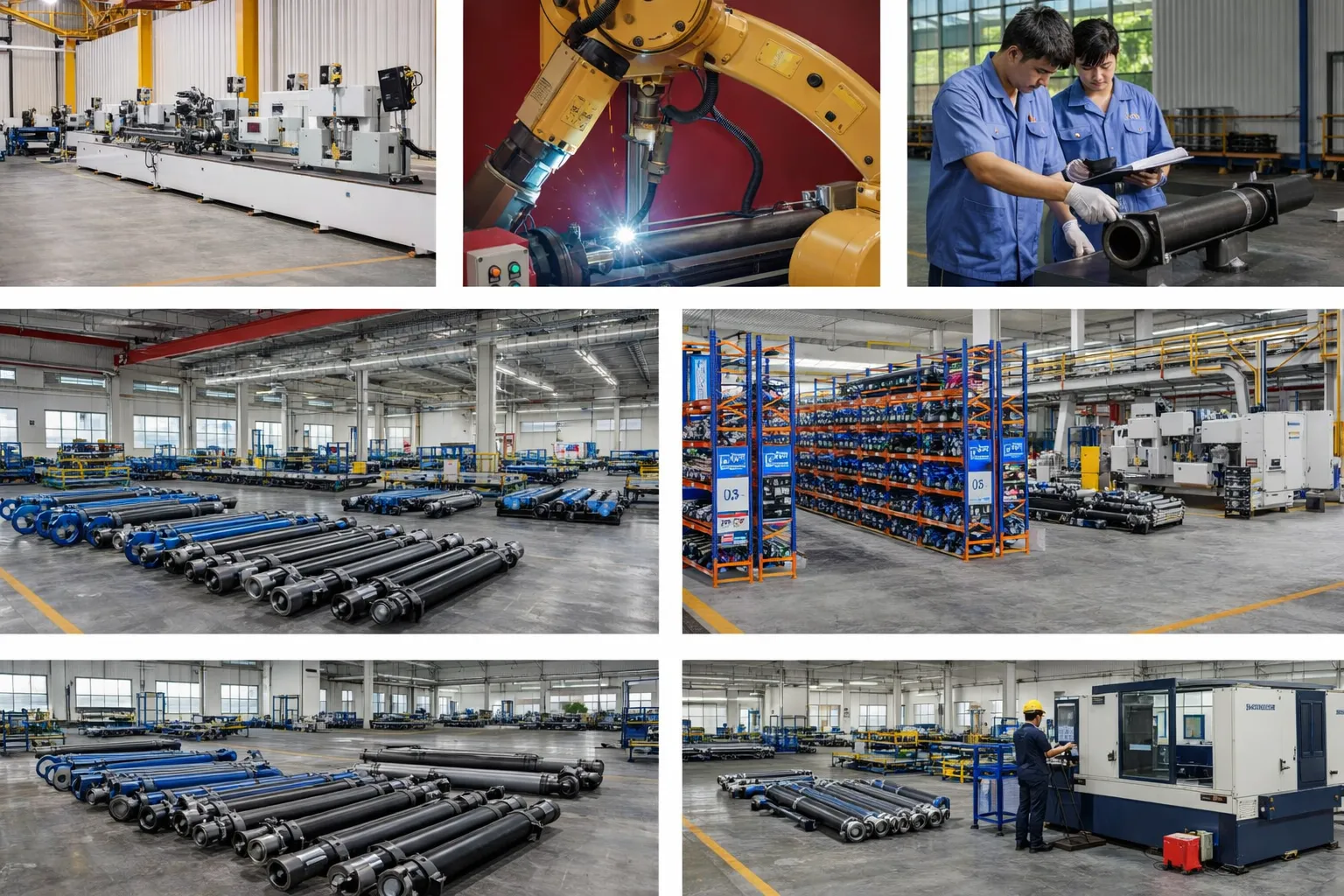
Autonomous Manufacturing & Absolute Quality Control
Trusting critical infrastructure requires complete transparency in manufacturing. We do not outsource our core machining. Our autonomous production cycle begins with raw 42CrMo forgings, which immediately undergo rigorous ultrasonic Non-Destructive Testing (NDT) to verify the absolute absence of internal voids, inclusions, or metallurgical flaws before any metal is cut.
The internal bores of our cylinders are processed on heavy-duty CNC deep-hole turning centers, followed by precision skiving and roller burnishing. This advanced method compresses the crystalline structure of the metal, achieving a mirror-like surface finish (Ra ≤ 0.2µm) that minimizes friction and maximizes seal longevity. Structural integrity is guaranteed via automated robotic submerged arc welding, delivering deep, flawless penetration that is subsequently verified by magnetic particle inspection.
Quality assurance culminates at our computerized test benches. We reject random batch sampling; 100% of our produced hydraulic parts are subjected to severe individual hydrostatic testing. We pressurize every unit to 1.5 times its maximum rated operating pressure to confirm zero internal fluid bypass and verify external seal integrity. Finally, a unique serial number is permanently laser-engraved onto the cylinder, ensuring comprehensive material traceability and streamlining any future hydraulic cylinder repair requirements.
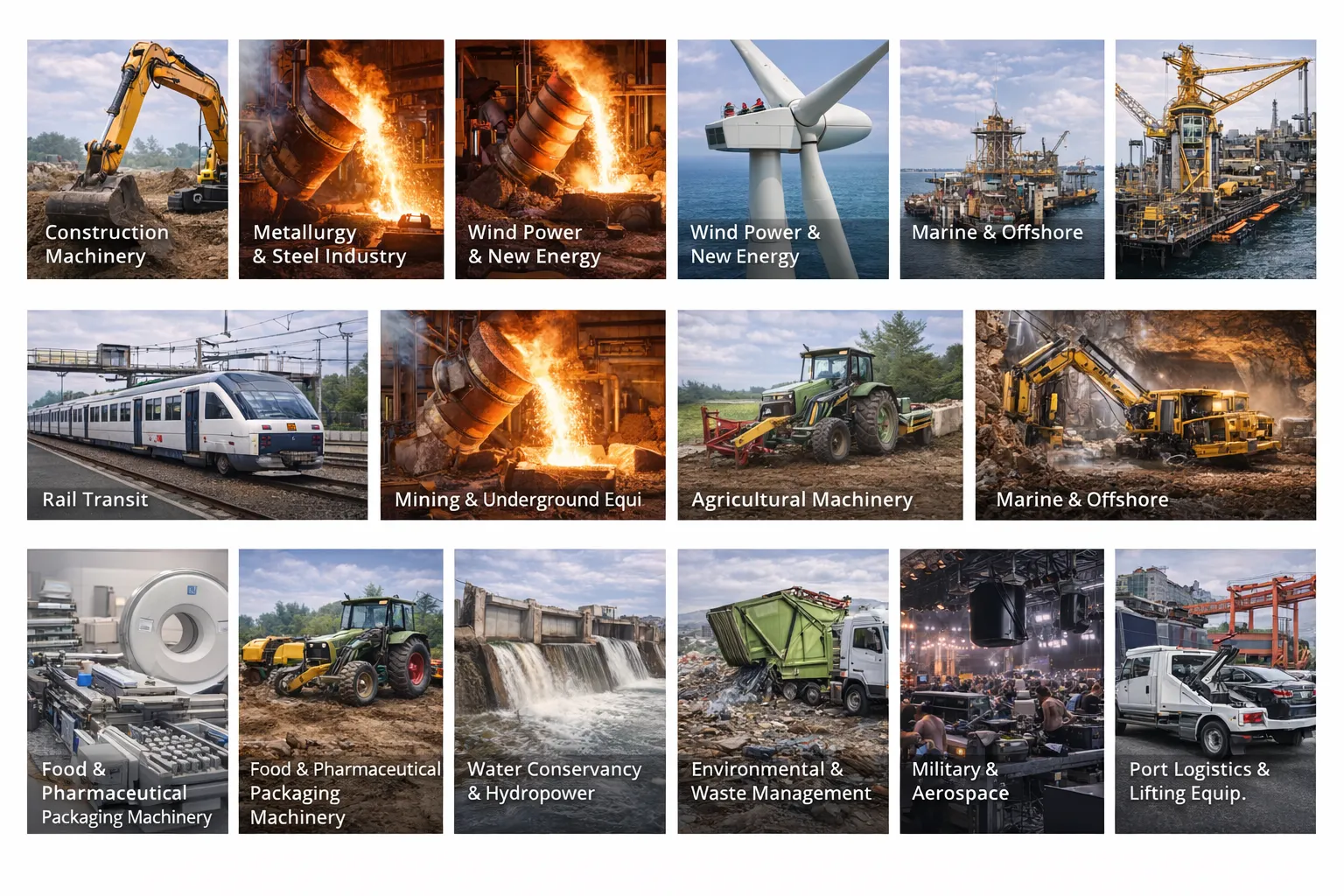
Broad Industrial Applications Beyond Metallurgy
While the sophisticated anti-offset load architecture of this product is perfectly optimized for rolling mills, the foundational engineering principles of extreme rigidity and zero-leakage durability make our fluid power solutions highly valuable across various punishing industrial sectors.
- Metallurgy & Heavy Manufacturing: Bending rolls, Automatic Gauge Control (AGC) actuators, continuous casting lines, and massive forging presses.
- Earthmoving & Infrastructure: Excavators, front-end loaders, and piling rigs subject their actuators to immense dirt and shock. Explore our rugged designs specifically engineered for the construction machinery industry.
- Resource Extraction: Underground roof supports, heavy rock crushers, and stacker-reclaimers demand survival-grade actuation. Discover our specialized components for the mining industry.
- Plastics & Rubber Processing: High-tonnage injection molding machines rely on our ultra-rigid cylinders for rapid, perfectly aligned mold clamping.
- Material Handling & Logistics: High-capacity automated guided vehicles (AGVs), straddle carriers, and port cranes require fail-safe lift cylinder systems to manage massive, unbalanced payloads securely.
- New Energy Equipment: Wind turbine pitch control systems facing offshore salt spray depend on our heavy nickel plating and consistent fluid force.
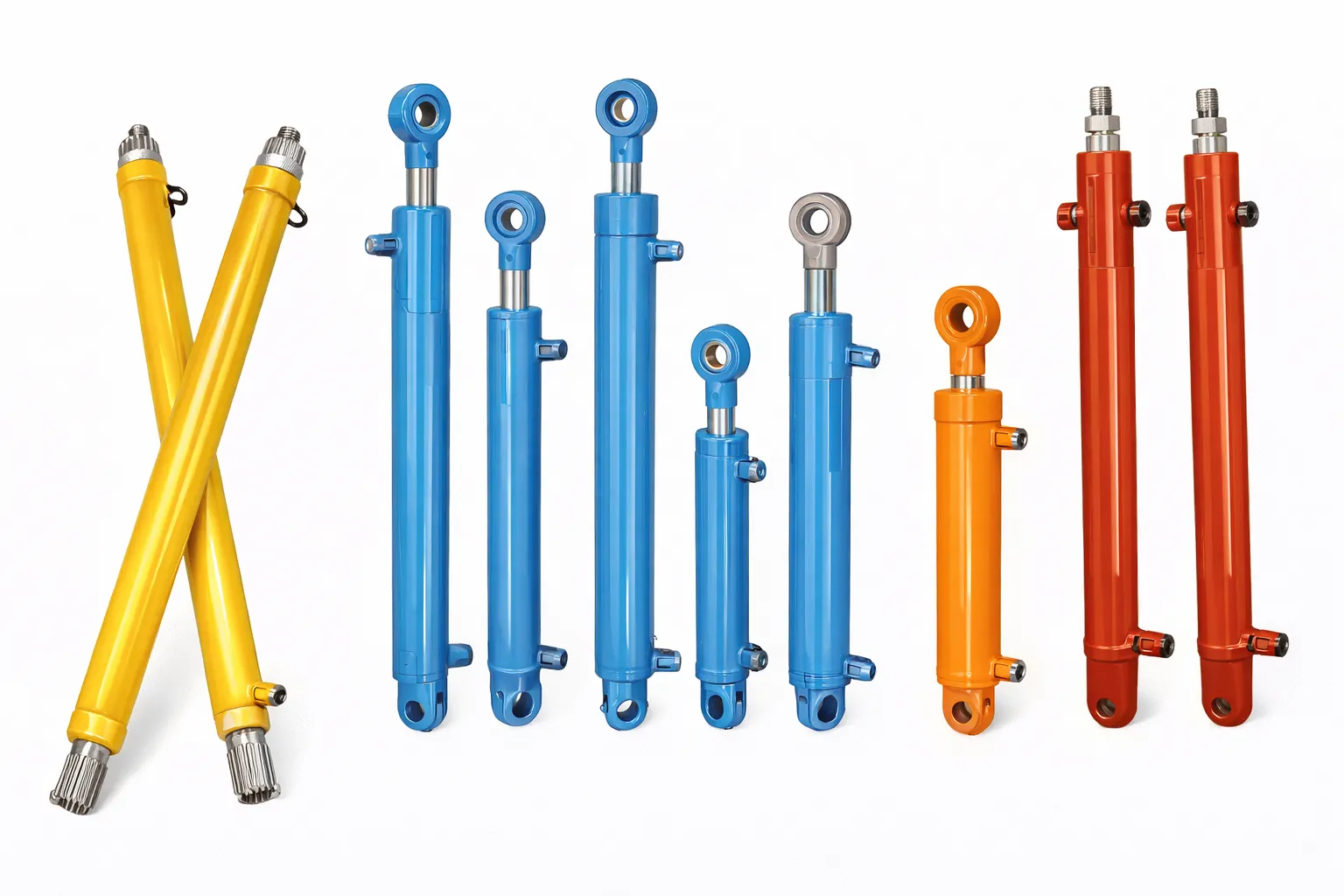
Comparative Analysis: Standard vs. High-Performance Engineering
When evaluating industrial procurement, focusing solely on the initial hydraulic cylinder price is a false economy. The true cost lies in unscheduled mill downtime, rejected coils, and constant seal replacements. The table below illustrates the stark mechanical differences between generic catalog actuators and our purpose-built metallurgical solutions.
| Critical Feature | Standard Commercial Hydraulic Cylinder | Our High-Performance Bending Cylinder |
|---|---|---|
| Eccentric Load Handling | Basic bronze wear bands. Readily crushes under side-loading. | Advanced composite guide rings entirely absorb massive offset loads. |
| Structural Rigidity | 1045 Carbon Steel. Exhibits elastic stretch under peak tonnage. | Forged 42CrMo Alloy Steel. Unyielding rigidity under extreme pressure spikes. |
| Corrosion Defense | Thin Hard Chrome. Micro-cracks permit rapid rust from cooling water. | Heavy Nickel Plating. Impermeable chemical barrier against emulsions. |
| Dynamic Friction | Standard PU seals cause stick-slip juddering, ruining gauge accuracy. | Ultra-low friction PTFE step seals guarantee instant servo responsiveness. |
| Reliability & Testing | Batch sampling. Frequent seal failures every 4 to 8 months. | 100% individual pressure testing. 24+ months leak-free operation. |
Proven Success: Real-World Global Case Studies
The true benchmark of any industrial component is its performance on the factory floor. Our fluid power solutions have continuously eradicated production bottlenecks across the dynamic East Asian manufacturing sector. Here are five documented case studies of our customized hydraulic cylinder components delivering exceptional results.
Case 1: Eradicating Asymmetric Seal Wear in Pohang, South Korea
Client Details: Tier-1 Automotive Steel Supplier | Application: Continuous Hot Strip Mill
The Challenge: The mill experienced massive fluid leaks every 5 months. Their existing OEM cylinders could not handle the severe lateral chocks shifting, resulting in crushed seals.
How They Found Us: The plant’s reliability engineers executed a targeted online search for an advanced hydraulic cylinder manufacturer capable of custom anti-offset load modifications.
The Results: We deployed upgraded bending roll cylinder units featuring our expanded composite guide rings. Installed in October 2024, the actuators have achieved 18 months of continuous, leak-free operation, boosting Grade-A coil yield by 14%.
“The geometric stability of these cylinders under extreme tonnage is phenomenal. Mid-campaign cylinder swaps are officially a thing of the past.” — Mr. Kang, Plant Maintenance Director.
Case 2: Overcoming Rod Fatigue in Ulsan, South Korea
Client Details: Heavy Naval Plate Mill | Application: Backup Roll Bending System
The Challenge: High-frequency pressure spikes were causing micro-cracking and fatigue failure on the 1045 carbon steel rods of their standard cylinders.
How They Found Us: Recommended by a specialized hydraulic system integrator based in Seoul.
The Results: We replaced the entire array with custom double acting hydraulic cylinder units forged purely from 42CrMo steel. The structural rigidity easily handled the pressure pulsations. They have recorded zero failures in over two years.
“We no longer worry about rod snapping during heavy passes. The 42CrMo material is an absolute game-changer for plant reliability.” — Lee J.H., Reliability Engineer.
Case 3: Perfecting Micro-Precision in Kobe, Japan
Client Details: Precision Aluminum Foil Manufacturer | Application: Automatic Gauge Control
The Challenge: Stick-slip friction in their legacy fluid power system was causing jerky responses, leading to microscopic chatter marks and unacceptable thickness variations in thin battery foils.
How They Found Us: Met our technical sales engineers during a major metallurgical machinery expo in Tokyo.
The Results: We supplied units featuring our ultra-low friction PTFE sealing architecture and super-finished internal bores. Dynamic response times improved by 18 milliseconds, instantly eradicating the foil chatter marks.
“The hydraulic cylinder piston moves with incredible smoothness. Your tribological design allowed our AGC software to perfectly control the thin strip profile.” — T. Sato, Lead Process Engineer.
Case 4: Eradicating Acidic Corrosion in Kaohsiung, Taiwan
Client Details: Stainless Steel Reversing Cold Mill | Application: Work Roll Bending Block
The Challenge: Highly acidic rolling emulsions were penetrating the micro-cracks of standard hard chrome rods, causing severe rust and rapidly tearing up the wiper seals.
How They Found Us: Submitted an urgent technical inquiry through our official website contact portal.
The Results: We provided heavily protected units utilizing our electroless nickel plating surface treatment. After 18 months of exposure to aggressive fluids, the rods remain completely pristine without a single pit.
“Your nickel-plating technology completely neutralized the corrosion threat. We save thousands annually on replacement parts.” — C.W. Lin, Procurement Lead.
Case 5: Emergency Fast-Track Replacement in Busan, South Korea
Client Details: Steel Processing & Logistics Center | Application: Heavy Coil Transfer System
The Challenge: A catastrophic cylinder failure on a main lifting rig threatened a month-long shutdown. The European OEM quoted a devastating 24-week lead time for a replacement.
How They Found Us: Searched Google for rapid hydraulic cylinder reverse-engineering services.
The Results: We received their schematics, matched the mounting footprint exactly, and fast-tracked a custom double-acting unit. We delivered the drop-in replacement via air freight in under 5 weeks.
“Your manufacturing speed saved our quarter. The unit bolted right up to the existing manifold and performed perfectly from day one.” — Park S.M., Operations Director.
Frequently Asked Questions (B2B Engineering FAQ)
For our procurement and maintenance partners in South Korea and globally, we have compiled detailed, technical answers to your most common operational inquiries.
1. How exactly does your guide ring technology prevent costly hydraulic cylinder repair?
2. Can you guarantee dimensional compatibility with our existing European brand cylinders?
3. What is the standard lead time for delivering a custom actuator to South Korea?
4. Why is Nickel plating superior to standard Hard Chrome for rolling mill parts?
5. Do you supply the exact hydraulic cylinder piston or seal kits as spare parts?
6. How do I request a quote and what drives the hydraulic cylinder price?
Ready to Eliminate Mill Downtime and Enhance Strip Quality?
Do not allow premature seal wear, fluid leaks, and generic equipment failure to dictate your production schedule or compromise your metal quality. Partner with a dedicated fluid power engineering team that deeply understands the severe realities of metallurgical eccentric loads. Let us analyze your operational challenges and deliver an actuator designed strictly for precision and survival.
Editor: Cxm


























