Column Lifting Cylinder for Drilling Platforms
Engineered with a robust forged 42CrMo body and an integrated hydraulic control lock to safely elevate thousands of tons, completely eliminating the risk of cylinder body yield under extreme marine loads.
Product Overview: The Core of Offshore Platform Stability
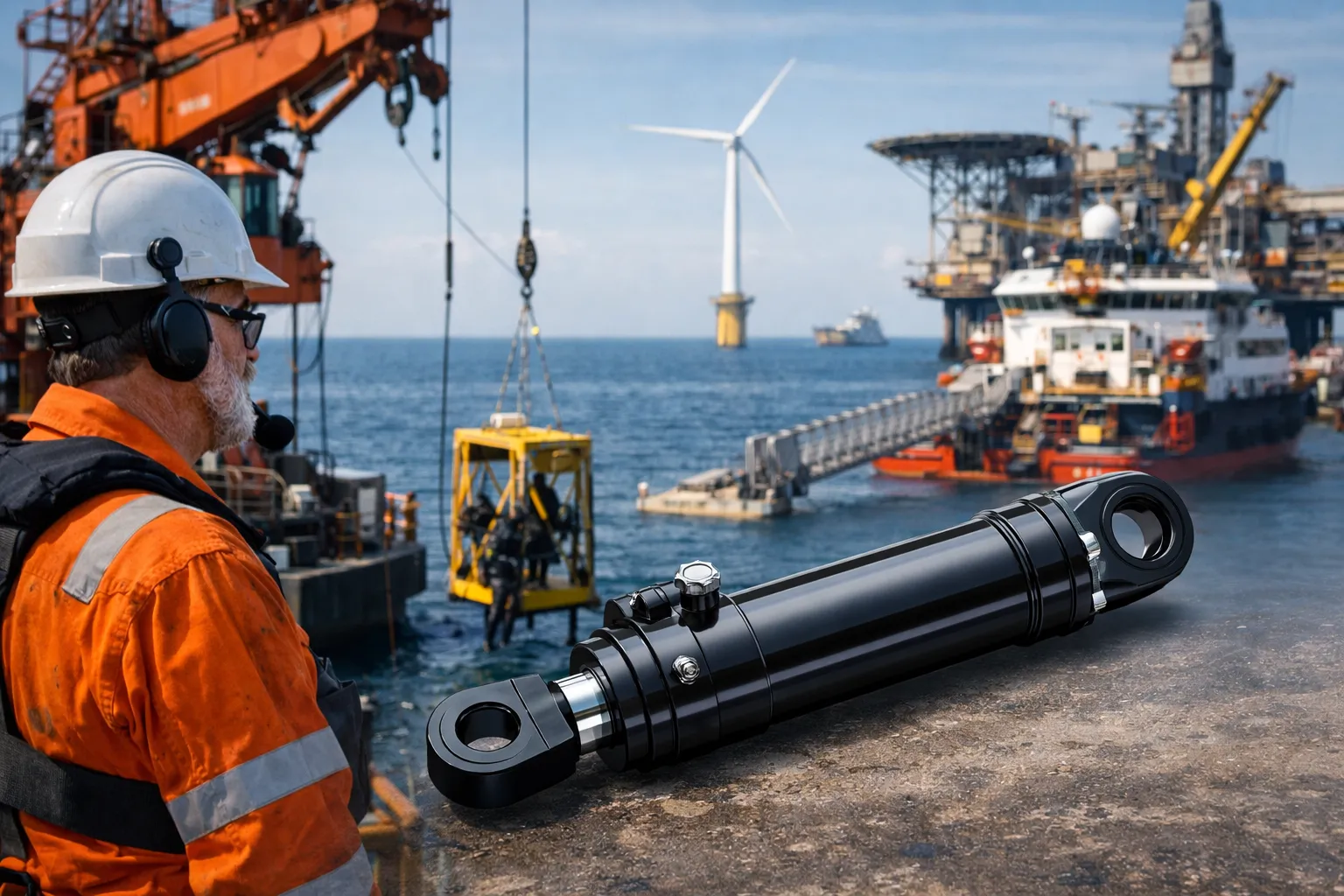
In the unforgiving offshore drilling sector, elevating a massive jack-up rig above the volatile ocean surface is a feat of extraordinary mechanical engineering. A drilling platform weighs tens of thousands of metric tons, and the entire burden of hoisting this colossal structure rests upon the platform’s column system. Operating at the absolute mechanical center of this elevation process is the column lifting cylinder. This primary linear actuator must generate an astronomical amount of thrust to push the steel legs down to the seabed and subsequently lift the entire hull safely above the wave crests, providing a highly stable environment for drilling operations.
Through decades of forensic engineering and diagnosing offshore equipment degradation, it has become abundantly clear that standard industrial fluid power systems cannot survive the extreme conditions of a marine drilling platform. When exposed to severe lateral winds, shifting ocean currents, and immense structural weight, standard welded actuators frequently encounter a catastrophic failure mode known as cylinder body yield. The intense hydrostatic pressure combined with mechanical shock loads causes the steel barrel of the cylinder to stretch, bulge, or violently rupture. When this yielding occurs, the internal sealing tolerances are instantly destroyed, causing an immediate loss of lifting pressure which can lead to a fatal platform tilt or collapse.
To permanently eradicate this profound safety risk, our engineering team has fundamentally redesigned the column lifting hydraulic cylinder. We have completely abandoned the use of traditional welded steel tubing. Instead, our massive actuators feature a monolithic, forged 42CrMo alloy steel body. This forged architecture delivers maximum metallurgical density and unparalleled yield strength, ensuring the pressure vessel never deforms under peak loads. By integrating this indestructible housing with heavy marine-grade nickel plating and a mandatory hydraulic control lock, we provide offshore contractors and major shipyards across South Korea and East Asia with the ultimate fail-safe lifting solution. Whether you are executing a new rig build or sourcing premium hydraulic parts for a mid-life refit, our highly competitive hydraulic cylinder price ensures you receive world-class safety without compromising your procurement budget.
Rigorous Technical Specifications
Offshore engineering demands absolute precision and strict adherence to maritime classification standards. The comprehensive table below outlines the specific customizable parameters and the robust baseline performance metrics of our large-scale elevation actuators designed exclusively for the offshore sector.
| Parameter Category | Engineering Specification | Operational Significance |
|---|---|---|
| Target Industry | Marine & Offshore Engineering | Strictly certified for exposure to high-salinity, deep-water ocean environments. |
| Equipment Category | Drilling Platforms / Jack-up Rigs | The foundational lifting structure for massive mobile offshore drilling units. |
| Subsystem / Action | Column System | Interfaces directly with the platform’s heavy steel legs to facilitate vertical displacement. |
| Cylinder Designation | Column Lifting Cylinder | A specialized, extreme-force linear actuator dedicated exclusively to structural elevation. |
| Action Mode | Double acting hydraulic cylingder | Provides highly controlled, actively powered hydraulic force for both lifting and lowering. |
| Structure Type | Large Piston Cylinder | Utilizes massive internal bore dimensions to generate thousands of metric tons of thrust. |
| Manufacturing Structure | Forged Cylinder Body | Completely eliminates longitudinal weld seams, producing an unbreakable pressure vessel. |
| Material System | 42CrMo Alloy Steel | Delivers exceptional physical yield strength and maximum fatigue resistance under continuous load. |
| Surface Treatment | Heavy Nickel Plating | Creates an impenetrable, highly ductile barrier against aggressive galvanic and atmospheric corrosion. |
| Environmental Rating | High Load / Severe Marine Weather | Engineered exclusively to survive dynamic wave impacts and continuous saltwater exposure. |
| Working Condition Feature | Platform Lifting | Executes slow, precisely synchronized extensions to maintain perfect deck leveling. |
| Typical Failure Mode Prevented | Cylinder Body Yield | The ultra-dense 42CrMo forging ensures the barrel absolutely never bulges or stretches. |
| Recommended Configuration | Hydraulic Control Lock | Integrated pilot-operated check valves physically trap the fluid to prevent catastrophic rig drops. |
Fluid Mechanics: How the Platform Jacking System Operates
To fully grasp the critical importance of these engineered components, one must dissect the complex fluid dynamics driving the operation. When the offshore rig superintendent initiates the lifting sequence, massive Hydraulic Power Units (HPUs) located on the platform deck activate. These systems pump highly pressurized hydraulic fluid through a heavy-duty manifold system directly into the extend chamber of the column lifting hydraulic cylinder. Inside this massive chamber, the pressurized fluid pushes against the enormous surface area of the internal hydraulic cylinder piston. Because output force is directly proportional to pressure multiplied by the area, this process generates an immense amount of linear thrust, pushing the heavy forged rod outward.
Because a drilling platform relies on multiple legs, dozens of these massive cylinders must operate in absolute synchronization. A few millimeters of deviation between the hydraulic rams on different legs can induce severe bending moments into the rig’s structural frame. Therefore, the internal friction of the cylinders must be exceptionally low and strictly uniform. When it is time to lower the massive hull back into the water, a single acting hydraulic cylingder cannot be used. Relying solely on gravity and a bleed valve to lower thousands of tons is a recipe for an uncontrollable, fatal descent. Instead, our systems function strictly as a double acting hydraulic cylingder. Fluid is actively pumped into the retract chamber, forcefully pulling the hull down in a smooth, millimeter-precise, and highly controlled manner.
The most critical safety phase occurs when the platform reaches its final operational altitude and the pumping stops. At this exact moment, the integrated hydraulic control lock engages. Mounted directly to the forged steel port of the cylinder, this pilot-operated check valve closes instantly. It physically traps the highly pressurized fluid beneath the piston. Even if a heavy piece of deck machinery falls and completely severs the main hydraulic supply hoses, the control lock ensures the fluid remains locked inside the forged 42CrMo body. The lift cylinder becomes an immovable structural pillar, guaranteeing the safety of the crew and the billion-dollar drilling asset above.
Global OEM Brand Integration and Rig Retrofits
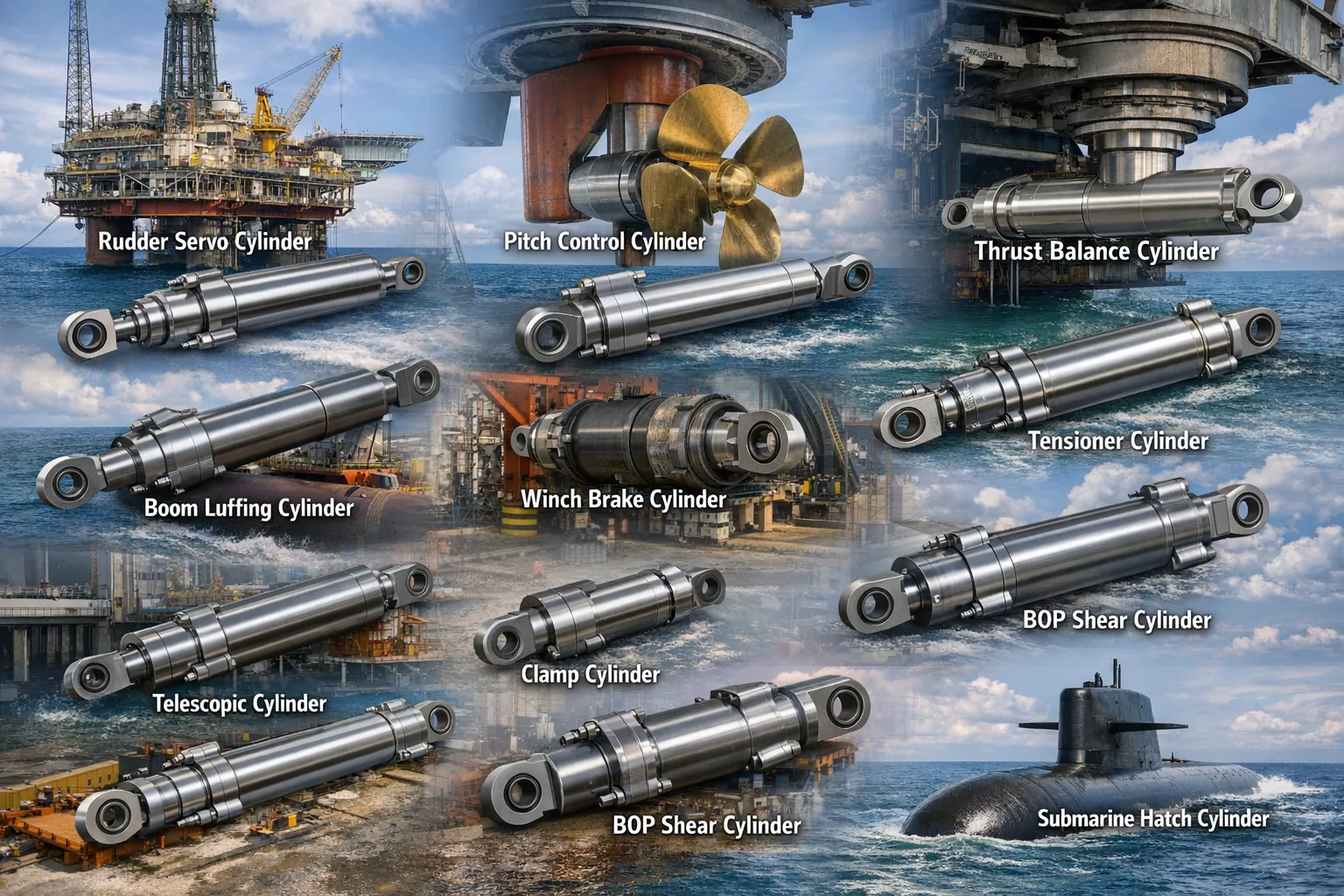
During scheduled five-year special periodic surveys (SPS) or emergency offshore repairs, procurement directors frequently face exorbitant markups and unacceptable lead times when attempting to source replacement hydraulic parts from European or American OEMs. Extended downtime for a jack-up rig translates into millions of dollars in lost drilling revenue. Our engineering department specializes in high-fidelity dimensional reverse-engineering to provide completely upgraded, flawless drop-in replacement units.
We routinely design and manufacture custom forged column lifting cylinder assemblies that seamlessly integrate with systems originally built by leading offshore brands, including National Oilwell Varco (NOV), Friede & Goldman (F&G), LeTourneau (Cameron), GustoMSC, and Keppel FELS. By precisely matching the stroke lengths, clevis pin diameters, and high-pressure manifold flange dimensions, we ensure that upgrading your platform requires absolutely no structural cutting or hot-work modifications. Your onboard engineers can execute the fixing hydraulic cylinders protocol swiftly, maintaining your rig’s critical deployment schedule.
(Disclaimer: The maritime and offshore brand names mentioned above are the registered trademarks of their respective corporate owners. They are referenced strictly for the purpose of dimensional cross-referencing, technical compatibility sizing, and mechanical interoperability to aid naval architects in component selection. We operate as an entirely independent hydraulic cylinder manufacturer, and our provision of high-performance aftermarket upgrades does not imply official affiliation with or endorsement by these entities.)
8 Core Technical Advantages of Our Forged Architecture
Safely elevating thousands of tons of steel requires metallurgical integrity that leaves zero margin for estimation. Our dedicated offshore actuators lead the heavy industry sector through eight critical engineering pillars:
1. Solid Forged 42CrMo Construction
To entirely eliminate the risk of cylinder body yield, we abandon standard drawn steel tubes. We forge our main cylinder bodies from solid 42CrMo alloy steel billets. This process aligns the internal metallic grain structure, vastly increasing the ultimate yield strength and creating an unbreakable pressure vessel.
2. Complete Eradication of Welded Seams
Heavy structural welding creates Heat-Affected Zones (HAZ) which alter the temper of the steel, creating prime locations for fatigue cracking under massive continuous loads. Our monolithic forged design completely eliminates load-bearing welds on the pressure cylinder, ensuring perfect structural uniformity.
3. Direct-Mount Hydraulic Control Locks
Absolute safety is our mandate. We integrate heavy-duty, pilot-operated check valves directly into the forged steel flanges of the cylinder. If a main hydraulic supply hose on the deck ruptures, the valve instantly locks the fluid inside the chamber, safely holding the platform aloft.
4. Heavy-Duty Nickel Plating Armor
To combat the highly corrosive, chloride-rich ocean atmosphere, the exterior of the forged cylinder body undergoes a specialized heavy electroless nickel plating process. This provides a substantially harder and significantly more durable barrier against salt spray compared to conventional marine epoxy paint.
5. Ultra-Low Friction PTFE Sealing
Synchronizing dozens of large actuators requires perfectly smooth movement. We utilize a proprietary matrix of bronze-filled PTFE seals and precision guide bands to entirely eliminate the “stick-slip” friction phenomenon, ensuring completely smooth micro-adjustments during the final platform leveling phase.
6. Optimized Thermal Stability Engineering
Continuous jacking operations generate immense internal fluid friction and heat. Our large-bore designs incorporate optimized fluid porting geometries to dramatically reduce flow restriction. This lowers internal heat generation, protecting the polymer seals from thermal degradation during extended lifts.
7. Rigorous Finite Element Analysis (FEA)
Prior to any steel being cut, our engineering team constructs highly detailed 3D models and subjects them to computerized FEA. This allows us to map stress concentrations at the trunnion mounts and optimize wall thicknesses to guarantee a prolonged, safe fatigue life under endless wave impacts.
8. Heavy-Duty Spherical Plain Bearings
Offshore platforms inevitably flex under high wind and current loads, which introduces dangerous lateral side-loading to the extended piston rods. We integrate massive marine-grade spherical bearings at the clevis mounts to mechanically absorb this misalignment, preventing internal bore scoring.
Autonomous Manufacturing Excellence & Total Traceability
When multi-million-dollar energy assets and the lives of offshore personnel rely entirely on the structural integrity of your lifting equipment, the manufacturing process cannot be fragmented across an unverified supply chain. To maintain our position as an elite hydraulic cylinder manufacturer, we operate a fully vertically integrated production campus. From raw metallurgical inspection to the final hydrostatic testing sequence, we command absolute control over every facet of production.
Our rigorous manufacturing protocol initiates with strict alloy verification. Every incoming forged billet of 42CrMo steel undergoes deep-penetration Ultrasonic Testing (UT) to detect any sub-surface voids or micro-fissures that could compromise structural strength. Once cleared, our large-swing, multi-axis CNC boring mills and honing machines process the internal cylinder barrels and hydraulic cylinder components to exacting micron-level diametrical tolerances. Achieving a flawless internal surface finish (Ra ≤ 0.2 µm) is absolutely critical to ensuring the longevity of the high-pressure seals and eliminating the risk of internal leakage during sustained holding operations.
Before any column lifting hydraulic cylinder is approved for dispatch to a shipyard, it is subjected to an exhausting Factory Acceptance Test (FAT). The assembled units are pressurized hydrostatically to 1.5 times their maximum rated operating pressure. During these intense holding periods, sensitive digital pressure transducers verify that the hydraulic control locks function flawlessly and zero fluid bypasses the piston. Every completed cylinder is permanently serialized. We provide our global B2B clients with comprehensive Material Test Reports (MTRs) and frequently coordinate with major marine classification societies—such as DNV, ABS, or the Korean Register (KR)—to conduct independent third-party surveys, ensuring total compliance with international offshore regulations.
Broad Spectrum Industrial Heavy-Lifting Capabilities
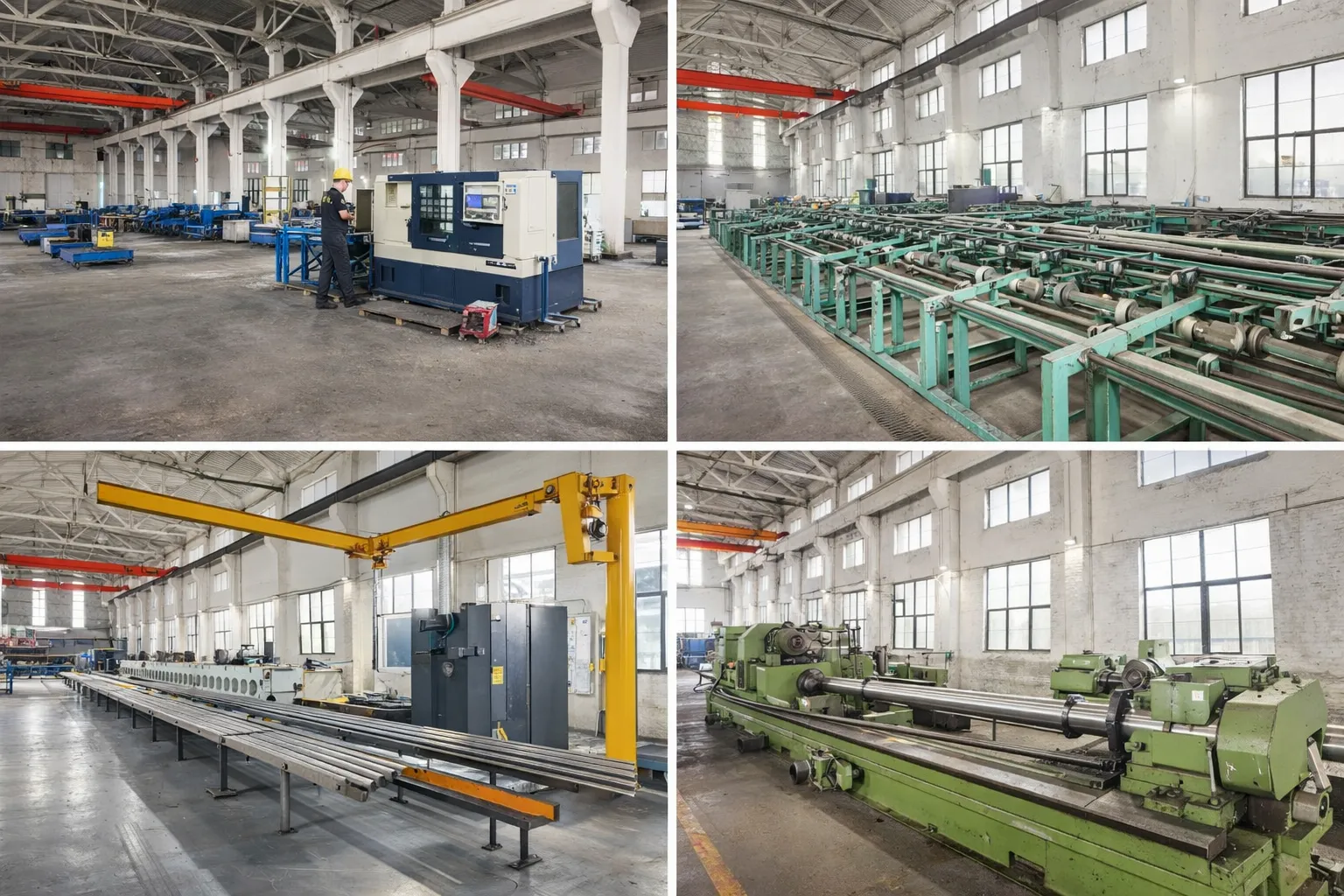
The specialized severe-duty engineering required to elevate an offshore jack-up platform—specifically the implementation of forged bodies to conquer immense payloads and control locks to secure the weight—translates into unparalleled reliability for other extreme industrial sectors. The highly robust design principles embedded in our massive hydraulic rams are actively sought after across multiple demanding environments.
Heavy Metallurgy & Steel Manufacturing
In environments completely dominated by extreme radiant heat and abrasive slag, our robust, heat-resistant actuators operate furnace doors and continuous casting equipment safely. Explore our highly specialized solutions for the metallurgical and iron industry.
Subterranean Mining & Tunneling
Underground operations expose machinery to massive rock falls and heavy lateral vibration. Our heavy-walled forged cylinders power roof supports and giant tunnel boring machines safely. Discover our heavy-duty applications in the mining industry.
Earthmoving & Heavy Construction
Earthmoving equipment requires absolute reliability. Our double-acting designs provide the massive breakout force needed for large excavator booms and specialized bridge-laying equipment. Review our rugged parts built for the construction machinery industry.
Offshore Renewable Energy
The specialized Wind Turbine Installation Vessels (WTIV) required to drive the massive monopile foundations for offshore wind farms rely on our heavily protected jacking cylinders to lift the crane ships safely out of the water.
Plastics & Rubber Injection Molding
Ultra-large industrial injection molding machines demand rapid, highly accurate clamping strokes to maintain strict production tolerances. Our low-friction designs provide the necessary micro-precision while holding thousands of tons of clamping pressure.
Port Logistics & Material Handling
Heavy-duty ship-to-shore gantry cranes, automated straddle carriers, and container lifters utilize our highly responsive, pressure-tested cylinders for safe, reliable, and highly efficient global cargo movement.
Comparative Analysis: Ordinary Commercial vs. High-Performance Offshore
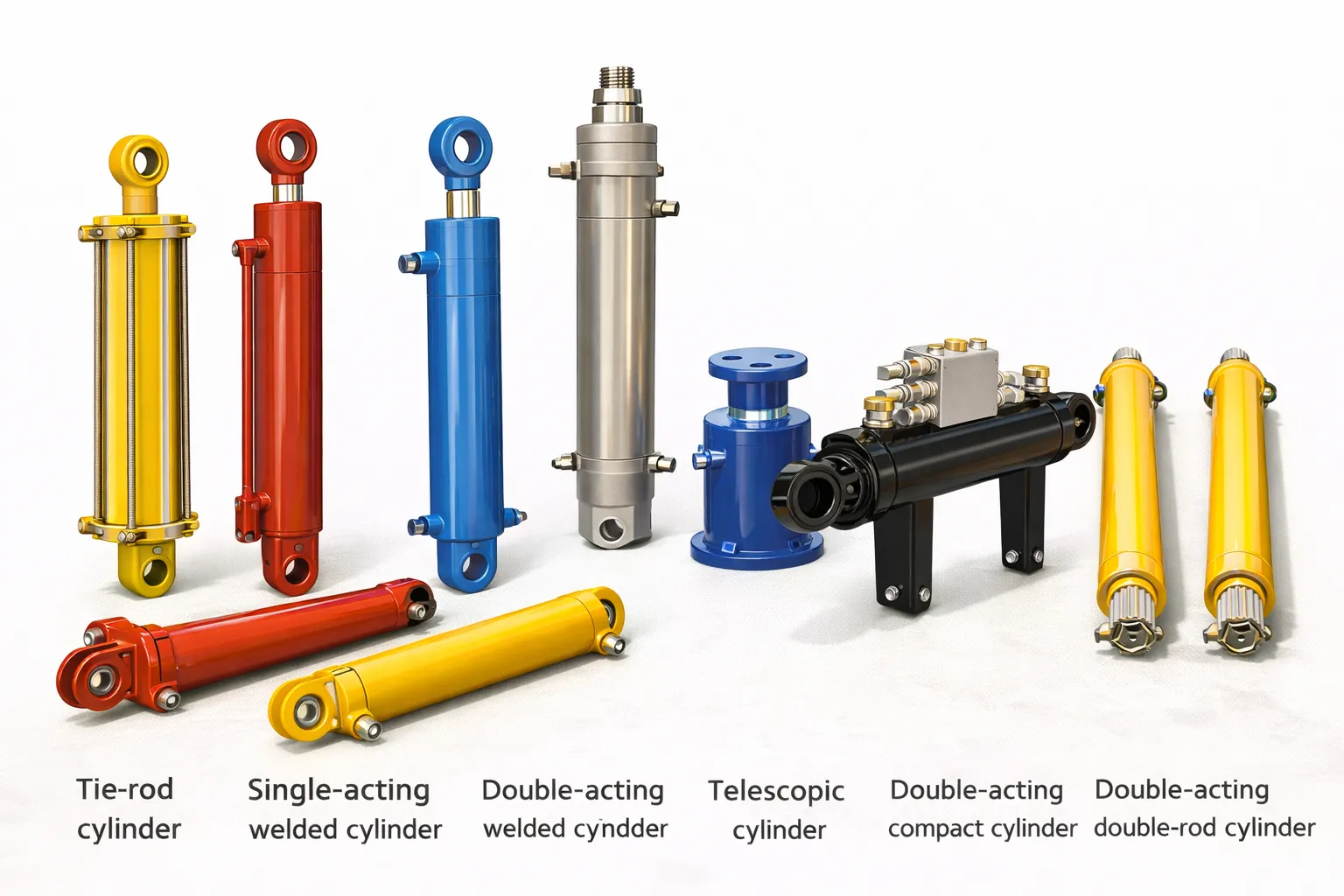
When outfitting a multi-million-dollar offshore asset, prioritizing a slightly lower initial hydraulic cylinder price by choosing standard commercial equipment is a catastrophic operational miscalculation. The comparative matrix below explicitly outlines why investing in our forged 42CrMo body structure is a strict necessity for safe platform elevation.
| Critical Performance Feature | Standard Commercial Lift Cylinders | Our Column Lifting Cylinder |
|---|---|---|
| Structural Architecture | Welded steel tubes (Creates dangerous Heat-Affected Zones at the welds) | Solid monolithic forged cylinder body (Completely seamless and uniform) |
| Risk of Cylinder Body Yield | Highly susceptible under massive sustained hydrostatic pressure spikes | Completely eliminated; extreme 42CrMo tensile strength resists all deformation |
| Load Holding Safety | Relies entirely on distant deck manifold valves (Vulnerable if hoses burst) | Integrated hydraulic control lock (Physical fail-safe bolted directly to the cylinder) |
| Marine Corrosion Defense | Standard marine epoxy paint (Chips easily, allowing rapid steel rusting) | Heavy Nickel Plating process (Superior metallurgical barrier against salt spray) |
| Dynamic Friction Control | Basic NBR seals (Causes severe stick-slip juddering during slow, heavy lifts) | PTFE low-friction matrix (Guarantees smooth, perfectly synchronized deck leveling) |
Proven Reliability: East Asian Offshore Case Studies
Theoretical safety margins must be empirically proven in the brutal operational realities of the world’s most demanding shipyards. Our highly engineered jacking solutions are extensively trusted by leading maritime drilling contractors and massive shipbuilding conglomerates across South Korea, Japan, and Singapore. The documented field cases below demonstrate our capacity to solve critical structural challenges.
Case Study 1: Preventing Structural Yielding on a 400ft Jack-Up Rig Refit
Location & Client: Geoje Island, South Korea – A premier global offshore drilling contractor.
The Challenge: During a rigorous maintenance overhaul in late 2024, structural engineers discovered severe micro-cracking and barrel swelling around the structural welds of the platform’s primary leg actuators. The original OEM welded cylinders were experiencing catastrophic cylinder body yielding under the massive 18,000-ton deck load. Replacing them with OEM European parts involved a staggering 10-month lead time, threatening to cancel a highly lucrative drilling contract.
The Solution: The shipyard procurement director reached out to us through our technical portal seeking an immediate, structurally superior alternative. We rapidly engineered and manufactured a full array of replacement column lifting cylinder units utilizing solid forged 42CrMo billets, entirely eliminating the dangerous welded zones while perfectly matching the original trunnion dimensions.
Result & Client Feedback: The new cylinders were fully certified by the Korean Register (KR) and delivered in under 12 weeks. The platform was successfully jacked and deployed on schedule.
Case Study 2: Upgrading Load Security for Wind Turbine Installation Vessels
Location & Client: Ulsan, South Korea – Offshore Renewable Energy Logistics Fleet.
The Challenge: A massive Wind Turbine Installation Vessel (WTIV) was experiencing dangerous, uncommanded deck settling (drift) during delicate piling operations. The existing jack system relied on outdated downstream manifold valves that were bypassing fluid. The safety risks to the crane operators lifting 800-ton monopiles were unacceptable, and constant hydraulic cylinder repair was becoming unviable.
The Solution: We designed a custom double acting hydraulic cylingder system featuring directly integrated hydraulic control locks. These high-flow, pilot-operated check valves physically locked the high-pressure fluid directly at the cylinder port, ensuring the vessel deck remained absolutely rigid regardless of any downstream valve leakage.
Result & Client Feedback: Installed in August 2025, the vessel has maintained perfectly level operations in heavy seas without a single millimeter of drift.
Case Study 3: Overcoming Severe Corrosion and Obsolescence
Location & Client: Jurong, Singapore – Regional Offshore Support Operator.
The Challenge: Operating in highly saline equatorial waters, a self-elevating liftboat was suffering from rapid external corrosion on its jacking cylinders. Furthermore, the original manufacturer had gone out of business, leaving the operator with no replacement parts. The standard marine paint was flaking off, and the underlying steel was rusting heavily, leading to frequent and costly fixing hydraulic cylinders operations while in port.
The Solution: We reverse-engineered the entire lifting system and supplied heavily upgraded replacements. The new units featured our heavy-duty nickel plating on the exterior forged body, providing an impenetrable metallurgical armor against the humid, salt-rich environment.
Result & Client Feedback: The liftboat returned to full service, avoiding a multi-million-dollar decommissioning.
Frequently Asked Questions (FAQ)
Acquiring major structural components for an offshore drilling platform demands absolute clarity regarding engineering specifications and manufacturing capabilities. Below, our technical specialists rigorously address the most common inquiries from marine architects and shipyard procurement teams.
Ensure Absolute Safety During Platform Elevation
The structural integrity of your offshore drilling platform is completely non-negotiable. Do not risk catastrophic deck tilting or component failure by utilizing standard welded actuators. Upgrade your jack-up rig with a premium forged column lifting cylinder specifically engineered to provide an immense ultimate yield strength and unyielding mechanical safety.
Editor: Cxm