Spray Boom Height Control Hydraulic Cylinder for Mounted Sprayers
Pesticide-resistant, vibration-dampened welded cylinder in Q345D structural steel. Designed for precise boom height regulation across uneven terrain.
Spray Drift Costs More Than You Think, and Boom Height Is the Biggest Variable
Research published by agricultural extension services across East Asia and Australia consistently points to the same finding: maintaining the spray boom at the correct height above the crop canopy reduces off-target drift by 30 to 50 percent compared to a boom that bounces even 10 centimeters above or below the optimal window. On a 600-liter mounted sprayer covering 30 hectares per day, that drift translates into wasted chemical worth hundreds of dollars per season, not to mention uneven pest control that forces follow-up applications.
The component responsible for holding that boom at the right height is a relatively small hydraulic cylinder mounted between the sprayer frame and the boom cradle. This spray boom height control cylinder raises and lowers the entire boom assembly to match terrain changes, and it does this continuously as the tractor moves across sloped, rutted, and undulating field surfaces. The cylinder must respond quickly enough to track the ground contour, hold position firmly enough to prevent bounce at the target height, and survive season after season in an environment saturated with agricultural chemicals that attack metal surfaces and degrade standard seal compounds.
Our boom height control cylinder is built from Q345D low-alloy structural steel with a hard chrome-plated piston rod, corrosion-resistant seals rated for prolonged pesticide contact, and an optional protective bellows boot that shields the rod from chemical splash and UV degradation. It is a double acting hydraulic cylinder in a welded piston configuration, sized to fit the boom cradle mounting points on major mounted sprayer brands sold across Korea, Japan, and Southeast Asia. If you operate, build, or distribute agricultural sprayers and you are tired of replacing corroded cylinders every year or two, this page covers the engineering details you need.
How a Boom Height Cylinder Controls Spray Coverage
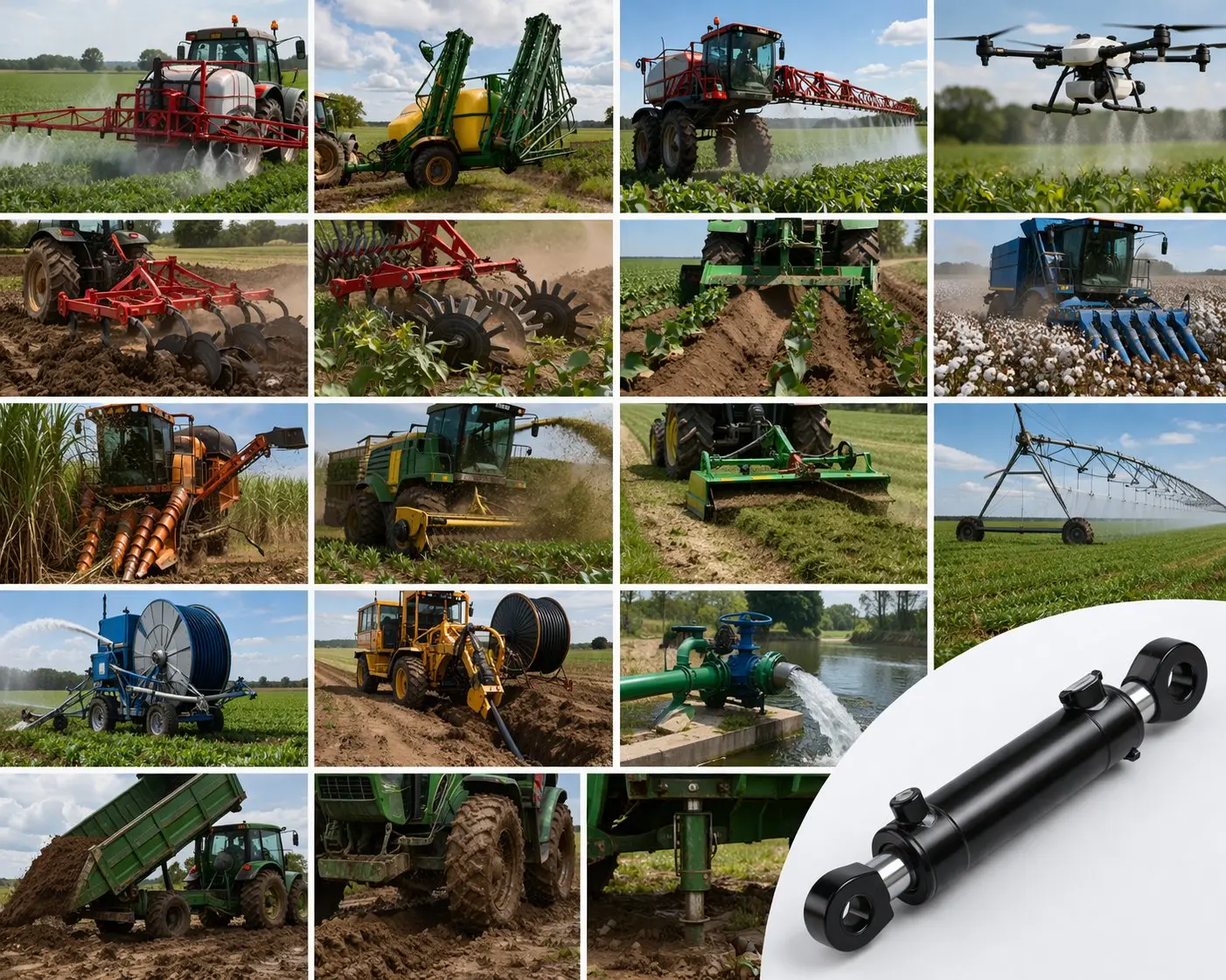
On a mounted sprayer, the boom is attached to the tractor through a central mast or cradle. The height control cylinder connects between this mast and the boom support frame. When the operator adjusts the boom height setting from the cab, pressurized oil enters one side of the agricultural hydraulic cylinder, extending or retracting the rod to raise or lower the boom to the target position above the crop canopy.
During spraying, the tractor travels at 8 to 15 km/h across terrain that is rarely flat. Every slope change, rut, or headland transition shifts the tractor frame angle, which would move the boom tips closer to or farther from the crop if the height cylinder did not compensate. On sprayers with automatic boom height control, ultrasonic or radar sensors measure the distance from the boom tips to the crop canopy and send correction signals to a proportional valve that feeds the cylinder. The cylinder responds by making small, rapid adjustments, extending a few millimeters to raise the boom over a ridge, retracting to drop it into a depression.
This operating pattern means the cylinder experiences constant micro-cycling under moderate pressure, combined with persistent vibration transmitted from the tractor through the sprayer frame. The hydraulic fluid inside heats up from the rapid valve switching, and the external surfaces are coated in a fine mist of diluted pesticide spray that settles on every exposed component throughout the working day. Standard carbon steel cylinders without chemical protection corrode visibly within a single season in this environment.
Pesticide Chemical Resistance: What Corrodes Your Cylinder and How We Stop It
Not all agricultural chemicals attack hydraulic components the same way. Understanding which chemical classes cause which types of damage is essential for selecting the right cylinder surface treatment and seal material. Here is a breakdown of the most common chemical threats faced by hydraulic cylinders for agricultural machinery in spraying applications.
| Chemical Class | Common Examples | Attack Mechanism | Our Protection |
|---|---|---|---|
| Organophosphates | Chlorpyrifos, Malathion | Solvent action swells NBR seals; attacks paint coatings | FKM seals + epoxy body coat |
| Sulfonylureas | Tribenuron, Metsulfuron | Mildly acidic solution pits bare steel and thin chrome | 20+ micron hard chrome on rod |
| Copper-Based Fungicides | Bordeaux mix, Copper hydroxide | Galvanic corrosion between copper residue and steel | Nickel undercoat + hard chrome |
| Glyphosate Formulations | Various brands | Surfactant penetrates standard paint; long-term seal swell | Polyurethane topcoat + FKM seals |
| Liquid Fertilizer (UAN) | 28-0-0, 32-0-0 | Highly corrosive to bare steel and zinc coatings | Full epoxy body + protective bellows |
Our standard configuration for sprayer boom cylinders uses FKM (Viton) rod seals that resist swelling from solvent-based pesticide formulations, a hard chrome rod plating of 20 micrometers minimum with an optional nickel undercoat for copper-fungicide environments, and a two-layer epoxy body coating that withstands direct chemical splash far better than standard black oxide or single-coat paint. For operations that spray UAN liquid fertilizer or handle particularly aggressive chemical mixes, we recommend the optional protective bellows boot, which encloses the entire rod travel length in a flexible rubber sleeve and prevents any chemical contact with the rod surface entirely.
Technical Specifications
| Specification | Available Range |
|---|---|
| Bore Diameter | 40 mm – 80 mm |
| Rod Diameter | 25 mm – 50 mm |
| Stroke Length | 100 mm – 600 mm |
| Working Pressure | Up to 18 MPa (2,610 PSI) |
| Action Type | Double Acting |
| Cylinder Structure | Welded Piston Cylinder |
| Body Material | Q345D Low-Alloy Structural Steel |
| Piston Rod | Q345D, Hard Chrome 20+ micron (Ni undercoat optional) |
| Body Coating | Two-Layer Epoxy / Polyurethane Topcoat |
| Rod Seal | FKM (Viton) + PTFE Back-up |
| Piston Seal | Polyurethane Compact Seal |
| Dust/Chemical Wiper | FKM Wiper + Optional Protective Bellows Boot |
| Mounting | Clevis, Pin Eye, Trunnion, Flange, Custom |
| Port Thread | BSP / NPT / Metric |
| Operating Temperature | -25 C to +85 C |
| Hydraulic Fluid | ISO VG 46 / VG 68 |
| Environment Rating | Pesticide Corrosion + Vibration |
Six Engineering Advantages for Chemical-Intensive Spraying Operations
Q345D Low-Alloy Steel Barrel and Rod
FKM (Viton) Seal System for Pesticide Resistance
Heavy Chrome with Optional Nickel Undercoat
Optional Protective Bellows Boot
Two-Layer Epoxy Body Coating
Vibration-Resistant Port and Fitting Design
Where This Cylinder Gets Installed
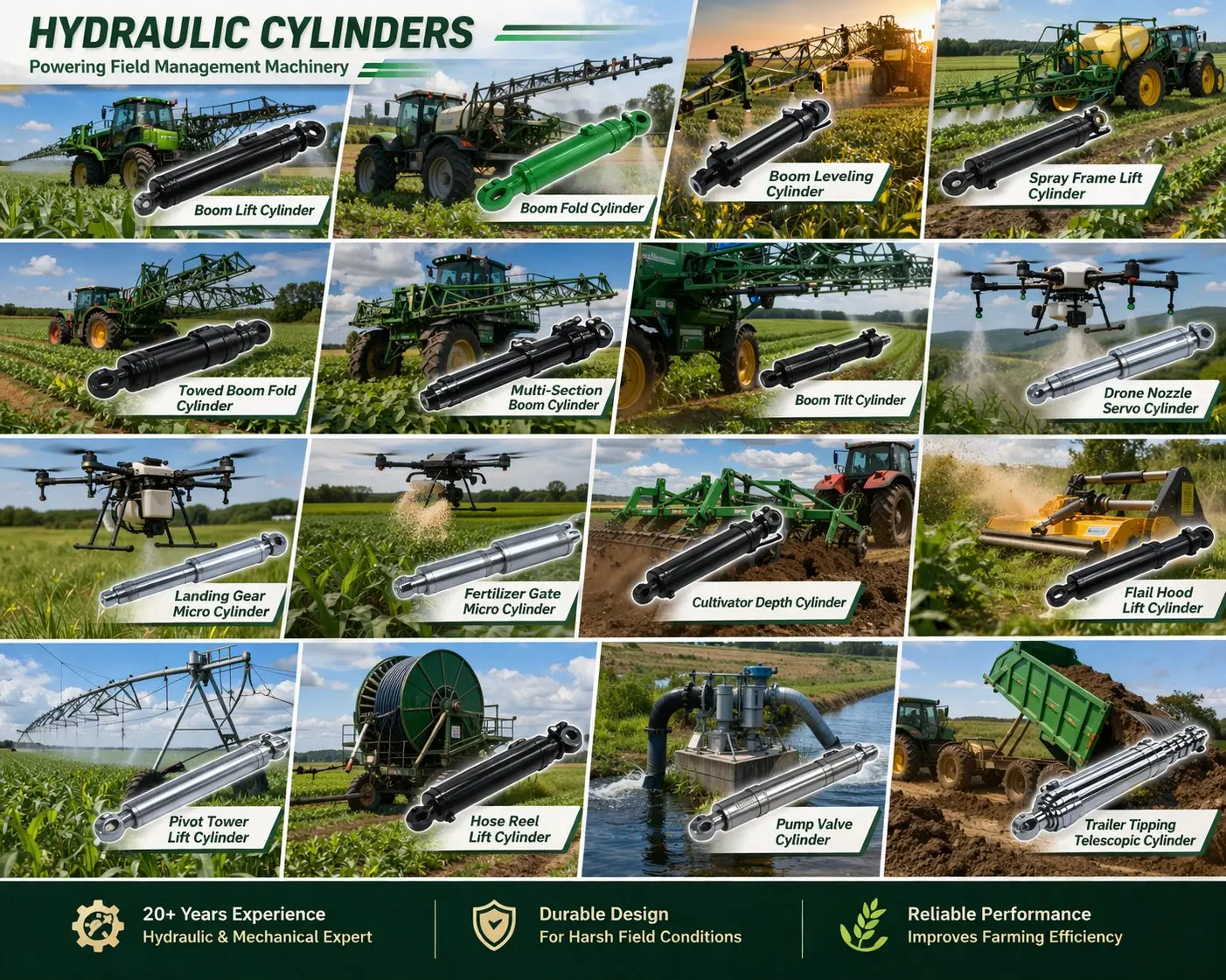
Three-Point Hitch Mounted Sprayers: The primary application. Boom height control on mounted sprayers ranging from 400 to 1,500 liter tank capacity, with boom widths from 8 to 18 meters. The cylinder mounts between the central mast and the boom cradle to provide vertical adjustment of 300 to 600 mm.
Trailed Sprayer Boom Lift Systems: Larger trailed sprayers with 2,000 to 5,000 liter tanks use similar boom height cylinders, often with longer strokes and higher working pressures to handle the heavier boom weights. Our Q345D construction handles these increased loads without the barrel flex that lighter carbon steel cylinders exhibit.
Self-Propelled Sprayer Boom Masts: Self-propelled crop sprayers use height control cylinders on both the main boom mast and individual boom section supports. The chemical exposure is identical to mounted sprayers, but operating speeds are higher (up to 30 km/h), increasing the cycle frequency and vibration intensity.
Orchard and Vineyard Vertical Boom Sprayers: Vertical boom sprayers used in fruit orchards and vineyards adjust boom height to target different canopy zones. These applications involve close-range chemical spray at high concentrations, making the FKM seal and protective bellows options especially valuable.
Liquid Fertilizer Applicator Booms: UAN and liquid fertilizer applicators use the same boom architecture as crop sprayers. The chemical environment is even more aggressive because UAN solutions are highly corrosive to bare steel. Our full protection package with nickel-chrome rod, epoxy body coating, and bellows boot is the recommended specification for this application. Browse our complete range of hydraulic cylinders for agricultural machinery for additional options.
Manufacturing and Quality Assurance
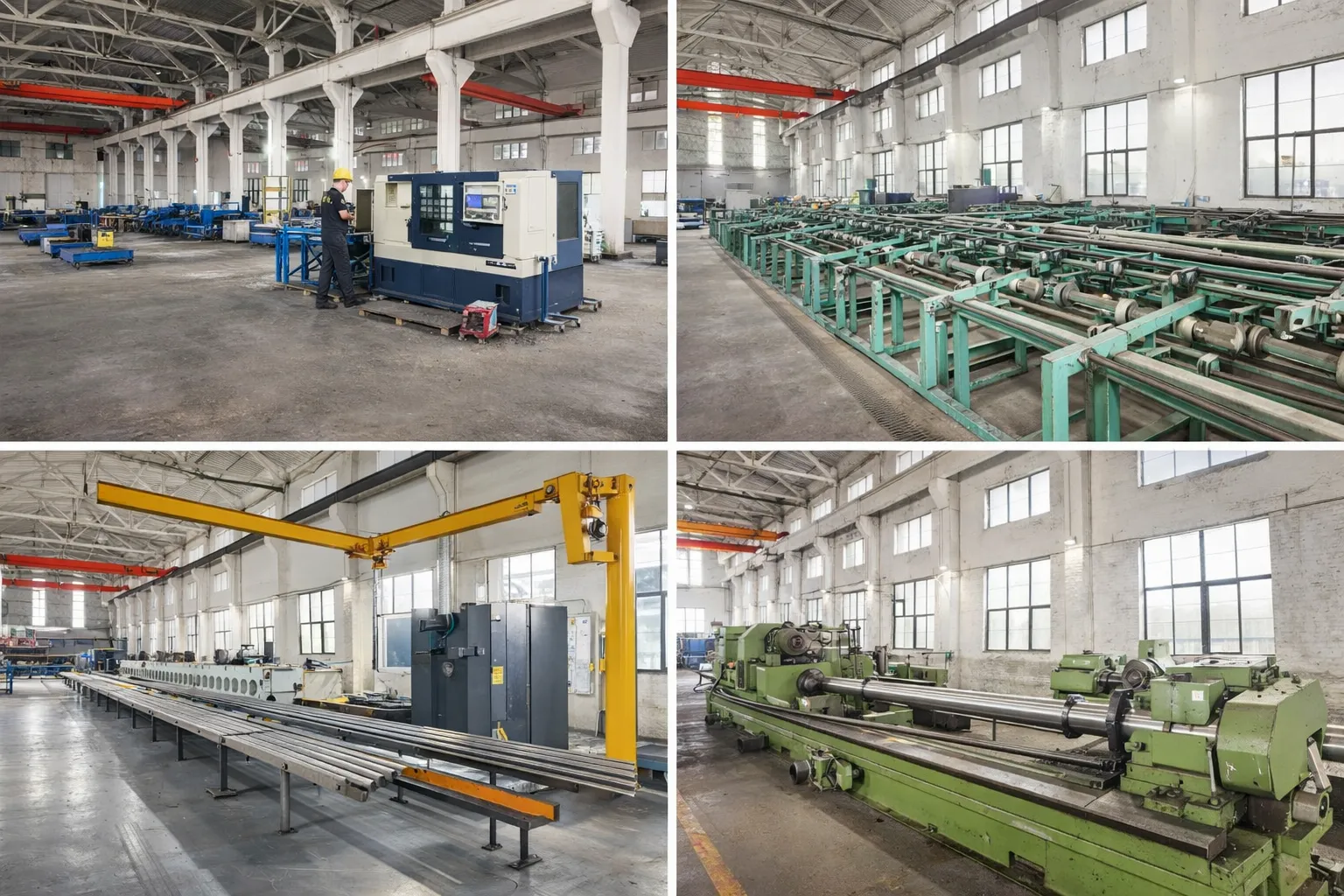
Every cylinder is manufactured in-house from raw Q345D steel through final pressure testing and coating. There is no outsourced sub-assembly. This matters for sprayer cylinders because the coating quality, seal selection, and chrome plating adhesion must all work together as a system. If any one element is outsourced to a supplier who does not understand the chemical exposure requirements, the entire corrosion protection strategy fails.
Material verification: Q345D tube and bar stock arrives with mill certificates. We verify each batch by spectrometer for chemical composition and perform Charpy impact testing at -20 C to confirm the low-temperature toughness specified for Q345D grade. This step is critical because substandard material can pass visual and hardness checks but fail under cyclic loading in cold-weather spring spraying conditions.
Machining and chrome plating: Bores honed to Ra 0.2. Rods ground to h7 tolerance, chrome plated to 20+ micron thickness with optional nickel undercoat. Chrome adhesion is verified by bend testing on sample pieces from each plating batch.
Welding: All barrel-to-cap welds are MIG welded by certified operators. Weld quality is inspected visually and by magnetic particle testing on a sampling basis.
Coating application: Body coating is applied after all welding and machining is complete. The surface is abrasive-blasted to Sa 2.5 standard before primer application. Each coat is allowed to cure fully before the next layer is applied. Dry film thickness is measured with a coating gauge and must meet minimum thickness at all points, including weld zones and port boss transitions.
Testing and traceability: 100% pressure tested at 1.5 times rated working pressure for three minutes. Leak inspection at all ports, welds, and rod seal. Unique serial number linked to material batch, seal lot, plating batch, and test results. ISO 9001 certified facility. Material test reports and pressure test certificates included as standard.
Standard Farm Cylinder vs. Our Boom Height Control Cylinder
| Sprayer-Relevant Metric | Standard Farm Cylinder | Our Boom Height Cylinder |
|---|---|---|
| Rod Corrosion Resistance (Pesticide Exposure) | Pitting visible after 1 season | No pitting after 3-5 seasons |
| Seal Material | NBR (swells in pesticide solvent) | FKM (chemically inert) |
| Body Coating Life in Chemical Spray | 1 season (single paint) | 3-5 seasons (duplex epoxy) |
| Salt Spray Test (Rod) | 150 – 200 hours | 500+ hours (Ni-Cr duplex) |
| Protective Bellows Option | Not available | CR rubber bellows, UV-stabilized |
| Body Material | S45C Carbon Steel | Q345D Low-Alloy Steel |
| Low-Temperature Rating | -10 C | -25 C |
Customer Case Studies
Iksan City, Jeollabuk-do, South Korea
Customer: Mounted sprayer OEM producing 800 to 1,200 liter three-point hitch sprayers for the Korean rice and vegetable market
Challenge: Chronic warranty returns for corroded boom height cylinders after one season of rice paddy spraying. Standard carbon steel cylinders with single-coat paint were visibly rusting within three months of delivery.
How They Found Us: Their quality manager contacted us after finding our listings while searching for hydraulic cylinders for sale with chemical-resistant coatings. First inquiry received in August 2024.
Results: After switching to our Q345D cylinders with duplex epoxy coating and FKM seals, the OEM reported zero corrosion-related warranty returns through two full spraying seasons (spring 2025 through autumn 2025). Cylinder-related warranty costs dropped by an estimated 85%.
“Our rice sprayer customers use copper fungicides heavily in the summer months. The old cylinders came back looking like they had been soaked in acid. Since switching to these coated Q345D units, not a single return. Our warranty manager has one less headache.” – Mr. Noh, Quality Director, October 2025
Hongseong County, Chungcheongnam-do, South Korea
Customer: Organic vegetable farming cooperative operating 40 mounted sprayers across 320 hectares
Challenge: Even organic-approved pesticide formulations (neem oil, copper hydroxide, sulfur) caused seal swelling and rod pitting on their existing cylinders, requiring annual replacement of the entire boom height cylinder on most machines.
How They Found Us: Recommendation from their sprayer maintenance contractor, who had sourced our cylinders for another cooperative in the region. Trial order placed in February 2025.
Results: After fitting 40 replacement cylinders across their fleet, the cooperative completed the entire 2025 season (March through October, approximately 180 spray days) without a single cylinder replacement. Pre-winter inspection showed no visible seal degradation or rod surface damage. Annual hydraulic maintenance costs fell by approximately 55%.
“People assume organic spraying is easy on equipment. It is not. Copper and sulfur formulations are brutal on metal and rubber. These cylinders are the first ones that actually lasted a full season without showing any signs of chemical damage.” – Ms. Hwang, Equipment Coordinator, November 2025
Saga Prefecture, Japan
Customer: Agricultural equipment R&D division of a major Japanese sprayer manufacturer
Challenge: Developing a new mounted sprayer line with automatic boom height control for the Japanese rice market. Their internal cylinder prototype used NBR seals that swelled after exposure to commonly used rice fungicide formulations during bench testing.
How They Found Us: Found our technical specifications through a Google search in December 2024. Their R&D team contacted us requesting FKM-sealed sample cylinders for chemical immersion testing.
Results: After a 90-day immersion test in diluted fungicide solution followed by a 30,000-cycle fatigue test, our FKM seals showed less than 2% volume change and no measurable performance degradation. The manufacturer approved our cylinder for series production supply. Current order schedule is 300 units per quarter for their 2026 model year sprayers.
“We tested four different suppliers’ cylinders in the same chemical immersion protocol. Only one passed with negligible seal swell. The FKM compound they use is clearly a different grade from the generic Viton we tested from catalog suppliers.” – R&D Test Report Summary, March 2025
Nakhon Pathom Province, Thailand
Customer: Contract spraying service operating a fleet of 25 mounted and trailed sprayers serving rice, sugarcane, and fruit farms in the central plains region
Challenge: The tropical climate, combined with year-round spraying of mixed chemical loads (herbicides, insecticides, fungicides, foliar fertilizers), created corrosion conditions that destroyed standard cylinders in under six months.
How They Found Us: Their fleet manager discovered our product pages through a web search for “chemical resistant hydraulic cylinder for sprayer” in May 2024.
Results: After replacing boom height cylinders on 10 machines as a trial in July 2024, all 10 completed over 12 months of continuous tropical spraying service without visible rod corrosion or seal failure. The fleet manager subsequently ordered replacements for the remaining 15 machines and estimates annual cylinder procurement costs have dropped by over 60% because each unit now lasts three to four times longer than previous suppliers’ products.
“In Thailand we spray 12 months a year. That means 12 months of chemical exposure with no off-season break for the equipment. My old cylinders lasted four to six months at best. These have been running for over a year now and still look new under the bellows boot.” – Mr. Kittisak, Fleet Operations Manager, August 2025
Punjab Province, Pakistan
Customer: Agricultural equipment importer supplying mounted sprayers and spare parts to the cotton and wheat belts of southern Punjab
Challenge: High return rates on aftermarket boom cylinders due to rapid corrosion from organophosphate insecticide spray used heavily in cotton pest management.
How They Found Us: Attended the Lahore Agri Expo in February 2025 where our catalog was on display at a partner booth. Placed a trial order of 50 units in March 2025.
Results: End-user feedback through the 2025 cotton spraying season (June through September) was uniformly positive. Zero corrosion complaints. The importer has since doubled their quarterly order volume and added our custom hydraulic cylinder options to their catalog for other sprayer subsystems.
“Cotton spraying in Punjab uses some of the harshest chemicals in agriculture. Our customers were bringing back corroded cylinders faster than we could replace them. Switching to the coated Q345D units stopped the returns completely. My warranty budget finally makes sense.” – Mr. Iqbal, Managing Director, November 2025
Frequently Asked Questions
What type of seal material resists pesticide chemical damage on sprayer cylinders?
How does a protective bellows boot extend cylinder life on sprayers?
Can your boom height cylinder fit my existing sprayer model?
What is the lead time for sprayer boom height cylinders?
Why is Q345D steel better than standard carbon steel for sprayer cylinders?
How should I maintain boom height cylinders during the off-season?
Do you deliver sprayer cylinders to South Korea, Japan, and Southeast Asia?
Stop Replacing Corroded Boom Cylinders Every Season
Send us your sprayer model, boom configuration, and the chemicals you spray most frequently. Our team will recommend the right protection level and deliver a quotation within 48 hours.
Editor: Cxm