Hood Lift Cylinder for Forage Chopper Machines
Q345D structural steel with protective boot and chrome rod. Designed for the dust-heavy, light-impact environment of opening and securing forage chopper inspection hoods safely.
A Hood That Drops Without Warning Is Not Just an Inconvenience. It Is a Safety Hazard.
The maintenance hood on a forage chopper protects the operator from the high-speed rotating blade assembly inside. When the hood is raised for inspection, blade replacement, or clearing a blockage, the hydraulic cylinder holding it open is the only thing preventing several hundred kilograms of steel from dropping onto the operator’s hands, arms, or head. A cylinder that leaks internally allows the hood to drift downward slowly. A cylinder with a corroded rod can lose holding force suddenly without warning. In both cases, the consequences range from damaged equipment to serious injury.
Forage chopper hood cylinders sit exposed on the outside of the machine body in one of the harshest environments a farm cylinder can face: constant grass and silage dust during chopping operations, road grit during transport, moisture from dew and rain when machines sit uncovered overnight, and light impact loads when the hood is closed firmly by the operator. The rod surface accumulates a coating of sticky grass juice and fine dust that bonds to the chrome and draws abrasive particles into the seal zone during every hood operation. Without a protective boot or effective dust management, the rod surface pits and the seal wears through within two to three seasons.
Our forage chopper hood lift cylinder is a double acting hydraulic cylinder built from Q345D low-alloy structural steel with a hard chrome-plated rod, a simple protective rubber boot that shields the entire rod travel zone, and an integrated PU dust wiper as a secondary barrier. The cylinder is sized to hold the hood open securely at any position within its travel range, with internal sealing good enough to prevent any measurable drift during a 30-minute maintenance session.
Safety-Critical Holding: What Keeps the Hood Up While You Work Underneath
A hood lift cylinder has a unique responsibility that most agricultural cylinders do not share: holding a heavy mass directly above a person. The operator raises the hood, locks it in position using the cylinder’s hydraulic hold, and then reaches into the machine to inspect or service the blade assembly. During this time, the cylinder must maintain zero rod retraction. Any internal leakage allows the hood to creep downward. On a hood weighing 150 to 300 kg pivoting on a hinge, even 5 mm of rod retraction can translate into 20 to 40 mm of hood edge drop, enough to strike an operator who has positioned their head or hands inside the machine.
Our approach to safe holding combines three measures:
Precision Piston Seal with Anti-Extrusion Ring
Internal leakage held below 0.3 ml per minute at working pressure. PTFE anti-extrusion back-up ring prevents seal deformation under the sustained gravity load of the open hood. This maintains holding integrity even when the cylinder is pressurized for extended maintenance sessions.
Bore Honed to Ra 0.2 with Controlled Roundness
Bore roundness within 0.01 mm eliminates the angular leakage paths that ovalized bores create. The seal maintains uniform contact pressure around the full circumference, preventing the position-dependent leakage that causes drift in poorly machined cylinders.
Recommended Pairing with Pilot-Operated Check Valve
For maximum safety, we recommend installing a pilot-operated check valve in the cylinder circuit. This valve mechanically locks oil on the rod side when the control valve is in neutral position, providing a secondary holding mechanism that does not rely on internal cylinder seal integrity alone. We can supply cylinders with port geometry optimized for direct check valve mounting if specified at the time of order.
Technical Specifications
| Specification | Available Range |
|---|---|
| Bore Diameter | 40 mm – 80 mm |
| Rod Diameter | 25 mm – 50 mm |
| Stroke Length | 150 mm – 600 mm |
| Working Pressure | Up to 16 MPa (2,320 PSI) |
| Action Type | Double Acting |
| Structure | Welded Piston Cylinder |
| Body Material | Q345D Low-Alloy Structural Steel |
| Piston Rod | Q345D, Hard Chrome 20+ micron |
| Body Finish | Black Oxide + Epoxy Paint |
| Piston Seal | PU + PTFE Anti-Extrusion Ring |
| Rod Seal | NBR + PTFE Back-up |
| Rod Protection | PU Wiper + Protective Rubber Boot |
| Mounting | Clevis, Pin Eye, Lug, Custom |
| Port Thread | BSP / NPT / Metric |
| Operating Temperature | -25 C to +80 C |
| Environment Rating | Dust / Grass Juice / Light Impact |
Five Design Features for Safe, Long-Lasting Hood Lift Service
Protective Rubber Boot
Simple accordion-fold boot encloses the entire rod travel, preventing grass juice, silage dust, and road grit from contacting the chrome surface. Field-replaceable in minutes. Extends rod and seal life from 2-3 seasons to 5+ seasons in typical forage chopper service.
Precision Internal Sealing for Safe Holding
Internal leakage below 0.3 ml/min with PTFE anti-extrusion ring. Holds open hood position with less than 0.5 mm drift over 30 minutes, well within the safety margin for maintenance access.
Q345D Structural Steel
345 MPa yield with -20 C Charpy toughness. Handles the light impacts from hood closing and the sustained gravity load during holding. Superior weldability for consistent barrel joints.
20+ Micron Hard Chrome Rod
Heavy chrome layer resists the sticky grass juice and dust mixture that coats exposed rod surfaces during chopping. Even inside the boot, condensation and minor debris ingress occur; the chrome thickness provides a safety margin for long-term surface integrity.
Check Valve Compatible Port Geometry
Port layout designed to accept direct mounting of a pilot-operated check valve for secondary mechanical load holding. This option provides an additional safety layer beyond internal seal holding, meeting the safety requirements of ISO and CE machine safety standards for gravity-loaded mechanisms.
Application Scenarios
Forage Chopper Inspection Hoods: The primary application. Self-propelled and trailed forage choppers use hood lift cylinders for accessing the blade drum, feed rollers, and shear bar for inspection and service.
Round and Square Baler Chamber Doors: Baler press chamber doors or tailgates use similar lift cylinders. The grass juice and dust exposure is comparable. The safety-critical holding requirement applies because baler chamber doors are heavy and operators work close to them during troubleshooting. These are common double acting hydraulic cylinder applications across forage equipment.
Mower Conditioner Hood Lift: Disc mower conditioners use hoods that cover the conditioning rollers. These hoods lift for maintenance access with similar safety-critical holding requirements.
TMR (Total Mixed Ration) Mixer Lids: Stationary and trailed feed mixer wagons use hydraulic cylinders to open heavy lids for ingredient loading and inspection. Silage juice and feed dust exposure is comparable to forage choppers.
Grain Combine Maintenance Panels: Modern combine harvesters have multiple hydraulically lifted service panels for accessing the threshing drum, cleaning shoe, and chopper assemblies. Grain dust and chaff create similar contamination challenges to forage chopper hoods.
Manufacturing and Quality Control
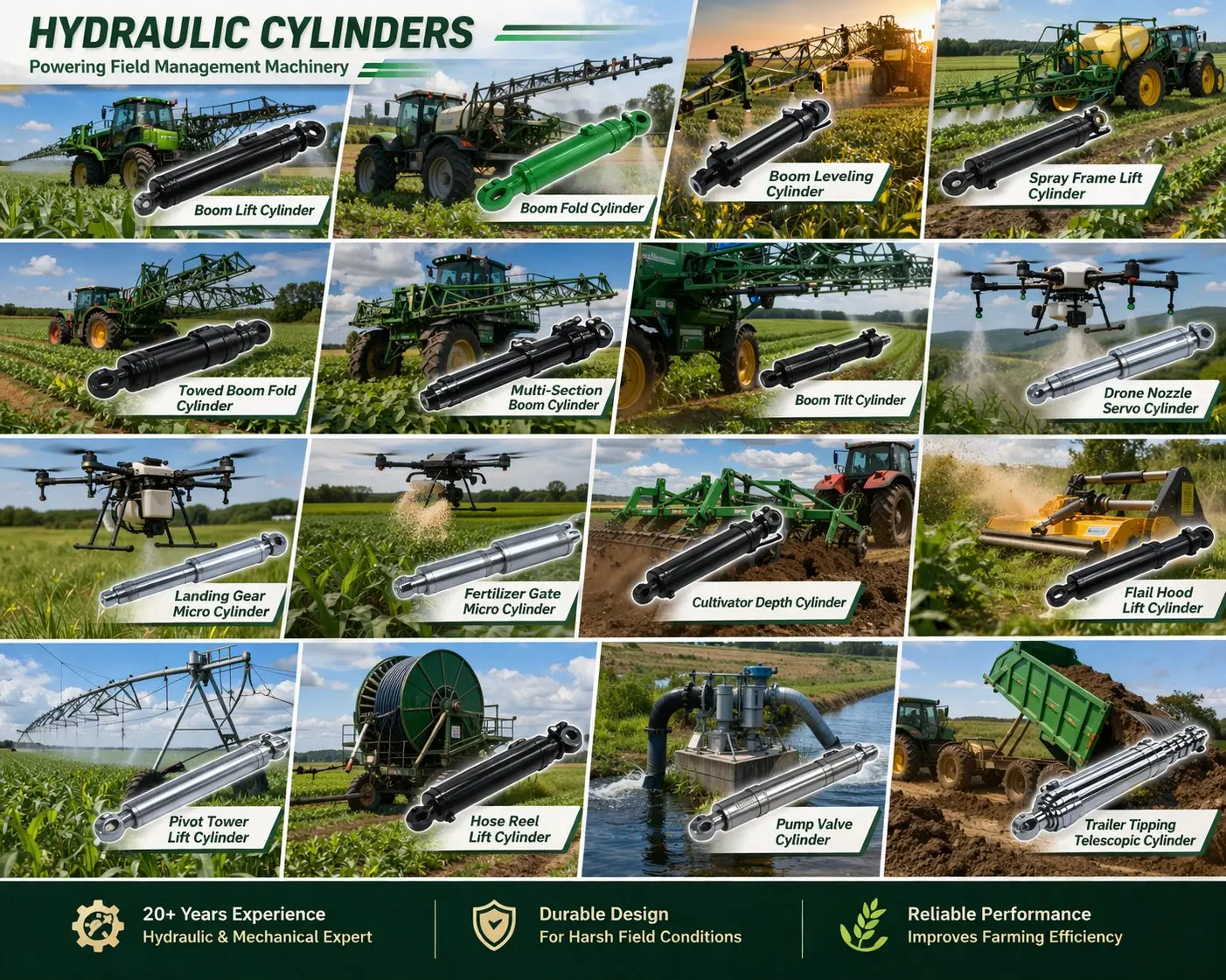
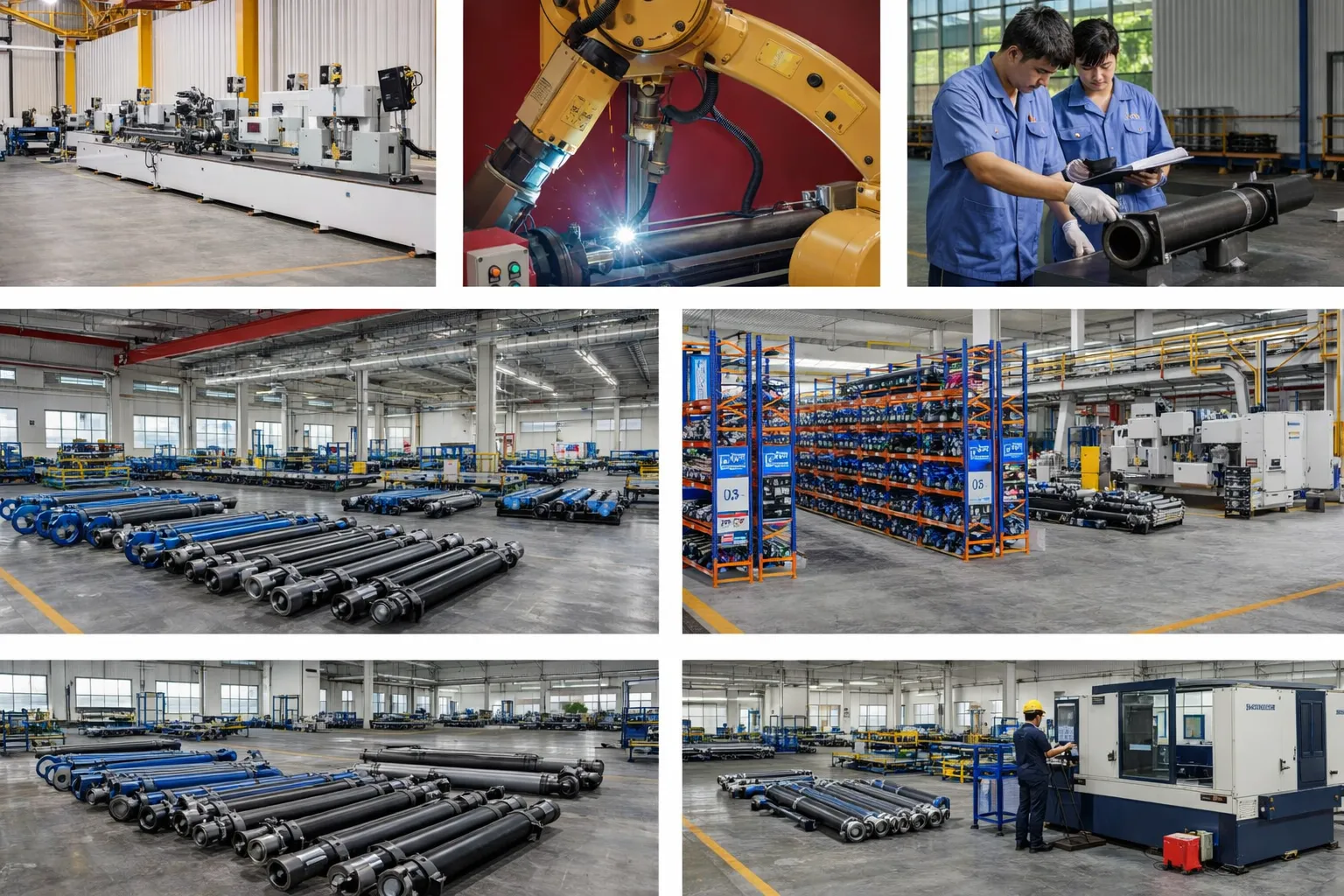
Built in-house in our ISO 9001 certified facility. Q345D tube and rod verified by spectrometer. Bores honed to Ra 0.2 with roundness within 0.01 mm. Rods ground to h7 and chrome plated to 20+ micron. MIG welded by certified operators. Piston seal internal leakage measured on every unit as part of the quality test protocol. 100% pressure tested at 1.5x rated pressure for three minutes. Boots fitted and compression-tested before shipment. Serial numbered with ten-year traceability. Material and test certificates included as standard. Internal leakage value recorded on individual test certificate for safety-critical applications.
Standard Lift Cylinder vs. Our Hood Lift Cylinder
| Hood Lift Metric | Standard Cylinder | Our Hood Lift Cylinder |
|---|---|---|
| Rod Surface Protection | Exposed (no boot) | Wiper + protective boot |
| Internal Holding Drift (30 min) | 2 – 8 mm | Below 0.5 mm |
| Check Valve Compatibility | Requires adapters | Direct-mount port geometry |
| Rod Life (grass juice + dust) | 2 – 3 seasons (pitting) | 5+ seasons (boot-protected) |
| Internal Leakage Data on Certificate | Not provided | Yes (per-unit value) |
Customer Case Studies
Frequently Asked Questions
Why is hood drift a safety concern on forage choppers?
What bore size is typical for a forage chopper hood lift cylinder?
Can I replace OEM hood cylinders with your boot-protected version?
What is the lead time for hood lift cylinders?
Your Operators Work Under That Hood. The Cylinder Should Hold It Absolutely.
Share your chopper model and hood weight. We will recommend a safe, boot-protected replacement and deliver a quotation within 48 hours.
Editor: Cxm