Heavy-Duty Shear Hydraulic Cylinder for Rolling Mill Equipment
Engineered specifically to conquer the immense mechanical shock of continuous metallurgical cutting systems. Featuring a heavy-duty welded Q345D structure and massively strengthened cylinder ears to permanently eradicate fatigue cracks and ensure uninterrupted steel production.
Product Overview and Core Industrial Imperative
Operating a continuous metal processing facility demands absolute mechanical reliability from every single piece of machinery on the production floor. In the unforgiving environment of heavy metallurgy, the sectioning, cropping, and trimming of steel billets, hot strips, or cold-rolled plates represent some of the most violent mechanical actions within the entire plant. At the dead center of this extreme operation is the shear cylinder. This specialized piece of fluid power equipment acts as the mechanical muscle driving the heavy shear blades through solid metal at extremely high speeds. For plant managers and maintenance directors, the operational health of the shear hydraulic cylinder dictates the continuous flow of the entire rolling line. An unexpected structural failure at the shear station does not just halt a single machine; it causes a cascading shutdown of the entire continuous casting or rolling operation, resulting in massive financial losses, wasted thermal energy, and severe production bottlenecks.
Through years of analyzing equipment breakdowns across East Asia, including prominent mills in South Korea and Japan, we have consistently observed that standard, commercial-grade actuators cannot survive the unique physical punishment delivered by a metallurgical shear. When a shear blade bites into a thick steel slab, the mechanical resistance skyrockets, causing the internal hydraulic pressure to spike instantaneously to overcome the yield strength of the metal. The massive kinetic energy released during the cut places unimaginable stress on the unit. Standard commercial cylinders quickly develop structural fatigue cracks at the base of their mounting brackets due to this relentless cyclic hammering, leading to catastrophic physical separation from the machine frame.

As a highly specialized hydraulic cylinder manufacturer, we have completely redesigned the core architecture of our shear cylinder to absorb this huge impact. By utilizing a robust welded structure made from Q345D low-alloy steel and integrating a dramatically strengthened cylinder ear, we effectively eliminate the fatigue cracks that destroy conventional units. When evaluating the overall hydraulic cylinder price, investing in a custom-engineered shear hydraulic cylinder provides a massive return on investment by guaranteeing years of uninterrupted, safe steel production.
Customizable Technical Specifications and Parameters
There is no universal, off-the-shelf solution for heavy industrial cutting. Every rolling mill has specific tonnage requirements, hydraulic flow capacities, and physical spatial constraints within the machine housing. We offer an extensive range of customizable engineering parameters to ensure perfect integration into your specific shear frame. The following table outlines the foundational technical data and design philosophy for our high-impact metallurgical shear actuators.
| System Attribute | Parameter Specification | Engineering Significance |
|---|---|---|
| Industry Segment | Metallurgy | Specifically developed to survive continuous operations in heavy steel manufacturing plants. |
| Equipment Category | Rolling Mill | Integrates flawlessly into hot strip mills, cold reduction lines, and heavy plate mills. |
| Subsystem / Action | Shearing System | The critical mechanical station responsible for cropping, dividing, and flying cuts. |
| Cylinder Name | Shear Cylinder | The primary hydraulic actuator generating the required tonnage to severe the solid metal. |
| Action Method | Double Acting | Functions as a double acting hydraulic cylinder for powered extension and rapid powered retraction. |
| Structure Type | Piston Cylinder | Utilizes a heavy-duty piston face optimized for maximum hydraulic push area and lateral stability. |
| Manufacturing Structure | Welded | Employs deep-penetration submerged arc welding to create a monolithic, indestructible body. |
| Material System | Q345D Low Alloy Steel | Selected for its high yield strength and exceptional low-temperature impact toughness. |
| Surface Treatment | Chrome Plated | Thick, high-density hard chrome protects the rod from abrasive iron scale, dust, and corrosion. |
| Environment Grade | Huge Impact | Engineered deliberately to absorb and dissipate extreme kinetic shockwaves continuously. |
| Working Condition Feature | Shearing Action | Manages the violent transition from maximum resistance to zero resistance instantly. |
| Typical Failure Mode | Fatigue Cracks | Common in standard designs; eliminated through our specialized geometry and material upgrades. |
| Recommended Configuration | Strengthen Cylinder Ear | Oversized, deep-welded clevis mounts prevent tearing and distribute shock loads safely. |
The Physics of Shearing: Working Principle and Hydrodynamic Control
To fully comprehend the necessity of specialized, heavy-duty engineering in this field, one must examine the extreme physics occurring during a single cycle of an industrial shear. Unlike a standard lift cylinder that smoothly hoists a static weight, a shear actuator operates in a realm of kinetic violence. When the plant’s automation system commands a cut, high-flow hydraulic fluid—often accelerated by large nitrogen-charged accumulators—floods the cap end of the barrel. This rapidly accelerates the massive steel blade assembly downward toward the moving steel slab. As the blade bites into the steel, the forward velocity drops near zero almost instantly, while the hydraulic pump continues to force fluid into the chamber. This creates an enormous pressure spike, often momentarily doubling the system’s rated operating pressure to overcome the yield strength of the material.
The critical moment arrives precisely when the steel fractures. In a fraction of a millisecond, the immense counter-resistance vanishes. Because hydraulic fluid under extreme pressure is slightly compressible, it acts like a tightly coiled liquid spring. When the steel snaps, this liquid spring explosively decompresses, causing the entire hydraulic cylinder piston and blade assembly to lurch forward violently. This “break-through shock” generates a massive tensile shockwave that travels backward, attempting to rip the shear hydraulic cylinder away from its rear mounting pins. If the cylinder ear is not explicitly designed to handle this alternating stress, fatigue cracks will initiate immediately at the microscopic level.
Our customized engineering combats this destructive energy through two sophisticated mechanisms. First, we incorporate highly precise, internal progressive hydraulic cushioning. As the piston hurtles forward after the material breaks, a specifically machined spear enters a deceleration cavity in the front head, forcing the escaping fluid through a tightly metered orifice. This creates a powerful hydraulic brake, transforming the kinetic energy into manageable heat and smoothly decelerating the mass before metal-to-metal impact occurs. Second, the structural load path is widened via oversized, forged Q345D strengthened cylinder ears. This ensures that whatever residual mechanical shock remains is distributed over a vast surface area, mathematically keeping the localized stress levels well below the fatigue limit of the steel. Following the cut, the fluid logic reverses, and the double acting hydraulic cylinder uses pressurized fluid to retract the heavy blade in a fraction of a second, clearing the path for the continuously advancing hot steel strand.

Seamless Brand Compatibility and Logistics for Upgrades
Many major rolling mills operate on robust legacy equipment installed decades ago. When the original hydraulic actuators driving these massive shears begin to fail repeatedly due to accumulated structural fatigue, purchasing an exact OEM replacement often means buying the exact same design flaw again. Furthermore, sourcing these heavy hydraulic parts from overseas usually entails astronomical costs and unacceptable lead times that cripple plant productivity. We offer a far more strategic alternative: engineered structural upgrades with perfect dimensional matching.
We routinely reverse-engineer and provide enhanced, 100% drop-in replacements for shearing equipment originally manufactured by heavy industry leaders such as SMS Group, Danieli, Primetals Technologies, Bosch Rexroth, and Parker Hannifin.
(Please Note: The mention of these corporate brand names is strictly for the purpose of communicating sizing, dimensional compatibility, and application context to plant engineers. We are an independent hydraulic cylinder manufacturer and claim no affiliation, sponsorship, or trademark rights with these organizations.)
Our objective is not simply to provide generic replacement parts. Whether you are conducting a scheduled plant overhaul or engaged in emergency operations involving fixing hydraulic cylinders on the line, we supply an upgraded unit that utilizes your existing clevis pin diameters, mounting distances, and manifold hose connections exactly. You receive our vastly superior Q345D reinforced architecture without needing to torch, weld, or modify your massive mill housing.
Five Core Technical Advantages for Maximum Reliability
Surviving the brutal, repetitive impact of a rolling mill shear requires uncompromising dedication to mechanical integrity. Standard tie-rod or light-duty welded designs will simply disintegrate within weeks. Here are the five definitive engineering advantages that place our high-impact shear cylinder in a class of its own:
1. Strengthened Cylinder Ears for Fatigue Immunity
The vast majority of shear cylinder failures manifest as fatigue cracks at the mounting points due to severe tensile shock. We completely eliminate this vulnerability by utilizing massively over-proportioned, forged steel cylinder ears. These strengthened clevises are integrated into the rear cap using large-radius geometric transitions, ensuring that shockwaves are dispersed evenly rather than concentrating at sharp corners or thin weld seams.
2. Q345D Alloy Steel Integration
Instead of using standard mild steel (like Q235 or standard 1045), we construct the pressure vessel, end caps, and structural mounts entirely from Q345D alloy. This high-strength, low-alloy structural steel possesses superior yield strength and, crucially, exceptional impact toughness even at lower ambient temperatures. It fundamentally resists the microscopic tearing and brittle fracturing that initiates fatigue failure in lesser materials under dynamic loads.
3. Advanced High-Shock Sealing Architecture
The rapid pressure spikes (often doubling the system’s rated pressure in milliseconds) during the cutting stroke easily extrude and destroy standard polyurethane lip seals. We integrate heavy-duty PTFE/Bronze composite step seals backed by robust anti-extrusion rings. This specialized sealing matrix absorbs the high-frequency pressure transients without deforming, ensuring the internal chambers remain completely separated and leak-free over millions of cycles.
4. Premium Hard Chrome Plating Resilience
Rolling mills are heavily laden with highly abrasive airborne iron scale, metallic dust, and acidic cooling fluids. Standard rods quickly score and pit, destroying the wiper seals and causing external leaks. We apply an ultra-thick, multi-layer hard chrome plating process with strict micro-crack control. This provides an exceptionally hard, low-friction surface that aggressively resists scoring from flying debris, ensuring the hydraulic rams remain pristine.
5. Post-Weld Thermal Stress Relief
A massive welded structure naturally retains internal thermal stresses created during the welding process. If left untreated, these residual stresses act as the perfect starting point for fatigue cracks. After we finish deep-welding the Q345D components, the entire shear hydraulic cylinder barrel assembly is subjected to controlled thermal stress-relief annealing in a massive furnace. This resets the molecular structure, providing maximum flexibility and unbreakable strength.
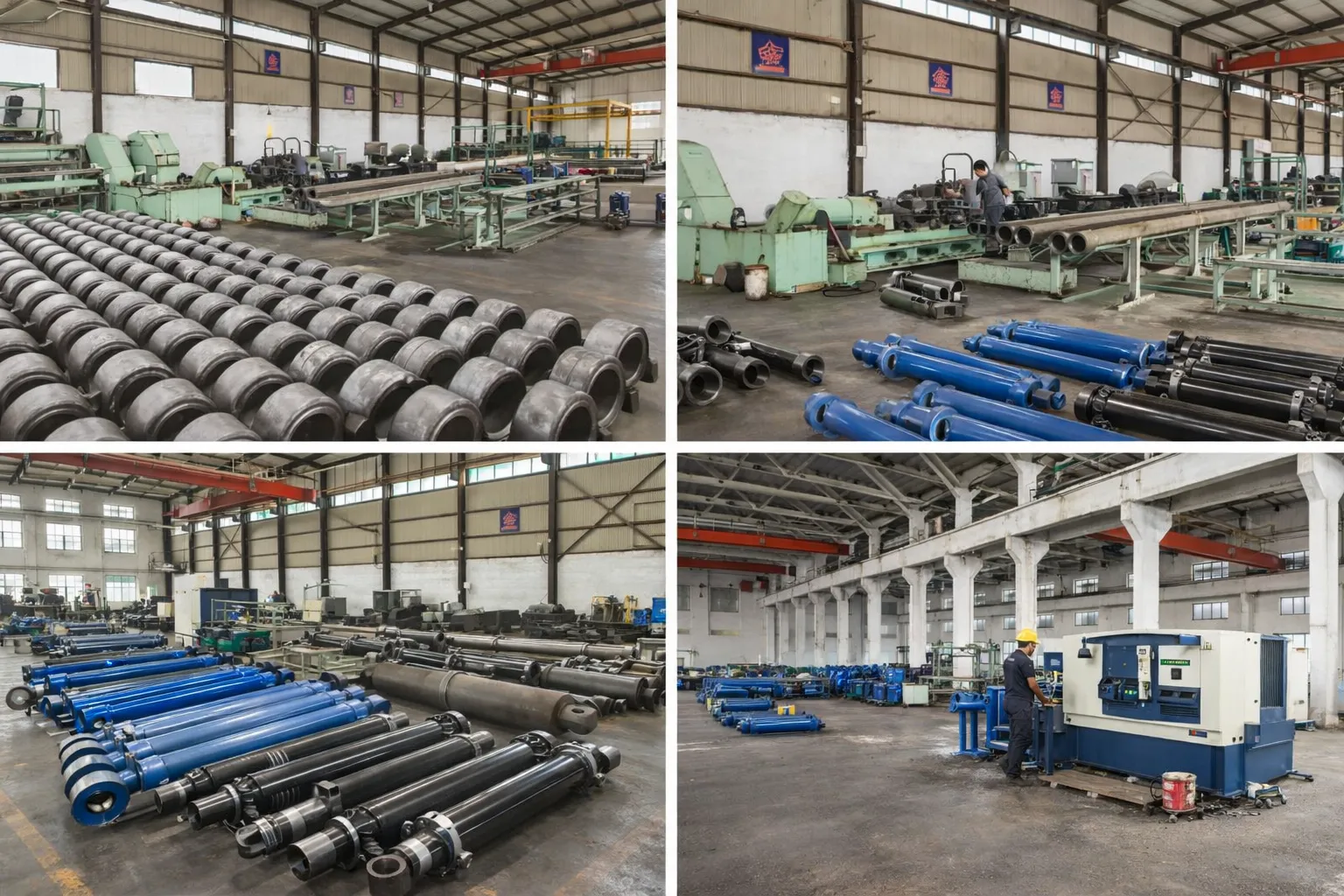
Manufacturing Process and Uncompromising Quality Control
Designing an indestructible shear cylinder on a CAD screen is only the first step; executing that design physically requires a world-class manufacturing facility. We maintain absolute autonomy over our entire production lifecycle. From the moment the raw Q345D steel tubes and forgings arrive at our receiving bays, they are subjected to strict metallurgical verification using optical emission spectrometers. This guarantees the chemical composition aligns perfectly with our engineering specifications. The heavy-walled tubes then undergo precision deep-hole boring, followed by skiving and roller burnishing to achieve a flawless internal mirror finish, which is critical for extending the life of the dynamic piston seals under high-velocity movements.
Because these actuators are classified as critical safety and operational components in high-impact environments, our welding and post-weld protocols are intensely rigorous. We utilize fully automated submerged arc welding (SAW) for all critical barrel-to-cap joints. This process provides incredibly deep weld penetration and a massive weld throat without introducing porosity or slag inclusions. Following the welding process, every joint is subjected to stringent Ultrasonic Testing (UT) and Magnetic Particle Inspection (MPI) to verify absolute internal solidity, ensuring the welds will never tear under the violent shearing impact.
Before any completed cylinder is cleared for international dispatch, it undergoes a brutal 100% factory acceptance test on our computerized hydraulic test rigs. We subject the unit to proof pressures reaching 150% of its rated operational maximum to certify the integrity of the pressure vessel and internal seals under simulated shock load conditions. Furthermore, we simulate rapid cycling to ensure the internal progressive cushioning functions flawlessly. Every unit receives a permanent stamped serial number, ensuring lifetime traceability for materials, seal kit dimensions, and engineering drawings, vastly simplifying any future requirements for precision hydraulic cylinder components or maintenance.
Expansive Typical Industry Applications
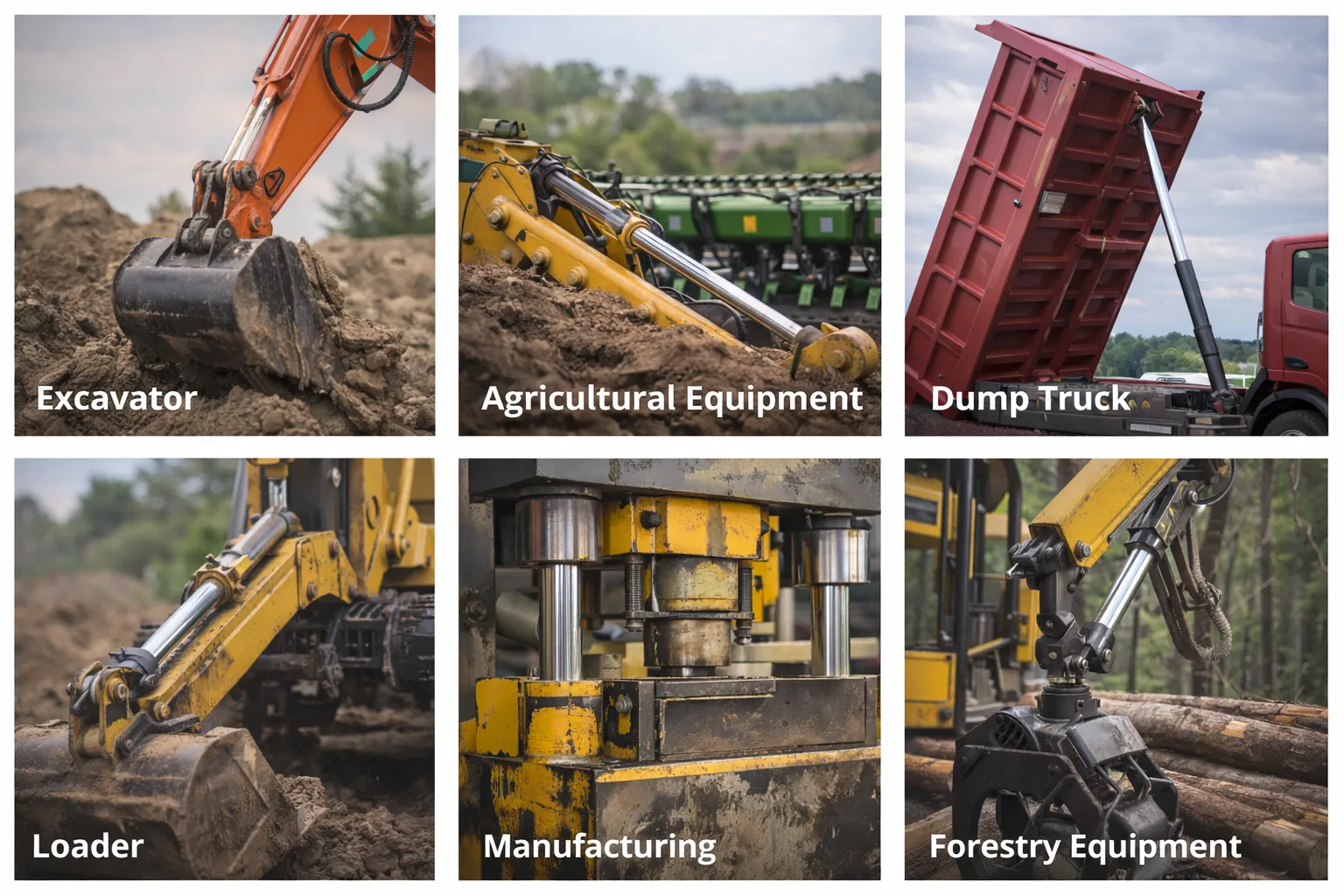
The technological capability to withstand immense, sudden impact forces while delivering extreme pushing tonnage makes our reinforced cylinder architecture highly sought after in multiple heavy-duty sectors beyond continuous steel rolling mills. Wherever a blade needs to part solid material forcefully, our fluid power solutions excel.
- Metallurgical and Iron Industry: Hot crop shears, high-speed flying shears, dividing shears, and heavy scrap choppers within continuous casting and rolling facilities. Explore our heavy-duty solutions for the Metallurgical and Iron Industry.
- Mining & Extraction: Heavy-duty sizing crushers, rock breakers, and massive articulated steering systems that experience severe, unpredictable shock loads. See our rugged systems designed for the Mining Industry.
- Construction Machinery Industry: Mobile hydraulic scrap shears, concrete crushers, and heavy demolition attachments mounted on excavators requiring a resilient crushing actuator that can double as a massive lift cylinder. View our robust parts for the Construction Machinery Industry.
- Material Handling & Recycling: Giant stationary guillotine shears and massive baling presses for processing end-of-life vehicles and heavy industrial scrap metal, where mixed materials create erratic, asymmetrical cutting loads.
- Heavy Forging Presses: Large tonnage industrial forging and stamping presses that require highly reliable hydraulic rams for rapid die return and fail-safe holding operations during the pressing cycle.
Comparative Analysis: Standard Commercial Cylinders vs. Our High-Performance Shearing Cylinders
Utilizing a generic heavy-duty cylinder in a shearing application is a false economy. The mechanical shock will destroy it rapidly, leading to downtime costs that dwarf the initial component savings. This comparative matrix illustrates precisely why our engineered solutions offer vastly superior longevity.
| Feature Assessment | Standard Heavy-Duty Cylinder | Our Specialized Shear Cylinder |
|---|---|---|
| Material Composition | Standard 1020 or Q235 mild steel. Brittle under continuous vibration. | High-toughness Q345D alloy steel. Absorbs kinetic energy safely. |
| Mounting Interface | Standard width cast or lightly welded clevis. Snaps under tension. | Massively reinforced, deeply welded forged cylinder ears. |
| Shock Handling | Transfers full breakthrough shock directly to welds and machine frame. | Actively dampens kinetic energy via custom progressive internal cushioning. |
| Welding Protocol | Standard MIG welding, often single pass. Retains thermal stresses. | Automated multi-pass SAW + UT Testing + Thermal Stress Relief. |
| Primary Failure Mode | Rapid development of fatigue cracks at the base of the mounts. | Exceptional multi-year fatigue life in continuous extreme conditions. |
Global Success: 5 Real-World Case Studies in the East Asian Industrial Sector
Our highly specialized engineering consistently resolves critical operational bottlenecks for massive industrial facilities across East Asia. Below are five documented instances where our heavy-duty solutions significantly enhanced plant reliability, safety, and profitability.
1. Eliminating Crop Shear Fatigue Cracks – Pohang, South Korea
Date: August 2024
Client Profile: A major Tier-1 steel manufacturer operating a high-speed continuous hot strip mill.
The Challenge: The existing hydraulic actuators on their primary crop shear were developing severe fatigue cracks at the rear clevis welds every four to five months due to the violent breakthrough shock when cropping thicker, high-carbon steel slabs.
How they found us: The chief maintenance engineer submitted a technical inquiry via our corporate website specifically seeking heavy forging and Q345D welding expertise to resolve their chronic breakdown issue.
The Result: We delivered a custom-engineered, dimensionally identical replacement featuring massively strengthened cylinder ears and internal hydrodynamic braking. The new shear hydraulic cylinder units have been in continuous operation for over 20 months without a single micro-crack detected during their routine UT inspections.
“The structural integrity of these units is phenomenal. We went from fearing a catastrophic failure every quarter to completely forgetting about the shear cylinders. Exceptional engineering that paid for itself immediately.” — Mr. Park, Chief Mechanical Engineer
2. Overcoming Seal Blowouts in a Hot Strip Mill – Kaohsiung, Taiwan
Date: November 2024
Client Profile: A fast-paced hot strip continuous rolling facility producing automotive sheet metal.
The Challenge: The flying shear, moving at immense synchronized speeds, created huge pressure spikes upon breaking the hot strip. These instantaneous spikes were literally blowing the standard polyurethane seals out of the piston grooves, causing massive internal fluid bypass and failure.
How they found us: Met our engineering representatives at an industrial heavy machinery trade exhibition in Taipei.
The Result: We redesigned the internal architecture to include high-shock PTFE step seals backed by rigid buffer rings and dramatically improved the progressive cushioning zone. The seal blowout issue was completely eradicated, stabilizing their entire production line speed.
“We used to keep a dedicated team just for swapping seals on that shear. Your advanced seal packages saved us incredible amounts of hydraulic oil and downtime. The investment in these units was incredibly wise.” — Chen W., Plant Operator
3. Doubling Lifespan in Heavy Scrap Shearing – Kobe, Japan
Date: February 2025
Client Profile: A major industrial metal recycling and processing center feeding electric arc furnaces.
The Challenge: Processing mixed steel scrap is highly unpredictable, causing extreme off-center loads and massive vibrations. Their standard cylinders were bowing, causing the rods to score heavily against the gland, and the high OEM replacement costs were destroying their profit margins.
How they found us: Referred to us by a heavy machinery consultant specializing in system optimization and lowering overall hydraulic cylinder price expenditure without sacrificing quality.
The Result: We supplied heavily reinforced shear cylinder units with extra-wide bronze guide bands to handle the lateral deflection and extra-thick chrome plating. The lifespan of the actuators more than doubled, costing significantly less than European imports.
“Unbelievable toughness. These cylinders chew through heavy I-beams all day without breaking a sweat. The cost-to-performance ratio is the best we have ever seen in the industry.” — H. Sato, Facility Manager
4. Urgent Breakdown Recovery on a Billet Shear – Gwangyang, South Korea
Date: April 2025
Client Profile: A continuous casting billet processing plant.
The Challenge: The primary billet shear suffered a catastrophic rear cap weld failure, stopping the casting line entirely. The original European manufacturer quoted an unacceptable 24-week lead time for a new unit.
How they found us: The emergency procurement team reached out directly via our website portal requesting rapid response hydraulic cylinder repair options or a full structural replacement.
The Result: We immediately mobilized, reverse-engineered the necessary dimensions, and manufactured a massive, stress-relieved drop-in shear hydraulic cylinder in just 4 weeks, saving the plant millions of dollars in lost revenue and preserving their export contracts.
“The speed at which you delivered a 4-ton customized cylinder without compromising on weld quality was astonishing. You are now our primary vendor for critical hydraulic parts.” — Director Park, Procurement
5. Cost-Effective Shear Modernization – Incheon, South Korea
Date: August 2025
Client Profile: A medium-sized bar and structural steel mill looking to modernize aging equipment to handle newer, tougher steel alloys.
The Challenge: The mill needed to increase its shearing capacity for thicker, high-tensile bars but had a severely restricted capital budget. They couldn’t afford to tear out the foundation for a whole new shear machine; they needed a powerful hydraulic upgrade that fit perfectly into the existing physical space.
How they found us: They explored our product catalog looking to optimize their hydraulic parts for a custom high-pressure build.
The Result: Rather than just selling a standard product, our engineering team re-calculated their fluid dynamics. We provided a custom ultra-high-pressure (350 Bar) cylinder with advanced sealing that fit exactly into the old legacy frame but delivered 25% more cutting tonnage, successfully modernizing the machine at a fraction of the cost.
“They provided genuine engineering value, not just a steel tube. We amplified our cutting capacity safely and effectively, entirely avoiding a massive capital expenditure.” — S. Choi, Project Lead
Frequently Asked Questions
Making capital investments in heavy fluid power requires thorough due diligence. Here are the most common technical questions our engineers receive from B2B clients and procurement officers regarding our metallurgical shearing systems.
1. How do you permanently prevent the fatigue cracks that constantly plague our current shear cylinders?
Fatigue cracks occur where tensile stress concentrates, usually at poor welds or sharp geometric corners on the mounting clevis. We prevent this by entirely redesigning the force pathways. We utilize vastly thicker, forged Q345D steel for the cylinder ears, ensuring massive structural rigidity. Furthermore, our deep-penetration submerged arc welding followed by mandatory thermal stress-relief annealing ensures the steel matrix is completely relaxed, leaving no residual stress points for cracks to initiate under the massive shock of the cut.
2. Can your engineering team customize these cylinders to perfectly match the footprint of our aging European machinery?
Absolutely. A major segment of our business involves upgrading outdated or underperforming equipment. You provide the basic dimensional constraints or OEM part numbers, and we will engineer a vastly superior shear hydraulic cylinder that drops exactly into your existing mill housings. This means you utilize your current mounting pins, hydraulic lines, and spatial footprint without expensive plant modifications.
3. What makes your double acting hydraulic cylinder safer under break-through shock?
The combination of our heavily reinforced physical structure and our proprietary progressive hydraulic cushioning makes the difference. When the metal fractures and resistance drops to zero, our integrated cushioning chamber rapidly but smoothly decelerates the hydraulic cylinder piston. This prevents the heavy rod assembly from violently slamming into the front cap, transforming a destructive mechanical impact into manageable fluid heat.
4. Why can’t we use a single acting hydraulic cylinder for a shearing application?
A single acting hydraulic cylinder only provides powered force in one direction and relies on gravity or mechanical springs to retract. In a high-speed continuous rolling mill, you need immense, powered, and tightly controlled force to drive the blade through the steel, and equally rapid, powered retraction to pull the blade out of the way before the continuous strip crashes into it. Therefore, a high-performance double-acting design is mathematically and functionally required.
5. Do you also provide services for fixing hydraulic cylinders that have failed from other brands?
Yes. Beyond new manufacturing, we possess a highly capable heavy engineering division dedicated to fixing hydraulic cylinders and comprehensive hydraulic cylinder repair. We can accept your heavily damaged OEM cylinders, completely cut away the cracked mounts, weld on vastly stronger reinforced trunnions using our Q345D procedures, re-chrome the rods, upgrade the seal packages, and return an actuator that is fundamentally stronger than when it was originally built.
6. Will we be able to source spare hydraulic components easily in the future?
Definitely. Every cylinder we manufacture is laser-engraved with a unique, traceable serial number linked to our digital engineering archive. Whether you need replacement high-shock PTFE seal kits, specialized bronze guide rings, or heavy-duty wiper seals ten years from now, we can instantly cross-reference your specific unit and dispatch exact-match hydraulic cylinder components to your facility rapidly.
7. What makes Q345D superior to standard steel for preventing fatigue?
Standard commercial carbon steel (like 1020 or Q235) has adequate static yield strength but relatively poor impact toughness, meaning it becomes brittle over time when subjected to constant severe vibration and shock. Q345D is a specialized high-strength, low-alloy structural steel formulated to maintain incredible impact resilience even at lower temperatures. When combined with our massive, over-engineered cylinder ears, the material matrix easily absorbs the shockwave without microscopic tearing.
Eradicate Mechanical Failures in Your Shearing Operations
Do not allow poorly engineered, off-the-shelf hydraulics to dictate the uptime of your multi-million dollar rolling mill. When you integrate our Q345D reinforced shear actuators, you are investing in absolute structural certainty. Secure your plant’s continuous output, eliminate the severe safety risks associated with catastrophic fatigue failure, and drastically reduce your maintenance overhead. Partner with the definitive experts in high-impact fluid power today.
Provide us with your current OEM drawing or operational tonnage requirements, and our team will rapidly architect an indestructible, custom-fitted solution.
Editor: Cxm