Press Wheel Lift Cylinder for Tillage Machinery
Meticulously engineered with Q345D structural steel and an aggressive heavy-duty mud scraping matrix to fundamentally eradicate rod pitting and ensure flawless implement downforce in severe agricultural environments.
Strategic Agronomic Value and Industrial Component Overview
In the highly meticulous and consequential science of modern agronomy, the final step of seedbed preparation absolutely dictates the ultimate success of the entire harvest season. Following aggressive primary tillage and field leveling, the agricultural topsoil is frequently left overly loose, highly aerated, and populated with large, dry clods. To guarantee rapid, uniform seed germination, establishing perfect seed-to-soil contact is a non-negotiable necessity. Furthermore, the soil profile must be strategically re-compacted to seal in vital subsurface moisture, actively preventing rapid evaporation during unexpected arid spells. To accomplish this critical agronomic task, professional farming operations across South Korea, Japan, and the broader East Asian sector deploy heavy soil covering and pressing machines, commonly known as cultipackers, seedbed finishers, or heavy field rollers. The central operating capability of these implements—specifically their ability to apply the exact required agronomic downforce and lift completely for safe transport—is governed entirely by the press wheel lift cylinder.
Despite operating in what is traditionally classified by engineers as a light-to-medium physical load environment compared to deep subsoilers, a press wheel lift hydraulic cylinder faces a uniquely insidious, highly destructive set of environmental challenges. These specific actuators are mounted perilously close to the ground level, operating directly within a constant, swirling cloud of abrasive dirt, wet clay, and highly corrosive chemical fertilizers. When the tractor traverses heavily saturated, muddy fields, wet soil aggressively packs around the extending rod. As this acidic mud dries under the sun or freezing wind, it adheres to the steel like industrial cement. When the hydraulic cylinder eventually retracts, this hardened debris acts like incredibly coarse sandpaper, forcefully dragging against the delicate internal fluid sealing matrix.
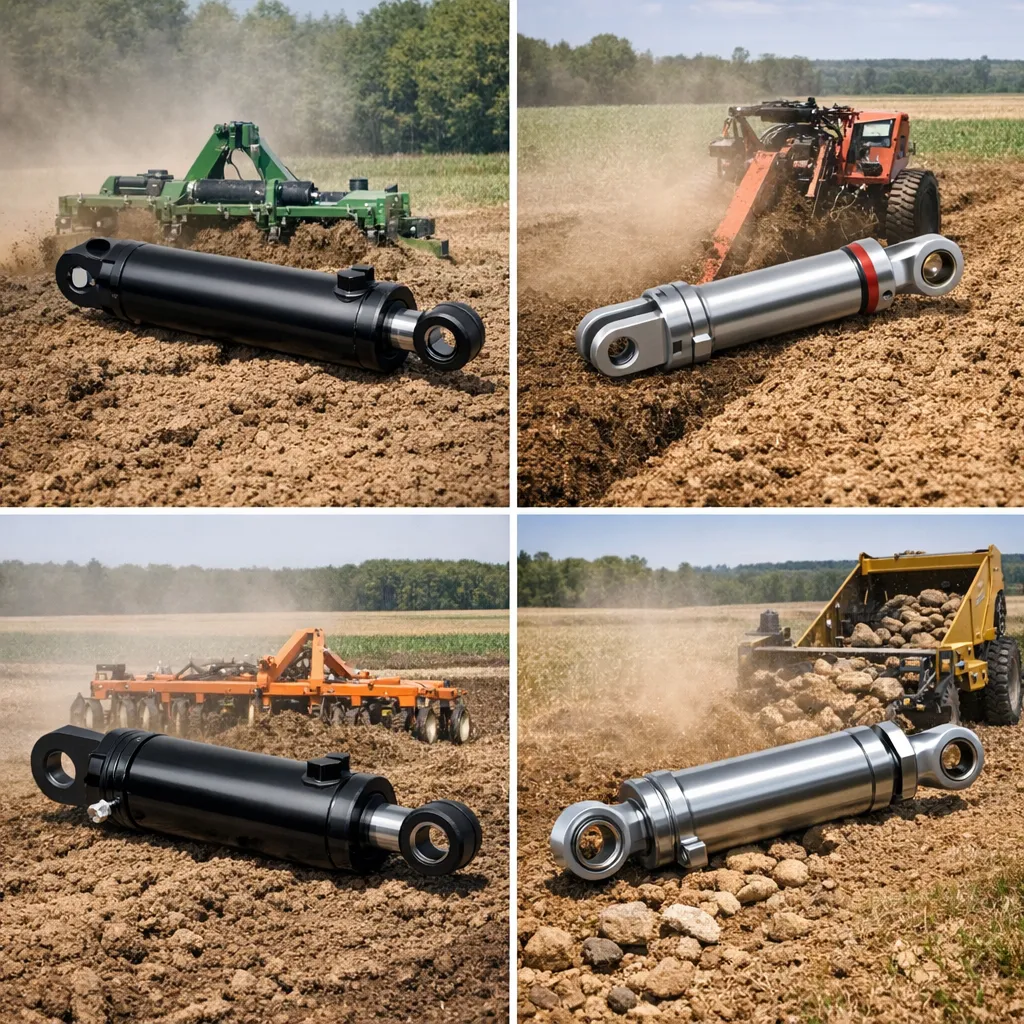
Over shockingly short operational windows, standard mass-produced commercial actuators fail catastrophically due to this exact environmental assault. The dried mud instantly compromises the primary wiper seal, allowing atmospheric moisture and acidic agricultural chemicals to penetrate deep into the internal gland. This initiates the most devastating failure mode for this specific tillage equipment class: severe rod pitting. Microscopic galvanic rust cavities form rapidly on the piston rod, which subsequently shred the primary fluid seals entirely, causing massive hydraulic fluid hemorrhage and forcing fleet maintenance teams into immediate, highly expensive cycles of fixing hydraulic cylinders mid-season. Functioning globally as a premier hydraulic cylinder manufacturer, our core engineering philosophy actively targets and permanently eradicates this exact failure mechanism. By integrating premium Q345D low-temperature structural steel, advanced anti-rust treatments, and a heavily reinforced mud scraper ring architecture, we deliver an indestructible hydraulic oil cylinder that simply refuses to pit or leak.
Precision Engineering Parameters and Customization Framework
Securing genuine operational longevity in severe, mud-caked agricultural environments demands absolute transparency regarding material science and dynamic sealing specifications. When upgrading large-scale tillage machinery, the fluid power actuators must be precisely matched to the implement’s required downforce and the specific environmental contaminants of the regional geography. Our fully autonomous, vertically integrated manufacturing infrastructure provides unmatched flexibility to tailor stroke lengths, bore diameters, and mounting geometries while strictly enforcing our heavy-duty anti-pitting baseline. The detailed technical matrix below clearly defines the exact parameters of our premium press wheel lift solutions.
| Engineering Classification | Specification Thresholds and Technical Directives |
|---|---|
| Target Industry Sector | Agriculture / Advanced Arable Tillage & Seeding |
| Designated Equipment Category | Tillage Machinery (Soil Covering and Pressing Machines / Seed Drill Packers) |
| Target Subsystem Mechanism | Press wheel assembly spatial elevation and compaction pressure regulation |
| Official Component Nomenclature | Press Wheel Lift Cylinder |
| Actuation Methodology | Double acting hydraulic cylinder (Mandatory for powered dynamic downforce and rapid retraction) |
| Fundamental Architecture | Heavy-wall Piston cylinder (Completely rigid, tie-rod free enclosed design) |
| Manufacturing Assembly | Welded structural construction (Automated robotic submerged arc fusion) |
| Core Metallurgical System | Premium Q345D Low-Alloy Structural Steel (Exceptional low-temperature impact toughness) |
| Surface Defense Treatment | Micro-cracked Hard Chrome Plating (HRC 65+) providing extreme rust and pitting mitigation |
| Operational Environment Rating | Light to Medium mechanical load + Severe, continuous mud and chemical exposure |
| Primary Working Characteristic | Provide precise lift clearance for transport and rigid, powered down-pressure for soil consolidation |
| Eradicated Typical Failure Mode | Total prevention of rod pitting (galvanic corrosion) and subsequent catastrophic seal blowout |
| Mandatory Engineering Configuration | Conventional heavy-duty anti-rust treatment + Integration of an aggressive mud scraper ring |
Advanced Fluid Dynamics and Operational Kinematics
To fully comprehend why highly specialized environmental engineering is non-negotiable for soil compaction implements, one must analyze the complex fluid dynamics governing the machine in the field. Cultipackers and heavy seedbed rollers require two distinct, powerful operational phases. During road transport or when making tight, complex turns at the headlands of a field, the tractor operator engages the main control valve to route pressurized hydraulic fluid into the rod end of the lift cylinder. This rapidly forces the hydraulic cylinder piston to retract, utilizing immense fluid lifting power to pull the heavy cast-iron or rubber press wheels entirely clear of the earth, ensuring safe, unimpeded transit without gouging the turned soil.
However, the absolutely critical agronomic phase occurs when the implement is lowered for continuous fieldwork. Utilizing a single acting hydraulic cylinder is fundamentally unacceptable for this task because it relies purely on gravity or the dead tare weight of the implement frame to compress the soil. In many varying soil conditions—such as dense, dry clay clods—the implement’s weight alone is simply insufficient to crush the material and eliminate subsurface air pockets. A genuine double acting hydraulic cylinder is structurally required. Highly pressurized fluid is routed into the base end, aggressively driving the rod outward. This powered extension applies active, rigidly locked down-pressure onto the press wheel frame, violently crushing clods and achieving the perfect, uniform seedbed consolidation that high-yield modern agronomy demands.
It is exactly during this extended, working phase that the polished steel rod is maximally exposed to the elements. Sticky mud, wet clay, and abrasive dust spatters and cakes onto the exposed chrome. When the operator eventually commands the cylinder to retract and lift the implement, our proprietary kinematic defense mechanism immediately engages. Before the retracting rod can ever enter the delicate internal hydraulic gland, it must pass forcefully through our heavily reinforced mud scraper ring. This aggressive, high-tension polyurethane component acts as a physical blade, forcefully shearing away dried clay and abrasive grit, ensuring only pristine, uncontaminated chrome passes through to the primary fluid seals. This calculated integration of fluid power and mechanical scraping ensures our hydraulic rams vastly outlive standard commercial units by thousands of operational hours.
Seamless Global Fleet Integration and OEM Drop-In Replacements
In the highly compressed, economically critical window of spring planting, suffering a sudden loss of down-pressure due to seal failure, and then facing multi-week supply chain delays for imported original equipment parts, is an operationally devastating scenario for large commercial farms. When a pressing machine is paralyzed in the field due to a blown seal caused by rod pitting, the planting schedule halts, exposing the entire crop to weather risks. Furthermore, replacing a failed factory component with the exact same inherently weak design guarantees a repeat failure the following season. Our dedicated B2B engineering database encompasses the precise retracted lengths, extended strokes, mounting pin diameters, and fluid port threads of the agricultural industry’s most trusted tillage machinery.
This vast dimensional capability empowers us to manufacture exact, direct drop-in replacement hydraulic parts that are fully and flawlessly compatible with world-renowned machinery brands, including Vaderstad, Lemken, Horsch, Amazone, Kuhn, and Great Plains. (Legal notation: The explicit use of these international trademarked brand names within this engineering document serves strictly to assist B2B procurement managers and independent field mechanics with rapid dimensional cross-referencing and aftermarket selection convenience. We operate proudly and entirely as an independent hydraulic cylinder manufacturer and firmly assert no formal commercial affiliation, sponsorship, or endorsement with these respective corporate entities.)
By choosing to bypass standard, fragile OEM replacements and actively upgrading directly to our mud-scraper integrated, Q345D reinforced units, fleet managers execute a permanent environmental upgrade. Field mechanics spend significantly less time in the dirt constantly fixing hydraulic cylinders because our components are dimensionally flawless and structurally fortified against rust. Procuring these critical components directly from our factory floor ensures you secure a highly aggressive, bulk-optimized hydraulic cylinder price, drastically reducing your long-term total cost of ownership while eliminating seal blowouts in muddy conditions.
Core Technological Advancements Defining Environmental Durability
What specifically elevates a genuinely premium industrial fluid power component far above the vast market of disposable, generic agricultural spare parts? The profound distinction arises from the strict application of advanced metallurgical science, specialized environmental defense mechanisms, and a deeply data-driven approach to resolving real-world field failures. Below are the definitive technical advantages deeply embedded into every severe-duty component we produce:
Aggressive Polyurethane Mud Scraper Matrix
The ultimate defense against rod pitting. Standard agricultural cylinders utilize basic rubber dust wipers that easily allow wet mud and chemical fertilizers to bypass and sit against the chrome rod. We utilize a heavily profiled, dual-lip polyurethane mud scraper ring. This incredibly stiff material physically shears dried clay, wet mud, and abrasive silica dust off the retracting rod, guaranteeing zero external contaminants enter the internal fluid chamber.
Q345D Low-Temperature Structural Steel
Early spring land preparation frequently occurs in near-freezing conditions. Standard 1045 mild steel becomes brittle and highly susceptible to fracture when a cold implement hits a rock. We forge our barrels and mounts from Q345D high-strength low-alloy structural steel, which is specifically certified for exceptional Charpy V-notch impact toughness at -20°C, ensuring the cylinder never shatters in freezing early-morning operations.
Micro-Cracked Hard Chrome Defense
Operating mere inches above the soil, the rod is constantly bombarded by flying debris and corrosive agricultural chemicals. Following precision centerless grinding, our rods receive a specialized micro-cracked hard chrome plating. This achieves an impenetrable surface hardness exceeding HRC 65, forcefully deflecting abrasive rock strikes while utilizing the microscopic cracks to retain a thin, rust-preventative film of lubricating oil.
Ultra-Low Friction Internal Sealing
To ensure the tractor operator can apply perfectly smooth, proportional downward pressure to the packing wheels without hydraulic stick-slip juddering, we utilize a premium PTFE (Teflon) glide ring matrix on the piston. This drastically reduces internal friction, lowering heat generation and extending the functional lifespan of the hydraulic cylinder components.
Automated Submerged Arc Welding
Vibration from the heavy iron packing rings transfers directly up into the cylinder base. Standard manual welds are prone to fatigue cracking under this chatter. We employ automated, multi-pass robotic submerged arc welding to fuse the Q345D steel components perfectly. This ensures deep, flawless metallurgical penetration and creates an indestructible joint immune to vibration tearing.
Comprehensive Anti-Rust Housing Coating
Agricultural equipment is frequently stored outdoors in punishing weather conditions between seasons. Beyond the internal components, the external cylinder housing undergoes an intense sandblasting preparation followed by a high-build, two-part industrial epoxy coating. This robust shell acts as an impenetrable barrier against atmospheric moisture, preventing severe external casing rust during long winter storage periods.
Autonomous Manufacturing Precision and Absolute Traceability
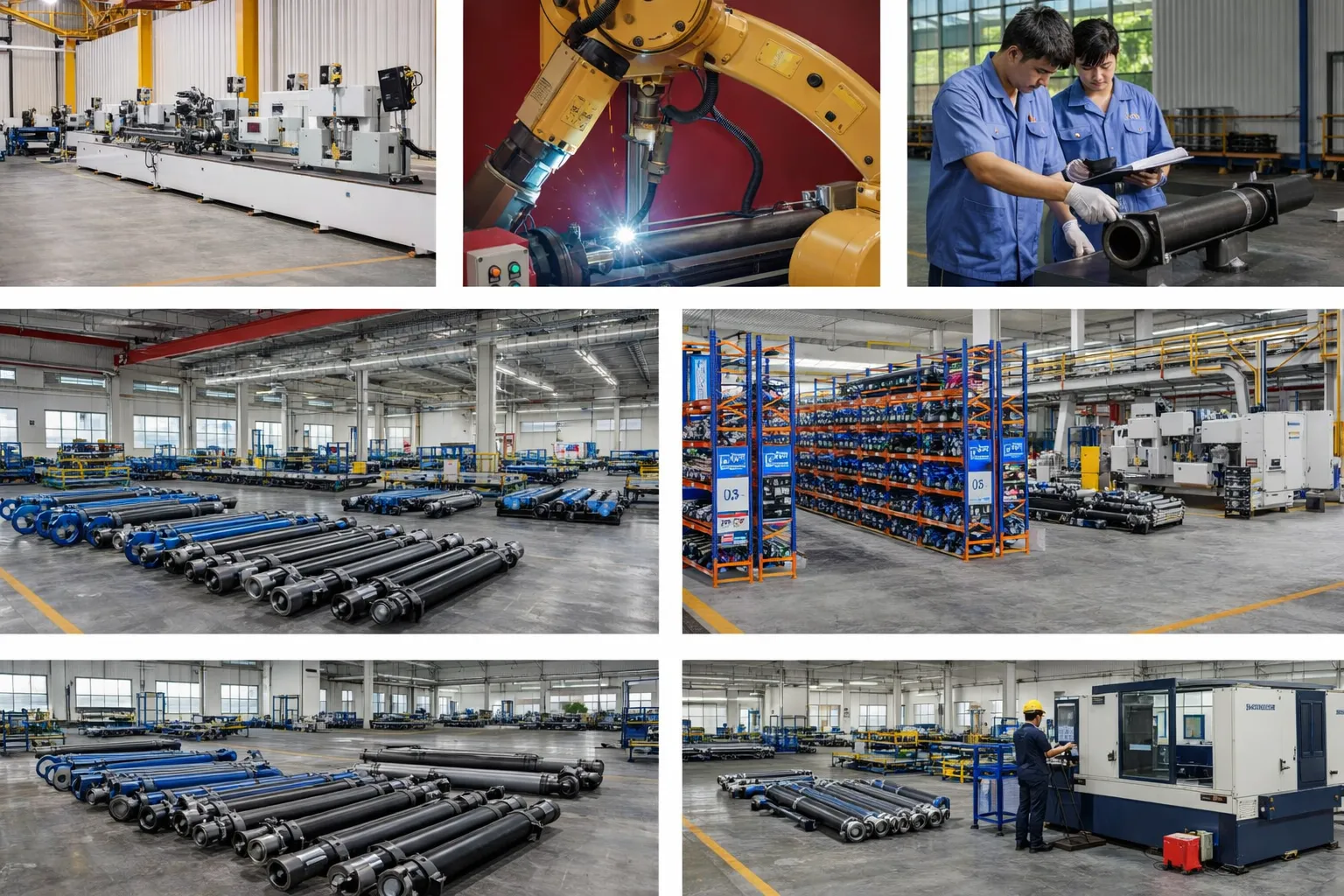
Advanced theoretical engineering holds zero value without uncompromising precision during physical execution on the factory production line. As a highly trusted, internationally ISO-certified fluid power manufacturing enterprise, we operate a vast, fully vertically integrated, autonomous production campus. This total infrastructure control over the entire supply chain—from the stringent ultrasonic defect verification of raw Q345D steel tubing to precision CNC machining, robotic assembly, and final industrial painting—guarantees that every single component dispatched meets our absolute industrial survival standards. We actively and completely reject the fragmented, outsourced supply chains that cause severe quality fluctuations in standard commercial agricultural parts.
During the critical CNC internal machining phase, our technicians maintain exacting bore tolerances of H8. The inner diameter of the steel barrel undergoes an advanced deep skiving and roller burnishing process. This critical cold-working technique compresses the internal steel grain, creating a stunning, mirror-like internal surface finish tighter than Ra 0.2 microns. This flawless, zero-friction environment is the absolute operational secret to exponentially extending the life of our internal PTFE seals, ensuring zero internal fluid bypass even when the cylinder is locked in position to hold constant heavy down-pressure on the soil.
Our internal quality assurance mandate is absolute. We rigorously enforce a strict 100% factory hydrostatic testing protocol for all outbound inventory. Every fully assembled hydraulic cylinder is securely mounted to automated diagnostic test benches, aggressively pressurized well beyond its maximum rated working threshold, and dynamically cycled repeatedly to verify the flawless operation of the seals and the structural holding power of the robotic welds. We guarantee absolute zero external weeping. Finally, to enforce permanent lifecycle accountability, each unit is deeply laser-etched with a unique alphanumeric serial number. This provides B2B procurement partners with complete metallurgical traceability, greatly simplifying localized aftermarket support for decades.
Cross-Industry Adaptability of Contaminant-Resistant Actuators
While this specific engineering architecture—featuring Q345D low-temperature steel and an aggressive mud scraper matrix—is uniquely optimized to conquer rod pitting on a soil covering machine, the core engineering philosophy of actively rejecting severe environmental contamination holds massive value across numerous heavy industrial sectors. Any heavy machinery tasked with operating in deep mud, abrasive dust, or chemically corrosive environments relies entirely on this robust structural defense.
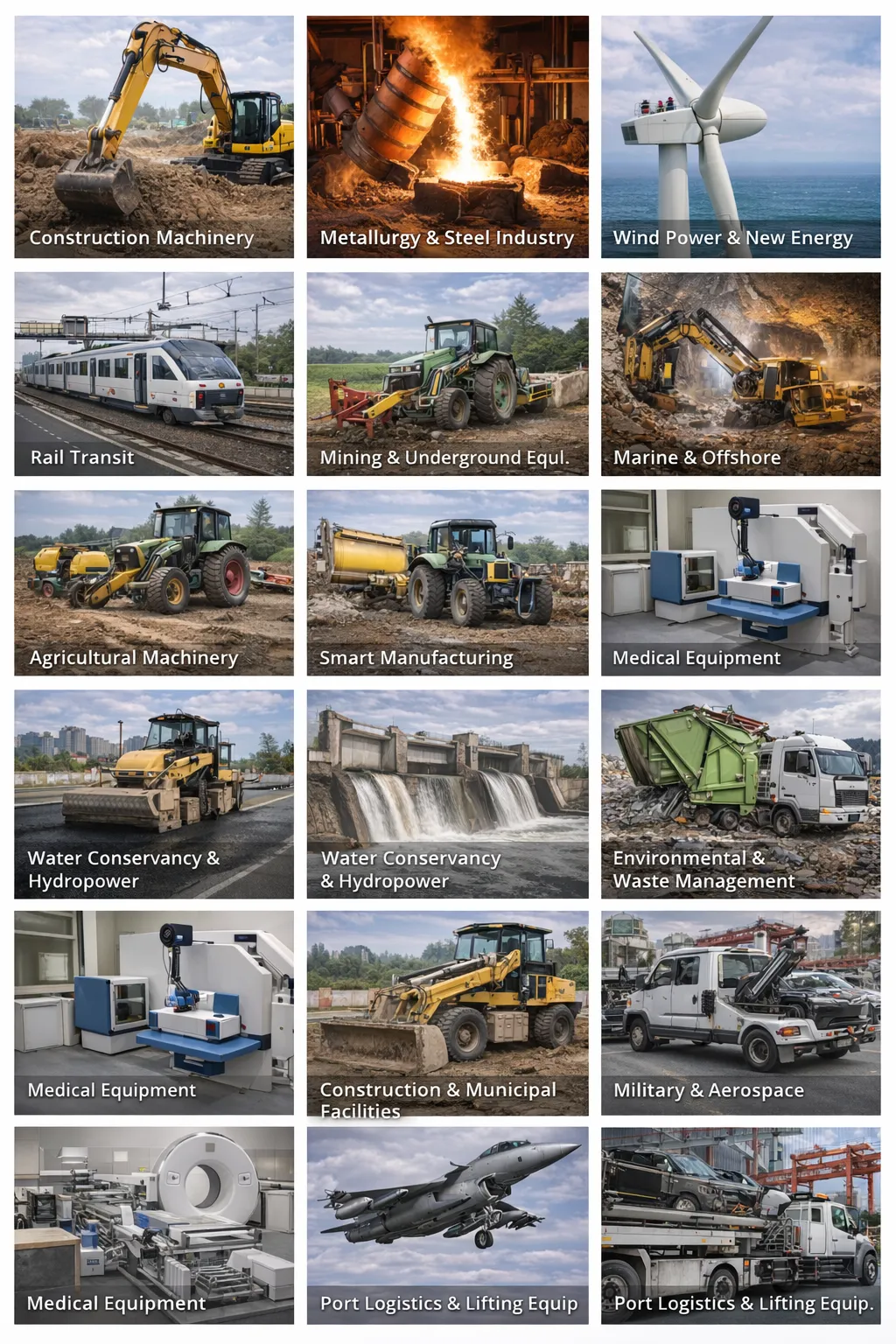
- Construction Machinery Industry: The aggressive mud scraper architecture is exceptionally ideal for the massive contamination experienced by excavator track tensioning cylinders, bulldozer blade actuators, and wheel loader steering systems constantly submerged in thick construction mud and abrasive silica dust.
- Mining Industry: Subterranean articulated loaders and massive surface rock crushers rely entirely on our hard chrome defense and robust polyurethane wipers to survive the constant, relentless abrasive shock and dense stone dust contamination inherent to global mineral extraction.
- Wind Power and New Energy: Specialized installation equipment and massive crawler cranes operating in remote, muddy terrains utilize our anti-corrosion plating to ensure reliable positioning operations during critical infrastructure builds.
Definitive Comparative Analysis: Disposable Commercial vs. High-Performance Engineering
When actively calculating operational capital expenditure and evaluating the optimal hydraulic cylinder price, astute B2B procurement teams profoundly understand that the initial purchase cost is entirely irrelevant if the seals blow out mid-season due to rod pitting. They must critically evaluate the true total cost of ownership (TCO) spanning the implement’s entire operational lifecycle in wet conditions. The highly transparent comparative matrix below clearly illustrates the stark, uncompromising structural differences between purchasing a generic agricultural cylinder and investing in our environmentally hardened masterpiece.
| Engineering Metric | Ordinary Commercial Agricultural Cylinder | Our High-Performance Press Wheel Cylinder |
|---|---|---|
| Environmental Ingress Defense | Basic rubber dust wiper (Allows wet mud and chemicals to easily bypass and sit on the rod) | Aggressive Polyurethane Mud Scraper (Physically shears thick mud entirely off the chrome) |
| Rod Pitting Vulnerability | Extremely high; trapped moisture instantly corrodes the chrome, shredding internal seals | Virtually eliminated; zero moisture enters the gland, preserving the chrome finish indefinitely |
| Base Steel Alloy | Generic 1045 Mild Steel (Highly brittle and prone to shattering in freezing weather) | Q345D Low-Temperature Structural Steel (Guaranteed impact toughness down to -20°C) |
| Down-Pressure Control | Jerky, stick-slip actuation makes achieving uniform seedbed compaction nearly impossible | Ultra-low friction PTFE seals allow perfectly smooth, infinitely variable hydraulic down-force |
| Structural Welding | Inconsistent manual welds often fatigue and crack under the vibration of heavy cast-iron wheels | Automated robotic submerged arc welds create massive, indestructible structural joints |
| Operational Lifecycle TCO | Fails rapidly in muddy or freezing conditions, requiring constant, expensive replacement | Delivers robust, reliable multi-season performance regardless of mud, cold, or chemical exposure |
Proven Global Reliability: Frontline Field Triage Cases Across Asia
Theoretical engineering matrices and metallurgical claims are completely meaningless unless they are definitively validated by harsh reality in the dirt. Our high-efficiency logistics network rapidly deploys premium fluid power solutions to major agricultural hubs across East Asia. Below are highly detailed, verified accounts demonstrating exactly how our environmental enhancements have fundamentally eradicated critical pain points and transformed equipment reliability for major B2B clients.
Field Triage: Eradicating Rod Pitting in Hokkaido, Japan
Client Profile: Large-Scale Agricultural Cooperative Fleet Management.
Application Environment: Deploying massive, heavy-duty pneumatic seed drills equipped with trailing cast-iron press wheels across sprawling, highly muddy, post-thaw acreage.
The Dire Challenge: The cooperative faced a catastrophic mid-season failure rate with their standard OEM cylinders. The heavy cast-iron wheels continuously flung thick, freezing mud directly onto the cylinder rods. The weak factory rubber wipers allowed the mud to penetrate the gland. Within weeks, severe rod pitting developed, instantly shredding the main seals and bleeding hydraulic fluid directly onto the seedbeds. The constant need for emergency hydraulic cylinder repair was obliterating their operational budget and severely delaying planting.
Contact & Engineered Solution: The desperate fleet director discovered our specific environmental defense technical specifications via an organic engineering search. After closely analyzing their tractor pump pressure and linkage dimensions, we rapidly supplied a custom batch of our hydraulic rams equipped with our aggressive dual-lip polyurethane mud scrapers and ultra-hard micro-cracked chrome.
Landed Outcome: Installed immediately, the cooperative proudly reported absolute zero seal failures over the subsequent three massive planting seasons. The rods remained pristine, free of any pitting or rust, despite continuous operation in freezing mud.
“The difference is visually undeniable. We used to rebuild these cylinders monthly because the mud destroyed the chrome. With these new scrapers, the mud is shaved clean off. Not a single pitted rod or blown seal in three years. Incredible environmental engineering.” — Mr. Tanaka H., Fleet Maintenance Director (March 2025).
Field Triage: Winter Structural Survival in Gyeonggi-do, South Korea
Client Profile: Prominent Regional Importer and Distributor of Aftermarket Tractor Implements.
Application Environment: Supplying replacement components for heavy tillage equipment operating in freezing, early-spring conditions.
The Dire Challenge: The importer noted widespread, furious complaints that standard commercial replacement cylinders were violently fracturing at the base welds. The cheap 1045 mild steel utilized in standard units became highly brittle in the sub-zero morning temperatures. When the heavy press wheel hit a frozen rock, the kinetic shock instantly snapped the brittle base mounts, spewing hydraulic oil and necessitating constant, expensive replacement of hydraulic cylinder components.
Contact & Engineered Solution: Seeking a premium, cold-weather proof upgrade for their catalog, they engaged our technical sales team. We completely transitioned their orders to our Q345D low-temperature alloy construction. We guaranteed the impact toughness down to -20°C, and combined it with our deep-penetration robotic welding to ensure absolute structural immunity to cold-weather shattering.
Landed Outcome: The modified aftermarket hydraulic parts survived the harshest Korean spring freezes without a single weld fracture incident. This dramatically boosted the importer’s premium market share and completely eliminated cold-weather warranty claims.
“The Q345D steel upgrade changed everything for our northern clients. The extreme cold used to snap standard welds like glass. These new units take a massive beating in the frost and simply do not fail. Our farmers are thrilled to have parts they can trust.” — Kim J., Procurement Lead (October 2025).
Field Triage: Chemical Corrosion Defiance in Chiayi, Taiwan
Client Profile: Large Commercial Corporate Plantation.
Application Environment: Pulling massive, multi-section seeders through soils heavily saturated with aggressive, highly acidic liquid fertilizers during the planting pass.
The Dire Challenge: The highly corrosive liquid fertilizers were pooling on the standard cylinder rods. The chemical reaction was rapidly stripping the cheap commercial chrome plating off the steel, causing massive rust blooming within weeks. The rusted, sandpaper-like rods were then instantly tearing the internal gland seals apart. The constant downtime spent fixing hydraulic cylinders was severely impacting their planting windows.
Contact & Engineered Solution: They submitted a direct technical inquiry through our main corporate website. We engineered a highly customized solution featuring our advanced micro-cracked hard chrome plating process to resist chemical stripping, paired closely with the aggressive polyurethane mud scraper to ensure no corrosive liquid ever pooled inside the gland housing.
Landed Outcome: Leveraging expedited maritime freight, the upgraded units were deployed rapidly mid-season. The extreme chemical resistance of the upgraded chrome, combined with the scrapers, resulted in the total elimination of rod rust and subsequent seal blowout.
“The chrome plating on these units is practically bulletproof. Even completely bathed in acidic fertilizer for months, they shine like new when wiped down. This is definitively the best return on our hydraulic cylinder price investment we’ve ever experienced.” — Chen W., Operations Manager (August 2025).
Expert Technical Inquiries (FAQ)
Selecting the optimal fluid power components to survive severe environmental contamination requires precise technical clarity. Below, we have comprehensively compiled in-depth technical answers to the most critical operational and structural inquiries our global engineering teams receive regarding tillage applications.
What exactly is ‘rod pitting’ and how does the mud scraper ring prevent it?
Why is it absolutely critical to utilize a double acting hydraulic cylinder for press wheels?
What specific structural advantage does Q345D steel offer over standard commercial 1045 steel?
Can your factory engineer exact drop-in replacements for my specific equipment fleet?
Do you reliably supply replacement wiper seals and comprehensive seal kits for maintenance?
What specific factors dictate your bulk OEM hydraulic cylinder price structure for the Asian market?
Eradicate Seal Blowouts and Command Flawless Seedbed Preparation
Do not allow the severe defensive inadequacies of generic, mass-market commercial cylinders to shred your seals, jeopardize your expensive heavy machinery, and aggressively drain your fleet maintenance budgets. Upgrade decisively to a genuinely severe-duty engineered solution built with massive Q345D steel, micro-cracked hard chrome, and an aggressive mud-scraping matrix to definitively conquer the most corrosive, muddy environments on earth.
Editor: Cxm