Frame Folding Cylinder for Subsoiler Tillage Machinery
Engineered specifically to survive violent road transport bouncing and massive eccentric loads. We utilize forged steel ear bases and overlap-welded reinforcing plates to permanently eradicate structural fatigue cracks and securely lock massive subsoiler wings in place.
Strategic Product Overview: Conquering Transport Stress in Heavy Agriculture
Deep subsoiling is a fundamental agronomic practice necessary for physically shattering compacted hardpans deep below the topsoil, facilitating extreme root development and drastically improving field drainage. To cover massive commercial acreage efficiently, modern subsoilers feature incredibly wide, heavy iron frames. However, transporting these expansive implements safely down narrow public highways or deeply rutted rural dirt roads requires the outer wings to be folded vertically. The critical mechanical responsibility of lifting these multi-ton iron wings against gravity, locking them rigidly upright during transit, and safely deploying them back into the earth rests entirely upon the structural integrity of the Frame Folding Cylinder.
From a mechanical engineering perspective, this specific application represents one of the most violent environments for fluid power systems. The true destructive force does not occur during actual linear plowing, but rather during road transport. When the heavy subsoiler wings are folded upright, the center of gravity is drastically altered. As the tractor bounces at transport speeds, these massive vertical wings act as giant pendulums. They sway and jerk violently, generating intense eccentric loads (off-axis bending and twisting forces) that are transferred directly into the mounting points of the hydraulic cylinder. Standard commercial actuators simply lack the structural architecture to survive this kinetic physics equation. Their generic cast iron mounts or thin, single-pass welded clevises rapidly succumb to the sheer stress, inevitably developing microscopic fatigue cracks at the base weld seam. Once this ear base fatigue cracking propagates, the mount completely tears away from the steel barrel, causing the heavy wing to violently crash down. This catastrophic failure destroys the implement, creates a massive safety liability on public roads, and forces fleet operators to waste critical planting hours frantically fixing hydraulic cylinders.
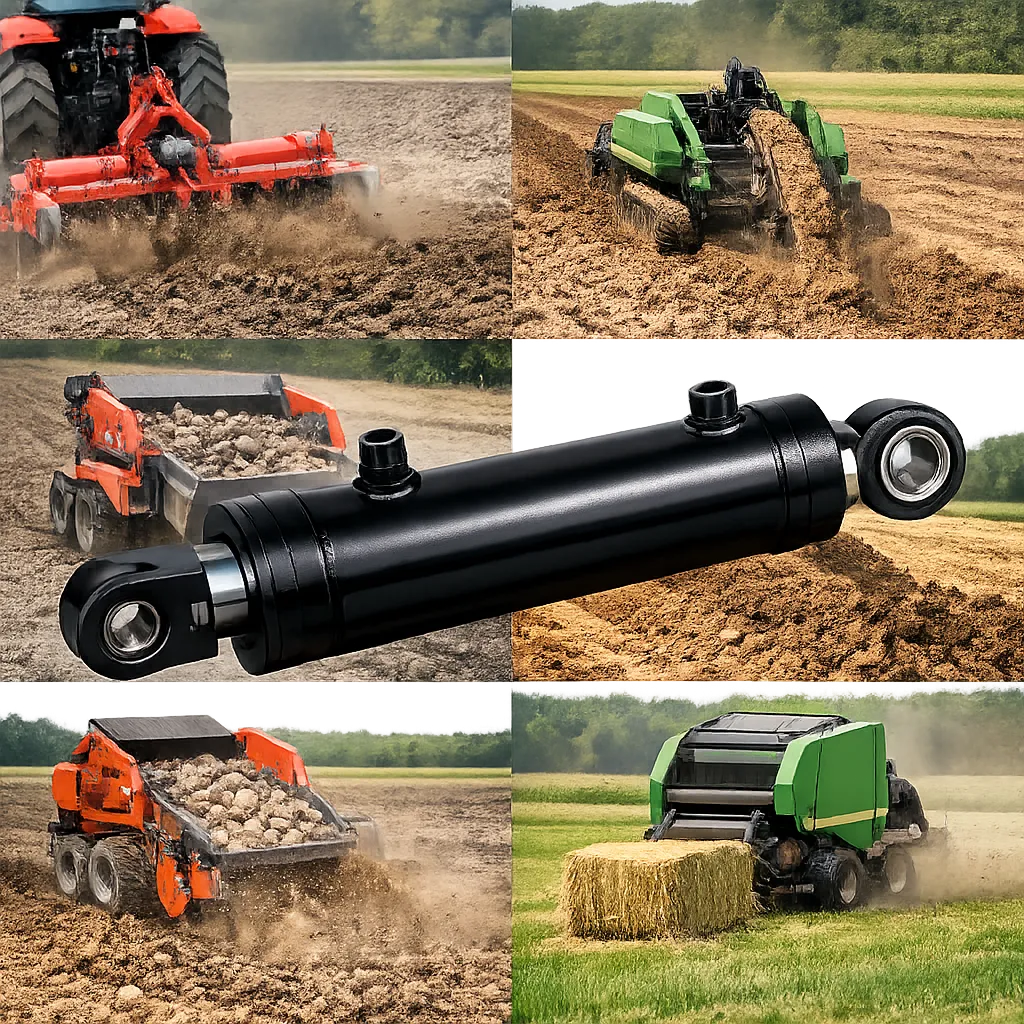
Recognizing this systemic industry vulnerability, our technical team, operating as a specialized hydraulic cylinder manufacturer, completely redesigned the foundational architecture of the folding mechanism. Our custom-engineered Frame Folding Hydraulic Cylinder directly attacks and neutralizes the root cause of ear base fatigue cracks. Instead of relying on standard butt-welded joints, we integrate high-density, forged steel ear bases combined with thick, overlap-welded reinforcing plates. This advanced structural geometry absorbs and harmlessly dissipates massive eccentric shockwaves across a massive surface area of the Q345D steel barrel, permanently eliminating the stress concentration points that cause fracturing. Upgrading your heavy tillage machinery with our heavily armored hydraulic parts guarantees your wide implements remain safely locked during the most brutal transport conditions.
Comprehensive Technical Specifications
Achieving absolute mechanical reliability under dynamic bouncing loads requires uncompromising structural geometry and advanced material metallurgy. The detailed matrix below outlines the stringent baseline parameters and optimized structural configurations of our subsoiler folding actuators. For procurement managers sourcing heavily armored components for varied machinery platforms, we strongly encourage reviewing our complete catalog of industrial hydraulic cylinder models.
| System Parameter | Engineering Specification Profile | Structural Design Rationale |
|---|---|---|
| Target Industry | Agriculture / Heavy Commercial Farming | Engineered explicitly to survive violent off-highway vibration profiles. |
| Equipment Category | Tillage Machinery | Built to manage the immense deadweight of wide-span iron implements. |
| Subsystem Integration | Subsoiler Folding Frame | Directly commands the precise geometric articulation of the heavy lateral wings. |
| Component Designation | Frame Folding Cylinder | The primary load-bearing linkage responsible for road transport safety. |
| Action Mode | Double Acting | Delivers powered, rigidly controlled fluid force for both folding up and unfolding down. |
| Internal Structure Type | Piston Cylinder | Ensures perfect internal concentricity and balanced high-pressure hydrostatic lifting. |
| Manufacturing Format | Heavy-Duty Welded Construction | Completely eliminates the joint stretching and weeping characteristic of tie-rod designs. |
| Core Material Metallurgy | Q345D Low-Alloy Structural Steel | Offers immense baseline yield strength and supreme low-temperature impact toughness. |
| Surface Armor Treatment | Micro-Cracked Hard Chrome Plating | Guards the rod against flying road stones, weather exposure, and agricultural chemicals. |
| Environmental Grade | Transport Condition + Eccentric Load | Specifically hardened to endure massive lateral off-axis forces while fully locked. |
| Working Condition Feature | Fold / Unfold Subsoiler Wings | Demands smooth mechanical articulation combined with unyielding transport stability. |
| Targeted Failure Mode | Ear Mount Fatigue Cracks | Bouncing road transport rips standard cast mounts directly off the steel barrel wall. |
| Recommended Upgrade | Lap-Welded Reinforcement Plate + Forged Ear Mount | The definitive structural defense against lateral shear force, guaranteeing infinite fatigue life. |
Operational Fluid Mechanics: Controlling Massive Tonnage
The physical act of raising heavy iron wings against the force of gravity, and subsequently lowering them safely, requires highly controlled fluid power kinematics. A single acting hydraulic cylinder cannot possibly be utilized in this safety-critical application. If a single acting unit were used, the wings would simply free-fall abruptly under their own massive deadweight when the hydraulic valve was opened, creating a lethal safety hazard for the operator and violently slamming the subsoiler into the ground, destroying the hinge pins. Therefore, the architecture of this component mandates that it operates strictly as a double acting hydraulic cylinder. This specific configuration utilizes highly pressurized fluid from the tractor’s main auxiliary pump to actively power and tightly control both the mechanical extension and retraction strokes.
When the operator shifts the cabin valve to unfold the implement for deep tillage, pressurized fluid is metered carefully into the rod end of the cylinder. This pressure acts upon the annular area of the hydraulic cylinder piston, safely and steadily pulling the rod back in. This powered retraction provides a deeply controlled descent of the wings, preventing them from slamming into the earth. Conversely, when preparing for road transport, the operator reverses the fluid flow. High-pressure oil floods into the cap-end (base) port, exerting tremendous hydrostatic force against the full face of the piston to forcefully extend the rod, pushing the heavy side wings upward into their vertical, locked transport configuration.
The absolute most critical phase of this fluid operation is the transit phase itself. During transport, the directional control valve is neutralized, physically trapping the incompressible hydraulic fluid inside the barrel. The actuator transforms from a kinetic moving part into a rigid, load-bearing structural pillar holding the bouncing wings. Every single time the tractor hits a pothole, the heavy iron wings jerk, creating a massive pressure spike inside the cylinder barrel and an intense physical twisting shock against the mounting pins. Because our hydraulic parts feature forged ear bases, heavy overlap welding, and premium composite seals that refuse to bypass fluid under pressure spikes, the cylinder acts as an unyielding structural tether, safely securing the load without experiencing mount fracture.
Seamless Aftermarket Upgrades for Leading Subsoiler Brands
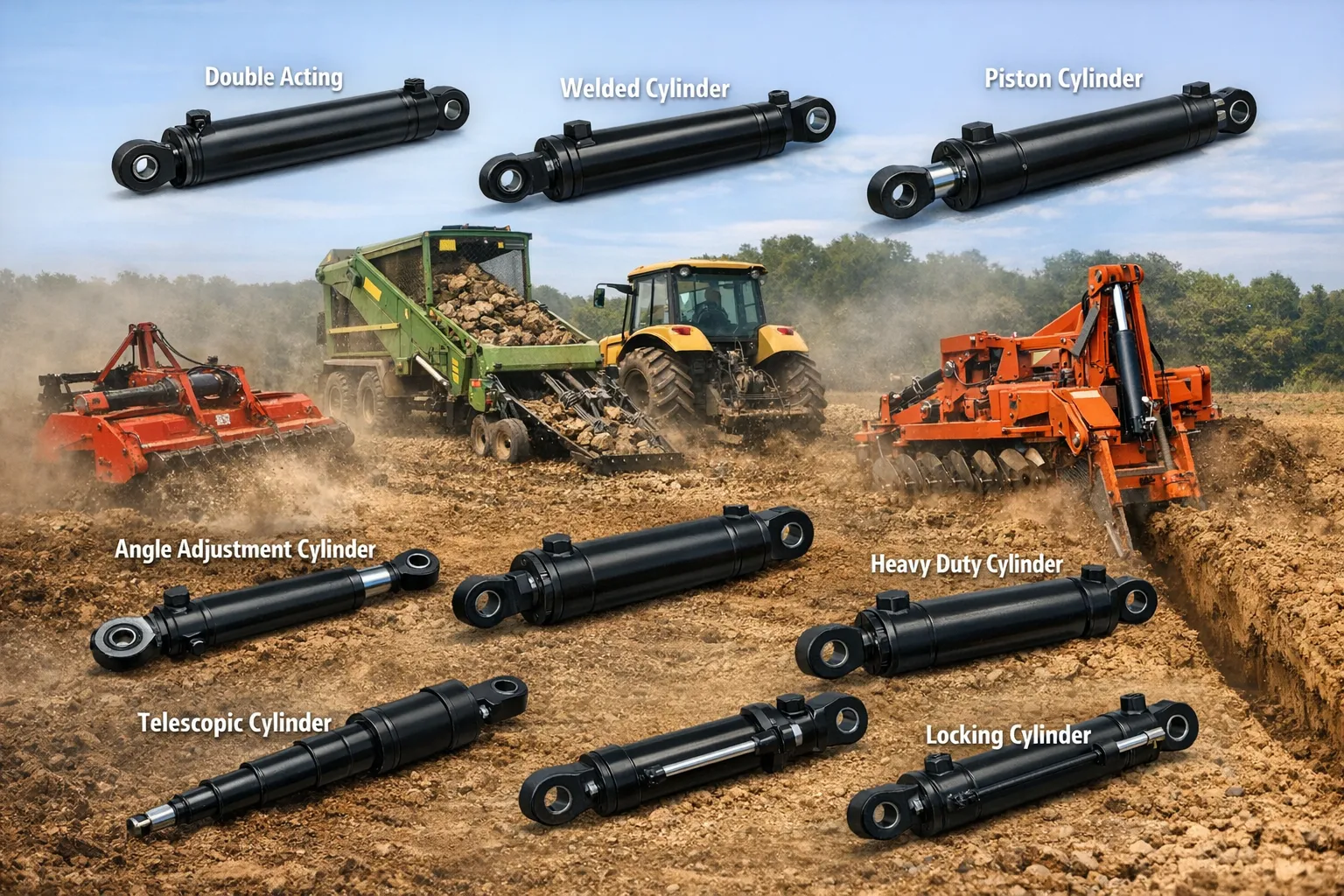
Agricultural fleet managers overseeing vast commercial operations understand that when an implement wing drops due to a cracked cylinder mount, the entire planting schedule halts. Waiting weeks for an imported, heavily marked-up factory original component is financially disastrous. We deliberately engineer our heavily reinforced aftermarket lift cylinder and folding models to serve as immediate, dimensionally exact structural upgrades for the world’s premier tillage implements. Our strict manufacturing tolerances guarantee that critical installation metrics—including closed pin-to-pin lengths, total stroke dimensions, heavy-duty rod eye diameters, and precise hydraulic port thread geometries—perfectly mirror your existing machinery for rapid field installation using standard tools.
We continuously manufacture extreme-duty structural replacements for heavy folding subsoilers and wide cultivators manufactured by global industry giants such as John Deere, Case IH, Great Plains, Krause, Lemken, Kuhn, Kverneland, and implements driven by large-chassis commercial tractors from LS Mtron, TYM, and Daedong. (Please be fully advised: The inclusion of these specific original equipment manufacturer brand names is strictly intended to assist agricultural technicians and procurement managers in cross-referencing dimensional compatibility and structural application parameters. We operate independently as a dedicated supplier and claim no trademark affiliation or corporate endorsement by these entities.)
By replacing your vulnerable, failing factory components with our specialized hydraulic rams equipped with forged bases, you actively bypass inflated dealership parts pricing while permanently curing the systemic mount-fracture vulnerabilities inherent in standard designs. This strategic upgrade significantly optimizes your long-term hydraulic cylinder price metrics by eliminating repetitive, costly replacement cycles.
Core Structural and Metallurgical Defenses
Preventing thousands of kilograms of bouncing iron from tearing a steel cylinder apart requires a radical departure from standard commercial manufacturing. It demands specific metallurgical upgrades and an obsessive engineering focus on structural stress dispersion. The following technical pillars explicitly define why our folding components survive where generic cylinders snap in half:
High-Density Forged Steel Ear Mounts
Standard commercial cylinders utilize cheap, brittle cast iron mounts or simple rolled steel plates that shatter or bend easily under sudden kinetic shock. We categorically utilize solid forged steel mounts. The intense pressure of the forging process physically aligns the internal metallurgical grain structure with the shape of the mount, creating a connection point with immense tensile strength and extreme resistance to sheer forces.
Overlap Welded Reinforcing Plates
To prevent the forged mount from simply tearing a hole in the barrel wall during transport sway, we introduce a thick Q345D steel reinforcing plate. This gusset plate is overlap welded to the base of the cylinder barrel, vastly increasing the surface area of the joint. This disperses the highly concentrated stress of eccentric transport loads across a wide area, entirely eradicating the risk of base fatigue cracking.
Q345D Low-Alloy Structural Barrel
Subsoiling operations often commence during the freezing ambient temperatures of early spring. Standard carbon steel becomes dangerously brittle in the cold, drastically increasing the likelihood of structural weld failure. We construct the entire load-bearing pressure vessel from Q345D low-alloy steel. This premium material provides exceptional low-temperature impact toughness, absorbing violent shocks without fracturing.
Eccentric Load Defense (PTFE Wear Bands)
When a folded implement bounces, the off-axis weight tries to severely bend the extended rod, which pushes the internal piston hard against the honed barrel wall, causing rapid scoring. We outfit our pistons with extra-wide, high-strength PTFE-bronze composite wear bands. These thick guide rings physically prevent metal-to-metal contact during severe eccentric loading, preserving the mirror-finish bore.
Micro-Cracked Hard Chrome Plating
Agricultural cylinders are continuously bombarded by flying stones, road gravel, and highly corrosive liquid fertilizer spray. We apply a strictly controlled, ultra-thick layer (25+ micrometers) of micro-cracked hard chrome plating to the induction-hardened rod. This surface armor rejects physical pitting while the micro-cracks retain a microscopic film of oil to deeply lubricate the heavy-duty wiper seals.
Deep Penetration Robotic Welding
Manual welding is prone to inconsistent penetration and hidden slag inclusions. To fuse the forged bases and overlap plates permanently, we utilize automated multi-pass submerged arc welding. This highly controlled robotic process guarantees maximum metallurgical fusion, producing a monolithic structure completely immune to the high-cycle fatigue generated by bouncing implements.
Autonomous Manufacturing and Exhaustive Quality Control
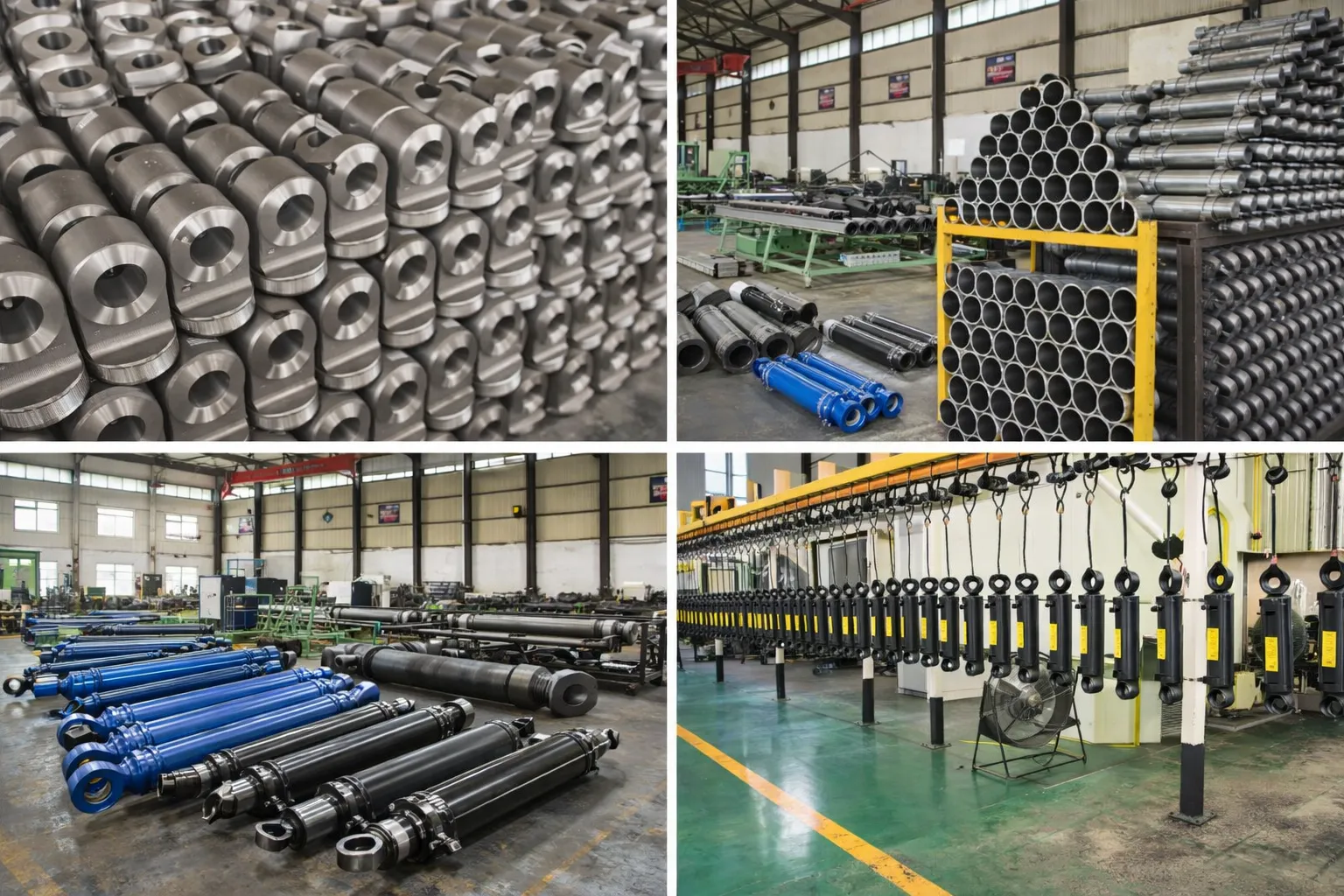
Industrial-grade structural integrity cannot be achieved by merely assembling outsourced parts; it must be systematically manufactured into the component from the raw material level upwards. Operating a heavily capitalized, vertically integrated manufacturing facility grants us absolute sovereign control over the entire production lifecycle. We sculpt our hydraulic cylinder components from premium raw steel. Upon arrival at our docks, the Q345D steel billets and forged mounts undergo immediate material spectrometry and ultrasonic non-destructive testing (NDT) to verify chemical composition and detect any sub-surface metallurgical imperfections that could cause structural failure.
The physical integration of the overlap reinforcing plates and the forged ear mounts is highly critical. We strictly utilize automated robotic submerged arc welding to apply continuous, deep-penetration seams. This automation completely eliminates the dangerous inconsistencies of manual welding, ensuring a flawless bond. Post-weld, these highly stressed joints undergo secondary ultrasonic testing to confirm the total absence of internal porosity or cold laps, guaranteeing the ear mount will never suffer fatigue tearing under eccentric transport load.
Crucially, before any Frame Folding Cylinder is cleared for global export, it is subjected to an uncompromising 100% factory pressure testing regimen. The units are mounted to highly calibrated, heavy-duty test benches and intensely pressurized to 1.5 times their maximum rated working capacity. We conduct stringent static holding tests to mathematically verify absolute zero internal fluid bypass, ensuring the heavy wings will not drift or sag during transport. Finally, a unique alphanumeric serial number is laser-etched directly into the barrel, providing absolute lifetime material traceability for our commercial B2B partners.
Cross-Industry Adaptability of Heavy-Duty Structural Actuators
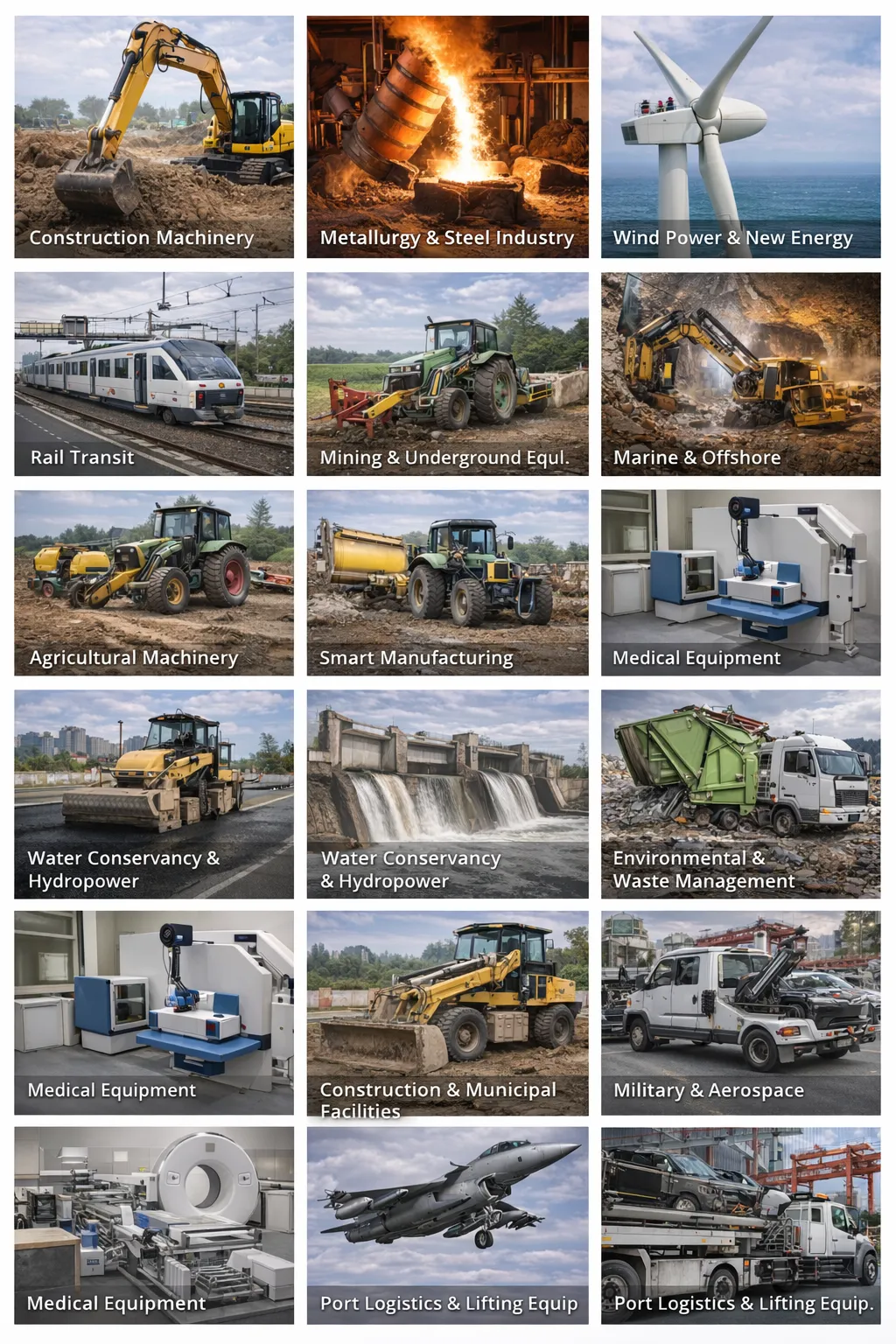
While the structural reinforcement of this specific actuator is meticulously optimized for agricultural folding machinery, the underlying resilient technology—specifically the integration of forged mounts and overlap plates to defeat eccentric loading—is universally demanded across severe-duty industrial landscapes where structural integrity is an absolute safety requirement.
- Heavy Earthmoving: The exact same forged mounting technology is essential for stabilizing massive excavator boom arms and articulating loaders within the construction machinery industry, preventing structural tearing during heavy rock extraction.
- Subterranean Extraction: The unyielding impact resistance provided by our reinforced Q345D welded structures makes our fluid power systems the premier choice for articulating rock-haulers and material handling machinery utilized deep within the mining industry.
- Heavy Infrastructure: Massive structural actuators are required to position heavy turbine components safely and adjust massive structural loads in the wind power and new energy sectors.
Comparative Analysis: Standard Commercial vs. Heavy-Duty Reinforced
Procurement officers often focus exclusively on the initial purchase invoice. However, evaluating true industrial value requires thoroughly analyzing the operational lifespan and the avoidance of catastrophic structural failures on the road. The comparative matrix below definitively illustrates why upgrading to our structurally reinforced holding components is a fundamentally sound business and safety decision.
| Critical Engineering Feature | Standard Aftermarket Tie-Rod Cylinder | Our Reinforced Folding Cylinder |
|---|---|---|
| Base Mounting Architecture | Cast iron mounts with simple butt-welds; highly prone to massive fatigue tearing and catastrophic breaking during rough transport. | Forged steel mounts on overlap reinforcing plates; infinite fatigue life, completely immune to transport sheer stress and snapping. |
| Eccentric Load Defense | Basic piston wear rings; rapid internal metal-to-metal scoring when the heavy wings violently bounce and bend the extended rod. | Over-sized PTFE-Bronze composite wear bands; mechanically isolates the piston, preventing bore damage from severe bouncing. |
| Structural Metallurgy | Standard carbon steel tubing; risks brittle structural weld fractures during freezing early-spring morning transports. | Q345D Low-Alloy Structural Steel; delivers exceptional yield strength and flawless low-temperature impact toughness. |
| Internal Sealing Matrix | Basic local nitrile seals; suffer rapid extrusion under massive static holding pressures, causing wings to sag slowly and dangerously. | Advanced low-friction composite polyurethane seals; creates an impenetrable hydrostatic lock for absolute zero wing sag. |
| Total Cost of Ownership | Dangerously high; risking catastrophic implement drops on the highway, massive repair welding bills, and constant delays. | Exceptionally low; install it once and transport heavy machinery with absolute peace of mind for years without field repairs. |
Proven Global Field Performance: Case Studies
The theoretical superiority of utilizing forged mounts and overlap welding gusset plates is definitively validated on the harsh, rutted rural roads of commercial agriculture. Below are documented cases detailing how our structural fluid power solutions have permanently resolved catastrophic mechanical failures for major partners across the Asian market.
Case Study 1: Eradicating Transport Failures for a South Korean Agricultural Cooperative
Location & Client: Chungcheongnam-do, South Korea — A massive regional agricultural cooperative managing a large fleet of deep-tillage tractors moving constantly between fragmented farming plots.
The Challenge: Because their fields were widely separated by rough, unpaved rural roads, the tractors spent significant time in high-speed transport mode. The intense bouncing of the heavy, folded subsoiler wings was generating severe eccentric loads. The base ear mounts on their standard aftermarket cylinders were suffering from severe fatigue cracking, leading to two harrowing instances where a wing crashed down violently during transit, causing massive equipment damage and blocking the road.
Contact & Solution: The head fleet technician located our engineering capabilities through an organic web search targeting solutions for hydraulic cylinder repair and structural mount failures. We rapidly manufactured a fleet-wide retrofit batch of our Frame Folding Hydraulic Cylinder, explicitly outfitted with our forged steel ear mounts and thick overlap-welded reinforcing plates.
The Result: Following installation, structural mounting failures were entirely eliminated. The subsoilers were transported safely at higher speeds without fear of sudden collapse, optimizing their planting schedule.
Case Study 2: Conquering Cold Weather Operations in Hokkaido, Japan
Location & Client: Hokkaido, Japan — An independent commercial potato farming enterprise utilizing heavy European deep-ripping implements in severe spring weather.
The Challenge: Subsoiling operations frequently commenced while the ambient temperature was still well below freezing. The combination of brittle standard carbon steel cylinders and the violent, sharp kinetic shock of transporting heavy folded wings over frozen, rutted ground caused catastrophic, clean fractures straight through the base cap welds of their existing cylinders, resulting in sudden wing drops and severe high-pressure fluid loss.
Contact & Solution: The owner contacted us directly via our website portal seeking tougher replacements. Our engineering team prescribed our heavy-duty models constructed entirely from Q345D low-alloy structural steel, utilizing its exceptional low-temperature impact toughness to absorb the shock without shattering.
The Result: Structural weld failures were completely eradicated. The machinery survived two of the harshest early-spring frost periods on record without a single fractured mount or leaking hydraulic port.
Case Study 3: Supplying Reliable Structural Actuators to a Taiwanese OEM Builder
Location & Client: Taichung, Taiwan — A specialized agricultural implement manufacturer exporting custom, wide-span heavy tillage equipment to Southeast Asia.
The Challenge: The manufacturer was struggling to source dependable holding mechanisms for their new line of heavy folding subsoilers. The cheap, locally sourced cylinders they initially used featured basic cast iron mounts that ripped off during the field testing phase, severely delaying their product launch due to safety concerns.
Contact & Solution: Searching the global trade directory for a highly capable hydraulic cylinder manufacturer, their procurement officer connected with us. We established a bulk-supply protocol, providing highly reinforced units featuring our forged mounts, overlap gusset plates, and thick 25-micron hard chrome rods.
The Result: The OEM successfully launched their new implement line with absolute confidence and zero structural warranty claims, elevating the technical reputation of their brand in the highly competitive export market.
Frequently Asked Questions
We prioritize complete engineering transparency. To assist agricultural fleet operators, OEM designers, and procurement managers in thoroughly qualifying our heavy-duty fluid power solutions, we have detailed comprehensive answers to the most common technical inquiries regarding our structural lifting components.
1. Why do the ear mounts on standard folding cylinders break off so easily during transport?
The failure is purely structural and physics-based. Standard commercial cylinders use cheap cast iron mounts joined to the barrel with a basic, single-pass butt-weld. During road transport, the heavy, vertical implement wings bounce violently. This bouncing acts as a massive lever, applying intense lateral shear forces (eccentric load) directly to that single, brittle weld line. It rapidly suffers fatigue cracking and rips off. We solve this permanently by using ultra-strong forged steel mounts attached to a large overlap-welded reinforcing plate, which disperses the shear force over a massive surface area of the steel barrel, entirely preventing the fatigue crack from ever forming.
2. Are these structural folding units capable of single acting operation?
No. Raising and safely lowering massive iron implement wings requires precise, powered hydraulic control in both directions. A single acting hydraulic cylinder would allow the wings to free-fall uncontrollably under their own weight when the valve is opened, severely damaging the equipment hinges and posing a lethal safety risk. Therefore, these actuators are exclusively engineered as a double acting hydraulic cylinder, utilizing pressurized fluid from the tractor to actively drive the piston both up and down smoothly.
3. Why utilize Q345D steel instead of standard structural carbon tubing?
Agricultural equipment frequently travels on freezing early-spring mornings. Standard carbon steel becomes brittle at low temperatures and can suffer catastrophic weld fractures when subjected to the dynamic shock of a bouncing wing hitting a pothole. Q345D is a specialized high-strength low-alloy steel that possesses immense yield strength and exceptional low-temperature impact toughness, effectively neutralizing the risk of brittle structural failure in freezing conditions.
4. How does your factory-direct model justify the hydraulic cylinder price compared to cheap aftermarket options?
By partnering with us, you are conducting business directly with the originating manufacturing facility, entirely bypassing the heavy markups imposed by trading companies and dealership networks. The price reflects direct-from-factory access to industrial-grade Q345D metallurgy, forged steel mounts, overlap welding, and premium composite sealing technology. This strategic investment drastically lowers your long-term total cost of ownership by entirely eliminating the catastrophic risk and expense of dropping a wing on the highway.
5. Can you accommodate custom pin sizes and heavy-duty spherical bearings for unique implement prototypes?
Yes. Custom mechanical engineering is a foundational aspect of our operations. While we stock standard configurations that perfectly drop-in replace global OEM dimensions, our technical department can rapidly adjust the bore diameter, specific stroke length, closed pin-to-pin dimensions, and exact ear mount geometry (including spherical bearings) to precisely match the mechanical kinematics of your specific subsoiler frame design.
6. What are the standard lead times for manufacturing and exporting a bulk order to South Korea or Japan?
By maintaining a robust, vertically integrated inventory of raw Q345D steel billets and forged mount blanks, our standard manufacturing, robotic welding, and pressure testing cycles typically require 25 to 35 days for bulk agricultural orders. Subsequent ocean freight logistics to major destinations in South Korea, Japan, or Taiwan generally add 5 to 10 days. We are highly accustomed to synchronizing our production with tight seasonal planting schedules to ensure timely delivery.
7. Can our mechanics execute routine fixing hydraulic cylinders maintenance on these units at our own shop?
Absolutely. We deliberately engineer our equipment specifically for lifetime maintainability within commercial fleets. Because our cylinders utilize easily accessible, heavy-duty threaded glands rather than cheap welded-shut designs, routine seal replacement and internal inspection can be executed efficiently by your personnel using standard heavy shop tools. We provide comprehensive, exact-match OEM-grade replacement seal kits globally.
Secure Your Implement Transport and Eliminate Mount Fatigue
The physical safety of your equipment and the profitability of your agricultural logistics should never be compromised by snapping mounts and falling machinery on a public road. By upgrading your heavy tillage frames with our heavily armored, structurally reinforced Frame Folding Cylinder, you definitively ensure that your implement wings will hold firm through the most aggressive transport bouncing and the harshest weather environments.
Whether you are an OEM design engineer attempting to resolve dangerous structural tearing issues on a new heavy folding subsoiler prototype, or a commercial fleet manager exhausted by the continuous financial drain and safety liability of generic aftermarket mount failures, our dedicated engineering team is prepared to heavily reinforce your fluid power systems.
Editor: Cxm