Lifting Hydraulic Cylinder for Ladle Transfer Car
Engineered with heavy-duty 27SiMn alloy steel and advanced high-life sealing architecture to completely conquer abrasive dust, extreme radiant heat, and prevent catastrophic fluid leakage in primary metallurgy logistics.
Product Overview & Core Metallurgical Value
Within the intensely demanding environment of an integrated steelmaking facility, the safe logistical movement of molten metal is the absolute lifeblood of production. The ladle car is the critical heavy-duty rail vehicle tasked with transporting massive vessels—frequently carrying over 200 metric tons of liquid steel at temperatures exceeding 1600°C—between the basic oxygen furnace, secondary refining stations, and the continuous casting lines. During these operations, the car body must be elevated and aligned with absolute millimeter precision to mate with stationary plant equipment. The primary driving force executing this colossal vertical thrust is the lifting hydraulic cylinder. If this specialized actuator shudders, loses pressure, or experiences mechanical binding, the entire continuous production sequence is immediately halted, and the safety of the melt shop personnel is severely jeopardized by the risk of an uncontrolled load drop.
Standard commercial fluid power actuators are entirely unsuited for the undercarriage of a ladle transfer car. The ambient environment is brutally harsh, continuously characterized by an aggressive combination of extreme radiant heat and dense clouds of highly abrasive, airborne metallic dust. When ordinary equipment is installed in this “dust and heat” zone, it rapidly experiences the most dangerous failure mode in heavy metallurgical lifting: catastrophic fluid leakage. The abrasive particulate settles aggressively on the extending rod, and as it retracts, the sharp crystallized slag bypasses standard soft polymer wipers, severely scoring the rod and shredding the internal sealing package. Simultaneously, the intense ambient temperature bakes the internal elastomers, destroying their flexibility and hydrostatic holding memory. Once the seals fail, pressurized hydraulic fluid escapes, causing the massive ladle to drift downwards unpredictably. Maintenance departments are subsequently forced into highly disruptive emergency shutdowns, spending costly and dangerous hours fixing hydraulic cylinders directly on the active hot floor.
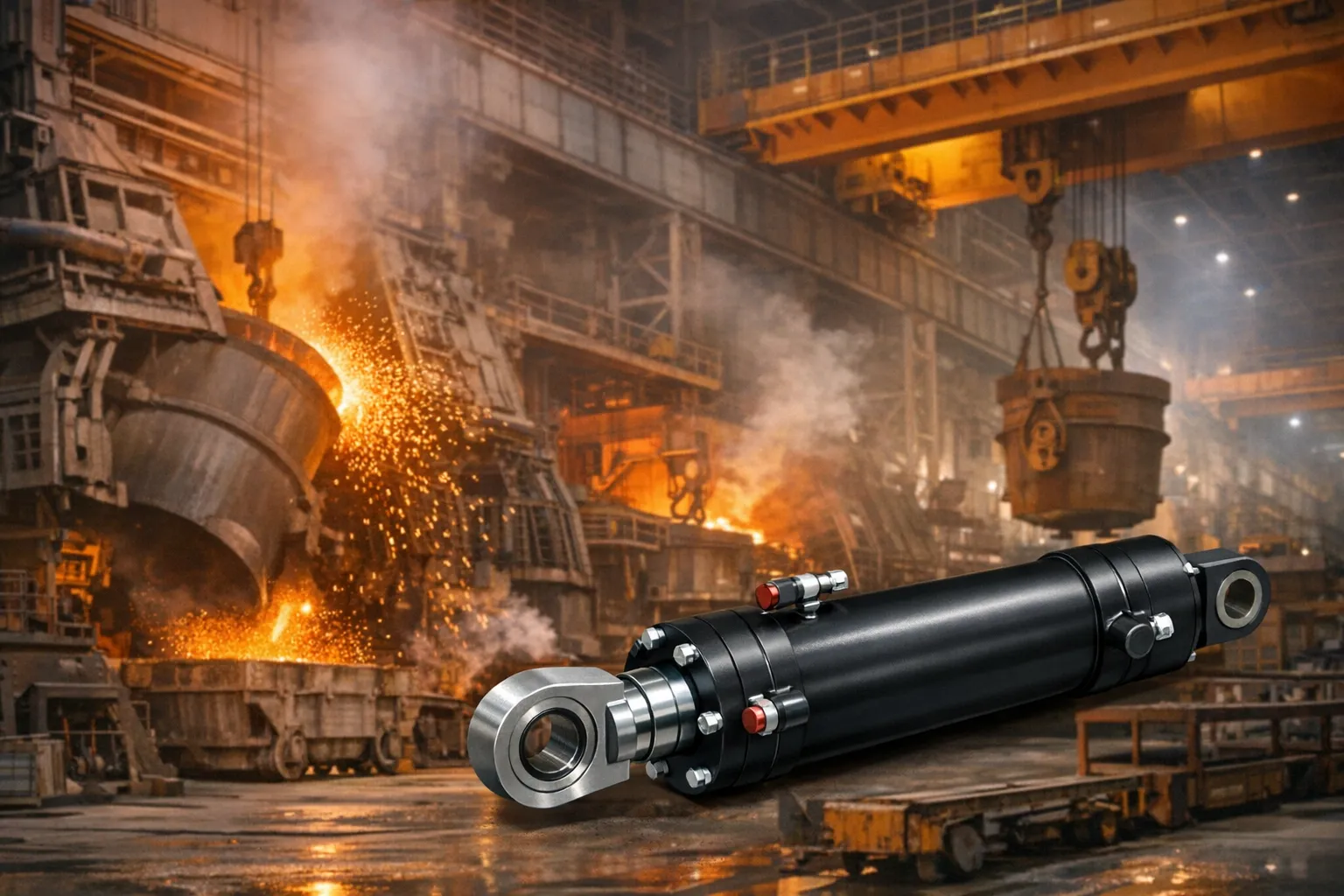
Operating as an elite, globally recognized hydraulic cylinder manufacturer, our heavy engineering division has systematically eliminated these exact failure points. We developed a severe-duty lifting cylinder designed exclusively for metallurgical car body elevation. By abandoning standard carbon steels in favor of ultra-high-yield 27SiMn alloy, utilizing a robust fully welded monolithic construction, and integrating our proprietary high-life sealing technology, we provide an actuator that is virtually immune to heat-induced leakage and particulate abrasion. Upgrading your transfer fleet with our purpose-built hydraulic oil cylinder solutions secures your continuous casting schedule, dramatically reduces annual maintenance expenditures, and fundamentally protects your facility against the severe hazards of unexpected equipment failure.
Comprehensive Technical Parameters
Properly sizing a fluid power actuator to safely hoist a 200-ton ladle car requires exact alignment with your plant’s structural constraints, payload capacities, and central pump station operating pressures. Because ladle car chassis designs vary significantly across different steelworks, we offer a highly adaptable manufacturing profile. The engineering matrix below outlines the foundational specifications of our heavy-duty lifting units, illustrating the precise material choices and structural designs employed to guarantee absolute reliability.
| Engineering Parameter | Specification Data & Customization Options |
|---|---|
| Target Industry Sector | Metallurgy and Heavy Iron Industry |
| Primary Equipment Category | Ladle Car / Ladle Transfer Vehicle |
| Subsystem / Specific Action | Car body lifting mechanism |
| Actuator Designation | Lifting Cylinder / Lifting Hydraulic Cylinder |
| Kinematic Methodology | Double acting hydraulic cylingder execution |
| Structural Body Type | Heavy-duty hydraulic cylinder piston architecture |
| Manufacturing Assembly | Fully Welded monolithic construction |
| Material System Base | 27SiMn High-Strength Alloy Steel |
| Rod Surface Treatment | Induction hardened & deeply Chrome plated (>50 microns) |
| Environmental Grade | Severe Airborne Dust and Extreme Radiant Heat |
| Primary Working Condition | Vertical Lifting of extreme deadweight payloads |
| Typical Failure Mode Prevented | Catastrophic fluid Leakage and load drifting |
| Recommended Core Configuration | Advanced High-life seal matrix |
| Mounting Interface Options | Heavy Base Clevis, Center Trunnion, or Spherical Bearings |
Operational Physics & High-Tonnage Fluid Dynamics
To fully comprehend the extraordinary load-bearing capacity and structural resilience of this equipment, one must examine the fundamental fluid dynamics and immense hydrostatic pressures at play. Hoisting the body of a ladle car loaded with a sloshing mass of liquid metal requires an actuator capable of translating hydraulic fluid pressure into overwhelming, yet perfectly stable, linear force. In significantly less critical environments, engineers might employ a basic single acting hydraulic cylingder that uses fluid pressure to lift and relies solely on the gravity of the payload to force the oil back during retraction. However, handling molten metal demands absolute, positive mechanical control in both axial directions to prevent uncontrolled free-fall scenarios or uneven descent. Therefore, our engineered solution utilizes a highly robust, large-displacement double acting hydraulic cylingder architecture.
During the critical lifting phase, the plant’s hydraulic power unit pumps fire-resistant hydraulic fluid through high-pressure lines into the blind end (cap end) of the heavy-walled 27SiMn steel barrel. Governed by core hydrostatic principles, this intense pressure acts uniformly across the entire large surface area of the internal piston. Because the 27SiMn alloy possesses exceptionally high yield strength, the cylinder barrel acts as a perfectly rigid pressure vessel; it does not balloon or deform microscopically even when systemic pressure spikes significantly to overcome initial static stiction. The resulting multiplication of force smoothly and decisively drives the hardened chrome rod upward, elevating the car chassis. To prevent the massive load from causing the internal piston to shudder or vibrate—a phenomenon known as “stick-slip” that could easily splash liquid steel—the internal bore is precision skived and roller burnished to a mirror-like finish (Ra < 0.2 µm).
The lowering phase is inherently more dangerous. The immense gravity of the ladle naturally wants to force the hydraulic fluid out of the cylinder at an accelerating, uncontrollable rate. The double-acting design actively directs pressurized fluid into the rod end of the cylinder while simultaneously routing the exhaust fluid from the cap end through highly restrictive, proportional counterbalance load-holding valves. This active hydraulic braking ensures the massive ladle car descends at a meticulously controlled, safe velocity. Furthermore, as the lift cylinder approaches full retraction, integrated hydraulic cushioning blocks trap a small volume of oil, forcing it through a decreasing orifice to gently decelerate the moving mass, completely neutralizing any concussive mechanical impact against the lower chassis rail frame.
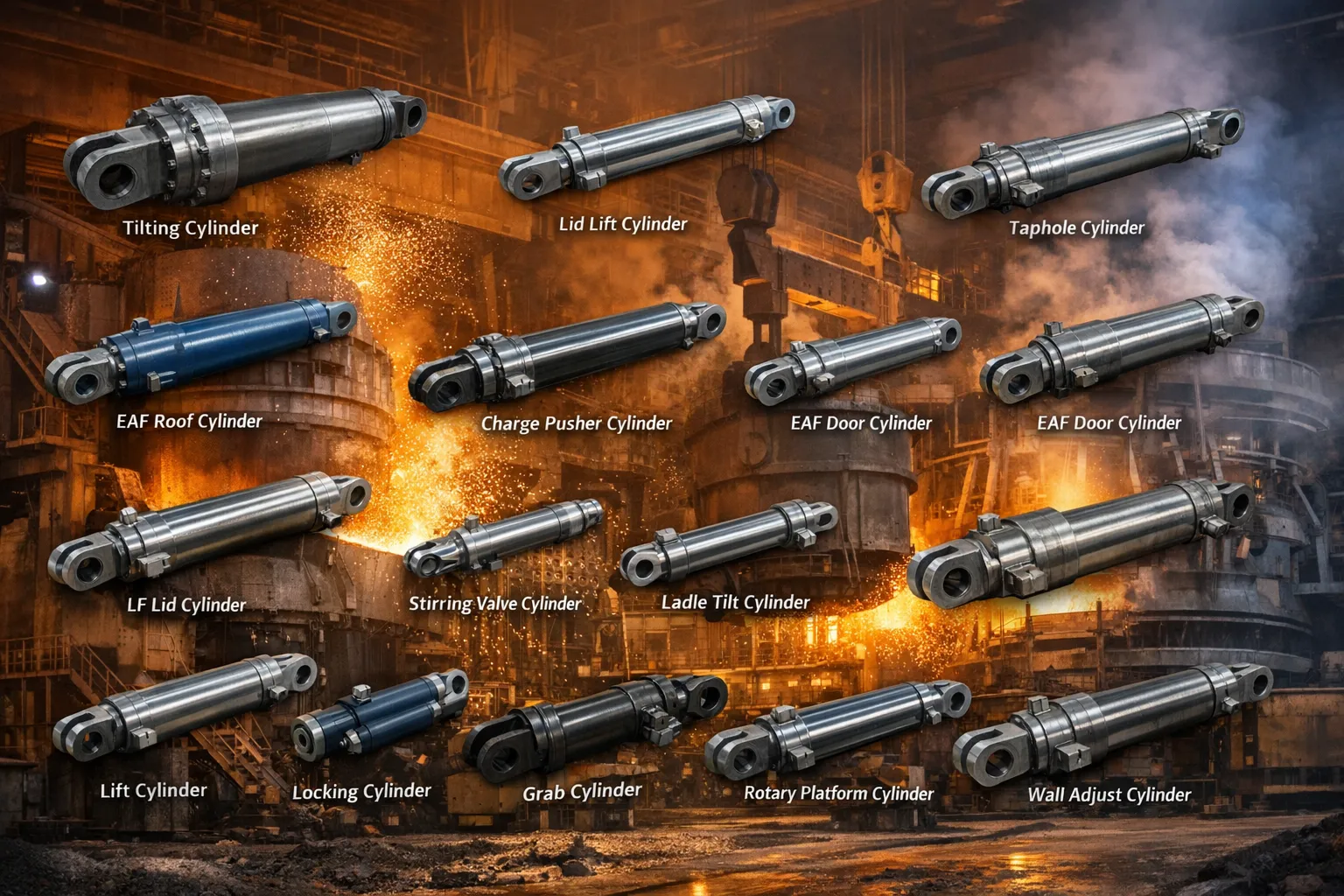
Seamless Legacy Brand Replacement & Plant Modernization
Maintenance directors managing aging, heavily utilized metallurgical facilities continuously face a highly frustrating supply chain dilemma. The original transfer cars in their plants were frequently commissioned utilizing standard catalog hydraulic rams supplied by massive global fluid power conglomerates. Over time, as these generic units inevitably succumb to high-heat seal failure and abrasive rod scoring, plant engineers attempt to source direct replacements from the Original Equipment Manufacturer (OEM). Tragically, this often results in receiving quotes with agonizingly long international lead times extending past 20 weeks and exceptionally inflated hydraulic cylinder price tags. An active blast furnace operation simply cannot afford to suspend its continuous casting logistics waiting for generic replacement components.
Our dedicated heavy project engineering division specializes in completely bypassing this critical bottleneck. We possess extensive, proven expertise in the rapid reverse-engineering and customized manufacturing of direct, 1:1 dimensional drop-in replacements for failing legacy equipment originally produced by prominent multinational brands such as Bosch Rexroth, Parker Hannifin, Eaton Vickers, and Enerpac. (We state unequivocally that our specific reference to these corporate brand names is utilized strictly for the professional engineering purpose of communicating dimensional structural interoperability to plant technical staff. We operate completely independently as a custom manufacturer and maintain no trademark affiliation or endorsement from these respective entities.)
By strategically specifying our custom-engineered metallurgical series to replace your failing equipment, your maintenance department secures a flawless physical upgrade. We meticulously replicate the exact pin-to-pin retracted length, heavy trunnion bracket positioning, clevis bore diameters, rod end thread pitches, and high-pressure fluid port spacing. This allows your mechanical technicians to seamlessly install our superior, high-strength hydraulic parts during a brief, scheduled maintenance window, without ever needing to execute costly hot-work modifications or structural welding on the existing ladle car framework.
Five Uncompromising Core Engineering Advantages
Designing heavy machinery capable of safely hoisting tons of liquid fire requires an absolute obsession with applied metallurgy, material science, and proactive failure prevention. What fundamentally elevates our application-specific lifting actuator above a standard industrial catalog item? It is the deliberate over-engineering embedded within every component. Below are five definitive technical superiorities that guarantee our product’s unyielding reliability.
1. Superior High-Yield 27SiMn Structural Alloy Steel
Lifting a loaded ladle car generates immense compressive forces and sudden lateral load shifts as the liquid steel sloshes. Standard cylinders utilizing basic 1045 carbon steel tubes can actually bow or flex under these dynamic stresses, leading to immediate seal failure. We manufacture our heavy-wall cylinder barrels exclusively from 27SiMn (Silicon-Manganese) alloy steel. This specific metallurgical composition yields exceptionally high tensile strength and superior resistance to mechanical fatigue, ensuring the cylinder remains absolutely rigid, maintaining perfect internal concentricity under the heaviest payloads.
2. High-Life Sealing Technology Eradicating Leakage
The primary and most catastrophic failure mode on ladle cars is fluid leakage caused by thermal seal degradation. Standard polyurethane or NBR seals rapidly melt, harden, and crack when subjected to the intense radiant heat radiating from the ladle bottom. We entirely replace these basic compounds with a proprietary high-life sealing matrix utilizing advanced Fluoroelastomer (FKM/Viton) compounds and heavy-duty PTFE composite glide rings. This matrix remains hydrostatically secure and maintains perfect elastomeric memory even when ambient operational temperatures approach 200°C.
3. Indestructible Fully Welded Monolithic Construction
Many generic industrial cylinders utilize a tie-rod construction, where external threaded bolts clamp the end caps to the barrel. Under the severe concussive vibration of a steel mill rail network, these tie-rods stretch, causing the end caps to misalign and violently leak fluid. Our actuators feature a fully welded construction. Using deep-penetration, automated submerged arc welding, the heavy forged steel base and end caps are permanently fused to the 27SiMn barrel, creating an immovable, monolithic pressure vessel completely immune to vibrational loosening.
4. Multi-Layered Particulate Defense Against Abrasive Dust
The atmosphere around a ladle car is saturated with jagged, abrasive metallic dust and crystalline slag. If this dust settles on a retracting rod, it acts like sandpaper, instantly destroying the primary internal seals. We implement an aggressive multi-stage particulate defense architecture within the front gland. A heavy-duty metallic scraper actively shears baked-on slag off the hard chrome rod, immediately followed by a high-density, heat-resistant polymer wiper. This ensures only a perfectly clean surface interacts with the hydraulic fluid.
5. Advanced Micro-Cracked Chrome Plating Durability
The extending piston rod is continuously exposed to extreme radiant heat and potential mechanical impacts from falling debris. We manufacture our heavy-duty rods from high-grade alloy steel that is first deep-induction hardened to resist physical denting. We then apply an exceptionally thick layer (>50 microns) of hard chrome plating using a specialized micro-cracking deposition process. These microscopic fissures in the chrome trap tiny reservoirs of oil, ensuring continuous self-lubrication and ultra-low friction, even in bone-dry, scorching ambient conditions.
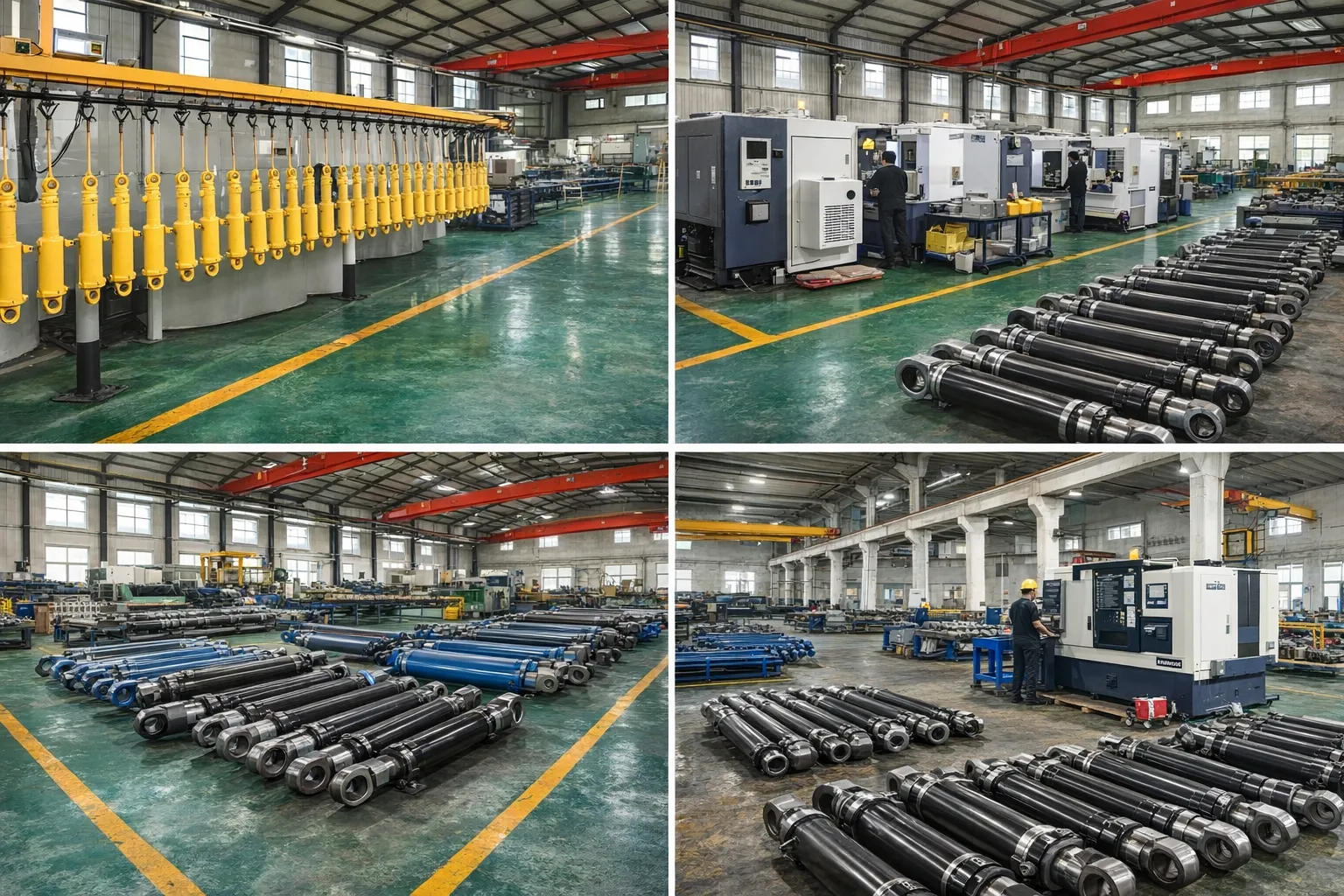
Autonomous Manufacturing Excellence & Quality Assurance
Genuine, repeatable industrial reliability capable of safely lifting molten steel cannot simply be inspected into a finished product; it must be methodically built into the component at every single stage of its fabrication. We maintain absolute vertical control over our entire production lifecycle. Operating from cutting-edge, ISO-certified heavy manufacturing facilities, we execute every process—from the initial deep-hole boring of the raw 27SiMn billet to the final hydrostatic overload testing—entirely in-house. This manufacturing autonomy allows us to strictly govern quality protocols that greatly exceed standard commercial fluid power practices.
The production methodology commences with strict raw material traceability. Every batch of incoming 27SiMn steel is subjected to optical emission spectrochemical analysis and deep ultrasonic flaw detection. We rigorously verify the absence of internal voids, slag inclusions, or microscopic fractures that could compromise the high-impact structural integrity of the final pressure vessel. The complex machining of the internal hydraulic cylinder components—such as the massive heavy-duty glands, intricate pistons, and forged heavy end caps—is performed on state-of-the-art multi-axis CNC turning and milling centers. The internal bore of the cylinder barrel undergoes advanced deep-hole skiving followed by precision roller burnishing to achieve the necessary glass-like smoothness.
Most critically, before any Lifting Hydraulic Cylinder is authorized for global export, it must survive our mandatory 100% factory dynamic testing protocol. We strictly refuse to rely on statistical batch testing. Each individual heavy-duty unit is integrated into an automated diagnostic test rig and hydrostatically pressurized to 150% of its maximum rated continuous working pressure. We digitally monitor for any microscopic internal volumetric bypass leakage, conduct rigorous tactile inspections for external fluid weeping, and verify smooth, shudder-free stroke execution. Every single approved unit is permanently etched with a unique alphanumeric serial code, ensuring complete lifecycle material traceability and dramatically simplifying any future scheduled hydraulic cylinder repair logistics.
Broad Spectrum Industrial Applications Across Severe Environments
While the intense, high-stakes demands of Ladle Transfer Car lifting drove the foundational engineering behind this robust product architecture, the resulting extreme durability is highly sought after across numerous other severe-duty industrial sectors globally. Mechanical fluid power technologies specifically designed to survive brutal vibration, immense static loads, and abrasive dust translate perfectly into providing supreme, unbroken reliability in other harsh operational theaters.
Beyond our absolute dominance in the metallurgical sector, our specialized heavy-wall 27SiMn actuators and high-life sealing technologies are incredibly effective within the mining industry. In underground continuous miners, heavy primary rock crushers, and bulk ore apron feeders, airborne silica dust and massive rock impacts present a constant threat to hydraulic integrity—a threat our hardened, welded units easily neutralize. The ability to rigidly hold massive loads without drifting is invaluable in subterranean roof support structures.
Similarly, the sheer linear lifting force, counterbalance integration, and unyielding structural rigidity we engineer into these mechanisms make them absolutely essential for heavy lifting and earth-moving tasks within the construction machinery industry. They are heavily utilized in massive tunnel boring machines (TBMs), heavy foundation piling rigs, and large-scale bridge erection gantries subjected to severe shock loading. Our high-performance engineering principles prove universally applicable wherever absolute lifting safety meets extreme environmental hostility.
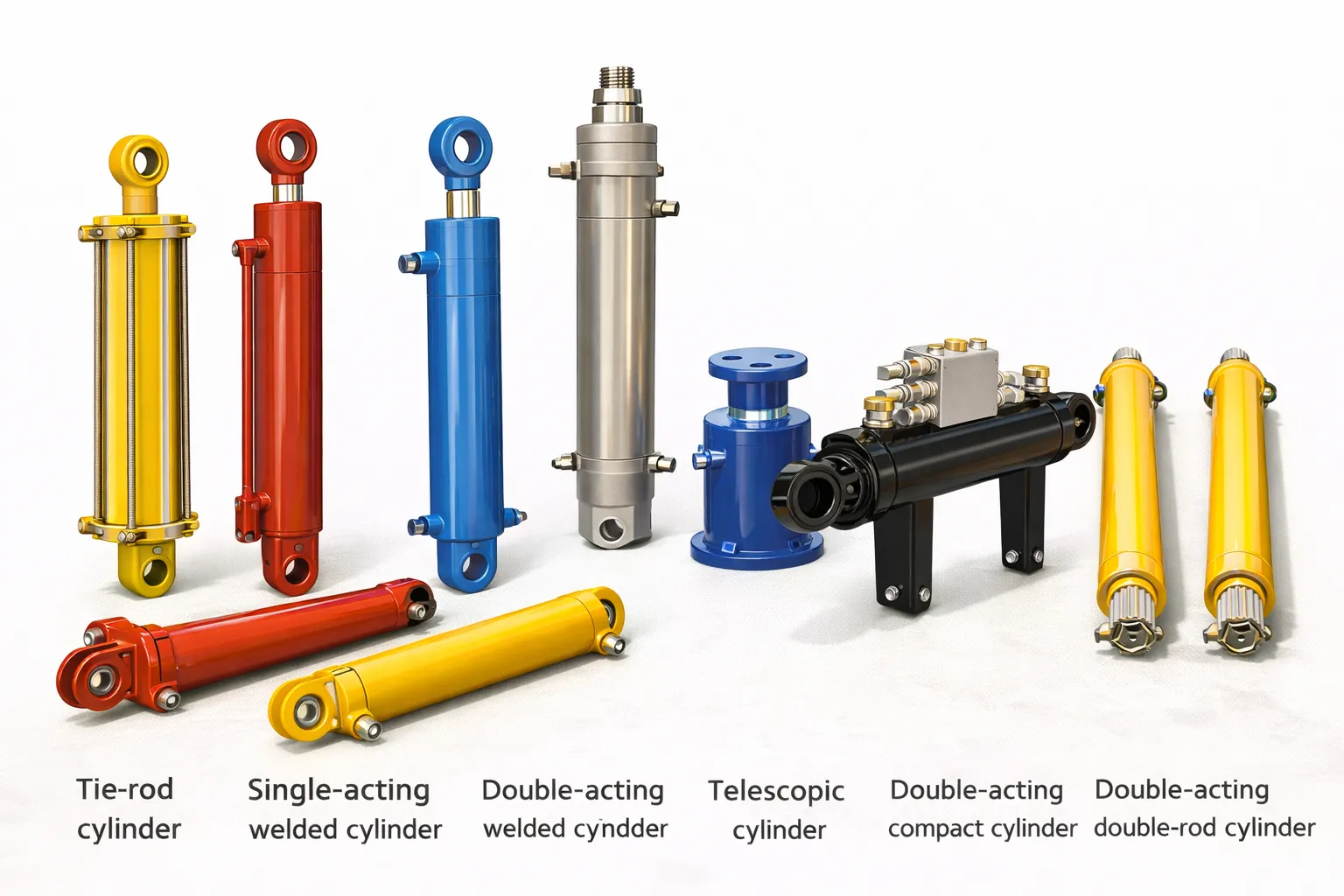
Comparative Analysis: Standard Commercial Actuators vs. Metallurgical Engineering
Strategic procurement decisions in heavy manufacturing operations must carefully evaluate the initial capital expenditure against the long-term total cost of ownership and the severe safety risks of equipment failure. The technical comparison matrix below highlights the critical engineering divergences between generic off-the-shelf industrial actuators and our highly specialized Lifting Hydraulic Cylinder, clearly demonstrating why upgrading provides a massive and rapid return on investment.
| Critical Engineering Metric | Ordinary Commercial Industrial Cylinder | Our High-Performance Lifting Cylinder |
|---|---|---|
| Structural Material & Rigidity | Standard 1045 Carbon Steel. Low yield strength allows barrel ballooning and microscopic bowing under heavy off-center loads. | Advanced 27SiMn Alloy Steel. Exceptionally high yield strength maintains absolute structural rigidity under maximum pressure spikes. |
| Seal Architecture & Leakage Control | Basic soft Polyurethane seals. Highly susceptible to thermal softening, extrusion, and catastrophic fluid bypass under heavy load. | High-Life Sealing Matrix. PTFE step seals energized by FKM perfectly resist heat and eliminate fluid leakage entirely. |
| Particulate Exclusion Defense | Single-lip soft polymer wiper. Easily breached and melted by hot abrasive metallic dust, dragging heavy contamination inside. | Tandem heavy-duty metallic scrapers aggressively shear crystallized slag off the thick hard-chrome rod prior to retraction. |
| Manufacturing Assembly Type | Standard tie-rod construction. Vibrational forces stretch the external bolts, causing end-cap separation and massive leakage. | Monolithic Fully Welded construction. Deep penetration robotic welds create an indestructible pressure vessel immune to vibration. |
| Maintenance Reality | Extremely poor. Requires constant emergency breakdown interventions, frequent seal repacking, and introduces severe safety hazards. | Exceptional MTBF. Secures continuous casting logistics, eliminates sudden load drops, and drastically cuts maintenance budgets. |
Proven Global Success: Verified Real-World Case Studies in East Asia
Theoretical engineering specifications must invariably withstand the harsh, unforgiving realities of actual heavy plant operations. Our robust fluid power solutions are actively trusted by some of the most prominent industrial conglomerates across the Asian manufacturing belt. Below are five verified field deployments where our engineering department successfully resolved critical, highly expensive operational bottlenecks for our corporate B2B clients in South Korea, Japan, and Taiwan.
Case Study 1: Eradicating Fatal Fluid Leakage and Load Drifting
Location: Pohang, South Korea | Application: 250-Ton Ladle Transfer Car Lifting System
The Challenge & Contact Method: In mid-2024, the plant’s chief reliability engineer was dealing with a severely dangerous situation. Their existing standard lifting cylinders were experiencing continuous internal bypass leakage due to thermal seal degradation from the 1600°C ladle. The cars were slowly drifting downwards while holding molten steel, risking collision with the casting turret. They discovered our heavy-duty capabilities via a targeted search and initiated a technical consultation through our web portal.
Engineered Solution & Result: We custom-engineered a suite of massive Lifting Hydraulic Cylinders utilizing our proprietary high-life sealing matrix featuring robust PTFE step seals. Since deployment, the mechanical drifting issue has been completely eradicated, and the cars maintain absolute, rigid elevation during the entire casting sequence.
“The hydrostatic holding capability of these new units is phenomenal. The high-life seals entirely solved the internal leakage problem. We have completely eliminated the safety hazard of load dropping.” — Melt Shop Safety Director, Pohang.
Case Study 2: Upgrading to Welded 27SiMn to Survive Structural Fatigue
Location: Incheon, South Korea | Application: Heavy Foundry Transfer Car Elevation
The Challenge & Contact Method: A busy foundry was experiencing terrifying structural failures where the external tie-rods on their generic commercial cylinders would stretch and snap when hoisting fully loaded ladles, causing the car to tilt dangerously. The procurement team met our regional technical representatives at an industrial heavy machinery exhibition in Seoul.
Engineered Solution & Result: We completely replaced the fragile tie-rod designs with our fully welded 27SiMn alloy steel hydraulic rams. The incredibly high yield strength of the 27SiMn alloy completely absorbed the massive mechanical stress without suffering any structural deformation or end-cap separation.
“The material science behind utilizing 27SiMn is immediately apparent. The heavy-wall welded construction has entirely solved the structural fatigue cracking we suffered from for years. An exceptionally reliable engineering upgrade.” — Foundry Operations Manager, Incheon.
Case Study 3: Defeating Extreme Particulate Abrasion in the Scrap Yard
Location: Gwangyang, South Korea | Application: Scrap Transport Car Lifting Hoist
The Challenge & Contact Method: Operating in the highly abrasive scrap yard, the standard soft polymer wipers on their transfer car cylinders were rapidly shredding, allowing heavy metallic dust into the glands. This caused severe internal scoring and fluid bypass. They reached out via direct email after a referral from another local steelworks in early 2024.
Engineered Solution & Result: We implemented our aggressive tandem metallic scraper architecture combined with heavily chrome-plated, induction-hardened rods. The rigid metallic scrapers forcefully shear the hardened dust off the rod before it retracts, keeping the internal hydraulic fluid perfectly clean and doubling the cylinder’s operational lifespan.
“The dual metallic scraper design is highly effective in this brutal dust environment. Our regular hydraulic fluid analysis shows an incredible reduction in particulate contamination since installing these customized units.” — Reliability Systems Supervisor, Gwangyang.
Case Study 4: Stabilizing High-Speed Deceleration and Eliminating Stick-Slip
Location: Kitakyushu, Japan | Application: Tundish Car Lifting Hydraulics
The Challenge & Contact Method: When lifting their tundish car into position, the erratic stick-slip motion of their aging OEM cylinders caused mechanical shuddering that threatened to damage the sensitive refractory linings and splash the steel. They required exceptionally smooth, judder-free lifting performance and submitted an urgent inquiry through our technical support page in late 2024.
Engineered Solution & Result: We supplied custom heavy-duty units featuring ultra-precision honed internal bores (Ra 0.2µm) and specialized PTFE composite wear bands. Additionally, we integrated progressive hydraulic cushioning blocks machined directly into the forged end caps. The mechanical shuddering was entirely eliminated, and the deceleration at the end of the stroke is perfectly smooth.
“The smooth ascent and descent of the heavy tundish carriage is exactly what we needed. It protects our expensive refractory bricks from vibration damage. Outstanding fluid dynamic engineering that solved a major operational headache.” — Process Automation Director, Kitakyushu.
Case Study 5: Rapid Emergency Drop-In Replacement for Legacy Equipment
Location: Kaohsiung, Taiwan | Application: Slag Pot Carrier Lifting Mechanism
The Challenge & Contact Method: A critical lifting actuator experienced a catastrophic barrel rupture due to age and fatigue, halting secondary slag removal entirely. The original European manufacturer quoted a 24-week lead time, which was financially unacceptable. The plant manager contacted our international rapid response engineering team via direct phone inquiry.
Engineered Solution & Result: Working directly from legacy OEM dimensional schematics, our engineering team reverse-engineered a 1:1 dimensional physical replacement utilizing high-strength 27SiMn. We manufactured the massive unit in under 5 weeks and air-freighted it directly to the facility. It bolted perfectly onto the existing trunnions without a single structural modification required to the car.
“The dimensional accuracy was absolute perfection. We bolted it right in and re-started slag removal immediately. Their ability to deliver superior custom manufacturing at a fraction of the OEM lead time drastically reduced our hydraulic cylinder repair downtime.” — Plant Operations Chief, Kaohsiung.
Frequently Asked Questions (FAQ)
Executing strategic procurement for highly critical heavy hoisting machinery requires absolute technical clarity and confidence in the product’s safety margins. Below are detailed, engineering-level answers to the most frequent operational inquiries our corporate B2B partners raise regarding our specialized severe-duty ladle lifting solutions.
Fortify Your Molten Steel Logistics Today
Do not allow generic commercial fluid power components and highly vulnerable standard seals to dictate the safety and continuous casting logistics of your multi-million dollar steelworks. Partner with a dedicated fluid power engineering team that truly understands the immensely destructive forces of heavy off-center loads, abrasive metallic dust, and the absolute necessity of zero fluid leakage. Upgrade your transfer cars to a purpose-built Lifting Hydraulic Cylinder and permanently eliminate the disastrous hazard of sudden load dropping.
Our technical support and heavy-industry export specialists are immediately available to thoroughly analyze your existing schematics, provide detailed 3D CAD modeling, and deliver a robust, customized 27SiMn actuation solution boasting a highly competitive hydraulic cylinder price-to-lifespan ratio. Explore our complete engineering capabilities in our Comprehensive Product Catalog.
Editor: Cxm