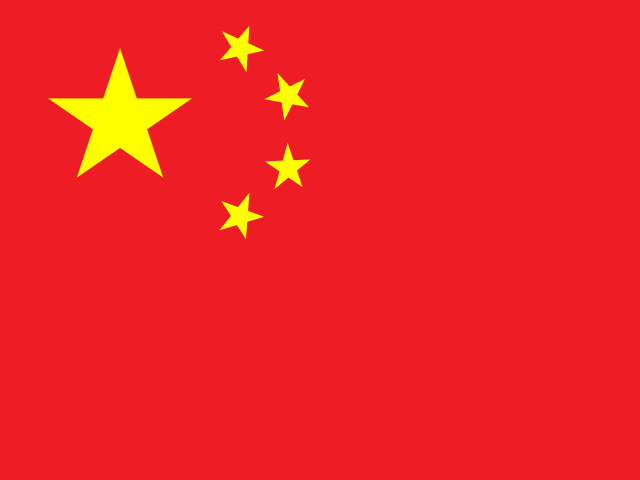
Main Boom Lift Cylinder for Aerial Work Platform
Engineered for uncompromising high-altitude stability. Featuring a premium 42CrMo thick-wall architecture that actively prevents cylinder tube deformation under severe offset loads, guaranteeing absolutely smooth lifting for maximum operator safety.
Product Overview & Industrial Value in High-Altitude Operations
Operating heavy machinery at extreme vertical elevations introduces a complex array of mechanical and fluid dynamic challenges that cannot be solved with standard, off-the-shelf components. In the architecture of modern construction equipment, the main boom lift hydraulic cylinder represents the critical muscular core of the entire machine. This specific actuator is tasked with an immense responsibility: elevating the primary structural boom arm, bearing the massive dead weight of thick steel linkages, the operator basket, skilled technicians, and their heavy tooling. When an operator is suspended thirty, forty, or even fifty meters in the air, the physical leverage and mechanical stresses acting upon the base lifting mechanisms are exponentially magnified. A microscopic deflection within the cylinder barrel at the base translates into a terrifying and highly dangerous swaying motion at the basket level.
As a dedicated and highly experienced hydraulic cylinder manufacturer, we have spent two decades analyzing the failure modes of high-altitude machinery. We recognize that producing generic actuators is entirely insufficient for this uncompromising sector. Aerial work environments constantly subject equipment to unpredictable wind shear, uneven payload distribution, and rapid directional changes, generating severe eccentric (offset) loads. Our deeply researched lift cylinder designs are formulated specifically to neutralize these environmental threats. By focusing relentlessly on metallurgical integrity and internal hydrodynamic stability, we have created a heavy-duty fluid power solution that actively resists the single most common and destructive failure mode in this industry: cylinder tube deformation.
The true industrial value of specifying premium hydraulic parts extends far beyond the initial procurement phase. Utilizing a robust, thick-wall design forged from high-yield alloy steel guarantees perfectly smooth lifting, protecting the mechanical pivots and bushings of the boom arm from chronic fatigue stress. Whether you are managing a massive construction equipment rental fleet across urban centers or operating critical facility maintenance machines, integrating our premium hydraulic cylinder ensures maximum equipment uptime, drastically reduced maintenance overhead, and the ultimate safety assurance for your field personnel. You can explore our foundational engineering standards and corporate capabilities at hydrauliccylindersprice.com.
Comprehensive Technical Parameters & Engineering Specifications
Accurate machinery integration requires precise, uncompromising specification data. Every dimension, material selection, and surface finish in our product line is calculated to maximize cyclic fatigue life and operational safety. The table below outlines the foundational structural parameters and highly customizable ranges for our main boom actuators, optimized explicitly for the severe demands of the modern aerial platform.
| Engineering Attribute | Specification Data & Configuration Details |
|---|---|
| Target Industry Sector | Engineering & Construction Machinery |
| Equipment Category | Aerial Work Platform (Articulating & Telescopic Boom Lifts) |
| Subsystem / Action Location | Main Boom System / Primary Elevation Linkage |
| Component Designation | Main Boom Lift Cylinder |
| Kinematic Action Mode | Double acting hydraulic cylinder (Powered extension and retraction) |
| Internal Structure Type | Heavy-duty Piston type with composite guide rings |
| Manufacturing Construction | Deep-penetration Welded assembly (Robotic pulsed MIG) |
| Primary Material Matrix | 42CrMo High-Tensile Alloy Steel (Superior yield strength) |
| Surface Treatment Defense | Hard Chrome-plated (Micro-cracked, 30-50 microns thick, induction hardened) |
| Environmental Resistance Grade | High altitude + Severe offset load capable (Extreme wind shear rated) |
| Dynamic Working Condition | Absolute smooth lifting (Zero-judder, anti-stick-slip operation) |
| Primary Failure Mode Prevented | Catastrophic cylinder tube deformation |
| Recommended Factory Configuration | Thick-wall barrel design + Advanced progressive stroke cushioning system |
By explicitly selecting high-yield 42CrMo alloy steel rather than standard commercial carbon steel, and implementing a mathematically verified thick-wall geometry, we ensure the structural hoop stress remains well within safe engineering margins, even when massive pressure spikes occur during sudden high-altitude wind resistance.
Understanding the Advanced Working Principle & Fluid Dynamics
To thoroughly comprehend the extraordinary reliability of these heavy-duty hydraulic components, analyzing the internal fluid dynamics and mechanical physics is essential. This primary actuator operates strictly as a highly refined double acting hydraulic cylinder. Unlike a basic single acting hydraulic cylinder, which depends entirely on the dead weight of the mechanical load or gravity to force a retraction, the double-acting mechanism utilizes pressurized hydraulic fluid for both directional movements. This allows for powered extension and, critically, highly controlled, powered descent—a non-negotiable safety feature when human lives are suspended in the air.
When the operator engages the lift controls, the machine’s main hydraulic pump actively pushes high-pressure oil through a series of control valves into the blind end (cap end) of the cylinder barrel. This incompressible fluid pushes against the entire surface area of the internal hydraulic cylinder piston. This volumetric expansion generates an immense linear pushing force, steadily raising the massive steel boom structure against the unrelenting force of gravity. The true engineering challenge occurs during this extension phase due to eccentric loads. As the boom reaches outward, crosswinds and unequal payload distribution in the basket create a massive lever effect, putting intense lateral bending stress on the extended piston rod and the surrounding barrel. If lower-grade materials or thin walls are utilized, this leads directly to cylinder tube deformation, permanently binding the piston, destroying the internal seals, and causing a catastrophic system failure.
To lower the platform safely, hydraulic fluid is redirected into the rod end of the cylinder chamber, while the fluid contained in the blind end is precisely metered out through integrated counterbalance valves (also known as load-holding valves). These specialized valves prevent the boom from entering a free-fall state, even in the event of a severed hydraulic hose. Furthermore, at the extreme ends of the physical stroke, our specialized internal progressive cushioning design engages. Machined cushioning spears restrict the fluid exit path during the final millimeters of travel. This creates a powerful, smooth dampening effect that decelerates the heavy boom, eliminating harsh mechanical shock waves and guaranteeing the completely smooth lifting and lowering cycle necessary for personnel safety and structural longevity.
Seamless Brand Replacement & Fleet Integration
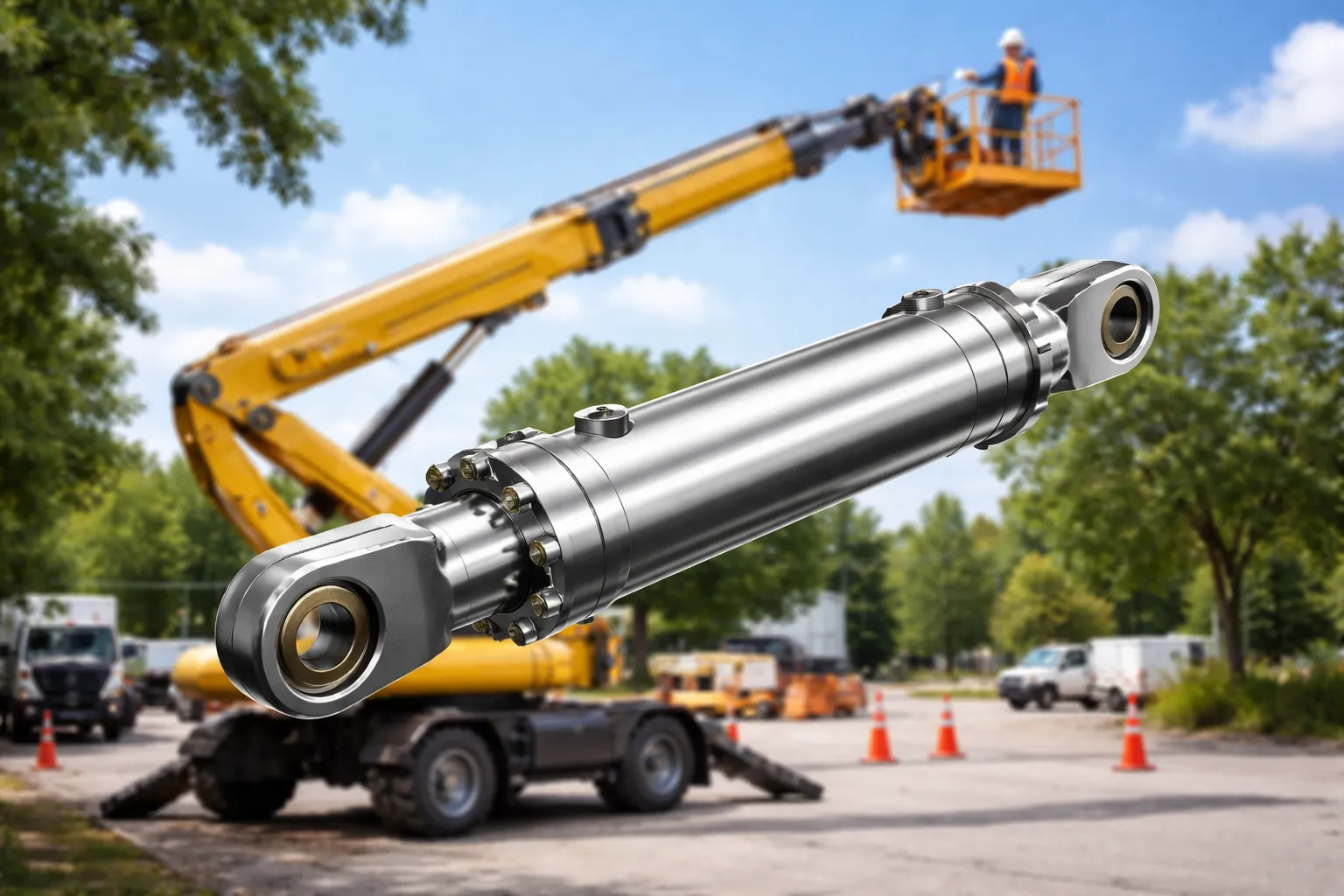
Sourcing reliable, heavy-duty aftermarket components can be a highly frustrating task for fleet maintenance directors who wish to avoid exorbitant OEM markup costs and unacceptably long global supply chain lead times. We have meticulously engineered our main boom lift hydraulic cylinder inventory to serve as direct, drop-in dimensional replacements for a vast array of global construction machinery.
Our robust cylinders feature identical pin-to-pin retracted lengths, precise stroke dimensions, matching heavy-duty trunnion or clevis mounts, and correct port thread specifications. They are routinely deployed as high-performance upgrades for equipment originally manufactured by prominent global brands such as Genie, JLG, Haulotte, Skyjack, Dingli, Manitou, Zoomlion, and XCMG. By replacing standard commercial units with our thick-wall architecture, fleets experience a massive reduction in the frequency of required hydraulic cylinder repair.
Notice for procurement selection: The machinery brand names and trademarks mentioned above are listed strictly for the purpose of helping engineering teams verify dimensional compatibility and facilitate proper aftermarket part selection. We operate globally as a completely independent hydraulic cylinder manufacturer and do not claim any trademark infringement, affiliation, or endorsement from these original equipment manufacturers. Our sole objective is to supply a superior, heavily engineered alternative that maximizes your fleet’s operational safety and profitability.
Five Core Technical Advantages of Our Lifting Solutions
Standard commercial fluid power actuators frequently fail under the relentless, compounding stress of high-altitude operations. We have systematically analyzed these failure points in the field and fundamentally re-engineered our hydraulic oil cylinder designs to establish a completely new benchmark in industrial reliability. Here are the five core technical pillars that separate our products from generic alternatives:
1. Ultra-Low Friction Polymer Sealing Technology
High-altitude platform positioning requires precise, millimeter-accurate micro-adjustments. Standard nitrile rubber (NBR) seals create high breakaway friction, causing a dangerous “stick-slip” phenomenon that makes the platform basket judder violently. We employ an advanced composite seal matrix consisting of imported PTFE (Polytetrafluoroethylene) blended with specialized polyurethane step seals and wipers. This drastically lowers the dynamic friction coefficient, providing perfectly linear, judder-free motion even at extremely low hydraulic pump flow rates, guaranteeing smooth lifting.
2. High-Rigidity 42CrMo Thick-Wall Construction
To actively prevent cylinder tube deformation, we completely abandoned the standard 1045 carbon steel tubing utilized by budget suppliers. Instead, we forge the barrel and rod from high-yield 42CrMo alloy steel, combined with a mathematically calculated thick-wall geometric design. This grants the lift cylinder an incredible increase in buckling resistance, safely neutralizing the severe bending moments generated by off-center payload distribution in heavy wind conditions.
3. Thermal Stability and Fatigue Life Optimization
Continuous lifting duty cycles in hot climates generate significant fluid heat, which rapidly degrades internal seals and fluid viscosity over time. Our internal porting geometry is optimized via fluid dynamics software to eliminate fluid turbulence and pressure bottlenecks, keeping operating temperatures remarkably stable. Additionally, all welded structural eyes and trunnions undergo automated post-weld stress-relief baking, improving the cyclic fatigue life of the mounting points by over fifty percent compared to conventionally welded hydraulic rams.
4. Proprietary Progressive Cushioning System
The sudden halting of a massive steel boom structure sends highly destructive mechanical shock waves through the pivot pins, chassis, and hydraulic circuits. We machine customized progressive cushioning spears at the rod and cap ends of the actuator. During the final millimeters of travel, these spears gradually throttle the escaping hydraulic oil into a constantly shrinking orifice. This gently and silently absorbs the immense kinetic energy of the boom, eliminating harsh mechanical stops entirely.
5. Deep Hard Chrome Plating for Environmental Defense
Aerial platforms are frequently parked outdoors year-round, exposing the critical piston rod to acid rain, abrasive dust, and highly corrosive maritime elements. We apply a dense 30 to 50-micron layer of micro-cracked hard chrome over a medium-frequency induction-hardened rod surface. This specialized electrochemical treatment retains microscopic pockets of hydraulic oil for continuous self-lubrication of the wiper seals, while providing an impenetrable shield against abrasive construction debris and salty coastal air.
Autonomous Manufacturing Excellence & Stringent Quality Control
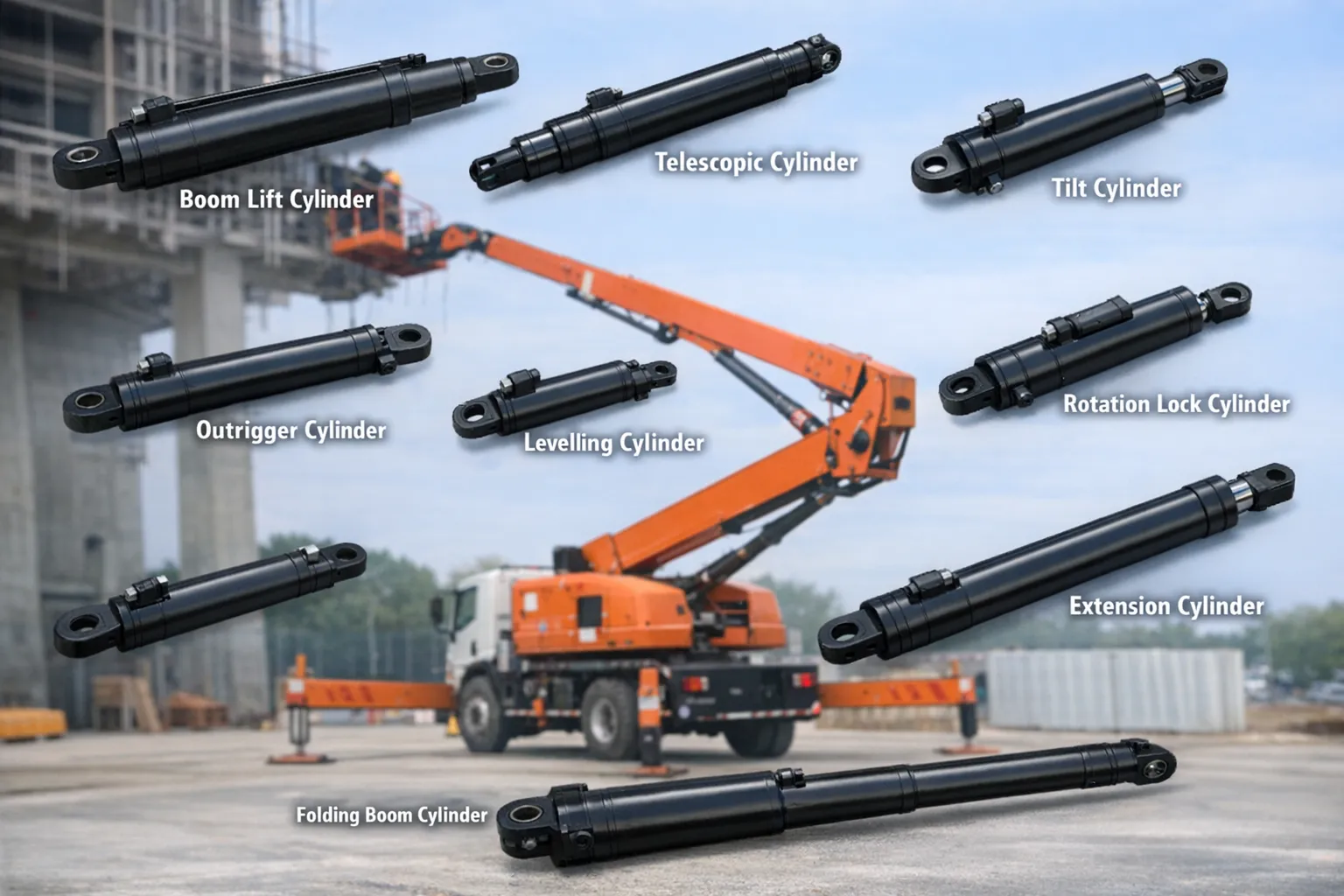
A flawlessly engineered piece of fluid power equipment loses all practical value if the manufacturing execution on the factory floor is inconsistent. We maintain absolute, uncompromising control over our entire production supply chain, performing all precision CNC machining, automated robotic welding, and clean-room seal assembly within our own state-of-the-art facility. The internal bore of the thick-wall 42CrMo barrel undergoes a complex, multi-stage deep-hole boring and skiving process, achieving an internal surface finish of Ra 0.2 to 0.4 microns. This mirror-like finish is strictly required for maximizing the operational lifespan of our low-friction composite seals and ensuring total volumetric efficiency.
For the structural integrity of the cylinder, we heavily utilize robotic pulsed MIG (Metal Inert Gas) welding. This highly controlled thermal process guarantees incredibly consistent, deep-penetration root welds that physically cannot crack under heavy eccentric loads. Every critical structural weld seam is then subjected to rigorous Ultrasonic Non-Destructive Testing (NDT) by certified inspectors to ensure the absolute absence of sub-surface micro-cracks or gas porosity.
Quality assurance dictates our entire daily workflow. We completely reject the budget industry standard of random statistical batch sampling. Before any main boom lift cylinder is authorized to leave our shipping dock, it undergoes a brutal 100 percent individual factory pressure and cycle test. We hold the unit at 150 percent of its rated nominal working pressure for a sustained duration to actively verify zero internal fluid bypass and zero external weeping. Finally, every validated cylinder receives a laser-etched permanent serial number. This digital footprint provides full manufacturing traceability, linking back to the specific metallurgical heat certificates of the raw steel and the exact assembly technician, ensuring unmatched accountability.
Extensive Typical Industry Applications
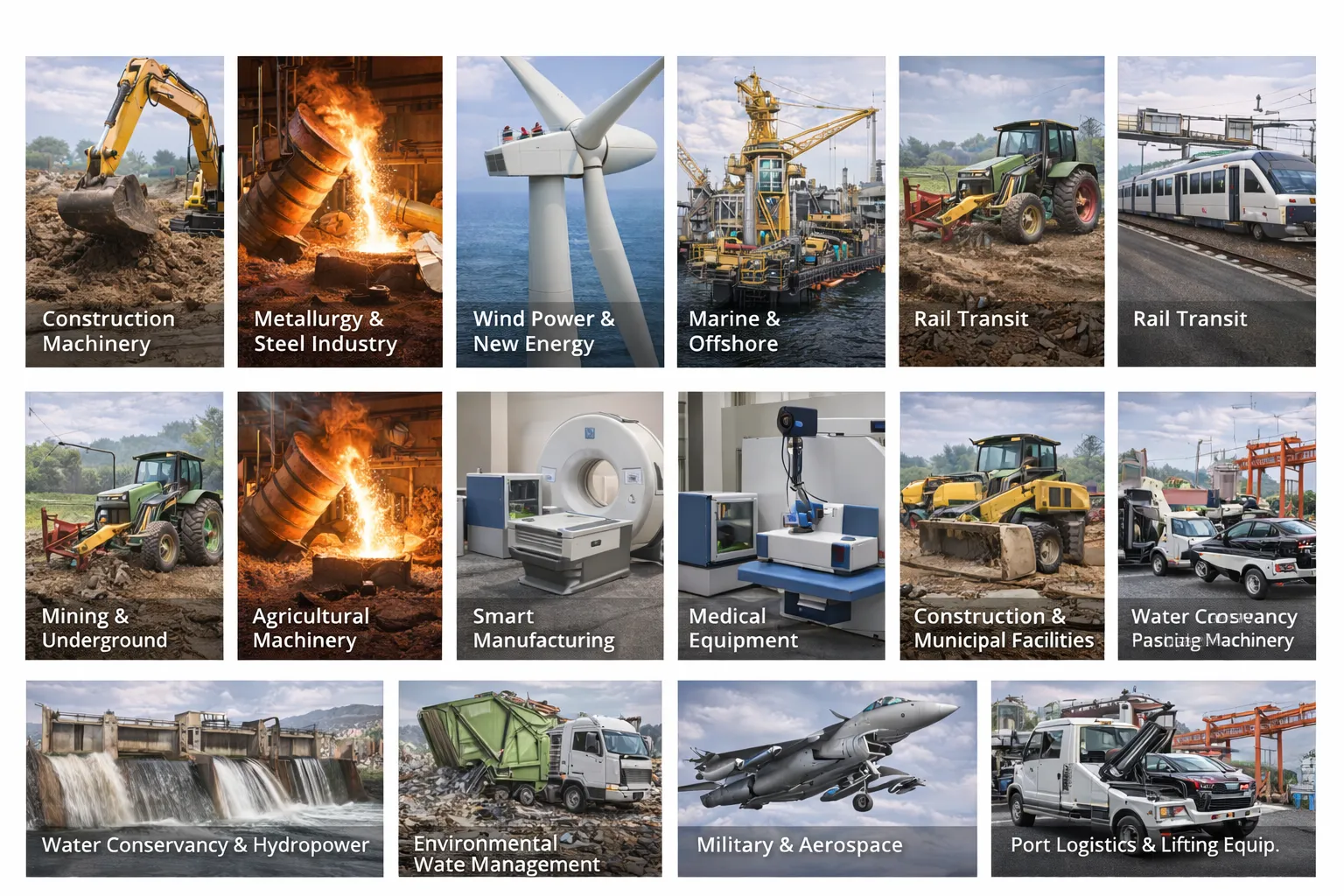
While explicitly designed and optimized as the ultimate high-safety actuator for aerial work platforms, the rugged 42CrMo architecture and flawlessly smooth operation of our cylinders make them highly adaptable across various severe-duty industrial sectors. We invite you to discover our related fluid power applications within the construction machinery industry.
- Engineering and Construction Machinery: Powering the massive lifting forces required for heavy crawler excavators, articulated wheel loaders, and rough terrain telehandlers operating in high-vibration, high-dust environments.
- Metallurgy and Heavy Manufacturing: Actuating heavy furnace doors, forging presses, and continuous casting manipulators where extreme ambient thermal radiation quickly destroys standard commercial hydraulic parts.
- Plastics and Rubber Machinery: Delivering the immense, sustained clamping pressure required for large-scale injection molding platens, ensuring zero mechanical deflection during high-pressure plastic injection phases.
- Material Handling and Logistics Automation: Integrated into heavy-duty reach stackers, container handlers, massive dock levelers, and automated guided vehicles (AGVs) operating continuously in high-cycle 24/7 port environments.
- New Energy and Environmental Equipment: Providing precise, weather-resistant actuation for large-scale solar array tracker mechanisms, wind turbine pitch controls, and heavy municipal refuse compactor plates.
- Specialized and Customized Scenarios: Bespoke engineering for subsea exploration robotic manipulator arms, heavy defense logistics bridging equipment, and massive tunnel boring machines requiring tailored units engineered entirely from scratch.
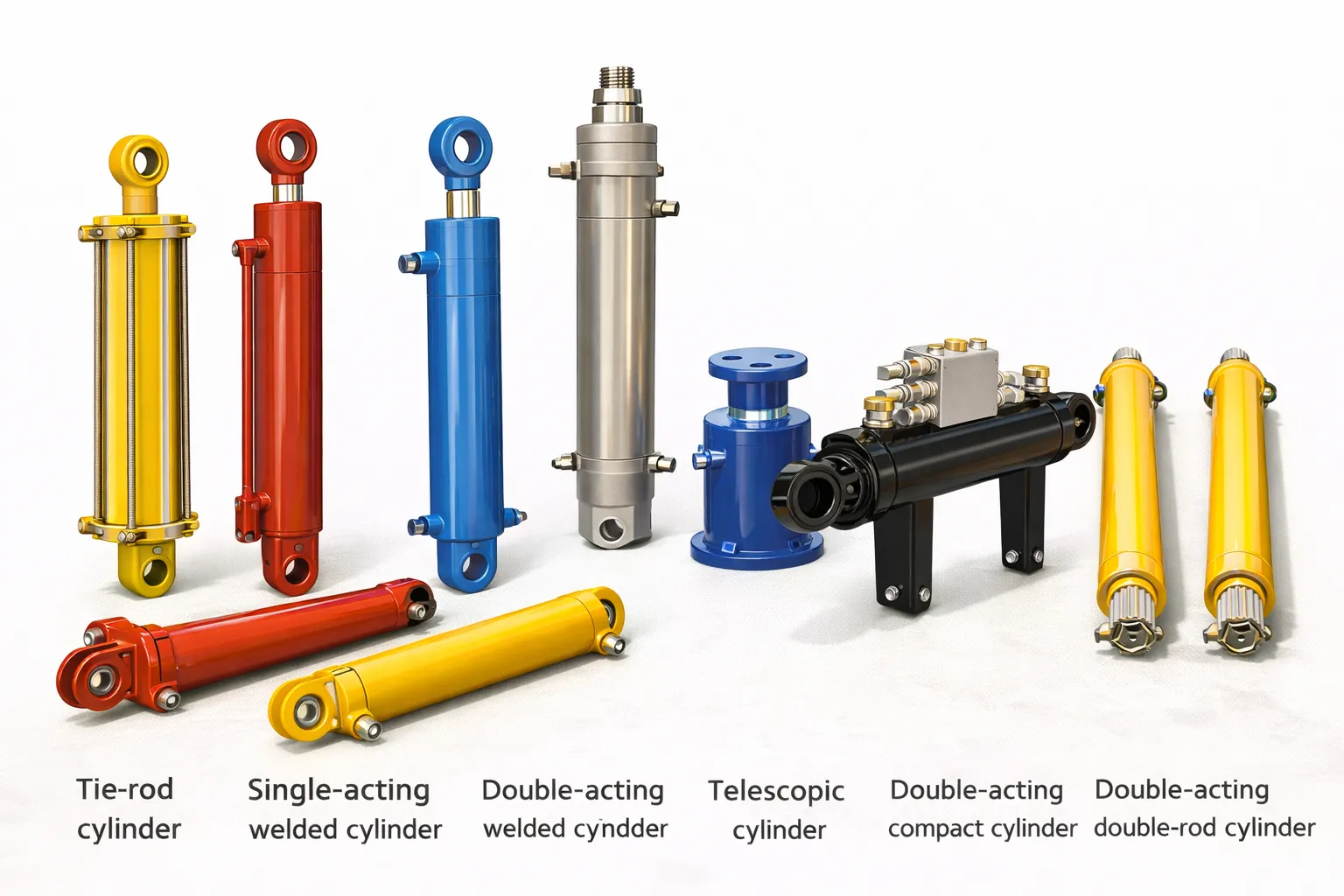
Comparative Analysis: Standard Market Cylinders vs. Our High-Performance Solution
Procurement professionals understand that evaluating the hydraulic cylinder price in isolation—without considering the total cost of ownership, downtime liabilities, and operator safety—is a critical operational error. This direct technical comparison illustrates precisely why elite heavy machinery fleets globally specify our engineered solutions over generic commercial commodities.
| Engineering Feature Analyzed | Ordinary Standard Market Cylinder | Our High-Performance Lift Cylinder |
|---|---|---|
| Base Material & Structural Rigidity | Constructed from standard ST52 carbon steel tubing. Highly susceptible to dangerous barrel expansion and permanent bowing. | Forged from premium 42CrMo alloy steel with a thick-wall design. Totally resists cylinder tube deformation under heavy eccentric loads. |
| Motion Control & Dynamic Friction | Utilizes basic NBR rubber seals. Extremely prone to stick-slip juddering at low speeds, causing platform instability. | Features advanced PTFE/Polyurethane composite seals. Guarantees perfectly smooth lifting and absolute millimeter-precise control. |
| End-of-Stroke Cushioning Mechanics | No hydraulic cushioning or rudimentary external rubber bumpers. Results in violent mechanical shocks during full extension. | Integrated internal progressive fluid dampening at both stroke limits. Silently decelerates the massive kinetic energy of the boom. |
| Surface Defense & Rod Coating | Thin 15-micron commercial chrome layer. Chips and rusts rapidly when exposed to saltwater or harsh construction grit. | Heavy 30 to 50-micron micro-cracked hard chrome over an induction-hardened rod. Extremely scratch and corrosion resistant. |
| Quality Assurance & Testing Protocol | Relies on statistical random batch sampling. High risk of field failures due to undetected manufacturing porosity or seal bypass. | 100% individual high-pressure cycle and leak tested before leaving the factory. Accompanied by full digital serial traceability. |
Real-World Impact: Detailed Case Studies in the Asian Market
Theoretical mechanical engineering must ultimately be validated by brutal, real-world field application. Below are five extensively documented scenarios detailing how our advanced fluid power systems systematically resolved critical operational bottlenecks for major B2B clients across South Korea and neighboring industrial powerhouses.
Case Study 1: Complete Fleet Modernization for Mega-Equipment Rental
Geographic Location: Seoul, South Korea (Project Executed: Q4 2024)
The Client: A tier-one heavy equipment leasing firm managing a diverse fleet of over 250 high-reach articulating boom lifts utilized in urban infrastructure projects.
The Application Challenge: The client was experiencing a staggering 15% failure rate on original OEM main boom cylinders. During high-wind winter construction operations on skyscrapers, the 135-foot platforms were acting as massive sails, causing the standard thin-wall cylinders to bend and structurally fail under the eccentric load.
How They Contacted Us: The desperate maintenance director conducted an extensive engineering search online, specifically looking for a hydraulic cylinder manufacturer capable of executing custom, thick-wall structural forging.
Delivered Result & Implementation: Our engineers rapidly mapped the OEM dimensions and supplied a massive bulk order of retrofitted 42CrMo lift cylinders. By increasing the moment of inertia through our thick-wall design, the cylinder tube deformation issues were completely and permanently eradicated across their entire rental fleet.
“Upgrading to these specific high-yield cylinders was the most profitable maintenance decision we made this decade. We haven’t had to ground a single machine for structural bending since the installation. The competitive hydraulic cylinder price combined with the massive jump in durability saved our Q1 profit margins.” – Mr. Park Ji-hoon, Fleet Maintenance Director.
Case Study 2: Eradicating Saltwater Corrosion in Dry Dock Maintenance
Geographic Location: Busan, South Korea (Project Executed: Q1 2025)
The Client: One of the world’s largest commercial shipbuilding and heavy marine engineering contractors.
The Application Challenge: Dozens of telescopic lifts used continuously for high-altitude ship hull welding were failing prematurely. The brutal coastal saltwater spray and abrasive welding slag were aggressively pitting the standard 15-micron chrome rods, which in turn shredded the wiper seals and caused catastrophic fluid blowouts.
How They Contacted Us: The procurement team discovered our rigorous technical specifications regarding long-term salt spray corrosion resistance via an industrial B2B maritime procurement portal.
Delivered Result & Implementation: We deployed our heavily reinforced double acting hydraulic cylinder units featuring a proprietary 50-micron, double-pass micro-cracked hard chrome plating over induction-hardened steel. These units withstood the brutal maritime environment flawlessly, extending the mandatory maintenance replacement interval by a verified 300 percent.
“We previously wasted thousands of hours of skilled labor budget on constantly fixing hydraulic cylinders. These specialized replacement units have endured constant sea salt exposure and welding spatter for 14 months without a single microscopic rust spot.” – Chief Engineer Kim Min-su.
Case Study 3: Surviving 24/7 High-Cycle Port Logistics Automation
Geographic Location: Tokyo, Japan (Project Executed: Q2 2025)
The Client: The primary operator of a fully automated, high-traffic international container shipping terminal.
The Application Challenge: Specially modified high-reach mobile elevating work platforms are used to continuously service automated container stacking cranes. Standard OEM cylinders were suffering complete thermal breakdown and seal blowouts due to the intense fluid heat generated by 24/7 continuous operation.
How They Contacted Us: They were referred directly to our bespoke engineering division by an existing, highly satisfied client operating in the heavy material handling sector.
Delivered Result & Implementation: We completely redesigned the internal fluid porting to eliminate thermal bottlenecks and implemented an extreme high-temperature polyurethane seal matrix inside the hydraulic rams. This entirely stopped the fluid leaks and handled the relentless high thermal load effortlessly.
“Unplanned equipment downtime at the port costs us literally thousands of dollars per hour. These incredibly robust cylinders handle the continuous, rapid heavy cycling without breaking a sweat. The internal thermal management and build quality are simply world-class.” – Maintenance Manager Kenji Sato.
Case Study 4: Stabilizing Urban Infrastructure Bridge Inspection
Geographic Location: Taipei, Taiwan (Project Executed: Q3 2025)
The Client: A major municipal highway and elevated rail maintenance contractor.
The Application Challenge: Highly specialized under-bridge inspection vehicles required extreme negative-angle boom articulation. Technicians demanded absolutely smooth, vibration-free lifting and descent to remain safe while working perilously close to live high-voltage railway lines, but the standard commercial cylinders were juddering and sticking severely.
How They Contacted Us: Their lead mechanical engineer met our technical representatives at a premier Asian fluid power and advanced hydraulics exhibition in Taipei.
Delivered Result & Implementation: We manufactured replacement actuators integrating our ultra-low friction PTFE sealing technology and Ra 0.2 honed barrels. This mechanical synergy provided the exact judder-free, perfectly linear motion they desperately required for delicate, millimeter-perfect platform positioning.
“The precision control capability is genuinely outstanding. The platform now moves with glass-like smoothness, eliminating all sway. This gives our inspection crews total confidence when maneuvering 40 meters in the air near deadly electrical lines.” – Lin Wei-chen, Operations Lead.
Case Study 5: Custom Engineering for Specialty Skyscraper Maintenance
Geographic Location: Ho Chi Minh City, Vietnam (Project Executed: Q1 2026)
The Client: A highly specialized facility management consortium servicing the exterior glass facades of newly constructed ultra-high-rise towers.
The Application Challenge: Custom roof-mounted articulating boom cranes were exposed to terrifying offset loads due to heavy, swinging multi-person hanging baskets. They urgently required a bespoke, heavy-duty cylinder that could cushion sudden stops to prevent catastrophic cable snapping.
How They Contacted Us: Reached out securely via our corporate website looking for an engineering partner capable of custom-machining unique hydraulic cylinder components from scratch based on raw CAD data.
Delivered Result & Implementation: Our engineering team designed a highly compact, immensely strong main boom lift hydraulic cylinder with specialized, aggressive internal progressive cushioning to entirely prevent sudden basket drops or harsh jarring during fast directional control changes.
“The safety factor these bespoke cylinders brought to our custom roof rigs is immeasurable. The integrated internal cushioning mechanism works exactly as advertised, absorbing all mechanical shock seamlessly and keeping our glass installers secure.” – Director Nguyen Van Minh.
Frequently Asked Questions (B2B Technical Procurement)
Procuring mission-critical industrial components across international borders requires absolute technical clarity and trust. Below are the highly detailed answers to the most common, rigorous queries our engineering and export teams receive from purchasing managers and lead mechanical engineers globally.
1. What is the fundamental safety difference between your double acting hydraulic cylinder and a single acting hydraulic cylinder for aerial platforms?
A single acting hydraulic cylinder relies entirely on gravity or the mechanical dead weight of the boom structure to force the fluid out and retract the arm. In extreme high-altitude aerial platforms, this is an unacceptable safety risk. Cold weather can drastically thicken hydraulic oil, causing a gravity-fed boom to stall or stutter violently. Conversely, our meticulously designed double-acting system allows highly pressurized fluid to actively and forcefully drive both the extension and the retraction phases. When tightly integrated with external counterbalance holding valves, this guarantees absolute, powered control over the descent, ensuring maximum operator safety and completely smooth lifting operations regardless of ambient temperature or severe wind conditions.
2. Can your facility manufacture these units as direct, drop-in replacements for older or discontinued machinery?
Yes, absolutely. Our dedicated reverse engineering team excels at creating perfect direct drop-in replacements for obsolete or heavily backordered OEM models. As long as your engineering department can provide the basic pin-to-pin retracted length, internal bore size, rod diameter, stroke length, and port thread dimensions, we can quickly manufacture a modernized, heavy-duty lift cylinder. It will fit perfectly into your existing machine’s mounting points without any structural modifications, while simultaneously providing a massive upgrade to its internal metallurgical strength and sealing capabilities.
3. Mechanically, how do you physically prevent the cylinder tube deformation that plagues high-altitude lifts?
We aggressively combat deformation by moving entirely away from the standard commercial thin-wall steel tubing utilized by budget manufacturers. Instead, we forge the critical barrel from high-yield 42CrMo alloy steel and utilize a mathematically engineered thick-wall configuration. This massively increases the moment of inertia and overall structural rigidity of the cylinder. It physically prevents the tube from bowing or ballooning when the fully extended boom acts as a giant lever against it during sudden high wind shear conditions, ensuring the internal piston never binds or destroys the seals.
4. Are replacement seal kits and wear parts readily available for future scheduled maintenance?
We actively support the long-term, multi-year operational lifecycle of our hydraulic parts. We purposely utilize standardized international seal dimensions for our advanced composite PTFE and polyurethane matrices. We can supply complete, OEM-grade aftermarket seal kits, high-strength guide rings, and replacement spherical bearings directly to your maintenance facility whenever your fleet requires scheduled servicing, ensuring your downtime is kept to an absolute minimum.
5. What is the typical manufacturing lead time and shipping duration to South Korea?
For standard dimensional configurations matching common AWP models, our highly optimized manufacturing team can complete full production, assembly, and our rigorous 100% individual pressure testing protocol within 15 to 20 days. Ocean freight from our export facility to major industrial ports like Incheon or Busan is highly efficient, utilizing established, high-frequency logistics routes that usually require only an additional 5 to 7 days for dock-to-dock delivery. Expedited air freight is also available for critical machine-down emergencies.
6. How does your pricing structure work for large B2B fleet upgrade programs?
By operating directly as the primary hydraulic cylinder manufacturer with our own massive production facilities, we completely bypass the extreme markup costs associated with OEM dealer networks and third-party middleman distributors. Consequently, your final hydraulic cylinder price is exceptionally competitive, especially when factoring in the premium 42CrMo materials and rigorous 1.5x working pressure factory testing included as standard. Furthermore, bulk orders designed for comprehensive fleet-wide component upgrades benefit from significant, volume-based pricing discounts.
7. Why is your specific micro-cracked chrome plating process vital for construction environments?
Standard commercial cylinders apply a very thin, cosmetic layer of chrome that chips or rusts easily when struck by falling construction debris or exposed to harsh weather. We utilize a highly advanced electroplating process to deposit a thick (30-50 micron) layer of micro-cracked hard chrome over an induction-hardened rod. The microscopic cracks in our plating purposely trap tiny amounts of hydraulic oil, continuously lubricating the wiper seals during operation. Simultaneously, this hardened shell provides an impenetrable, 500-hour salt-spray tested barrier against severe environmental corrosion and abrasive scratching.
Secure Your High-Altitude Fleet Operations Today
Do not allow inferior, commercial-grade fluid power components to compromise the critical safety of your field operators or the lucrative profitability of your heavy machinery fleet. Partner directly with an elite engineering manufacturing team absolutely dedicated to extreme structural reliability, 42CrMo anti-deformation metallurgy, and perfectly smooth lifting mechanics.
Editor: Cxm