Chute Flip Cylinder for Concrete Machinery
Engineered with advanced low friction seal technology and robust 27SiMn steel to eliminate seal wear caused by abrasive cement dust during light load frequent actions.
Product Overview: Precision Control in Hostile Environments
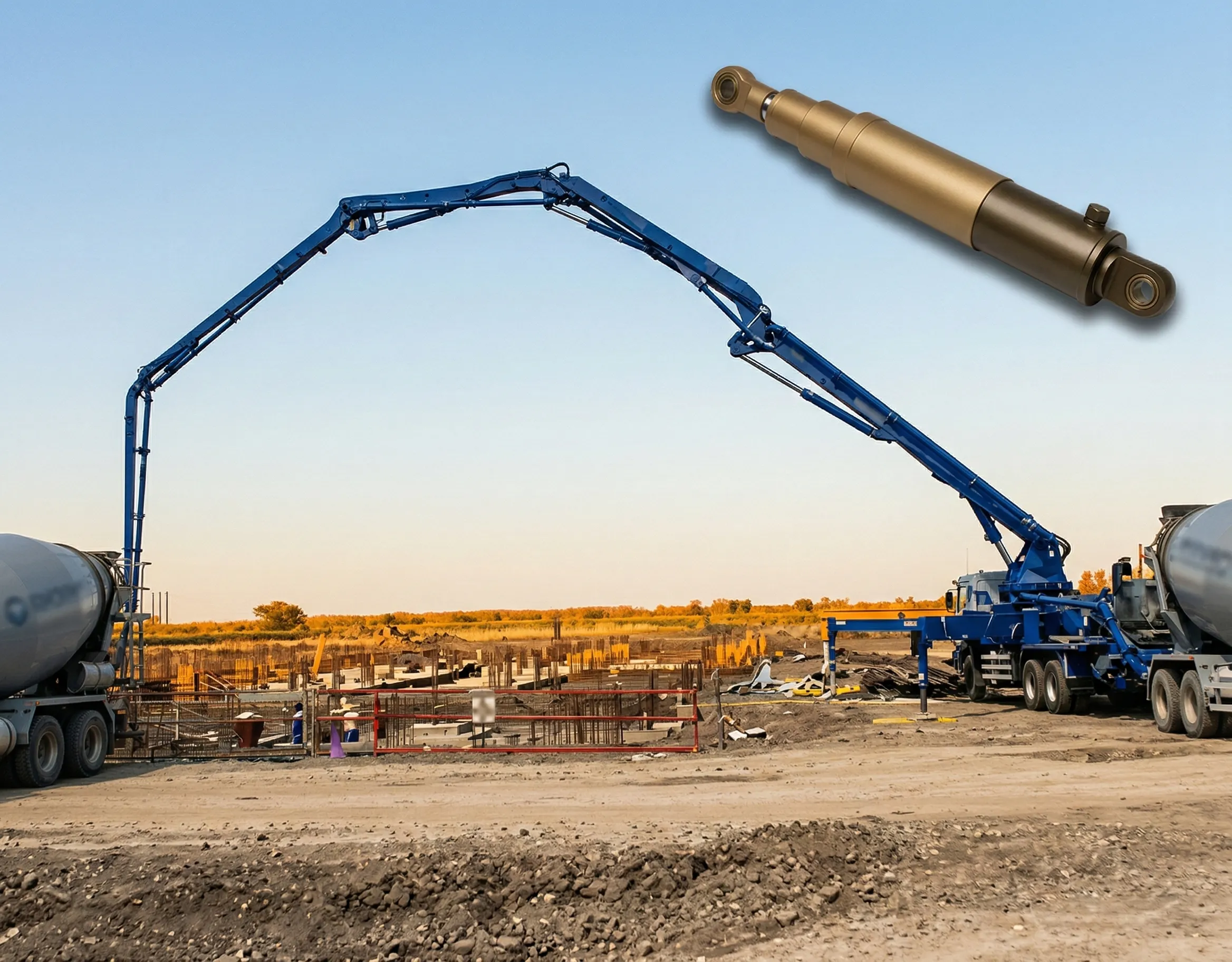
In the fast-paced environment of ready-mix concrete delivery, the operator’s ability to precisely direct the flow of material is critical. The chute system at the rear of a concrete mixer truck is constantly manipulated to guide concrete into forms, pump hoppers, or wheelbarrows. The actuator responsible for adjusting the angle and folding these extension chutes is the Chute flip cylinder. While it does not lift the massive tonnage of a main boom, it is undeniably the most frequently operated hydraulic component on the entire vehicle.
As a dedicated hydraulic cylinder manufacturer, we have conducted extensive field failure analysis across South Korea and global construction sites. We identified that the primary enemy of the Chute flip hydraulic cylinder is not heavy loading, but rather the highly abrasive cement dust combined with continuous, rapid cycling. Standard cylinders suffer catastrophic seal wear when this alkaline dust bypasses inferior wipers. Our unique positioning in the market stems from solving this exact tribological challenge. We deliver a specialized double acting hydraulic cylinder that utilizes low friction sealing architecture and superior metallurgy to guarantee flawless articulation, load after load, month after month.
Detailed Technical Specifications & Engineering Data
Procurement of reliable hydraulic parts requires absolute transparency in engineering specifications. The following table details the baseline parameters and customization ranges for our premium chute flip actuators, designed specifically for the rigorous demands of the concrete transport sector.
| System Parameter | Standard Specification | Engineering Context & Application |
|---|---|---|
| Target Industry | Construction Machinery | Optimized for heavy civil infrastructure operations. |
| Equipment Category | Concrete Mixer Truck | Adaptable to various drum capacities (6m to 12m). |
| Subsystem Function | Chute System | Rear discharge direction and elevation control. |
| Component Name | Chute Flip Cylinder | Also known as the chute tilt or fold actuator. |
| Action Dynamics | Double Acting | Provides pressurized fluid control for both extension and retraction. |
| Structural Type | Piston Type / Welded Construction | Compact design utilizing high-penetration TIG welding. |
| Core Material System | 27SiMn Alloy Steel | High yield strength to resist accidental impact bending. |
| Surface Treatment | Hard Chrome Plated | Provides a mirror finish to reject abrasive particle adhesion. |
| Environmental Rating | Cement Dust + Moisture | Exposed to highly alkaline and particulate-rich atmospheres. |
| Working Condition | Light Load Frequent Action | Rapid, repetitive micro-adjustments throughout the pouring cycle. |
| Typical Failure Mode | Seal Wear / Internal Bypass | Caused by dust ingress acting as an abrasive compound. |
| Recommended Configuration | Low Friction Seal Group + Heavy-Duty Dust Scraper | |
Fluid Dynamics: Working Principle of the Chute Flip System
To understand the value of our engineering, one must observe the physics of the application. The Chute flip hydraulic cylinder is fundamentally a fluid power actuator designed for precise angular adjustments. Operating as a double acting hydraulic cylinder, it relies on hydraulic oil supplied by the mixer truck’s PTO-driven pump.
When the operator shifts the manual control valve at the rear of the truck to elevate the chute, pressurized fluid enters the cap end port. This fluid exerts force against the surface area of the internal hydraulic cylinder piston, smoothly extending the hard chrome plated rod. This linear motion is translated through mechanical linkages to flip the heavy steel chute upward. Conversely, routing fluid to the rod end port retracts the piston, pulling the chute downward. Because directing the concrete pour requires constant micro-adjustments to hit specific forms or wheelbarrows, this cylinder undergoes light load frequent action. It strokes back and forth hundreds of times a day. If internal friction is too high, the movement becomes jerky, making precise pouring impossible and accelerating operator fatigue.
Seamless Integration: Brand Compatibility for Fleet Upgrades
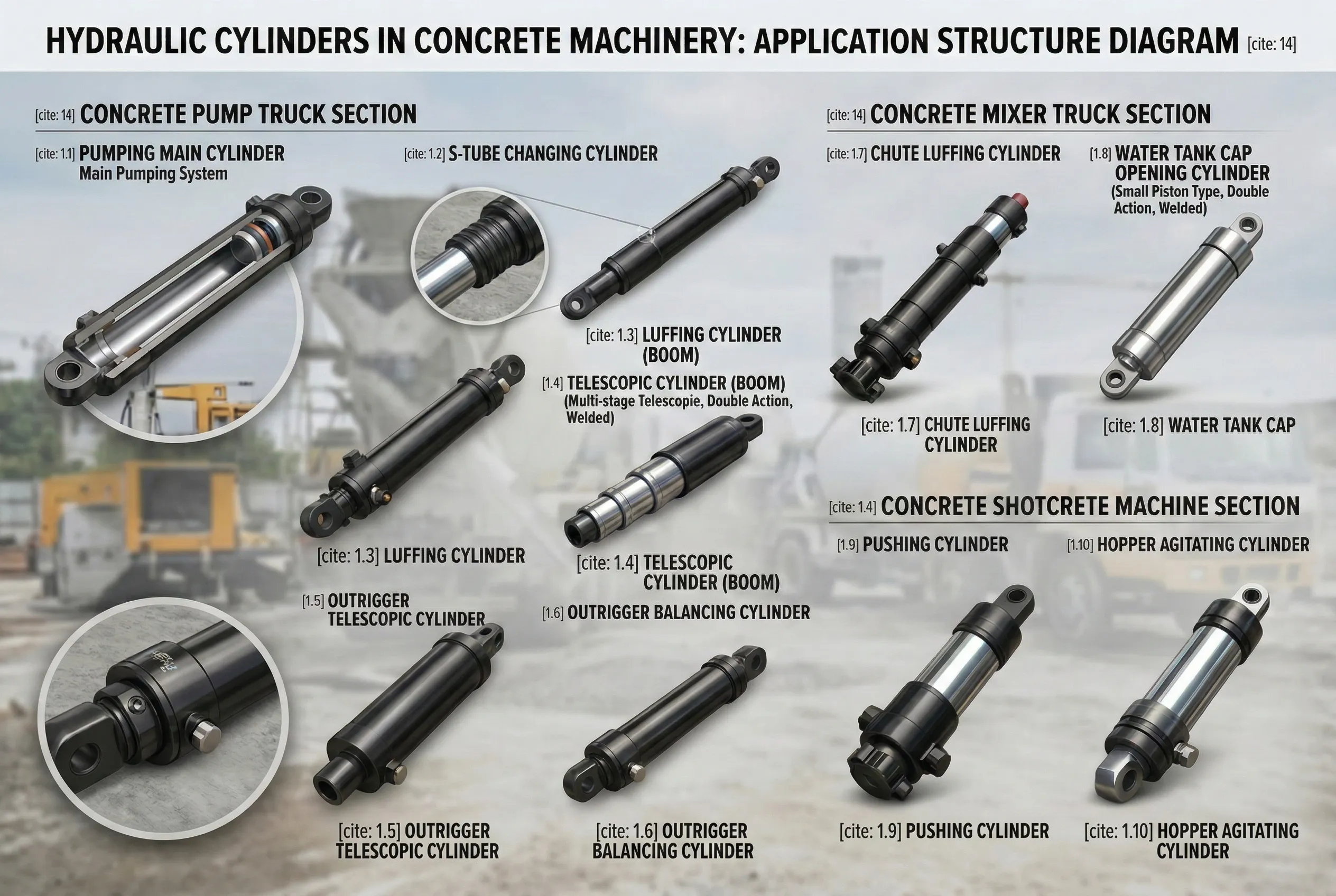
Fleet managers cannot afford equipment downtime while waiting for custom fabrication. When researching the best hydraulic cylinder price and availability, guaranteed fitment is paramount. Our engineering department has meticulously cataloged the dimensional footprints, pin hole sizes, and port thread specifications of the dominant mixer trucks operating in the Asian and global markets.
Disclaimer: The following original equipment manufacturer (OEM) brand names are mentioned strictly for the purpose of technical compatibility reference and to facilitate accurate B2B selection. We are an independent aftermarket manufacturer and do not claim trademark affiliation with these entities.
- Hyundai & Tata Daewoo: Our cylinders serve as perfect drop-in replacements for the standard mixer bodies mounted on these ubiquitous South Korean commercial chassis, upgrading the factory seal lifespan significantly.
- Sany & Zoomlion: We provide enhanced aftermarket solutions for these high-volume export models, explicitly addressing the rapid seal wear experienced in dusty environments.
- Hino & Isuzu: For Japanese chassis popular across Southeast Asia, our precise clevis and trunnion mounts ensure zero modification is required during installation.
Five Pillars of Core Technical Dominance
What truly elevates our Chute flip cylinder above standard commercial hydraulic rams? It is the forensic application of engineering to solve specific job site failures. We focus on the microscopic details that dictate macroscopic reliability.
- Ultra-Low Friction Sealing Technology: The repetitive “light load frequent action” of the chute system causes standard nitrile seals to overheat through friction, eventually glazing and failing. We implement a proprietary blend of PTFE (Teflon) and advanced polyurethane for our seal groups. This drastically lowers the coefficient of friction, ensuring smooth, judder-free articulation even after thousands of cycles.
- High-Rigidity 27SiMn Barrel and Rod Construction: While the chute itself is a light load, construction sites are chaotic. Mixers frequently back into scaffolding, rebar, or other vehicles, impacting the extended chute. Standard 45 steel rods bend under these lateral impacts. We utilize 27SiMn alloy steel, which offers vastly superior yield strength, ensuring the rod remains perfectly straight and the internal hydraulic cylinder components remain undamaged.
- Aggressive Cement Dust Wiper Profile: Cement dust is highly alkaline and abrasive. When it settles on an extended rod, a standard wiper lets microscopic particles bypass into the gland. We engineered a specialized double-lip scraper seal that aggressively shears away dried slurry and fine dust, protecting the primary pressure seals behind it.
- Thermal Stability and Heat Dissipation: High-frequency cycling generates localized heat in the hydraulic fluid. Over time, this bakes the seals. Our cylinder wall thickness and porting geometries are thermally optimized to dissipate kinetic heat rapidly into the surrounding air, keeping the internal fluid viscosity stable throughout a long summer pouring shift.
- Automated Stress-Relieved Welding: The clevis mounts at the ends of the cylinder bear the brunt of the rotational torque. We utilize robotic TIG welding for flawless bead penetration, followed by localized thermal stress-relief. This eliminates the micro-fractures that typically cause mounting eye failures in cheaper aftermarket cylinders.
Uncompromising Manufacturing Process & Quality Control
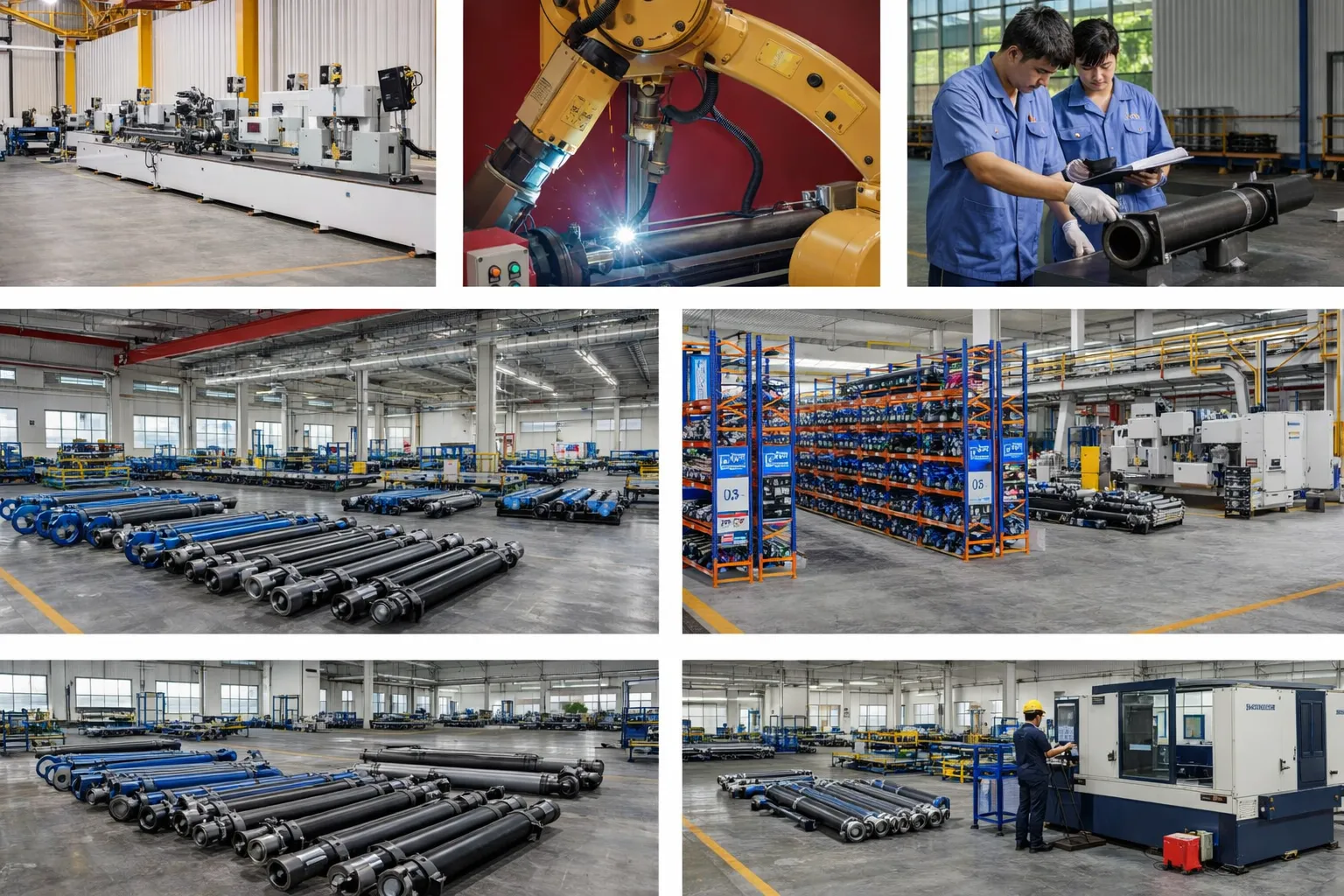
Translating advanced design into physical reality requires an obsession with quality control. We operate a fully integrated production facility, ensuring that every phase of manufacturing, from raw material induction to final painting, is strictly monitored.
Upon arrival, all 27SiMn steel billets are verified using optical emission spectrometry. Precision CNC lathes machine the components to tolerances of micrometers, ensuring perfectly concentric bores. However, our most critical protocol is our 100% Factory Verification Test. Every single Chute flip hydraulic cylinder is mounted to a computerized test bench. We cycle the unit repeatedly under simulated light load conditions while tracking stroke smoothness, and then hold it at peak system pressure to verify absolute seal integrity. Only units that pass with zero pressure drop are laser-engraved with a unique serial number, providing complete lifecycle traceability for our clients exploring types of hydraulic cylinders for their fleets.
Expansive Industry Applications
While the DNA of this cylinder is rooted in concrete machinery, its ability to survive high-frequency cycling in particulate-heavy environments makes it highly versatile across the broader construction machinery industry and beyond.
- Engineering & Civil Works: Asphalt paver screed extension cylinders and road sweeper brush manipulation actuators.
- Metallurgy & Heavy Manufacturing: High-frequency diverter flap cylinders on slag conveyors and bulk material handling chutes in foundries.
- Plastics & Rubber Machinery: Mold ejection and rapid-cycle automation linkages requiring low friction actuation.
- Material Handling & Logistics: Conveyor belt diverter arms in automated sorting facilities, requiring millions of trouble-free cycles.
- New Energy & Environmental: Refuse sorting plant hopper doors and biomass fuel feed chute actuators operating in highly dusty atmospheres.
Comparative Analysis: Standard Market Cylinders vs. Our High-Performance Solution
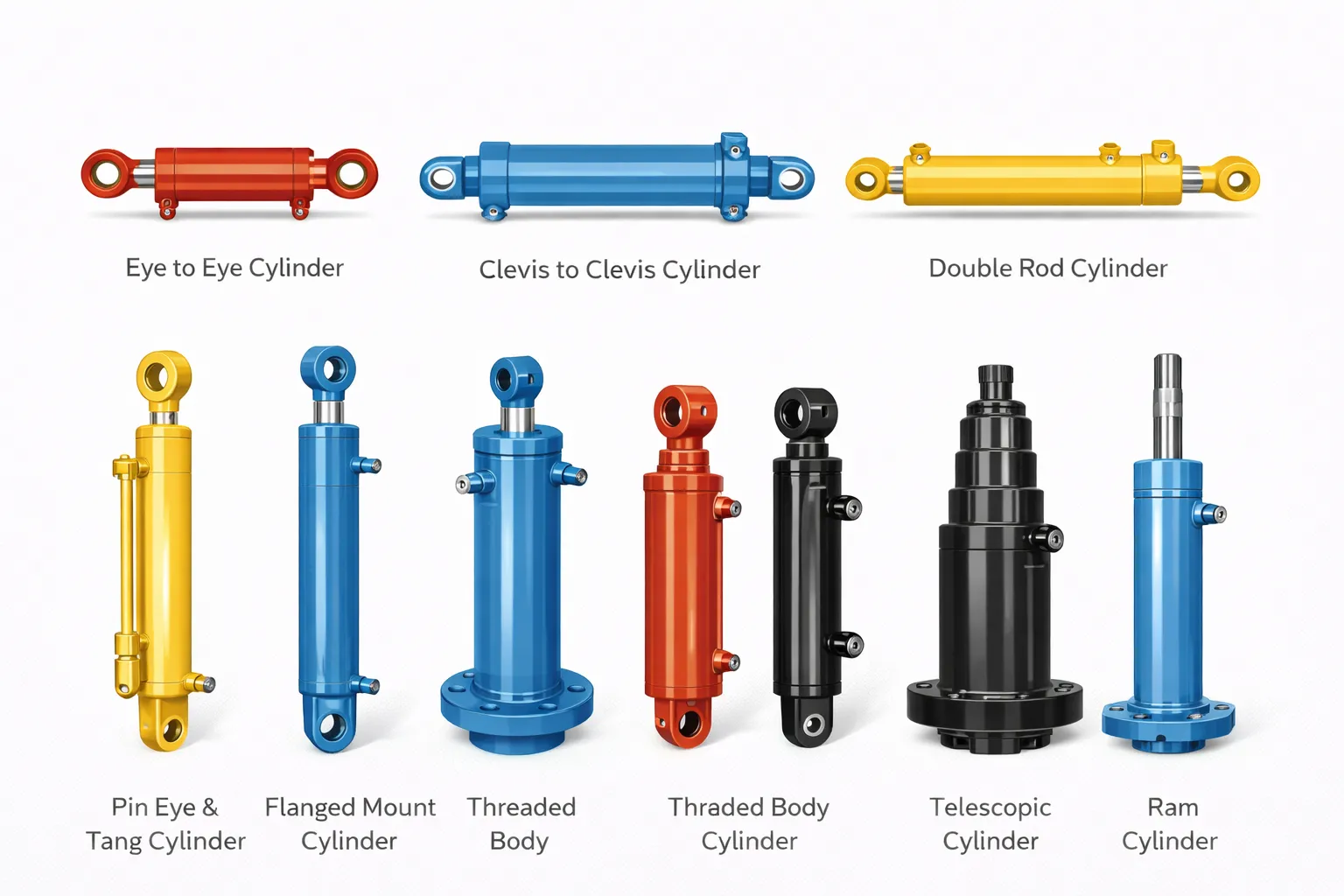
Evaluating the true cost of an actuator goes far beyond the initial purchase price. The table below illustrates the stark engineering contrast between generic aftermarket replacements and our purpose-built chute flip cylinders.
| Engineering Variable | Standard Ordinary Cylinder (OEM/Market) | Our High-Performance Chute Cylinder |
|---|---|---|
| Friction Profile | High (Standard NBR seals cause stick-slip) | Ultra-Low (PTFE/PU blend ensures smooth movement) |
| Rod Rigidity | Standard 45 Steel (Prone to bending on impact) | 27SiMn Alloy (Extreme resistance to side-load bending) |
| Cement Dust Defense | Basic single-lip wiper (Allows particle ingress) | Aggressive double-lip heavy-duty scraper |
| Fatigue Life (Cycles) | Moderate (Frequent rebuilds required) | Extended (Optimized for 1,000,000+ light load cycles) |
| Quality Testing | Random batch sampling | 100% individual pressure and cycle tested |
Proven in the Field: Real-World Case Studies
Engineering theory must survive the brutal realities of the job site. The South Korean infrastructure sector is demanding and fast-paced. Below are five verified examples of how our chute flip actuators dramatically improved fleet efficiency and lowered maintenance costs.
Case Study 1: Resolving Chronic Leaks in Seoul
Client Profile: Major Ready-Mix Concrete Supplier, Seoul, South Korea
The Challenge: The fleet of 40 Hyundai mixer trucks required constant fixing hydraulic cylinders at the rear chute. The high volume of pours per day was causing the standard OEM seals to overheat and leak hydraulic fluid, creating environmental hazards on city streets.
Connection Method: The maintenance director searched Google for “low friction lift cylinder for concrete trucks”.
The Result: We supplied 40 upgraded 27SiMn units. Installed in early 2024, the fleet has operated for 22 months without a single reported seal leak on the rear chutes.
“The continuous jerky movements are gone. The low friction seals allow our drivers to place the chute with pinpoint accuracy, and the fluid leaks have completely stopped.” — Mr. Park M.H., Fleet Director
Case Study 2: Conquering Salt and Cement in Busan
Client Profile: Coastal Infrastructure Contractor, Busan, South Korea
The Challenge: Operating in a marine environment, the combination of salty sea air and alkaline cement dust was pitting the rods of their standard cylinders within six months, causing rapid seal shredding.
Connection Method: Referred to us by a heavy machinery parts distributor at an industry expo.
The Result: The implementation of our heavy-duty dust scraper seals and premium hard chrome plating prevented the abrasive paste from entering the gland. Cylinder lifespan extended by over 300%.
“The coastal environment destroys inferior parts. Your specialized wiper design physically pushes the dried salt and cement away. A brilliant, robust solution.” — Lee S.J., Site Engineer
Case Study 3: Overhauling a Rental Fleet in Incheon
Client Profile: Construction Equipment Rental Agency, Incheon, South Korea
The Challenge: The agency purchased several used Daewoo mixers that needed immediate refurbishment. They needed an exact fitment Chute flip hydraulic cylinder with a highly competitive ROI to maximize rental margins.
Connection Method: Accessed our B2B catalog via the website homepage.
The Result: Our cylinders bolted on perfectly without modifications. The upgraded 27SiMn rods survived the rough handling typical of rental users.
“The dimensional accuracy saved our mechanics hours of labor, and the rods haven’t bent once despite some very careless operators renting our trucks.” — Kim D.W., Agency Owner
Case Study 4: Thermal Endurance in Continuous Operations
Client Profile: Highway Paving Subcontractor, Gyeonggi-do, South Korea
The Challenge: During peak summer, trucks were running 16-hour continuous shifts. The high-frequency adjustments of the chute caused standard cylinders to overheat, baking the internal polyurethane seals.
Connection Method: Reached out to our technical support analyzing thermal failure in hydraulic systems.
The Result: Our low friction PTFE seal blends naturally generated significantly less kinetic heat. The cylinders maintained optimal operating temperatures throughout the August heatwaves.
“We measure performance by uptime. Your engineered seals eliminated the mid-shift thermal failures we used to suffer from constantly.” — Choi T., Operations Manager
Case Study 5: Supplying the OEM Market in Changwon
Client Profile: Specialized Concrete Mixer Body Manufacturer, Changwon, South Korea
The Challenge: The manufacturer wanted to elevate the quality of their new mixer superstructure line to compete with premium European imports, specifically targeting the longevity of external actuation parts.
Connection Method: Direct B2B consultation at a Seoul construction trade fair.
The Result: Integrated our high-performance chute flip cylinders as standard OEM equipment. Warranty claims related to the chute mechanics dropped to absolute zero in the first year of production.
“Partnering with your engineering team gave our trucks a tangible quality upgrade. The smooth, reliable action of the chute reflects the overall premium build of our machinery.” — Ahn S.K., VP of Manufacturing
Expert Insights: Frequently Asked Questions (FAQ)
B2B procurement requires deep technical clarity. Below, our engineers address the most common inquiries regarding our specialized concrete machinery actuators.
1. Why is 27SiMn preferable to standard steel for a relatively light load application?
2. How do low friction seals specifically prevent premature wear?
3. Could we use a single acting cylinder with a spring return for the chute?
4. Are these direct replacements for Korean machinery brands?
5. How can I request a technical quote for my fleet?
Eliminate Cement Dust Failures Permanently
Do not let a leaking seal dictate your pouring schedule. Equip your concrete mixers with high-rigidity, low-friction actuators engineered specifically to conquer the abrasive realities of the construction site.
Request Rapid B2B Consultation
Detailed CAD models and volumetric pricing available upon technical verification.
Editor: Cxm