Row Spacing Adjustment Hydraulic Cylinder for Vegetable Transplanters
Precision-engineered double acting cylinder for accurate row and plant spacing control. Designed to fit major transplanter brands across Korea, Japan, and Southeast Asia.
Why Does Inconsistent Row Spacing Keep Costing You Yield?
Have you ever walked through a freshly transplanted vegetable field and noticed uneven gaps between rows? Maybe some seedlings sit too close together, competing for water and nutrients, while others are spaced so far apart that you lose productive acreage. For growers across South Korea, Japan, and Southeast Asia, this is not a minor inconvenience. It directly eats into harvest volume and profit margins season after season.
The root cause, in most cases, is not operator error or poor machine calibration. It is a worn-out or poorly matched row spacing adjustment cylinder inside the transplanter mechanism. This small but critical hydraulic cylinder is responsible for shifting the transplanting units laterally, setting the exact distance between each row. When the cylinder seal starts to weep, or when internal friction prevents smooth stroke travel, your spacing goes off by centimeters that add up to real money lost at harvest.
Our row spacing adjustment hydraulic cylinder is purpose-built for vegetable transplanters used in intensive farming operations. It is a compact, welded-body, double acting hydraulic cylinder made from carbon steel with a chrome-plated piston rod. Every dimension, seal profile, and mounting configuration is designed around the specific demands of transplanter row adjustment, not borrowed from a generic catalog. Whether you grow cabbage, lettuce, pepper, or onion seedlings, this cylinder gives you repeatable, millimeter-level spacing accuracy across thousands of planting cycles per season.
How Does a Row Spacing Adjustment Cylinder Work?
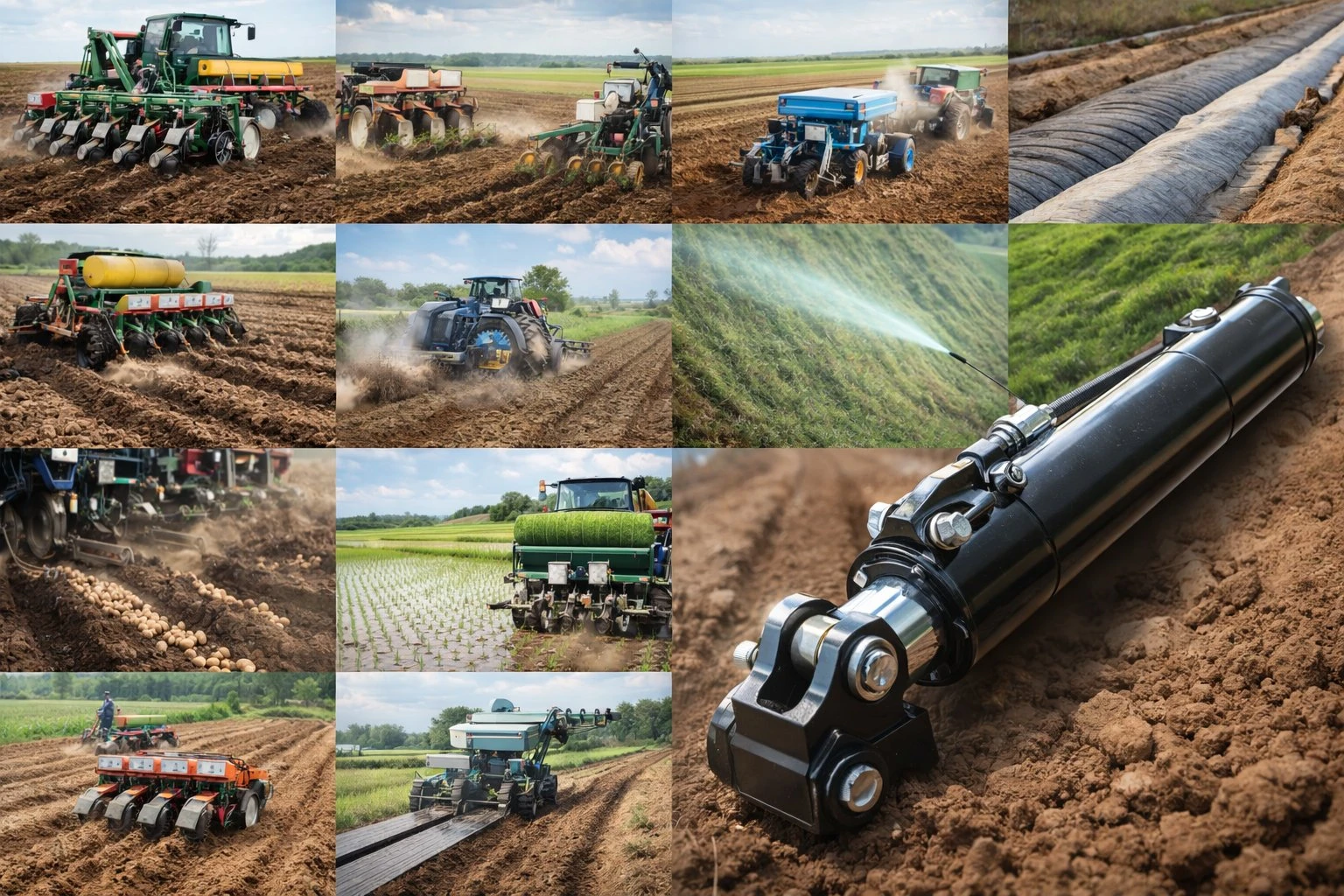
The operating principle behind this agricultural hydraulic cylinder is straightforward, but the engineering tolerances that make it reliable in the field are anything but simple. Here is what happens step by step when the operator changes the row spacing setting on a vegetable transplanter:
The transplanter frame carries multiple planting units mounted on a sliding rail or guide track. Each planting unit can move left or right along this track. The row spacing adjustment cylinder connects between the frame and the sliding assembly through clevis or pin-type mounts.
When the operator activates the spacing control, pressurized hydraulic oil enters the cylinder bore through one of two ports. Because this is a double acting design, oil pushing against one side of the piston extends the rod, while oil entering the opposite port retracts it. The piston rod movement physically pushes or pulls the transplanting units along the rail, widening or narrowing the distance between rows.
A flow control valve in the hydraulic circuit regulates speed so the units slide into position gradually, without jerking or overshooting. Once the piston reaches the target stroke length, the valve locks the oil in the cylinder, holding the planting units firmly at the selected row width. The cylinder stays pressurized during planting operations, keeping spacing locked even as the machine vibrates over rough field terrain.
The critical factors that separate a good hydraulic cylinder for vegetable transplanter use from a mediocre one are seal integrity under dust and moisture exposure, bore surface finish that minimizes friction, and dimensional consistency that ensures the same stroke length produces the same spacing every time. Our cylinders are honed to a bore finish of Ra 0.2 or better and use polyurethane piston seals rated for at least 5,000 hours of field service before replacement.
Technical Specifications
The table below shows the customizable parameter ranges for our row spacing adjustment cylinder series. Because every transplanter model has different frame geometry and spacing requirements, we manufacture each cylinder to your exact dimensions. All values can be adjusted within the listed ranges during the quotation process.
| Parameter | Specification Range |
|---|---|
| Bore Diameter | 25 mm – 63 mm |
| Rod Diameter | 12 mm – 35 mm |
| Stroke Length | 50 mm – 400 mm |
| Working Pressure | Up to 16 MPa (2,320 PSI) |
| Action Type | Double Acting |
| Structure Type | Compact Welded Body |
| Cylinder Body Material | Carbon Steel (S45C / AISI 1045) |
| Piston Rod Material | Carbon Steel, Chrome Plated (20 micron min.) |
| Surface Treatment | Hard Chrome Plating + Black Oxide / Paint on Body |
| Seal Type | Polyurethane Piston Seal + NBR Rod Seal |
| Mounting Options | Clevis, Pin Eye, Cross Tube, Foot Mount, Custom |
| Operating Temperature | -20 C to +80 C |
| Hydraulic Fluid | ISO VG 32 / VG 46 Mineral Oil |
| Environment Rating | Light-Duty / Agricultural Field Use |
| Port Thread | BSP or NPT (per customer request) |
Transplanter Compatibility Guide
One of the most frequent questions we receive from buyers in South Korea and neighboring markets is: “Can your cylinder fit my existing transplanter?” The short answer is yes. We reverse-engineer and manufacture replacement transplanter hydraulic parts that match OEM mounting dimensions, stroke lengths, and port sizes. Below is a reference table of common transplanter models and the corresponding cylinder specifications our factory can produce as direct-fit replacements.
| Transplanter Brand | Typical Model Series | Row Count | Matching Bore | Matching Stroke | Mount Type |
|---|---|---|---|---|---|
| Kukje / Branson | KVP Series | 4-6 Row | 32 mm | 150 mm | Pin Eye |
| Daedong / Kioti | DK / NX Transplanter | 4-8 Row | 40 mm | 200 mm | Clevis |
| Kubota | KP / EP Series | 4-6 Row | 32 mm | 130 mm | Cross Tube |
| Yanmar | PF / VP Series | 4-6 Row | 32 mm | 150 mm | Pin Eye |
| TYM | T-Series Attachment | 4-6 Row | 32 mm | 160 mm | Pin Eye |
| Iseki | PZ / PVR Series | 4-6 Row | 32 mm | 140 mm | Clevis |
| Ferrari (Italy) | Futura / Rotostrapp | 3-6 Row | 40 mm | 180 mm | Foot Mount |
Note: All brand and model names listed above are the property of their respective owners. They are referenced here solely to assist buyers in identifying the correct replacement cylinder specifications. No sponsorship, endorsement, or trademark affiliation is implied.
If your transplanter model is not listed above, send us a drawing or photo of the existing cylinder along with the basic dimensions, and our engineering team will confirm compatibility within 24 hours. You can request custom cylinder specifications directly through our inquiry form.
Core Technical Advantages
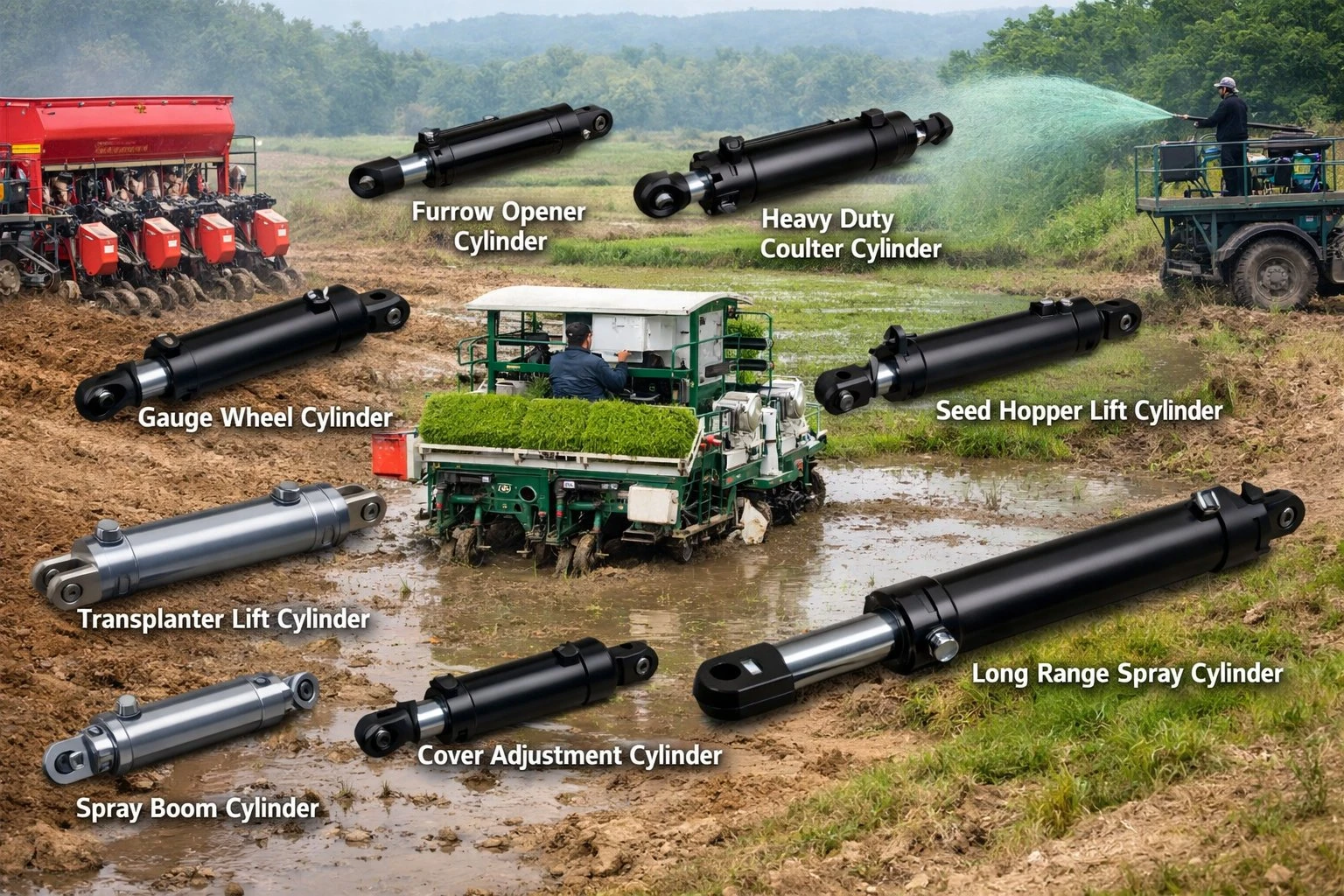
What makes this compact hydraulic cylinder for farming different from a standard off-the-shelf unit? The differences are built into every stage of design and production. Here are the six areas where our row spacing cylinders outperform generic alternatives.
Ultra-Low Friction Seal System
Row spacing adjustments happen frequently throughout a planting day, often dozens of times per field as the operator adapts to changing bed widths or crop types. Every stroke cycle puts wear on the piston and rod seals. Our cylinders use a custom polyurethane piston seal combined with an NBR rod seal, selected specifically for low sliding friction and long wear life in light-duty, high-cycle environments. This seal combination reduces breakaway pressure by up to 30% compared to standard nitrile seals, which means smoother and more precise rod extension with less hydraulic pressure wasted on overcoming internal friction. Less friction also means less heat generation inside the cylinder, extending seal service life well past 5,000 operating hours.
Precision-Honed Bore Finish
The bore of this small bore hydraulic cylinder is honed to a surface roughness of Ra 0.2 micrometers or finer. This mirror-like finish serves two purposes. First, it minimizes friction between the piston seal and the bore wall, which directly affects stroke smoothness and spacing repeatability. Second, it reduces micro-leakage paths that form when a rough bore surface creates tiny gaps under the seal lip. The result is consistent holding force with virtually zero internal oil seepage, even after years of seasonal use.
Chrome-Plated Piston Rod for Corrosion Resistance
Agricultural fields expose hydraulic components to moisture, soil particles, crop residue, and sometimes liquid fertilizer splashes. Our piston rod receives a hard chrome plating layer of at least 20 micrometers, which provides excellent scratch resistance and corrosion protection. Unlike paint or powder coatings that chip under mechanical contact, hard chrome bonds metallurgically to the steel surface and maintains its protective qualities through thousands of extension and retraction cycles. For environments where fertilizer chemicals are present, we also offer an optional nickel-chrome duplex plating for added chemical resistance.
Welded Construction for Compact Envelope
Space inside a transplanter frame is tight. Tie-rod cylinder designs with protruding bolts and external tubes simply do not fit into the narrow gaps between planting units. Our welded hydraulic cylinder for agriculture uses a one-piece welded body that eliminates external tie rods entirely. The result is a cylinder with a significantly smaller outer envelope, making it easy to install in confined frame sections without interfering with adjacent mechanical components. Welded construction also increases structural rigidity, reducing barrel flex under pressure and improving stroke accuracy.
Thermal Stability Across Seasonal Temperatures
Planting seasons in Korea and Japan can start in early spring when morning temperatures still drop below freezing, and continue into summer when midday heat exceeds 35 degrees Celsius. Our cylinders are rated for an operating range of -20 C to +80 C. The seals maintain their elasticity and sealing force throughout this range without hardening in cold weather or softening in heat. We test every seal batch at both temperature extremes before approving it for production, because a seal that works fine at 25 C but leaks at -5 C is useless in a real farming calendar.
Precision Port Machining for Leak-Free Connections
A common failure point on agricultural cylinders is the hydraulic port connection. Poorly machined port threads lead to slow drips at the fitting that get worse with vibration over a planting season. We CNC-machine every port thread to BSP or NPT standard with tight tolerances, and chamfer the port entry to prevent O-ring damage during hose assembly. The port bosses are reinforced with additional weld material to handle side loads from hose routing without cracking. These details may seem small, but they are the difference between a cylinder that stays dry for five seasons and one that starts weeping after one.
Where This Cylinder Gets Put to Work
While vegetable transplanters are the primary application for this row spacing adjustment hydraulic cylinder, the same design principles apply across a range of hydraulic cylinders for agricultural machinery. Here are the most common scenarios where our customers install these cylinders:
Vegetable Transplanting Machines
This is the core use case. Multi-row vegetable transplanters use row spacing cylinders to adjust the lateral position of each planting unit. Crops like cabbage, lettuce, broccoli, pepper, tomato, and onion seedlings all require different row widths, sometimes even within the same field if beds vary. The cylinder allows the operator to switch spacing settings in minutes rather than spending an hour manually loosening bolts and sliding units by hand.
Seedling Nursery and Plug Tray Handling Equipment
In automated seedling nurseries, tray spacing on conveyor lines needs to be adjustable for different plug tray sizes (128-cell, 200-cell, 288-cell). Small hydraulic cylinder for planting equipment units control the guide rail width on these conveyor systems, ensuring trays feed through watering, fertilizing, and grading stations without jamming.
Precision Seeding Machines
Pneumatic or mechanical precision seeders for crops such as corn, soybean, and sunflower also use row spacing adjustment mechanisms. Our hydraulic cylinder for seeding machine applications delivers the same accuracy, and the compact welded body fits seeder frames just as well as transplanter frames.
Fertilizer Applicator Width Adjustment
Granular and liquid fertilizer applicators with adjustable boom widths or nozzle spacing use similar cylinders to change the spread pattern. The cylinder pushes nozzle brackets along a rail to match the row layout of the crop being treated. This prevents fertilizer from landing between rows where it does nothing and wastes product.
Greenhouse Rail and Track Positioning
Inside greenhouses, movable growing tables and rail-mounted watering booms use compact cylinders for lateral positioning. The low-pressure, short-stroke characteristics of our row spacing cylinder make it a natural fit for these indoor applications where space is extremely limited and noise from hydraulic operation needs to be kept low.
Manufacturing Process and Quality Control
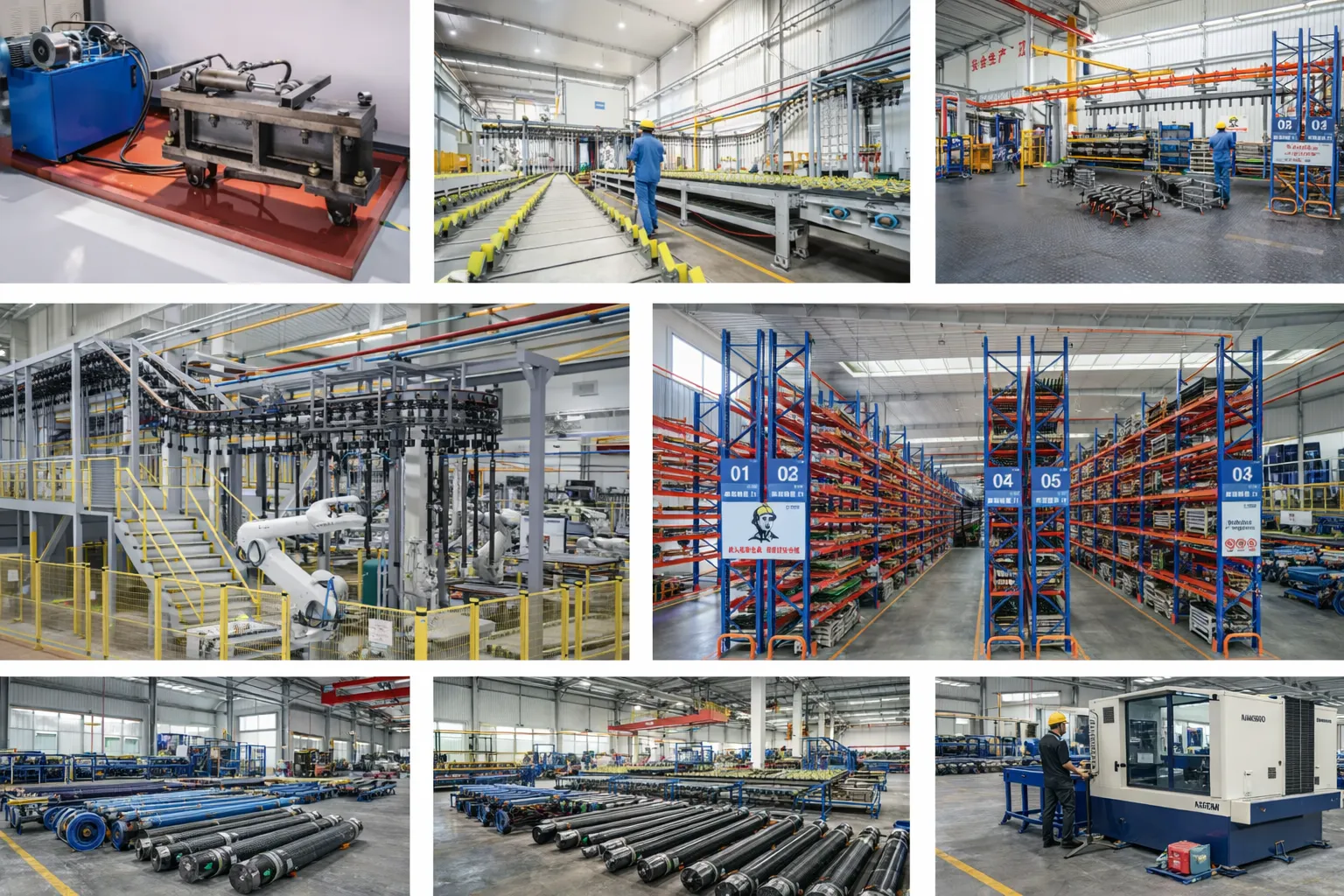
Every cylinder we ship starts and finishes inside our own factory. There is no outsourced assembly, no third-party welding, and no mystery about where any component comes from. Here is how we build these cylinders from raw steel to boxed product.
In-House Material Sourcing and Cutting
We purchase certified carbon steel tube and bar stock directly from approved steel mills. Each batch arrives with a mill certificate verifying chemical composition and mechanical properties. Incoming material is inspected with a portable spectrometer before it enters our cutting area. Tubes are cut to length on CNC saws with a length tolerance of plus or minus 0.5 mm.
CNC Machining, Boring, and Honing
Cylinder tubes are bored on CNC lathes and then honed on dedicated honing machines to achieve the target Ra 0.2 surface finish. Piston rods are turned, ground, and polished before the chrome plating process. End caps, pistons, and gland components are CNC machined from solid bar stock to tight dimensional tolerances, ensuring consistent fit across every production batch.
Welding and Assembly
Barrel-to-end-cap welds are performed by certified welders using MIG or CO2 shielded arc welding. Weld penetration is checked visually and by magnetic particle inspection on a sampling basis. After welding, cylinders go through a stress-relief process if needed, then move to the assembly line where seals, pistons, and rods are installed in a clean environment to prevent contamination.
100% Factory Testing
Every finished cylinder undergoes a pressure test at 1.5 times rated working pressure for a minimum of two minutes. We check for external leaks at all ports and weld joints, and verify that rod extension and retraction are smooth across the full stroke. Cylinders that pass testing receive a unique serial number that links to the production batch, material certificates, test results, and operator records. This traceability system is maintained digitally for at least ten years.
Certifications
Our facility holds ISO 9001 quality management certification. We can also manufacture to CE marking requirements for customers selling equipment into EU markets. If your project requires specific third-party certification or documentation such as material test reports or pressure test certificates, we include these as standard at no extra charge.
Standard Agricultural Cylinder vs. Our Row Spacing Adjustment Cylinder
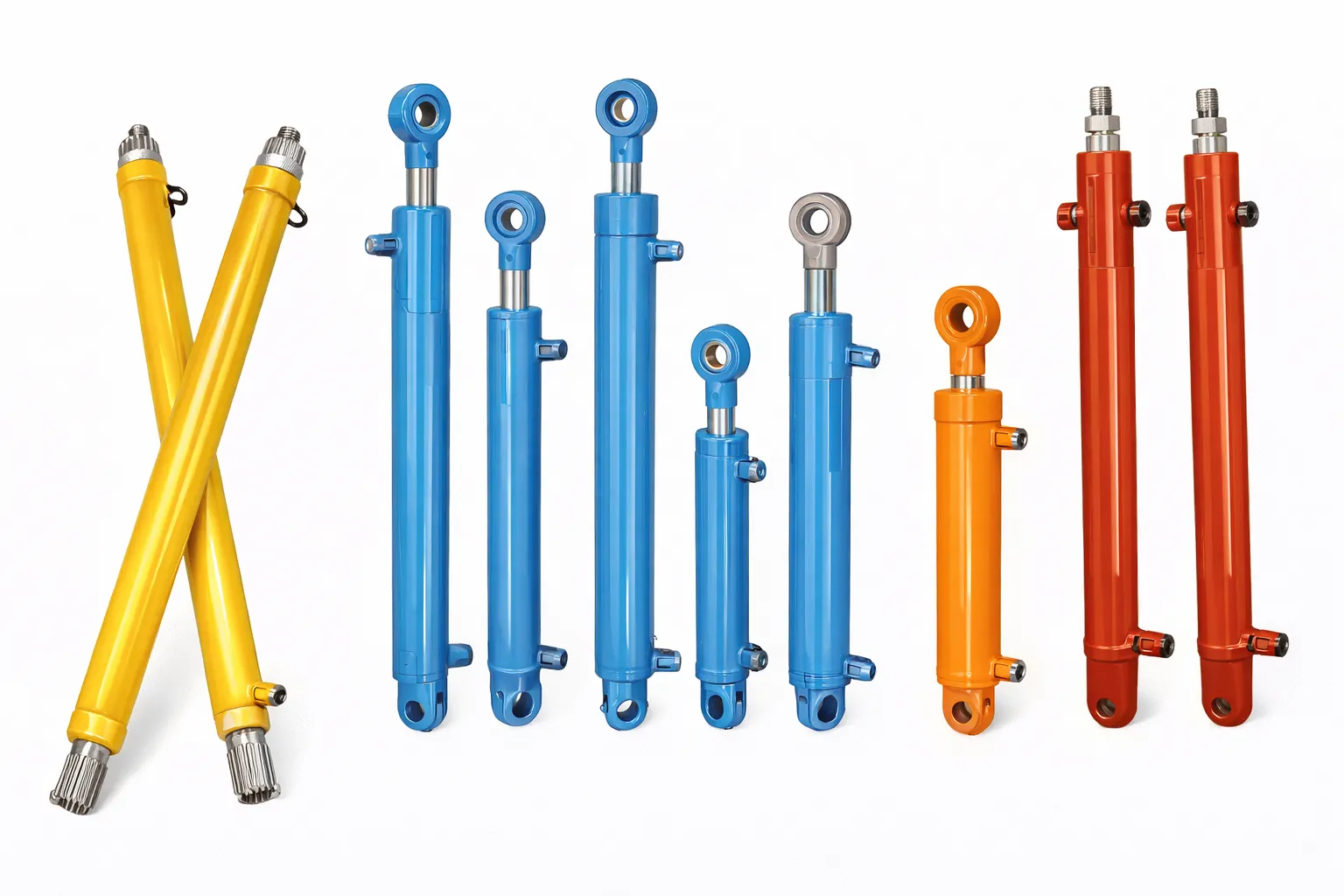
How does our purpose-built cylinder stack up against a generic agricultural hydraulic cylinder pulled from a standard catalog? The table below breaks it down by the metrics that actually matter in transplanter field operations.
| Performance Metric | Standard Ag Cylinder | Our Row Spacing Cylinder |
|---|---|---|
| Seal Life Under Mud/Dust Exposure | 1,500 – 2,500 hrs | 5,000+ hrs |
| Stroke Accuracy for Row Spacing | +/- 3 mm | +/- 0.5 mm |
| Corrosion Resistance (Fertilizer Contact) | Painted Surface, 200 hrs Salt Spray | Chrome + Oxide, 500 hrs Salt Spray |
| Maintenance Interval (Field Conditions) | Every 500 hrs or 1 season | Every 2,000 hrs or 3-4 seasons |
| Operating Temperature Range | -10 C to +60 C | -20 C to +80 C |
| Body Width (Compact for Narrow Frames) | Tie-rod design, +15 mm wider | Welded body, minimal envelope |
| Chrome Plating Thickness (Piston Rod) | 10 – 15 micron | 20+ micron (duplex option available) |
| Bore Surface Finish | Ra 0.4 – 0.8 | Ra 0.2 or finer |
Real-World Case Studies
Specifications on a data sheet only tell half the story. Here is what happened when actual farming operations switched to our row spacing adjustment cylinders.
Case 1 – Chungnam Province, South Korea
Customer: Nonghyup-affiliated vegetable farming cooperative (120+ member farms)
Equipment: Fleet of 18 Daedong-based 6-row cabbage transplanters
How They Found Us: The cooperative’s equipment manager searched for “transplanter hydraulic cylinder replacement Korea” on Google in October 2024 and contacted us through our website form.
Results: After replacing OEM cylinders across all 18 machines before the March 2025 spring planting season, the cooperative reported a 70% drop in mid-season cylinder leak incidents and an average row spacing deviation reduction from 4 mm to under 1 mm. Annual maintenance costs for the row adjustment system fell by approximately 40%.
“We used to keep spare cylinders on the truck because at least two or three machines would start dripping every week during the busy season. After switching, we went through all of spring and fall planting with zero cylinder replacements. That has never happened in the fifteen years I have been managing equipment for this co-op.” – Mr. Park, Equipment Manager
Case 2 – Gyeongbuk Province, South Korea
Customer: Regional agricultural equipment dealership selling and servicing Korean and Japanese transplanters
Equipment: Replacement parts inventory for Kukje and Kubota transplanter models
How They Found Us: Referred by another dealer in Jeonnam Province who had been ordering from us since 2023. First trial order placed in January 2025.
Results: The dealer tested five sample cylinders on customer machines during the 2025 season. All five performed without any leakage through the entire planting campaign. The dealer now carries our cylinders as their standard replacement part and has re-ordered three times at increasing volumes.
“Price was a little lower than OEM, but honestly the quality surprised me. The chrome finish on the rods looked better than what we get from the original brand. My technician said the seals were smoother during installation, too. We have made this our go-to replacement line.” – Mr. Kim, Dealership Owner
Case 3 – Niigata Prefecture, Japan
Customer: Mid-size OEM manufacturer producing vegetable transplanters for the domestic Japanese market
Equipment: New-build 4-row and 6-row transplanters for lettuce and cabbage
How They Found Us: Met our sales representative at the AGRITECHNICA Asia trade show in Bangkok in June 2024. Requested sample evaluation in August 2024.
Results: After a six-month bench test and a full-season field trial, the OEM approved our cylinder for series production. They cited stroke consistency and bore finish quality as the deciding factors. Current order volume is around 200 units per quarter.
“We tested stroke repeatability over 10,000 cycles on our bench and measured less than 0.3 mm drift. That exceeded our internal specification. The transition from our previous supplier was very smooth.” – Engineering Department, via email correspondence, February 2025
Case 4 – Chiang Mai Province, Thailand
Customer: Large-scale vegetable farming operation with 600+ rai (96 hectares) under cultivation
Equipment: Imported Italian transplanters adapted for Thai field conditions
How They Found Us: The farm’s maintenance engineer found us through a Google search for “small bore hydraulic cylinder for transplanter” in September 2024 and contacted us via WhatsApp.
Results: The original Italian cylinders suffered from accelerated corrosion due to Thailand’s high humidity and frequent fertilizer exposure. Our chrome-plated replacement cylinders have been running since November 2024 with no visible corrosion or leakage. The farm estimates annual savings of around 35% on hydraulic parts replacement costs.
“The original European cylinders were not designed for tropical conditions. Within one rainy season, the rods started pitting. Your cylinders have gone through an entire wet season with no rust at all. Very happy with the result.” – Mr. Somchai, Maintenance Supervisor
Case 5 – Punjab Region, Pakistan
Customer: Agricultural machinery import and distribution company supplying transplanters to local farms
Equipment: Chinese-manufactured transplanters requiring aftermarket cylinder upgrades
How They Found Us: Discovered our website after browsing hydraulic cylinders for sale online in May 2024. Placed a trial order of 30 units in July 2024.
Results: The upgraded cylinders eliminated the chronic leaking problems present in the original equipment. The distributor’s end customers reported noticeably smoother row spacing adjustments. Repeat orders have followed every quarter since the initial shipment.
“Our customers used to complain about oil spots under their machines after every field session. After we switched to these cylinders, the complaints stopped completely. That is the best kind of feedback for a parts distributor.” – Mr. Hassan, Procurement Director
Seasonal Maintenance Tips for Agricultural Hydraulic Cylinders
A well-built cylinder still benefits from basic seasonal care. Follow these guidelines to get the maximum service life from your row spacing adjustment cylinders between planting campaigns.
Pre-Season Inspection (Late Winter / Early Spring)
Before the first planting run of the year, fully extend and retract each cylinder several times at low pressure. Watch for any oil weeping at the rod seal or port fittings. Check the piston rod surface for scratches, dents, or rust spots that may have developed during winter storage. If the chrome surface shows damage, address it before the rod wears through the seal lip and causes a bigger leak mid-season.
Mid-Season Care (During Active Planting)
Keep the cylinder body and exposed rod surface clean. A quick wipe-down with a rag after each field session removes soil, fertilizer residue, and moisture that can accelerate corrosion or drag abrasive particles past the rod seal. Check hydraulic hose connections weekly for tightness, and top off the hydraulic reservoir to the correct level.
Post-Season Storage (Autumn / Winter)
When the planting season ends, retract the cylinder rod fully to protect the chrome surface from exposure to air and moisture during storage. Apply a thin film of anti-rust oil or hydraulic fluid to any exposed metal surfaces. Store the machine indoors or under cover if possible. If outdoor storage is unavoidable, wrap the cylinder rod end with a plastic cover to keep rain and condensation from sitting on the seal area.
Hydraulic Fluid Replacement
Replace the hydraulic oil in the transplanter system at least once every two seasons, or annually if operating in particularly dusty or humid environments. Old oil loses its anti-wear additives and accumulates fine particles that gradually score the bore surface and degrade seal performance. Use ISO VG 32 or VG 46 mineral-based oil as specified for your machine.
Frequently Asked Questions
What size hydraulic cylinder do I need for a vegetable transplanter?
How does a row spacing adjustment cylinder work on a transplanter?
Can I replace my OEM transplanter cylinder with a custom one?
What is the lead time for custom agricultural hydraulic cylinders?
How do I prevent hydraulic cylinder leaks in dusty farm conditions?
What maintenance does a row spacing cylinder need between planting seasons?
Do you ship hydraulic cylinders to South Korea and Southeast Asia?
Ready to Solve Your Row Spacing Problems for Good?
Send us your transplanter model, cylinder dimensions, or a photo of the existing part. Our engineers will confirm compatibility and deliver a detailed quotation within 48 hours, with no obligation.
Editor: Cxm