Deflector Swing Cylinder for Forage Chopper Discharge Chutes
Carbon steel welded cylinder with vibration-compatible seals. Controls discharge direction smoothly and holds chute angle accurately under continuous chopping vibration.
Where Is the Forage Actually Landing? And Is It Going Where You Aimed It?
The discharge deflector on a forage chopper directs the stream of chopped material, whether silage corn, grass, or whole-crop cereal, into the transport wagon following alongside. The operator adjusts the deflector angle to aim the discharge stream as the wagon fills, sweeping from front to back and side to side to distribute material evenly. If the deflector angle drifts between adjustments, the chopped material piles up on one side of the wagon while the other side stays empty. On a silage corn harvest running at 40 to 60 tons per hour, even a small deflector drift wastes loader time re-distributing material and slows the entire harvest chain.
The hydraulic cylinder controlling the deflector swing sits on the discharge spout of the chopper, where it is subjected to continuous vibration from the blade drum, material flow turbulence, and engine-transmitted frame vibration. The cylinder makes periodic full-stroke adjustments to redirect the discharge stream, then holds the deflector at the set angle until the next adjustment. The holding period may last 30 seconds to several minutes, during which the constant vibration works against the piston seal, causing gradual internal leakage that allows the deflector to drift off its aimed position.
Our deflector swing cylinder is a compact, double acting hydraulic cylinder built from carbon steel with a chrome-plated piston rod, vibration-compatible seals that resist the thermal aging and compression set caused by continuous vibration loading, and a PU dust wiper that handles the chopped material dust and moisture that coats every surface near the discharge chute. The bore is honed to Ra 0.2 for consistent seal performance and minimal internal bypass during holding periods.
Seal Aging Under Continuous Vibration: The Hidden Cause of Deflector Drift
Standard rubber and polyurethane seals degrade faster under vibration than under static loading, even if the vibration amplitude is too small to cause visible piston movement. This degradation happens through a mechanism that is often overlooked: vibration-induced heat generation at the seal-bore interface.
When the cylinder body vibrates, the seal lip oscillates against the bore surface at the vibration frequency. Even micro-amplitude oscillation of 0.01 to 0.05 mm generates friction heat at the contact zone. This heat does not dissipate quickly because the seal material is a thermal insulator. Over hours of continuous chopping, the temperature at the seal-bore interface rises 15 to 25 degrees above ambient, accelerating the thermal aging of the seal compound. The seal gradually loses its elastic recovery, developing compression set where the lip no longer springs back to full contact pressure when the load reverses. The result is progressive internal leakage that manifests as deflector angle drift.
Our countermeasures target this aging mechanism directly:
Heat-Resistant Seal Compound
The piston seal uses a PU formulation with a heat deflection temperature 15 C higher than standard agricultural PU. This keeps the seal material well below its softening threshold even at the elevated contact-zone temperatures produced by continuous vibration during all-day chopping operations.
Low Compression Set Rating
Seal compound selected for less than 18% compression set after 1,000 hours at 70 C. Standard agricultural PU typically shows 30 to 40% compression set under the same conditions. Lower compression set means the seal lip maintains its contact pressure longer, delaying the onset of internal leakage that causes deflector drift.
Ra 0.2 Bore for Reduced Friction Heat
Smoother bore surface reduces the coefficient of friction between the seal lip and bore wall, directly lowering the heat generated by vibration-induced micro-oscillation. Less heat means slower aging, which extends the time before compression set begins affecting holding performance.
PTFE Back-up Ring
Prevents seal extrusion during the pressure spikes that occur when the deflector catches a sudden gust of material stream. PTFE back-up maintains the seal in its groove even during transient overloads, preventing the irreversible deformation that accelerates aging.
How the Deflector Swing Cylinder Controls Discharge Direction
The deflector plate or flap sits at the top of the discharge spout. It pivots on a hinge and is connected to the swing cylinder through a short linkage arm. Extending the cylinder rod pushes the deflector to one side, directing the chopped material stream toward the front of the wagon. Retracting the rod swings the deflector the opposite way, aiming the stream toward the rear. Intermediate positions distribute material across the wagon width.
The operator typically makes 10 to 20 deflector adjustments per wagon load, with each wagon filling in 3 to 8 minutes depending on the chopping rate. Between adjustments, the cylinder holds the deflector at the selected angle while absorbing continuous vibration from the chopper drum (typically operating at 800 to 1,200 rpm) and periodic material stream impacts against the deflector plate.
The cylinder must respond quickly to operator commands for direction changes but also hold position firmly during the intervals between adjustments. This combination of quick response and stable holding requires a seal with low breakaway pressure for fast starts and very low internal leakage for drift-free holding. The continuous vibration environment makes achieving both requirements simultaneously much harder than in a static application, which is why seal quality is the critical success factor for deflector swing cylinders.
Technical Specifications
| Specification | Available Range |
|---|---|
| Bore Diameter | 32 mm – 63 mm |
| Rod Diameter | 18 mm – 36 mm |
| Stroke Length | 60 mm – 300 mm |
| Working Pressure | Up to 16 MPa (2,320 PSI) |
| Action Type | Double Acting |
| Structure | Small Welded Piston Cylinder |
| Body Material | Carbon Steel (S45C / AISI 1045) |
| Piston Rod | Carbon Steel, Hard Chrome 20+ micron |
| Body Finish | Black Oxide + Epoxy Paint |
| Piston Seal | Heat-Resistant PU + PTFE Back-up Ring |
| Rod Seal | NBR + PTFE Back-up |
| Dust Seal | PU Wiper Ring |
| Mounting | Clevis, Pin Eye, Lug, Custom |
| Port Thread | BSP / NPT / Metric |
| Operating Temperature | -20 C to +80 C |
| Environment Rating | Medium Load / Continuous Vibration / Forage Dust |
Five Design Advantages for Vibration-Loaded Deflector Service
Heat-Resistant, Low-Compression-Set Piston Seal
PU compound with less than 18% compression set at 70 C / 1,000 hours and a heat deflection temperature 15 C above standard. Resists the thermal aging caused by vibration-induced friction heat, maintaining holding pressure for 3 to 4 times longer than standard seals in continuous chopping vibration environments.
Ra 0.2 Bore Finish
Smoother bore surface reduces friction heat generation during micro-oscillation, slowing the thermal aging that causes compression set. Also improves breakaway characteristics for quick deflector response to operator commands.
PU Dust Wiper for Forage Material Debris
The discharge chute area is coated in a continuous mist of chopped plant material, juice, and fine dust. The PU wiper prevents this material from reaching the primary rod seal, extending rod seal life from 1 to 2 seasons (unprotected) to 3 to 4 seasons.
Compact Welded Body
The discharge spout has limited mounting space for hydraulic components. Our welded body without tie rods achieves the smallest diameter for any given bore, fitting within the tight clearance around the deflector hinge mechanism.
Vibration-Resistant Port Connections
CNC-threaded ports with reinforced bosses and chamfered entry for O-ring protection. Resists the gradual loosening that continuous blade drum vibration causes on standard tapered pipe fittings.
Application Scenarios
Forage Chopper Discharge Deflectors: The primary application. Self-propelled and trailed forage choppers use deflector swing cylinders to direct the chopped material stream into transport wagons. Accurate angle holding under vibration is critical for even wagon loading.
Grain Combine Discharge Spout Direction: Modern grain combines with powered grain spout swivel use similar small cylinders. The vibration and dust environment from threshing and cleaning operations is comparable to forage choppers.
Manure Spreader Deflector Plates: Rear-discharge manure spreaders use deflector plates to control spread width and direction. The continuous vibration from the spreading mechanism and the corrosive manure environment make our vibration-compatible seals and dust wiper valuable features for this application. These are common double acting hydraulic cylinder uses across livestock farm equipment.
Wood Chipper Discharge Chute Control: Forestry and landscape wood chippers use similar deflector mechanisms to direct chip output. The vibration from chipping and the wood dust environment match forage chopper conditions closely.
TMR Mixer Discharge Door Position: Total mixed ration mixer wagons use small cylinders to control discharge door opening angle. Vibration from the mixing auger and feed dust create similar conditions to forage chopper operation.
Manufacturing and Quality Control
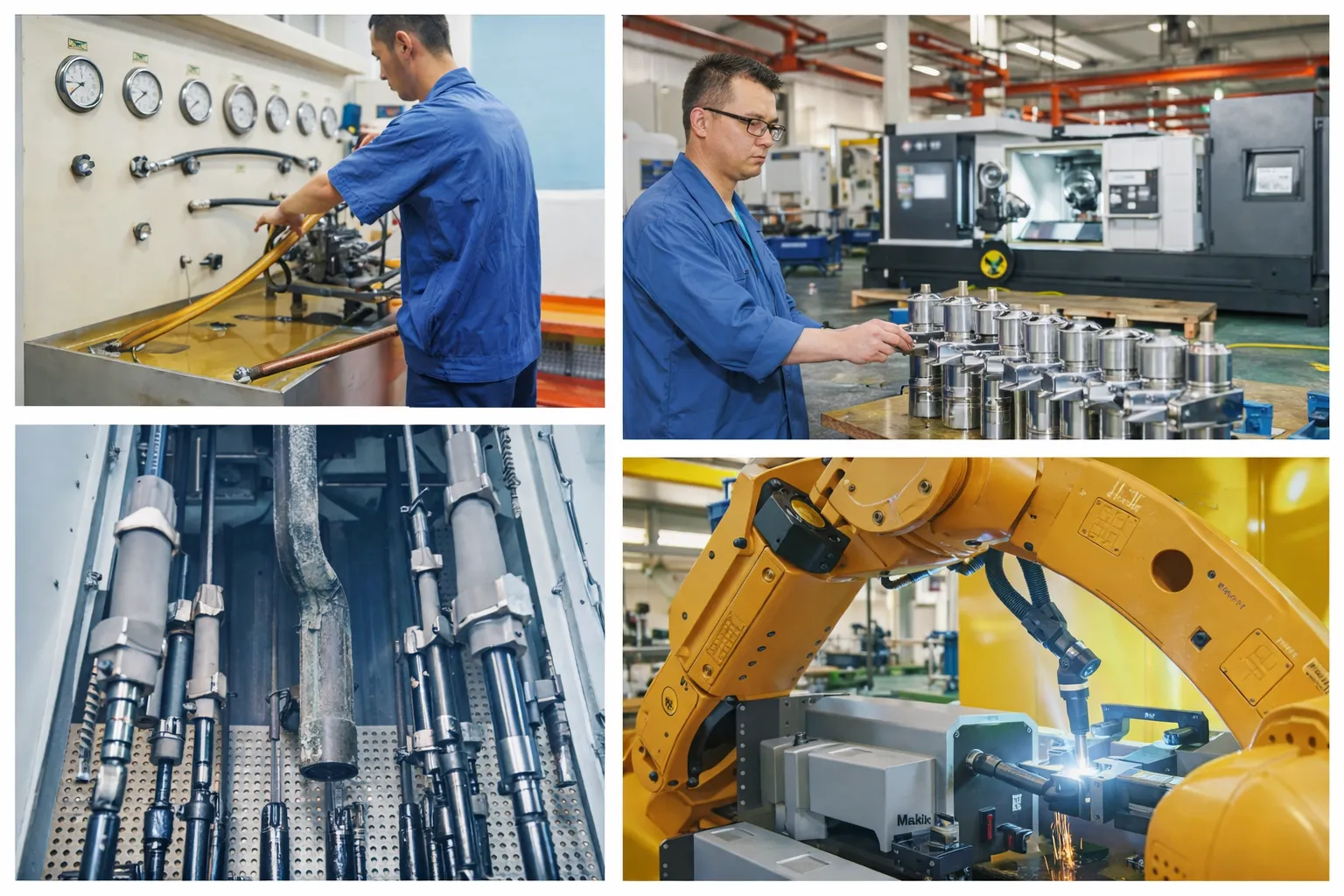
Built in our ISO 9001 certified facility. Carbon steel tube and rod verified by spectrometer. Bores honed to Ra 0.2. Rods ground to h7 and chrome plated to 20+ micron. MIG welded by certified operators. Seals from single manufacturing lots per order. 100% pressure tested at 1.5x rated pressure for three minutes with internal leakage measurement. Serial numbered with ten-year traceability. Material and test certificates included as standard.
Standard Small Cylinder vs. Our Deflector Swing Cylinder
| Deflector-Relevant Metric | Standard Cylinder | Our Deflector Cylinder |
|---|---|---|
| Seal Compression Set (1,000 hr / 70 C) | 30 – 40% | Below 18% |
| Deflector Angle Drift (5 min vibration hold) | 2 – 5 degrees | Below 0.5 degrees |
| Bore Finish | Ra 0.4 – 0.8 | Ra 0.2 |
| Dust Protection | None | Integrated PU wiper |
| Seal Service Life (continuous vibration) | 1 – 2 seasons | 3 – 5 seasons |
Customer Case Studies
Pocheon City, Gyeonggi-do, South Korea
Customer: Forage equipment OEM building self-propelled and trailed choppers for Korean dairy farms
How They Found Us: Engineering team contacted us after deflector drift complaints from customers. Inquiry February 2025.
Results: OEM bench testing showed deflector angle hold improved from 3.2 degrees drift to 0.4 degrees over a 5-minute vibration test. Warranty claims for deflector drift dropped to zero on 2025 model year machines. Current order is 150 units per quarter.
“Deflector drift complaints stopped completely after we switched the swing cylinder. The heat-resistant seal was the key improvement our previous supplier could not match.” – Mr. Ahn, Engineering Manager, September 2025
Wonju City, Gangwon-do, South Korea
Customer: Dairy cooperative running 15 forage choppers during corn silage season
How They Found Us: Referral from their chopper OEM. Order placed April 2025.
Results: Operators reported consistently better wagon loading uniformity. Loader time redistributing unevenly piled wagons dropped by approximately 40%. Deflector cylinders completed the full 2025 silage season without seal replacement.
“Our drivers used to curse the deflector because it never stayed where they pointed it. Now they set it and it stays. Wagon loading takes less time and the loader is not constantly fixing uneven piles.” – Mr. Yoo, Fleet Supervisor, October 2025
Nasu District, Tochigi Prefecture, Japan
Customer: Dairy equipment dealer servicing large-scale dairy farms in the Kanto region
How They Found Us: Found our hydraulic cylinders for agricultural machinery through a web search in March 2025.
Results: 20 units tested across customer machines. Zero seal failures and zero deflector drift complaints through the 2025 silage season. Dealer adopted as standard aftermarket replacement.
“Japanese dairy farmers expect precision from every component. Deflector drift was a common complaint that eroded confidence in the entire chopper. Solving it with a better cylinder was straightforward.” – Mr. Ogawa, Service Director, November 2025
Suphan Buri Province, Thailand
Customer: Dairy cooperative operating year-round forage chopping for commercial silage production
How They Found Us: Contacted via website in August 2024.
Results: Year-round tropical operation with daily vibration exposure. Previous cylinders developed deflector drift within 3 months. Our heat-resistant seal cylinders completed 16 months with no measurable drift increase.
“In Thailand, choppers run every day all year. Standard seals age fast in the heat and vibration. These seals lasted five times longer than what we used before.” – Mr. Preecha, Equipment Manager, December 2025
Schleswig-Holstein, Germany – via Korean OEM
Customer: European forage equipment buyer sourcing deflector cylinders through a Korean OEM partner for their European-market choppers
How They Found Us: Korean OEM included our deflector cylinder in their export configuration. First delivery in May 2025.
Results: European field trials in intensive North German dairy operations confirmed deflector angle holding within 0.5 degrees through 8-hour continuous chopping runs. The buyer approved our cylinder as standard on their import specification.
“North German silage operations run hard and fast. The deflector has to keep up. This cylinder held angle through a full day of continuous chopping, which is what our operators demanded.” – European Buyer, via OEM correspondence, August 2025
Frequently Asked Questions
Why does the deflector angle drift during chopping?
What bore size is typical for a forage chopper deflector cylinder?
Can this cylinder replace OEM deflector cylinders?
What is the lead time for deflector swing cylinders?
Aim It Once. It Should Stay Where You Pointed It.
Share your chopper model and deflector configuration. We will recommend a vibration-rated swing cylinder and deliver a quotation within 48 hours.
Editor: Cxm