
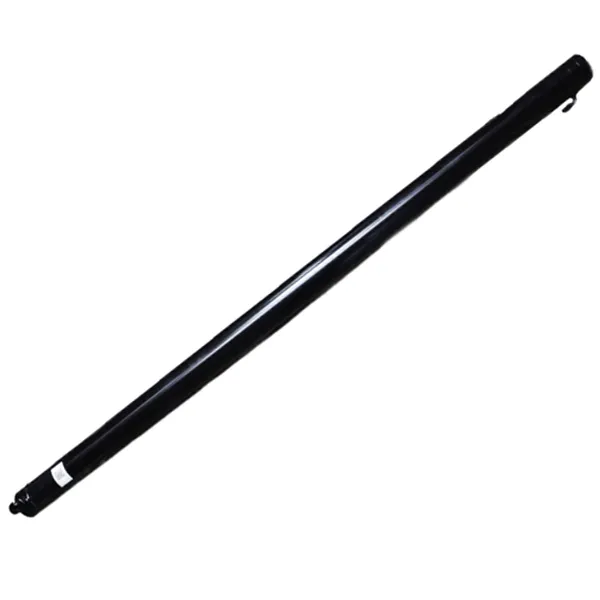
Heavy-Duty Hydraulic Tilt Cylinder for Industrial Vehicles
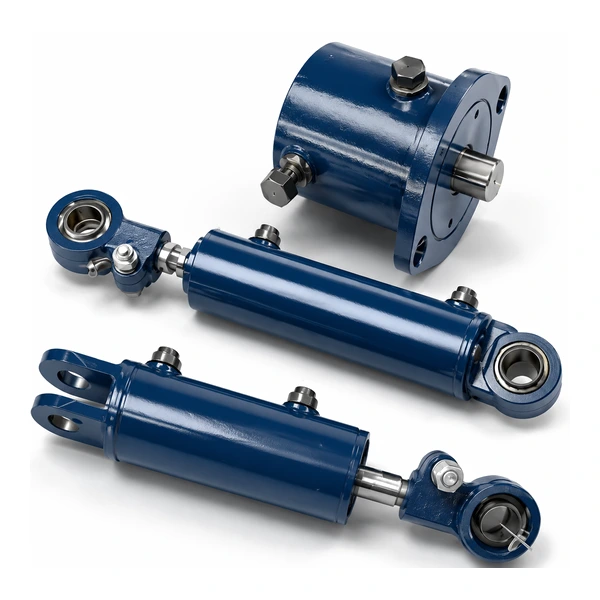
100 kg CLASS
OEM CUSTOM
Heavy-Duty Hydraulic Tilt Cylinder for Industrial Vehicles
Standard forklift tilt cylinders top out at 22 kg and Φ100 bore — enough for the 10-tonne class. Beyond that, the mast assemblies grow into multi-tonne structures that require tilt cylinders with bore diameters of Φ120 to Φ200+, strokes exceeding 300 mm, and working pressures up to 30 MPa. A single heavy-duty tilt cylinder at 100 kg delivers more force than a pair of standard tilt cylinders combined. Korea Ever-Power produces these heavy-duty cylinders as OEM custom builds — because at this size, no two vehicle platforms share the same bore, stroke, mounting geometry, or port configuration.
When Standard Forklift Cylinders Reach Their Limit
The standard forklift hydraulic cylinder catalogue covers machines from 1.5 to 10 tonnes. Above that, the physics changes. A 25-tonne container handler's mast assembly weighs 3,000–5,000 kg. Tilting that mass 6° forward requires 150–250 kN of cylinder force — beyond what a Φ100 bore at 18 MPa can produce (142 kN maximum). The machine needs a larger bore, and a larger bore means a heavier, structurally reinforced cylinder that shares no dimensions with the standard forklift range.
The 100 kg class heavy-duty tilt cylinder fills this gap. With bores from Φ120 to Φ200 and working pressures up to 30 MPa, it generates the 200–600+ kN of tilt force that these large machines demand. Every parameter — bore, stroke, rod diameter, wall thickness, mounting centres, port position, and clevis geometry — is custom-manufactured to the OEM's vehicle specification because no two heavy equipment platforms in this class share the same tilt cylinder dimensions.
| Parameter | Standard Tilt Cylinder | Heavy-Duty Tilt Cylinder |
|---|---|---|
| Vehicle Class | 1.5–10 tonne forklifts | 10–45 tonne heavy equipment |
| Bore Range | Φ60–Φ100 | Φ120–Φ200+ |
| Max Tilt Force (single cyl.) | 142 kN | 350–950 kN |
| Working Pressure | 18.1 MPa | Up to 30 MPa |
| Cylinder Weight | 3.4–22 kg | 60–150+ kg |
| Mast Assembly Weight | 200–800 kg | 3,000–8,000 kg |
| Production Type | Standard catalogue (7 models) | OEM custom only |
Product Specification
| Product Type | Custom heavy-duty hydraulic tilt cylinder for industrial vehicles |
| Acting Type | Double-acting (primary) / Single-acting available |
| Structure | Piston cylinder, 25-component architecture |
| Reference Weight | 100 kg (varies by bore, stroke, wall thickness) |
| Body Material | 20# carbon steel / 45# medium carbon steel |
| Seal Options | Parker, NOK, Hallite, Busak Shamban |
| Certification | ISO 9001:2015, ISO 14001, ISO 45003 |
| Quality | 100% pressure and leakage tested |
| Service | OEM (build-to-print) + ODM (design-to-spec) |
| MOQ | 1 piece |
| Annual Capacity | 1,200,000 cylinders / year (all product types) |
| Shipping | Crate or pallet · Port: Shanghai / Ningbo |
What Changes at 100 kg — Heavy-Duty Construction Details
Scaling a tilt cylinder from 22 kg to 100 kg is not simply a matter of making every part proportionally larger. The physics of high-bore, high-pressure cylinder design introduces structural challenges that do not exist at the standard forklift scale. Korea Ever-Power addresses these challenges through specific design decisions at the heavy-duty tier.
Increased Wall Thickness
At Φ150 bore and 25 MPa, the hoop stress in the cylinder tube exceeds the yield strength of 20# steel at standard wall thickness. Heavy-duty cylinders use either 45# medium carbon steel with proportionally thicker walls, or cold-drawn seamless tube (DIN 2391) with verified minimum wall thickness — ensuring the tube's burst pressure exceeds 4× the working pressure per ISO 6022 safety requirements. This wall thickness increase accounts for approximately 30% of the weight gain from 22 kg to 100 kg.
Reinforced Clevis and Mounting
The clevis bracket on a standard 22 kg tilt cylinder transmits 142 kN of force. The clevis on a 100 kg cylinder transmits 350–950 kN — a 2.5× to 6.7× increase. The clevis must be forged or machined from solid bar stock (not sheet-metal formed as on standard cylinders), the pin bore must accommodate Φ50–Φ80 hardened clevis pins (versus Φ25–Φ40 standard), and the weld between the clevis and the tube must be full-penetration with inspection per ISO 5817 Class B. Clevis and mounting hardware contribute approximately 25% of the total cylinder weight at this scale.
Heavy-Duty Piston Rod
The piston rod on a 100 kg tilt cylinder is typically Φ60–Φ100 (versus Φ25–Φ40 standard). At these diameters, the rod's weight per unit length is 4× to 6× higher than a standard rod, and induction hardening must penetrate deeper (2–3 mm case depth versus 1–1.5 mm) to resist the higher contact pressures at the guide bush and Du bush interfaces. Chrome plating thickness increases to 30–50 μm to accommodate the higher surface stresses and the longer reseal intervals typical of heavy equipment maintenance schedules.
Spherical Bearing End Connections
At heavy-duty loads, even small misalignments between the cylinder axis and the mast pivot arc create bending moments on the piston rod that accelerate rod seal wear and guide bush damage. Spherical bearing end connections (item 25 in the 25-component architecture) absorb angular misalignment of ±3–5° during the tilt stroke, eliminating the side-loading that rigid pin connections would transmit to the rod seals. At 100 kg cylinder loads, spherical bearings are not optional — they are a structural necessity.
Where 100 kg Class Tilt Cylinders Work
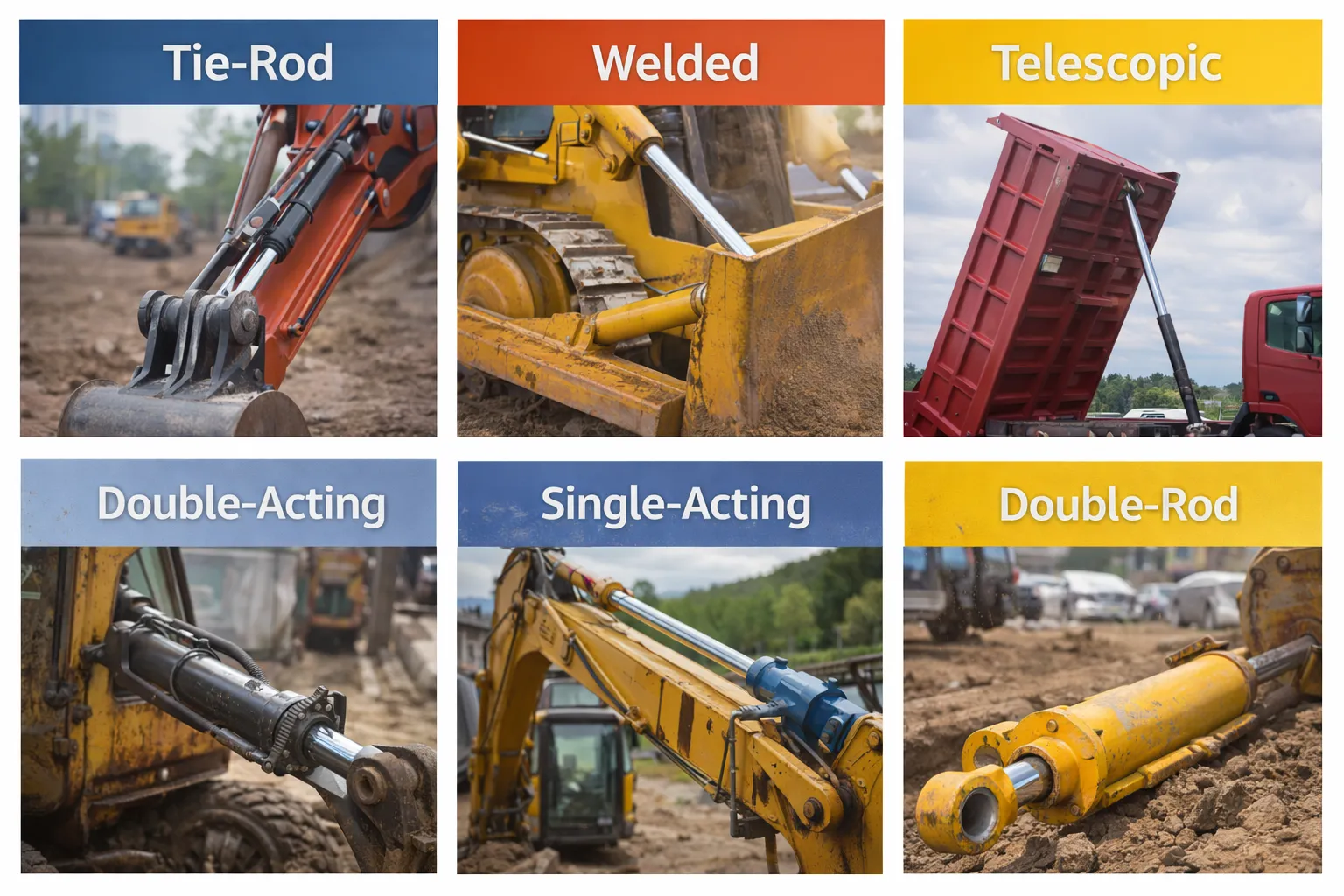
Container Handlers (10–45 t)
Empty and laden container handlers at port terminals and intermodal yards. The mast assembly on a 25-tonne container handler weighs 4,000–6,000 kg and carries a 30-tonne container at 12+ metres lift height. The tilt cylinder must control the mast angle through this full height range with sub-degree precision — because at 12 metres, 1° of tilt error translates to 200+ mm of load displacement at the spreader, enough to miss the container lock positions on a trailer chassis.
Reach Stackers
Reach stackers handle 40-foot containers at 5-container-high stacking heights. The tilt cylinder on a reach stacker serves a different geometry than a standard forklift — it controls the boom tilt angle rather than a vertical mast. The heavy-duty cylinder operates at high pressure (25–30 MPa) through a longer stroke (300–500 mm) to provide the extended boom angular range needed to place containers at the correct angle for stacking.
Mining Loaders and Material Handlers
Underground mining loaders and large surface material handlers (20+ tonnes) use heavy-duty tilt cylinders to angle the bucket or fork carriage during loading and dumping operations. These machines impose the most severe combination of load, vibration, and contamination that any tilt cylinder faces. The cylinder must withstand impact loads from bucket strikes against rock faces, continuous vibration from operating on uneven underground surfaces, and severe dust contamination from the mining environment.
Specialised Industrial Vehicles
Timber handlers, coil handlers, paper roll clamps, and other specialised material handling vehicles with non-standard mast geometries. These vehicles often require tilt cylinder configurations that no catalogue product covers — unusual mounting angles, non-standard port positions, integrated proximity sensor mounts, or cushioned end-of-stroke deceleration. The OEM custom service produces the cylinder that the vehicle architect specifies, not the closest available alternative from a catalogue.
The Same 25 Components — Scaled to Heavy Duty
The internal architecture of the 100 kg heavy-duty tilt cylinder is identical to the 3.4 kg standard tilt cylinder — the same 25 components in the same assembly sequence. What changes is the dimensional scale, the material grade, and the surface treatment of each component. This architectural consistency is fundamental to Korea Ever-Power's manufacturing strategy: the same production lines, the same tooling concepts, and the same quality process apply at every scale, from the lightest standard cylinder to the heaviest OEM custom unit.
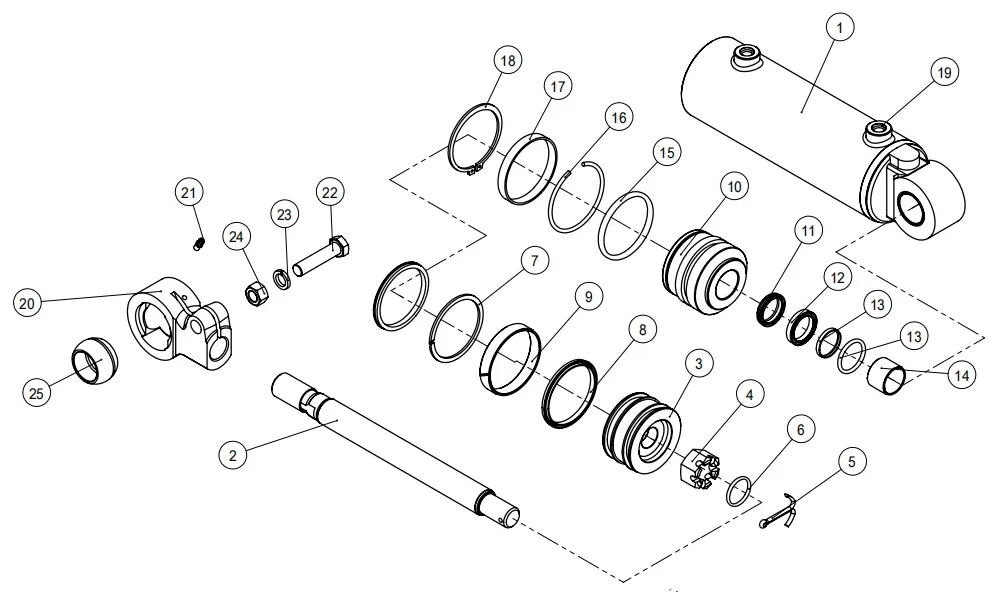
| # | Component | # | Component | # | Component |
|---|---|---|---|---|---|
| 1 | Cylinder Housing Assy | 10 | Guide Bush | 18 | Circlips for Shaft |
| 2 | Piston Rod | 11 | Dust Wiper | 19 | Plug |
| 3 | Piston | 12 | U-Ring | 20 | Clevis |
| 4 | Hex Nut | 13 | Rod Seal | 21 | Grease Nipple |
| 5 | Cotter Pins | 14 | Du Bush | 22 | Bolt |
| 6 | O-Ring | 15 | O-Ring | 23 | Spring Washers |
| 7 | Back-Ring | 16 | Round Wire | 24 | Nut |
| 8 | Hole Seal | 17 | Key Ring | 25 | Spherical Bearing |
| 9 | Wear-Ring |
Heavy-Duty Tilt Cylinder — Technical Questions
Standard-Duty Alternatives
For forklifts under 10 tonnes, the standard catalogue tilt cylinder provides the same quality at lower cost and shorter lead time.
Informação adicional
| Editor | Cxm |
|---|
Produtos relacionados
-
Forklift Fork Positioner & Side Shift Cylinder | Bore Φ40–125mm
-

Forklift Steering Cylinder | EP-HCYY11112002 Model
-
LS-HCZD30N-03 Forklift Truck Steering Cylinder
-
Tractor & Forklift Hydraulic Steering Cylinder — OEM Cross-Industry Power Steering Cylinder
-
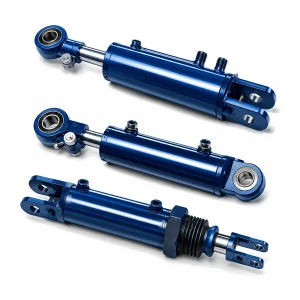
Custom Hydraulic Cylinder for Forklift Steering
-
Forklift Lifting Hydraulic Cylinder
-
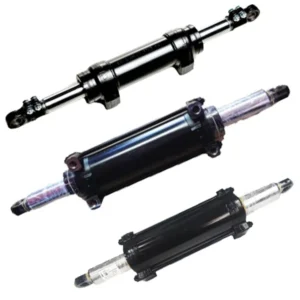
Forklift Steering Hydraulic Cylinder
-
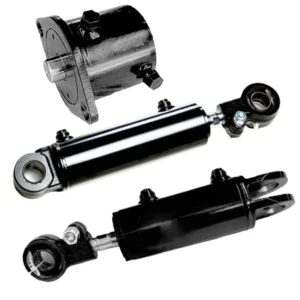
Forklift Tilt Hydraulic Cylinder


























