Trenching Depth Cylinder for Subsurface Drain Installation Machines
42CrMo alloy steel with oversized piston rod and enhanced guide bearing. Built for the extreme impact, hard soil penetration, and continuous lateral loading of deep trenching operations.
Subsurface Drainage Trenching Is the Hardest Job a Hydraulic Cylinder Can Face in Agriculture
In twenty years of designing and manufacturing hydraulic cylinders for agricultural equipment, subsurface drain installation trenchers rank as the single most punishing application I have encountered. The depth control cylinder on a drain trenching machine must push a cutting chain or disc into undisturbed soil to depths of 1.0 to 2.5 meters, hold that depth steady while the machine crawls forward at walking speed, and absorb the continuous shock from buried rocks, compacted clay layers, tree roots, and old field drainage infrastructure that the cutting head encounters along the trench line.
The loads are extreme. A trenching chain cutting through heavy clay at 1.8 meters depth generates a reaction force at the depth control cylinder that can reach 80 to 120 kN during steady cutting and spike to 200 kN or more when the chain hits an obstruction. These forces have a large lateral component because the chain deflects sideways around hard objects, transmitting bending loads into the cylinder rod. Standard agricultural cylinders are not built for this. Their rods bend, their seals blow out from pressure spikes, and their barrel welds crack from cyclic fatigue, often all within a single drainage season.
Our trenching depth control cylinder is built from 42CrMo alloy steel, the same chromium-molybdenum alloy used in heavy construction and mining equipment cylinders. The piston rod is oversized to resist the bending forces unique to deep trenching work. An extended guide bearing in the gland distributes lateral loads over a wide contact area. And every weld joint undergoes post-weld stress relief to extend barrel fatigue life into the millions-of-cycles range. This is a double acting hydraulic cylinder designed for the most demanding application in agricultural field management.
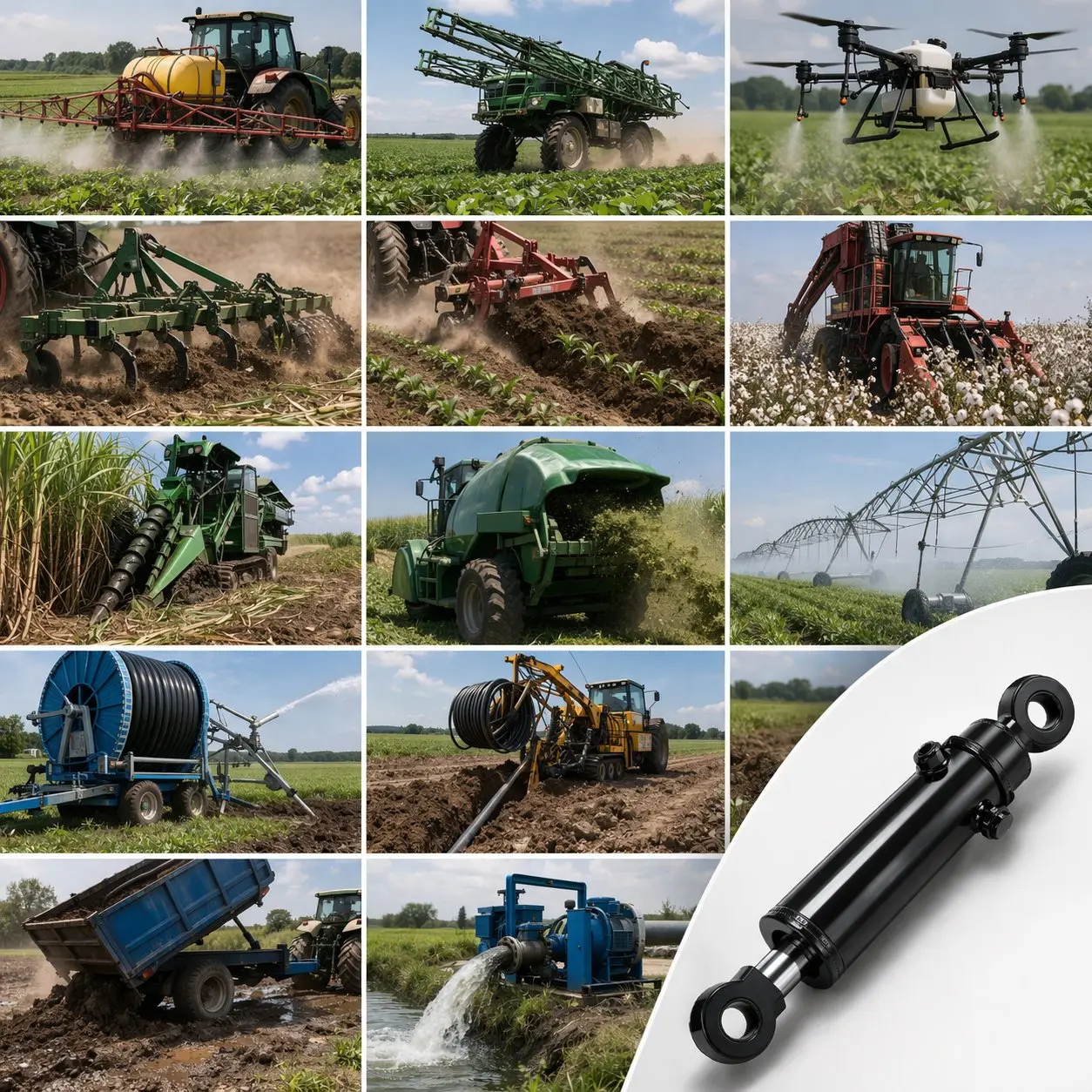
Load Analysis: What the Cylinder Experiences at 1.5 to 2.5 Meter Trench Depth
Understanding the forces involved in deep subsurface trenching helps explain why this application demands cylinder specifications that go far beyond standard agricultural practice. The loads increase non-linearly with depth, meaning that doubling the trench depth more than doubles the force the cylinder must handle.
| Trench Depth | Soil Type | Steady-State Chain Force | Obstruction Peak Force | Lateral Component | Rod Bending Risk |
|---|---|---|---|---|---|
| 1.0 m | Medium Clay | 40 – 60 kN | 80 – 120 kN | 15 – 25% | Moderate |
| 1.5 m | Heavy Clay | 70 – 100 kN | 140 – 200 kN | 25 – 40% | High |
| 2.0 m | Heavy Clay + Stones | 90 – 130 kN | 180 – 260 kN | 30 – 50% | Very high (requires oversized rod) |
| 2.5 m | Compacted Subsoil | 120 – 180 kN | 240 – 350+ kN | 35 – 55% | Extreme (42CrMo mandatory) |
At 2.0 meter depth in stony clay, the lateral force on the cylinder rod can exceed 100 kN. A standard S45C carbon steel rod at 50 mm diameter will permanently deflect under this load. Our 42CrMo rod at 63 mm diameter has approximately 4 times the bending resistance and 1.5 times the yield strength, keeping it safely within the elastic range even at peak obstruction loads.
How a Trenching Depth Cylinder Works on a Drain Installation Machine
A subsurface drain installer carries a vertical cutting chain or disc on a mast that descends into the ground. The depth control cylinder connects between the machine chassis and the mast, governing how far down the cutting head penetrates. A separate pipe-laying mechanism follows behind the chain, placing corrugated drainage tubing into the trench bottom as the machine advances.
The operator sets a target trench depth, and the hydraulic cylinder extends to push the mast downward until the chain reaches the desired depth. A grade control system, often laser-guided, monitors the actual depth and sends correction signals to a proportional valve that fine-tunes the cylinder position to maintain a consistent trench bottom grade. This grade accuracy is critical because the drainage pipe must follow a consistent slope for water to flow by gravity.
During cutting, the chain generates a massive pulling force that tries to lift the mast and machine. The cylinder must resist this lift force while simultaneously absorbing impact shocks from obstructions and maintaining the precise grade position that the laser system commands. This combination of high static holding force, dynamic shock absorption, and millimeter-level position accuracy is among the most demanding duty cycles in agricultural hydraulic applications.
Technical Specifications
| Specification | Available Range |
|---|---|
| Bore Diameter | 63 mm – 140 mm |
| Rod Diameter (Oversized) | 45 mm – 100 mm |
| Stroke Length | 300 mm – 1,500 mm |
| Working Pressure | Up to 25 MPa (3,625 PSI) |
| Burst Pressure | 75 MPa (10,875 PSI) |
| Action Type | Double Acting |
| Structure | Welded Piston Cylinder, Heavy-Duty |
| Body Material | 42CrMo Alloy Steel (AISI 4140), Quenched and Tempered |
| Piston Rod | 42CrMo, Hard Chrome 25+ micron, Micro-Polished |
| Body Finish | Zinc Primer + Epoxy Topcoat |
| Piston Seal | High-Strength PU + PTFE-Bronze Wear Ring |
| Rod Seal | FKM (Viton) + PTFE Back-up |
| Scraper | Heavy-Duty Metal-Cased Mud Scraper |
| Gland Guide | Extended Bearing Length (1.5x to 2.0x rod diameter) |
| Mounting | Clevis, Trunnion (Forged), Spherical Bearing Eye, Custom |
| Port Thread | BSP / NPT / SAE / Metric |
| Operating Temperature | -30 C to +90 C |
| Environment Rating | Extreme Impact / Mud-Water / Hard Soil |
Eight Engineering Measures for Extreme Trenching Loads
42CrMo Alloy Steel Throughout
Barrel, rod, and end caps are all 42CrMo (AISI 4140), quenched and tempered to a yield strength above 750 MPa. This provides roughly 50% higher yield than standard carbon steel, giving the entire assembly greater resistance to the extreme static and dynamic loads encountered during deep trenching.
Oversized Piston Rod
Rod diameter is selected based on combined axial and lateral loading rather than axial alone. For an 80 mm bore, we use a 56 mm or 63 mm rod instead of the standard 45 mm. This dramatically increases bending resistance, which is critical when the cutting chain deflects sideways around buried obstructions and transmits lateral shock into the rod.
Extended Guide Bearing (2x Rod Diameter)
The gland bearing is lengthened to 2.0 times rod diameter, double the standard 1.0x ratio. This extended bearing spreads lateral loads over a much wider contact band, preventing the localized wear and rod scoring that shorter bearings allow under sustained side loading. The bearing material is PTFE-bronze composite for self-lubrication and high load capacity.
25-Micron Chrome with Optional Ceramic Overlay
The rod receives hard chrome plating of 25 micrometers minimum. For the most abrasive trenching conditions (gravelly subsoil, ironstone layers), we offer a ceramic-oxide overlay that pushes surface hardness above 1200 HV, virtually eliminating rod scoring from rock and debris contact.
FKM Rod Seals for Mud-Water Environments
Trenching machines operate in standing water and liquid mud. The rod seal is constantly exposed to water-contaminated soil slurry. FKM (Viton) rod seals resist water absorption and maintain sealing integrity in wet conditions far better than standard NBR, which swells and softens when exposed to water for extended periods.
Heavy-Duty Mud Scraper
A metal-cased polyurethane scraper with a heavy-cut lip profile removes wet clay, gravel fragments, and trench slurry from the rod surface during retraction. The metal case is mechanically retained to prevent dislodgement under the extreme vibration that trenching machines generate.
Post-Weld Stress Relief on All Joints
42CrMo requires careful welding procedure: pre-heat to 200 to 300 C, controlled interpass temperature, and post-weld stress relief at 550 to 620 C. We monitor every furnace cycle with thermocouple data loggers. This heat treatment restores material toughness in the weld zone and reduces residual stresses that would otherwise initiate fatigue cracks under the intense cyclic loading of trenching.
Forged Mounting Ears
Cast or flame-cut mounting ears crack under the dynamic loads of trenching. Our clevis and trunnion ears are drop-forged from alloy steel and attached with full-penetration welds that are stress-relieved in the same furnace cycle as the barrel joints. Reinforcing gusset plates are added where load analysis indicates stress concentrations at the ear-to-barrel junction.

Application Scenarios
Chain Trencher Drain Installers: The primary application. Machines with vertical chain cutters for installing corrugated drainage pipe at depths of 1.0 to 2.5 meters in agricultural fields.
Disc Trencher Drain Installers: Rotary disc trenching machines that cut narrower trenches at similar depths. The load profile is slightly different from chain trenchers but equally demanding on the depth cylinder.
Mole Plow Drainage Machines: Mole plows that pull a torpedo-shaped expander through the subsoil to create unlined drainage channels at depths up to 600 mm. The pulling force and lateral loads on the depth cylinder are comparable to shallow trenching, making the 42CrMo custom hydraulic cylinder ideal for this application.
Cable and Pipe Laying Trenchers: Agricultural and rural utility trenchers that lay irrigation pipe, fiber optic cable, or electrical conduit operate at similar depths and encounter similar soil conditions to drain installers.
Deep Subsoiling and Ripping Equipment: Deep rippers that break compacted subsoil layers at 500 to 800 mm depth generate extreme impact loads when the ripper shank hits rocks or hardpan. The oversized rod and 42CrMo construction apply directly to these agricultural machinery hydraulic cylinder applications.
Manufacturing and Quality Assurance
42CrMo alloy steel requires specialized metallurgical handling at every production stage. Our factory has the equipment and expertise to process this material correctly: incoming verification by spectrometer and hardness test on every batch, CNC boring and honing to Ra 0.2 bore finish, rod grinding to h6 tolerance with 25+ micron chrome plating, controlled pre-heat and interpass temperature during MIG welding, post-weld stress relief at 550 to 620 C with thermocouple-monitored furnace cycles, clean-room assembly with filtered oil flush, and 100% pressure testing at 1.5 times rated pressure for three minutes with full external leak inspection. Forged mounting ears are ultrasonically inspected for internal defects before welding. Every cylinder carries a unique serial number with complete material-to-test traceability maintained for a minimum of ten years. ISO 9001 certified facility. Full documentation package included with every shipment.
Standard Agricultural Cylinder vs. Our Trenching Depth Cylinder
| Trenching-Specific Metric | Standard Ag Cylinder | Our Trenching Cylinder |
|---|---|---|
| Material Yield Strength | ~490 MPa (S45C) | 750+ MPa (42CrMo Q&T) |
| Rod Diameter Ratio (Rod/Bore) | 0.50 – 0.55 | 0.70 – 0.80 (oversized) |
| Gland Guide Bearing Length | 1.0x rod diameter | 1.5x – 2.0x rod diameter |
| Chrome Thickness | 10 – 15 micron | 25+ micron (ceramic option) |
| Rod Seal Material | NBR (swells in wet conditions) | FKM (water-resistant) |
| Mounting Ears | Cast or flame-cut | Drop-forged + gusset reinforced |
| Typical Service Life (heavy clay trenching) | 1 season or less | 5+ seasons |
Customer Case Studies
Gimje City, Jeollabuk-do, South Korea
Customer: Government-contracted agricultural land improvement agency operating drain installation machines across the Honam Plain
Challenge: Heavy alluvial clay soils at 1.5 to 2.0 m depth bent standard cylinder rods on every project. The agency was replacing 3 to 5 depth cylinders per machine per drainage season.
How They Found Us: Agency procurement officer searched for “42CrMo trenching hydraulic cylinder” in October 2024.
Results: After refitting all 6 machines before the 2025 spring drainage campaign, zero rod bending incidents occurred through 1,200 combined operating hours of deep clay trenching. Cylinder replacement costs dropped from approximately 8,500 USD per season to zero.
“The Honam Plain clay has been bending our cylinder rods for years. These 42CrMo units went through the entire spring campaign without a single bent rod. We have already approved the budget to refit our reserve machines.” – Mr. Kwak, Project Engineer, July 2025
Naju City, Jeollanam-do, South Korea
Customer: Private drainage contractor specializing in paddy field conversion projects
Challenge: Paddy conversion requires trenching through compacted hardpan layers at 1.2 to 1.8 m depth. The contractor was losing 2 to 3 working days per month to cylinder failures.
How They Found Us: Referral from another drainage contractor in Chungcheong Province, January 2025.
Results: Downtime from cylinder failures dropped from 2 to 3 days per month to zero across the entire 2025 campaign. The contractor completed 15% more linear meters of drainage than the previous year with the same equipment, simply because the machines stayed running.
“Every day my machine sits broken is money lost. These cylinders kept all three machines running through the busiest drainage season we have ever had. The extra 15% output more than covered the cylinder investment.” – Mr. Hwang, Owner-Operator, October 2025
Niigata Prefecture, Japan
Customer: Land improvement district managing subsurface drainage installation across 3,000 hectares of rice paddies
Challenge: Niigata alluvial soils contain buried gravel layers that destroy standard cylinder seals and scratch rod surfaces, causing oil contamination that degrades the laser grade control system accuracy.
How They Found Us: Engineering consultant recommendation, February 2025.
Results: Our 25-micron chrome rods with metal-cased scrapers eliminated the rod scratching problem. The laser grade control system maintained accuracy throughout the entire campaign because clean hydraulic oil was no longer contaminated by seal debris. Grade compliance on installed drainage improved from 88% to 97%.
“Grade accuracy is everything in drainage installation. When the cylinder seal fails and contaminates the hydraulic oil, the proportional valve loses precision and the drain grade suffers. Keeping the cylinder clean and leak-free improved our installed drainage quality measurably.” – Mr. Suzuki, Drainage Engineer, September 2025
Can Tho Province, Vietnam
Customer: Mekong Delta land development company installing subsurface drainage to convert flood-prone paddy land to year-round vegetable production
Challenge: Mekong Delta clay is extremely sticky and abrasive when wet. Standard cylinders suffered seal failures within 100 operating hours from mud ingress, and rods corroded rapidly from constant water and soil contact.
How They Found Us: Found our website through a Google search for “heavy duty trenching cylinder mud resistant” in July 2024.
Results: Our FKM-sealed cylinders with heavy-duty mud scrapers completed over 600 operating hours across the 2024-2025 dry season trenching campaign with zero seal failures and no detectable rod corrosion. The company placed a repeat order for their expanded 2025-2026 drainage program.
“The mud in the Mekong Delta is like glue mixed with sandpaper. Our old cylinders were destroyed in weeks. Yours survived an entire dry season of continuous trenching in the worst mud conditions I have seen in 15 years of drainage work.” – Mr. Le, Project Director, April 2025
Isfahan Province, Iran
Customer: Agricultural engineering firm installing subsurface drainage systems in the Zayandeh Rud river basin for soil salinity management
Challenge: Saline clay soils with embedded gypsum layers at 1.5 to 2.0 m depth. Standard cylinders failed from a combination of rod bending (from gypsum layer impact), seal degradation (from saline moisture), and barrel cracking (from cyclic fatigue).
How They Found Us: Contacted us after an Iranian agricultural machinery exhibition in October 2024.
Results: Our 42CrMo cylinders with oversized rods, FKM seals, and stress-relieved welds addressed all three failure modes simultaneously. The firm completed two drainage projects totaling 45 km of trench in saline clay with zero cylinder failures, compared to an average of 8 to 12 cylinder replacements per project with their previous supplier.
“Saline soil drainage in Isfahan is among the most difficult in the world. The salt attacks the seals, the gypsum bends the rods, and the pressure cycles crack the barrels. Having one cylinder that survives all three challenges has transformed our project economics.” – Mr. Hosseini, Senior Engineer, February 2025
Frequently Asked Questions
What bore and rod size do I need for a drain trencher working at 1.5 to 2.0 meter depth?
Why is 42CrMo steel required instead of standard carbon steel for trenching cylinders?
Can I replace the OEM depth cylinder on my existing drain installer with your 42CrMo version?
What is the lead time for trenching depth cylinders?
Do you ship heavy-duty trenching cylinders internationally?
Deep Drainage Demands a Cylinder Engineered for the Extreme
Share your trencher model, target depth, soil conditions, and current cylinder specifications. Our engineering team will design a matched replacement and deliver a quotation within 48 hours.
Editor: Cxm