
Transfer Chute Cylinder for Roadheader
Engineered with high-yield 27SiMn alloy steel and a proprietary three-stage sealing matrix. Permanently eliminate severe rod wear caused by abrasive dust and corrosive muddy water during continuous angle adjustment operations in deep subterranean excavation environments.
Subterranean Material Handling and Core Industrial Value
The continuous advancement of an underground heading is entirely dependent on the heavy machinery’s ability to evacuate cut material efficiently. When a roadheader or continuous miner shatters the solid rock face, massive volumes of debris fall onto the gathering apron and are propelled into the transfer conveyor system. The rear transfer machine serves as the critical loading mechanism, directing highly abrasive rock, coal fragments, and heavy muck onto trailing haulage vehicles or secondary continuous belt systems. Maintaining the exact elevation and trajectory of this massive steel structure requires absolute kinematic control over uneven tunnel floors. This continuous, load-bearing alignment is executed exclusively by the Transfer Chute Cylinder. If this heavy-duty component sags, loses pressure, or fails structurally, material spills uncontrollably into the tunnel invert, instantly creating a logistical bottleneck that halts the entire multi-million dollar excavation process.
Operating fluid power equipment in this specific location exposes it to the most destructive mechanical conditions imaginable. Positioned directly beneath the primary flow of excavated material, the atmosphere is heavily saturated with abrasive silica dust, falling rock fragments, and high-pressure spray water utilized for spark and dust suppression. This combination creates a highly corrosive, grinding muddy slurry. Standard commercial hydraulic parts deployed in this zone suffer from a highly predictable and catastrophic failure mode: aggressive rod wear. Abrasive particles bypass generic, single-lip wiper seals and become trapped against the internal bearing rings, literally sanding away the hard chrome plating with every extension and retraction stroke. Once the polished rod surface is compromised, complete fluid bypass and pressure loss follow within days. As a globally trusted hydraulic cylinder manufacturer, our engineering mandate focuses exclusively on resolving these severe environmental failure modes. We have developed a heavily fortified Transfer Chute Hydraulic Cylinder featuring an impenetrable three-stage sealing matrix and high-toughness 27SiMn steel, designed strictly to operate flawlessly while submerged in heavy dust and mud.
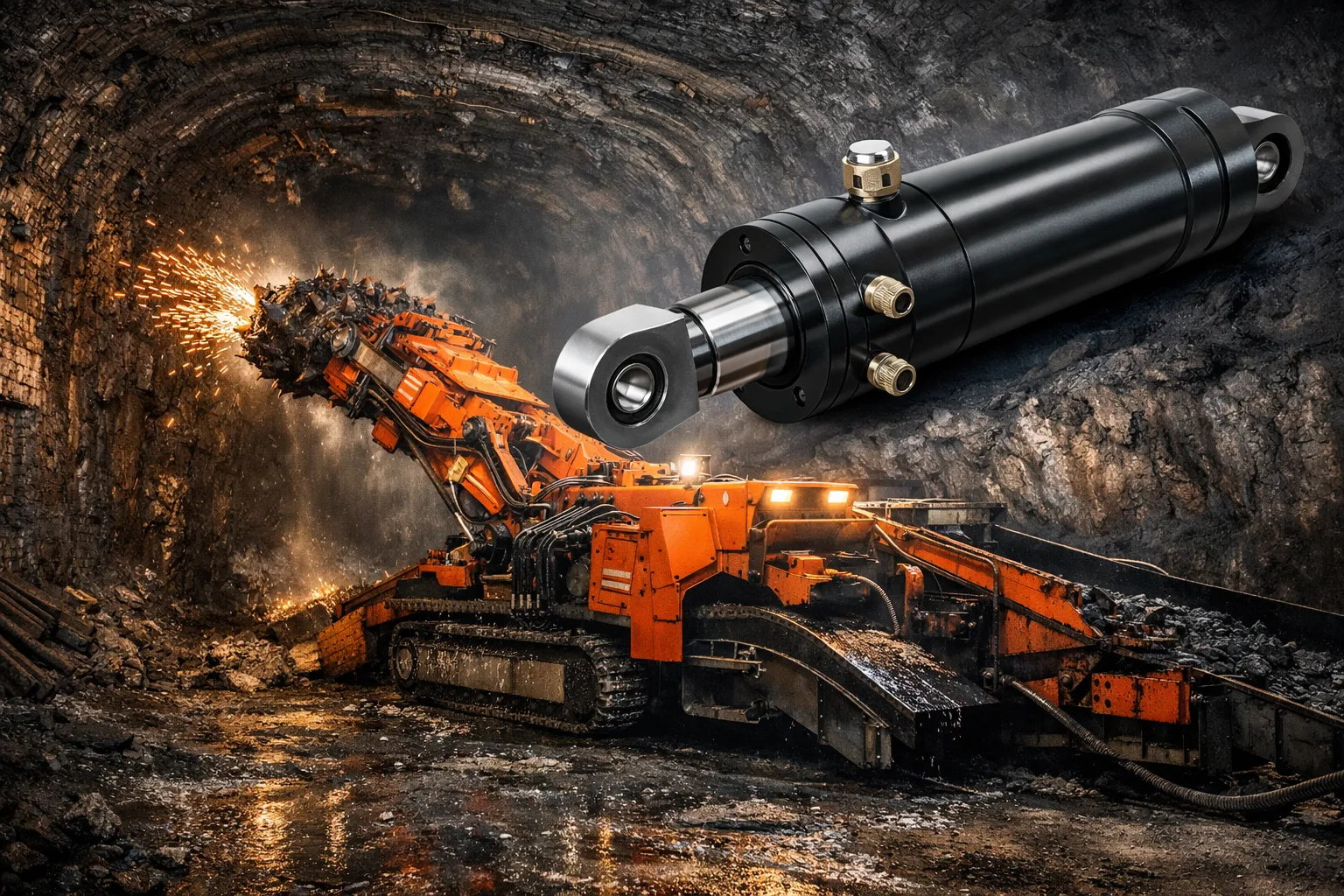
For B2B procurement directors, heavy equipment leasing agencies, and fleet maintenance managers operating across South Korea, Japan, and the wider Asia-Pacific industrial sector, the financial implications of component selection are massive. Upgrading your tunneling fleet to our engineered hydraulic cylinder translates directly into uninterrupted material evacuation. By entirely eliminating recurring maintenance stoppages and continuous emergency seal replacements, you significantly maximize operational uptime. Evaluating the total lifecycle hydraulic cylinder price reveals that the capital saved by preventing unscheduled underground conveyor breakdowns delivers an extraordinary return on investment, making this specialized actuator an indispensable asset for heavy infrastructure projects.
Engineered Technical Parameters
Mechanical reliability in hostile subterranean environments begins with absolute transparency in engineering data. The comprehensive matrix below outlines the specific tolerances, metallurgical specifications, and structural geometries of our transfer conveyor actuators. These parameters are rigorously calculated and tested to vastly exceed the standard operational demands of mineral extraction and heavy civil excavation.
| Engineering Category | Specification Data and Material Profile |
|---|---|
| Industry Sector | Mining Equipment / Subterranean Excavation |
| Equipment Category | Roadheader / Tunneling Machine / Continuous Miner |
| Subsystem / Action Target | Transfer Machine / Bridge Conveyor |
| Component Nomenclature | Transfer Chute Cylinder |
| Fluid Action Method | Double Acting |
| Structural Typology | Heavy-Duty Piston Cylinder |
| Manufacturing Structure | Fully Welded Assembly (Robotic Submerged Arc) |
| Core Material System | 27SiMn Alloy Steel (High yield and impact toughness) |
| Exterior Surface Treatment | Micro-Cracked Hard Chrome Plated |
| Environmental Grade | Heavy Dust + Muddy Water Slurry |
| Working Condition Feature | Continuous Load-Bearing Angle Adjustment |
| Typical Failure Mode Solved | Abrasive Rod Wear and Internal Leakage |
| Recommended Configuration | Three-Stage Sealing Architecture (Triple Seal) |
Kinematic Principles and Applied Fluid Dynamics
To fully understand why our engineering blueprint succeeds where standard commercial components fail, one must analyze the kinetic forces at play during high-volume material evacuation. This specialized component functions strictly as a double acting hydraulic cylinder. Unlike a basic single acting hydraulic cylingder that relies on gravity or external mechanical tension to retract, this heavy-duty unit actively controls immense loads in both kinetic directions. Highly pressurized hydraulic fluid, generated by the roadheader’s main axial piston pumps, is directed into the cap end of the barrel to forcefully extend the rod, lifting the heavy steel chute to match the exact height of a receiving dump truck or trailing belt. To safely lower the assembly, proportional directional control valves route fluid into the rod end chamber while the opposing fluid is carefully exhausted through calibrated counterbalance valves. This creates a state of active, bi-directional hydraulic tension, preventing the heavy, rock-laden chute from violently dropping and causing severe structural damage.
The real engineering challenge occurs externally. As the cylinder extends to lift the chute, a large surface area of the chrome plated rod is exposed directly to the tunnel atmosphere. In a roadheader application, this atmosphere is essentially a continuous rain of muddy slurry and jagged silica dust. When the operator commands the chute to lower, the rod retracts rapidly back into the cylinder barrel. If the external wiper seals are inadequate, a microscopic film of this abrasive mud is dragged past the gland head and directly into the internal fluid loop.
Once silica enters the fluid, it acts as a relentless lapping compound. It physically grinds away the primary polyurethane pressure seals from the inside out and aggressively scores the hydraulic cylinder piston seals. This sequence leads to massive internal fluid bypass, causing the chute to gradually sag and lose its critical alignment. Our advanced fluid power logic intercepts this threat precisely at the physical boundary. By deploying a specialized three-stage sealing arrangement, we create an absolute barrier. The primary aggressive scraper physically shears away thick caked mud, ensuring that the retracting rod is entirely free of contamination before it enters the main bearing area. This keeps the hydraulic fluid completely isolated and allows the system to perform relentless angle adjustments without losing holding pressure or degrading the metal finish.
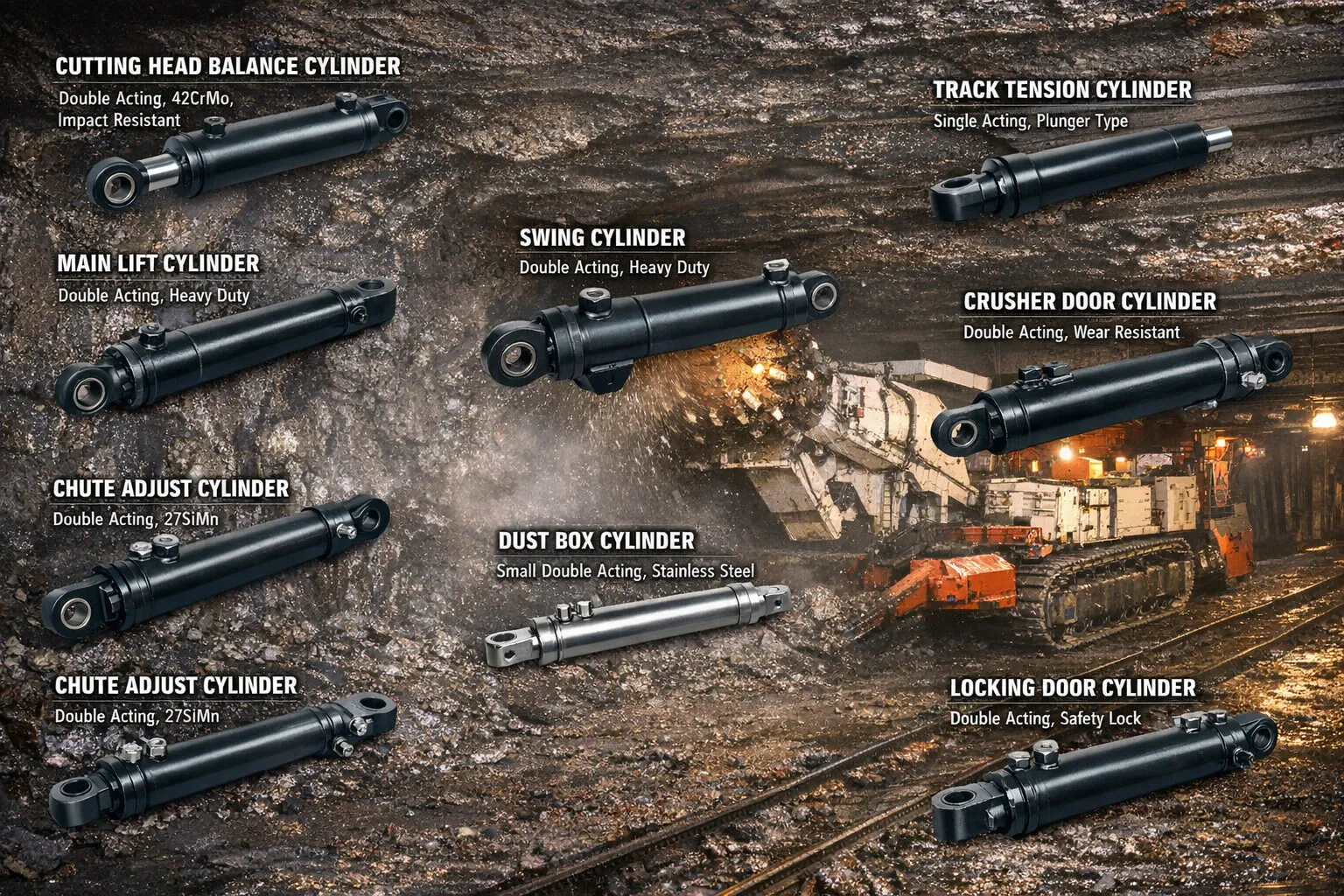
Flawless OEM Fleet Integration and Direct Upgrades
When the transfer conveyor drops due to a blown cylinder, the entire mining shift is compromised. Maintenance engineering teams require immediate, dimensionally perfect drop-in replacements. Waiting extensively for imported original equipment manufacturer parts from Europe or North America heavily inflates your project’s downtime costs and creates unacceptable logistical hurdles. We specialize in mapping the exact dimensional geometry—including retracted stroke lengths, extended dimensions, pin hole diameters, and exact metric fluid port thread pitches—of the industry’s most widely utilized tunneling platforms, allowing your crew to execute seamless field replacements without any chassis modifications or hot welding.
Technical Disclaimer: The following original equipment manufacturer (OEM) brand names and machinery classifications are referenced exclusively for technical sizing convenience, kinematic compatibility verification, and clear B2B procurement communication. We function as a premier independent engineering and manufacturing facility, and this reference does not imply trademark infringement, direct corporate affiliation, or official endorsement by these respective entities.
- Sandvik MT Series Roadheaders: Complete dimensional compatibility for the rear transfer chute articulation, providing a massive structural upgrade in environmental defense against abrasive rock slurry and water ingress.
- Epiroc / Atlas Copco Miners: Optimized internal port geometries matched perfectly to their high-flow hydraulic systems, ensuring smooth, highly responsive rear conveyor angle adjustment without dangerous pressure spikes.
- SANY and XCMG Rigs: A heavily requested pin-for-pin upgrade utilized extensively in South Korean and Asian infrastructure projects, completely curing the factory-standard problem of rapid rod scoring and subsequent seal blowout.
- Mitsui Miike: Engineered specifically to withstand the highly humid and flooded tunnel conditions frequently encountered in Japanese deep-shaft mineral extraction, maintaining perfect fluid containment.
Five Formidable Core Technical Advancements
Surviving relentless exposure to abrasive slurries requires dedicated material science and highly specialized fluid engineering. When sourcing heavy-duty hydraulic rams for your infrastructure fleet, these five engineered advantages dictate the immense lifespan and reliability of our specific transfer chute technology:
1. Absolute Defense: The Triple-Stage Sealing Architecture
The absolute leading cause of actuator failure underground is rod wear from fine particle ingress. We entirely discard standard commercial single-lip wipers. Instead, we machine our heavy-duty gland assemblies to accept a three-stage defense matrix. An aggressive metallic-encased rigid scraper forcefully shears away thick mud deposits and ice. Following this, a double-lip polyurethane wiper acts as an absolute barrier against fine airborne silica dust. The final inner layer is a high-pressure PTFE step seal. This triad guarantees perfect fluid purity inside the barrel, completely neutralizing the threat of abrasive rod scoring.
2. High-Toughness 27SiMn Alloy Steel Construction
Because the cylinder is located directly under the material flow, the transfer conveyor is frequently struck by heavy, falling rock debris. Standard 45# carbon steel barrels dent easily, which immediately seizes the internal piston assembly. We construct our Transfer Chute Hydraulic Cylinder barrels and solid rods entirely from 27SiMn (Silicon-Manganese) alloy steel. Widely utilized in heavy-duty underground coal mine hydraulic roof props, this specific metallurgy boasts massive yield strength and impact toughness. It absorbs the kinetic shock of falling boulders without plastically deforming, ensuring smooth linear actuation at all times.
3. Deep-Layer Micro-Cracked Chrome Plated Defense
The surface of the rod represents the frontline in the war against severe abrasion. We utilize a highly specialized, multi-pass hard chrome electroplating process applied directly over the 27SiMn core. We rigorously control the plating bath to deposit a thick layer with a specific micro-cracked surface topography. This creates a glass-hard armor against physical scratching from quartz and granite dust, while the microscopic fissures miraculously retain trace amounts of lubricating hydraulic oil, drastically reducing friction heat against the triple wiper seals during continuous, rapid angle adjustments.
4. Robotic Deep-Penetration Structural Welding
The persistent, high-frequency vibration of the heavy transfer conveyor chain destroys weak structural mounts rapidly. Manual welding creates inconsistent fusion zones that are highly prone to fatigue cracking over time. Our manufacturing protocol relies exclusively on automated, robotic submerged arc welding to ensure incredibly deep, consistent metallic fusion at the base caps and trunnion mounts. Every critical structural weld undergoes subsequent thermal stress relief in advanced ovens to eliminate the heat-affected zones, ensuring the mounting eyes never tear away from the chassis.
5. Thermodynamic Fatigue Optimization
Continuous angle adjustments under heavy loads generate significant internal fluid friction heat, which can rapidly bake and shatter elastomer pressure seals. We utilize advanced computational fluid dynamics modeling to optimize our internal port geometries, drastically reducing fluid turbulence and internal pressure drops. When paired with high-temperature synthetic bronze guide bands that prevent all metal-to-metal contact, the cylinder effectively dissipates heat, maintaining precise dimensional tolerances over millions of grueling stroke cycles in hot subterranean environments.
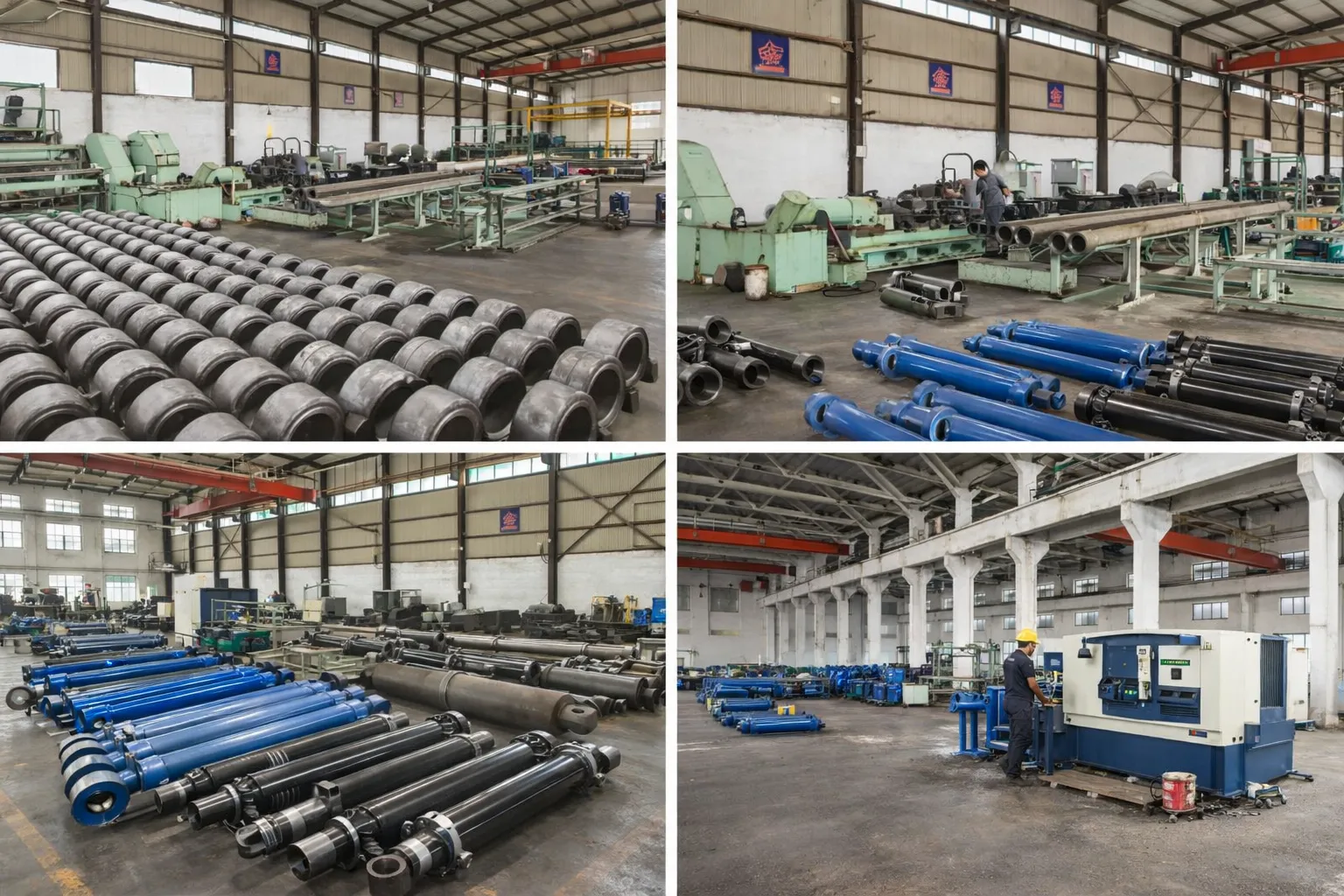
Autonomous Manufacturing and Relentless Quality Control
Protecting your operational uptime requires that we command total authority over our production ecosystem. We operate a highly advanced, fully integrated manufacturing facility, completely eliminating the unpredictability of fragmented third-party supply chains. Every critical component begins with optical emission spectrometry to verify the precise silicon and manganese chemistry of the 27SiMn steel billets. From the accurate CNC deep-hole boring and skiving of the internal barrels to the heavy electroplating of the rods, our internal traceability protocols ensure zero manufacturing deviations. This absolute concentricity drastically reduces dynamic sliding friction, preventing destructive heat build-up inside the fluid chamber.
Quality assurance within the heavy infrastructure supply sector leaves absolutely no margin for error. We fundamentally reject random statistical batch sampling. Every single Transfer Chute Cylinder manufactured in our facility is subjected to a mandatory 100% computerized hydrostatic pressure evaluation. The units are internally pressurized to 1.5 times their maximum rated operational capability and held statically while high-resolution digital sensors monitor for microscopic fluid bypass or external leaks. All load-bearing robotic welds undergo intensive ultrasonic non-destructive testing to guarantee the absence of internal voids. Only upon passing this flawless testing matrix is the unit serialized and cleared for global deployment.
Expansive Cross-Industry Application Matrix
The robust engineering blueprint developed to conquer the extreme dust and highly corrosive mud of underground transfer chutes is exceptionally adaptable. The verified capability to endure heavy abrasive contamination, corrosive moisture, and continuous load holding makes our hydraulic parts highly sought after across numerous extreme-duty industrial sectors globally.
- Mining Industry Equipment: Deployed heavily in longwall shearers, continuous miners, and heavy articulated mine trucks facing highly abrasive operating conditions. Explore our dedicated engineering within the mining industry hub.
- Heavy Construction Machinery: Providing essential lifting and bucket articulation for large-scale crawler excavators, demolition shears, and foundation piling rigs working in muddy, flooded trenches. Discover our construction machinery industry solutions.
- Bulk Material Handling and Logistics: Providing ruggedized, dust-proof lift cylinder configurations for enormous ship loaders, stacker-reclaimers, and bulk conveyor tensioning systems operating in dusty coastal port environments.
- Metallurgical Processing and Forging: Built specifically to withstand intense radiant heat and heavy metallic dust surrounding industrial blast furnaces, continuous casting lines, and rolling mills.
Comparative Analysis: Standard Commercial vs. High-Performance
Procuring generic commercial cylinders in an attempt to minimize initial purchasing costs invariably leads to immense financial losses caused by continuous equipment failures and halted tunnel advances. The analytical table below clearly illustrates the specific engineering disparities that justify our uncompromising, heavy-duty manufacturing approach.
| Engineering Feature | Standard Commercial Cylinders | Our Transfer Chute Cylinder |
|---|---|---|
| Material Composition | Standard 45# Carbon Steel (Highly prone to denting under heavy loads) | Forged 27SiMn Alloy Steel (Massive yield strength and impact rigidity) |
| Contamination Defense | Single rubber wiper seal (Rapid failure in mud and silica dust) | Three-Stage Sealing Matrix (Absolute barrier against slurry ingress) |
| Reaction to Rod Wear | Thin flash chrome easily scratches, causing immediate fluid leaks | Deep-layer hard chrome plating resists scoring, protecting internal oil |
| Structural Welds | Manual MIG welding, untested heat-affected zones prone to cracking | Robotic Submerged Arc + 100% Ultrasonic NDT + Thermal Stress Relief |
| Operational Lifecycle | Requires constant halt of excavation for emergency seal replacements | Maintains continuous angle adjustments, extending operational life up to 300% |
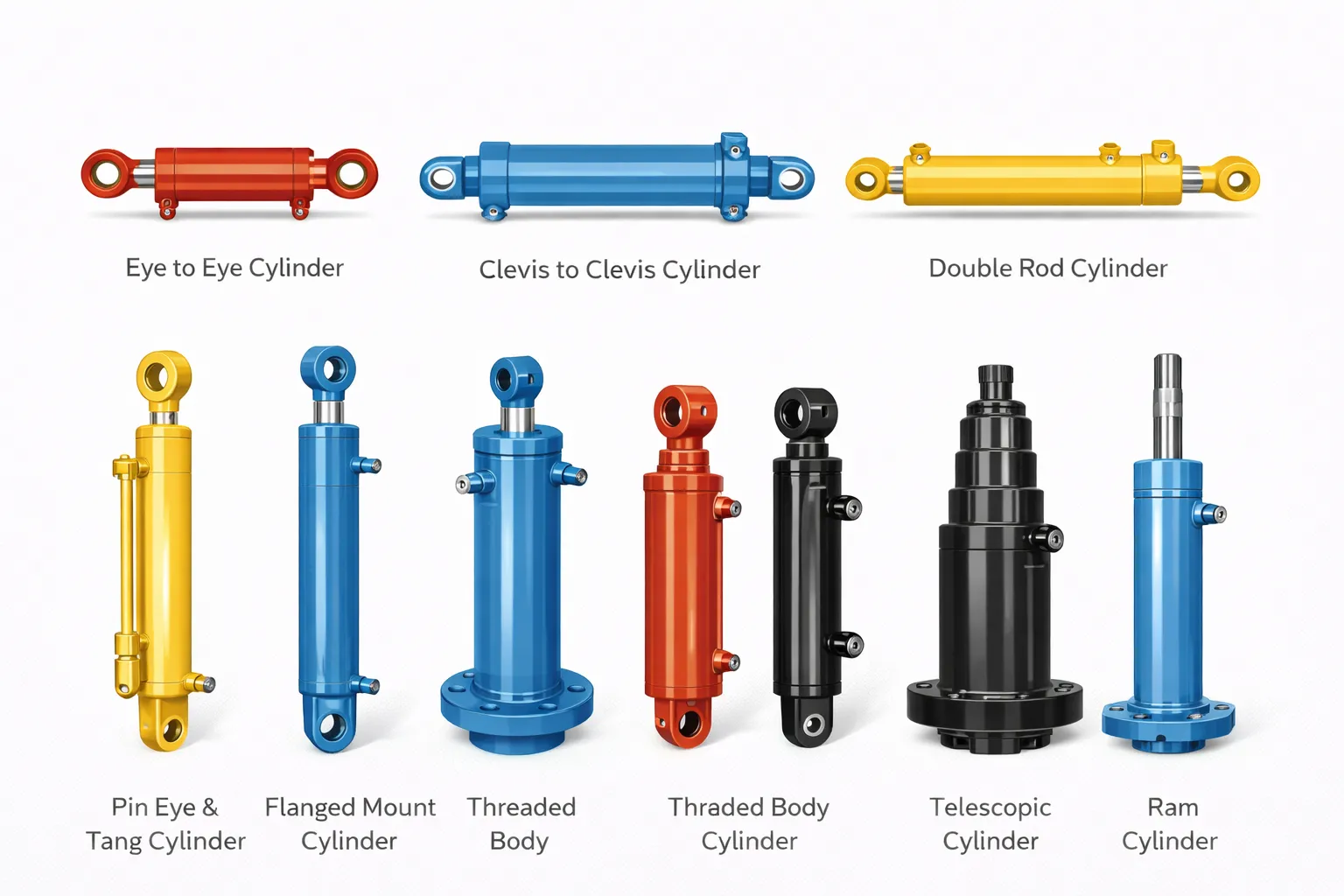
Global Field Validation: Proven Operational Case Studies
Advanced engineering theory is ultimately proven true in the mud, dust, and shattered rock of live construction and mining operations. Our hydraulic solutions have secured extensive, long-term procurement partnerships across the Asia-Pacific region. Here are five documented accounts of our components resolving critical mechanical crises.
Case Study 1: Seoul Underground Expressway Project, South Korea
Client Entity: Leading Tier-1 Heavy Civil Infrastructure Consortium.
Application Setting: Continuous angle adjustment of transfer chutes on roadheaders cutting through highly abrasive, watery coastal geology.
Context & Connection: The chief procurement officer contacted us after searching online for a reliable hydraulic cylinder manufacturer to overhaul their fleet. Their factory-installed OEM cylinders were leaking fluid every four hundred hours because the aggressive, sandy granite slurry was shredding the standard wiper seals. The transfer chute would sag unpredictably, spilling tons of rock onto the tunnel floor and halting the entire advance.
The Solution & Result: We deployed a fleet of custom Transfer Chute Cylinder units integrated with our three-stage sealing architecture. Installed in late twenty twenty-three, the units logged over three thousand eight hundred continuous operational hours. The aggressive external scraper perfectly rejected the abrasive sandy mud, completely eliminating internal fluid bypass and saving the project weeks of downtime.
“The sealing technology is phenomenal. We haven’t had to perform a single mid-tunnel seal replacement since integrating these units. A genuinely permanent fix to our mud problem that has optimized our budget.” — Park J.W., Lead Equipment Superintendent.
Case Study 2: Hokkaido Deep Seam Mineral Mine, Japan
Client Entity: Regional Specialized Coal Mining Corporation.
Application Setting: Transfer machinery operating in an environment completely saturated with highly abrasive, pulverized coal dust and acidic water.
Context & Connection: The client’s maintenance depot was overwhelmed, frequently needing expensive hydraulic cylinder repair. The ultra-fine coal dust was mixing with condensation to form a grinding paste that rapidly degraded the single-lip wipers on their factory units, eventually destroying the internal hydraulic pumps due to oil contamination. They reached out via our website for advanced sealing solutions.
The Solution & Result: We delivered fully optimized Transfer Chute Hydraulic Cylinder units featuring our multi-pass hard chrome plating process and impenetrable triple sealing matrix. After fourteen months of daily exposure, fluid sampling confirmed the internal oil remained completely free of particulate contamination.
“The defense against abrasive dust is vastly superior to the original equipment. These units handle the coal slurry without breaking a sweat, keeping our conveyors loaded continuously and our pump failures near zero.” — Kenji M., Operations Director.
Case Study 3: Taipei Metro Expansion Project, Taiwan
Client Entity: Municipal Civil Engineering Contractor.
Application Setting: High-frequency chute angle adjustments cutting through unpredictable urban bedrock and fractured shale.
Context & Connection: The contractor was actively seeking to bypass the exorbitant European OEM hydraulic cylinder price index. Furthermore, heavy rock falls onto the chute were physically bending the standard carbon steel rods of their existing units, causing catastrophic seal blowouts during operation and delaying the project timeline.
The Solution & Result: By upgrading the core material to high-tensile 27SiMn alloy steel, we provided a double acting hydraulic cylinder drop-in replacement that absorbed the impact shocks flawlessly. Rod deflection was entirely neutralized, and the transfer machines maintained maximum operational availability throughout the bedrock phase.
“The metallurgical upgrade makes all the difference. These cylinders take brutal hits from falling rock and the rods remain perfectly straight. Incredible engineering value that fit perfectly without any modifications.” — Lin C., Fleet Maintenance Supervisor.
Case Study 4: Queensland Contract Mining, Australia
Client Entity: Heavy Machinery Leasing Consortium.
Application Setting: Supplying rugged continuous miners dealing with extreme load shocks when large coal boulders hit the transfer chute.
Context & Connection: The client was evaluating the global market for reliable hydraulic cylinder components to upgrade their lease fleet. Standard carbon steel cylinders were denting under the sudden weight of heavy coal lumps dropping onto the conveyor barrel, rendering the internal piston permanently jammed and paralyzing the machine deep in the drift.
The Solution & Result: By fabricating the entire double acting hydraulic cylinder from high-yield 27SiMn alloy steel, barrel denting was completely eradicated. The leased machines operated across grueling twenty-four hour schedules with absolute mechanical reliability, securing lucrative contract extensions for the leasing firm.
“The structural toughness of the 27SiMn steel saved our lease contracts. Our clients can literally dump boulders onto the chute, and the cylinders handle the impact without flinching.” — D. Mitchell, Fleet Supervisor.
Case Study 5: Hydroelectric Diversion Tunnel, Vietnam
Client Entity: State-Owned Hydropower Engineering Group.
Application Setting: Confined, high-humidity tunnel advancing through fractured, highly abrasive bedrock with relentless mud accumulation.
Context & Connection: Discovered our expertise through a B2B search for fixing hydraulic cylinders solutions. Their maintenance team was exhausted from constantly repairing units on-site because the trunnion welds on their standard cylinders were vibrating apart, threatening total structural collapse of the loader mechanism.
The Solution & Result: We provided custom Transfer Chute Hydraulic Cylinder units manufactured with robotic submerged arc welding and comprehensive thermal stress relief. The mounting brackets remained completely intact through severe vibration, allowing the tunneling crews to focus on advancing the heading rather than executing dangerous underground welding.
“The welding integrity is absolutely flawless. These units absorb the machine’s vibration perfectly, completely eliminating the dangerous structural failures we were experiencing.” — Nguyen T., Chief Engineer.
Frequently Asked Questions
Sourcing critical fluid power equipment demands rigorous mechanical due diligence. Below, we address the most prevalent technical inquiries from engineering directors and procurement managers regarding our highly specialized material handling solutions.
1. What primarily causes severe rod wear in transfer conveyor cylinders?
2. How does the three-stage sealing matrix completely prevent mud and dust from entering the fluid chamber?
3. Why choose 27SiMn alloy steel over standard carbon steel for this specific component?
4. Can this double acting hydraulic cylinder replace a Sandvik or Epiroc unit directly?
5. What is the standard production and shipping lead time to South Korea or Southeast Asia?
6. Do you provide internal components for fixing hydraulic cylinders at our own maintenance depot?
7. How does investing in this 27SiMn unit impact the long-term hydraulic cylinder price structure of our project?
Stop Abrasive Contamination Today
Do not allow substandard sealing technology or weak carbon steel to dictate your material extraction velocity or compromise your project’s profitability. Partner with a globally trusted engineering facility and equip your heavy tunneling machinery with the most robust, mud-resistant Transfer Chute Cylinder available in the heavy industrial sector.
Transmit your exact OEM machinery part numbers, maximum hydrostatic system pressure ratings, and baseline physical dimensions for a comprehensive technical evaluation and a rapid, factory-direct quotation.
Editor: Cxm


























