Jacking Cylinder for Wind Tower Docking Vehicles
Engineered with forged ear mounts and Q345D high-strength structural steel to permanently eliminate cylinder body fatigue during the heavy-duty lifting and millimeter-precision alignment of massive wind turbine sections.
Product Overview & Core Industrial Value
The global renewable energy infrastructure boom, particularly across the coastal and mountainous terrains of South Korea, Japan, and Taiwan, has mandated the construction of exceptionally massive wind turbines. The steel tower segments composing these multi-megawatt structures frequently exceed 150 tons. To maneuver and assemble these colossal components, specialized heavy transport equipment known as tower docking vehicles are deployed. The absolute mechanical heart of these vehicles—the exact component that dictates whether a multi-ton payload is aligned safely or dropped disastrously—is the jacking cylinder.
Standard industrial fluid power equipment is hopelessly outmatched in this extreme environment. When a docking vehicle attempts to maneuver a massive tower section across uneven construction pads, immense lateral wind loads and shifting weight distributions transfer lethal mechanical stress directly into the suspension and lifting framework. A conventional hydraulic oil cylinder utilizing basic welded flat-plate mounts will rapidly suffer from localized stress concentrations. This quickly leads to the most dangerous failure mode in the heavy transport sector: cylinder body fatigue. Once the barrel or the mounting welds develop micro-fractures under alternating loads, catastrophic structural collapse is imminent.
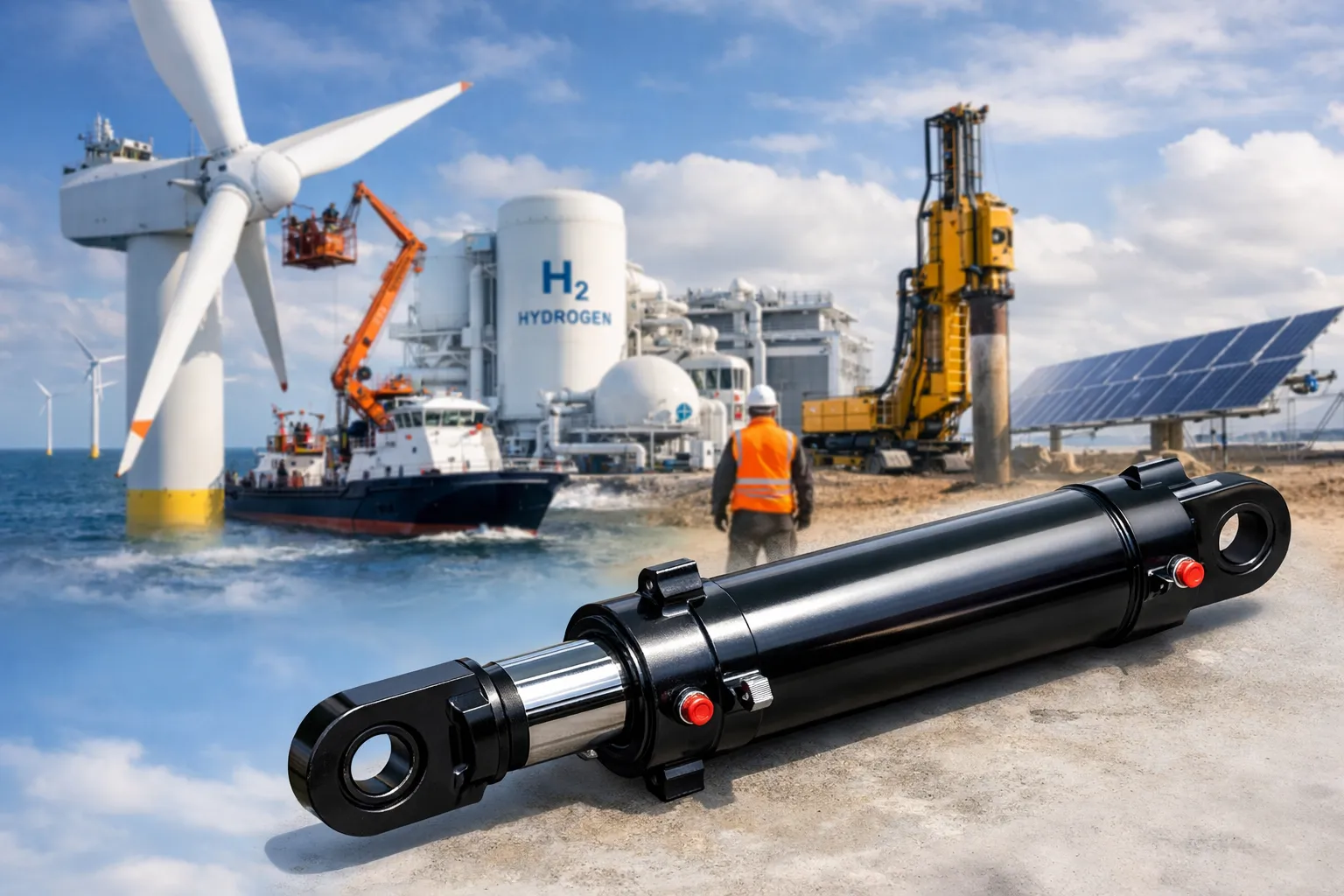
As an elite hydraulic cylinder manufacturer, we perceived this vulnerability and engineered a fundamentally superior fluid power solution. Our specialized jacking hydraulic cylinder entirely abandons standard carbon steel, utilizing Q345D low-alloy, high-strength structural steel instead. This ensures unparalleled impact toughness, even in freezing winter construction scenarios down to -20 C. Most importantly, we integrate solid forged ear mounts directly into the cylinder’s architecture, completely eliminating the welded weak points that plague standard actuators. By providing this level of extreme structural over-engineering, we offer EPC contractors an exceptional hydraulic cylinder price-to-lifespan ratio, ensuring your multi-million dollar wind tower assemblies proceed with zero equipment-related delays.
Technical Parameters & Customization Matrix
Integrating fluid power into a complex multi-axle tower docking vehicle requires exact dimensional conformity and rigorous load-bearing calculations. Our engineering division works directly with heavy equipment designers to customize internal bore capacities, stroke lengths, and structural mounting points to accommodate the specific tonnages of varying wind turbine classes. The comprehensive table below details the foundational specifications and adaptable engineering boundaries of our lifting solutions.
| Engineering Category | Specification Details & Adaptable Ranges |
|---|---|
| Industry Sector | New Energy / Wind Power Construction Equipment |
| Device Category | Tower Docking Vehicle / Specialized Modular Transporter |
| Subsystem / Action | Suspension and lifting chassis / Elevating tower segments |
| Actuator Designation | Jacking cylinder / Heavy-duty lift cylinder |
| Primary Action Mode | Double acting hydraulic cylinder (Powered bidirectional force) |
| Architectural Structure | High-pressure Piston Cylinder |
| Manufacturing Structure | Heavy-duty Automated Deep Penetration Welded Assembly |
| Material System | Q345D Low-Alloy Structural Steel (Superior sub-zero toughness) |
| Surface Machining Finish | Hard Chrome Plated (High wear and marine corrosion resistance) |
| Environmental Grade | Heavy-duty docking / Aggressive coastal and mountain climates |
| Crucial Working Condition | Lifting tower sections (Supporting extreme vertical and shifting lateral loads) |
| Primary Failure Mode Prevented | Cylinder body fatigue and welded mount shearing |
| Recommended Configuration | Forged ear mounts (Solid forged trunnion/clevis for maximum integrity) |
Fluid Dynamics & Operational Working Principle
The operation of a tower docking vehicle relies on the flawless synchronization of multiple lifting points to control pitch, roll, and vertical elevation simultaneously. When the operator initiates the lifting command to align the massive wind tower flanges, the vehicle’s central hydraulic power unit pumps highly pressurized synthetic fluid—often exceeding 350 bar—into the cap end (blind end) ports of the cylinder barrels.
This extreme fluid pressure acts immediately upon the vast surface area of the internal hydraulic cylinder piston. Given the incompressible nature of hydraulic oil, this translates into an overwhelming, yet seamlessly smooth, vertical lifting force. The massive steel rods extend, physically elevating the docking platform and the 150-ton tower section resting upon it. During this critical phase, it is not merely about lifting; it is about microscopic precision. The operator must make millimeter-level height adjustments to align the hundreds of bolt holes on the connecting flanges. Our proprietary low-friction guide rings and precisely honed internal bores ensure that even under a hundred tons of payload, the jacking cylinder executes these micro-movements without suffering from erratic mechanical “stick-slip” juddering, which could severely damage the machined faces of the flanges.
Safety and control during the descent are equally paramount. Relying on a basic single acting hydraulic cylinder that uses only gravity and the weight of the load to retract is highly dangerous in wind farm construction, as irregular track friction or freezing temperatures can cause uneven, stalled dropping. Our equipment functions strictly as a true double acting hydraulic cylinder. To lower the platform, the directional control valves reverse the flow, aggressively pumping fluid into the rod end while venting the cap end through precise counterbalance valves. This hydraulically pulls the platform down in a perfectly horizontal, controlled manner, eliminating the risk of binding or sudden load shifts and freeing the vehicle for the next transport cycle rapidly.
Seamless Fleet Upgrades & Brand Replacement Compatibility
Fleet managers operating specialized heavy transport equipment often face significant logistical hurdles when original equipment manufacturer (OEM) parts fail in the field. Sourcing replacement lifting modules directly from European manufacturers can involve exorbitant lead times and highly inflated logistics costs, effectively paralyzing a wind farm construction schedule for months.
To resolve this operational bottleneck, our engineers have aggressively cataloged the dimensional footprints, retracted pin-to-pin lengths, trunnion diameters, and fluid port threads of the global heavy transport industry’s leading platforms. Our high-strength hydraulic rams and lifting modules are engineered to serve as direct, drop-in replacements for equipment originally manufactured by heavy logistics brands such as Scheuerle, Kamag, Goldhofer, Faymonville, Enerpac, and Bosch Rexroth. (Please note: Mention of these specific corporate trademarks is provided solely for the purpose of dimensional cross-referencing, engineering compatibility, and assisting fleet mechanics in equipment selection. We operate as an entirely independent manufacturing entity and respect all international intellectual property rights.) By supplying dimensionally identical, upgraded Q345D steel solutions, we ensure that executing routine maintenance or comprehensive fixing hydraulic cylinders overhauls keeps your heavy alignment vehicles fully operational on the job site without requiring cutting or welding of the chassis.
8 Core Technical Advantages: Engineering for Heavy-Duty Survival
A commercial actuator designed for a factory floor cannot survive on a muddy, freezing wind farm construction site. Our jacking hydraulic cylinder incorporates profound engineering enhancements that definitively distinguish it from standard fluid power:
-
1. Eradication of Mount Shearing via Forged Ear Mounts
Standard lifting cylinders often utilize steel plates that are simply surface-welded onto the cylinder base. Under the immense, shifting lateral loads of a swaying wind tower section, these surface welds experience extreme stress concentrations and frequently shear off. We integrate massive, solid forged steel ear mounts directly into the cylinder’s base architecture. The continuous grain flow of the forged steel provides unparalleled tensile strength, making the mount virtually indestructible under heavy-duty docking maneuvers.
-
2. Q345D Low-Temperature Structural Resilience
The primary cause of catastrophic failure in lifting equipment is cylinder body fatigue—the gradual microscopic cracking of the barrel under constant high-pressure cycling. We completely reject standard carbon steel. Our entire pressure vessel is machined from thick-walled Q345D low-alloy, high-strength steel. The ‘D’ designation indicates exceptional impact toughness even at freezing ambient temperatures (-20 C), ensuring the barrel never ruptures or deforms during high-stress winter construction projects.
-
3. Deep Penetration Anti-Fatigue Welding
The structural integrity of a welded piston cylinder is entirely dependent on the quality of its fusion zones. We utilize advanced multi-pass, automated submerged arc welding (SAW) to bond the end caps to the Q345D barrel. This deep-penetration process creates a flawless metallurgical bond, entirely free of internal porosity, slag inclusions, or stress-inducing undercuts, completely immunizing the joint against long-term mechanical fatigue.
-
4. Advanced Hard Chrome Plating for Coastal Defense
Wind logistics bases are frequently located in coastal ports, subjecting equipment to highly corrosive, chloride-rich sea air. We protect the high-carbon steel rod with a heavily optimized, micro-cracked hard chrome plating process. This produces an exceptionally hard surface that actively repels salt-induced oxidation, ensuring the rod remains mirror-smooth and prevents premature wear on the delicate wiper seals.
-
5. Ultra-Low Friction Polymer Seal Matrix
Aligning massive steel flanges requires the ability to bump the cylinder up or down by mere millimeters. Standard rubber seals grip the cylinder wall, causing a jerky, unpredictable motion. We integrate a proprietary sealing matrix featuring bronze-filled PTFE step seals and extended polymer guide bands. This dramatically reduces static breakaway friction, allowing the operator to execute flawless, microscopic alignments without jarring the multi-ton payload.
-
6. Load-Holding Safety Valve Integration Readiness
In the event of an external hydraulic hose rupture, a suspended tower section could plummet, causing catastrophic damage. Our cylinders are engineered with precision-machined cavities directly within the cylinder head or base block to house pilot-operated check valves or counterbalance valves. This integral safety feature instantly locks the fluid inside the jacking cylinder if external pressure is lost, holding the load rigidly in place.
-
7. Aggressive Environmental Scraper Systems
Construction sites are plagued by abrasive dirt, cement dust, and ice. If debris bypasses the outer seal, it acts like a grinding paste against the internal components. We equip our front glands with aggressively profiled, heavy-duty polyurethane and metallic dual-lip scraper rings. These physically shear baked-on mud, ice, and grit away from the retracting rod, ensuring internal fluid contamination remains at absolute zero.
-
8. Highly Accessible Modular Serviceability
Wind farm construction often occurs in highly remote locations. When a heavy equipment breakdown happens, removing a massive actuator and shipping it back to a city for service is economically unviable. We design our front gland architectures using heavy-duty bolts or robust threaded designs. This allows on-site fleet mechanics to swiftly extract the rod assembly and execute comprehensive hydraulic cylinder repair and seal replacements right on the back of the docking vehicle, utilizing standard tools.
In-House Manufacturing Craftsmanship & Quality Control
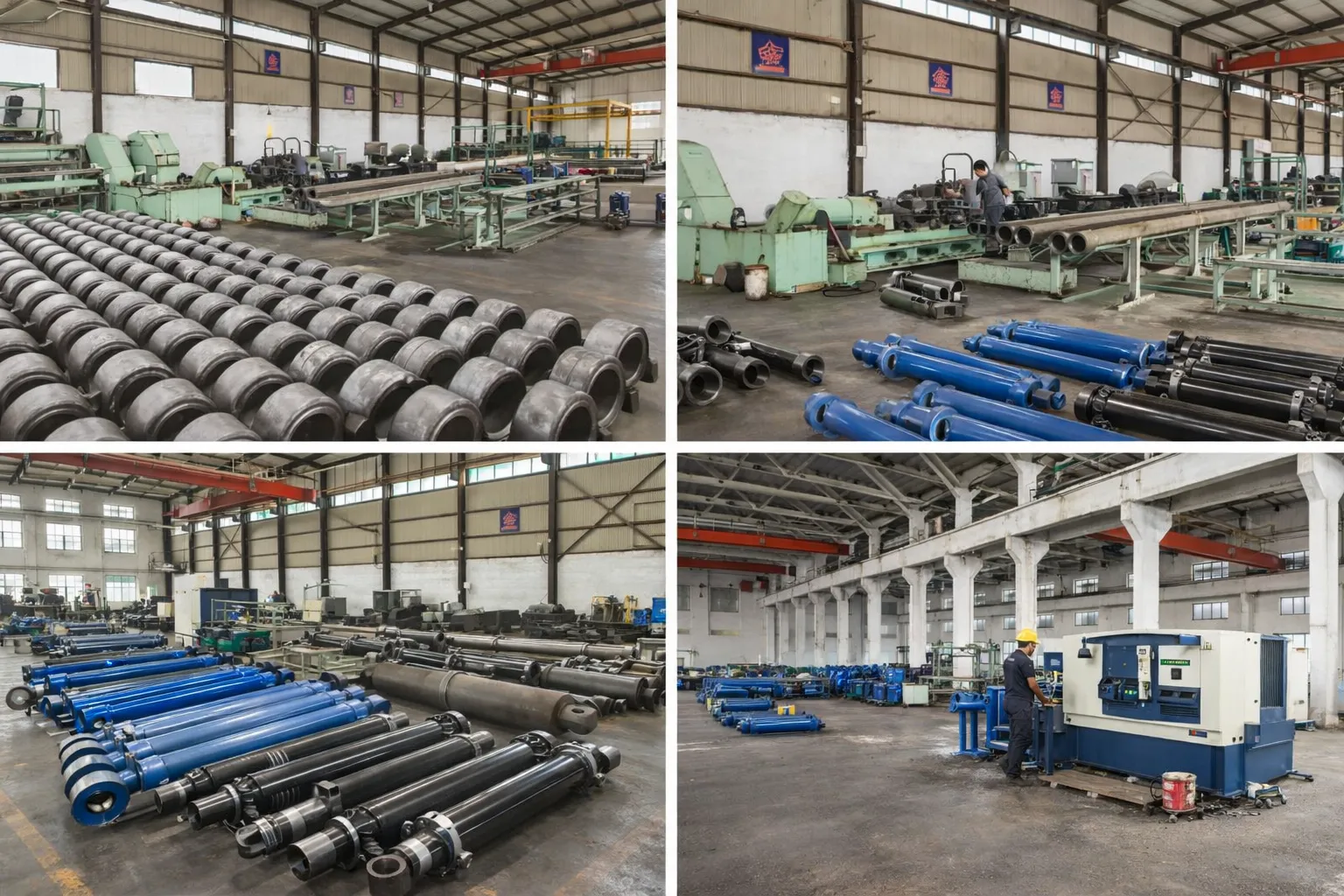
The distinction between a generic parts broker and an elite OEM fluid power manufacturer lies exclusively in the rigor of the production floor. We execute 100% of our critical manufacturing operations in-house to maintain absolute command over quality. The process begins in our metallurgy lab, where incoming batches of Q345D steel tubing and forged ear mounts are subjected to ultrasonic flaw detection to guarantee the raw materials contain zero internal voids or hairline cracks before a single cut is made.
Physical machining is performed on advanced multi-axis heavy-duty CNC lathes, ensuring that all threaded components and the internal bore tolerances holding the hydraulic cylinder piston are cut to exact micrometer specifications. Following the deep-penetration automated welding phase, the structural welds undergo Magnetic Particle Inspection (MPI) to verify the absolute absence of surface-breaking defects, confirming their resilience against cylinder fatigue.
Quality assurance is a non-negotiable mandate. Before any jacking cylinder is cleared for global export, it must survive an exhaustive factory testing protocol. We perform dynamic functional stroke testing and a mandatory hydrostatic pressure hold test, deliberately pushing the unit to 150% of its maximum rated operational pressure. This verifies zero internal fluid bypass and absolute external seal integrity under severe overload conditions. Following testing, each unit receives a unique laser-etched serial number, providing our B2B partners with immutable, decades-long traceability for all material certificates and replacement hydraulic parts.
Cross-Industry Adaptability & Extreme Heavy Applications
While meticulously engineered to conquer the massive payloads and precision requirements of wind tower construction equipment, the foundational technology—forged structural integrity, Q345D fatigue resistance, and high-pressure load holding—makes these actuators indispensable across a wide spectrum of punishing heavy industries. We continually supply tailored lifting solutions for facilities where structural failure is simply not an option:
- Construction Machinery Industry: Providing the massive vertical force required for bridge launching gantries, heavy piling rigs, and self-propelled modular transporters (SPMTs) that move entire mega-structures.
- Metallurgical and Iron Industry: Elevating heavy ladle transfer cars and powering continuous casting manipulators where ambient radiant heat and extreme tonnages easily destroy conventional lifting mechanisms.
- Mining Industry: Supplying highly resilient suspension and steering cylinders for ultra-class haul trucks and massive ore crushers operating continuously under severe vibratory shock loads.
- Material Handling & Logistics: Supplying ultra-reliable double acting units for automated heavy-duty dock levelers, straddle carriers, and massive container lifting spreaders at major international seaports.
- Marine & Shipbuilding: Engineering custom jacking systems for dry dock ship transfer platforms and offshore jack-up oil rigs requiring extreme saline corrosion resistance.
- Special & Customized Scenarios: From massive aerospace testing jigs to bespoke hydraulic presses, our engineering department routinely scales this resilient technology for highly unique extreme-load challenges.
We invite you to discover our broader manufacturing capabilities by exploring our comprehensive Hydraulic Cylinder Product Portfolio.
Comparative Analysis: Standard Lifting vs. Specialized Jacking Cylinders
Heavy equipment procurement must be guided by engineering realities rather than merely upfront costs. When elevating hundred-ton wind tower sections, utilizing standard commercial-grade cylinders drastically increases the probability of structural deformation and lethal accidents. The table below starkly contrasts standard off-the-shelf actuators with our purpose-built, fatigue-resistant docking solutions.
| Performance Metric | Standard Commercial Lifting Cylinder | Our Q345D Wind Tower Jacking Cylinder |
|---|---|---|
| Base Metallurgy | Basic Carbon Steel (Prone to brittle failure in cold weather) | Q345D Low-Alloy Structural Steel (High impact toughness down to -20 C) |
| Mounting Architecture | Flame-cut welded steel plates (High risk of HAZ tearing and fatigue) | Solid Forged Steel Ear Mounts (Continuous grain structure, fatigue immune) |
| Precision Load Holding | Standard seals allow microscopic drift downward over several hours. | Zero-leak advanced seal matrix locks 150-ton loads solidly indefinitely. |
| Lateral Load Defense | Narrow wear rings lead to internal metal-to-metal scoring when load shifts. | Oversized bronze guide bands completely absorb lateral deflection forces. |
| Safety Mechanisms | Relies entirely on external hoses. Sudden burst causes load collapse. | Integrated counterbalance manifolds lock fluid instantly upon hose failure. |
Global Engineering Success: Real Heavy-Lifting Case Studies in Asia
Theoretical engineering must be validated by relentless performance under multi-ton payloads. Our footprint across major East Asian infrastructure projects clearly demonstrates our capacity to solve the most critical lifting crises for major equipment operators and EPC contractors.
Case Study 1: Eradicating Mount Shear in Ulsan, South Korea
Client & Location: A premier heavy transport logistics provider handling a massive 400MW offshore wind staging project in the port city of Ulsan, South Korea (May 2024).
The Challenge: The client utilized customized multi-axle docking vehicles to maneuver 120-ton lower tower sections. The original European OEM cylinders featured surface-welded mounting bases. The lateral sway of the massive tower sections during transit caused severe stress concentrations, completely shearing the welded mounts off the cylinder barrels and dropping the payload onto the vehicle chassis.
Engagement & Solution: Facing catastrophic equipment failure, the fleet director contacted us seeking an indestructible alternative. We designed a rapid retrofit utilizing our specialized jacking hydraulic cylinders featuring solid forged trunnion mounts machined directly into the Q345D steel base, eliminating the vulnerable weld joint entirely.
The Result: The entire fleet of docking vehicles was retrofitted within 45 days. They have since successfully transferred over 200 tower sections with absolute zero structural deformation or mount failures.
“The sheer mass and structural integrity of your forged mounts solved our most terrifying safety issue overnight. These cylinders are built like bank vaults. They laugh at the lateral stresses that destroyed our previous equipment.” — Kang Dae-hyun, Director of Heavy Logistics.
Case Study 2: Conquering Cold Weather Fatigue in Hokkaido, Japan
Client & Location: A major renewable energy EPC contractor constructing a high-altitude onshore wind farm in the freezing mountains of Hokkaido, Japan (November 2025).
The Challenge: Ambient temperatures frequently plummeted to -15 C. The standard carbon steel cylinders on their docking equipment became dangerously brittle in the cold. The continuous pressure cycling caused severe cylinder fatigue, resulting in microscopic hairline cracks along the barrel that began weeping hydraulic fluid onto the pristine snow.
Engagement & Solution: They urgently required high-performance replacements. We supplied a batch of highly customized double acting hydraulic cylinders manufactured exclusively from Q345D steel, specifically chosen for its exceptional low-temperature impact toughness, combined with aerospace-grade low-temp elastomeric seals.
The Result: The equipment operated flawlessly through the harshest winter months. The cylinder fatigue was entirely eliminated, and the environmental hazard of leaking oil was resolved, keeping the project strictly on schedule.
“Standard steel simply shatters up here under these loads. Your Q345D metallurgy was the exact engineering intervention we needed. The reliability in sub-zero conditions is flawless.” — Kenji Yamamoto, Lead Project Engineer.
Case Study 3: Flawless Micro-Alignment in Binh Thuan, Vietnam
Client & Location: A specialized turbine installation firm operating on a major coastal wind project in Binh Thuan province, Vietnam (August 2023).
The Challenge: The operators were struggling immensely to align the bolt holes of the tower flanges. The high static friction (stiction) of their current cylinders caused the docking platform to jump unpredictably when they tried to make millimeter-level height adjustments, resulting in damaged flange faces and hours of wasted crane time.
Engagement & Solution: The procurement team found us while searching for advanced fluid power solutions and inquired about our hydraulic cylinder price for low-friction upgrades. We delivered our specialized jacking cylinders featuring bronze-filled PTFE composite seals and micro-polished internal bores.
The Result: The stick-slip phenomenon vanished completely. Operators could now smoothly creep the 80-ton payloads up or down by fractions of a millimeter, reducing the average flange mating time by over 40%.
“The kinematic control is unbelievable. Being able to smoothly feather a multi-ton tower section into perfect alignment on the first try has revolutionized our installation speed.” — Nguyen Van Binh, Chief Installation Supervisor.
Case Study 4: Upgrading SPMT Fleets in Kaohsiung, Taiwan
Client & Location: An elite offshore wind logistics contractor managing the transport of massive monopiles and tower sections at the Port of Kaohsiung (August 2025).
The Challenge: The heavy salt spray from the ocean was aggressively pitting the chrome rods of their existing transport cylinders. Once the rods pitted, they destroyed the wiper seals, leading to severe fluid leaks directly onto the port tarmac during heavy lifting operations.
Engagement & Solution: During routine maintenance and fixing hydraulic cylinders across their fleet, the chief mechanic contracted us to provide a superior defense. We delivered heavy-duty cylinders featuring our double-thickness hard chrome plating and dual-lip aggressive marine wiper seals designed to physically eject crystallized salt.
The Result: The new rods have maintained their mirror finish for over a year of brutal coastal operation. Seal replacement frequency plummeted by 80%, drastically lowering their annual maintenance budget.
“The marine environment destroys weak hydraulics fast. Your thick chrome and aggressive wipers are exactly what we needed to keep our SPMTs lifting without constant seal blowouts.” — Lin Wei-chen, Chief Fleet Mechanic.
Frequently Asked Questions (FAQ)
We believe in total technical transparency. Below are the precise, expert answers to the most common engineering and logistical inquiries posed by heavy equipment OEMs and international fleet operators.
1. Why is Q345D steel strictly necessary, and how does it justify the hydraulic cylinder price?
Standard Q235 steel lacks the tensile strength to resist the continuous dynamic expansion forces generated by lifting 100+ tons, leading to rapid cylinder fatigue and barrel cracking. Furthermore, in cold weather, standard steel becomes brittle. Q345D is a low-alloy, high-strength steel that offers massive yield strength and retains exceptional impact toughness at -20 C. While the raw material increases the initial hydraulic cylinder price, it completely eradicates the risk of catastrophic barrel rupture, saving millions in potential equipment damage and liability.
2. Can your cylinders precisely match the footprint of our existing European OEM equipment?
Absolutely. A major segment of our business is rescuing fleets bound by slow OEM supply chains. We meticulously customize the pin-to-pin retracted lengths, stroke, internal bore diameters, and specifically, the forged ear mount dimensions to ensure our heavy-duty jacking hydraulic cylinder drops flawlessly into your existing docking vehicle chassis without requiring any cutting, welding, or vehicle modification.
3. How do forged ear mounts prevent the shearing failures seen in welded plate designs?
When a towering payload sways, immense lateral leverage is transferred down to the cylinder mounts. Surface-welded plates concentrate all this stress onto a single weld bead, which inevitably cracks. Forged ear mounts are shaped from a solid block of heated steel under massive pressure. This creates a continuous, uninterrupted metallurgical grain structure that can absorb monumental shear forces without yielding, ensuring the connection to your vehicle chassis remains unbreakable.
4. How does the double acting design improve the safety of tower section docking?
A single acting hydraulic cylinder relies solely on gravity to push the fluid back into the reservoir when lowering the load. If there is mechanical binding in the docking vehicle’s tracks, the cylinder can hang up, causing the heavy load to drop suddenly when it frees itself. Our true double acting hydraulic cylinder utilizes pressurized fluid to actively pull the platform down. This provides the operator with 100% powered control in both directions, ensuring a safe, smooth, and utterly predictable descent.
5. Do you supply replacement kits for ongoing hydraulic cylinder repair by our own mechanics?
Yes. We design our equipment specifically for serviceability in the field. The front gland utilizes robust, accessible bolting or heavy threading. We supply comprehensive matched seal kits, replacement guide bands, and heavy-duty scrapers tailored to your specific serial numbers. This empowers your fleet technicians to perform rapid fixing hydraulic cylinders procedures right at the coastal logistics base, ensuring your equipment stays operational.
6. How do you eliminate the “stick-slip” juddering during microscopic flange alignment?
Stick-slip occurs when the static friction of rubber seals is significantly higher than dynamic friction. We eradicate this by polishing the internal Q345D bore to a mirror finish and utilizing advanced bronze-filled PTFE step seals on the hydraulic cylinder piston. PTFE has an incredibly low coefficient of friction that remains constant whether moving fast or creeping slowly, guaranteeing flawlessly smooth micro-adjustments.
7. What are the logistics and delivery timelines for the South Korean and Asian markets?
By centralizing 100% of our machining, welding, and assembly in-house, we eliminate external delays. Standard heavy-duty fleet orders are manufactured, fully pressure-tested, and crated within 35 to 45 days. Sea freight to major heavy industrial hubs like Busan, Ulsan, or Incheon is exceptionally fast. We utilize heavy-duty, moisture-proof timber crating to ensure the pristine chrome rods arrive fully protected against the marine environment.
8. Do you conduct hydrostatic load testing on every cylinder before shipment?
Absolutely. When lives and massive infrastructure are on the line, theoretical calculations are not enough. We subject every single jacking cylinder to rigorous hydrostatic factory testing, pushing it to 150% of its rated maximum operating pressure. This physically proves that the deep-penetration welds are perfect and the internal seals hold flawlessly under extreme overload conditions before the unit ever leaves our facility.
Secure Your Heavy Lifting Operations with Unyielding Reliability
Do not allow substandard fluid power to jeopardize your personnel or your critical wind farm construction timelines. Upgrade your docking vehicles with Q345D high-strength actuators engineered specifically to conquer immense payloads and eliminate cylinder fatigue. Connect directly with our heavy engineering specialists to discuss your precise tonnage metrics and fleet footprint requirements.
Editor: Cxm