Column Cylinder for Hydraulic Support
Engineered for heavy-duty mining extraction, delivering absolute roof stabilization and eliminating barrel yielding under extreme subterranean pressure spikes.
Product Overview: The Backbone of Subterranean Safety
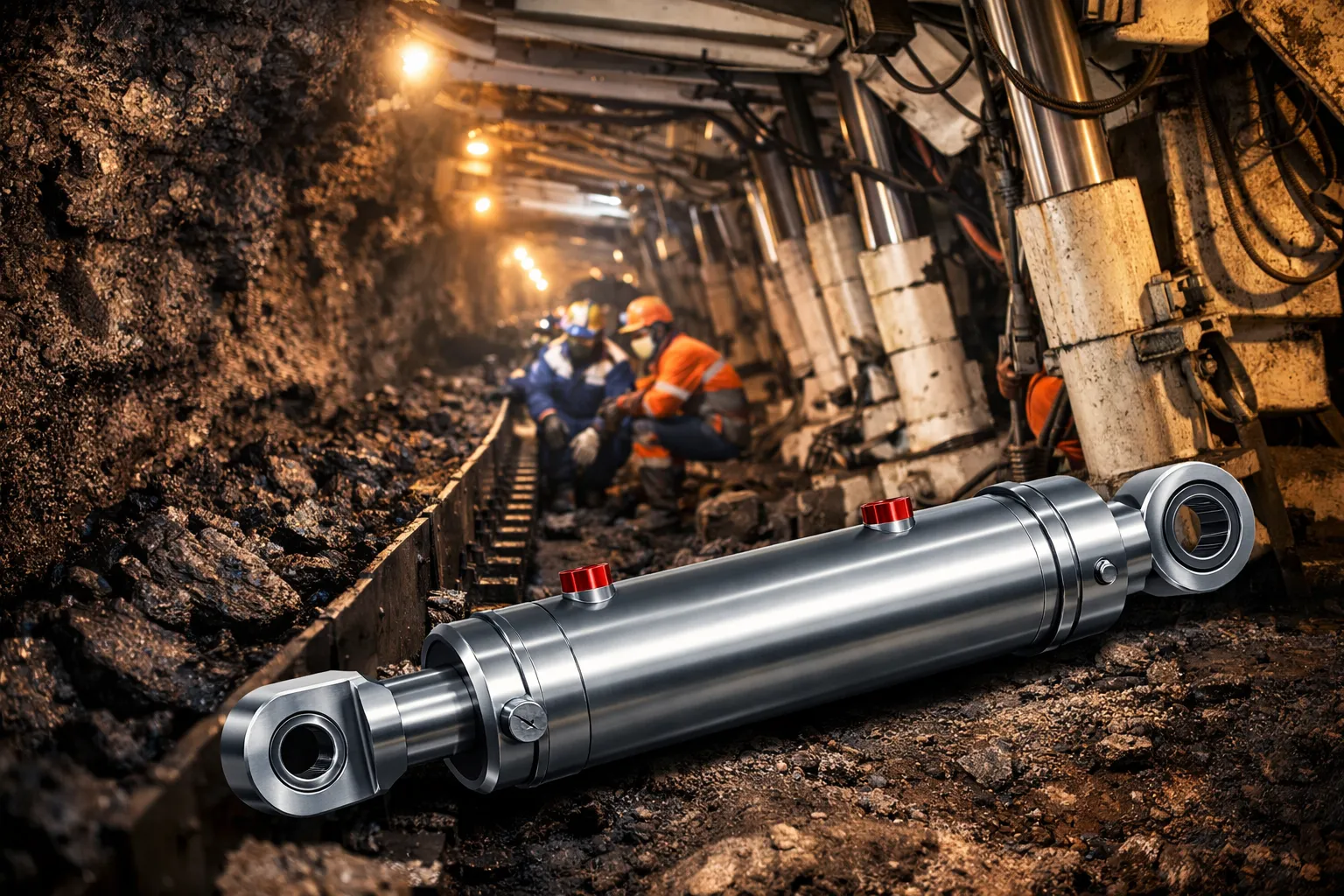
In the unforgiving environment of underground mineral extraction, mechanical failure is not merely a logistical inconvenience; it is an immediate safety hazard. At the center of any mechanized longwall or shortwall mining operation is the hydraulic support system. This massive steel shield is tasked with holding up millions of tons of overhead geological strata, providing a secure working envelope for extraction machinery and personnel. The active, load-bearing core of this protective structure is the column cylinder. Unlike standard industrial actuators that operate in predictable conditions, a column hydraulic cylinder must survive highly corrosive acidic groundwater, abrasive particulate contamination, and sudden, violent seismic impacts known as roof weighting.
Through decades of metallurgical research and structural fluid dynamics analysis, it is clear that standard fluid power components fail rapidly in these environments. When a conventional cylinder absorbs a massive geological shock, the internal hydrostatic pressure escalates instantly. This frequently results in cylinder barrel yielding—a catastrophic plastic deformation where the steel tube swells permanently, instantly destroying the internal seals and causing a complete loss of structural holding force. As a highly specialized hydraulic cylinder manufacturer, our engineering philosophy is centered entirely on eliminating this exact failure mode.
We have developed a high-performance cylinder that utilizes a mathematically optimized thick-wall barrel configuration combined with an integrally forged trunnion structure. By utilizing premium 42CrMo alloy steel instead of standard carbon steel, we deliver a hydraulic component that maintains its elastic integrity even under extreme dynamic impact forces. For procurement and maintenance directors operating in high-demand markets like South Korea and the broader Asia-Pacific region, investing in our premium hydraulic parts drastically reduces the total cost of ownership. It minimizes the dangerous necessity of fixing hydraulic cylinders at the active coal face and ensures your extraction machinery operates with uninterrupted reliability.
Comprehensive Technical Parameters
Proper equipment selection requires absolute transparency regarding dimensional tolerances, material composition, and functional limits. The table below details the exact manufacturing specifications and customizable engineering ranges for our heavy-duty roof support components.
| Engineering Category | Technical Specification & Data |
|---|---|
| Target Industry Focus | Mining Equipment / Heavy Subterranean Extraction |
| Equipment Category | Hydraulic Support Shields |
| Subsystem / Mechanical Action | Support System (Vertical Load Bearing) |
| Component Designation | Column Cylinder (Prop Cylinder) |
| Actuation Method | Double acting hydraulic cylinder Architecture |
| Internal Structure Type | High-Pressure Piston Cylinder Configuration |
| Manufacturing Construction | Heavy-Duty Welded Type |
| Core Material Matrix | Premium 42CrMo Alloy Steel (Quenched & Tempered) |
| Surface Treatment | Micro-cracked Hard Chrome Plating |
| Environmental Class | High load + High impact Conditions |
| Working Condition Feature | Active Roof Support and Strata Stabilization |
| Primary Failure Mode Mitigated | Cylinder Yield / Barrel Plastic Deformation |
| Recommended Engineering Configuration | Thick-Wall Barrel + Integrally Forged Trunnion |
Fluid Dynamics: Understanding the Working Principle
To appreciate the structural integrity of this equipment, one must understand the precise fluid dynamics governing its operation. The double acting hydraulic cylinder manages both extension and retraction through controlled hydrostatic pressure. In underground mining, this cycle is categorized into three critical phases: active setting, dynamic holding, and controlled advancing.
During the active setting phase, high-pressure, water-based emulsion fluid is pumped rapidly into the lower bore chamber. This fluid applies immense force against the surface area of the hydraulic cylinder piston, driving the high-tensile 42CrMo rod upward. This mechanical action forces the heavy steel canopy firmly against the rock ceiling. Once the required setting pressure is reached, highly responsive pilot-operated check valves lock the fluid inside the chamber, instantly transforming the unit from a lifting mechanism into an unyielding, rigid support pillar.
The most demanding phase is dynamic holding. As nearby coal is extracted, the geological strata shifts unpredictably, transferring colossal kinetic energy downward. The internal pressure within the hydraulic rams spikes dramatically. To prevent the barrel from exploding, a highly sensitive yield valve monitors the pressure. If the threshold is exceeded, it vents a microscopic amount of fluid, allowing the cylinder to compress fractionally. This controlled yielding safely absorbs the shockwave while maintaining constant upward resistance. Finally, during the advancing phase, fluid is directed into the upper annular chamber. The pressure acts on the rod side, forcibly retracting the canopy downward so the entire shield can be repositioned along the advancing coal face.
Seamless Equipment Compatibility and Brand Replacement
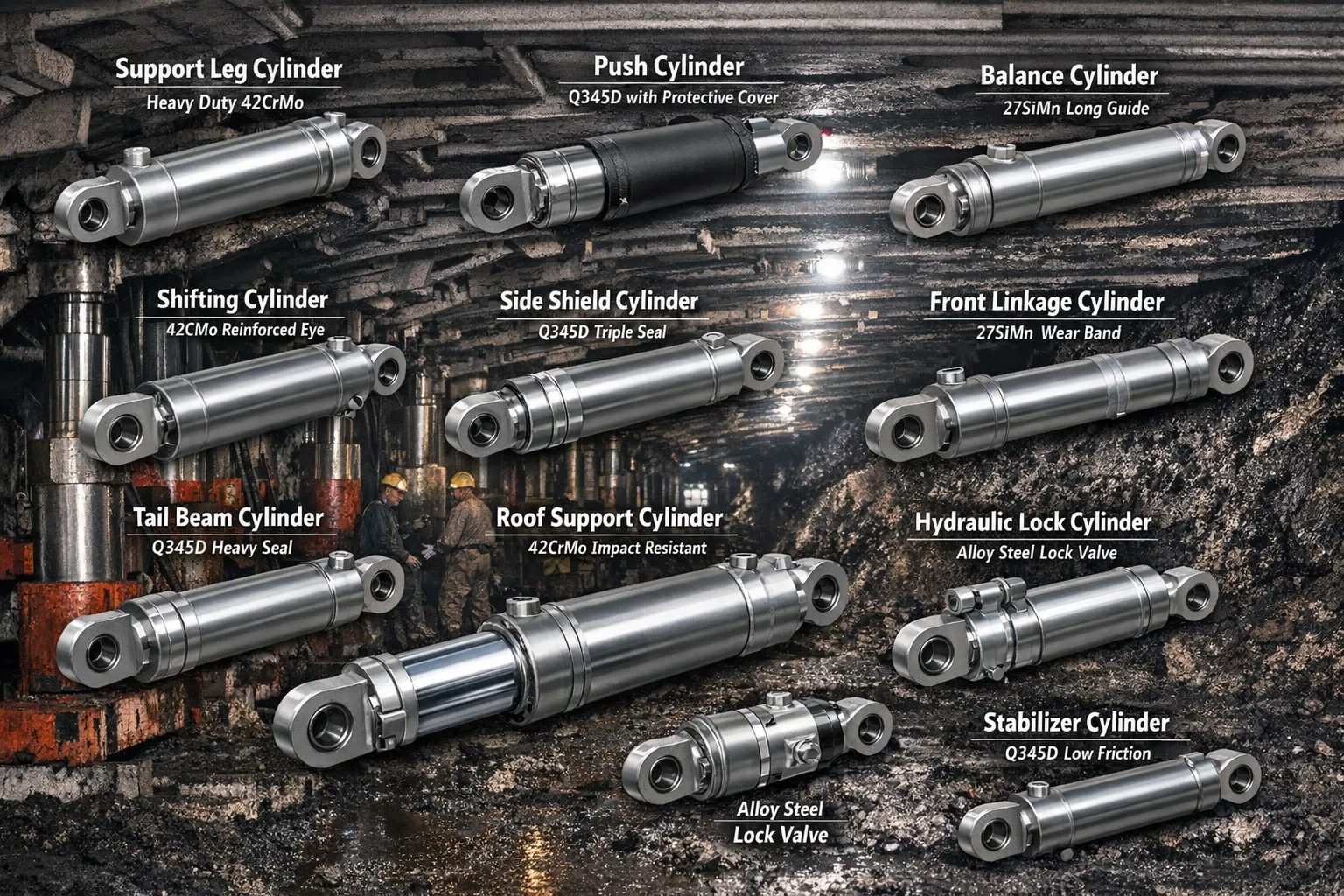
Fleet managers frequently struggle with excessive lead times and inflated costs when sourcing replacement parts from original equipment manufacturers. We provide an highly efficient alternative. Our engineering division accurately maps the dimensional footprints, pin diameters, stroke lengths, and fluid port specifications of globally recognized extraction equipment.
Technical Selection Note: Our robust hydraulic cylinders are dimensionally engineered to serve as direct drop-in replacements for machinery manufactured by industry leaders such as Caterpillar (Cat), Joy Global (Komatsu Mining), Sandvik, Epiroc, and Famur. Mention of these specific OEM brands is strictly for the purpose of communicating sizing compatibility and facilitating accurate technical selection for our clients; it does not imply any trademark infringement, direct corporate affiliation, or endorsement.
By choosing our highly compatible aftermarket solutions, maintenance teams can execute rapid, flawless upgrades without requiring expensive structural modifications to existing heavy steel frames. We provide access to a wide range of premium hydraulic cylinders that instantly elevate your fleet’s load-bearing safety margins.
Five Core Technical Advantages
What sets our subterranean-grade components apart from ordinary commercial actuators? The distinction lies in our rigorous application of metallurgical science and tribology. Below are the five foundational engineering advantages integrated into our designs:
1. Absolute Mitigation of Cylinder Yielding
We mathematically calculate the maximum theoretical hoop stress generated during severe geological impacts. By implementing a customized thick-wall barrel geometry, we ensure the structural integrity remains firmly within the elastic limit of the steel. This entirely prevents permanent plastic deformation, maintaining continuous seal compression and preventing catastrophic fluid blowouts under violent shock loads.
2. Integrally Forged Trunnion Architecture
Standard mounting blocks are typically surface-welded onto the barrel, creating heat-affected zones that are highly susceptible to fatigue cracking under lateral stress. We eliminate this weakness by utilizing an integrally forged trunnion structure. Machined from a single solid steel billet, this design ensures a continuous, uninterrupted grain flow, exponentially increasing resistance against high-impact shear forces.
3. Premium 42CrMo Alloy Steel Matrix
We reject the use of standard carbon steels (such as 1045 or Q345) for critical subterranean load-bearing applications. Every barrel and rod is constructed from premium 42CrMo alloy steel, subjected to meticulous quenching and high-temperature tempering. This achieves an exceptional balance of high surface hardness and deep core toughness, allowing the unit to resist bending during asymmetric roof convergence.
4. Ultra-Low Friction Composite Sealing
Internal friction generates destructive heat and accelerates wear. We equip the hydraulic cylinder piston with advanced polyurethane and PTFE composite sealing matrices. This ultra-low friction technology prevents the erratic “stick-slip” phenomenon during slow, high-pressure extensions, ensuring absolute volumetric efficiency and zero fluid bypass, even when handling aggressive water-based mining emulsions.
5. Thermal Stability and Micro-Cracked Chrome Plating
The underground environment is highly corrosive. We apply a specialized, multi-stage hard chrome plating process to the piston rods, strictly controlling the micro-cracking density. These microscopic fissures retain trace amounts of lubricating fluid, drastically reducing friction while forming an impenetrable barrier against acidic groundwater and abrasive silica dust, thereby optimizing overall fatigue life and extending maintenance intervals.
Autonomous Manufacturing and Rigorous Quality Control
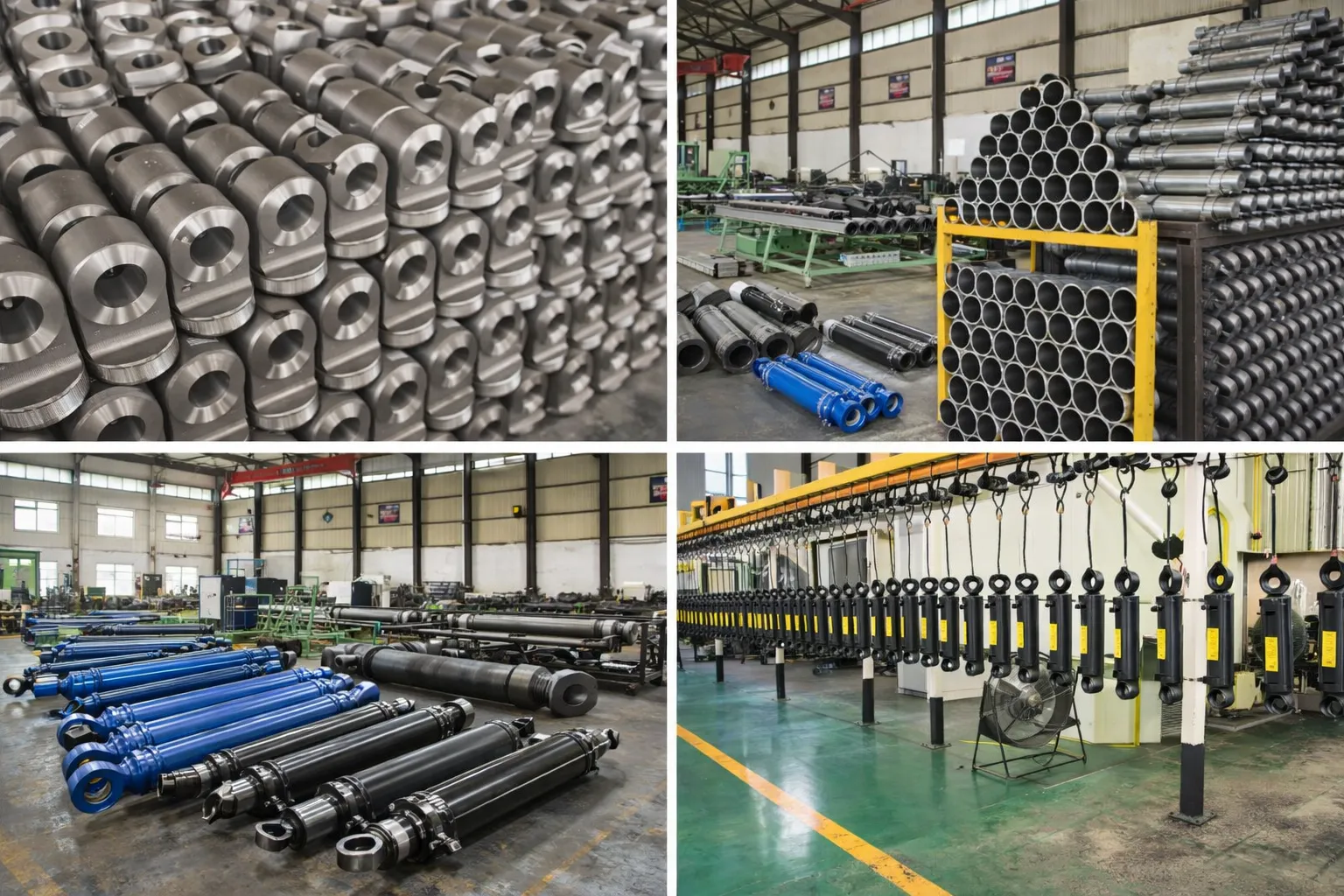
The theoretical excellence of a design is meaningless without absolute precision on the factory floor. Operating a fully vertically integrated manufacturing facility allows us to control every variable of the fabrication process. We employ multi-axis CNC turning centers and specialized deep-hole boring machines to guarantee the concentricity and extreme straightness of the thick-walled barrels. Advanced honing processes achieve a mirror-like internal surface finish, vital for maximizing seal longevity.
For structural joints, we utilize automated robotic submerged arc welding. This guarantees deep, consistent weld penetration entirely free from porosity or slag inclusions. Furthermore, every structural weld undergoes mandatory non-destructive testing (NDT), including ultrasonic flaw detection (UT) and magnetic particle inspection (MT), to verify absolute solidity.
Quality assurance culminates in our rigorous final acceptance protocols. Before shipping, 100% of our hydraulic cylinder components undergo intense hydrostatic pressure testing at 1.5 times their rated working load. We verify absolute seal integrity and zero internal fluid bypass. Finally, each unit is permanently laser-engraved with a unique serial number, providing complete, lifelong traceability back to the original steel mill certificates and factory test reports.
Typical Industry Applications
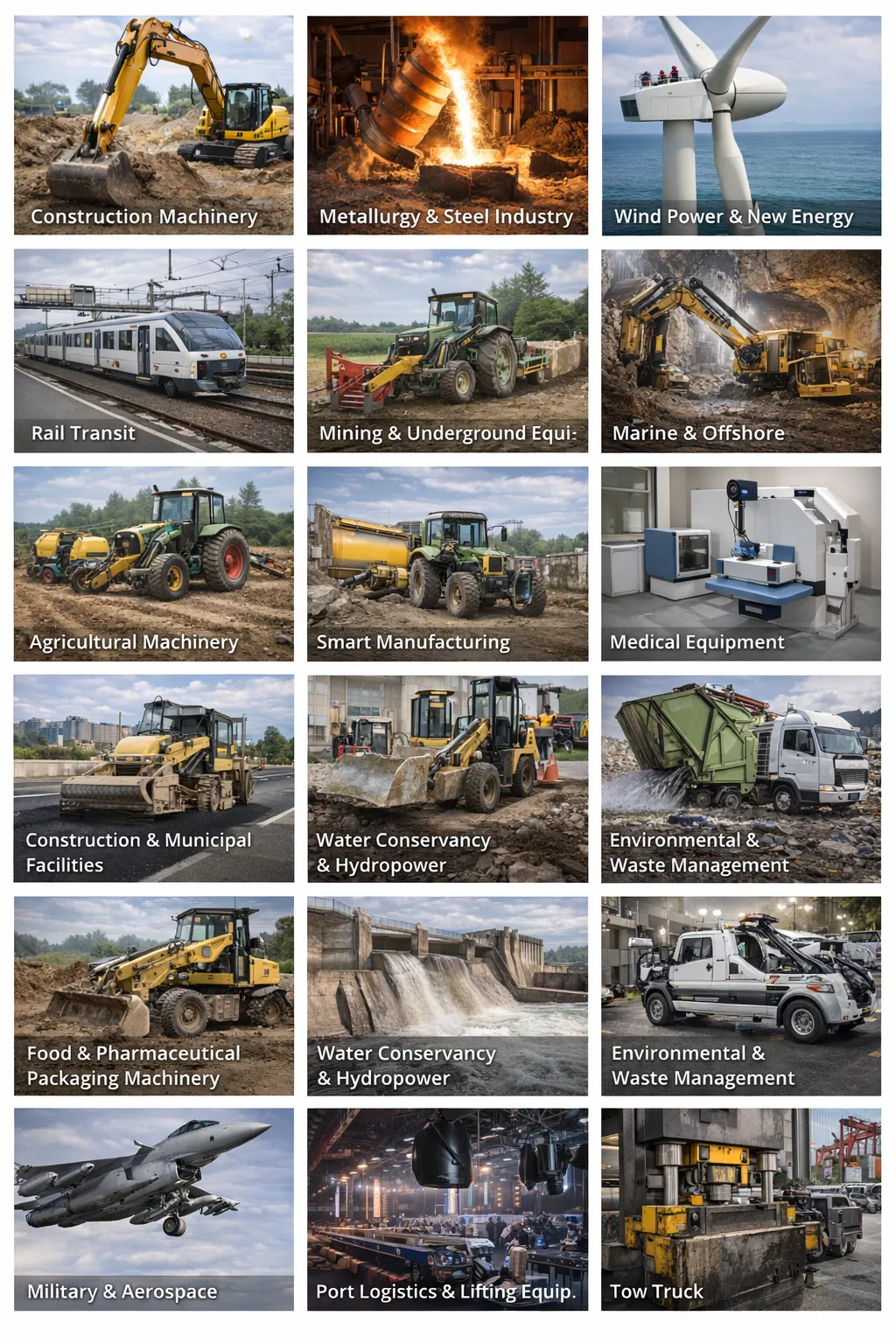
While engineered explicitly for extreme subterranean strata control, the robust, anti-yield architecture of this unit makes it highly valuable across numerous heavy industrial sectors requiring immense force generation and unyielding static load holding.
- Mining & Extraction Equipment: Primary application in mechanized longwall roof supports, continuous shearer height adjustments, and tunneling jumbos.
- Construction Machinery: Integrated as a heavy-duty lift cylinder in massive 100-ton excavators, rotary drilling rigs, and foundation piling machines. Explore our solutions for the construction machinery industry.
- Metallurgy & Heavy Forging: Powering high-temperature furnace tilting mechanisms, heavy billet extrusion presses, and continuous casting machinery.
- Plastic & Rubber Machinery: Delivering exact, repeatable high-tonnage clamping forces in industrial injection molding presses.
- Material Handling & Port Logistics: Essential for heavy gantry cranes, massive container reach stackers, and automated high-bay reclaiming systems.
- Custom Engineering Scenarios: Articulation control in custom Tunnel Boring Machines (TBMs) and marine offshore jack-up platform stabilization.
Comparative Analysis: Standard Market Cylinders vs. High-Performance Column Cylinders
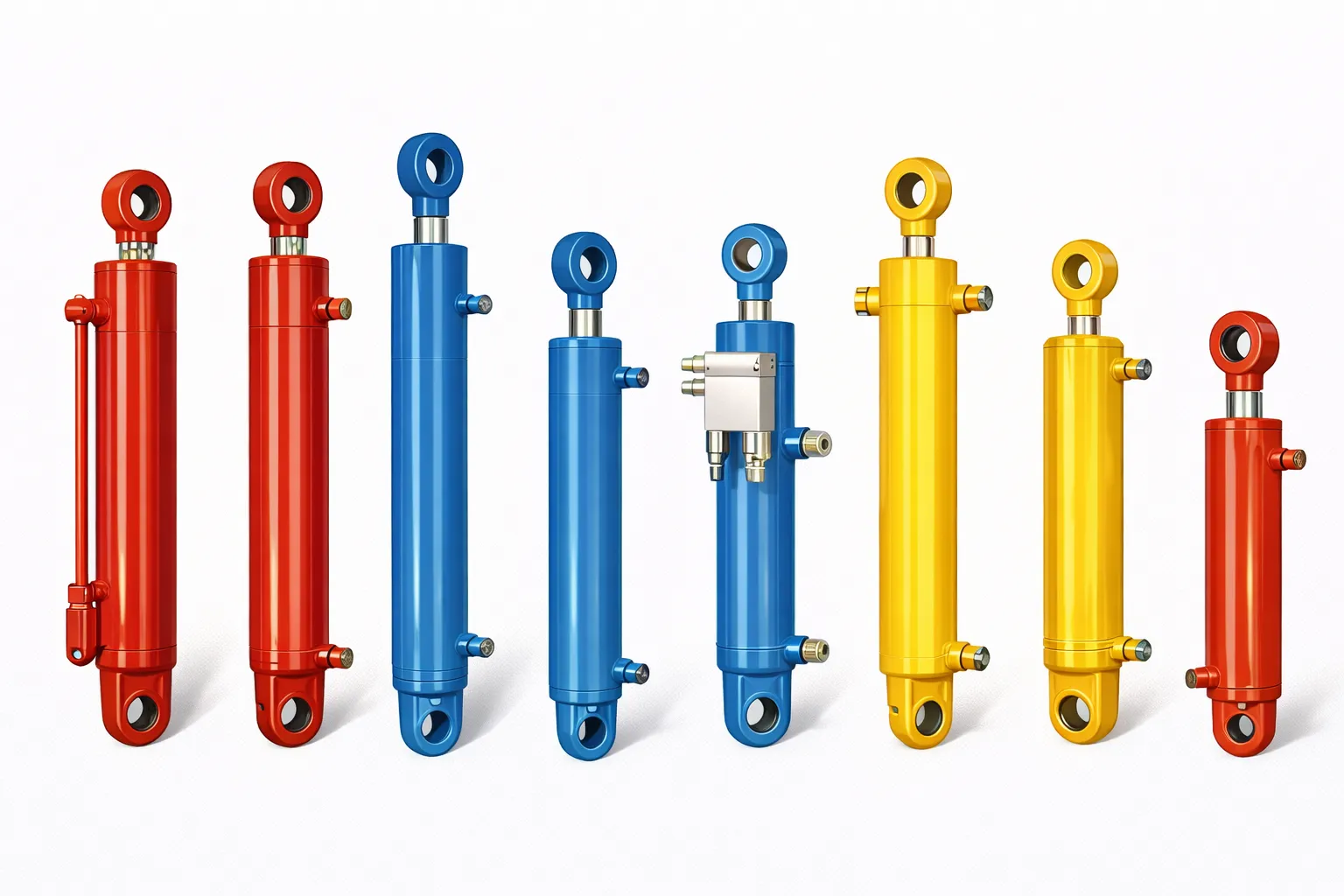
When evaluating fluid power procurement options, the initial component cost must be weighed against the long-term cost of machinery downtime. Standard industrial cylinders lack the metallurgical foundation to survive violent geological impacts. The comparison table below highlights the critical engineering distinctions.
| Engineering Feature | Ordinary Standard Hydraulic Cylinders | Our High-Performance Column Cylinders |
|---|---|---|
| Base Material Strength | Standard carbon steel (e.g., Q345/St52). Low yield strength under impact. | Premium forged 42CrMo alloy steel; exceptionally high tensile strength. |
| Barrel Geometry | Thin-walled tubes highly susceptible to plastic deformation and bursting. | Mathematically calculated thick-wall design; entirely prevents cylinder yielding. |
| Trunnion Design | Surface welded mounts creating brittle, crack-prone heat-affected zones. | Integrally forged solid trunnion blocks ensuring continuous grain flow. |
| Sealing Architecture | Standard NBR seals causing stick-slip motion and rapid thermal degradation. | Ultra-low friction composite PTFE/Polyurethane with anti-extrusion geometry. |
| Quality Testing Protocol | Random batch sampling; hidden internal defects often reach the end user. | 100% individual high-pressure holding tests at 1.5x working load with full traceability. |
Global Engineering Success: 5 Real-World Case Studies
The ultimate validation of specialized engineering is successful field deployment. Our robust fluid power solutions secure critical operations across the Asia-Pacific territory. Below are five detailed instances demonstrating how our highly optimized components resolved severe industrial challenges.
Case 1: Eradicating Barrel Yield in Deep Seam Coal Extraction
Location: Taebaek Mining District, South Korea | Date: October 2025
Client Profile: Major Regional Underground Energy Consortium
The Challenge: The operator was experiencing catastrophic cylinder yielding on their OEM roof supports due to localized seismic activity causing unpredictable, violent pressure spikes. They located our technical documentation via a B2B Google organic search.
The Engineered Result: We rapidly delivered a customized batch of 42CrMo column cylinders featuring our integrally forged trunnion geometry. Following installation, the facility recorded zero yielding incidents over 14 months, completely eliminating dangerous pressure loss emergencies.
“The structural rigidity of these components is visibly and operationally superior. They flawlessly absorbed recent heavy roof settling without a millimeter of deformation. The competitive hydraulic cylinder price provided immense value.” — Mr. Choi, Lead Maintenance Director.
Case 2: Advanced Coastal Infrastructure Tunneling
Location: Hokkaido, Japan | Date: May 2024
Client Profile: Large-Scale Civil Engineering and Tunneling Contractor
The Challenge: A custom Tunnel Boring Machine (TBM) required highly durable thrust mechanisms. Highly acidic coastal groundwater was rapidly stripping standard chrome plating, causing internal seals to shred. They connected with us via a specialized industrial networking portal.
The Engineered Result: We supplied specialized units protected by our advanced micro-cracked hard chrome plating over high-tensile alloys. After an intensive 10-month tunneling operation through corrosive saline strata, the rods exhibited absolutely no signs of pitting.
“We cannot halt a TBM operation for complex hydraulic cylinder repair. The anti-corrosion barrier performed flawlessly in an aggressively hostile environment.” — K. Tanaka, Project Manager.
Case 3: Extreme Temperature Metallurgical Forging
Location: Kaohsiung, Taiwan | Date: August 2025
Client Profile: Industrial Steel Billet Forging Facility
The Challenge: Ambient heat radiating from the forging presses was causing standard internal polyurethane seals to melt, leading to dangerous losses of holding pressure during critical extrusion cycles. They requested an engineering audit via our website.
The Engineered Result: We engineered custom double acting hydraulic cylinder assemblies utilizing high-temperature resistant PTFE composite seals and optimized internal fluid flow channels for heat dissipation. The units maintained absolute pressure holding indefinitely.
“The pressure retention over long, high-heat continuous casting cycles is exceptional. Their technical support permanently solved a severe bottleneck in our hot-zone operations.” — Lin C.W., Plant Operations Head.
Case 4: Open-Pit Construction Machinery Modernization
Location: Kalimantan, Indonesia | Date: January 2026
Client Profile: Heavy Open-Pit Mining Fleet Operator
The Challenge: Facing unacceptable multi-month lead times from their primary OEM dealer, the fleet manager urgently needed highly resilient aftermarket boom and stick replacements capable of surviving highly abrasive tropical silica mud.
The Engineered Result: We swiftly provided dimensionally exact single acting hydraulic cylinder and double-acting drop-in replacements. Equipped with heavy-duty wiper seals designed to reject abrasive dust, the massive machinery fleet was fully operational within three weeks.
“Incredibly fast turnaround time to Southeast Asia. The robust physical build quality was visible immediately out of the crate, drastically reducing our time spent fixing hydraulic cylinders.” — Budi S., Fleet Maintenance Supervisor.
Case 5: Cost-Effective Longwall Shield Fleet Upgrades
Location: Quang Ninh Province, Vietnam | Date: November 2024
Client Profile: Rapidly Expanding State-Owned Mineral Extraction Enterprise
The Challenge: The enterprise needed to upgrade 40 aging hydraulic shields to handle heavier geological top loads but lacked the capital for entirely new machinery. They sourced our manufacturing capabilities to bypass European OEM markups.
The Engineered Result: We supplied perfectly dimensioned 42CrMo drop-in replacements. The exceptional cost-to-performance ratio allowed the client to upgrade their load-bearing capacity by 35% without requiring any expensive mechanical framing alterations.
“The integration was flawless. Upgrading the internal fluid power components instead of replacing the entire steel shield structure saved us millions while significantly boosting workforce safety margins.” — Nguyen V., VP of Operations.
Frequently Asked Questions
We prioritize technical transparency with our international partners. Below are detailed engineering and logistical answers to common inquiries from heavy industry procurement directors.
1. What is the standard lead time for shipping heavy bulk orders to South Korea?
2. How specifically does your thick-wall design actively prevent cylinder yielding?
3. Can you guarantee dimensional compatibility with our obsolete legacy machinery?
4. Are the internal seals compatible with high water-based mining emulsion fluids?
5. Do you provide formal material certification and pressure testing documentation?
6. Do you supply aftermarket replacement seal kits and internal components?
Secure Your Critical Operations with Unyielding Reliability
Do not allow compromised, mass-produced commercial components to dictate your extraction productivity or endanger your subterranean personnel. Partner directly with a proven fluid power engineering facility dedicated to unparalleled metallurgical excellence and exact precision. Discuss your specific dimensional requirements and request a customized, highly competitive quotation today.
Editor: Cxm