Tamping Vibration Cylinder for Track Construction Vehicle
Engineered exclusively for extreme high-frequency railway ballast maintenance. Guaranteeing precise amplitude adjustment and entirely preventing position drift through servo-grade sealing and a fully welded alloy steel structure.
Product Overview: The Core of High-Speed Rail Track Maintenance
Maintaining the geometric stability of high-speed rail networks, particularly across the demanding routes of South Korea and East Asia, requires continuous infrastructure upkeep. The crushed stone ballast that supports the heavy concrete sleepers gradually shifts and loses its structural integrity under the massive kinetic load of passing high-speed passenger trains. To restore the exact track geometry required for safe operations, maintenance crews deploy heavy track construction vehicles to perform automated ballast tamping. The absolute mechanical center of this demanding process is the tamping vibration cylinder. This specialized fluid power actuator is tasked with driving heavy steel tamping tines directly into the compacted crushed rock and oscillating them at extremely high frequencies to fluidize and pack the ballast beneath the railway sleepers.
Installing a standard commercial hydraulic cylinder in this environment guarantees rapid mechanical failure. The tamping process generates continuous, extreme kinetic energy, often operating at 35 to 45 Hertz. This high-frequency vibration quickly exposes the flaws in generic fluid power equipment. Standard threaded tie-rods vibrate loose within a few shifts, causing massive fluid depressurization on the track bed. More importantly, the extreme vibration induces severe fluid heat, which melts conventional rubber seals. As these standard seals fail, the actuator suffers from a critical issue known as position drift. Internal fluid bypass prevents the tamping vibration hydraulic cylinder from maintaining its precise center point during oscillation, resulting in uneven tamping, poor ballast compaction, and ultimately, an unstable railway track geometry.
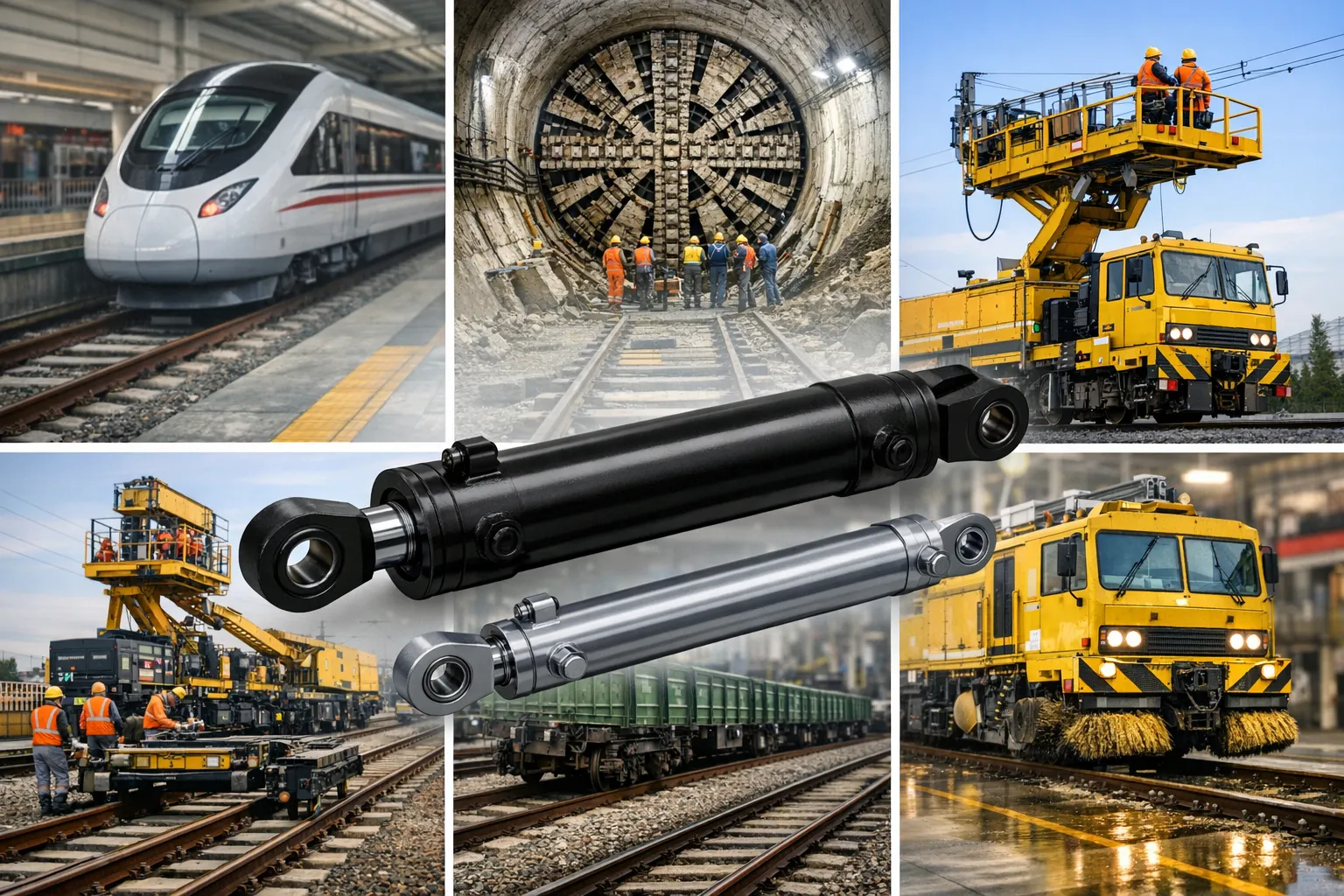
To solve this complex industrial problem, we have engineered a purpose-built tamping vibration cylinder. Operating as a specialized hydraulic cylinder manufacturer, we construct these units using an unyielding, fully welded architecture forged from high-yield alloy steel. We integrate true servo-grade sealing matrices. These advanced, ultra-low friction composite seals provide absolute fluid retention even under violent, high-frequency directional changes. By entirely eliminating internal leakage, our cylinders guarantee zero position drift, enabling the precise amplitude adjustment required by modern automated track construction vehicle systems. This results in perfectly compacted rail ballast and a massive reduction in depot downtime.
Comprehensive Technical Parameters
Integrating an extreme-duty actuator into a highly complex track construction vehicle requires absolute dimensional and operational accuracy. The following table details the rigorous engineering parameters, material choices, and specialized configurations that define our dedicated tamping vibration hydraulic cylinder series, ensuring perfect compliance with international railway maintenance standards.
| Engineering Parameter | Specification Details & Material Configuration |
|---|---|
| Target Industry Sector | Rail Transit / High-Speed Railway Infrastructure |
| Specific Equipment Category | Track Construction Vehicle / Ballast Tampers |
| Subsystem & Mechanical Action | Tamping Vibration / Ballast Squeezing |
| Component Designation | Tamping Vibration Cylinder |
| Hydraulic Action Mode | Double acting hydraulic cylinder |
| Structural Base Type | Precision Servo Cylinder with high-speed response |
| Manufacturing Architecture | Fully Welded Construction to prevent mechanical loosening |
| Core Material System | High-Fatigue Alloy Steel (e.g., 42CrMo or 27SiMn) |
| Rod Surface Treatment | Induction Hardened + Hard Chrome Plated (Thickness: 30-50µm) |
| Environmental Operating Grade | Severe: Constant High-Frequency Vibration & Silica Dust |
| Working Condition Feature | Precise Amplitude Adjustment based on track density |
| Primary Failure Mode Prevented | Position Drift leading to uneven ballast compaction |
| Core Engineering Configuration | Servo-Grade Sealing Matrix for zero internal bypass |
| Structural Mounting Options | Heavy-Duty Trunnion, Spherical Bearing Clevis, Flange (Customizable) |
Operational Fluid Dynamics: Mastering High-Frequency Actuation
To understand the specialized engineering behind the tamping vibration cylinder, one must examine the complex fluid dynamics of high-speed electro-hydraulic oscillation. Unlike a standard lift cylinder that smoothly extends and holds a static load in place, the tamping cylinder operates in a constant state of rapid kinetic flux. The track construction vehicle utilizes highly sensitive proportional directional valves (servo valves) to direct pressurized hydraulic oil into the cylinder. To achieve the necessary ballast fluidization, these valves must rapidly alternate the high-pressure fluid between the cap end and the rod end of the cylinder up to 45 times every single second.
This rapid, alternating pressure requires a flawless double acting hydraulic cylinder design. A single acting hydraulic cylinder relying on mechanical return springs would fail instantly under these frequencies. As the high-pressure fluid rapidly enters and exhausts the opposing chambers, it forcibly drives the solid alloy hydraulic cylinder piston back and forth in incredibly short, powerful strokes. This mechanical oscillation is transferred directly down the heavy steel arms into the tamping tines, creating a localized liquefaction effect in the crushed rock ballast, allowing it to flow and tightly pack under the concrete rail sleepers.
The critical engineering challenge lies in amplitude adjustment. As the machine moves continuously along the track, sensors detect variations in the ballast density. The onboard computer commands the servo valves to widen or narrow the oscillation stroke (the amplitude) on the fly to achieve perfect compaction density. If standard, high-friction rubber seals are used on the piston, the cylinder suffers from severe mechanical lag. If the high-frequency vibration causes the seals to overheat and wear slightly, pressurized fluid bypasses the piston internally. This bypass causes the entire oscillating assembly to slowly “walk” or drift off its calculated center axis. This position drift results in the tamping tines misstriking the concrete sleepers. Our specialized servo-grade sealing matrix ensures completely frictionless movement and absolute zero fluid bypass, guaranteeing that when the computer commands a precise 4.5mm amplitude centered exactly under the rail, the hydraulic rams execute it exactly.
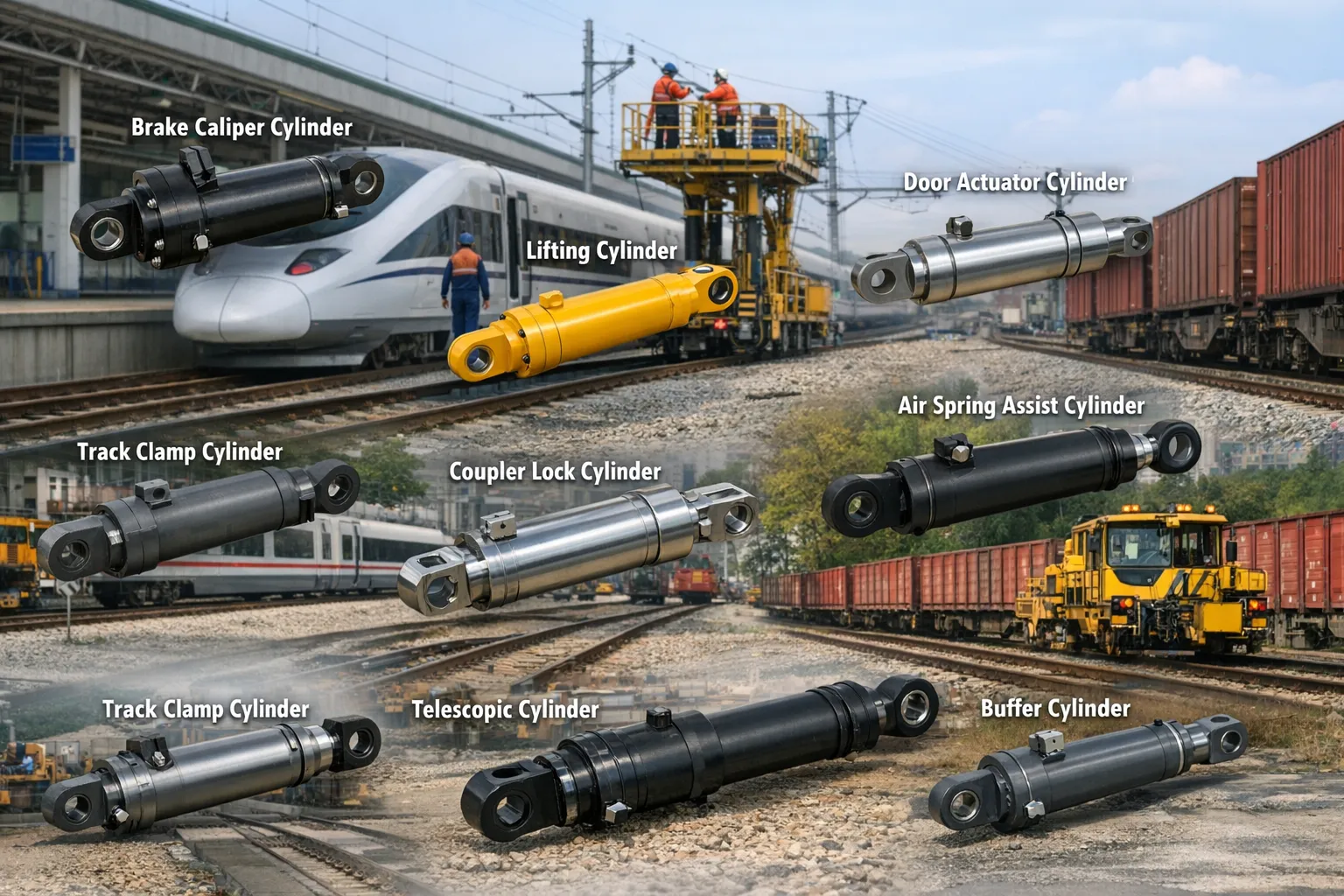
Direct Dimensional Replacement for Railway Fleets
Railway maintenance contractors and national transit authorities frequently face serious logistical and financial bottlenecks when managing their heavy machinery fleets. When the factory-installed vibratory actuators on track vehicles inevitably fail due to seal degradation, sourcing replacements directly from the original equipment manufacturers (OEMs) located in Europe or North America often dictates lead times stretching into many months. Furthermore, the hydraulic cylinder price commanded by these large corporations frequently consumes an unsustainable portion of the annual depot maintenance budget. Attempting local, unauthorized fixing hydraulic cylinders routines on high-frequency servo units usually results in rapid re-failure, as standard hydraulic repair shops lack access to proprietary servo-grade sealing technology.
Our manufacturing facility offers a highly strategic alternative. We specialize in the precision reverse-engineering of bespoke hydraulic parts designed to serve as exact, drop-in replacements for original heavy equipment. By extensively analyzing the structural blueprints or physical samples of your failing units, our engineering team identically matches the exact closed pin-to-pin dimensions, the stroke lengths, the specific spherical bearing sizes in the clevis mounts, and the complex fluid port manifold geometries. We routinely manufacture heavily upgraded replacements for track machinery originally produced by global industry leaders such as Plasser & Theurer, Harsco Rail, Matisa, Loram, and Robel.
Legal Disclaimer: The corporate brands, trademarks, and specific machinery models mentioned above are the exclusive intellectual property of their respective owners. We reference these names strictly for the practical purposes of technical cross-referencing, dimensional compatibility analysis, and to assist fleet procurement officers in accurate component selection. We operate as an entirely independent manufacturer of premium hydraulic cylinder components and maintain no formal affiliation or endorsement from these entities. Our products are engineered from the ground up to solve the inherent fatigue and drift flaws found in mass-produced factory units.
Core Technological Advantages: Conquering High-Frequency Fatigue
Deploying actuators directly onto a vibrating tamping bank requires an uncompromising approach to metallurgical strength and fluid control. Standard catalog specifications are entirely irrelevant here. The distinction of our tamping vibration cylinder lies in a concentrated engineering focus on eliminating high-cycle fatigue and fluid bypass. Here are the precise technical advantages integrated into our systems:
-
1. Servo-Grade Sealing Matrix (Zero Position Drift)
Standard NBR lip seals cause excessive “stick-slip” friction and rapidly melt under high-frequency short strokes. We exclusively utilize advanced, ultra-low friction Polytetrafluoroethylene (PTFE) composite step seals heavily energized by fluorocarbon (FKM) O-rings. This specialized servo-grade sealing creates a perfect, frictionless fluid barrier across the piston, mathematically eliminating internal bypass and completely curing the critical issue of position drift during dynamic amplitude adjustments.
-
2. High-Fatigue Alloy Steel Architecture
Vibrating a heavy steel tine into compacted rock 40 times a second subjects the cylinder rod to immense alternating tensile and compressive stresses. Standard 1045 carbon steel will rapidly develop micro-fissures and snap under this cyclical fatigue. We forge our barrels and rods entirely from premium alloy steel (such as 42CrMo or deeply treated 27SiMn). This massively increases the yield strength and completely prevents metal fatigue fracture during continuous heavy-duty rail maintenance operations.
-
3. Deep-Penetration Welded Construction
The relentless high-frequency vibration generated by the tamping bank acts like a mechanical jackhammer on threaded fasteners. Cylinders utilizing traditional tie-rod designs will inevitably vibrate loose, leading to catastrophic structural separation and high-pressure fluid loss. Our cylinders employ fully automated, robotic TIG/MIG welded construction. The end caps and mounting trunnions are permanently fused to the main alloy barrel, creating an unyielding, unified pressure vessel completely immune to vibration loosening.
-
4. Optimized Thermal Dissipation Geometry
Forcing hydraulic fluid back and forth through servo manifolds at 40Hz generates immense fluid friction and severe internal heat. If this heat is not managed, the hydraulic oil thins out, losing viscosity and destroying the seals. We mathematically optimize the internal fluid porting geometries and barrel wall thicknesses of our tamping vibration cylinder to act as highly efficient heat sinks, rapidly dissipating thermal energy and ensuring stable fluid viscosity during long, continuous overnight track tamping shifts.
-
5. Aggressive Ballast Dust Defense System
Track tamping physically pulverizes rock, creating a massive cloud of highly abrasive silica dust around the actuators. Our cylinders feature an extreme-duty, dual-lip polyurethane scraper seal integrated into the heavy front gland. As the highly polished alloy rod rapidly retracts, the stiff outer lip aggressively shears away caked dirt and abrasive rock dust, ensuring absolutely zero particulate matter enters the pristine hydraulic fluid chamber, vastly extending the life of the internal hydraulic parts.
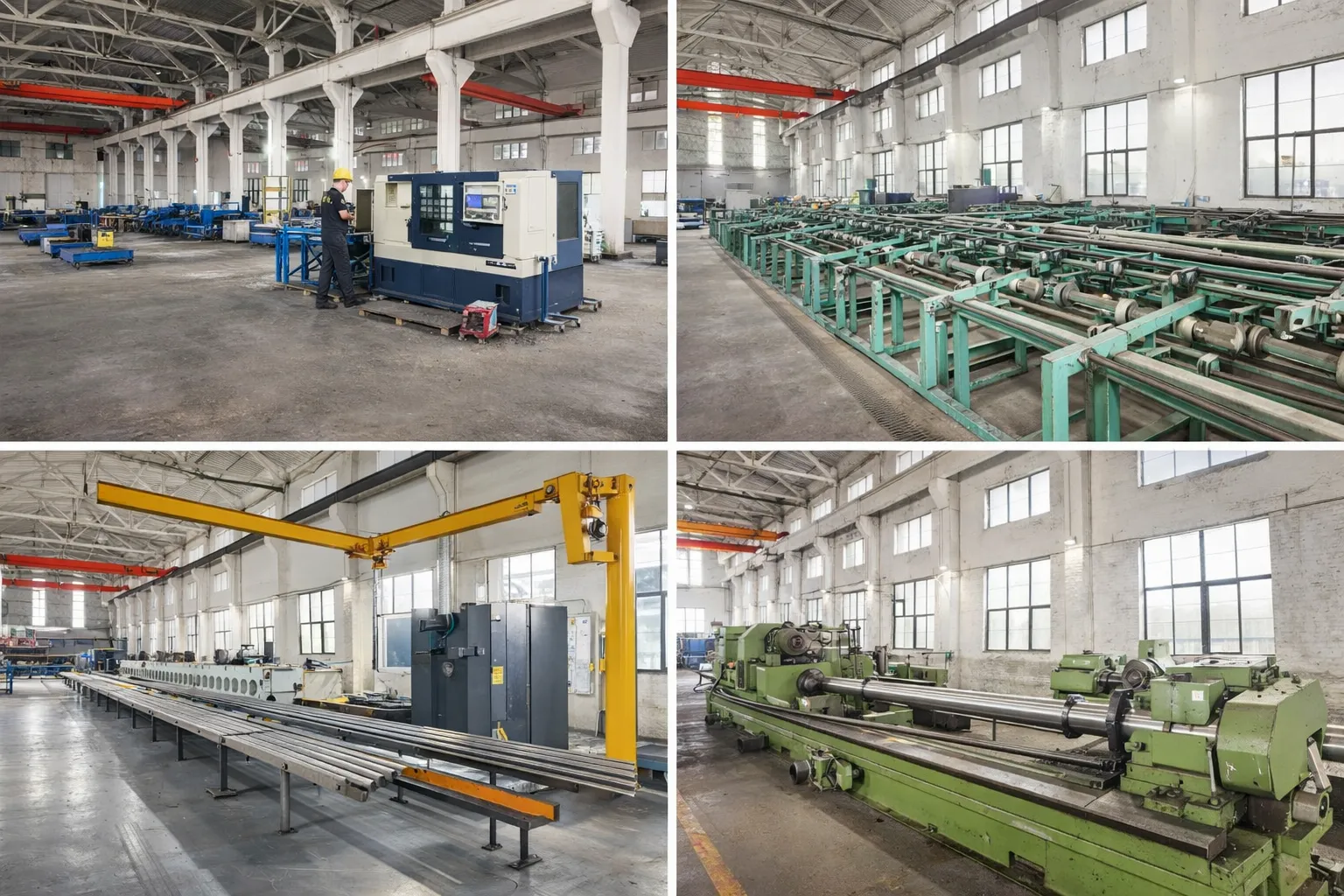
Autonomous Manufacturing Mastery & Quality Traceability
Producing high-frequency servo-actuators requires a complete departure from standard, outsourced assembly line manufacturing. As an authoritative and fully integrated facility, we exercise absolute sovereign control over every single phase of the manufacturing lifecycle. Every batch of raw alloy steel billet that arrives at our factory is subjected to rigorous optical emission spectrometry to verify its exact metallurgical composition, guaranteeing the necessary high-fatigue strength before a single piece of metal is ever cut.
The internal bores of our cylinders undergo highly specialized CNC skiving and roller burnishing. This process cold-works the internal metal, increasing surface hardness while achieving a pristine, mirror-like finish (Ra ≤ 0.2µm). This flawless internal environment is absolutely critical for the servo-grade seals to glide frictionlessly during the intense 40Hz oscillation cycles. Every structural weld joining the trunnions to the barrel is verified using Ultrasonic Non-Destructive Testing (NDT) to ensure perfect, deep penetration with zero sub-surface slag inclusions that could crack under vibration.
Our quality assurance culminates in our specialized high-frequency testing laboratory. We do not rely on standard static pressure tests for these units. 100% of our tamping vibration hydraulic cylinder production is hooked into a simulated servo-loop. They are pressurized and subjected to dynamic, high-frequency oscillation testing to mathematically verify zero position drift and validate thermal stability before they are approved for export. Finally, a unique alphanumeric serial number is permanently laser-etched onto every barrel. Decades into the future, your depot technicians can provide this number, and we can instantly retrieve the exact CAD blueprints, seal profiles, and steel heat batches, making future hydraulic cylinder repair routines highly precise and remarkably efficient.
Versatile Heavy-Duty Industrial Applications
The extreme metallurgical engineering and ultra-low friction fluid dynamics required to survive the violent vibration of track tamping results in a highly robust actuator platform. This unyielding, high-frequency design translates perfectly to other severe-duty industrial sectors where continuous vibration, precise control, and high fatigue resistance are mandatory:
- Construction Machinery Industry: Specialized vibro-hammers used for driving massive steel sheet piles deep into the earth rely entirely on high-frequency hydraulic rams. Our welded alloy architecture perfectly withstands the severe vertical shock forces required for deep foundation construction.
- Mining Industry: Heavy subterranean drilling rigs and large-scale vibratory rock crushers utilize these actuators to provide continuous, high-impact force in environments plagued by extreme silica dust and continuous mechanical shock.
- Metallurgical and Iron Industry: High-capacity vibratory shaker screens used to sort heavy iron ore or filter abrasive slag utilize our servo-grade cylinders to maintain precise oscillation frequencies without succumbing to thermal degradation or weld cracking.
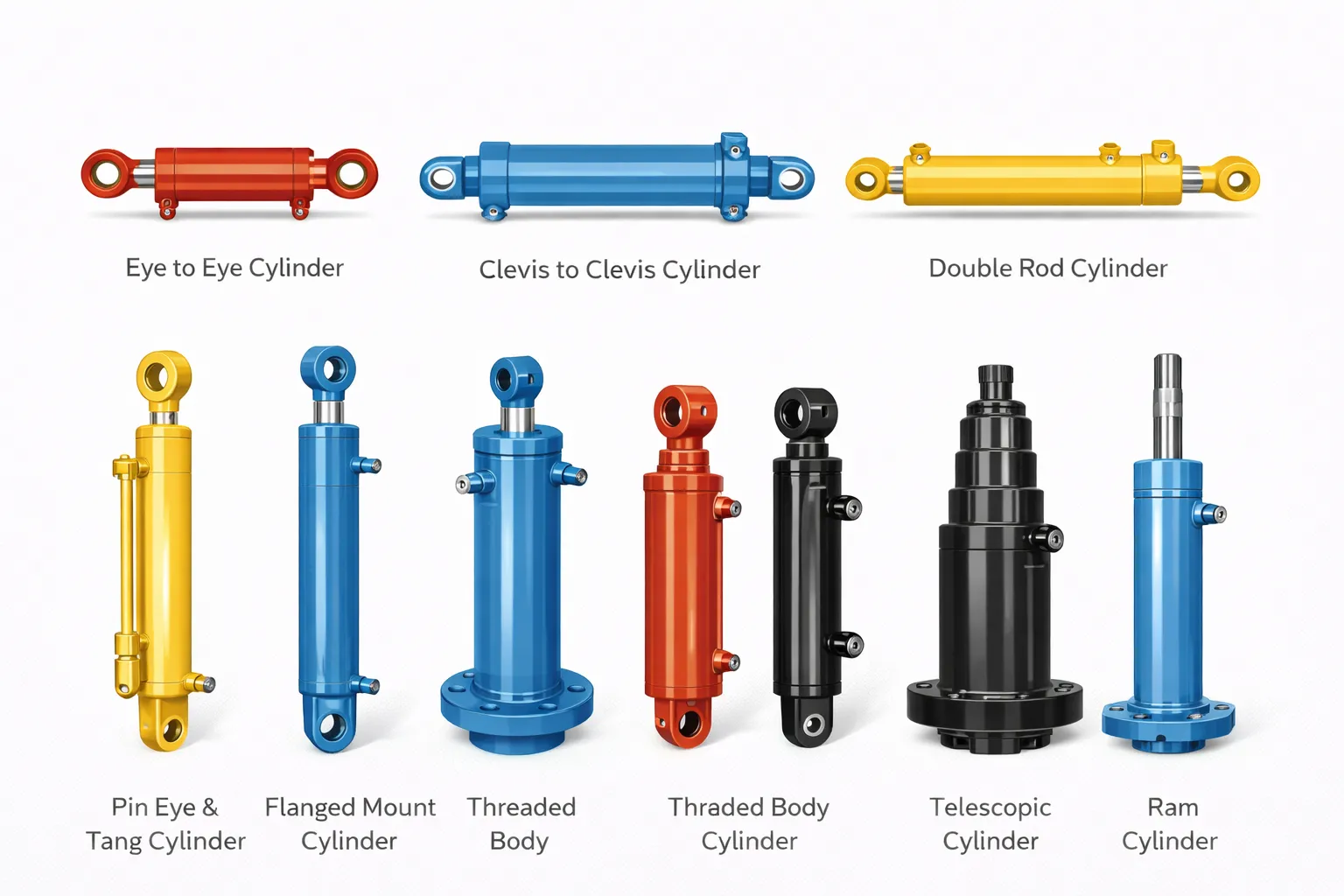
Comparative Analysis: Standard Commercial vs. Tamping Vibration Cylinder
Attempting to minimize initial capital expenditure by sourcing standard catalog cylinders for track tamping machinery is a profound engineering error that rapidly results in catastrophic mechanical failure. The comparative table below outlines the critical engineering differences that dictate long-term system survival.
| Engineering Metric | Standard Commercial Cylinder | Our Specialized Tamping Cylinder |
|---|---|---|
| Sealing Technology & Friction | Standard NBR Rubber. High friction; causes rapid heat buildup and mechanical lag. | Servo-Grade PTFE Matrix. Ultra-low friction; ensures instantaneous 40Hz oscillation. |
| Vibration Immunity | Poor. Threaded tie-rods vibrate loose rapidly, causing massive fluid blowouts. | Absolute. 100% TIG Welded Alloy structure creates a rigid, unified pressure vessel. |
| Operational Precision | Fails. Internal fluid bypass causes severe position drift during tamping. | Flawless. Zero internal leakage guarantees exact amplitude adjustment. |
| Long-Term Economic Value | Requires constant monitoring and frequent, expensive hydraulic cylinder repair routines. | Drastically reduces depot downtime and maximizes track maintenance efficiency. |
Real-World Case Studies: Elevating Asian Rail Infrastructure
The definitive validation of our specialized fluid power engineering methodology is demonstrated in active field deployment. Below are detailed accounts of how our technical interventions successfully resolved critical track maintenance failures for major railway contractors across East Asia.
Case Study 1: KTX High-Speed Rail Track Maintenance Contractor
Location: Daegu Corridor, South Korea | Application: Continuous Action Tamping Machine Overhaul
The Engineering Crisis: A major railway contractor responsible for maintaining the KTX high-speed rail lines was experiencing a severe crisis with their heavy tamping machines. During the crucial overnight maintenance windows, the generic replacement cylinders they had sourced locally were suffering from massive internal fluid bypass due to the extreme heat generated by 35Hz vibration. This position drift caused the tamping tines to strike the concrete rail sleepers rather than the ballast, causing immense structural damage to the track infrastructure and forcing work stoppages.
Consultation & Solution: The chief mechanical officer reached out to our engineering desk via our B2B portal. After analyzing the failed units, we designed a custom batch of our tamping vibration cylinder units. We upgraded the base material to high-yield alloy steel and integrated our proprietary servo-grade PTFE sealing matrix. We perfectly matched the complex spherical bearing mounts of their European machinery for a straightforward, weld-free drop-in install.
Operational Result: The new units were installed during a scheduled winter depot overhaul. The position drift was entirely eliminated. The machines could now perfectly execute micro-adjustments to the tamping amplitude on the fly, ensuring flawlessly packed ballast. The contractor avoided millions in potential track damage penalties.
“The technical superiority of your double acting hydraulic cylinder design is undeniable. By completely solving the internal leakage issue, our tamping banks are more precise than when the machines were brand new. The direct manufacturer pricing also significantly helped our maintenance budget.” — Mr. Choi, Senior Maintenance Director.
Case Study 2: National Shinkansen Infrastructure Support
Location: Osaka Region, Japan | Application: Heavy Ballast Profiling and Tamping
The Engineering Crisis: A specialized track leveling firm was fighting chronic weld fatigue on their tamping actuators. The immense, continuous high-frequency vibration was literally cracking the welds on the rear mounting trunnions of their existing commercial cylinders, leading to terrifying high-pressure fluid blowouts on the track and forcing them into constant, expensive hydraulic cylinder repair cycles.
The Solution: We supplied heavily reinforced, custom-welded tamping vibration cylinder units. By utilizing automated, deep-penetration submerged arc welding on highly specialized alloy steel, we effectively merged the trunnion and the barrel into a single, indestructible piece of metal that completely resisted fatigue failure.
Operational Result: The weld cracking issue was completely resolved. The firm reported that the new cylinders easily survived the grueling 40Hz continuous duty cycles, drastically improving their track coverage per night and minimizing emergency trackside maintenance.
Case Study 3: Metropolitan Mass Rapid Transit Upgrade
Location: Taipei, Taiwan | Application: Switch and Crossing Tamping Operations
The Engineering Crisis: Tamping track switches and railway crossings requires incredibly precise, variable amplitude adjustments because the space between the steel rails is highly irregular. Their legacy OEM cylinders suffered from “stick-slip” friction due to degraded rubber seals, causing the tamping tines to jerk violently rather than oscillate smoothly, damaging the complex switch mechanisms.
The Solution: The procurement team contacted us directly to bypass the exorbitant hydraulic cylinder price demanded by European OEMs. We engineered drop-in hydraulic parts featuring our ultra-low friction servo-grade PTFE sealing matrix to guarantee perfectly smooth, frictionless directional changes.
Operational Result: The new cylinders provided the operators with micro-millimeter control over the tamping amplitude. The jerky “stick-slip” motion was entirely eradicated, allowing the crews to safely and efficiently tamp the highly sensitive and expensive railway crossing switches without risking mechanical collisions.
Expert Technical FAQ for Engineering Procurement
Specifying highly dynamic, mission-critical fluid power components involves rigorous engineering due diligence. Below, we provide comprehensive technical answers to the most frequent inquiries raised by mechanical engineers and fleet B2B procurement specialists regarding our track maintenance solutions.
1. Exactly how does internal leakage cause “position drift” during high-frequency tamping?
During 40Hz oscillation, the servo valve is rapidly pushing fluid to alternate sides of the hydraulic cylinder piston. If the dynamic seals are worn, highly pressurized fluid bypasses the piston internally from the high-pressure side to the low-pressure side. Because the volume of fluid in the chambers becomes unequal, the physical center-point of the oscillation slowly “drifts” away from the programmed center. Our Servo-Grade Sealing mathematically stops this bypass, locking the fluid in place and ensuring the tines oscillate exactly where the onboard computer dictates.
2. Why is alloy steel required for these cylinders instead of standard carbon steel?
Standard 1045 carbon steel simply does not possess the high-cycle fatigue limit required to survive continuous industrial vibration. Driving a steel tine into compacted rock 40 times a second creates immense, reversing shockwaves up the cylinder rod. We forge the tamping vibration cylinder from advanced alloy steels (like 42CrMo) which offer dramatically higher yield strength and elasticity, ensuring the metal can infinitely absorb these violent kinetic shocks without developing microscopic stress fractures.
3. Can you guarantee dimensional matching with our existing Plasser & Theurer or Harsco machinery?
Absolutely. A massive segment of our operation involves engineering drop-in replacements for aging OEM fleets. If your engineering team provides us with the original manufacturer part numbers, precise dimensional schematics, or a physical sample, we will manufacture bespoke hydraulic cylinder components that perfectly match your existing pin diameters, complex clevis mounts, and fluid portings, guaranteeing a simple, weld-free installation for your depot mechanics.
4. How does the cylinder manage the intense fluid heat generated by 40Hz oscillation?
Heat is a major enemy of fluid power. We manage it in two ways. First, our ultra-low friction PTFE seals inherently generate significantly less mechanical friction than standard rubber. Second, we mathematically optimize the internal porting geometries to eliminate fluid turbulence—a major source of hydraulic heat. The alloy barrel itself is dimensioned to act as an efficient thermal heat sink, rapidly bleeding heat into the surrounding air and preserving the viscosity of your hydraulic oil.
5. What defines the final hydraulic cylinder price for a massive fleet upgrade?
Because we operate as a direct, autonomous manufacturing facility, we completely eliminate the massive markups charged by third-party distributors and international OEM catalogs. The final hydraulic cylinder price is strictly determined by the volume of alloy steel required, the complexity of the machined trunnion mounts, the integration of specific sensor ports, and the total order quantity. We consistently deliver vastly superior engineering at a highly competitive factory-direct price point.
6. Is it feasible for our depot technicians to perform internal fixing hydraulic cylinders routines on these units?
Yes. Despite their rugged, deep-penetration welded construction to combat vibration, the front sealing gland (the head) is explicitly designed for mechanical accessibility. Utilizing heavy-duty spanner tools, your on-site mechanics can unbolt the head to access the internal PTFE seals. This thoughtful engineering allows for rapid, in-house seal replacement and routine maintenance without requiring you to ship the massive unit back to a factory.
7. What are the standard manufacturing lead times for shipping to South Korea or East Asia?
For a batch of highly customized, servo-grade alloy cylinders, standard production timelines range from 25 to 35 working days, heavily dependent on current factory capacity and metallurgical availability. Because we retain 100% control over the machining, welding, and high-frequency testing, we can often expedite critical track-maintenance emergencies. Ocean freight logistics to major Asian transit hubs like Busan, Incheon, or Yokohama are highly streamlined and efficient.
Secure the Integrity of Your High-Speed Rail Infrastructure
Continuing to utilize inadequate, mass-market actuators on heavy track construction vehicles leads directly to devastating position drift, uneven ballast compaction, and dangerous railway geometries. When maintaining the foundation of high-speed transit networks, partner with a dedicated hydraulic cylinder manufacturer capable of engineering absolute precision and fatigue resistance into every millimeter of alloy steel.
Editor: Cxm