Product Overview & Core Industrial Value
In the highly demanding sectors of heavy civil engineering and massive infrastructure development, the elevating scraper stands as an indispensable asset for rapid, self-loading earthmoving operations. Unlike traditional models that require a separate pusher tractor, this machinery utilizes a complex chain-and-flight elevator mechanism to actively sweep and force compacted soil, aggregate, and clay upward into the storage bowl. The precise positioning, downforce, and lifting capacity of this entire mechanical assembly are dictated entirely by the scraper cylinder. Operating in an extraordinarily hostile zone subjected to continuous high-frequency vibration, severe abrasive dust, and violent physical shocks, an inferior actuator will rapidly suffer catastrophic structural failure, paralyzing the machine and hemorrhaging project capital.
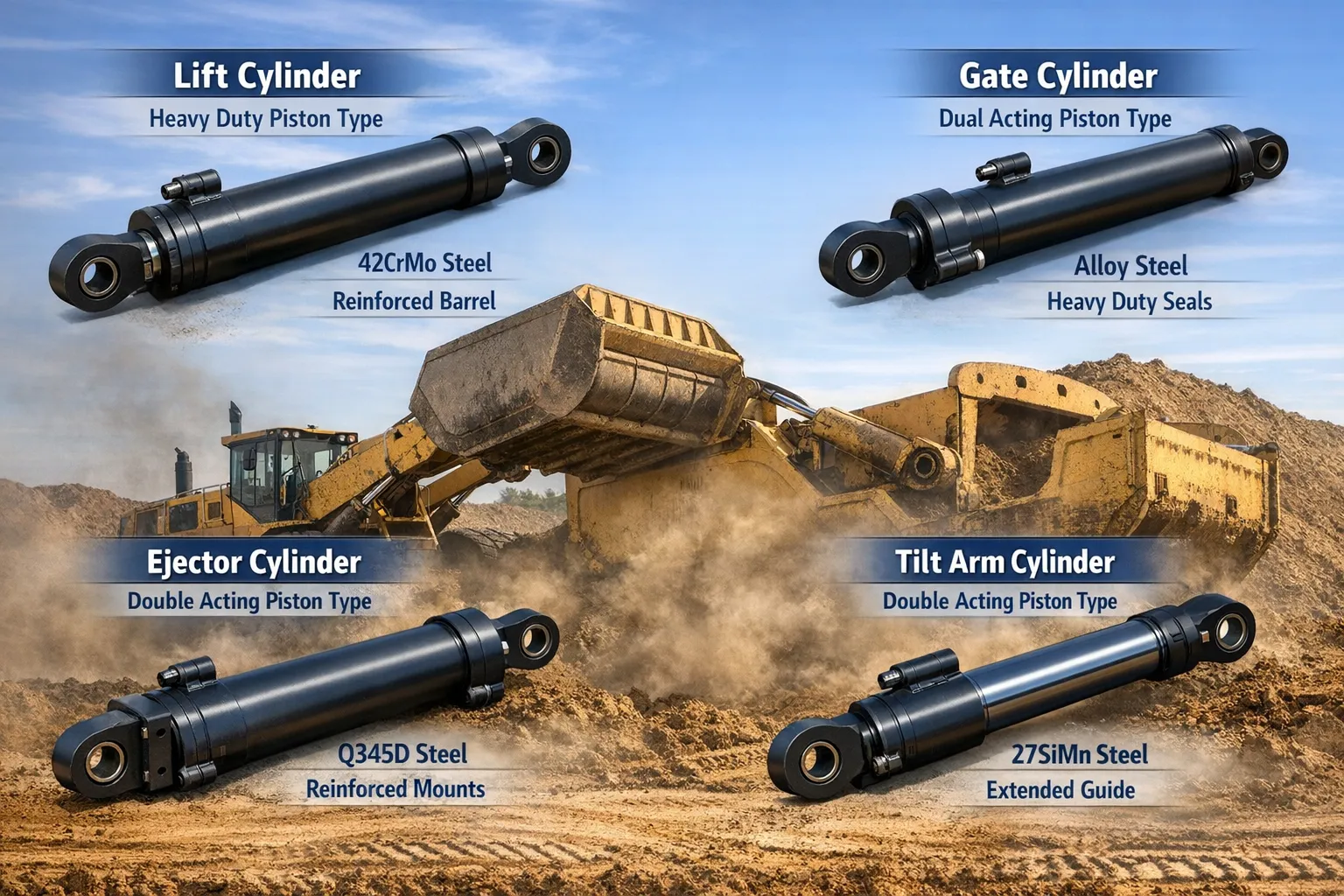
As an authoritative hydraulic cylinder manufacturer, our engineering division has exhaustively analyzed the failure modes inherent to scraper elevation systems. The most critical vulnerability during heavy duty lifting applications is advanced cylinder ear wear and subsequent mounting point fracture. When the rotating elevator flights strike an immovable subterranean boulder or dense bedrock, a massive kinetic shockwave travels instantaneously through the mechanical linkage directly into the cylinder mounts. Standard cast or thin-plate steel ears physically stretch, ovalize, and tear under these extreme dynamic loads. We have definitively neutralized this flaw by forging our scraper hydraulic cylinder with deeply reinforced ear plates and constructing the main pressure vessel entirely from Q345D high-strength low-alloy structural steel.
Our strategic market positioning appeals directly to rigorous fleet operators and procurement directors across the rapidly expanding construction hubs of South Korea, Japan, and the broader Asia-Pacific region. By upgrading your heavy equipment with our premium hydraulic oil cylinder solutions, you fundamentally lower your Total Cost of Ownership (TCO). You are investing in a heavily reinforced structural enhancement that completely mitigates unplanned mechanical downtime, dramatically reduces the labor hours required for fixing hydraulic cylinders in the field, and ensures your scraper fleet maintains maximum payload efficiency throughout its operational lifespan.

Comprehensive Technical Parameters
Uncompromising reliability is achieved through precise material science and mathematically validated engineering tolerances. The data matrix below delineates the exceptionally robust architectural framework of our scraper elevator lifting actuators. While we provide extensive dimensional customization regarding stroke and bore size to accommodate various machine tonnages, these baseline parameters represent the core metallurgical standards necessary to survive extreme impact loading environments.
| Engineering Attribute | Specification Details & Material Matrix |
|---|---|
| Industry Application | Engineering Machinery / Civil Infrastructure Development |
| Equipment Category | Scraper (Specifically Elevating Scrapers) |
| Subsystem / Specific Action | Scraper Elevation / Elevator Chain Lift Mechanism |
| Component Designation | Elevator cylinder / Scraper cylinder |
| Action Mode | Double acting hydraulic cylinder |
| Internal Structure Type | Heavy-Duty Piston Type Actuator |
| Manufacturing Structure | Deep-Penetration Welded Assembly |
| Core Material System | Q345D High-Strength Low-Alloy Structural Steel |
| Surface Treatment | Micro-Cracked Hard Chrome Plating (30-50 μm, Ra 0.2 finish) |
| Environment Rating | Heavy Duty Lifting / Highly Abrasive Particulate Contamination |
| Working Condition Profile | Violent Kinetic Impact / Continuous High-Frequency Vibration |
| Addressed Typical Failure Mode | Cylinder Ear Wear / Mounting Point Elongation and Shearing |
| Strategic Recommended Configuration | Reinforced ear plates integrated with hardened steel bushings |
| Operating Pressure Capacity | 16 MPa to 31.5 MPa (Engineered relative to machine scale) |
Dynamic Working Principle of the Elevator Mechanism
To fully grasp the magnitude of the forces involved, it is necessary to examine the internal fluid mechanics driving the machine. Relying on a basic single acting hydraulic cylinder is impossible for this application, as gravity alone cannot provide the rigid downforce necessary to engage heavy aggregate. Instead, the scraper elevation system relies completely on a double acting hydraulic cylinder architecture, utilizing highly pressurized fluid to actively generate immense mechanical power in both the extension and retraction phases.
During the lifting stroke, the operator engages the directional control valve, which channels fluid from the main hydraulic pump into the cap end (blind end) of the heavy-walled Q345D cylinder barrel. As the fluid volume expands, it acts against the complete surface area of the internal hydraulic cylinder piston. The resulting hydrostatic pressure creates a massive breakout force that drives the forged piston rod outward. This physical extension pushes the heavy steel elevator linkage upward, lifting the chain and flight assembly clear of the ground to allow the machine to transport the loaded bowl over uneven terrain safely.
Conversely, to lower the elevator and initiate an aggressive cutting pass, pressurized fluid is pumped into the rod-end port. Because the physical volume of the solid steel rod occupies space within this chamber, the effective fluid surface area is reduced. This engineered volumetric difference results in a slightly lower overall force but a significantly faster retraction speed, dropping the elevator flights forcefully into the soil. It is during this rapid, downward engagement that sudden collisions with buried rocks occur. The resulting violent kinetic shockwaves are safely absorbed by our heavily reinforced ear plates, transferring the energy without stretching the mounting pins or rupturing the internal hydraulic cylinder components.
Flawless Machinery Compatibility & Brand Replacement
When field equipment suffers a structural breakdown, procurement teams face a critical race against time. Extensive lead times for original parts or complicated on-site chassis modifications are unacceptable. To solve this, our technical division has meticulously reverse-engineered the precise dimensional geometries, fluid port threading, and pin-mounting specifications of the global construction industry’s most prevalent heavy machinery platforms. Our scraper lifting modules are manufactured as exact, drop-in aftermarket upgrades.
Our specialized scraper cylinder models are actively utilized by heavy equipment service centers performing major hydraulic cylinder repair operations on fleets originally manufactured by international giants such as Caterpillar (CAT), Komatsu, Volvo Construction Equipment, John Deere, Terex, and Fiat-Allis. By matching the exact extended and retracted pin-to-pin lengths, our B2B partners guarantee that their technicians can execute a flawless installation and return the scraper to the dirt rapidly.
B2B Engineering Disclaimer: The heavy construction machinery brand names, corporate trademarks, and original equipment manufacturer (OEM) designations mentioned above are provided strictly to demonstrate technical fitment, sizing compatibility, and accurate replacement selection for our global procurement clients. We operate as an independent, premium aftermarket manufacturing facility, and this technical cross-reference does not constitute direct corporate affiliation, endorsement, or trademark infringement.
Five Unrivaled Core Technical Advantages
The performance discrepancy between a standard commodity actuator and a genuine industrial-grade powerhouse is found entirely in its metallurgical choices and microscopic manufacturing tolerances. Based on exhaustive failure analysis in the earthmoving sector, we have integrated five distinct engineering upgrades into our architecture to dominate the aftermarket sector:
1. Reinforced Ear Plates to Eradicate Cylinder Ear Wear
The constant pivoting and violent shock loading of an elevating scraper causes intense, highly localized stress at the mounting points. Standard cast mounts inevitably suffer from rapid ovalization and severe cylinder ear wear. We eradicate this vulnerability by machining significantly thickened, profoundly reinforced ear plates. Integrated with oversized, self-lubricating hardened steel bushings, this configuration drastically expands the load-bearing surface area, permanently preventing the mounting pin from elongating the hole and tearing through the steel casing.
2. Q345D High-Strength Steel Architecture
Instead of utilizing commercial-grade carbon steel, our entire welded structure and pressure vessel barrel are forged from Q345D low-alloy high-strength structural steel. This advanced metallurgical composition provides immense yield strength (approximately 345 MPa) and remarkable impact toughness even in extreme sub-zero environments. It decisively resists the dangerous “ballooning” effect caused by massive internal fluid pressure spikes, ensuring absolute dimensional stability.
3. Ultra-Low Friction Polymer Sealing Matrix
Parasitic heat generation rapidly destroys internal seals during continuous scraper cycles. We utilize an advanced multi-lip sealing architecture combining heavy-duty polyurethane primary seals with ultra-low friction PTFE (Teflon) step seals. This composite matrix drastically reduces dynamic drag against the honed barrel wall. Furthermore, highly aggressive dual-lip exterior wiper seals physically scrape baked-on clay and abrasive silica dust off the retracting rod, effectively sealing the system against contamination.
4. Advanced Micro-Cracked Hard Chrome Plating
The exposed piston rod is subjected to a constant barrage of flying rock fragments and corrosive soil moisture. Our high-yield rods undergo a rigorous micro-cracked hard chrome electroplating process (30-50 μm thickness). Polished to a mirror-like Ra 0.2 finish, the extreme surface hardness deflects physical impacts without chipping. Simultaneously, the microscopic fissure network naturally retains a minute film of hydraulic oil, providing continuous self-lubrication to the gland seals.
5. Optimized Fatigue Life through Automated Welding
Inconsistent manual welding is a critical liability in heavy machinery vessels. We strictly utilize 6-axis robotic submerged arc welding for all foundational structural joints, including the critical connections between the end caps and the reinforced ear plates. This fully automated process guarantees flawless, deep-root penetration without dangerous slag inclusions, porosity, or incomplete fusion, mathematically maximizing the fatigue life of the cylinder under high-frequency operational vibrations.
Uncompromising Manufacturing Process & B2B Quality Control
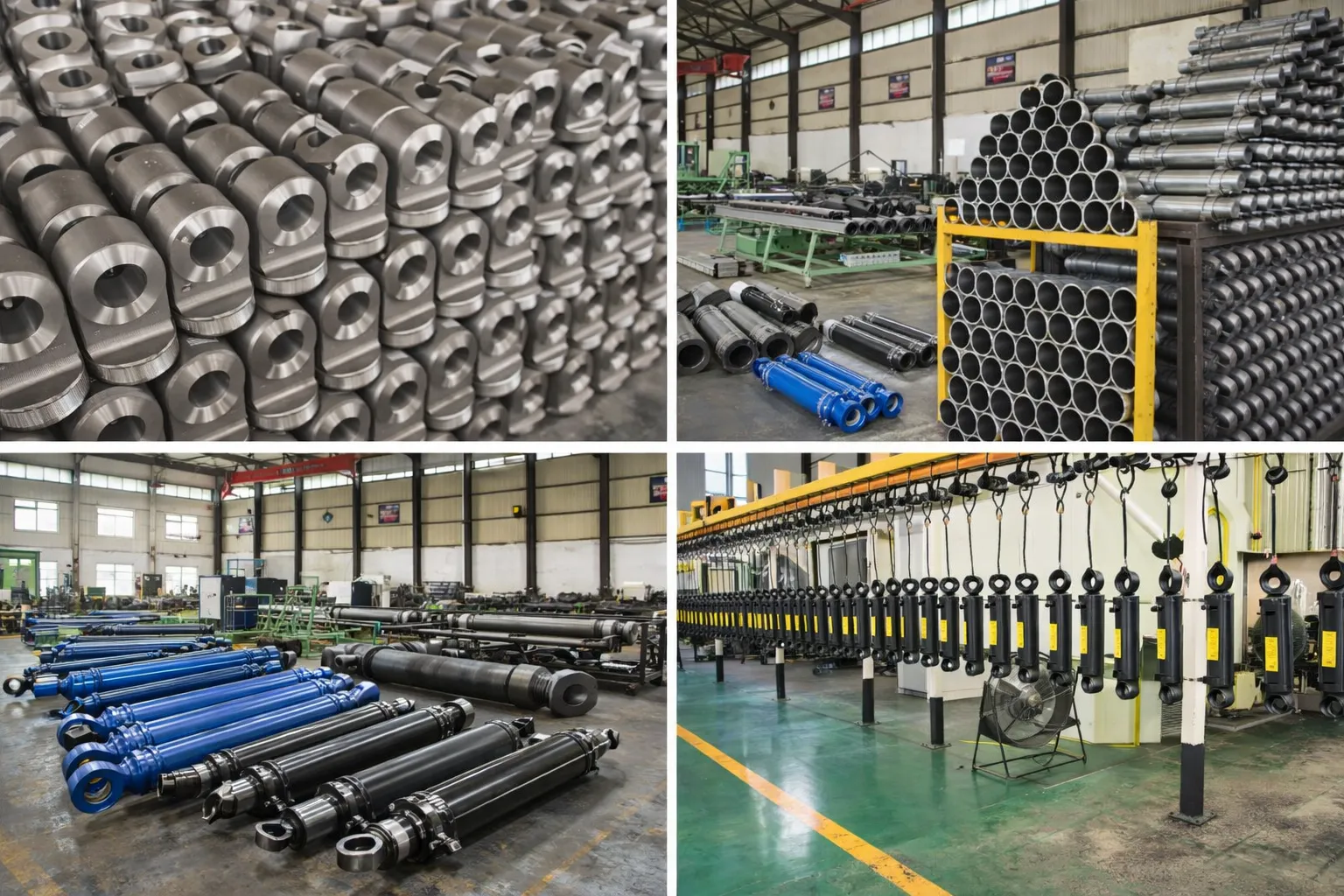
Producing high-reliability industrial fluid power solutions mandates absolute, unyielding control over every phase of manufacturing. We reject the fragmented supply chain models that plague lower-tier suppliers. Our modern facilities operate as a fully vertically integrated ecosystem, handling everything from the initial metallurgical spectral analysis of incoming Q345D steel billets to the final robotic application of high-durability epoxy paints entirely in-house.
The internal bores of our welded steel tubes undergo a highly specialized deep-hole boring process, followed immediately by advanced Skiving and Roller Burnishing (SRB). The skiving knives shave the metal to exacting dimensional tolerances, while the roller burnishing heads aggressively cold-work the interior surface. This creates a highly hardened, microscopically smooth internal finish that dramatically reduces seal friction, ensuring zero fluid bypass and massively extending the lifespan of the dynamic seals. Concurrently, our multi-axis CNC turning centers machine all intricate internal components—such as glands, pistons, and cushion valves—to micrometer precision.
Quality control is the absolute cornerstone of our global engineering reputation. We strictly enforce a policy of 100% individual hydrostatic pressure testing. We categorically do not rely on random statistical batch sampling. Every single scraper hydraulic cylinder is mounted to our computerized test benches and pressurized to 1.5 times its maximum rated operational pressure. We verify absolute leak prevention, structural weld integrity, and perfectly smooth stroke actuation. Finally, every validated unit receives a permanent, laser-etched serial code, guaranteeing complete supply chain traceability and simplifying future hydraulic parts reordering for your maintenance teams.
Versatile Heavy Industry Applications
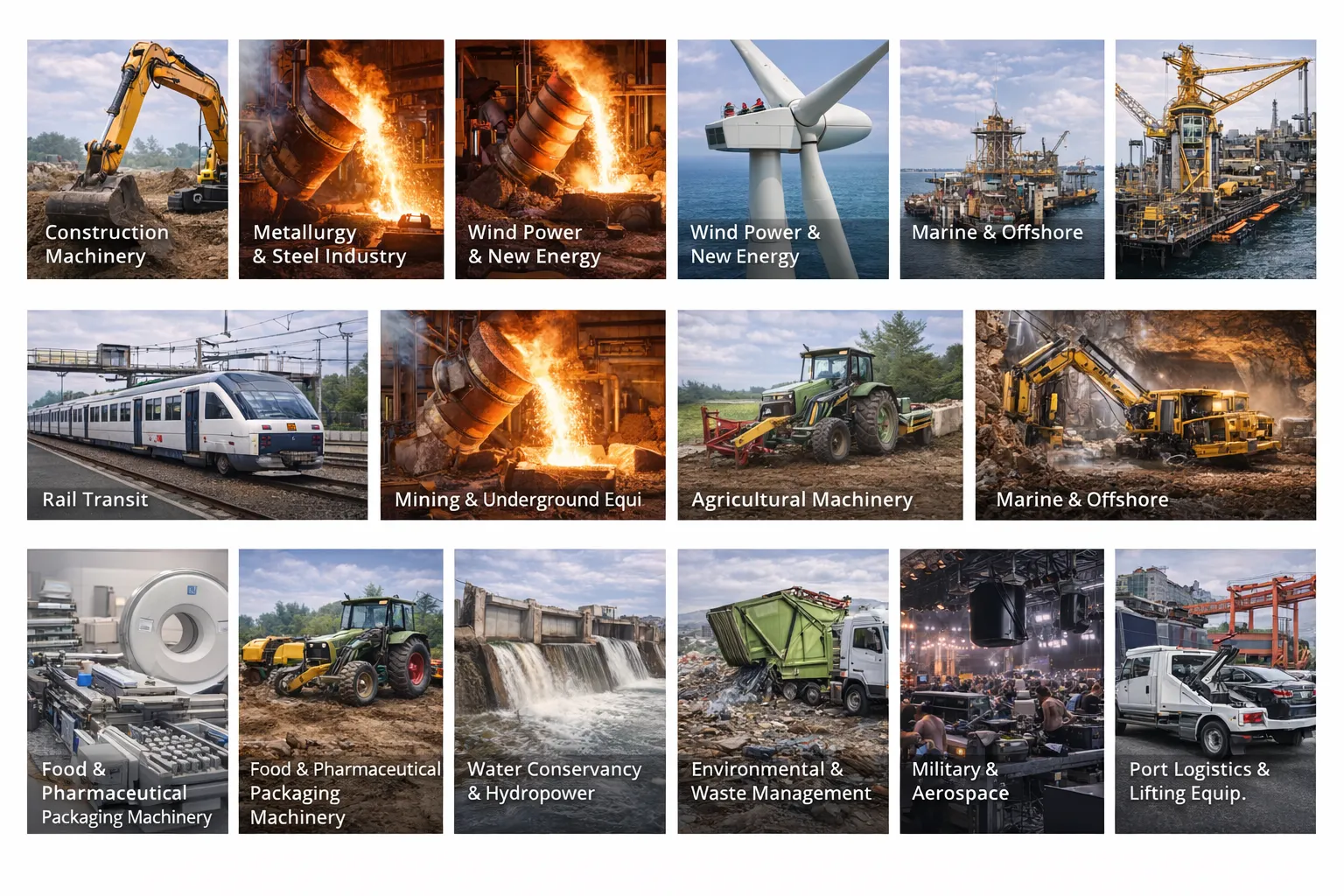
While primarily engineered to conquer the brutal impact forces of scraper elevator lifting, this profoundly robust Q345D architectural methodology makes our actuators highly adaptable across a vast array of severe B2B industrial landscapes. To view our comprehensive scope of sector deployments, we invite you to explore our dedicated construction machinery industry hub.
- Engineering Machinery & Heavy Earthmoving: Powering the critical boom, stick, and bucket linkages of heavy excavators, articulated dump trucks, and wheel loaders operating in severe rock quarries and deep foundation civil works.
- Metallurgy & Heavy Manufacturing: High-strength components are utilized to lift heavy furnace doors and manipulate massive ladles of molten metal in foundries, where extreme radiant heat rapidly destroys commercial equipment.
- Plastics & Rubber Injection Machinery: Large-scale industrial injection molding machines rely on our precision, leak-free piston designs to maintain massive, unwavering clamping pressures during complex curing cycles.
- Material Handling & Logistics: Port authority reach stackers, massive container handlers, and high-capacity automated guided vehicles (AGVs) depend entirely on our reinforced ear plates for safe, high-cycle lifting operations.
- New Energy & Environmental Processing: Actuating heavy refuse compactors and balers in solid waste management facilities, and precisely articulating industrial-scale solar array tracking systems facing extreme weather.
- Specialized Custom Deployments: Modifying our base structures with marine-grade protective coatings for subsea dredging operations, deep-shaft mining equipment, and massive tunnel boring machines (TBMs).
Comparative Analysis: Standard Market Cylinders vs. Our High-Performance Solution
When sourcing essential heavy equipment components, upfront pricing is highly deceptive. Fleet managers must evaluate true durability. A slightly lower initial hydraulic cylinder price often masks catastrophic long-term maintenance costs and devastating machine downtime. The following analytical breakdown demonstrates exactly why our highly engineered products vastly outperform standard aftermarket offerings in high-impact scenarios.
| Critical Metric | Standard Commercial Cylinders | Our High-Performance Scraper Cylinder |
|---|---|---|
| Mounting Integrity | Standard thickness steel plates. Highly prone to severe cylinder ear wear and rapid ovalization under repetitive shock loads. | Oversized, profoundly reinforced ear plates. Permanently maintains pin geometry and overall structural integrity. |
| Barrel Material Quality | Basic Q235 Carbon Steel. Low yield strength, highly susceptible to barrel ballooning and fluid bypass under pressure spikes. | Q345D Low Alloy High-Strength Steel. Massive yield strength, survives heavy load lifting flawlessly without deformation. |
| Internal Sealing Package | Standard Nitrile (NBR). High friction generation, rapid thermal degradation leading to premature blowout in hot environments. | Advanced PTFE/Polyurethane composite matrix. Ultra-low friction, exceptional thermal stability, and leak-free reliability. |
| Welding Reliability | Manual MIG welding. High risk of poor root penetration, leading to dangerous fatigue cracks and joint failures over time. | Automated Robotic Submerged Arc Welding. Absolute structural uniformity and maximum calculated fatigue life. |
| Economic Outlook (TCO) | Requires frequent downtime for part replacement, structural welding repairs, and massive hidden operational losses. | Massive reduction in maintenance cycles, providing unparalleled operational uptime and exceptional Return on Investment. |
Proven Global Success: 5 Real-World Case Studies
Engineering theories must be proven in the mud, rock, and dust of active job sites. Our fluid power solutions form the mechanical backbone of major infrastructure developments across East Asia. The following documented field cases highlight how our technical upgrades directly resolved critical operational failures for our B2B partners.
Case Study 1: Eradicating Ear Wear on Highway Grading
Location & Date: Seoul, South Korea (October 2024)
Client Profile: Daewoo Civil Engineering Contractors.
The Challenge: Operating twin-engine elevating scrapers through highly compacted, rocky soil caused immense vibration. The standard OEM cylinder mounts suffered from severe cylinder ear wear, leading to dangerous pin sloppiness and ultimately tearing the mounting bracket entirely off the machine frame.
Discovery & Solution: The lead equipment manager searched online for heavy-duty replacement hydraulic parts and engaged our engineering desk. We dispatched 12 custom units featuring our massively reinforced ear plates and oversized Q345D clevis mounts.
The Result: The structural upgrades perfectly handled the vibration. Ear ovalization was completely halted, saving the firm thousands of dollars in line-boring repair costs and restoring full fleet capacity.
“The reinforced mounts are visually thicker and structurally superior to the originals. We haven’t had a single pin failure since the retrofit. Exceptional engineering that actually solves the problem.” – Lee Kang-ho, Fleet Maintenance Director
Case Study 2: Defeating Coastal Corrosion in Land Reclamation
Location & Date: Busan, South Korea (May 2025)
Client Profile: OceanFront Infrastructure Corp.
The Challenge: Moving highly abrasive, salt-saturated dredged sand resulted in rapid pitting and rusting on the cylinder rods. This rough, oxidized surface quickly shredded the primary seals, causing massive fluid leaks and unacceptable environmental contamination on the coastal site.
Discovery & Solution: Referred by a regional port authority partner. We manufactured lifting assemblies with a specialized 50-micron hard chrome plating process and aggressive dual wiper seals designed specifically to reject wet saline sand from entering the gland.
The Result: Surface corrosion was completely arrested. The lifespan of the primary seals was extended by over 300% in the highly corrosive marine environment.
“Salt air usually destroys hydraulic equipment in months. Your advanced chrome process completely shielded the rods. It’s exactly the heavy-duty durability we needed to stay on schedule.” – Park Ji-min, Site Operations Manager
Case Study 3: High-Frequency Urban Redevelopment
Location & Date: Tokyo, Japan (November 2025)
Client Profile: Kanto Urban Excavation Ltd.
The Challenge: Operating in tight, complex urban environments required constant, rapid lifting and lowering of the scraper elevator to avoid buried city utilities. The resulting fluid hammer effect was ballooning the weak barrels of their cheaper aftermarket replacement cylinders.
Discovery & Solution: Contacted our technical sales team via our main portal. We provided scraper hydraulic cylinder units constructed with thicker-walled Q345D steel and integrated advanced internal progressive cushion valves to smoothly absorb the hydraulic shock at the end of the stroke.
The Result: The smooth cushioning eliminated the damaging fluid hammer entirely, and the Q345D barrels maintained perfect internal geometric circularity with zero ballooning.
“The precision of the stroke is remarkable. The machinery no longer shudders violently when dropping the bowl. An incredibly robust product that gives our operators fine control.” – Kenji Takahashi, Chief Engineer
Case Study 4: Extreme Cold Weather Reliability for Mining Operations
Location & Date: Hokkaido, Japan (January 2026)
Client Profile: Northern Aggregate Mining Co.
The Challenge: Brutal winter temperatures plunging below -20°C caused the standard nitrile seals in their lifting mechanisms to lose elasticity, shrink, and shatter during morning cold-starts, immediately grounding the machinery and requiring constant intervention.
Discovery & Solution: Reached out directly via our B2B website. We provided units engineered specifically with cold-weather optimized polyurethane seals and Q345D steel, which naturally retains its impact toughness at freezing temperatures.
The Result: The equipment achieved 100% start-up reliability throughout the severe winter season without a single blown seal, maximizing their daily production quota.
“We used to lose critical hours every morning replacing shattered seals in the freezing wind. Your winter-grade components hold pressure perfectly from the moment we turn the key.” – Kenji Yamamoto, Site Operations Manager
Case Study 5: Upgrading an Aging Rental Fleet Profitably
Location & Date: Incheon, South Korea (February 2026)
Client Profile: K-Machinery Leasing Solutions.
The Challenge: Needed to refurbish a fleet of 20 older elevating scrapers. The exorbitant cost of genuine OEM replacement parts was destroying their profit margins, but cheaply made imports were failing immediately on rental sites, damaging their reputation.
Discovery & Solution: Found our detailed product catalog. We supplied dimensionally identical drop-in replacements. Our vertically integrated manufacturing kept the hydraulic cylinder price highly competitive while delivering vastly superior material quality.
The Result: Successfully modernized the entire rental fleet well under budget. Equipment returns due to hydraulic lift failure dropped to zero, significantly boosting their rental profitability.
“Finding a manufacturer that balances premium engineering with realistic B2B pricing is rare. The fit was exact, and our rental clients have noticed the increased lifting reliability. You are now our exclusive fluid power supplier.” – Lee Hyun-woo, Procurement Director
Expert B2B Procurement FAQ
Transparent communication of technical capabilities is absolutely vital for international engineering partnerships. Below, our specialized engineering team answers the most critical questions frequently asked by global procurement managers regarding our scraper lifting assemblies.
Secure Your Earthmoving Operations Today
Relying on substandard fluid power components ultimately destroys project schedules and evaporates profit margins. Do not let chronic cylinder ear wear, ruptured barrels, or blown seals stall your scraper fleet. Upgrade to Q345D precision-engineered durability. Connect directly with a deeply experienced manufacturing partner capable of delivering absolute mechanical reliability to your heaviest earthmoving challenges.
Editor: Cxm