Cushioning Hydraulic Cylinder for Transport Vehicles
Engineered with an advanced damping structure to absorb extreme kinetic energy, mitigate frequent vibration, and protect heavy-duty chassis structures in severe mining operations.
Product Overview & Industrial Value
Operating transport vehicles in open-pit mines, underground galleries, and massive construction sites subjects heavy equipment to continuous, brutal mechanical punishment. The constant jolting of hauling massive payloads over uneven, unpaved terrains creates a working environment defined by frequent vibration. This relentless bouncing generates high-amplitude kinetic shockwaves that travel directly through the vehicle’s chassis and suspension linkages. If these shockwaves are not properly managed, they concentrate at the mechanical joints and actuators, rapidly deteriorating standard equipment. In such high-stress environments, deploying a conventional fluid power actuator is an operational liability. This is exactly where our highly engineered cushioning cylinder becomes absolutely indispensable, functioning as the primary defense mechanism to absorb extreme kinetic shocks and preserve the structural integrity of your entire fleet.
As a dedicated and globally recognized hydraulic cylinder manufacturer, we have analyzed decades of failure data from the field. Our findings consistently show that standard actuators fail prematurely not from steady loads, but from violent end-of-stroke impacts. When a heavy dump bed drops or a suspension system bottoms out, the internal piston crashes into the steel end cap. This collision generates a catastrophic pressure spike—often called a fluid hammer—which instantly extrudes and destroys internal seals. To completely neutralize this threat, our specialized cushioning hydraulic cylinder incorporates a highly precise cushioning damping structure. This active mechanical feature smoothly decelerates the moving mass before it reaches its mechanical limit, providing essential cushion protection that eliminates metal-to-metal impacts.
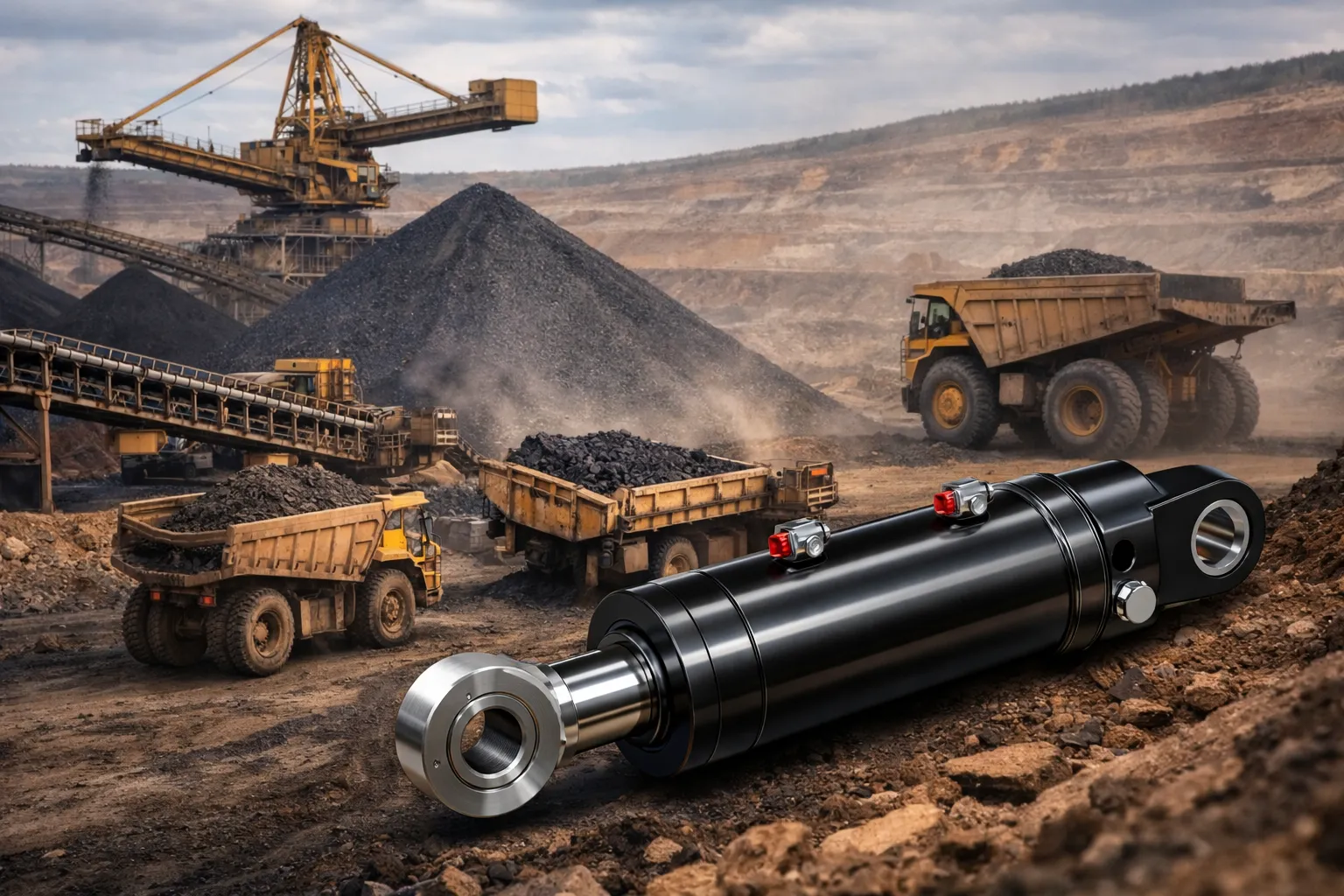
Evaluating the true hydraulic cylinder price requires a comprehensive understanding of total lifecycle economics. The initial procurement cost of a high-performance cushioning unit is negligible when compared to the massive financial losses incurred during unscheduled vehicle downtime. A blown suspension seal leading to a grounded 100-ton haul truck costs thousands of dollars per hour in lost production. By investing in our purpose-built shock mitigation systems, fleet operators in South Korea, Japan, and Taiwan drastically reduce their maintenance burdens, virtually eliminate impact-induced seal leakage, and maximize their overall haulage profitability.
Technical Specifications & Custom Configuration Parameters
Precision engineering dictates that every fluid power component must be tailored to its specific operational reality. The technical matrix below details the structural dimensions, metallurgical selections, and advanced performance parameters that define our heavy-duty cushioning solutions designed exclusively for the mining transport sector.
| Engineering Specification | Configured Data & Detail |
|---|---|
| Target Industry Sector | Mining Equipment & Heavy Earthmoving |
| Specific Equipment Category | Transport Vehicle (Rigid Haulers, Articulated Dump Trucks) |
| Subsystem & Core Action | Cushioning System / Active Cushion Protection |
| Product Nomenclature | Cushioning Cylinder (Buffer Actuator) |
| Actuation Method | Double acting hydraulic cylinder |
| Internal Architecture | Piston cylinder arrangement |
| Manufacturing Method | Heavy-duty welded construction |
| Core Material Metallurgy | High-Yield Carbon Steel (Optimized for vibration absorption) |
| Rod Surface Treatment | Micro-cracked Chrome Plated (Extreme wear and corrosion resistance) |
| Environmental Operating Grade | Severe Condition: Frequent vibration and dynamic kinetic impact |
| Primary Failure Mode Mitigated | Seal leakage caused by sudden pressure spikes |
| Recommended Core Upgrade | Integrated Cushion Damping Structure |
| Mounting Interface | Heavy Trunnion, Clevis, or Spherical Plain Bearings (Customizable) |
Functional Dynamics: The Working Principle of the Damping System
To truly grasp the immense protective value of our specialized cushioning cylinder, one must delve into the complex fluid dynamics that occur within the thick carbon steel barrel during a sudden impact event. A standard, basic actuator allows fluid to exit the cylinder freely until the heavy load abruptly forces the piston to crash into the metal end cap. In a 60-ton transport vehicle, this sends a violently destructive shockwave through the machinery. Our engineered fluid power solution completely alters this physical dynamic through highly calculated, progressive fluid restriction.
Because these specialized units are configured strictly as a double acting hydraulic cylinder, they maintain pressurized hydraulic fluid on both sides of the internal hydraulic cylinder piston. This ensures absolute, powered control over the massive load during both the extension and retraction phases, eliminating the dangerous free-fall associated with older single acting hydraulic cylinder designs. The critical protective phase, however, occurs exclusively at the very end of the stroke. As the vehicle’s dump body descends or the suspension rapidly compresses, the integrated cushion damping structure physically engages. A precisely tapered spear attached to the piston enters a corresponding, tight-tolerance cavity machined into the steel cylinder head, gradually choking off the primary hydraulic exhaust port.
By forcing the remaining, trapped hydraulic oil to exit through a significantly smaller, calibrated secondary orifice, massive back-pressure is intentionally generated within this localized cushioning chamber. This controlled hydraulic resistance acts exactly like an immensely powerful internal brake. The vast kinetic energy of the rapidly moving transport load is absorbed by compressing this restricted fluid, smoothly decelerating the piston to a gentle, controlled stop before any internal metal components can make physical contact. The absorbed kinetic energy is seamlessly converted into thermal energy, which is then harmlessly dissipated outward through the thick carbon steel barrel. This specific mechanism is the absolute key to preventing the sudden, explosive internal pressure spikes that are the root cause of catastrophic seal leakage in heavy transport applications.
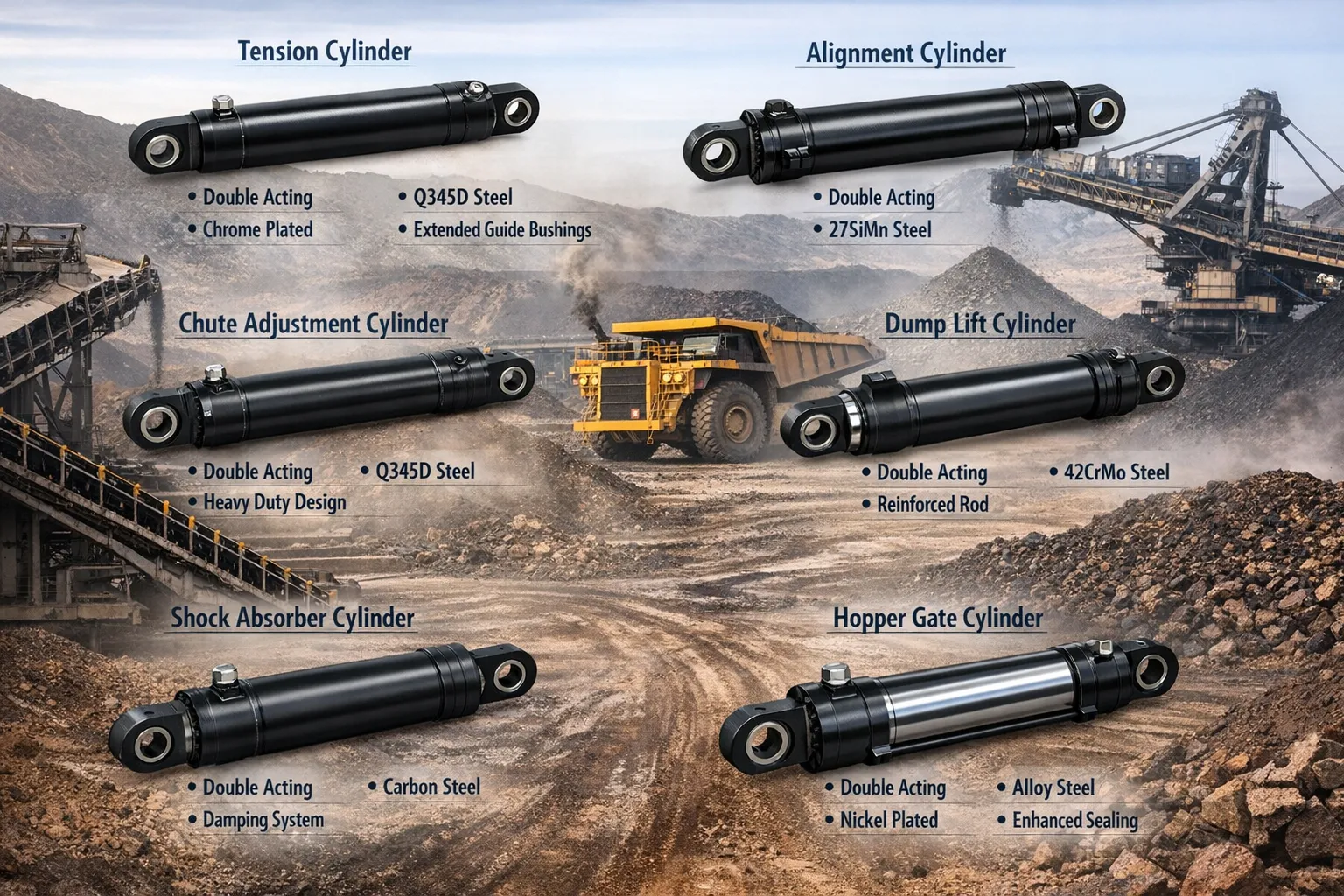
Seamless Dimensional Replacement for Leading Machinery Fleets
Maintenance teams managing large-scale mining fleets operate under strict uptime mandates and cannot afford to spend hours modifying vehicle chassis to accommodate non-standard aftermarket parts. When sourcing critical replacement hydraulic parts, dimensional accuracy is just as paramount as internal durability. We engineer our specialized cushioning hydraulic cylinder assemblies to function as exact, drop-in dimensional replacements for the original equipment found on the world’s leading transport vehicles.
Our comprehensive engineering database allows us to routinely provide upgraded replacements that match the exact mounting pin diameters, closed lengths, and stroke dimensions of equipment manufactured by globally recognized brands such as Caterpillar (CAT), Komatsu, Volvo Construction Equipment, Hitachi, Terex, and Doosan. (Please note: Mentioning these specific global corporate brand names is strictly intended to assist maintenance engineers and procurement officers in confirming dimensional compatibility and does not imply any official trademark affiliation or endorsement.) By integrating our highly engineered hydraulic rams, you instantly upgrade the shock resilience of your fleet without making any costly or time-consuming structural modifications to your existing machinery frames.
Five Core Technical Advantages for Heavy Logistics
Surviving the relentless, brutal conditions of an active mining haul road requires an uncompromising, holistic engineering approach. We have isolated the five absolute critical points of failure in mobile fluid power and engineered specific, heavy-duty countermeasures into every cushion cylinder we manufacture to guarantee uninterrupted performance.
1. Advanced Cushion Damping Structure
Standard industrial dampeners often result in a jerky, two-stage deceleration that still jolts the equipment. Our specialized tapered cushion spear profiles are mathematically designed to provide a remarkably smooth, exponential deceleration curve. This manages the kinetic energy flawlessly, preventing the sudden terminal pressure spikes that cause explosive seal leakage, setting our cushioning cylinder entirely apart from conventional models.
2. Heavy-Duty Welded Carbon Steel Construction
Standard tie-rod cylinders are completely inadequate for transport vehicles; they will physically shake apart under the frequent vibration of haul roads. We utilize a high-penetration welded construction. The heavy base ends and trunnions are merged to the carbon steel barrel using automated, robotic submerged arc welding, creating a monolithic structure with immense tensile strength that ignores vibrational fatigue.
3. Ultra-Low Friction Sealing Architecture
Frequent vibration and continuous kinetic dampening generate significant internal heat. We equip our hydraulic cylinder components with an advanced, high-temperature PTFE and polyurethane sealing matrix. This ensures the dynamic seals maintain their geometric integrity and prevent fluid extrusion even during intense summer mining operations, vastly outperforming standard elastomer rings.
4. Micro-Cracked Hard Chrome Plating
The exposed external rod is constantly bombarded by flying rock debris, highly abrasive dust, and corrosive mine water. We apply a thick, heavy layer of hard chrome plating over an induction-hardened carbon steel base, finished via a micro-cracking process. This incredibly dense surface deflects physical impacts, while the microscopic fissures retain a film of hydraulic oil to constantly lubricate the main wiper seals.
5. Vibration-Isolated Articulation Mounts
Kinetic energy isn’t just internal; chassis twisting transfers immense lateral side-loads to the rigid cylinder body. We integrate heavy-duty, self-lubricating spherical plain bearings into the mounting eyes. These specialized bearings allow for multi-axis articulation, completely isolating the carbon steel barrel from the severe torsional twisting of the transport vehicle frame as it navigates deep ruts.
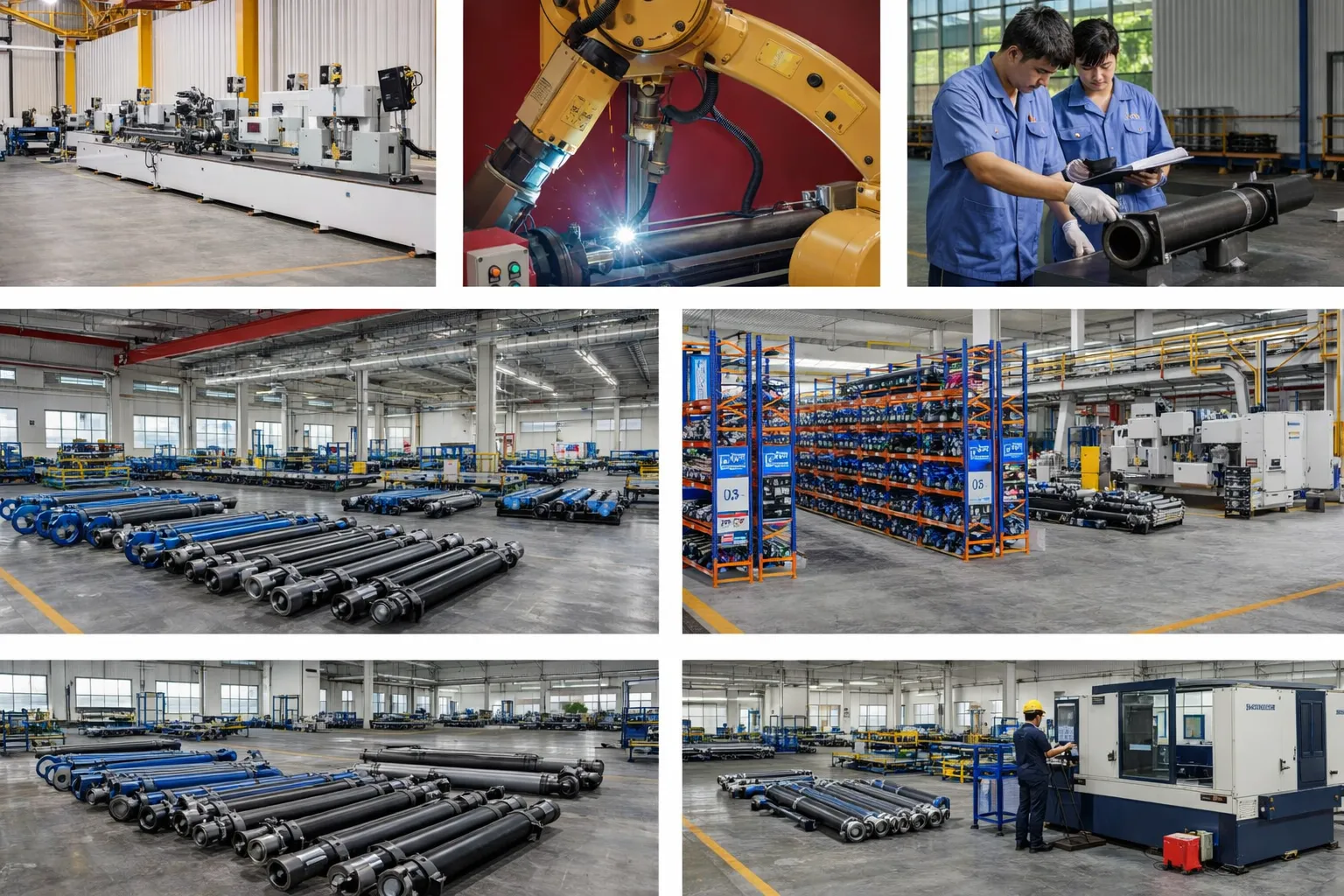
Strict Manufacturing Craftsmanship & Quality Control
Consistent reliability in heavy-duty fluid power requires absolute control over the manufacturing ecosystem. We do not outsource the machining of our critical components to fragmented supply chains. The process begins with raw, high-yield carbon steel tubes that undergo rigorous ultrasonic non-destructive testing (NDT) to ensure there are absolutely no internal metallurgical voids. Our advanced CNC skiving and roller burnishing machines create a flawless, mirror-like finish on the internal barrel walls, optimizing the operating environment to extend the lifespan of the internal hydraulic cylinder piston seals.
Welding is recognized as a critical failure point in high-vibration logistics applications. We employ automated, robotic submerged arc welding stations to attach heavy base ends and mounting trunnions. This guarantees a flawlessly consistent, deep-penetration weld that will not fracture under the heavy bouncing of transport vehicles. Absolute precision is the baseline for all our engineered hydraulic parts.
Every single cushioning hydraulic cylinder must survive our stringent automated testing bays before being authorized for dispatch. We perform a severe 100% hydrostatic pressure test, pressurizing the assemblies to 150% of their operational limits to ensure zero internal bypass or external weeping. Furthermore, dynamic cycle testing mechanically verifies the exact deceleration profile of the cushioning structure. Following passing results, a unique serial number is laser-engraved onto the barrel. This total traceability guarantees that if your mechanics ever require parts for fixing hydraulic cylinders five years down the line, we can instantly retrieve your exact engineering blueprints and supply identical replacement components.
Expansive Industry Applications
While explicitly optimized to protect transport vehicles from frequent vibration and severe shock, the ability to safely arrest massive kinetic energy makes these units highly valuable across multiple heavy industrial sectors.
- Mining Industry Logistics: The primary application. Critical for the heavy suspension struts, steering linkages, and massive bed-hoist mechanisms of rigid haul trucks and articulated dumpers moving raw ore.
- Construction Machinery Industry: Heavily utilized in heavy wheel loaders, large excavators, and graders where sudden bucket impacts transfer severe shockwaves directly into the machine frame.
- Metallurgical Transporters: Operating reliably in high-heat steel mills on slag transporters and heavy ladle transfer cars where incredibly smooth deceleration is necessary to prevent dangerous molten spills.
- Port Material Handling Automation: Integrated into terminal tractors, reach stackers, and automated guided vehicles (AGVs) handling heavy shipping containers. In these applications, the unit often functions as a heavy-duty lift cylinder with critical soft-stop capabilities.
- Specialized Custom Logistics: Deployed in custom military transport and aerospace ground support equipment where zero-shock transportation of highly sensitive cargo is mandatory.
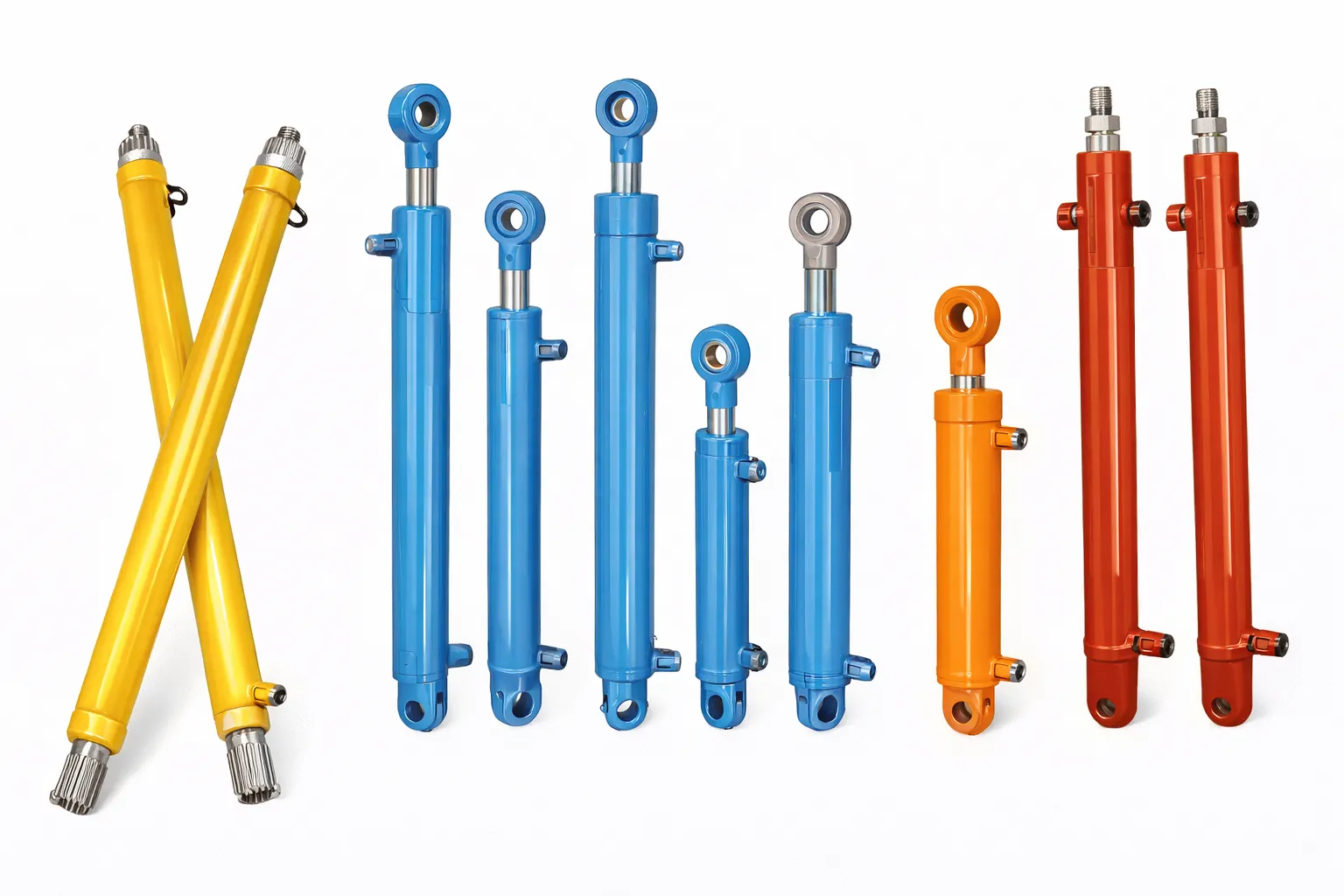
Comparative Engineering Analysis: Standard Cylinder vs. High-Performance Cushioning
Procurement teams often face the choice between cheap commercial-off-the-shelf fluid power components and purpose-built engineering solutions. The following table clearly illustrates why standard units fail so quickly under severe shock loads, and why our specialized damping design delivers vastly superior long-term lifecycle value.
| Evaluation Metric | Standard Off-the-Shelf Cylinder | Our Cushioning Hydraulic Cylinder |
|---|---|---|
| End-of-Stroke Dynamics | Hard metal-to-metal collision; generates a massive shockwave. | Progressive fluid restriction; smooth, highly controlled deceleration. |
| Vibration Tolerance | Tie-rods stretch and loosen; rigid mounts crack. | Heavy welded carbon steel and spherical bearings isolate frequency. |
| Seal Integrity Under Shock | Highly prone to sudden blowout and massive fluid leakage. | Internal pressure spikes are managed; seals are heavily protected. |
| Maintenance Burden | Requires constant, expensive hydraulic cylinder repair. | Extremely high Mean Time Between Failures (MTBF). |
| Total Equipment Lifecycle | Transfers shock directly to the chassis, accelerating machinery aging. | Actively protects the chassis frame, extending overall vehicle life. |
Proven in the Field: Global Real-World Deployments
Theoretical engineering concepts must be validated by the dirt, heavy payloads, and punishing environments of active job sites. Below are five detailed accounts from our heavy industry partners in East and Southeast Asia who transformed their fleet reliability by adopting our specialized damping technology.
Case 1: Open-Pit Limestone Mine, South Korea
Client Profile: A major aggregates producer operating a fleet of 60-ton transport vehicles near Donghae.
The Challenge: The jagged, rocky haul roads caused extreme frequent vibration. The OEM suspension cylinders were suffering from severe seal leakage within months of installation.
How They Found Us: The maintenance director contacted our engineering team in early 2024 through our main web portal after researching impact failure modes.
The Results: We delivered a fleet-wide upgrade of custom cushioning cylinder units. Installed in October 2024, the integrated cushion protection entirely eliminated the end-of-stroke impacts.
“The ride stability is phenomenal. We used to spend a small fortune on hydraulic cylinder repair. These new buffered units haven’t leaked a single drop despite the brutal roads.” — Mr. Park, Fleet Director.
Case 2: Coastal Port Logistics Terminal, Japan
Client Profile: A heavy shipping logistics company operating in Yokohama.
The Challenge: Specialized transport vehicles moving massive steel coils were experiencing structural fatigue. The sudden stopping of the lift mechanism transferred huge kinetic shocks into the chassis, cracking the welds.
How They Found Us: Met our engineering representatives at an industrial machinery expo specializing in heavy lifting.
The Results: Integrated our specialized double acting hydraulic cylinder assemblies equipped with customized cushion damping structures. The smooth deceleration curve allowed the massive coils to be moved quickly and stopped gently.
“The dampening technology saved our truck frames from cracking. The fluid control is incredibly precise and reliable under immense weight.” — K. Sato, Operations Manager.
Case 3: Underground Copper Mine, Taiwan
Client Profile: A subterranean mining contractor using specialized low-profile loaders.
The Challenge: Confined spaces meant the loaders were constantly hitting uneven rock floors, causing standard tie-rod cylinders on the steering linkage to physically stretch and fail.
How They Found Us: Reached out via the detailed inquiry form on our contact page.
The Results: We replaced the failing units with our highly rigid, welded carbon steel cushioning hydraulic cylinder. The robust construction and fluid cushioning halted the fatigue breakages entirely.
“Operating deep underground is brutal on joints. These actuators survived conditions that destroyed standard parts in weeks. Exceptional structural integrity.” — Lin Y., Chief Mine Mechanic.
Case 4: Coal Extraction Fleet, Vietnam
Client Profile: A vast open-cast coal mining operation utilizing rigid dump trucks.
The Challenge: Tropical heat and continuous 24/7 hauling caused the hydraulic fluid to overheat, melting standard seals and causing loss of load control when the dump beds were lowered on steep inclines.
How They Found Us: Referred to us by an international heavy machinery consultancy firm.
The Results: Transitioned the dump body hoists to our units equipped with high-temperature seal matrices. The heat dissipation properties of our thick carbon steel design kept the fluid stable and the dampening consistent.
“Heat and vibration are killers in our pits. These units handle the continuous cycle times beautifully without a single seal failure.” — Nguyen H., Reliability Head.
Case 5: Specialized Heavy Transport Logistics, South Korea
Client Profile: A logistics firm moving massive wind turbine components across mountainous terrain.
The Challenge: Needed an exceptionally reliable lift cylinder mechanism that could handle unpredictable load shifting on the trailers without jarring the highly sensitive cargo.
How They Found Us: A B2B digital procurement search analyzing the best overall hydraulic cylinder price to performance ratio for custom applications.
The Results: We engineered highly compact, high-pressure cushioning units. The integrated fluid buffering absorbed the transport shocks effortlessly, smoothing the entire logistical flow.
“We transport multi-million dollar components. The precise, dampened control these cylinders provide gives us absolute confidence on the road.” — Choi S., Logistics Director.
Expert B2B FAQ: Technical & Procurement Insights
For fleet managers and procurement engineers, absolute technical clarity is crucial before executing a fleet-wide equipment upgrade. Here are detailed answers to the most frequent inquiries we receive regarding our damping technology and supply capabilities.
1. How exactly does the cushion damping structure prevent seal leakage under heavy vibration?
2. Can these units serve as drop-in replacements for our older transport vehicles?
3. Why use a welded carbon steel design instead of a lighter tie-rod construction?
4. Do you offer hydraulic cylinder repair support and aftermarket components for your products?
5. What is the typical lead time for shipping heavy fleet orders to South Korea or Taiwan?
6. Are your cushioning units strictly double acting hydraulic cylinder designs?
7. How does the chrome plating withstand highly abrasive mine dust?
8. Can the internal damping rate be customized for specific vehicle payloads?
Protect Your Heavy Fleet Equipment Today
Continuous kinetic shock and frequent vibration will eventually destroy even the toughest machinery. Do not let inferior standard cylinders dictate your maintenance schedule or cause catastrophic seal leakage. Upgrade to our purpose-built, heavy-duty cushioning solutions to protect your chassis and maximize fleet uptime. Connect with our engineering experts to discuss your specific operational challenges.
Editor: Cxm