Pipe Lay Frame Lift Cylinder for Subsurface Drainage Installation Machines
Q345D structural steel with metal-cased scraper and water-resistant seals. Controls pipe placement depth accurately while operating continuously in the chemically aggressive wet trench mud of subsurface drainage installation work.
Trench Mud Is Not Just Dirt and Water. It Is a Corrosion Accelerator.
Subsurface drainage installation involves cutting a trench 80 to 150 centimeters deep through waterlogged soil, laying perforated drainage pipe at the bottom, and backfilling. The pipe lay frame lift cylinder sits at the deepest point of the machine, controlling how the pipe guide assembly feeds the drainage pipe into the trench bottom at the correct grade. This cylinder operates continuously surrounded by wet trench mud that is significantly more corrosive than ordinary field soil or even the standing water inside a pump station.
Waterlogged subsoil is anaerobic—meaning it contains dissolved organic acids, hydrogen sulfide, and reduced iron and manganese compounds that are not present in surface soil. When this material mixes with water during trenching, it creates a slurry that is chemically aggressive toward both carbon steel and standard NBR seals. The pH of waterlogged subsoil slurry can drop to 4.5 to 5.5 in acidic peat and clay formations, and the dissolved sulfides attack chrome plating at rates several times faster than clean water. This is why drainage installation cylinders corrode faster than irrigator or cultivator cylinders exposed to surface soil—the chemistry of what they are sitting in is fundamentally different.
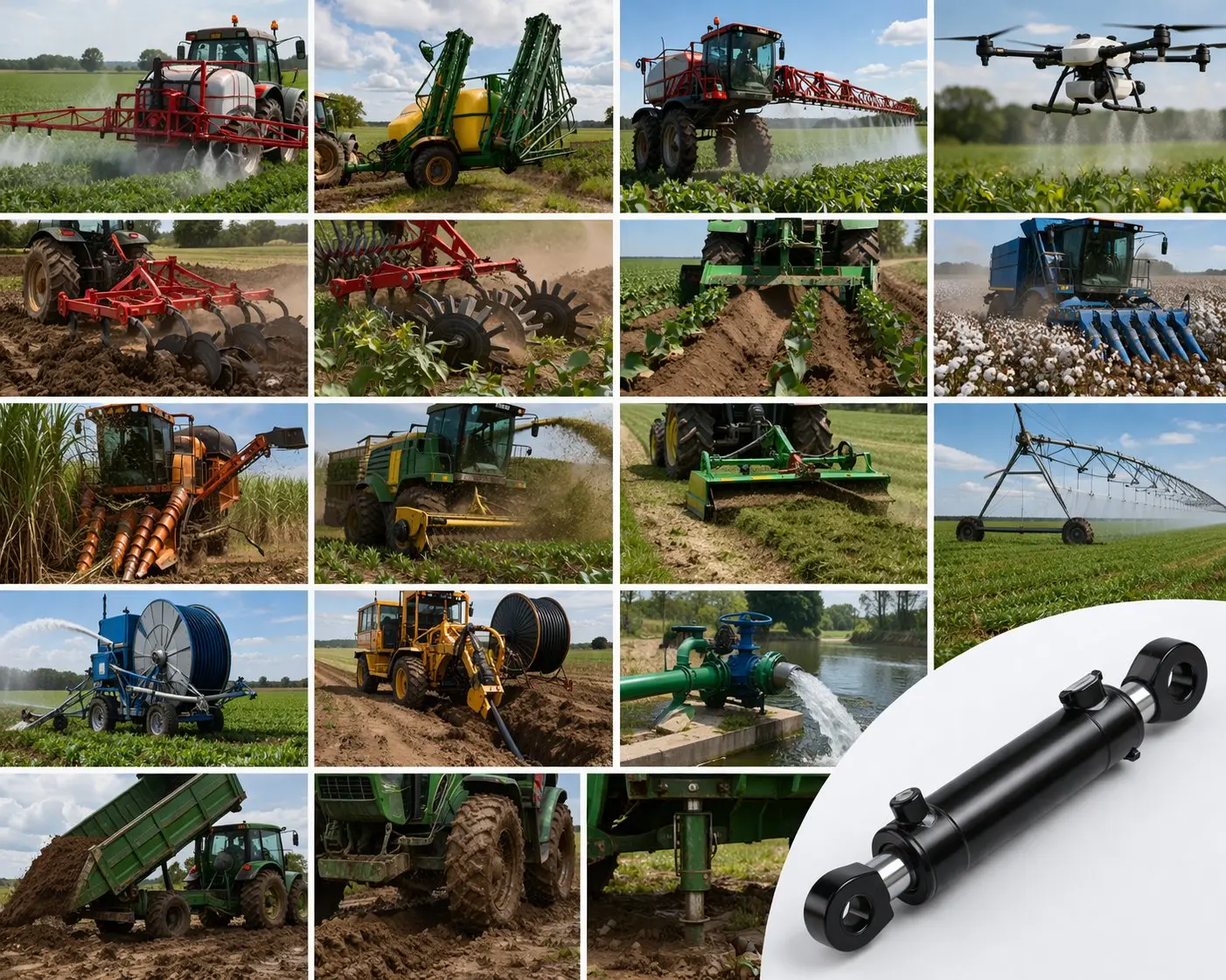
The physical environment compounds the chemical problem. The trench walls collapse intermittently during installation, dumping fresh loads of sandy silt and gravel onto the cylinder. The trenching chain or wheel throws wet soil continuously past the hydraulic cylinder body. And the machine vibration from cutting through variable soil layers transmits constant shock loading through the frame into the pipe lay assembly. A standard agricultural cylinder in this environment faces simultaneous attack from chemical corrosion, abrasive particle ingress, and mechanical vibration—a combination that destroys unprotected seals and rod surfaces in 20 to 50 operating hours.
Our pipe lay frame lift cylinder is a double acting hydraulic cylinder built from Q345D with a metal-cased scraper that handles wet sticky trench mud, a secondary PU wiper behind the scraper, water-resistant NBR seals with FKM upgrade option for acid-soil conditions, immersion-grade epoxy body coating, and a 20+ micron heavy chrome rod. Every component is selected for the specific combination of chemical, abrasive, and mechanical stresses that subsurface drainage trenching generates.
Technical Specifications
| Specification | Available Range |
|---|---|
| Bore Diameter | 50 mm – 100 mm |
| Rod Diameter | 28 mm – 63 mm |
| Stroke Length | 150 mm – 600 mm |
| Working Pressure | Up to 20 MPa (2,900 PSI) |
| Action Type | Double Acting |
| Structure | Welded Piston Cylinder |
| Body Material | Q345D Low-Alloy Structural Steel |
| Piston Rod | Q345D, Hard Chrome 20+ micron |
| Body Coating | Immersion-Grade Two-Layer Epoxy |
| Scraper | Metal-Cased Hardened PU + Secondary PU Wiper |
| Piston Seal | PU + PTFE Wear Ring |
| Rod Seal | Water-Resistant NBR + PTFE Back-up (FKM upgrade for acid soils) |
| Mounting | Clevis, Pin Eye, Trunnion, Custom |
| Port Thread | BSP / NPT / Metric |
| Operating Temperature | -20 C to +80 C |
| Environment Rating | Wet Trench Mud / Anaerobic Subsoil / Chemical + Abrasive |
The Chemistry of Waterlogged Subsoil: Four Corrosive Agents and How We Counter Each One
Understanding why trench mud is so much more aggressive than surface soil reveals why the pipe lay frame lift cylinder needs materially different protection than a standard field implement cylinder. The four primary corrosive agents in waterlogged subsoil slurry each attack the cylinder through a different mechanism, and our design addresses each one with a targeted countermeasure.
| Corrosive Agent | Source in Waterlogged Soil | Effect on the Cylinder | Our Countermeasure |
|---|---|---|---|
| Low pH (4.5-5.5) | Organic acid decomposition in anaerobic conditions, particularly in peat and humus-rich clay layers | Accelerated general corrosion of both the steel body and the chrome rod surface. Acid dissolves the passive oxide layer faster than it can reform. | Heavy 20+ micron chrome provides depth buffer. Metal-cased scraper prevents acid mud from reaching the seal zone. Immersion epoxy on body resists acid contact. |
| Dissolved Hydrogen Sulfide | Sulfate-reducing bacteria thrive in oxygen-depleted waterlogged clay and produce H2S as a metabolic byproduct | Sulfide attacks chrome from beneath, causing undercut pitting that progresses faster than surface corrosion. Also degrades standard NBR seal compounds. | FKM seal upgrade recommended for sulfide-rich soils. FKM is chemically inert to H2S. Scraper exclusion prevents prolonged sulfide contact with rod surface. |
| Dissolved Iron and Manganese | Reduced Fe²⁺ and Mn²⁺ ions dissolve from mineral particles in the anaerobic zone and precipitate as oxides when exposed to air during trenching | Precipitated iron and manganese oxides deposit as hard, abrasive scale on the rod surface. This scale grinds against the seal lip during every rod movement. | Metal-cased scraper physically removes oxide deposits before they reach the primary seal. Secondary wiper catches residual particles. |
| Abrasive Sand and Silt | Trench wall collapse during installation dumps fresh loads of sand and silt directly onto the cylinder body and rod | Water lubricates the abrasive particles against the chrome surface, dramatically increasing their cutting efficiency compared to dry dust. Rod scratching accelerates seal wear. | Two-stage scraper system: metal-cased primary scraper maintains geometry in packed wet mud, PU secondary wiper catches remaining particles. High-hardness rod seal compound resists particle cutting. |
The combined effect of these four agents is a corrosion environment that is 5 to 10 times more aggressive than surface field soil. A pipe lay frame lift cylinder with standard agricultural seals and a basic rubber wiper can fail in as few as 20 operating hours in acidic waterlogged clay. Our multi-layer protection approach—scraper exclusion, chemical-resistant seals, heavy chrome, and immersion epoxy—extends service life to 400+ operating hours across multiple installation seasons, even in the most aggressive subsoil conditions found in lowland rice-growing regions.
How the Pipe Lay Frame Lift Cylinder Controls Drainage Pipe Depth
A subsurface drainage installation machine cuts a continuous trench using either a chain trencher or a trenchless drainage plow, feeds the drainage pipe into the bottom of the trench through a pipe guide shoe, and then backfills the trench with excavated material. The pipe lay frame lift cylinder connects between the main machine frame and the pipe guide assembly. Extending the rod lowers the guide shoe deeper into the trench; retracting it raises the shoe to reduce pipe depth.
Pipe depth accuracy is critical because subsurface drainage works by gravity flow. The pipe must maintain a consistent downward grade—typically 0.1 to 0.5 percent—over distances of 100 to 500 meters from the field interior to the collector outlet. A grade error of just 5 mm over 100 meters can create a flat or reverse-graded section where water ponds instead of draining, which defeats the purpose of the entire installation. The pipe lay frame lift cylinder must hold depth position with minimal internal leakage while the machine moves forward at 10 to 30 meters per minute through variable soil conditions that change the resistance on the guide shoe continuously.
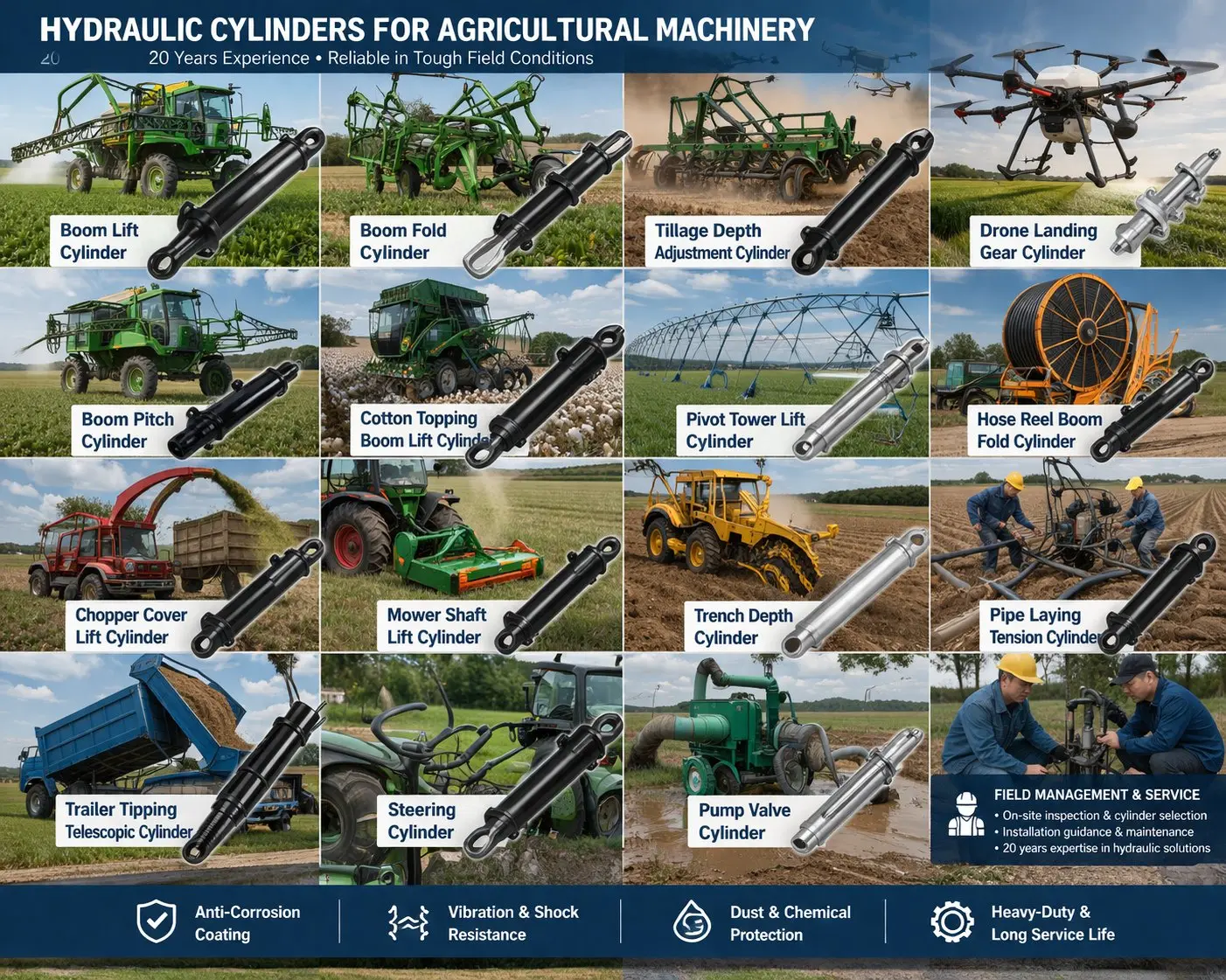
On laser-guided installations—now the standard on professional drainage projects in Korea, Japan, and Europe—the pipe lay frame lift cylinder receives continuous depth correction signals from the laser receiver. The cylinder must respond smoothly to these corrections without stick-slip behavior that would create step changes in pipe depth rather than the smooth grade transitions the laser system calculates. Our low-friction piston seal provides the smooth response these automated grade control systems require, while the PTFE wear rings prevent the lateral metal-to-metal contact that causes intermittent binding in cylinders exposed to the side loads generated by angled trenching passes.
Six Features Engineered for Aggressive Trench-Mud Service
Metal-Cased Scraper with Secondary Wiper
Primary defense against wet, sticky trench mud. The metal housing maintains the scraper lip geometry under the lateral force of packed mud that deforms and flattens standard rubber wipers within days. The hardened PU lip scrapes wet clay and iron oxide deposits from the rod surface during every retraction stroke. Behind the scraper, a secondary PU wiper catches any residual particles, providing redundant protection for the primary rod seal.
FKM Seal Upgrade for Acid and Sulfide Soils
Standard NBR seals swell and degrade when exposed to hydrogen sulfide and low-pH organic acids found in anaerobic peat and clay subsoils. For installations in acidic peat, sulfide-rich clay, or coastal acid-sulfate soils, FKM (Viton) seals provide complete chemical inertness. Available as a factory option on every pipe lay frame lift cylinder in our range, specifiable at the time of order with no impact on mounting dimensions or delivery schedule.
Immersion-Grade Epoxy Body Coating
The cylinder body sits in trench mud continuously during installation runs that may last hours at a time. Standard paint dissolves within days in acidic subsoil slurry. Our zinc primer plus immersion-grade epoxy topcoat system withstands prolonged direct contact with chemically aggressive waterlogged soil while the sacrificial zinc layer prevents under-coating corrosion spread at any scratch or impact site.
Heavy Chrome Rod (20+ Micron)
The thick chrome layer provides a deep corrosion buffer against the acid and sulfide attack that the trench environment delivers to the rod surface. Even with effective scraper exclusion, some chemical contact occurs during the brief moment the rod passes through the mud layer. Heavier chrome provides more material to resist this contact without exposing the base metal beneath.
PTFE Wear Rings for Side Load from Angled Trenching
Drainage installation machines frequently trench at angles to the direction of travel when following curved field boundaries or navigating around obstacles. These angled passes generate lateral forces on the pipe guide assembly that transfer directly into the pipe lay frame lift cylinder as side loading on the piston. PTFE-bronze wear rings absorb this lateral force, preventing metal-to-metal contact between the piston and bore that would score the honed bore surface and create an internal leakage path.
Q345D Body with Low-Temperature Toughness
Drainage installation in Korea and Japan often starts in early spring when soil temperatures are still near freezing but the water table is high enough for effective drainage work. Q345D provides 345 MPa yield with certified Charpy impact toughness at -20 C, preventing brittle fracture of the cylinder barrel and mounting ears during cold-season operation under the heavy loads of deep trenching.
Application Scenarios
Subsurface Drainage Pipe Laying: The primary application. Controlling pipe guide shoe depth in wet trenches during chain-trencher and wheel-trencher drainage installation. The pipe lay frame lift cylinder maintains grade accuracy in the most chemically aggressive soil environment in agricultural field management.
Laser-Guided Grade Control Systems: Automated laser-guided installations use the cylinder for continuous real-time depth correction. Our low-friction seal provides the smooth, stutter-free response that custom hydraulic cylinder applications in precision grade control demand.
Trenchless Drainage Plow Depth Control: Drainage plows that install pipe without trenching pull the pipe through a narrow slit using a plow blade. The depth control cylinder faces identical waterlogged subsoil exposure as trench-based systems.
Tile Drainage Renovation: Re-grading and replacement of aging clay tile drainage systems uses the same installation equipment and encounters the same subsoil chemistry, often made more aggressive by decades of accumulated biological activity around the old tiles.
Underground Irrigation Pipe Installation: Subsurface drip irrigation installation rigs work in similar trench environments. The metal scraper and chemical-resistant seal options on our cylinder apply directly to these agricultural machinery hydraulic cylinder applications.
Manufacturing and Quality Control
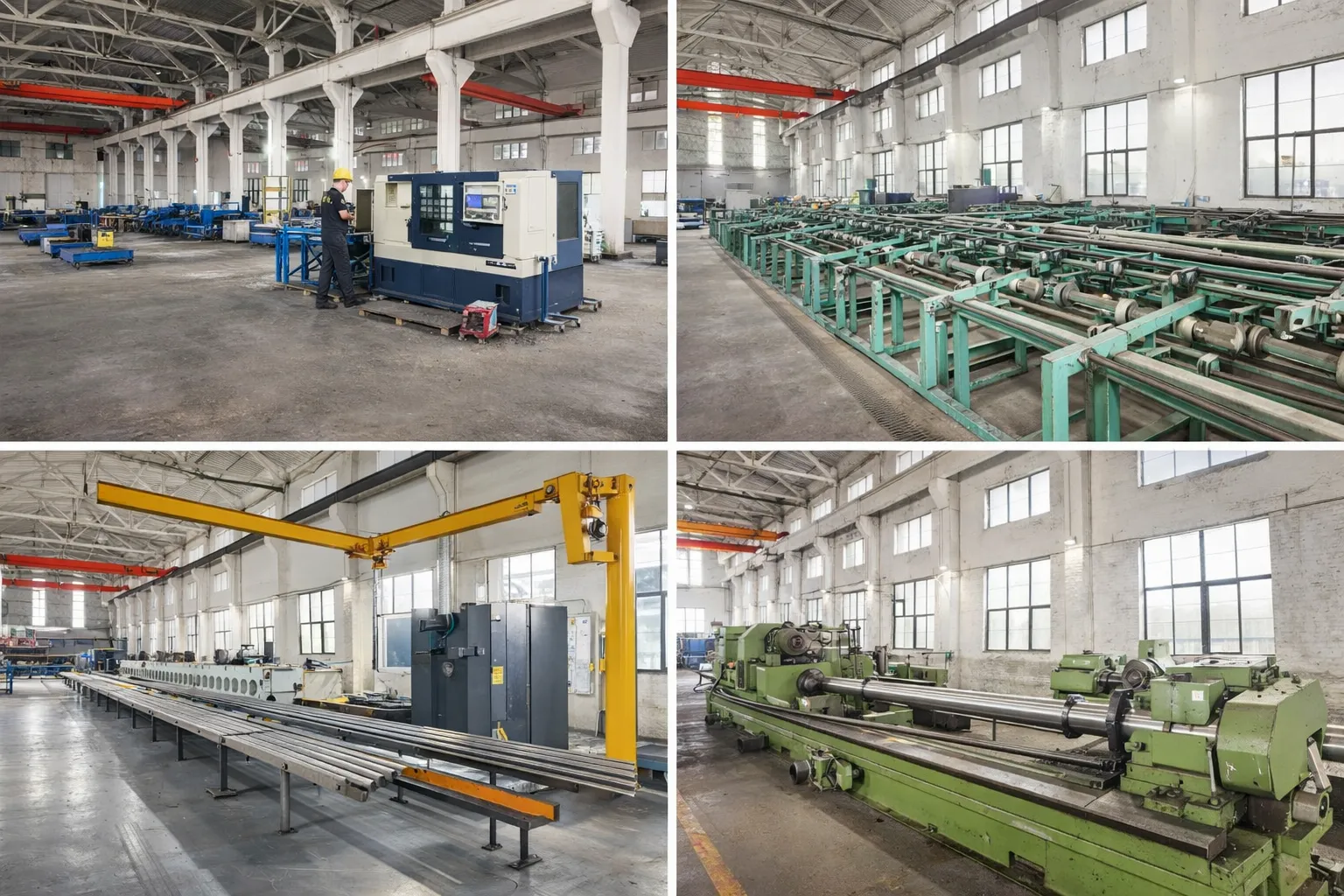
Every pipe lay frame lift cylinder is manufactured in-house in our ISO 9001 certified facility. Q345D tube and rod stock verified by spectrometer on each incoming batch with Charpy impact testing at -20 C. Bores CNC bored and honed to Ra 0.2 in single-setup runs. Rods ground to h7 and hard chrome plated to 20+ micron with thickness verified by eddy current gauge. MIG welded by certified operators with visual weld inspection. Body surfaces blasted to Sa 2.5, zinc-primed, and immersion-grade epoxy top-coated with dry film thickness measurement at multiple points. Metal-cased scraper fit-checked on every unit for correct lip contact pressure against the rod. FKM seal compound (when specified) verified by manufacturer certificate for acid and sulfide resistance. 100% pressure tested at 1.5 times rated pressure for three minutes with full leak inspection. Serial numbered with ten-year traceability to material heat, seal lot, and test data. Material certificates, pressure test reports, and seal data sheets included as standard documentation.
Standard Farm Cylinder vs. Our Drainage Pipe Lay Cylinder
| Trench Service Metric | Standard Farm Cylinder | Our Pipe Lay Cylinder |
|---|---|---|
| Scraper Type | Rubber wiper (deforms in wet mud) | Metal-cased scraper + secondary wiper |
| Rod Seal Chemical Resistance | NBR (swells in acid/sulfide) | Water-resistant NBR or FKM upgrade |
| Body Coating (trench mud contact) | Standard paint (dissolves in days) | Immersion epoxy (survives seasons) |
| Seal Life in Acidic Clay Trench | 20 – 50 operating hours | 400+ operating hours |
| Lateral Load Protection | None | PTFE wear rings on piston + gland |
| Grade Control Response | Stick-slip, step changes in depth | Smooth, stutter-free correction |
Customer Case Studies
Iksan City, Jeollabuk-do, South Korea
Customer: Subsurface drainage installation contractor serving the Honam plain, Korea’s largest lowland rice-growing region with 280,000 hectares of paddy land requiring systematic drainage improvement
How They Found Us: Installation supervisor searched for “drainage trench hydraulic cylinder acid resistant scraper” on Google in January 2025 after losing three standard cylinders to seal failure in a single week of work in waterlogged Honam clay.
Results: The Honam plain clay is heavy, waterlogged, and moderately acidic (pH 5.0 to 5.5). Previous standard cylinders needed seal replacement every 40 to 60 operating hours due to iron oxide scale buildup on the rod and acid degradation of the NBR seals. Our pipe lay frame lift cylinder with metal scraper and water-resistant seals completed over 400 hours across two full installation seasons without seal work. Annual cylinder maintenance costs dropped by approximately 80%.
“We used to carry a box of seal kits on every job because the cylinder would start leaking within two to three days. Two full seasons with these cylinders and the seal kit box is still unopened.” – Mr. Baek, Installation Supervisor, November 2025
Tokachi District, Hokkaido, Japan
Customer: Agricultural land improvement cooperative managing the largest subsurface drainage installation program in Japan, covering over 5,000 hectares of former wetland converted to arable production
How They Found Us: Found our hydraulic cylinders for agricultural machinery through a Google search in February 2025 specifically looking for cylinders rated for Hokkaido’s acidic volcanic peat soils.
Results: Hokkaido volcanic peat is among the most acidic agricultural soils in Asia (pH 4.8 to 5.2) with high dissolved sulfide content. Standard NBR seals degraded visibly within one week of continuous operation. Our FKM seal upgrade completely prevented acid-induced seal degradation. Two full installation seasons completed without any seal or scraper replacement across 6 machines, a result the cooperative had never achieved with any previous cylinder supplier.
“Hokkaido peat acid dissolves standard seals like sugar in water. The FKM upgrade was essential and it worked perfectly. Two seasons, six machines, zero seal failures.” – Mr. Tanaka, Cooperative Installation Director, October 2025
Nakhon Ratchasima Province, Thailand
Customer: Drainage equipment OEM building laser-guided installation machines for Southeast Asian rice drainage projects across Thailand, Cambodia, and Vietnam
How They Found Us: OEM engineering team contacted us in August 2024 after their existing pipe lay cylinder supplier could not offer a metal-cased scraper option for the extreme mud conditions their machines operate in.
Results: OEM accelerated corrosion testing with acidic clay slurry (pH 5.0, injected with iron oxide particles) showed our scraper/seal system lasting 8 times longer than their previous supplier’s rubber-wiper units. Field trials across three Thai provinces confirmed the laboratory results. The OEM adopted our pipe lay frame lift cylinder as standard equipment on all their drainage installation rigs. Annual order is 180 units across four machine models.
“Southeast Asian subsoils are aggressive. Our customers in Cambodia and Vietnam cannot get replacement parts quickly, so the cylinder has to survive the entire installation campaign without maintenance. These do.” – Mr. Prasert, OEM Engineering Manager, July 2025
Chiang Rai Province, Thailand
Customer: Highland rice drainage contractor installing subsurface systems in upland rice paddies at 600 to 900 meter elevation in northern Thailand
How They Found Us: Referral from the Nakhon Ratchasima OEM customer. Trial order placed November 2024.
Results: Highland laterite soils are dense, acidic, and contain high concentrations of dissolved iron that precipitates as abrasive red scale on exposed metal surfaces. Our metal-cased scraper removed the iron deposits effectively, and the immersion epoxy body coating resisted the red staining that peeled paint off every other cylinder on the machine within days. Completed 300+ hours of highland installation with zero cylinder maintenance.
“Everything on the machine turns red from dissolved iron within the first hour of trenching. The scraper kept the rod clean and the epoxy kept the body intact. Nothing else we tried could do that.” – Mr. Wichai, Installation Contractor, April 2025
Adana Province, Turkey
Customer: Drainage installation equipment manufacturer building machines for the Cukurova delta and export to Central Asian irrigation and drainage projects
How They Found Us: Met at the Konya Agriculture Fair in September 2024. Began engineering evaluation in November 2024.
Results: The Cukurova delta has brackish clay subsoil with chloride concentrations of 500 to 1,500 ppm that attack chrome plating aggressively. OEM field testing showed our heavy-chrome, scraper-protected cylinder surviving a full 120-day installation campaign in delta clay where their previous supplier’s units failed at 15 to 20 days. The OEM has standardized our cylinder across their entire product line. Annual order is 200 units plus spare scrapers and seal kits.
“Delta clay is the hardest test for any drainage installation cylinder. Full campaign survival in Cukurova brackish clay was the qualification test for our production approval. These passed on the first attempt.” – Mr. Sahin, OEM Test Lab Manager, June 2025
Related Products and Spare Parts
A pipe lay frame lift cylinder is one component in the hydraulic system powering a drainage installation machine. We also manufacture and supply the following related products and replacement parts that integrate seamlessly with our drainage cylinders to keep your installation rigs running through the full campaign without interruption.
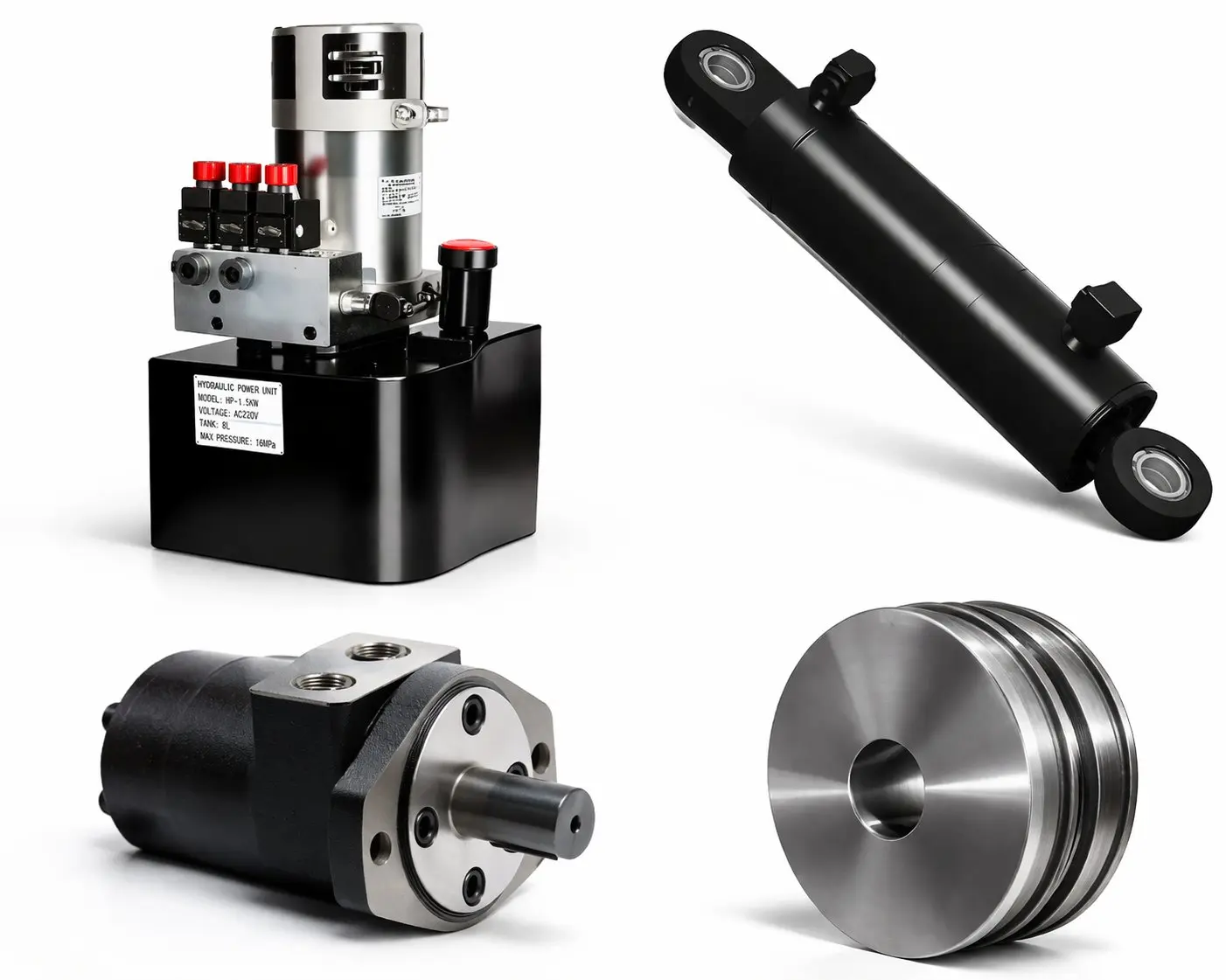
Hydraulic Power Unit: Compact self-contained power units for driving pipe lay, depth control, and grade adjustment cylinders on drainage installation rigs. Electric and diesel configurations from 0.75 to 7.5 kW with 5 to 60 liter reservoirs. Pre-matched to our cylinder bore and pressure specifications for plug-and-play system integration on new builds and retrofit installations.
Hydraulic Pump: Gear pumps and vane pumps for drainage machine hydraulic circuits. Flow rates from 2 to 40 liters per minute, selected to match the cylinder speed and force requirements of laser-guided pipe lay and grade control systems. SAE, DIN, and metric flange options for compatibility with all common installation machine power units.
Hydraulic Motor: Low-speed, high-torque motors for auxiliary drives on drainage installation machines. Powers trenching chain drives, pipe feed mechanisms, and backfill augers alongside the hydraulic cylinder systems. Orbital and gear types from 50 to 500 cc displacement.
Replacement Piston Rod: Factory-matched replacement piston rods for all our drainage cylinder models. Same Q345D material, chrome specification (20+ micron), and dimensional tolerance as original production. Drop-in replacement when rod reconditioning is not economical after extended trench service. Supplied with a new rod seal kit for complete rod-end rebuild.
Replacement Cylinder Barrel: Precision-honed replacement barrels for field rebuild. Same Q345D material, Ra 0.2 bore finish, seal groove dimensions, and port specifications as original production. Supplied pre-coated with immersion-grade epoxy. Complete rebuild kit including barrel, piston seal, wear ring, scraper, and O-rings available as a single part number for streamlined ordering and inventory management.
All related products and spare parts are available to order alongside new hydraulic cylinders for sale or separately for existing installations. Our engineering team provides system-matched recommendations that consider the complete hydraulic circuit on your drainage installation rig.
Frequently Asked Questions
Why do standard farm cylinders fail so quickly in drainage trench service?
When should I specify the FKM seal upgrade instead of standard water-resistant NBR?
What bore size is typical for a drainage machine pipe lay frame lift cylinder?
What is the lead time and can I order replacement scrapers and seal kits separately?
Trench Mud Is Corrosive. Your Pipe Lay Cylinder Should Be Ready for It.
Share your installation rig model, trench depth range, and soil conditions. We will recommend a pipe lay frame lift cylinder with the right scraper and seal configuration and deliver a quotation within 48 hours.
Editor: Cxm