Hood Lift Cylinder for Lawn and Pasture Mulching Machines
Carbon steel with integrated dust ring and hard chrome rod. Keeps mulcher inspection hoods operating smoothly season after season in the dustiest working environment on the farm.
Two Things Go Wrong With Mulcher Hood Cylinders. Both Start With Dust.
Ask any mulcher operator what goes wrong with the hood lift cylinder and you will hear the same two complaints every time. First, the rod develops a rough, pitted surface that you can feel with your fingernail within a season or two of use. Second, once the rod surface is damaged, the rod seal starts weeping oil that drips onto the mulcher body and eventually onto the ground beneath the machine. A hood cylinder that leaks cannot hold the hood open reliably for blade inspection or maintenance, and on some machines it makes the hood progressively harder to lift as air enters the circuit through the worn seal.
Both problems originate from the same source: the massive volume of fine dust that mulching operations generate. A pasture mulcher turning over tall grass and surface residue produces a continuous cloud of soil particles, dried plant material, and shredded fiber that coats every exposed surface on the machine, including the chrome surface of the hood lift hydraulic cylinder rod. Each time the hood is opened or closed, the rod moves through this dust layer, and without effective dust exclusion, particles are dragged into the gland where they scratch the chrome and grind against the seal lip.
Our mulcher hood lift cylinder is a double acting hydraulic cylinder built from carbon steel with a hard chrome-plated piston rod, an integrated polyurethane dust exclusion ring specifically designed for the fine, dry dust of mulching operations, and a bore honed to Ra 0.2 for consistent seal-to-bore contact. The dust ring intercepts particles before they reach the primary rod seal, breaking the scratch-pit-leak chain at its first link. The result is a rod surface that stays smooth and a seal that stays intact through multiple seasons of heavy mulching use.
Dust Ring vs. No Dust Ring: What Happens to the Rod Over Three Seasons
The difference between a cylinder with and without effective dust exclusion is not subtle after a few seasons of mulching service. We tracked rod surface condition on matched pairs of cylinders, one with our integrated PU dust ring and one without, installed on identical mulchers operating in the same fields over three consecutive seasons.
| Condition | Without Dust Ring | With Our PU Dust Ring |
|---|---|---|
| After Season 1 – Rod Surface | Visible micro-scratches, dull finish | Chrome surface unchanged, mirror finish |
| After Season 2 – Rod Surface | Pitting visible, rough to touch | Minor wear marks, still smooth |
| After Season 3 – Seal Condition | Oil weeping, seal lip grooved | Seal intact, no leakage detected |
| After Season 3 – Hood Holding | Drift 5-10 mm in 5 minutes (unsafe) | Drift below 1 mm in 30 minutes |
| Replacement Needed? | Yes, full cylinder or rod + seal | No, continued in service |
The data tells a clear story: dust exclusion at the rod gland is not optional for mulcher hood cylinders. It is the single most impactful design feature for extending service life in this application. Our PU dust ring costs a fraction of a cylinder replacement but extends rod and seal life by a factor of 2 to 3 or more.
Technical Specifications
| Specification | Available Range |
|---|---|
| Bore Diameter | 32 mm – 63 mm |
| Rod Diameter | 18 mm – 36 mm |
| Stroke Length | 100 mm – 400 mm |
| Working Pressure | Up to 14 MPa (2,030 PSI) |
| Action Type | Double Acting |
| Structure | Small Welded Piston Cylinder |
| Body Material | Carbon Steel (S45C / AISI 1045) |
| Piston Rod | Carbon Steel, Hard Chrome 20+ micron |
| Body Finish | Black Oxide + Epoxy Paint |
| Piston Seal | PU Compact Seal |
| Rod Seal | NBR + PTFE Back-up |
| Dust Protection | Integrated PU Dust Exclusion Ring |
| Mounting | Clevis, Pin Eye, Lug, Custom |
| Port Thread | BSP / NPT / Metric |
| Operating Temperature | -20 C to +80 C |
| Environment Rating | Dust / Grass Debris |
Five Features That Keep Mulcher Hood Cylinders Working Season After Season
Integrated PU Dust Exclusion Ring
Sharp-edged polyurethane wiper at the outermost gland position. Designed for the dry, fine dust of mulching operations rather than the wet mud of tillage. The lip profile strips dried grass dust and soil particles from the rod before they can be dragged into the seal zone, directly preventing the scratch-pit-leak progression.
20+ Micron Hard Chrome with Micro-Polish
Heavy chrome layer provides a deep barrier that takes significantly longer to scratch through to base metal than the 10 to 15 micron layer on standard cylinders. Micro-polish reduces surface roughness below Ra 0.1, eliminating the micro-valleys where dust particles lodge and initiate scratching.
Ra 0.2 Bore for Reliable Holding
Hood lift cylinders must hold the hood open during maintenance. Our precision bore provides consistent seal contact for minimal internal leakage, keeping hood drift below 1 mm during typical inspection periods. The operator can work under the hood with confidence.
Compact Welded Body
Mulcher hood mechanisms have limited space for hydraulic components. Welded body without tie rods produces the smallest diameter for any given bore, fitting within tight clearances on compact and mid-size mulcher frames.
Epoxy Body Coating
Epoxy paint resists the combination of grass juice, moisture, and soil that accumulates on mulcher surfaces. Maintains body protection for 3 to 5 seasons without touch-up under normal mulching conditions.
Application Scenarios
Pasture and Lawn Mulcher Inspection Hoods: The primary application. Tractor-mounted and offset mulchers use hood lift cylinders for accessing the blade shaft for inspection, hammer replacement, and clearing wrapped material.
Roadside Vegetation Mulcher Service Panels: Boom-mounted roadside mulchers have service panels that open for blade maintenance. The dust environment from road shoulder mulching is as demanding as pasture work. These are typical double acting hydraulic cylinder applications in vegetation management equipment.
Forestry Mulcher Guard Lift: Land clearing mulchers use heavy guards that lift for access to the rotor. The wood dust and bark particle environment is comparable to grass mulching for cylinder contamination severity.
Straw Chopper and Spreader Hoods: Grain combine straw choppers and spreaders have service hoods exposed to chaff and straw dust. The dust ring provides the same protection benefit as in mulcher applications.
Manufacturing and Quality Control
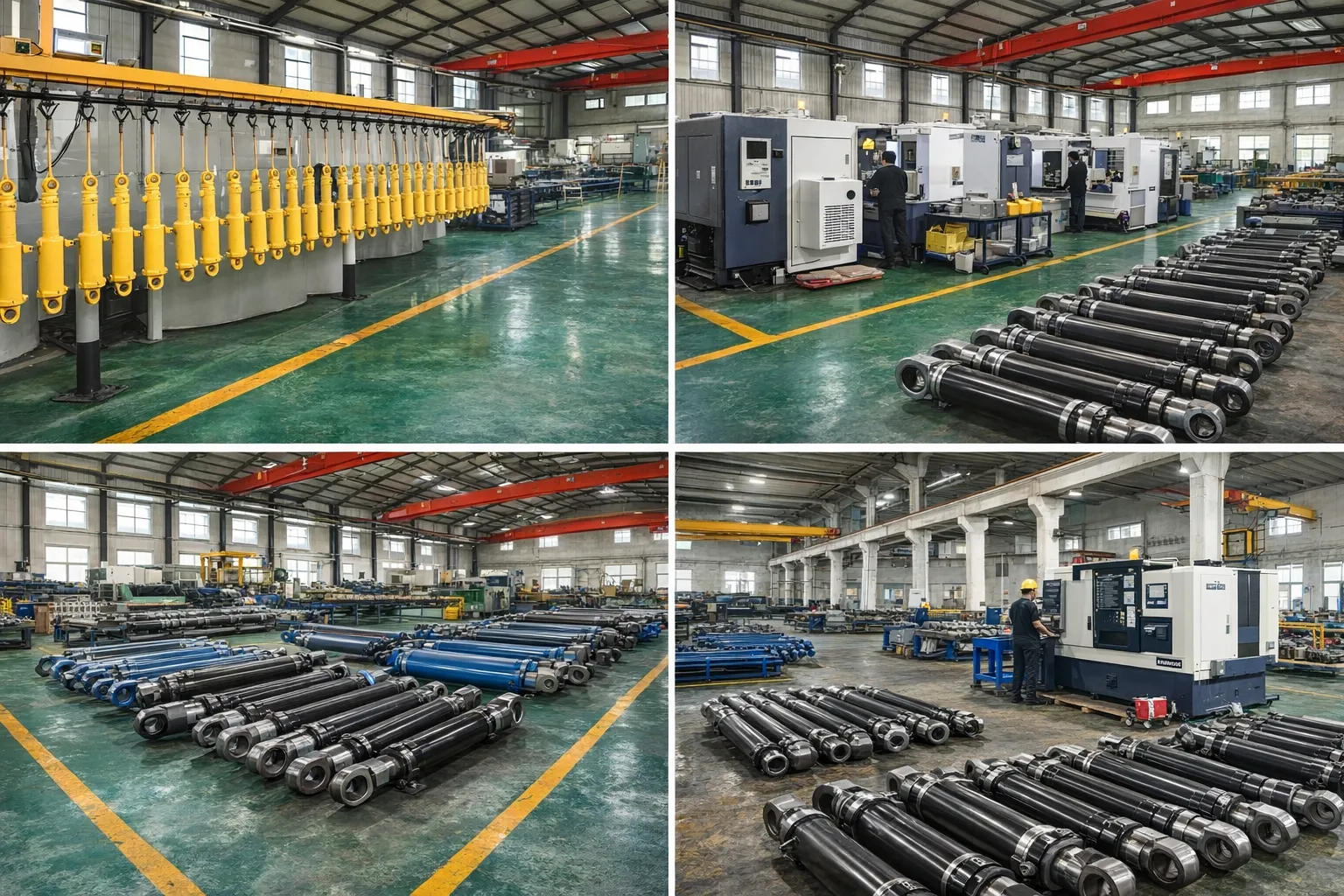
Built in our ISO 9001 facility. Carbon steel verified by spectrometer. Bores honed to Ra 0.2. Rods ground to h7, chrome plated to 20+ micron, micro-polished. Chrome thickness verified by eddy current gauge on every rod. MIG welded. Clean-room assembly. 100% pressure tested at 1.5x rated pressure. Serial numbered with ten-year traceability. Material and test certificates included.
Standard Cylinder vs. Our Mulcher Hood Lift Cylinder
| Dust-Relevant Metric | Standard Cylinder | Our Hood Lift Cylinder |
|---|---|---|
| Dust Exclusion | None or basic wiper | Integrated PU dust ring |
| Rod Pitting Onset | 1 – 2 seasons | 4+ seasons |
| Chrome Thickness | 10 – 15 micron | 20+ micron (micro-polished) |
| Hood Holding Drift (5 min) | 3 – 10 mm after 2 seasons | Below 1 mm after 3+ seasons |
| Service Life (mulching dust) | 2 – 3 seasons | 5+ seasons |
Customer Case Studies
Frequently Asked Questions
Why does mulching cause rod pitting faster than other farm applications?
What bore size for a mulcher hood lift cylinder?
Can I add a dust ring to an existing cylinder design?
What is the lead time?
A Dust Ring Costs Almost Nothing. Replacing a Pitted Cylinder Costs Real Money.
Share your mulcher model and hood dimensions. We will recommend a dust-protected replacement and deliver a quotation within 48 hours.
Editor: Cxm