Tail Beam Cylinder for Hydraulic Support
Engineered with heavy-duty Q345D structural steel and an advanced anti-extrusion sealing matrix to conquer severe dust impact and extreme geological pressure in highly mechanized underground extraction.
Product Overview & Uncompromising Industrial Value
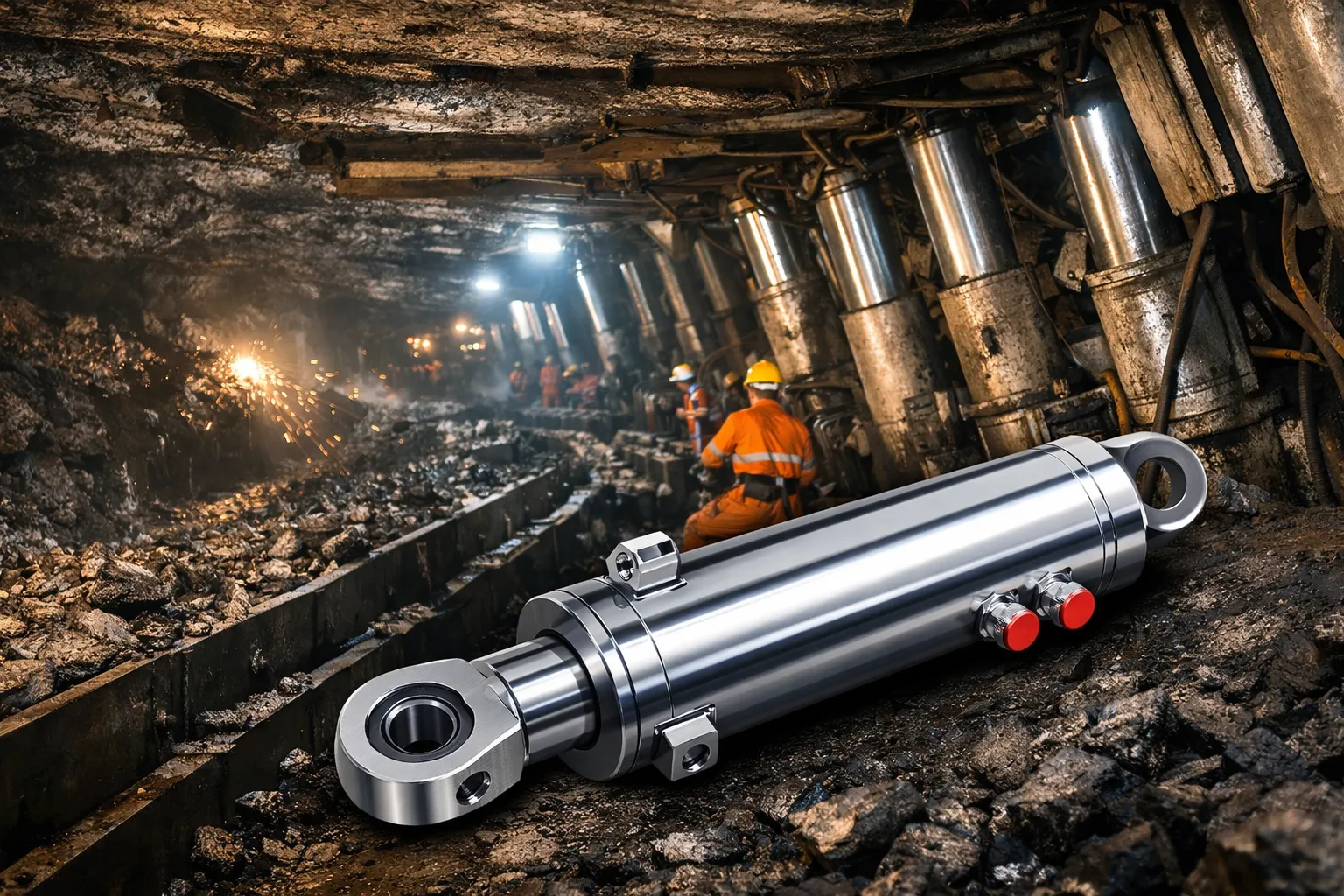
In the unforgiving operational theater of highly mechanized underground coal extraction, the structural integrity of the longwall working face is the definitive metric of both personnel safety and mine profitability. While the primary canopy protects the active shearer and the miners, managing the deliberately caved rock in the mined-out area behind the supports—known as the gob—is equally critical to the continuous progression of the face. As the support shield advances, the roof strata must be allowed to collapse in a highly controlled manner. This violent geological transition is managed entirely by the tail beam, a massive hinged steel barrier at the rear of the canopy. The immense kinetic energy and static holding force required to manipulate this structure and prevent collapsed waste rock from flushing forward into the rear armored face conveyor is provided exclusively by the tail beam cylinder. Operating in a harsh environment defined by relentless vibration, severe abrasive dust, and heavy, unpredictable structural loading, this specific actuator must deliver an uncompromising holding pressure without yielding.
Through exhaustive forensic analysis of subterranean fluid power failures, our engineering team has conclusively determined that standard commercial actuators are profoundly inadequate for this specific application. Positioned at the extreme rear of the canopy, the tail beam hydraulic cylinder is continuously subjected to a severe environmental grade of “dust impact”. Falling rock debris, shattered coal, and dense particulate clouds constantly bombard the extended cylinder rod. However, the most critical and financially devastating failure mode in this precise location is known as “seal extrusion”. When a sudden roof weight transfer occurs, or a massive block of unsupported rock strikes the tail beam, it creates an instantaneous, exponential pressure spike within the trapped hydraulic fluid inside the barrel. This microsecond pressure surge violently forces soft, standard polyurethane seals into the microscopic clearance gaps between internal metallic components. This instantly shreds the seal matrix, causing catastrophic internal fluid bypass and a total loss of supporting pressure. As a highly specialized and globally recognized hydraulic cylinder manufacturer, we have fundamentally re-engineered the internal fluid dynamics and sealing tribology to permanently eliminate this specific, highly dangerous vulnerability.
For procurement directors, fleet maintenance managers, and chief mechanical engineers across South Korea and the broader Asia-Pacific heavy extraction sector, calculating the true lifecycle hydraulic cylinder price necessitates factoring in the immense financial devastation of unplanned mid-shift maintenance. Relying on substandard, off-the-shelf hydraulic parts guarantees inflated operational budgets, excessive labor costs, and unacceptable safety risks to underground personnel. By integrating our advanced anti-extrusion sealing technology and high-yield structural metallurgy into your fleet, you permanently enhance the reliability of your entire extraction operation. This strategic engineering upgrade drastically minimizes the hazardous necessity of constantly fixing hydraulic cylinders deep underground, ensuring your automated longwall systems achieve their maximum designed production tonnage safely and without interruption.
Definitive Technical Specifications
To eliminate mechanical unpredictability and ensure absolute operational safety, strict engineering specification is mandatory. The technical matrix provided below details the optimized structural blueprint for our heavy-duty tail beam cylinder. These parameters do not represent basic minimums; they represent a highly evolved, field-proven configuration designed exclusively to survive extreme dust impact and permanently prevent internal seal extrusion under massive geological loads. Furthermore, our vertically integrated manufacturing facility maintains the agile capability to fully customize bore dimensions, stroke lengths, trunnion dimensions, and high-pressure port geometries to seamlessly integrate with your proprietary mining machinery frameworks.
| Engineering Parameter | Component Specification Details & Metallurgical Standards |
|---|---|
| Target Industry Segment | Mining Equipment & Subterranean Heavy Extraction Systems |
| Equipment Classification | Hydraulic Support Systems (Shields, Chocks, and Transitions) |
| Subsystem Integration | Tail Beam Assembly (Rear Gob Shielding and Rock Deflection) |
| Component Designation | Tail Beam Cylinder / Tail Beam Hydraulic Cylinder |
| Kinematic Action Mode | Double acting hydraulic cylinder format for active push/pull control |
| Internal Architecture | Hydraulic cylinder piston configuration for balanced force density |
| Manufacturing Structure | Welded Type construction (Automated 6-axis SAW deep penetration) |
| Primary Material System | Q345D High-Strength Low-Alloy Structural Steel |
| Rod Surface Treatment | Precision Hard Chrome Plated (Micro-cracked, high wear resistance) |
| Environmental Hazard Grade | Severe: Direct Dust Impact + Heavy Falling Rock Debris |
| Working Condition Profile | Supporting Tail Beam (Dynamic angle adjustment under massive rock load) |
| Typical Industry Failure Mode | Seal Extrusion caused by sudden, massive geological pressure spikes |
| Expert Recommended Solution | Heavy-Duty Seal Matrix with robust anti-extrusion backup rings |
Kinematic Functionality: Controlling the Caving Zone
To thoroughly grasp the sheer engineering resilience required for this component, maintenance specialists must analyze the brutal fluid dynamics involved during a standard extraction cycle. The tail beam mechanism relies entirely on the fundamental principles of a high-pressure double acting hydraulic cylinder. This signifies that highly pressurized, fire-resistant hydraulic emulsion (typically HFA fluid) is actively pumped into the unit to generate massive mechanical thrust during both the extension and retraction phases. However, unlike a primary vertical lift cylinder that predominantly handles steady, static compressive roof weight, the tail beam actuator operates at an inclined angle, managing complex, violent dynamic loads as the gob continuously caves in behind the shield.
During the mining sequence, as the support shield advances forward toward the newly cut coal face, the tail beam must be manipulated to prevent the collapsing rear strata from breaching the active working area. The directional electro-hydraulic control system forces high-pressure fluid into the cap end (blind end) of the tail beam hydraulic cylinder. This creates immense volumetric pressure against the surface area of the hydraulic cylinder piston, forcing the heavy, chrome-plated steel rod outward. This extension pushes the articulated tail beam downward and outward, effectively packing and sealing the loose waste rock safely behind the shield. The cylinder must then act as an unyielding structural strut. If large, solid boulders suddenly drop from the roof onto the tail beam, the trapped hydraulic fluid inside the cylinder experiences microscopic but extremely violent pressure spikes. It is precisely during these milliseconds of extreme shock loading that inferior standard seals suffer from fatal seal extrusion, leading to immediate mechanical failure.
Conversely, when the shield needs to be repositioned, or if the tail beam angle requires upward adjustment to clear a massive floor obstacle, the hydraulic system reverses. High-pressure fluid is injected into the annular rod end while the cap end vents fluid to the return line. The heavy-duty hydraulic rams forcefully retract, pulling the steel tail beam upward. Because this critical retraction occurs in an atmosphere heavily saturated with abrasive airborne coal dust, highly acidic moisture, and flying rock shards, the rod must slip seamlessly through the seal gland without dragging these abrasive contaminants into the internal hydraulic system. This relentless, violent cyclical operation dictates that only premium, specialized hydraulic cylinder solutions possessing advanced surface treatments and heavy-duty wiping technologies can provide the necessary fatigue life for continuous mining operations.
Strategic Fleet Modernization: Unrestricted Brand Compatibility
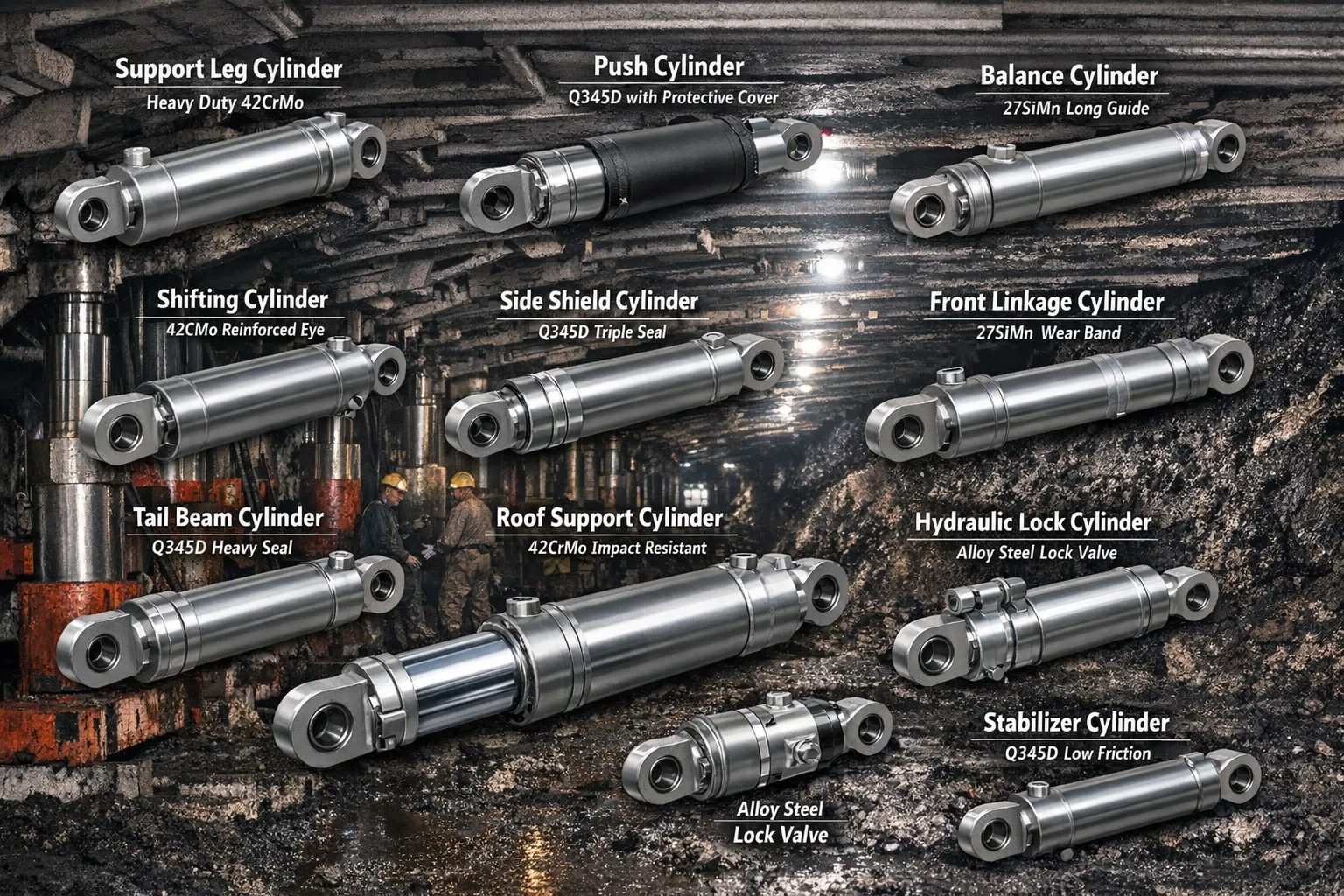
Managing the lifecycle and maintenance schedule of a vast, aging fleet of heavy underground extraction equipment is a formidable logistical challenge. Procuring proprietary replacement actuators directly from Original Equipment Manufacturers (OEMs) frequently leads to exorbitant pricing structures, unacceptable delivery delays, and the deeply frustrating reality of repeatedly installing the exact same flawed standard seals that caused the initial failure. We completely resolve this critical supply chain obstacle. Our extensive engineering database houses the precise dimensional tolerances, high-pressure fluid port specifications, and heavy-duty clevis mounting geometries required to manufacture exact, superior drop-in replacement units for the world’s most ubiquitous longwall machinery brands.
Our high-performance tail beam cylinder configurations are routinely deployed globally to seamlessly upgrade the rear canopy sub-systems originally fabricated by heavy industry leaders such as Caterpillar (CAT), Joy Global (Komatsu Mining), Sandvik, Eickhoff, Famur, Tiandi Science & Technology, and Zhengzhou Coal Mining Machinery Group (ZMJ).
Please note: The inclusion of these specific corporate brand names and trademarks within this technical documentation is provided strictly for the functional purpose of identifying mechanical compatibility and assisting engineers with dimensional equipment selection. We operate proudly as an independent manufacturer of premium fluid power technology and claim no official affiliation, sponsorship, or endorsement from these respective OEM trademark holders.
When your operational maintenance budget is being rapidly consumed by the relentless cycle of hydraulic cylinder repair, switching to our heavily armored aftermarket replacements is a vital strategic decision. You are not merely procuring a spare hydraulic cylinder components; you are fundamentally upgrading your machinery’s capability to withstand extreme geological pressure and abrasive dust impact, drastically reducing the overall need for fixing hydraulic cylinders.
Five Core Technical Advantages Eradicating Mechanical Failure
Surviving an environment dominated by extreme shock loading, devastating seal extrusion, and heavy dust impact demands a profound mastery of advanced metallurgy and tribological seal engineering. Our customized tail beam cylinder establishes the new industry benchmark through five distinct technical innovations:
1. Heavy-Duty Anti-Extrusion Sealing Matrix
The absolute leading cause of actuator death in the tail beam mechanism is seal extrusion. Sudden rock falls cause massive internal fluid pressure spikes that physically push soft standard seals out of their machined grooves and into the microscopic clearance gaps. We counteract this destructive phenomenon by utilizing an advanced, heavy-duty seal matrix. This intelligent system includes premium polyurethane (PU) primary seals reinforced with highly rigid POM (Polyoxymethylene) or PTFE anti-extrusion backup rings. Under sudden shock loads, these backup rings dynamically expand to physically block the extrusion gap, allowing the soft seal to handle immense pressure without deforming, tearing, or shredding, permanently solving the fluid bypass issue.
2. Q345D Low-Alloy Structural Supremacy
Tail beam operation subjects the cylinder barrel to extreme lateral bending moments and brutal kinetic impact forces. Instead of relying on standard carbon steel (such as 1045 or #45), our welded cylinder barrels and heavy-duty trunnion mounts are forged exclusively from Q345D low-alloy, high-strength structural steel. This superior metallurgical choice provides phenomenal yield strength and exceptional impact toughness, even operating at freezing subterranean temperatures. It guarantees the cylinder will not suffer from fatigue micro-cracking or catastrophic barrel ballooning under heavy geological pressure spikes.
3. High-Velocity Dust Wiper Technology
Because the operational environment is explicitly classified under the severe “dust impact” grade, abrasive particulate ingress is a constant, highly destructive threat. We integrate a highly aggressive, double-lipped wiper seal architecture at the gland. As the chrome rod retracts, the rigid primary outer lip physically scrapes away caked-on rock mud, dried coal dust, and heavy debris. The secondary flexible lip entirely blocks microscopic airborne silica dust from entering the housing. This absolute defense mechanism ensures the main pressure seals operate continuously in a pristine, uncontaminated fluid environment, effectively stopping rod scoring in its tracks.
4. Micro-Cracked Hard Chrome Plating
The constant bombardment of falling rock fragments and abrasive debris causes standard commercial rods to dent, which subsequently tears internal seals upon retraction. Our high-carbon steel piston rods undergo a rigorous medium-frequency induction hardening process to provide massive physical impact resistance. This is followed by specialized micro-cracked hard chrome plating applied to a thick deposit of 30-50 microns. This engineered finish possesses a microscopic network of fissures that actively retain a nanometer-thin film of hydraulic emulsion, drastically lowering sliding friction and providing an impenetrable barrier against acidic mine water corrosion.
5. Robotic Submerged Arc Welding (SAW)
Severe spatial restrictions at the rear of the canopy require a highly compact welded cylinder design, completely eliminating the possibility of utilizing bulky, traditional tie-rods. To ensure absolute metallurgical integrity at the crucial mounting points and end-caps, we utilize fully automated 6-axis robotic submerged arc welding (SAW) for all attachments. This highly computerized process guarantees deep, perfectly uniform weld penetration without porosity, cold laps, or slag inclusions, easily absorbing massive tensile and compressive shock loads without joint fatigue over the product’s extended lifespan.
Autonomous Manufacturing & Unyielding Quality Control
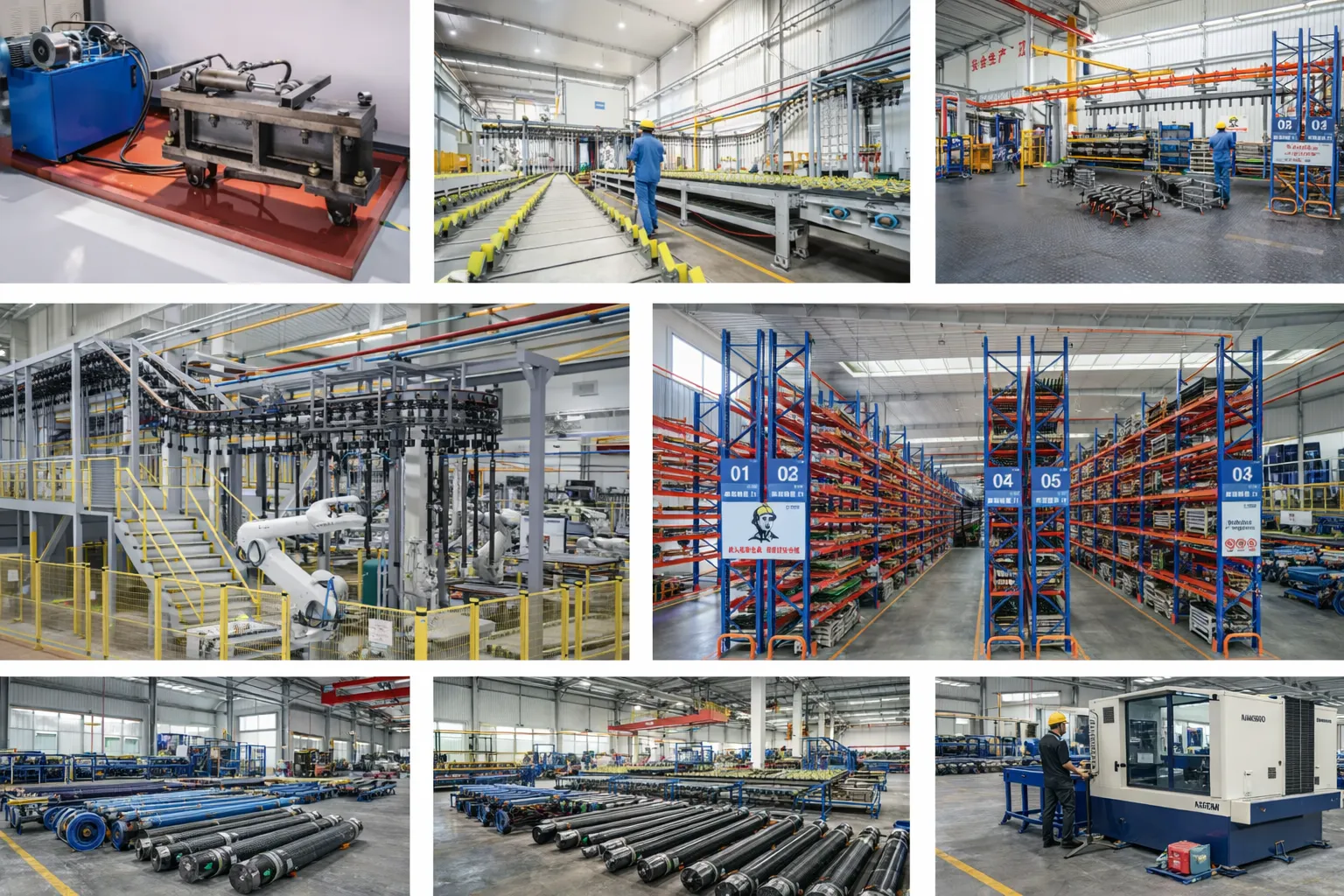
Producing highly critical fluid power components that safeguard human lives and subterranean operations requires total dominion over the entire manufacturing lifecycle. We operate a highly advanced, fully vertically integrated production campus. From the initial optical emission spectral chemical validation of raw Q345D steel billets to the final CNC deep-hole skiving and roller burnishing of the internal cylinder bores (achieving a frictionless, mirror-like Ra 0.2 finish), every single phase of fabrication is executed under our strict internal supervision and quality auditing.
Our most vital quality assurance mechanism is our uncompromising 100% factory hydrostatic testing mandate. No tail beam cylinder is permitted to leave our facility without passing exhaustive computerized bench testing. We flood the completed units and subject them to extreme pressure spikes—typically up to 150% of their rated operational capacity. Digital telemetry rigorously monitors for internal volumetric bypass across the piston, validates absolute external seal integrity under simulated dynamic shock loads, and ensures perfectly smooth actuation free from the dangerous stick-slip behavior common in inferior units.
We deliver absolute engineering transparency. Every dispatched cylinder is permanently laser-engraved with a unique, traceable serial number. This allows our industrial B2B procurement partners to instantly access the specific material metallurgical reports, the ultrasonic non-destructive testing (NDT) logs verifying the integrity of the critical weld joints, and the individual graphical output of the final pressure cycle test. This uncompromising dedication to verifiable quality ensures unmatched value and safety for your critical hydraulic cylinder investments.
Versatile Adaptability: Broad Industry Implementations
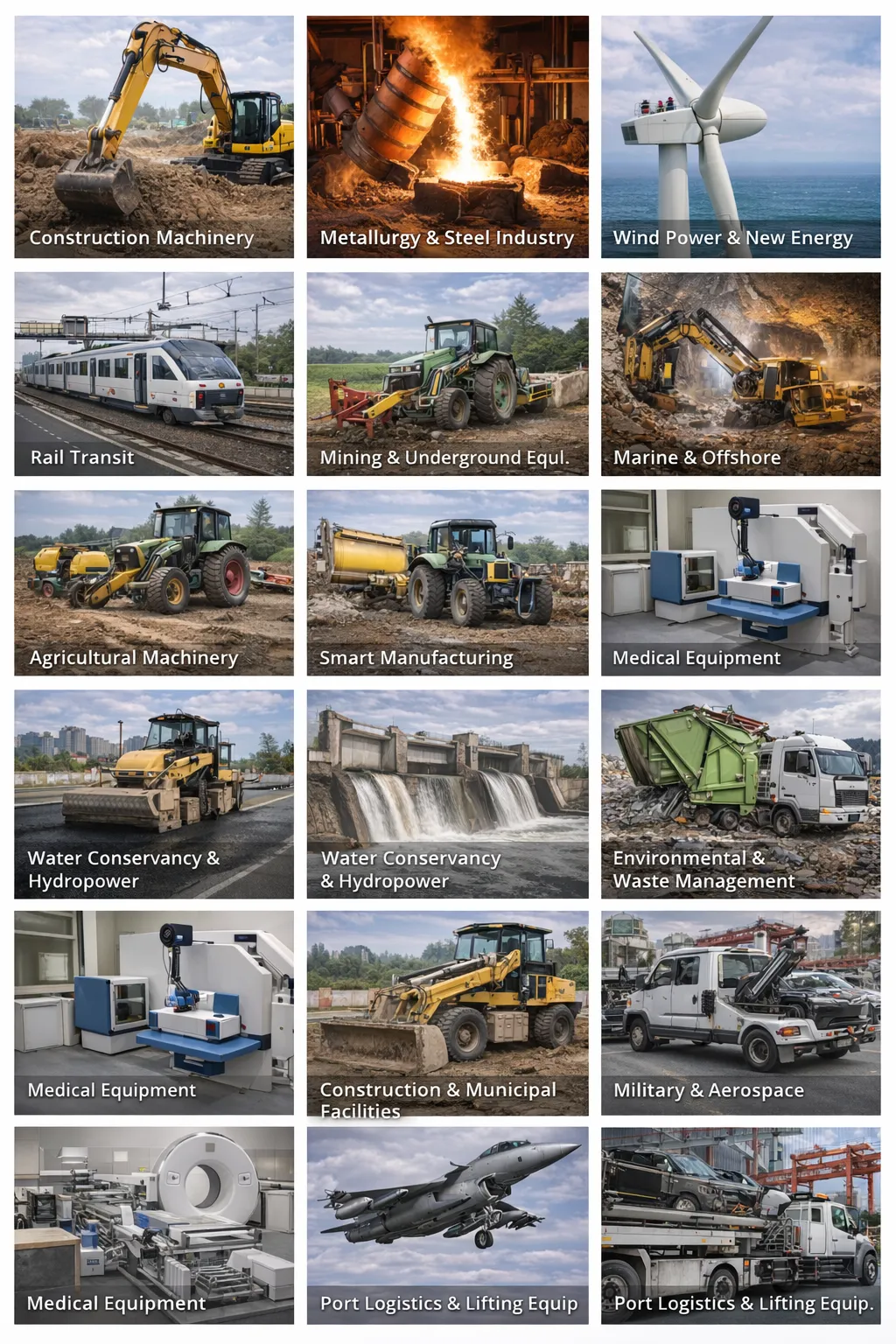
While the tail beam hydraulic cylinder was initially optimized to conquer the horrific realities of underground coal seams, the exceptional force density, anti-extrusion sealing matrix, and extreme impact resistance of these units make them highly sought after across a multitude of heavy-duty industrial landscapes.
- Underground Civil Tunneling: Essential for the stabilizing grippers and heavy pushing sleds of massive Tunnel Boring Machines (TBMs) operating in fractured, high-impact rock formations where dust and debris are ubiquitous.
- Heavy Construction Equipment: Integrated into the primary booms, heavy demolition shears, and ripper attachments of large-scale excavators where violent shock loads cause standard seals to fail instantly. See more in our construction machinery industry applications.
- Heavy Metallurgy and Forging: Operating seamlessly in steel mills near continuous casters and slag pushers, where airborne metallic dust, intense radiant heat, and severe physical impact mimic the severity of mining environments.
- Material Handling & Port Automation: Providing relentless actuation for heavy bulk material stacker-reclaimers and robust clamping mechanisms in corrosive, salt-heavy coastal port logistics.
- Plastics and Rubber Machining: Supplying the continuous, high-tonnage clamping pressures required for industrial-scale injection molding operations without suffering from thermal seal degradation or pressure bleed-off.
Engineering Comparison: Standard vs. High-Performance Cylinders
Evaluating long-term economic viability requires looking well beyond the initial acquisition invoice. Deploying basic commercial components in a heavy extraction system guarantees multiplied maintenance labor, severe safety hazards, and catastrophic production halts. The comparative matrix below illustrates the dramatic engineering disparities. Procurement decisions based solely on the lowest upfront hydraulic cylinder price are statistically the leading cause of fleet-wide fluid power failure.
| Evaluation Metric | Standard Commercial Hydraulic Cylinder | Our High-Performance Tail Beam Cylinder |
|---|---|---|
| Seal Extrusion Resistance | Basic soft PU seals; easily deform, extrude, and shred under sudden geological pressure spikes. | Heavy-duty seal matrix with rigid POM/PTFE backup rings to physically block extrusion gaps. |
| Structural Material | Standard carbon steel (#45/1045) vulnerable to brittle fracture and heavy shock loading. | Premium Q345D low-alloy steel providing maximum yield strength and sudden impact resistance. |
| Dust & Impact Defense | Single-lip wiper; allows abrasive rock dust to enter, destroying the main pressure seals rapidly. | Aggressive double-lip high-velocity wiper and induction hardened rod to deflect rock strikes. |
| Testing & Quality Control | Random batch sampling (1 in 20) with basic manual visual weld inspections. | 100% individual hydrostatic cycle testing and ultrasonic NDT verification on robotic welds. |
| Maintenance Lifecycle | Short MTBF; frequent failure requiring dangerous mid-shift internal seal replacements. | Extended MTBF; engineered explicitly for continuous, uninterrupted deep-seam operation. |
Global Engineering Success: Real B2B Case Studies
Our custom fluid power solutions have radically optimized machinery performance and slashed maintenance budgets worldwide. The following detailed operational case studies highlight how our precise engineering intervention resolved severe bottlenecks across the Asia-Pacific region.
1. Eradicating Seal Extrusion in Deep Seams — Taebaek, South Korea
Client Profile: A prominent South Korean domestic energy conglomerate operating heavily mechanized longwall faces in deep, highly unstable geology.
Operational Challenge: Frequent, sudden roof collapses behind the shield were causing massive, instantaneous pressure spikes inside the tail beam actuators. The standard soft seals were extruding and shredding, leading to a disastrous 35% failure rate within six months and constant halts to coal extraction operations.
How We Connected: The chief maintenance engineer discovered our specialized manufacturing capabilities via a targeted search for robust anti-extrusion hydraulic cylinder solutions to replace their failing OEM components.
Delivered Outcome: We engineered a comprehensive fleet-wide retrofit utilizing our heavy-duty seal matrix with rigid POM backup rings. Following installation, extrusion failures plummeted to zero over the subsequent 18 months, entirely stabilizing their canopy support operations and increasing their daily yield.
“The rigid backup ring technology is an absolute necessity for our unstable roof conditions. Your components solved a critical seal extrusion issue that the OEM simply ignored. A massive reduction in hazardous underground repair hours.” — Mr. Lee, Fleet Maintenance Director, November 2025.
2. Defeating Heavy Dust Impact in Civil Tunneling — Hokkaido, Japan
Client Profile: A major Japanese civil engineering firm specializing in large-diameter infrastructure tunneling through highly fractured rock formations.
Operational Challenge: Required heavily customized lateral clamping cylinders for a modified TBM sled. Heavy falling rock and thick, abrasive silica dust were destroying the standard rod wipers, leading to severe rod scoring and pressurized fluid leakage within weeks of operation.
How We Connected: Found our engineering portal through a B2B sourcing network while explicitly searching for high-impact Q345D cylinder fabrication capabilities.
Delivered Outcome: We delivered highly rigid Q345D double-acting cylinders equipped with our aggressive double-lip dust wipers and induction-hardened rods. The robust exterior easily deflected rock strikes, and the internal seals remained perfectly intact, allowing the infrastructure project to complete ahead of schedule.
“The structural integrity and dust defense of these units are exceptional. Your automated weld quality and comprehensive NDT reports provided our engineering board with complete peace of mind.” — K. Takahashi, Lead Structural Engineer, August 2025.
3. Conquering Corrosive Wet Environments — Quang Ninh, Vietnam
Client Profile: A large-scale mineral extraction operation running legacy shields in severely wet, highly acidic subterranean conditions.
Operational Challenge: The subterranean groundwater was highly acidic. The thin commercial chrome on their existing cylinders was pitting rapidly, creating sharp rust edges that subsequently destroyed the fluid seals during retraction. Maintenance crews were constantly fixing hydraulic cylinders mid-shift.
How We Connected: Contacted our technical sales team directly through our website to inquire about advanced surface treatment and heavy-duty plating options.
Delivered Outcome: We supplied exact drop-in replacements featuring our 50-micron micro-cracked hard chrome plating over induction hardened steel. The chemical corrosion was completely halted, more than doubling the lifecycle of the rear support equipment.
“The micro-cracked chrome technology is a massive operational advantage. Despite the horrific acidic water conditions at the gob, the rods remain completely smooth and rust-free after a full year.” — Nguyen V., Operations Supervisor, January 2026.
4. Optimizing High-Impact Shock Loading — Queensland, Australia
Client Profile: A highly mechanized joint venture operating an ultra-high production, rapid-advance thick-seam longwall.
Operational Challenge: The immense weight of the thick-seam roof strata falling onto the tail beams generated incredible shock loading. Standard welded trunnion mounts on their OEM cylinders were suffering from metal fatigue and cracking under the continuous bombardment.
How We Connected: Reached out for an engineering consultation seeking a more robust aftermarket alternative focusing on structural metallurgy and weld integrity.
Delivered Outcome: We provided fully customized tail beam cylinder assemblies utilizing Q345D steel and our robotic SAW welding process to ensure maximum joint strength. The units easily absorbed the impact loading without any signs of fatigue cracking.
“Flawless execution of applied metallurgy. The ROI on these upgraded cylinders is undeniable. They handle the continuous high-impact loading flawlessly without the structural degradation that crippled our previous units.” — Lead Mechanical Consultant, October 2025.
5. Revolutionizing Supply Chain Procurement — Kalimantan, Indonesia
Client Profile: A massive industrial procurement and maintenance contractor servicing multiple regional heavy equipment fleets and mining operations.
Operational Challenge: Struggled to source reliable sub-components and complete drop-in assemblies for varying legacy machine brands. They needed a single, high-quality factory to source all critical hydraulic parts and hydraulic rams without enduring extreme OEM lead times.
How We Connected: Discovered our comprehensive online B2B catalog seeking an agile, large-scale manufacturer for fleet standardization and aftermarket upgrades.
Delivered Outcome: We established a continuous, streamlined supply pipeline. Providing exact dimensional match, heavy-duty upgraded assemblies dramatically improved their workshop turnaround time and significantly reduced their overall hydraulic cylinder price metrics.
“Partnering with a factory that provides precise dimensional matches combined with vastly superior internal engineering has totally transformed our repair efficiency and increased our profit margins.” — B. Suryono, Procurement Director, December 2025.
Expert Engineering Answers (FAQ)
Strategic procurement requires absolute technical clarity. Below, our expert engineering team addresses the most frequent B2B inquiries from industrial buyers and fleet directors regarding our highly fortified actuation systems.
1. How exactly does your heavy-duty seal matrix prevent seal extrusion under rock load?
2. Why is Q345D steel critical for the tail beam actuator application?
3. Can you manufacture exact dimensional replacements for my legacy equipment?
4. When is it more economical to replace the entire unit rather than repairing it?
5. Do you provide formal factory testing documentation for bulk B2B orders?
6. What are the typical lead times for shipping to South Korea and surrounding nations?
Fortify Your Extraction Operations Today
Do not allow inadequate commercial seals and brittle carbon steel to dictate your mine’s safety margins and production targets. Partner with a specialized engineering manufacturer that deeply understands subterranean mechanical warfare. Let our technical team design and supply the ultimate heavy-duty actuation configuration customized for your specific geological challenges.
Editor: Cxm