Taphole Door Cylinder For Electric Arc Furnace
Defeat high-temperature molten slag corrosion and secure your primary smelting operations. Engineered with 42CrMo alloy and acid-resistant nickel plating for the most aggressive metallurgical environments.
Product Overview: The Backbone of Metallurgical Actuation
In the heavy industrial domain of primary steel production, the Electric Arc Furnace (EAF) is the central melting vessel. Operating an EAF involves extreme thermal loads, heavy mechanical vibration, and continuous exposure to highly reactive byproducts. The absolute most critical phase of the smelting cycle is the tapping process, where refined liquid steel is discharged into a ladle. The safety and precision of this transfer are completely governed by the tapping system. The mechanical heart of this system is the Taphole door cylinder. This heavy-duty actuator must reliably drive the mechanism that opens and closes the taphole. If the cylinder fails, drifts, or leaks, the consequences include contaminated steel chemistry, delayed production schedules, and severe safety hazards for the operators on the furnace deck.
Standard commercial fluid power equipment simply cannot survive the tapping environment. The primary destructive element is high-temperature molten slag. When conventional actuators operate near the EAF, acidic slag spatter inevitably lands on the extended piston rod. Standard hard chrome plating features microscopic thermal cracks. The acidic slag penetrates these cracks, rapidly corroding the base steel underneath and causing the chrome layer to flake. As the rod retracts into the barrel, the hardened, adhered slag acts as a rasp, instantly shredding the gland seals. This precise failure sequence leads to sudden fluid bypass and dangerous pressure loss. As a specialized hydraulic cylinder engineering facility, our entire product positioning revolves around eliminating this specific, repetitive failure.
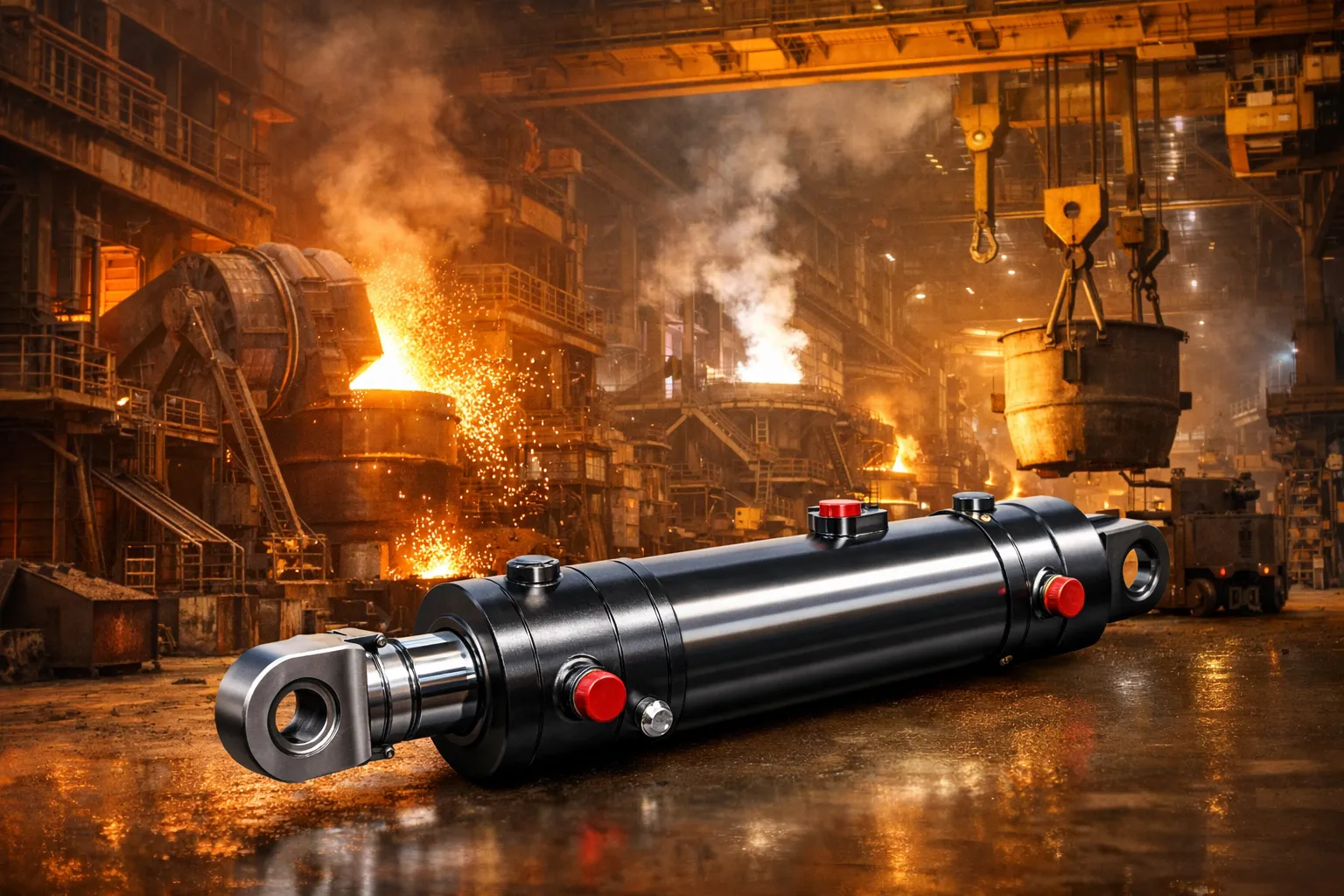
We engineered the Taphole door hydraulic cylinder explicitly to conquer the severe conditions of the EAF. By replacing vulnerable carbon steels with ultra-high-strength 42CrMo alloy forgings, and upgrading the surface treatment to a pore-free, acid-resistant anti-corrosion nickel layer, we created an impenetrable defense against slag adhesion. Plant directors and maintenance superintendents across South Korea, Japan, and the wider East Asian industrial sector heavily rely on our premium hydraulic parts to dramatically extend their equipment lifecycles. By investing in an actuator built exclusively for metallurgy, facilities optimize their long-term hydraulic cylinder price metrics by entirely bypassing the constant need for emergency replacements and securing continuous production.
Technical Specifications and Customization Matrix
Proper integration into a massive Electric Arc Furnace requires exact dimensional matching and uncompromising structural parameters. We offer an expansive, fully customizable engineering platform to ensure our solutions align flawlessly with your existing mechanical linkages and hydraulic power capacities. The data below outlines the primary configurations and engineering boundaries of our metallurgical tapping system actuators.
| Technical Engineering Parameter | Standard Specification & Highly Customizable Range |
|---|---|
| Target Industry Sector | Metallurgy & Heavy Iron Production |
| Equipment Category | Electric Arc Furnace (EAF) |
| Subsystem / Specific Action | Tapping System / Opening and closing the steel taphole door |
| Product Nomenclature | Taphole door cylinder (Also designated as Taphole door hydraulic cylinder) |
| Kinematic Action Method | Double acting hydraulic cylinder (Powered linear extension and forced retraction) |
| Internal Structure Type | Piston type (Delivers robust force distribution directly along the central axis) |
| Manufacturing Structure | Heavy-Duty Welded Construction (Ensures zero tie-rod stretch or loosening) |
| Core Material System | 42CrMo High-Tensile Alloy Steel (Exceptional yield strength and impact resistance) |
| Protective Surface Treatment | Advanced Nickel Plating (Forms an amorphous, non-porous deposition barrier) |
| Environmental Rating | High-temperature molten slag, corrosive acidic off-gases, and heavy industrial dust |
| Typical Failure Mode Prevented | Severe surface corrosion leading to gland seal destruction and fire-resistant fluid loss |
| Recommended Configuration | Acid-resistant anti-corrosion layer combined with high-temperature FKM/Viton seals |
| Heavy Mounting Options | Heavy Clevis, Trunnion, or Flange Mounts (Customized precisely to match furnace geometry) |
Fluid Mechanics and Precision Actuation
Grasping the exact fluid kinematics of the tapping mechanism is essential to appreciating the necessary robust design. The operational sequence of the Taphole door cylinder demands absolute spatial precision combined with unyielding mechanical power. Functioning strictly as a high-capacity double acting hydraulic cylinder, the unit relies on pressurized fire-resistant fluid—typically water-glycol (HFC) or synthetic phosphate esters (HFDR)—to physically drive the massive mechanical door components. The exact moment the melting phase concludes, timing is critical. A delayed door opening disrupts the continuous casting schedule, while a leaking closure presents fatal safety hazards to the personnel below.
When the automated command is issued to initiate tapping, directional control valves rapidly shift, flooding the cap end (blind end) of the heavy welded barrel with high-pressure fluid. This fluid generates immense hydrostatic pressure evenly distributed across the entire surface area of the massive 42CrMo hydraulic cylinder piston. The resulting force pushes the heavy rod outward, moving the refractory-lined door to release the refined molten steel. The incredible structural rigidity of the 42CrMo alloy ensures that off-axis side-loading forces, generated by the leverage of the door mechanism, do not bend the rod or score the internal barrel walls during the stroke.
Once the precise tonnage of tapping is complete and the oxidative slag layer approaches, the operator must terminate the flow instantly. The main hydraulic circuit shifts, directing pressurized fluid into the rod end port while simultaneously venting the cap end back to the reservoir. The internal piston is driven backward with massive retracting force, crushing through semi-solidified slag debris and sealing the taphole shut securely against the pressure of the remaining furnace load. Throughout this violent cycle, the exterior of the rod is relentlessly bombarded by acidic slag spatter. Our highly specialized acid-resistant anti-corrosion layer vigorously repels these molten droplets, preventing them from fusing to the base metal. This flawless orchestration of fluid dynamics is why our heavy-duty hydraulic rams are considered the standard for metallurgical reliability.
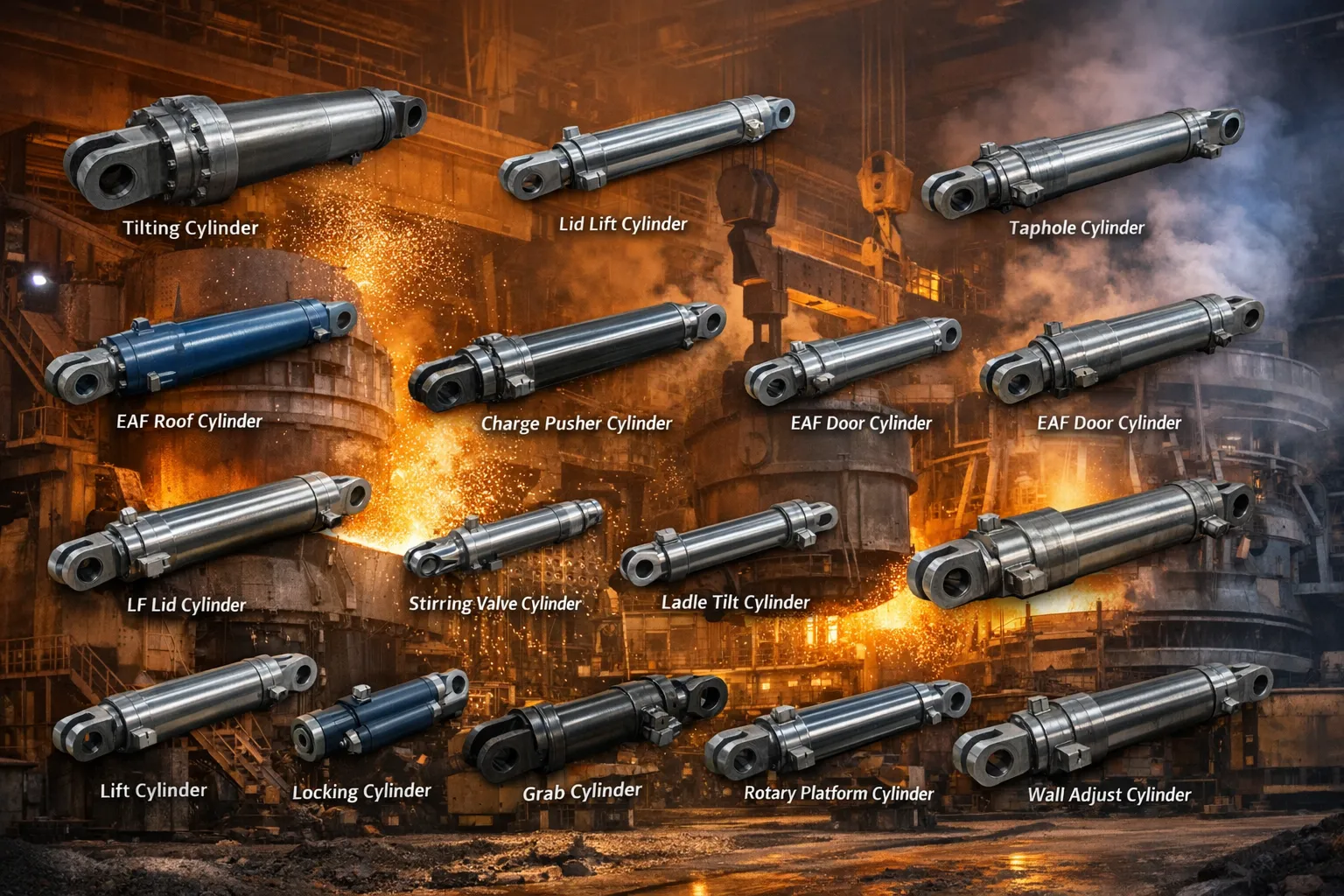
Seamless Integration and OEM Compatibility
During a tightly scheduled maintenance outage, plant engineers possess incredibly small windows of time to execute machinery upgrades. The profound delay caused by cutting, welding, or modifying heavy furnace framing to fit a non-standard part is unacceptable in modern steel production. Acknowledging this reality, our design department has specifically developed the Taphole door hydraulic cylinder series to conform strictly to global heavy-duty mounting dimensional standards, encompassing ISO 6022, ISO 6020, and DIN equivalents. This absolute dimensional compliance guarantees our actuators act as an immediate, direct-fit replacement for failing OEM equipment.
We possess the extensive engineering blueprints and technical archives necessary to seamlessly cross-reference, dimensionalize, and replace original equipment manufactured by prominent global brands such as Bosch Rexroth, Parker Hannifin, Eaton Vickers, SMC, and Atos.
(Please explicitly note: The mention of these respective industrial manufacturing brands is provided strictly to assist your plant personnel in identifying correct mounting dimensions, matching stroke profiles, and ensuring complete technical cross-reference accuracy. We operate proudly as a premium, entirely independent hydraulic cylinder manufacturer, and this reference does not imply any direct commercial affiliation, formal endorsement, or trademark infringement regarding those entities.)
When facility managers are constantly burdened with the task of fixing hydraulic cylinders that repeatedly fail near the taphole heat, they recognize the financial futility of rebuilding a fundamentally flawed design. Upgrading your systems to our heavily armored 42CrMo units allows plants to bypass the costly necessity of structural redesigns. We deliver a massively upgraded fluid power component that mounts directly onto your existing furnace clevises and trunnion pins, instantly curing the root cause of the failure.
Five Core Technical Advantages for Supreme Reliability
What specific engineering principles separate our specialized heavy-duty actuators from generic commercial market cylinders found in catalogs? The definitive distinction lies in uncompromising metallurgical science and highly targeted problem-solving. We engineer definitive scientific solutions to the exact failure mechanisms destroying equipment on your furnace deck. Below are five foundational advantages built directly into our product:
- 1.Advanced Acid-Resistant Anti-Corrosion Defense: Standard hard chrome plating is inherently prone to microscopic cracking during violent thermal cycling. Acidic molten slag easily breaches these cracks, corroding the base steel and causing the chrome to peel. Our proprietary electroless nickel-plating process creates an amorphous, entirely non-porous layer. This ductile shield aggressively repels high-temperature molten slag adhesion and remains entirely chemically inert against acidic fumes, eliminating rod degradation.
- 2.High-Rigidity 42CrMo Welded Structure: The heavy mechanical linkages of the EAF taphole door subject the cylinder to severe lateral side-loads and continuous mechanical vibration. Traditional tie-rod cylinders stretch, loosen, and leak under these conditions. We exclusively utilize 42CrMo alloy steel for the rod and barrel. The fully penetrated automated welded design ensures absolute geometric stability, preventing internal scoring even during violent mechanical shock.
- 3.Ultra-Low Friction Thermal Sealing Technology: Radiant ambient heat from the EAF quickly carbonizes standard nitrile (NBR) elastomers, turning them into brittle plastic. We implement highly advanced fluoroelastomer (FKM/Viton) and polytetrafluoroethylene (PTFE) composite sealing profiles specifically engineered for the hydraulic cylinder piston and the main rod gland. These complex polymers maintain their elastomeric memory up to 220°C, providing an absolute zero-leakage barrier against synthetic fire-resistant fluids.
- 4.Optimized Fluid Thermal Dissipation: The severe ambient heat attempts to literally cook the hydraulic fluid trapped inside the heavy steel barrel. To combat this, we engineer significantly oversized internal porting and specialized fluid flow channels to maximize the rapid exchange of hydraulic fluid during actuation. This high-volume flushing effect continuously pulls destructive thermal energy away from the critical rod gland seals, actively cooling the system and preventing localized fluid coking.
- 5.Extended Mechanical Fatigue Life Optimization: The relentless cycle of opening and closing the heavy refractory door over millions of cycles induces profound mechanical stress on the cylinder mounts. Utilizing rigorous computational Finite Element Analysis (FEA), our design teams completely eliminate stress concentration zones around the trunnions and clevis welds. Subsequent post-weld stress relief heat treatment ensures a mechanical fatigue life that regularly outlasts conventional off-the-shelf alternatives by massive margins.
Autonomous Manufacturing and Unyielding Quality Control
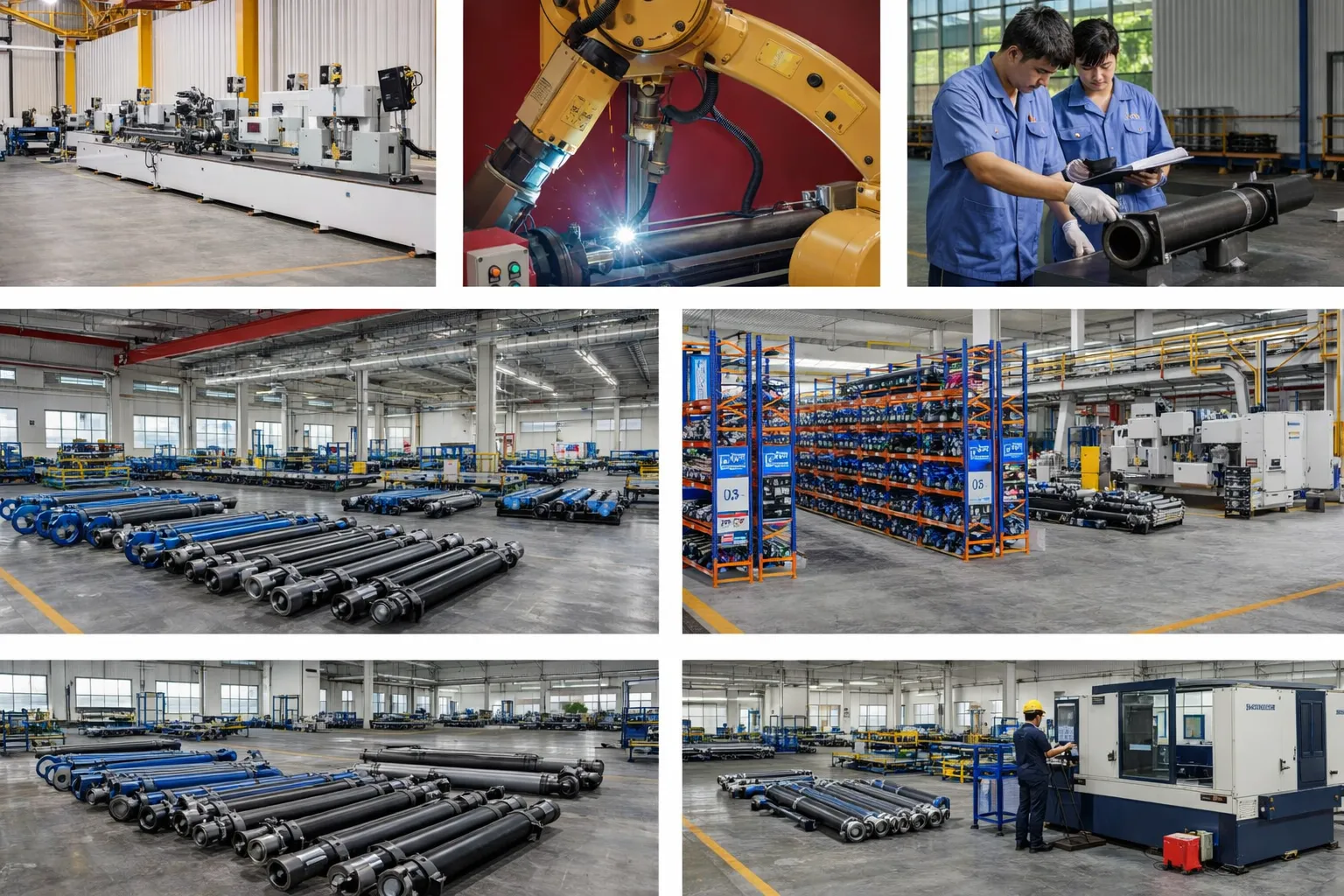
The uncompromising, zero-defect reliability required by the primary steel industry demands total, unbroken control over the entire manufacturing ecosystem. We strictly reject the fragmented supply chain approach. Operating as a completely vertically integrated hydraulic cylinder manufacturer, every single phase of fabrication—from the initial ultrasonic verification of raw 42CrMo forgings to the final high-pressure testing protocols—is executed and meticulously documented under strict ISO 9001 quality standards completely within our own advanced manufacturing facilities.
This rigid manufacturing cycle commences with multi-point ultrasonic flaw detection of the raw steel billets to guarantee absolute internal structural integrity without a single microscopic void. Following extreme precision heavy CNC machining, the cylinder barrels are subjected to a proprietary, multi-pass deep-hole skiving and roller burnishing process, achieving a stunning internal mirror-like surface finish (Ra 0.15 to 0.3 micrometers). This extreme level of internal precision is vital for maximizing the operational lifespan of the PTFE piston seals. The heavy structural welds binding the massive end caps and mounting hardware are performed via automated Submerged Arc Welding (SAW), ensuring deep, flawless penetration. These critical pressure-retaining seams are subsequently verified through comprehensive non-destructive radiographic (X-ray) inspection to eliminate any possibility of catastrophic burst failures.
Prior to final packaging and global dispatch, 100% of our produced products undergo severe, computerized hydrostatic factory testing. We intentionally and safely pressurize every single Taphole door cylinder to an extreme 150% of its rated operational maximum, utilizing highly sensitive digital transducers to detect even the most microscopic pressure drops that would indicate internal seal bypass. Every successfully approved unit is permanently laser-stamped with a unique serial identifier, granting our B2B partners total material traceability and immediate, seamless access to lifetime technical documentation. This systematic philosophy toward zero-defect engineering fundamentally eliminates the constant, draining need for emergency field repairs.
Expansive Cross-Industry Technical Applications
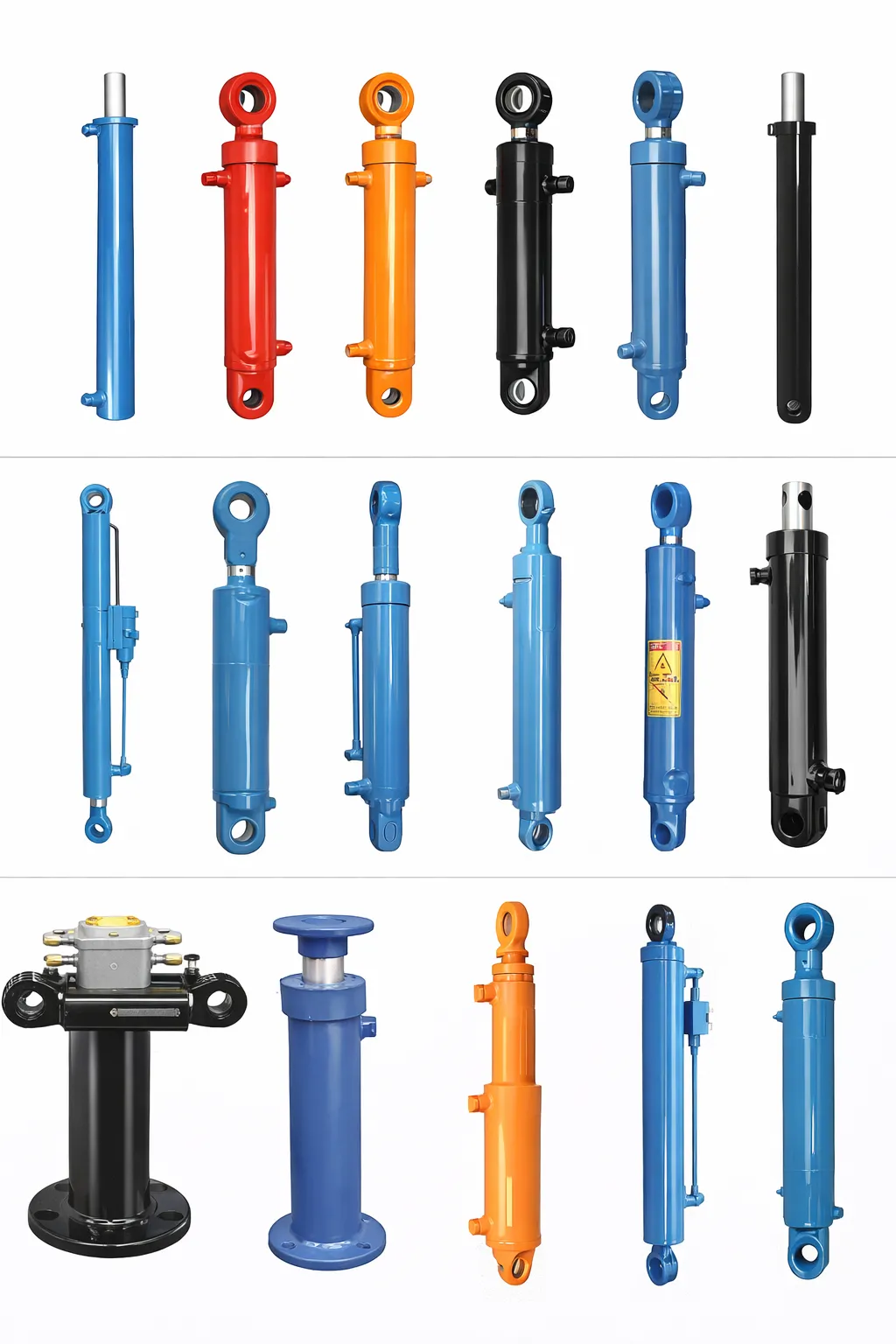
While this ultra-heavy-duty 42CrMo architecture is heavily optimized to conquer the devastating conditions of the electric arc furnace taphole, the core engineering principles of supreme yield strength and absolute environmental exclusion translate perfectly to other extreme-duty sectors. Any heavy industrial environment facing massive lateral loads, highly abrasive airborne particulates, corrosive fluids, and continuous operational shock can vastly benefit from integrating our fluid power advancements.
Naturally, our deepest core expertise continuously supports the broader Metallurgical and Iron Industry. However, far beyond the steel mill deck, the sheer structural rigidity of our fully welded designs makes them an exceptionally valuable upgrade for heavy earthmoving equipment. They function seamlessly as nearly indestructible lift cylinder units for massive mining excavators and heavy tunnel boring machines, where unpredictable side-loading forces constantly threaten standard commercial components. Discover our incredibly resilient linear solutions engineered explicitly for the Construction Machinery Industry. Additionally, the advanced dust exclusion profiles and superior high-temperature sealing technologies we deploy are critically required in deep-shaft and heavy surface extraction operations. Learn more about our specialized heavy actuators designed specifically to combat abrasive slurries and highly acidic groundwater in the Mining Industry.
Furthermore, our highly customized actuation systems provide flawless, unyielding clamping force for massive plastic and rubber injection molding machinery, operate continuously within automated port logistics and material handling equipment, drive highly specialized renewable energy applications including offshore wind turbine pitch control mechanisms, and dominate in harsh offshore marine platforms that require absolute maximum salt-spray resistance via our heavy nickel-plating technology.
Comparative Analysis: Standard Hydraulics vs. Our High-Performance Solutions
For corporate procurement officers and chief reliability engineers, the final purchasing decision always involves intelligently balancing initial capital expenditure against the massive, crippling long-term costs of unplanned EAF downtime. To clearly articulate our engineering value proposition, the following analytical table highlights the profound physical differences between relying on standard commercial components and deploying our heavily armored metallurgical actuator.
| Critical Performance Metric | Standard Commercial Hydraulic Cylinder | Our Specialized Taphole Door Cylinder |
|---|---|---|
| Rod Surface Defense | Standard Hard Chrome (Inherent micro-cracks continuously invite rapid acid and slag penetration) | Acid-Resistant Anti-Corrosion Layer (Amorphous nickel shield aggressively repels slag adhesion) |
| Primary Structural Material | Basic 45# Carbon Steel (Highly susceptible to heavy mechanical deformation and rapid fatigue) | High-Strength 42CrMo Alloy (Provides exceptional yield strength and massive impact toughness) |
| Sealing Architecture Thermal Limit | Max 90°C (Nitrile/Polyurethane materials rapidly melt and carbonize near the radiant EAF) | Up to 220°C Continuous Operations (Advanced FKM / PTFE thermal aerospace composites) |
| Assembly Architecture | Tie-Rod Assembly (Heavy vibration causes dangerous stretching, leading directly to seal blowout) | Fully Welded Heavy-Duty Assembly (Guarantees absolute geometric rigidity under heavy shock loads) |
| Dominant Failure Mode Pathway | Severe rod corrosion leading directly to catastrophic fluid leaks during critical tapping cycles | Slow, highly predictable internal seal wear occurring only after millions of safe, controlled cycles |
| Average Expected EAF Lifespan | Merely 2 to 5 months before requiring a major repair overhaul or full component replacement | 18 to 36+ months continuous (Drastically lowering the plant’s Total Cost of Ownership) |
Proven in the Field: 5 Industrial Engineering Case Studies in Asia
True engineering credibility is forged entirely on the brutal production floor. Our custom technical solutions consistently drive operational stability across major metallurgical hubs globally, with a profound dominance in East Asia. Below are five highly detailed deployments demonstrating exactly how our interventions permanently solved critical plant failures.
Case Study 1: Halting Chronic Spatter Leaks in Pohang
Location & Valued Client: Major Integrated Steelworks Facility, Pohang, South Korea.
Application Context: 150-ton EAF bottom tapping mechanism requiring high-speed, flawless actuation.
Initial Connection: The plant’s central procurement team located our engineering specifications via a targeted online search analyzing competitive hydraulic cylinder price models in early March 2024.
The Challenge: Extreme ambient temperatures and heavy slag spatter were literally melting standard nitrile seals and physically destroying the chrome piston rods, causing highly dangerous, pressurized water-glycol fluid leaks near the molten steel roughly every three months.
The Solution & Verifiable Result: We provided a direct drop-in replacement utilizing our massive 42CrMo welded barrel combined with our proprietary acid-resistant nickel plating. Safely installed in May 2024, the units have operated continuously for over 20 months without a single seal failure, saving the facility hundreds of thousands in avoided maintenance delays.
“The thermal resilience is exactly what we needed. The nickel layer completely rejected the slag adhesion, allowing us to rewrite our entire scheduled maintenance intervals for the furnace deck.” — Head of EAF Maintenance, Pohang
Case Study 2: Expedited Custom Replacements in Busan
Location & Valued Client: Specialty Alloy Steel Foundry, Busan, South Korea.
Application Context: Slag door opening and precision closing mechanism on a medium-capacity arc furnace.
Initial Connection: Reached out through our digital engineering portal urgently requesting replacements for heavily worn OEM hydraulic components in late 2024.
The Challenge: The busy foundry was experiencing completely unacceptable taphole delays due to the sluggish, physical binding operation of their existing double acting hydraulic cylinder units. The internal seals were failing due to rapid fluid coking from excessive radiant heat transfer.
The Solution & Verifiable Result: We rapidly manufactured newly designed units featuring optimized thermal fluid paths and high-temp FKM seals. Delivered and installed within a strict five-week window, the new actuators provided smooth, high-velocity movement, reducing taphole operational delays by over 90%.
“Their rapid engineering turnaround and superior internal sealing design immediately stabilized our tapping schedule. The sluggish mechanical binding is completely gone.” — Operations Superintendent
Case Study 3: Custom Shock Load Defiance in Osaka
Location & Valued Client: Heavy Forging and Steel Equipment Manufacturer, Osaka, Japan.
Application Context: Complete mechanical integration for a newly commissioned massive scrap charging system and tapping mechanism.
Initial Connection: An international metallurgical consultant recommended our highly durable hydraulic rams specifically for this high-vibration project.
The Challenge: The massive vibration profile during the EAF oxygen blowing phase was continuously causing microscopic stress fractures in the tie-rods of standard European cylinders previously specified for the project.
The Solution & Verifiable Result: We engineered fully welded 42CrMo cylinders integrated tightly with advanced mechanical cushioning. The robust design absorbed the kinetic shock perfectly, completely stopping the weld fractures and providing a completely seamless drop-in fit for the Japanese equipment builder.
“The structural rigidity of the 42CrMo welded barrel is magnificent. It handles the chaotic vibration of the charging phase without a single sign of metal fatigue.” — Lead Mechanical Integrator
Case Study 4: Defeating Acidic Fume Corrosion in Incheon
Location & Valued Client: Industrial Scrap Recycling and High-Capacity Smelting Facility, Incheon, South Korea.
Application Context: Taphole closure mechanism continuously exposed to dense, acidic off-gases and floating slag.
Initial Connection: Reached out to us heavily through a specialized B2B industry forum seeking expert engineering advice on permanently fixing hydraulic cylinders destroyed by chemical pitting.
The Challenge: Standard chrome plating was literally peeling off in strips due to severe chemical attack from the high sulfur content present in the smelted scrap, destroying the primary high-pressure seals almost immediately.
The Solution & Verifiable Result: We replaced the vulnerable chrome plating entirely with our heavy electroless nickel plating. During an 18-month routine maintenance inspection in late 2025, the rods were wiped clean and showed absolutely zero surface pitting or chemical degradation, entirely resolving the chronic leak issue.
“Their engineers deeply understood the complex chemistry of our failure mode. The acid-resistant layer has effectively saved us from having to rebuild these actuators every few months.” — Smelting Facility Director
Case Study 5: Life-Cycle Extension and Cost Reduction in Kaohsiung
Location & Valued Client: Rapidly Expanding Steel Milling Enterprise, Kaohsiung, Taiwan.
Application Context: Comprehensive EAF tapping and ladle transfer system modernization project.
Initial Connection: Contacted our technical engineering department directly from our corporate website in early 2025, actively looking to partner with a high-end hydraulic cylinder manufacturer to drastically reduce their overall maintenance footprint.
The Challenge: The enterprise was looking to dramatically lower their total operational expenditure (OPEX) by massively extending the lifecycle of all furnace deck machinery, moving decisively away from cheap, disposable cylinders that constantly interrupted production.
The Solution & Verifiable Result: By deploying our fully optimized 42CrMo actuators equipped with high-temp FKM seals and the acid-resistant anti-corrosion layer, the plant achieved a certified 300% lifespan improvement over their previous vendors, drastically reducing annual component budgets and eliminating emergency downtime.
“The initial, slightly higher investment in premium metallurgy paid for itself within the first year of operation. The 3x lifespan improvement has completely transformed our annual maintenance budgeting approach.” — Plant Modernization Lead
B2B Engineering Frequently Asked Questions (FAQ)
Selecting the exact heavy-duty fluid power configurations for a volatile steel mill requires absolute technical clarity and trust. Below, our senior metallurgical engineering team thoroughly addresses the most critical inquiries posed daily by industrial procurement directors and plant maintenance operators.
Secure Your Critical Smelting Operations Today
Do not permit highly vulnerable commercial components to constantly compromise your production targets or jeopardize the critical safety of your EAF deck. Stop continuously fixing hydraulic cylinders that were fundamentally never designed to survive this level of heat and corrosive slag. Partner with a deeply specialized engineering manufacturer capable of delivering heavily armored, high-temperature actuation solutions designed specifically for the realities of your steel mill.
Editor: Cxm