
Blade Swing Cylinder for Ridger Angle Adjustment
27SiMn alloy steel with high-quality precision seals for zero-drift angular micro-adjustment. Maintains exact blade angle under sustained soil pressure without internal leakage.
Internal Leakage Is the Invisible Problem That Slowly Ruins Your Ridge Profile
Most hydraulic cylinder failures announce themselves with visible oil on the outside of the unit. Internal leakage is different. There is no oil on the ground, no drip from the rod seal, and no obvious sign that anything is wrong. The operator simply notices that the ridger blade angle has shifted slightly from where it was set at the start of the pass. The ridge profile is a little asymmetric. One side is steeper, the other shallower. By the end of a long field, the drift has accumulated enough that the ridges look noticeably different from end to end.
This is what happens when the piston seal inside a blade swing cylinder allows oil to migrate slowly from one side of the piston to the other. The rod does not retract visibly, but the blade angle shifts by fractions of a degree with each pass. Over a full day of hilling, the cumulative drift can reach 3 to 5 degrees, which is enough to create ridge profiles that are too steep on one side for uniform tuber development or too shallow on the other to provide adequate soil cover.
The blade swing cylinder on a hilling machine or ridger controls the left-right angle of the blade body. It is a small-bore double acting hydraulic cylinder that makes fine angular adjustments and then holds the selected angle against continuous soil pressure during the hilling pass. Unlike the main lift cylinder that handles large vertical loads, the swing cylinder operates at moderate loads but must hold its position with virtually zero drift for extended periods. The seal quality inside this cylinder determines whether your ridge profile stays consistent from the first row to the last.
Our blade swing cylinder is built from 27SiMn manganese-silicon alloy steel with precision-grade piston seals selected for minimal internal bypass at sustained holding pressure. The bore is honed to Ra 0.2 for optimal seal contact, and PTFE back-up rings prevent seal extrusion under pressure spikes from soil reaction loads. It is a compact, welded hydraulic cylinder for agriculture that delivers the holding accuracy a swing angle application demands.
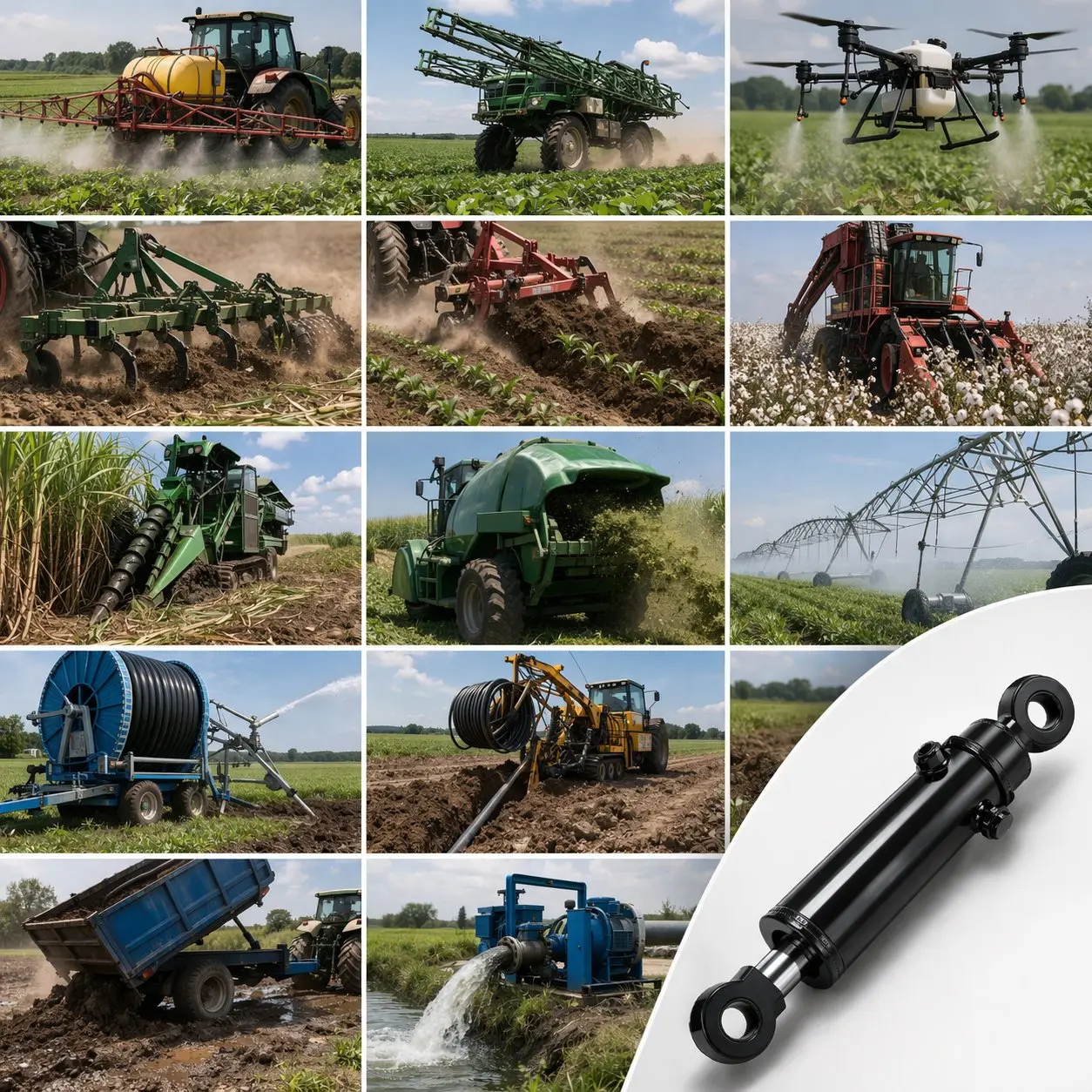
Inside the Seal: What Causes Internal Leakage and How We Eliminate It
Internal leakage occurs when hydraulic oil passes across the piston seal from the pressurized side to the unpressurized side. In a position-holding application like blade swing control, any internal bypass allows the piston to drift under external load, changing the blade angle. Understanding the mechanisms that cause this leakage reveals why seal selection for swing cylinders requires different criteria than for extend-retract cylinders.
There are four primary leakage paths, and our design addresses each one:
| Leakage Path | Root Cause | Our Countermeasure |
|---|---|---|
| Seal lip micro-gap | Bore surface roughness creates microscopic channels under the seal lip | Bore honed to Ra 0.2 or finer, reducing peak height to near-zero |
| Seal extrusion gap | Pressure spikes push soft seal material into the clearance gap between piston and bore | PTFE back-up ring fills the extrusion gap, preventing seal material from entering it |
| Bore dimensional drift | Bore ovality or taper allows seal to lose contact at certain angular positions | Bore roundness held to 0.01 mm, taper within 0.005 mm per 100 mm length |
| Seal compression set | Over time, seal material loses elastic recovery and lip contact pressure drops | High-quality PU with low compression set rating (less than 15% after 1,000 hrs at 70 C) |
The combined effect of these four countermeasures is a cylinder that holds blade angle position with less than 0.2 degrees of drift over a 30-minute static holding test at working pressure. For a ridger blade operating at 200 mm ridge height, this translates to less than 0.7 mm of ridge profile variation from start to end of a typical pass. Standard cylinders with general-purpose seals typically show 1 to 3 degrees of drift under the same test, producing visible ridge profile inconsistencies by mid-field.
How a Blade Swing Cylinder Controls Ridger Angle
The swing cylinder mounts between the ridger frame and the blade pivot assembly, typically at a short lever arm. When the operator adjusts the blade angle, hydraulic oil enters the cylinder, extending or retracting the rod by a few centimeters to rotate the blade body around its pivot point. Small rod movements produce significant angular changes because the lever arm is short, which is why positional accuracy is so critical in this application.
Once the desired angle is set, the control valve closes and the cylinder holds the blade position against the continuous soil reaction force during hilling. The soil pushes against the blade at an angle determined by the ridge profile geometry, creating a sustained torque around the blade pivot that the cylinder must resist by maintaining internal hydraulic pressure. Any internal oil bypass across the piston allows the blade to drift toward the equilibrium position where soil pressure and cylinder force balance, which is almost never the angle the operator originally set.
The holding duty is continuous, typically 20 to 40 minutes per pass on a large field. During this time, the cylinder is pressurized on one side with the piston held stationary. Temperature changes from engine heat and sun exposure cause thermal expansion of the oil, and vibration from the tractor and soil contact transmits through the frame into the cylinder body. Both of these factors create small pressure fluctuations that test the seal’s ability to maintain zero-bypass performance over extended holding periods.
Technical Specifications
| Specification | Available Range |
|---|---|
| Bore Diameter | 25 mm – 63 mm |
| Rod Diameter | 16 mm – 36 mm |
| Stroke Length | 30 mm – 200 mm |
| Working Pressure | Up to 16 MPa (2,320 PSI) |
| Action Type | Double Acting |
| Structure | Small Welded Piston Cylinder |
| Body Material | 27SiMn Alloy Steel |
| Piston Rod | 27SiMn, Hard Chrome 20+ micron |
| Body Finish | Black Oxide + Epoxy Paint |
| Piston Seal | Precision-Grade PU + PTFE Back-up Ring |
| Rod Seal | NBR + PTFE Back-up Ring |
| Dust Seal | PU Wiper Ring |
| Mounting | Clevis, Pin Eye, Lug Mount, Custom |
| Port Thread | BSP / NPT / Metric |
| Operating Temperature | -20 C to +80 C |
| Environment Rating | Medium-Duty / Precision Holding |
Six Advantages for Precision Angle Holding Under Sustained Load
Precision-Grade Piston Seal with PTFE Anti-Extrusion Ring
The piston seal is a high-quality polyurethane compound selected for low internal bypass at sustained holding pressure. A PTFE back-up ring prevents the seal from extruding into the bore-to-piston clearance gap during pressure spikes from soil reaction loads. This combination maintains sealing integrity at sustained pressures up to 16 MPa, keeping internal leakage below 0.3 ml per minute, which translates to less than 0.2 degrees of blade angle drift over a 30-minute holding period.
Ra 0.2 Bore with Controlled Roundness
The bore is honed to Ra 0.2 or finer with roundness held within 0.01 mm. This eliminates the micro-channels and ovality that allow oil to bypass the seal lip at certain piston positions. Uniform bore geometry means the seal maintains consistent contact pressure throughout the full stroke range, preventing the position-dependent leakage that oval or tapered bores create.
27SiMn Alloy Steel for Fatigue and Impact Resistance
27SiMn provides superior fatigue strength compared to standard carbon steel. The silicon content enhances the material’s resistance to cyclic stress from vibration and pressure fluctuations during holding duty. The alloy also has better toughness at low temperatures, maintaining performance during early spring hilling when temperatures may still drop below freezing overnight.
Compact Welded Body for Tight Pivot Assemblies
The swing cylinder mounts in the confined space between the ridger frame and the blade pivot, where clearance is often less than 50 mm. Our welded body design eliminates external tie rods and produces the smallest possible outside diameter. Short overall length options are available to fit the short lever arms typical of blade swing mechanisms.
Dust Wiper Ring for Field Protection
Although the swing cylinder is partially shielded by the ridger frame, airborne soil dust still settles on the exposed rod surface. An integrated PU wiper ring removes this dust during rod travel, preventing abrasive particles from reaching the primary rod seal. This extends rod seal life from the typical 1 to 2 seasons to 3 to 4 seasons in normal field conditions.
Chrome Rod with Micro-Polish for Seal Compatibility
The 20-micron hard chrome layer is micro-polished to Ra 0.1 or finer. This ultra-smooth surface creates optimal contact conditions with the rod seal, reducing friction-generated heat during the small angular adjustments the cylinder makes. Lower heat means slower seal aging and longer maintenance-free service.

Application Scenarios
Ridger Blade Angle Adjustment: The primary application. Single and double-row ridgers use swing cylinders to set the blade angle that determines ridge shape and symmetry. Precision holding prevents ridge profile drift during long field passes.
Cultivator Shank Offset Control: Inter-row cultivators with laterally adjustable shanks use similar small cylinders to offset the blade position relative to the crop row. The same holding accuracy requirements apply. Our custom hydraulic cylinder platform supports a wide range of these positioning applications.
Bed Former Wing Angle Control: Raised-bed forming machines adjust wing blade angles to shape the bed profile. The swing cylinder sets and holds the wing angle against soil pressure, maintaining consistent bed cross-section throughout the field.
Fertilizer Placement Shank Adjustment: Sub-surface fertilizer injectors use small cylinders to adjust shank angle for band placement depth. The holding accuracy of our cylinder ensures fertilizer is consistently placed at the target soil horizon.
Planter Row Unit Lateral Adjustment: Some planter configurations allow individual row units to be shifted laterally using small hydraulic cylinders. The micro-adjustment capability and holding precision of our swing cylinder suit this application well.
Manufacturing and Quality Control
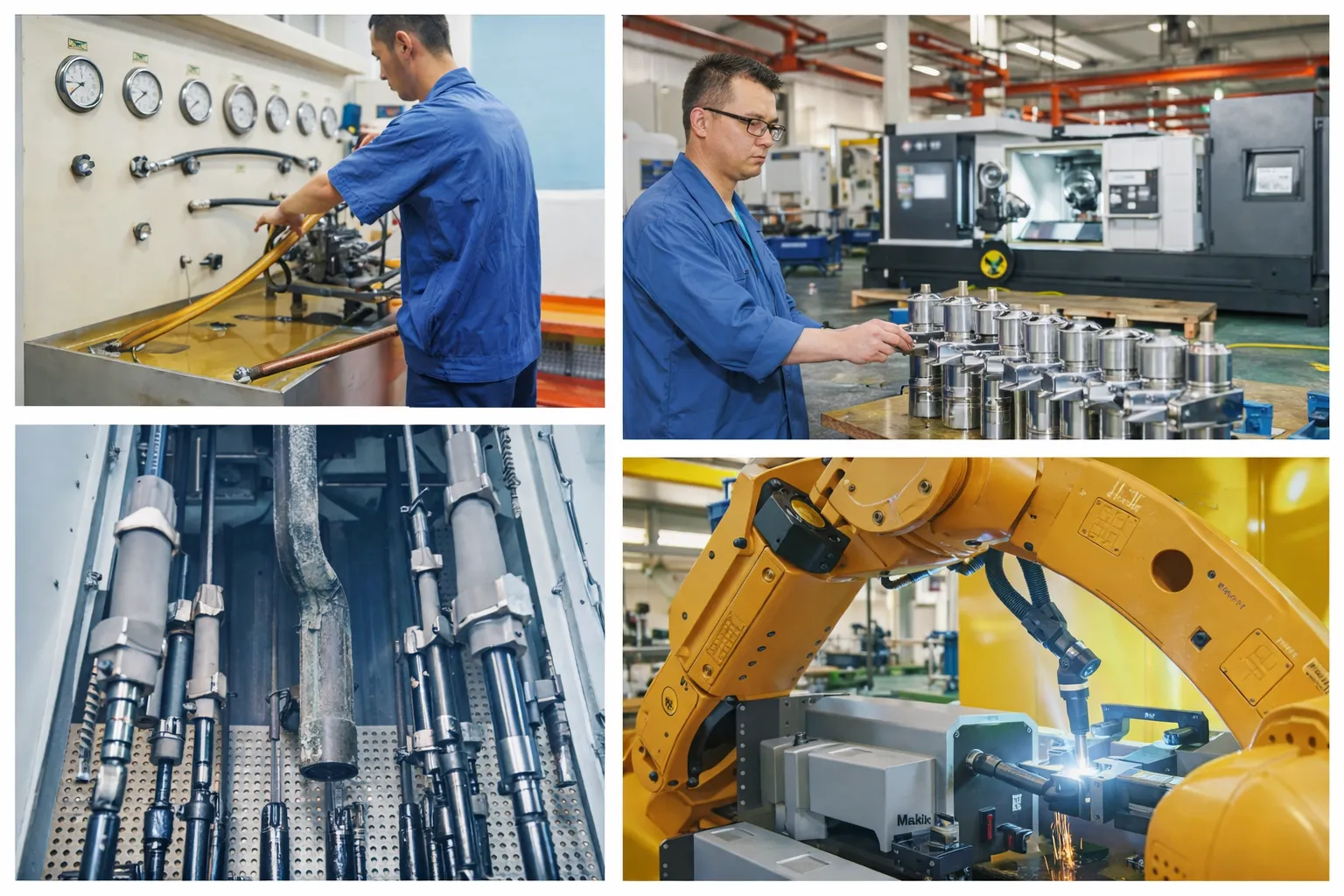
Built in-house in our ISO 9001 certified facility. 27SiMn tube and rod stock verified by spectrometer and hardness test. Bores CNC honed to Ra 0.2 with roundness certified within 0.01 mm. Rods ground to h7 and chrome plated to 20+ micron with micro-polish. MIG welded with pre-heat control. Seals sourced from single manufacturing lots for batch uniformity. 100% pressure tested at 1.5 times rated pressure for three minutes. Internal leakage measured on every unit under static holding conditions and recorded in the test certificate. Serial numbered with ten-year traceability. Material test reports and pressure/leakage test certificates included as standard.
Standard Small Cylinder vs. Our Blade Swing Cylinder
| Holding-Accuracy Metric | Standard Small Cylinder | Our Blade Swing Cylinder |
|---|---|---|
| Internal Leakage at Rated Pressure | 1.5 – 3.0 ml/min | Below 0.3 ml/min |
| Angle Drift (30 min hold test) | 1 – 3 degrees | Below 0.2 degrees |
| Bore Roundness Tolerance | 0.03 – 0.05 mm | 0.01 mm |
| Piston Seal Anti-Extrusion | None (seal only) | PTFE back-up ring |
| Seal Compression Set (1,000 hrs / 70 C) | 25 – 40% | Below 15% |
| Internal Leakage Test Included | No (pressure test only) | Yes (per-unit data on certificate) |
Customer Case Studies
Nonsan City, Chungcheongnam-do, South Korea
Customer: Ginseng farming cooperative using precision ridgers for raised-bed ginseng cultivation requiring exact ridge symmetry
How They Found Us: Cooperative agronomist searched for “precision hydraulic cylinder for ridger angle control” in February 2025.
Results: Ginseng ridges must be perfectly symmetric to ensure uniform root development. After installing our swing cylinders, blade angle drift dropped from an average 2.8 degrees per pass to under 0.15 degrees. Ridge symmetry compliance improved from 82% to 98% across audited fields.
“Ginseng buyers inspect ridge quality before they even look at the roots. Asymmetric ridges indicate poor cultivation practice and lower the price. These cylinders gave us nearly perfect ridge symmetry across every field.” – Mr. Cho, Quality Manager, October 2025
Buyeo County, Chungcheongnam-do, South Korea
Customer: Sweet potato agricultural equipment OEM producing ridging machines for domestic and export markets
How They Found Us: Engineering director contacted us after testing our lift cylinders on a separate product line. Added swing cylinders to their inquiry in April 2025.
Results: OEM internal quality tests showed blade angle holding accuracy improved 10x compared to their previous supplier. Warranty claims for ridge profile inconsistency dropped to zero on machines equipped with our swing cylinders. Current order is 200 swing cylinders per quarter alongside their lift cylinder orders.
“We did not realize how much ridge quality depended on the swing cylinder until we tested one that actually held position. The improvement was immediate and obvious in the field.” – Mr. Ryu, Engineering Director, August 2025
Aomori Prefecture, Japan
Customer: Garlic and potato farming cooperative in northern Honshu, operating ridgers in heavy volcanic clay
How They Found Us: Found our hydraulic cylinders for agricultural machinery pages through a Google search in March 2025.
Results: Aomori clay creates high sustained soil pressure on the blade. Previous swing cylinders drifted noticeably within 10 minutes of operation. Our cylinders held angle for the full 25-minute passes across their fields with no detectable drift.
“In heavy clay, the soil pushes back hard against the blade angle. Every cylinder we tried before would drift within the first few minutes. This one held solid the entire pass. That was the first time we achieved consistent ridge shape from start to finish.” – Mr. Sasaki, Equipment Manager, September 2025
Hai Duong Province, Vietnam
Customer: Vegetable farming operation producing garlic and carrots on raised beds in the Red River Delta clay soils
How They Found Us: Farm manager discovered our website through a web search in October 2024.
Results: Red River Delta clay is extremely dense and creates heavy sustained pressure on blade swing cylinders. Our cylinders maintained angle accuracy across two full seasons without any internal leakage detectable by the operator. Bed shape uniformity improved measurably, reducing the hand-finishing labor the farm previously required.
“Before, our workers had to reshape about 15% of the raised beds by hand because the ridger blade drifted during the pass. After installing these cylinders, hand correction dropped to less than 2%. The labor savings alone justified the investment.” – Mr. Duc, Farm Manager, March 2025
Diyarbakir Province, Turkey
Customer: Ridging equipment OEM manufacturing machines for cotton and potato hilling in southeastern Turkey and export to Middle East
How They Found Us: Met at the Konya Agriculture Fair in September 2024. Requested swing cylinder samples alongside lift cylinder evaluation.
Results: The OEM’s internal holding test confirmed less than 0.18 degrees of drift at 14 MPa for 30 minutes, exceeding their specification by a wide margin. They standardized our swing cylinder on their entire ridger line. Warranty claims related to ridge shape inconsistency dropped from 6% to under 0.5%.
“We always thought ridge shape problems were caused by blade wear or frame flex. It turned out the swing cylinder was drifting under load all along. Fixing this one component improved the quality perception of our entire machine.” – Mr. Arslan, Chief Engineer, May 2025
Frequently Asked Questions
What causes blade angle drift during hilling and how is it prevented?
What bore size is used for blade swing cylinders on ridging machines?
Can I replace my existing swing cylinder with your precision-sealed version?
What is the lead time for blade swing cylinders?
Consistent Ridge Shape Starts With a Cylinder That Holds Angle Under Load
Share your ridger model and blade pivot dimensions. We will recommend a precision-sealed swing cylinder and deliver a quotation within 48 hours.
Editor: Cxm


























