Balance Cylinder for Subsurface Drainage Installation Machines
Carbon steel with low-friction seals and vibration-compatible design. Maintains machine frame level and pipe grade accuracy during high-vibration trenching operations across undulating field terrain.
Is Your Pipe Grade Drifting Off Spec? The Problem Might Not Be the Depth Cylinder.
When a subsurface drainage installation comes back with a laser grade check showing unacceptable deviations, the first component everyone investigates is the depth control cylinder. But pipe grade errors do not always come from depth control. They frequently originate from a different cylinder entirely: the balance cylinder that keeps the machine frame level as it traverses undulating terrain. If the frame tilts because the balance system is too sluggish or too leaky to compensate for ground changes, the depth control cylinder holds its set position relative to a tilted frame—which means the pipe enters the trench at the wrong angle even though the depth setting is correct.
This distinction is critical because the engineering requirements for a balance cylinder are fundamentally different from those of a depth or pipe lay cylinder. A depth cylinder mostly holds a static position. A balance cylinder makes continuous micro-adjustments—hundreds per minute on rough terrain—while absorbing the constant vibration from the trenching chain or wheel cutting through variable soil layers. The cylinder must respond instantly to every terrain change, which requires extremely low breakaway friction, and it must resist the thermal aging that continuous vibration causes in standard seal compounds, which degrades their elastic recovery and leads to progressive internal leakage.
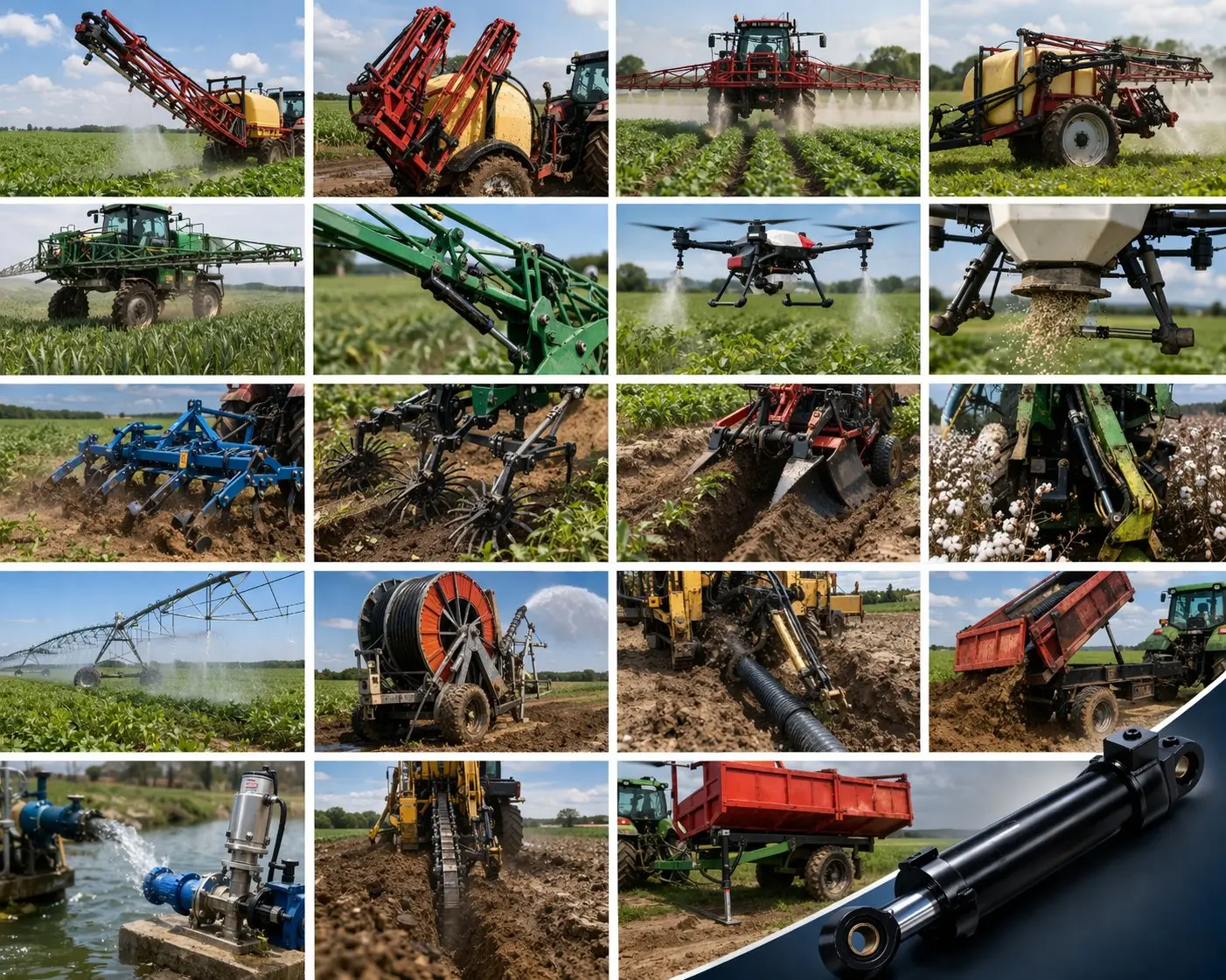
A standard agricultural hydraulic cylinder with general-purpose seals develops stick-slip behavior within the first season of drainage installation service. The operator feels it as jerky balance corrections that create step changes in pipe grade instead of the smooth transitions the laser system is calculating. By mid-season, the thermally aged seals have developed enough compression set that internal leakage allows the frame to drift off level between corrections, producing the grade deviations that show up at the post-installation laser verification check.
Our balance cylinder is a double acting hydraulic cylinder in a compact welded carbon steel body with PTFE-impregnated low-friction piston seals, heat-resistant seal compound rated 15 C above standard PU, a bore honed to Ra 0.2 with controlled cross-hatch for oil film retention, and reinforced port connections that resist vibration-induced loosening. It delivers the smooth, stutter-free balance response that precise drainage grade control requires, and it maintains that response quality through hundreds of hours of continuous trenching vibration without developing the sluggishness that standard cylinders exhibit.
Technical Specifications
| Specification | Available Range |
|---|---|
| Bore Diameter | 40 mm – 80 mm |
| Rod Diameter | 25 mm – 50 mm |
| Stroke Length | 100 mm – 500 mm |
| Working Pressure | Up to 18 MPa (2,610 PSI) |
| Action Type | Double Acting |
| Structure | Welded Piston Cylinder |
| Body Material | Carbon Steel (S45C / AISI 1045) |
| Piston Rod | Carbon Steel, Hard Chrome 20+ micron |
| Body Coating | Black Oxide + Epoxy Paint |
| Piston Seal | Low-Friction PTFE-Impregnated PU (Heat Resistant) |
| Rod Seal | NBR + PTFE Back-up Ring |
| Dust Seal | PU Wiper Ring |
| Mounting | Clevis, Pin Eye, Custom Bracket |
| Port Thread | BSP / NPT / Metric |
| Operating Temperature | -20 C to +80 C |
| Environment Rating | Continuous Vibration / Micro-Adjustment / Field Debris |
Balance Cylinder vs. Depth Cylinder: Same Machine, Completely Different Engineering Requirements
On a subsurface drainage installation machine, the depth control cylinder and the balance cylinder look similar externally but perform fundamentally different jobs with different movement patterns, different failure modes, and different seal requirements. Understanding this distinction explains why a cylinder that works well in the depth position often fails prematurely when used as a balance unit.
| Characteristic | Depth Control Cylinder | Balance Cylinder (This Product) |
|---|---|---|
| Primary Function | Set and hold pipe trench depth | Keep machine frame level on uneven terrain |
| Movement Pattern | Mostly static holding with occasional adjustment | Continuous micro-adjustments, hundreds per minute |
| Critical Seal Property | Minimal internal leakage for position holding | Low friction for instant stutter-free response |
| Vibration Exposure | High (directly at trenching tool) | Medium-high (at frame, filtered by structure) |
| Failure Consequence | Pipe depth error at a specific location | Systematic grade error across entire run length |
| Seal Failure Mode | Gradual drift from internal bypass | Stick-slip causing jerky corrections → grade steps |
The balance cylinder’s need for continuous smooth micro-adjustments under vibration demands a low-friction seal with excellent thermal stability—a combination that general-purpose agricultural seals do not provide. A seal that develops stick-slip under vibration causes jerky balance corrections. A seal that thermally ages from vibration-induced friction heat develops progressive compression set that leads to frame drift. Our PTFE-impregnated, heat-resistant PU seal addresses both failure modes simultaneously, which is why we specify a different seal for the balance position than for the depth position on the same machine.
How the Balance Cylinder Maintains Frame Level During Trenching
A subsurface drainage installation machine is a heavy tracked or wheeled unit that must maintain precise frame orientation while moving forward at 10 to 30 meters per minute across agricultural fields that are never flat. The terrain changes constantly: soft spots where the wheels sink, hard compacted zones where the machine rides high, old plow furrows that tilt the frame sideways, and ditches or depressions that shift the machine attitude front-to-back. Each of these terrain changes tilts the frame, which tilts the pipe guide assembly, which changes the angle at which the pipe enters the trench.
The balance cylinder connects between the machine frame and the running gear or a dedicated leveling linkage. On machines with automatic laser grade control, an inclinometer mounted on the frame detects tilt and sends correction signals to the balance cylinder’s proportional valve. The cylinder extends or retracts a few millimeters to compensate for the terrain-induced tilt, keeping the frame within the acceptable level tolerance—typically ±0.1 to 0.3 degrees—for the required pipe grade accuracy.

During a typical 500-meter drainage run at 15 meters per minute, the leveling system makes approximately 1,500 to 3,000 micro-corrections over the 33-minute run time. Each correction involves a piston movement of 1 to 10 mm under working pressure. Simultaneously, the trenching mechanism transmits constant vibration through the frame at frequencies of 10 to 50 Hz depending on the soil type and cutting speed. The balance cylinder must respond to the terrain corrections while ignoring this background vibration—a filtering function that requires the seal to have low static friction for quick response to intentional corrections but enough dynamic damping to avoid amplifying the vibration noise into unwanted balance movements.
Six Features for Smooth Balance Response Under Continuous Vibration
Low-Friction PTFE-Impregnated Piston Seal
Breakaway pressure below 0.3 MPa eliminates the stick-slip that causes jerky balance corrections on rough terrain. PTFE micro-particles in the seal compound migrate to the sliding surface during operation, forming a self-renewing low-friction layer that maintains quick response throughout the seal’s service life—not just when it is new. This is the single most important specification that differentiates a purpose-built balance cylinder from a general-purpose farm cylinder used in the same position.
Heat-Resistant Seal Compound (HDT +15 C Above Standard)
Continuous trenching vibration generates friction heat at the seal-bore interface that accumulates over hours of operation. The heat deflection temperature of our seal compound is 15 C above standard agricultural PU, keeping the seal material well below its softening threshold even during all-day trenching sessions. Lower thermal aging means slower compression set development, which keeps internal leakage stable and prevents the progressive frame drift that thermally aged seals allow.
Ra 0.2 Bore with Controlled Cross-Hatch
The honed bore surface has a controlled cross-hatch pattern that retains a thin oil film between the seal lip and the bore wall. During the rapid micro-stroke cycles of balance correction, this oil film acts as a hydrostatic bearing that reduces seal-to-bore friction and prevents the oil film starvation that causes stick-slip in cylinders with improperly finished bores. The smoother bore also generates less friction heat during vibration, contributing to slower thermal aging of the seal compound.
Reinforced Port Connections for Vibration Resistance
The continuous vibration from the trenching mechanism transmits through the hydraulic lines into the port fittings of the balance cylinder. Over time, this vibration gradually loosens standard pipe thread connections, causing nuisance drips that contaminate the hydraulic oil and create mess on the machine frame. Our port bosses are reinforced with extra weld material and CNC-threaded after welding for tight fitting engagement. Chamfered port entries protect O-rings during assembly, preventing the installation damage that leads to early-life fitting leaks.
PU Wiper Ring for Field Debris
Although the balance cylinder is mounted higher on the machine frame than the trench-level pipe lay components, soil splash and debris from the trenching operation still reaches it. Backfill material thrown upward by the trencher chain lands on the frame and settles onto the cylinder body and rod. The PU wiper prevents this debris from reaching the primary rod seal, extending the seal service life that vibration-environment thermal aging would otherwise shorten.
Compact Welded Body
The balance cylinder mounts within the machine frame structure where space is shared with the running gear, hydraulic lines, and laser receiver mounting hardware. Our welded body without tie rods produces the smallest outside diameter for any given bore, fitting within the tight clearances typical of modern drainage installation machine frame designs.
Application Scenarios
Drainage Installation Machine Frame Balance: The primary application. Keeping the machine frame level during trenching for accurate pipe grade installation. The balance cylinder makes thousands of micro-corrections per installation run to compensate for terrain undulation.
Laser-Guided Grade System Balance Input: Automated laser grade systems use the leveling cylinder for continuous real-time frame leveling based on inclinometer feedback. Our low-friction seal provides the response speed these custom hydraulic cylinder applications in precision grade control demand.
Trenching Machine Frame Stabilization: General-purpose trenching machines for pipe and cable laying use similar frame leveling cylinders with the same vibration and response requirements as drainage-specific equipment.
Paving Machine Grade Control: Asphalt and concrete paving machines use frame leveling cylinders under continuous vibration from the compaction and screeding mechanisms. The low-friction and vibration-resistance requirements overlap significantly with drainage machine balance service.
Earthmoving Equipment Auto-Level Systems: GPS and laser-guided earthmoving equipment with automatic blade leveling uses small balance cylinders for frame tilt correction. These represent growing agricultural machinery hydraulic cylinder applications in precision land forming and drainage work.
Manufacturing and Quality Control
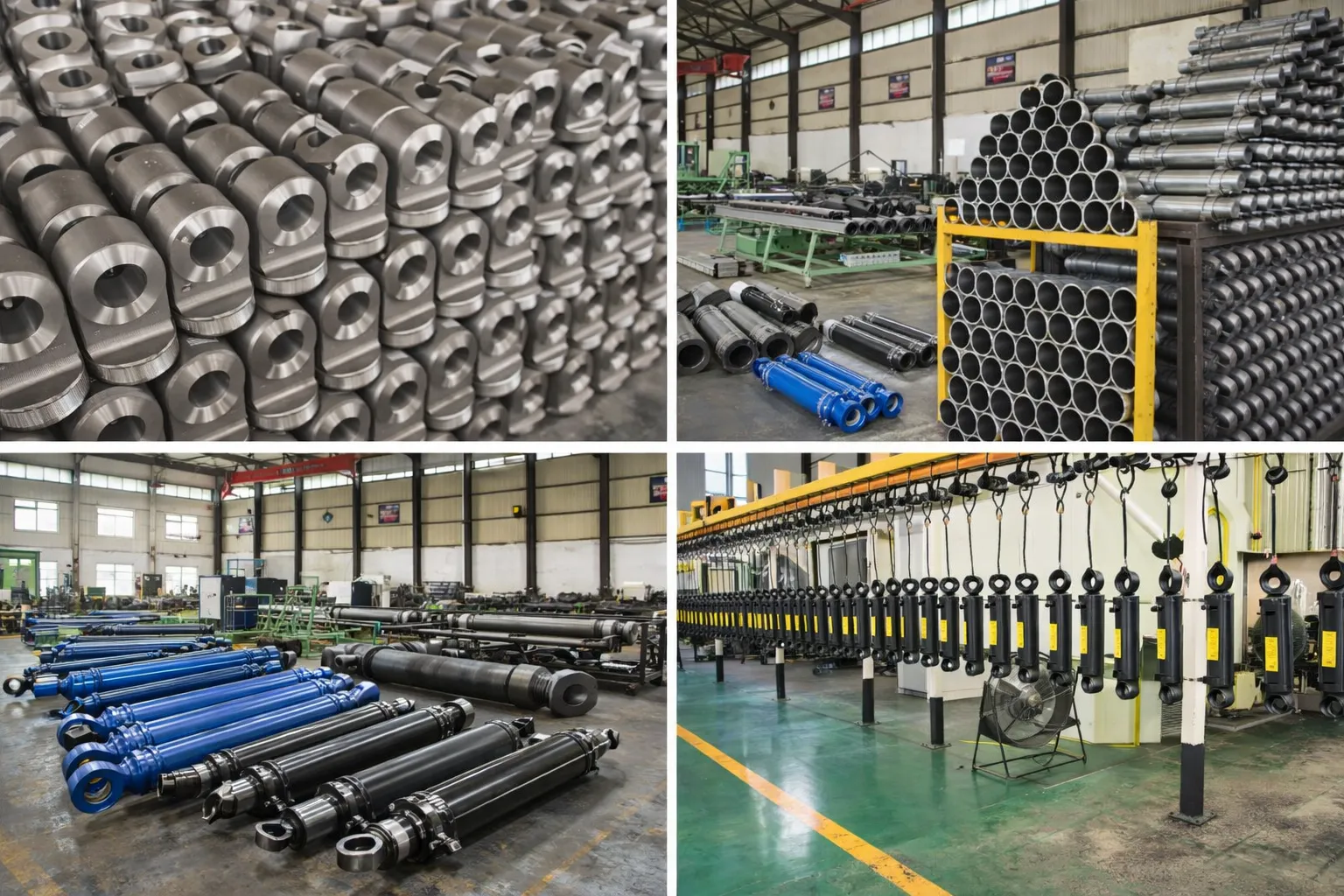
Every balance cylinder is manufactured in-house in our ISO 9001 certified facility. Carbon steel tube and rod stock verified by spectrometer on each incoming batch. Bores CNC bored and honed to Ra 0.2 with controlled cross-hatch verified by profilometer. Rods ground to h7 tolerance and hard chrome plated to 20+ micron. MIG welded by certified operators. Port bosses reinforced and CNC-threaded after welding. PTFE-impregnated seal compound verified for breakaway pressure specification (below 0.3 MPa) and compression set rating (below 18% at 70 C / 1,000 hours) by material certificate from the seal manufacturer. Breakaway pressure measured on every balance cylinder as part of the production test protocol. 100% pressure tested at 1.5 times rated pressure for three minutes. Serial numbered with ten-year traceability to material heat, seal lot, and test data. Material certificates, pressure test reports, and breakaway pressure measurements included as standard documentation.
Standard Farm Cylinder vs. Our Drainage Machine Balance Cylinder
| Balance Service Metric | Standard Farm Cylinder | Our Balance Cylinder |
|---|---|---|
| Breakaway Pressure | 0.6 – 1.2 MPa (stick-slip) | Below 0.3 MPa (smooth) |
| Seal Compression Set (1,000 hr / 70 C) | 30 – 40% | Below 18% |
| Grade Accuracy (laser check) | ±8 to 15 mm per 100 m | ±3 mm per 100 m |
| Balance Response Quality | Jerky step corrections | Smooth proportional tracking |
| Seal Life Under Vibration | 1 – 2 seasons | 3 – 5 seasons |
| Port Connection Vibration Resistance | Standard threads (loosen over time) | Reinforced bosses, CNC post-weld threads |
Customer Case Studies
Related Products and Spare Parts
The leveling unit works within the larger hydraulic system of a drainage installation machine alongside depth control, pipe lay, and steering cylinders. We manufacture and supply the following related products and spare parts that integrate with our cylinders and other drainage machine hydraulic components.
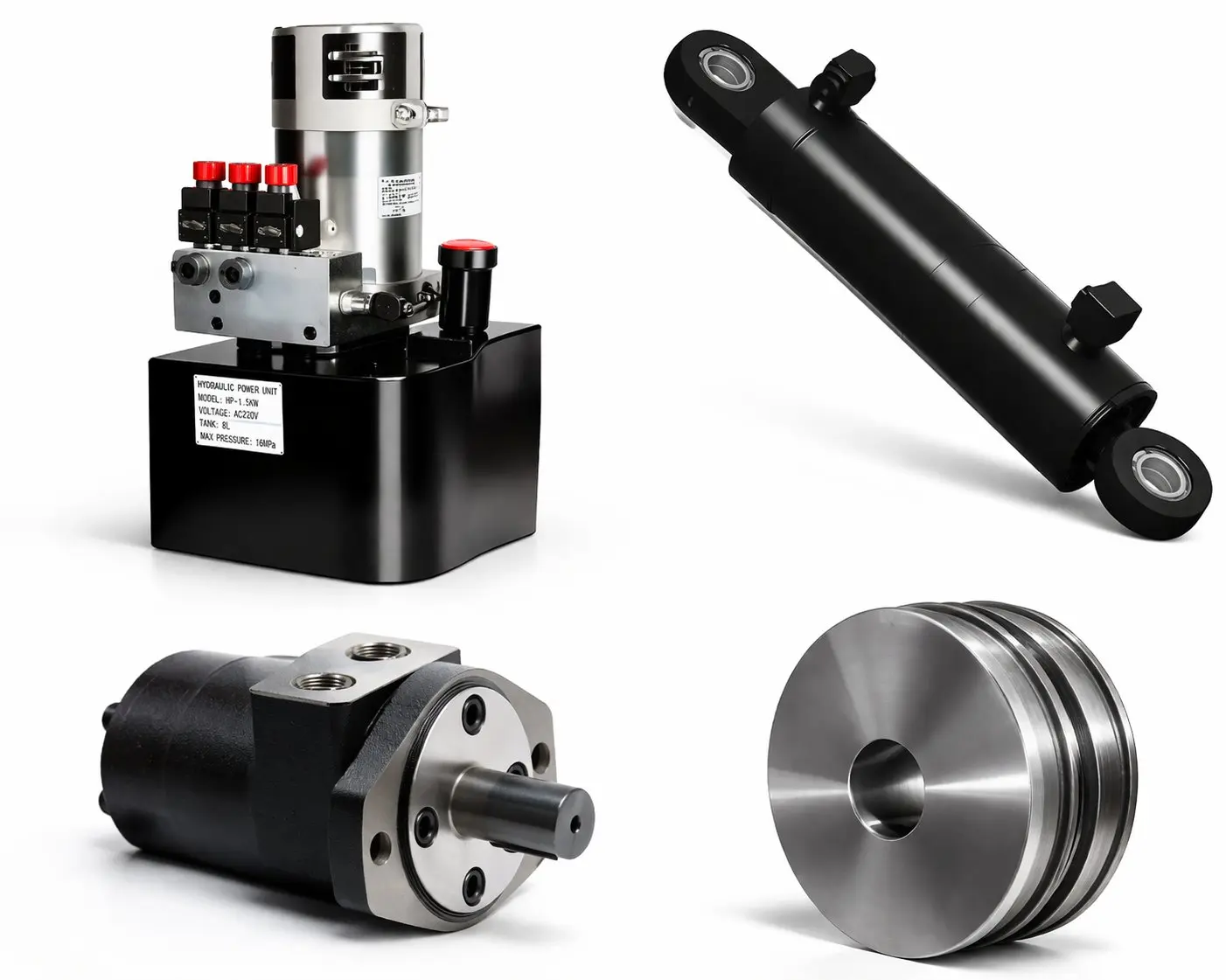
Hydraulic Power Unit: Self-contained power units for drainage machine hydraulic systems. Electric and diesel configurations from 0.75 to 7.5 kW, reservoir sizes 5 to 60 liters. Pre-matched to our cylinder bore and pressure specifications for system-level integration.
Hydraulic Pump: Gear and vane pumps for cylinder drive circuits on drainage installation machines. Flow rates 2 to 40 L/min matched to the response speed requirements of proportional balance control valves. SAE, DIN, and metric flange mounting.
Hydraulic Motor: Orbital and gear motors (50 to 500 cc) for trenching chain drives, pipe feed mechanisms, and backfill augers that operate alongside the balance cylinder in the machine’s hydraulic circuit.
Replacement Piston Rod: Factory-matched rods for all our balance cylinder models. Same material, chrome spec, and tolerance as original. Supplied with rod seal kit for complete rod-end rebuild when reconditioning is not economical.
Replacement Cylinder Barrel: Precision-honed replacement barrels with same bore finish (Ra 0.2), cross-hatch pattern, seal grooves, and port specifications as original production. Complete rebuild kit available as a single part number.
All related products and spare parts available alongside new hydraulic cylinders for sale or separately for existing installations.
Frequently Asked Questions
Why does the balance cylinder need a different seal than the depth control cylinder on the same machine?
What bore size is typical for a drainage machine balance cylinder?
How do you verify breakaway pressure on every balance cylinder?
What is the lead time for balance cylinders?
Accurate Pipe Grade Starts With a Balance Cylinder That Responds Smoothly
Share your machine model and laser grade control system details. We will recommend a low-friction balance cylinder matched to your installation requirements and deliver a quotation within 48 hours.
Editor: Cxm