Cotton Topper Arm Lift Cylinder for Mechanical Topping Machines
Q345D structural steel with low-friction seals rated for continuous micro-adjustment. Tracks canopy height in real time without drift, stutter, or mid-season seal failure.
A 5 mm Height Error Across 100 Hectares Costs More Than a New Cylinder
Cotton topping research from major producing regions in Central Asia and western China reports that a consistent 5 mm deviation from optimal topping height reduces fiber quality grading by one full class, cutting the per-hectare return by 8 to 12 percent. Across a 100-hectare cotton operation, that translates to thousands of dollars lost per season to something the operator cannot see from the tractor seat: a hydraulic cylinder that is slowly drifting off its set height because the piston seal no longer holds position under the constant micro-vibration of topping at field speed.
The topping arm on a mechanical cotton topper makes 100 to 300 micro-adjustments per minute as it follows the uneven canopy surface. Each adjustment involves a piston movement of 2 to 15 mm under working pressure. This micro-cycling pattern wears standard seals in a localized band, causing progressive internal leakage that manifests as height drift, jerky arm movement, and eventually visible oil weeping at the rod seal. By the time the operator notices the problem, the seal damage is already severe enough to affect topping quality across entire field sections.
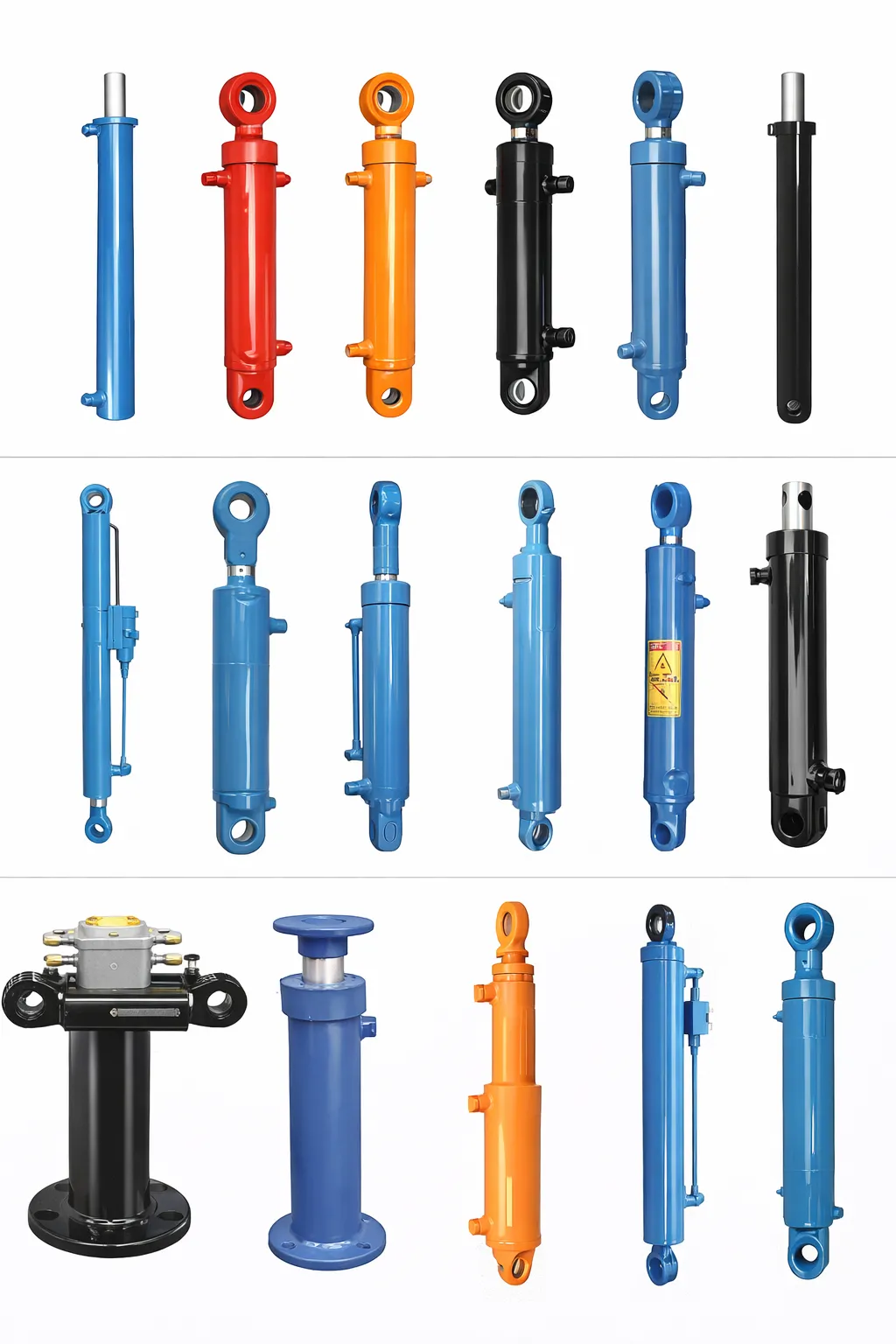
Our cotton topper arm lift cylinder is a double acting hydraulic cylinder built from Q345D low-alloy structural steel with low-friction polyurethane seals specifically formulated for the micro-cycling pattern of canopy tracking. The bore is honed to Ra 0.2 with a controlled cross-hatch that retains lubricating oil in the micro-stroke zone. Breakaway pressure is held below 0.25 MPa for the smooth, stutter-free response that precise canopy tracking demands. A PU dust wiper ring keeps the cotton fiber dust and soil debris that topping generates out of the seal zone entirely.
Canopy Tracking Response: Why Milliseconds Matter in Cotton Topping
At a topping speed of 8 km/h, the machine travels approximately 133 mm per second. If the cylinder takes 200 milliseconds longer than necessary to respond to a height correction signal from the sensor or operator, the topping blade overshoots or undershoots by 27 mm before the arm catches up. On a cotton plant where the optimal topping window is only 30 to 50 mm between the uppermost effective boll and the terminal bud, a 27 mm error means the difference between clean topping and either leaving too much unproductive growth or cutting into productive boll-bearing nodes.
Cylinder response time in this context is not about how fast the rod can travel. It is about how quickly the piston starts moving after a pressure change arrives at the port. This start-of-motion delay is controlled almost entirely by the breakaway pressure of the piston seal. A seal with 1.0 MPa breakaway pressure requires the system to build 1.0 MPa of differential pressure before the piston begins to move. At the low system pressures used in topper arm circuits (typically 3 to 8 MPa), that 1.0 MPa breakaway represents 12 to 33 percent of the available pressure, creating a measurable dead zone in the control response.
Our cylinder achieves breakaway pressure below 0.25 MPa through a combination of three design choices:
Low-preload seal profile: The piston seal lip geometry is designed with reduced initial compression against the bore surface. This lowers the static friction that the oil pressure must overcome to initiate movement, without compromising dynamic sealing performance once the piston is in motion.
Ra 0.2 bore with oil-retention texture: The honed bore surface has a controlled cross-hatch pattern that holds a thin oil film between the seal lip and the bore wall. This oil film acts as a hydrostatic bearing that reduces the seal-to-bore coefficient of friction during initial movement, cutting the breakaway force needed to start the piston sliding.
PTFE-impregnated seal compound: The piston seal material includes PTFE micro-particles that migrate to the sliding surface during operation, forming a self-renewing low-friction layer. This keeps breakaway pressure low throughout the seal’s service life, not just when it is new.
The combined effect is a cylinder that begins responding within 40 to 60 milliseconds of a pressure signal, compared to 150 to 250 milliseconds for standard agricultural cylinders with conventional seals. At 8 km/h, that difference represents a tracking error reduction from 27 mm to approximately 7 mm, well within the acceptable window for clean cotton topping.
Technical Specifications
| Specification | Available Range |
|---|---|
| Bore Diameter | 40 mm – 80 mm |
| Rod Diameter | 22 mm – 50 mm |
| Stroke Length | 100 mm – 500 mm |
| Working Pressure | Up to 16 MPa (2,320 PSI) |
| Action Type | Double Acting |
| Structure | Welded Piston Cylinder |
| Body Material | Q345D Low-Alloy Structural Steel |
| Piston Rod | Q345D, Hard Chrome 20+ micron |
| Piston Seal | Low-Friction PTFE-Impregnated PU |
| Rod Seal | NBR + PTFE Back-up Ring |
| Dust Protection | PU Wiper + Optional Rubber Boot |
| Mounting | Clevis, Pin Eye, Lug, Custom |
| Port Thread | BSP / NPT / Metric |
| Operating Temperature | -15 C to +85 C |
| Environment Rating | High-Frequency Micro-Action / Cotton Dust |
Six Design Advantages for Canopy-Tracking Topper Arms
Sub-0.25 MPa Breakaway for Instant Response
Low-preload seal profile combined with PTFE-impregnated compound and Ra 0.2 bore finish produces breakaway pressure below 0.25 MPa. This enables 40 to 60 ms response to height correction signals, reducing canopy tracking error to under 7 mm at normal topping speeds.
Micro-Cycle Rated Seal with 1M+ Cycle Life
Seal compound selected for elastic recovery under repeated 2 to 15 mm micro-strokes. Bench-tested past 1,000,000 micro-cycles with less than 5% leakage increase. Standard PU shows degradation at 250,000 cycles under the same protocol.
Oil-Retaining Bore Texture
Controlled cross-hatch honing pattern maintains lubricating oil film in the micro-stroke zone between full-stroke events. This prevents the oil film starvation that accelerates seal wear during continuous canopy tracking operation.
Cotton Dust Exclusion
Integrated PU wiper ring intercepts cotton fiber, leaf debris, and soil particles before they reach the primary rod seal. Optional rubber boot covers the full rod travel for extreme dust conditions. Together these prevent the dust ingress that causes rod surface scratching and accelerated seal wear.
Q345D Body with Low-Temperature Capability
Q345D provides 345 MPa yield and Charpy toughness at -20 C. The low-alloy composition accepts chrome plating adhesion consistently. Excellent weldability for reliable barrel-to-cap joints that resist cyclic fatigue from continuous micro-vibration loading.
Compact Welded Body for Tight Arm Assemblies
Topper arm mechanisms leave minimal clearance for hydraulic components. Welded body eliminates external tie rods, achieving the smallest outside diameter for any given bore. Fits within the arm envelope without interfering with cutting blades, guards, or drive components.
Application Scenarios
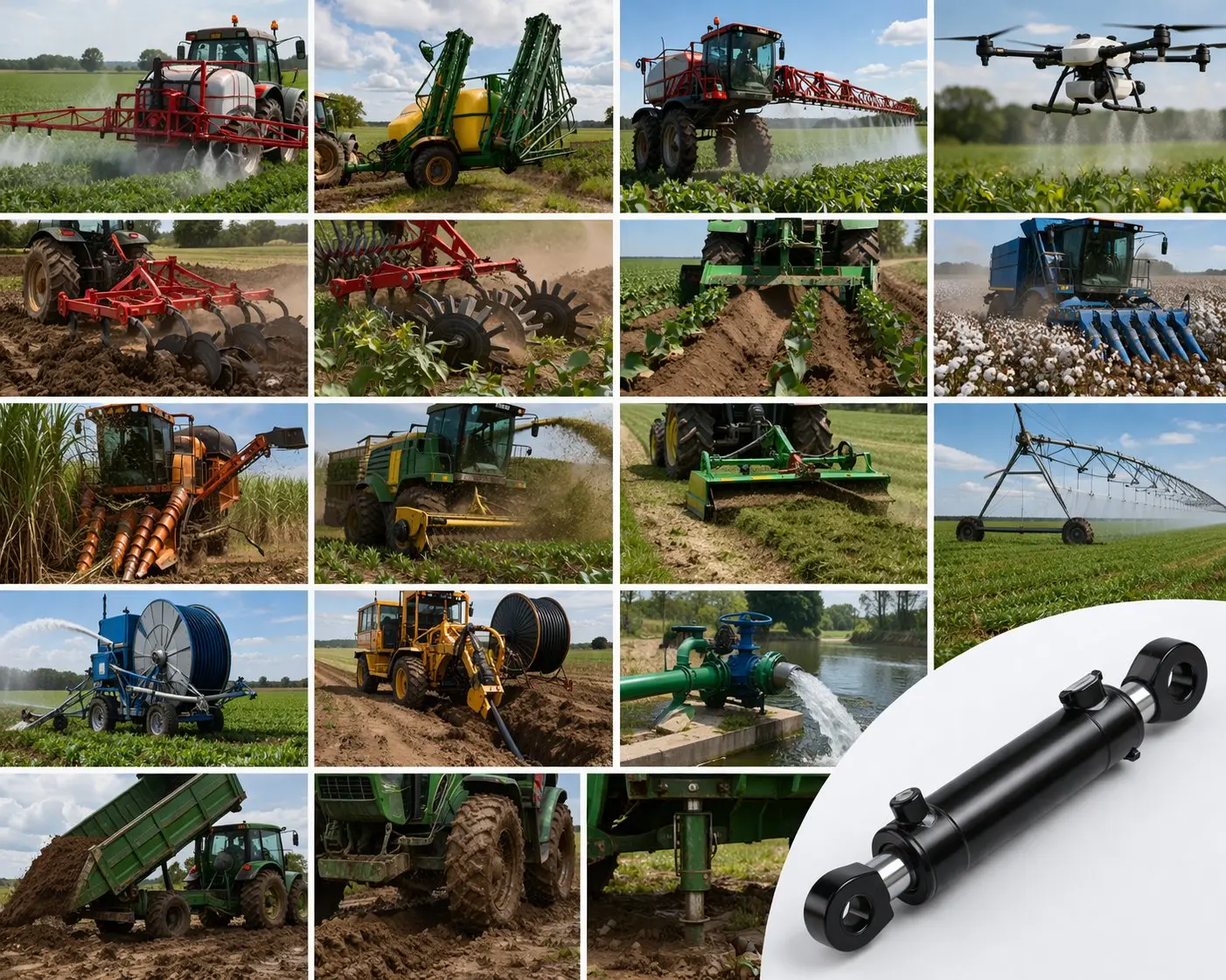
Mechanical Cotton Topping Machines: The primary application. Both tractor-mounted and self-propelled toppers use boom arm lift cylinders for real-time canopy height tracking. Our low-friction seal and sub-0.25 MPa breakaway deliver the fine height resolution needed for uniform topping across varying plant heights.
Sensor-Guided Automatic Topping Systems: Ultrasonic or optical sensor-guided toppers require cylinder response times below 100 ms for closed-loop height control. Our 40 to 60 ms response enables the control resolution these systems demand.
Tobacco Topping Machines: Tobacco flower removal requires the same micro-adjustment capability and dust resistance. The operating pattern and agricultural machinery hydraulic cylinder duty cycle is comparable to cotton topping.
Tea Bush and Vineyard Hedge Trimmers: Canopy-tracking trimming equipment for tea, grapes, and ornamental hedges uses boom arm cylinders with similar micro-adjustment requirements.
Cotton Defoliator Boom Height Control: Chemical defoliation spray boom arms require the same real-time height tracking. The optional FKM seal upgrade addresses the added chemical exposure in defoliant environments.
Manufacturing and Quality Control
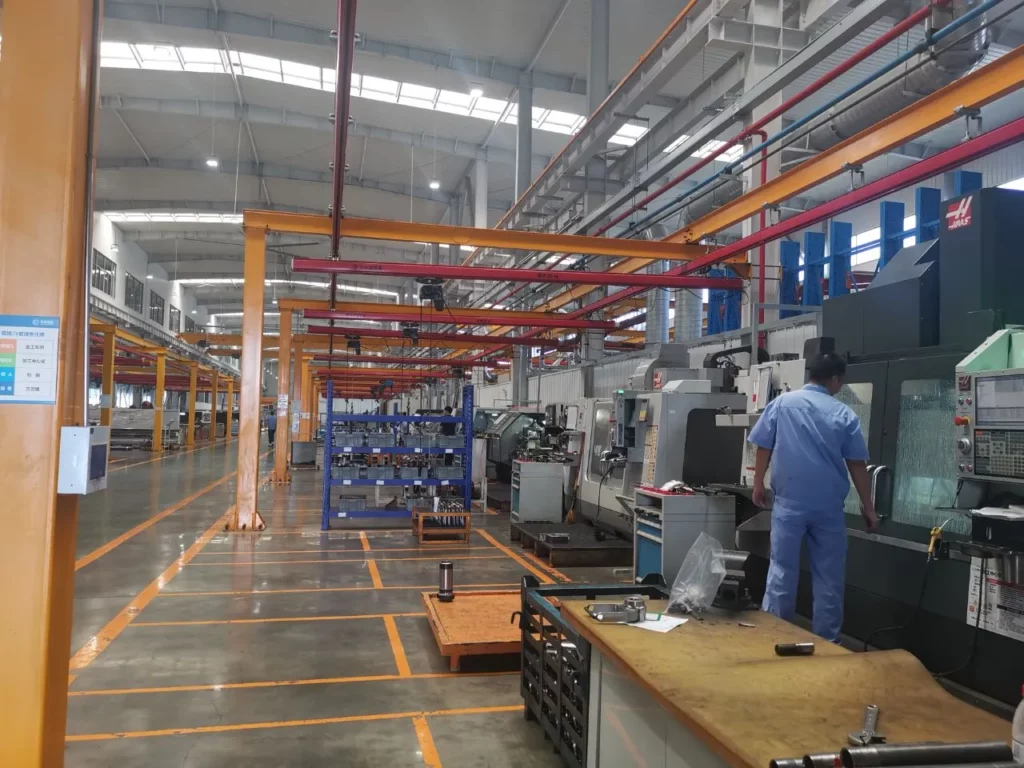
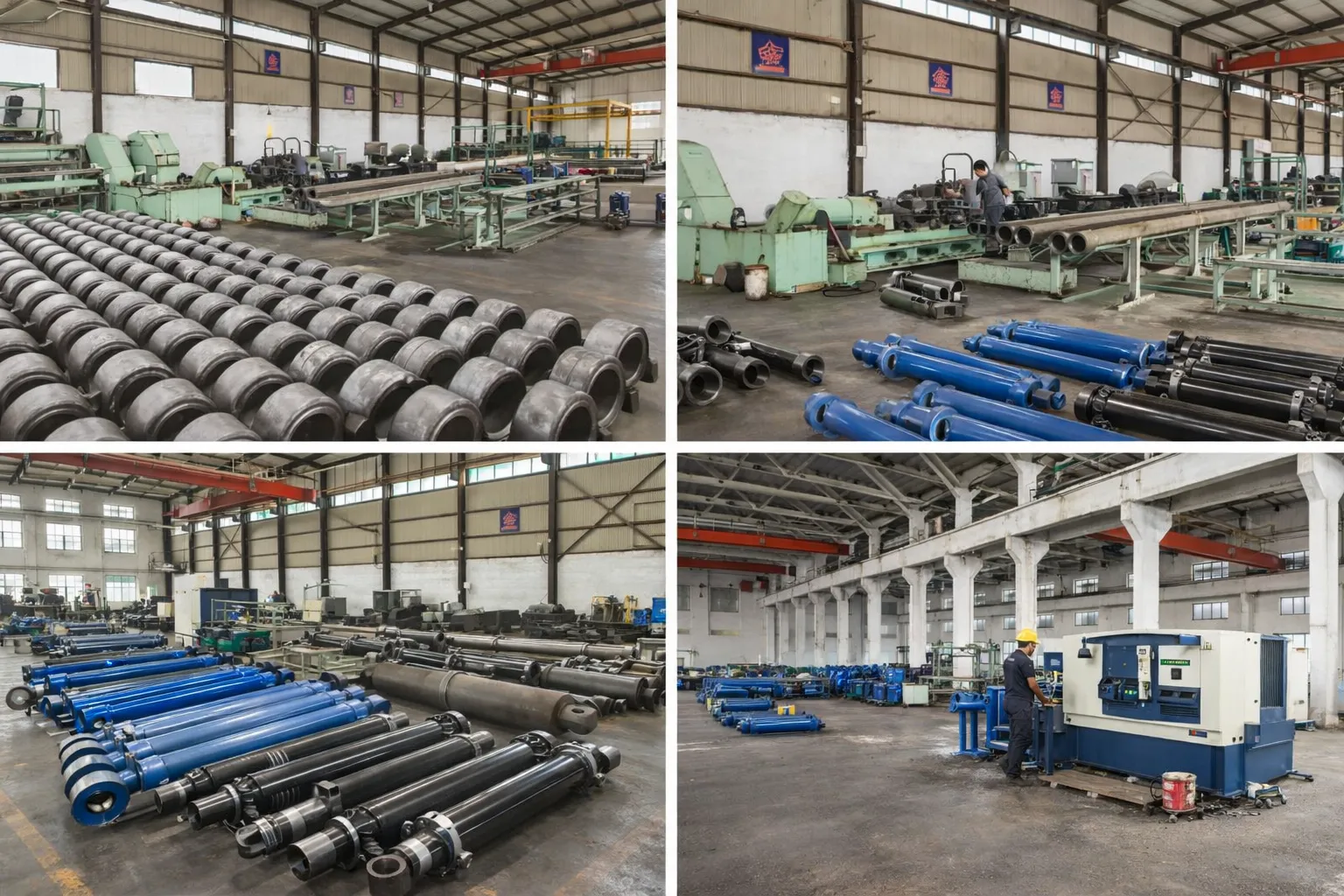
Built entirely in our ISO 9001 certified facility. Q345D tube and rod stock verified by spectrometer. Bores honed to Ra 0.2 with controlled cross-hatch verified by profilometer. Rods ground to h7 and chrome plated to 20+ micron. MIG welded by certified operators. Seals from single lots per order for batch uniformity. 100% pressure tested at 1.5 times rated pressure with breakaway pressure measurement on every unit. Serial numbered with ten-year traceability. Material and test certificates included as standard.
Standard Boom Cylinder vs. Our Topper Arm Lift Cylinder
| Topping-Relevant Metric | Standard Boom Cylinder | Our Topper Arm Cylinder |
|---|---|---|
| Breakaway Pressure | 0.6 – 1.2 MPa | Below 0.25 MPa |
| Response Time to Pressure Signal | 150 – 250 ms | 40 – 60 ms |
| Canopy Tracking Error at 8 km/h | 20 – 33 mm | 5 – 8 mm |
| Seal Micro-Cycle Life | ~250,000 cycles | 1,000,000+ cycles |
| Height Drift Over 1-Hour Operation | 3 – 8 mm | Below 0.5 mm |
| Dust Protection | Basic rubber wiper | PU wiper + optional boot |
Customer Case Studies
Changnyeong County, Gyeongsangnam-do, South Korea
Customer: Cotton research station testing mechanical topping for Korean upland cotton varieties
How They Found Us: Station engineer searched for “low friction hydraulic cylinder cotton topper arm” in March 2025.
Results: Breakaway pressure measured at 0.21 MPa on their bench, meeting their sub-0.3 MPa requirement. Field trials showed canopy tracking accuracy improved from 22 mm error to under 6 mm at 7 km/h. The station adopted our cylinder as the standard for their topper development program.
“We measure every millimeter in research plots. These cylinders gave us the tracking precision needed to generate valid data on topping height effects across different varieties.” – Dr. Kang, Cotton Research Lead, August 2025
Jinju City, Gyeongsangnam-do, South Korea
Customer: Agricultural equipment OEM producing cotton and tobacco topping machines for Korean and export markets
How They Found Us: Met at Korea Machinery Fair, March 2025. Evaluation began in April 2025.
Results: OEM bench testing confirmed response time 65% faster than their previous supplier. Warranty complaints about jerky arm movement dropped to zero on pilot machines. Current production order is 180 units per quarter.
“Jerky topping was our biggest customer complaint. Switching the arm cylinder solved it completely. The response speed improvement was obvious even without instruments.” – Mr. Moon, Quality Manager, September 2025
Kagoshima Prefecture, Japan
Customer: Tea cultivation equipment manufacturer using canopy tracking boom arms for precision tea bush trimming
How They Found Us: Found our double acting hydraulic cylinder pages through a Google search in May 2025.
Results: Kagoshima tea requires extremely uniform canopy surface for premium matcha-grade harvest. Our cylinder’s 40 ms response time eliminated the visible striping that their previous cylinders caused during high-speed trimming passes. Trimming surface uniformity improved enough to increase the proportion of harvest qualifying for premium grade by approximately 8%.
“In Kagoshima tea, surface quality directly determines price grade. The faster cylinder response eliminated the waviness that was costing us premium classification on 10% of our canopy.” – Mr. Harada, Development Engineer, October 2025
Sindh Province, Pakistan
Customer: Cotton machinery distributor serving the Sindh cotton belt with mechanical topping equipment
How They Found Us: Contacted us after finding our website in August 2024. Placed trial order in October 2024.
Results: Sindh cotton fields operate in extreme heat (45+ C) with heavy dust. Our cylinders completed the full 2024 topping season (8 weeks of daily operation) without seal replacement or detectable drift. The distributor doubled their quarterly order for the 2025 season.
“Dust and heat in Sindh destroy cylinder seals in weeks. Ours went eight weeks without a problem. The wiper ring makes a real difference in keeping dust out.” – Mr. Shaikh, Director, January 2025
Mersin Province, Turkey
Customer: Cotton machinery OEM building toppers for Turkish and Central Asian markets
How They Found Us: Met at EIMA International, November 2024. Sample evaluation began December 2024.
Results: OEM internal testing showed height drift reduced by 90% compared to their previous supplier. Field trials in Cukurova cotton region confirmed consistent topping quality across 60+ hectare daily runs. Annual order is 250 units.
“Our export customers in Uzbekistan demanded better topping consistency. This cylinder upgrade solved the problem without redesigning the topper arm mechanism.” – Mr. Gungor, Export Director, June 2025
Frequently Asked Questions
Why does breakaway pressure matter for cotton topper arm cylinders?
What bore size is right for a cotton topper arm?
Can this cylinder replace OEM topper arm cylinders?
What is the lead time and do you ship to cotton-producing regions?
Every Millimeter of Topping Accuracy Protects Your Fiber Grade
Share your topper model, arm geometry, and operating speed. We will recommend a fast-response cylinder and deliver a quotation within 48 hours.
Editor: Cxm