Cultivator Depth Control Cylinder for Inter-Row Cultivation
27SiMn alloy steel construction with heavy chrome rod and stone-impact-rated barrel. Keeps your cultivator blades at the right depth through the hardest ground.
Spring Soil Does Not Wait for a Cylinder Repair
Every spring across the grain belts of Korea, Japan, and mainland Asia, there is a narrow window of a few weeks when soil conditions are right for inter-row cultivation. The ground has dried enough to support tractor traffic but still holds enough moisture to make weed roots easy to uproot. Miss that window and you are either cultivating in mud that clogs the shanks or baking dry soil that dulls the blades and kicks up dust clouds without disturbing weed roots.
In that critical window, the one component that cannot afford to fail is the depth control cylinder on each cultivator shank or toolbar section. This hydraulic cylinder sets how deep the cultivator blades penetrate the soil and holds that depth constant as the machine crosses the field. When the cylinder seal starts leaking or the rod bends from hitting a buried stone, depth becomes erratic. Some blades cut too shallow and miss weeds entirely. Others dive too deep and prune crop roots, stunting growth for the rest of the season.
Our cultivator depth control cylinder is built from 27SiMn manganese-silicon alloy steel, a material selected specifically for its ability to absorb impact energy without cracking or permanently deforming. The piston rod is oversized relative to standard depth cylinders and hard chrome plated to resist the scoring that rocks and hardpan layers inflict on exposed rod surfaces. A dedicated scraper ring at the gland removes mud and debris before it can reach the primary rod seal. This is a double acting hydraulic cylinder in a welded piston configuration, designed for the high-impact, stone-filled, and abrasive conditions that cultivation equipment faces in every field, every season.
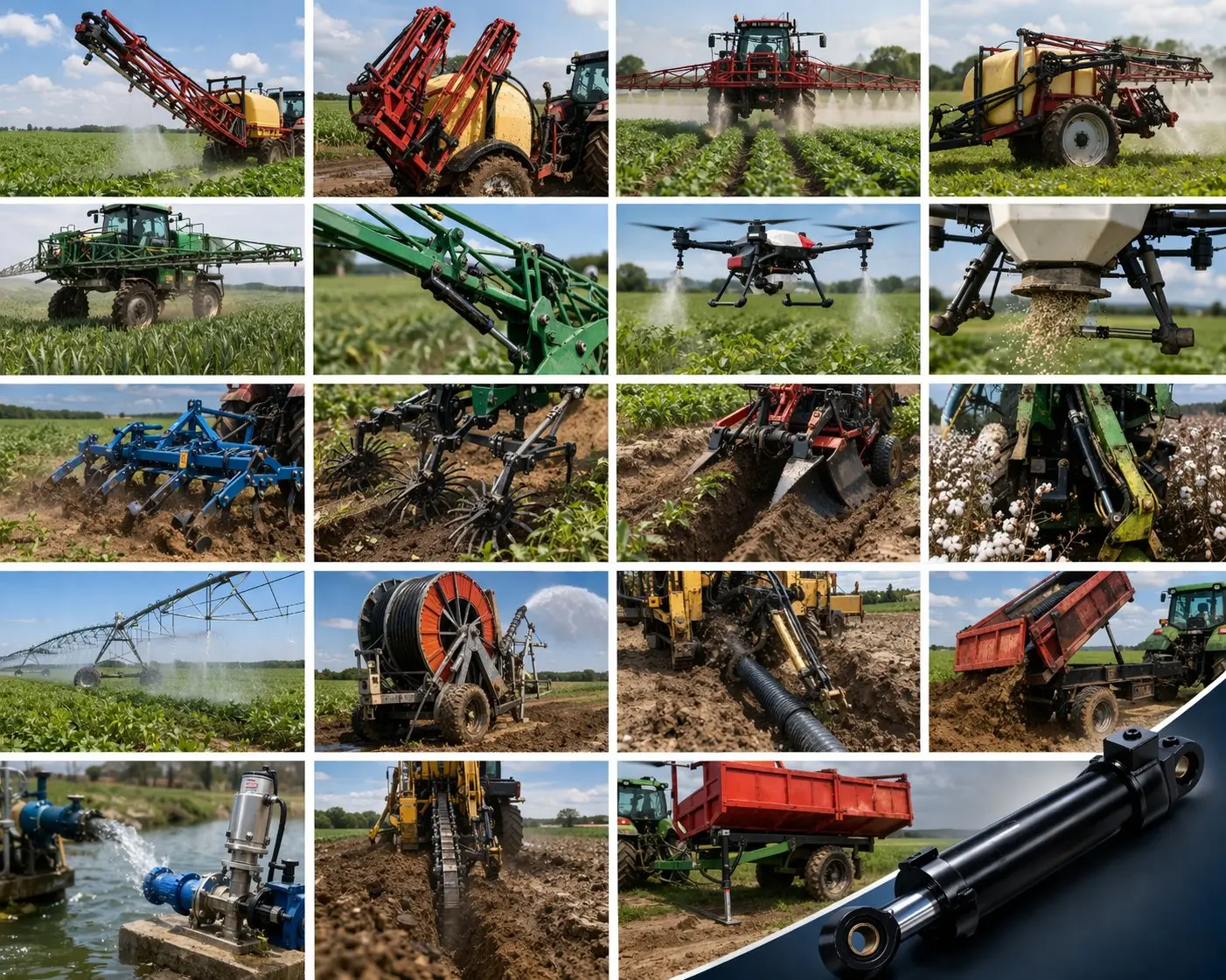
How a Depth Control Cylinder Operates on a Cultivator
An inter-row cultivator carries multiple shank or blade assemblies mounted along a toolbar. Each assembly connects to the toolbar through a parallel linkage or a pivot arm. The cultivator depth control cylinder links the toolbar frame to this pivot, controlling how far down the blade or shank enters the soil.
The operator selects a target cultivation depth from the cab, typically between 30 mm and 100 mm depending on the crop stage and weed size. Pressurized hydraulic oil extends the cylinder rod, pushing the linkage arm downward and driving the blade into the ground. When the target stroke is reached, the control valve locks oil on both sides of the piston, holding the blade at the set depth as the tractor moves forward.
During operation, the blade encounters varying soil conditions every few meters. Soft soil offers little resistance and the blade maintains depth easily. Compacted wheel tracks and clay layers push back hard against the blade, generating high pressure spikes in the cylinder bore. Buried stones deliver sudden impact loads that can exceed normal working pressure by 50 percent or more in a fraction of a second. These transient spikes stress the barrel walls, piston seals, rod chrome, and weld joints in ways that continuous steady pressure does not.
The scraper ring at the rod gland plays a critical role during cultivation. The blade throws soil upward along the shank, and some of this soil reaches the cylinder body and exposed rod. Without an effective scraper, soil particles get dragged into the seal zone during rod retraction and grind against the seal lip and chrome surface. Our polyurethane scraper ring with a hardened metal case removes caked soil and embedded stones from the rod surface before they can enter the gland bore.
Engineering for Stone Impact: What Happens Inside the Cylinder When the Blade Hits a Rock
Understanding the mechanics of a stone strike helps explain why standard agricultural cylinders fail in cultivator duty and what engineering measures prevent that failure.
When a cultivator blade hits a buried stone at 8 km/h travel speed, the stone does not give way instantly. For a brief moment (typically 10 to 50 milliseconds), the stone resists the blade’s forward motion completely. The kinetic energy of the tractor and cultivator mass, concentrated at the blade tip, generates a reaction force that travels up the shank, through the linkage, and into the cylinder rod. This force has two components: an axial thrust that tries to compress the cylinder against its locked hydraulic oil, and a lateral bending load caused by the blade deflecting sideways around the stone.
The axial component produces a pressure spike inside the cylinder that can reach 1.5 to 2 times the normal working pressure. If the cylinder barrel wall is too thin or the weld joints are not fatigue-rated, this spike initiates micro-cracks that grow with each subsequent stone strike until the barrel starts seeping oil at the weld seam. The lateral component tries to bend the piston rod sideways. A rod that is too slender for the application will take a permanent set after enough stone hits, and a bent rod destroys the bore surface and seals on every subsequent stroke.
Our approach addresses both load paths:
27SiMn Alloy Steel Barrel
27SiMn (equivalent to AISI 1527 with added silicon) delivers a yield strength of 490 to 590 MPa in the quenched and tempered condition, roughly 20% higher than standard S45C carbon steel. More importantly, the silicon content improves fatigue resistance under cyclic loading, extending the number of pressure spike cycles the barrel can absorb before crack initiation. The barrel wall thickness is calculated with an impact safety factor of 2.5 times rated working pressure, well above the 1.5x factor used for standard cylinders.
Oversized Piston Rod
We select a rod diameter one size larger than what axial load alone would require. For a 63 mm bore depth cylinder, standard practice would use a 35 mm rod. Ours uses a 40 mm or 45 mm rod. Bending resistance scales with the fourth power of diameter, so a 5 mm increase roughly doubles the rod’s resistance to lateral deflection from stone strikes. The rod is also chrome plated to 20+ micrometers and ground to Ra 0.1 for maximum seal compatibility and scratch resistance.
Extended Gland Bearing Length
The rod guide bushing inside the gland cap is lengthened to distribute lateral loads over a wider contact area. This reduces point stress on both the rod surface and the bushing material, preventing the localized wear grooves that short-guided cylinders develop after repeated side loading. The longer bearing also improves rod alignment during dynamic operation, reducing the eccentric loading pattern that initiates bending fatigue.
Metal-Cased Mud Scraper
Stone strikes throw soil fragments and small rock chips toward the cylinder body. A standard press-fit rubber wiper cannot withstand the impact energy of these projectiles and gradually works loose from its groove. Our scraper uses a metal case that is mechanically retained in a machined groove in the gland, ensuring it stays seated through seasons of stone-impact vibration. The polyurethane scraper lip has a sharp edge profile designed to shear off caked clay and embedded stone chips from the rod surface during retraction.
Technical Specifications
| Specification | Available Range |
|---|---|
| Bore Diameter | 40 mm – 100 mm |
| Rod Diameter (Oversized) | 28 mm – 70 mm |
| Stroke Length | 50 mm – 400 mm |
| Working Pressure | Up to 20 MPa (2,900 PSI) |
| Action Type | Double Acting |
| Structure | Welded Piston Cylinder |
| Body Material | 27SiMn Alloy Steel (Q&T) |
| Piston Rod | 27SiMn, Hard Chrome 20+ micron |
| Body Finish | Black Oxide + Epoxy Paint |
| Piston Seal | High-Strength PU + PTFE Wear Ring |
| Rod Seal | NBR + PTFE Back-up Ring |
| Scraper | Metal-Cased PU Mud Scraper |
| Mounting | Clevis, Pin Eye, Trunnion, Custom Bracket |
| Port Thread | BSP / NPT / Metric |
| Operating Temperature | -25 C to +85 C |
| Environment Rating | Stone Impact / Abrasive Soil |
Application Scenarios
Inter-Row Cultivators: The primary application. Multi-row cultivators for corn, soybean, sugar beet, and vegetable crops use individual depth cylinders on each shank unit or section. Our oversized rod and 27SiMn barrel handle the repeated stone impacts that are inevitable in stony field soils across Korea, Japan, and Central Asia.
Field Cultivators and Chisel Plows: Full-width field cultivators with hydraulic depth control face the same stone impact challenges at larger scale. Our cylinders fit both individual shank control and section-wide toolbar adjustment configurations.
Ridger Blade Depth Control: Ridging machines for potato, sweet potato, and peanut bed formation require precise blade depth to create uniform ridges. The stone-resistant barrel and oversized rod prevent the depth drift and rod bending that standard cylinders develop after a few seasons of ridge work in stony ground.
Strip-Till and Zone-Till Shanks: Strip-till machines with deep shanks operating at 150 to 300 mm depth encounter the most severe stone and hardpan impacts. Our welded hydraulic cylinder construction with impact-rated barrel walls is specifically suited for these extreme-depth applications. See our full range of hydraulic cylinders for agricultural machinery for related products.
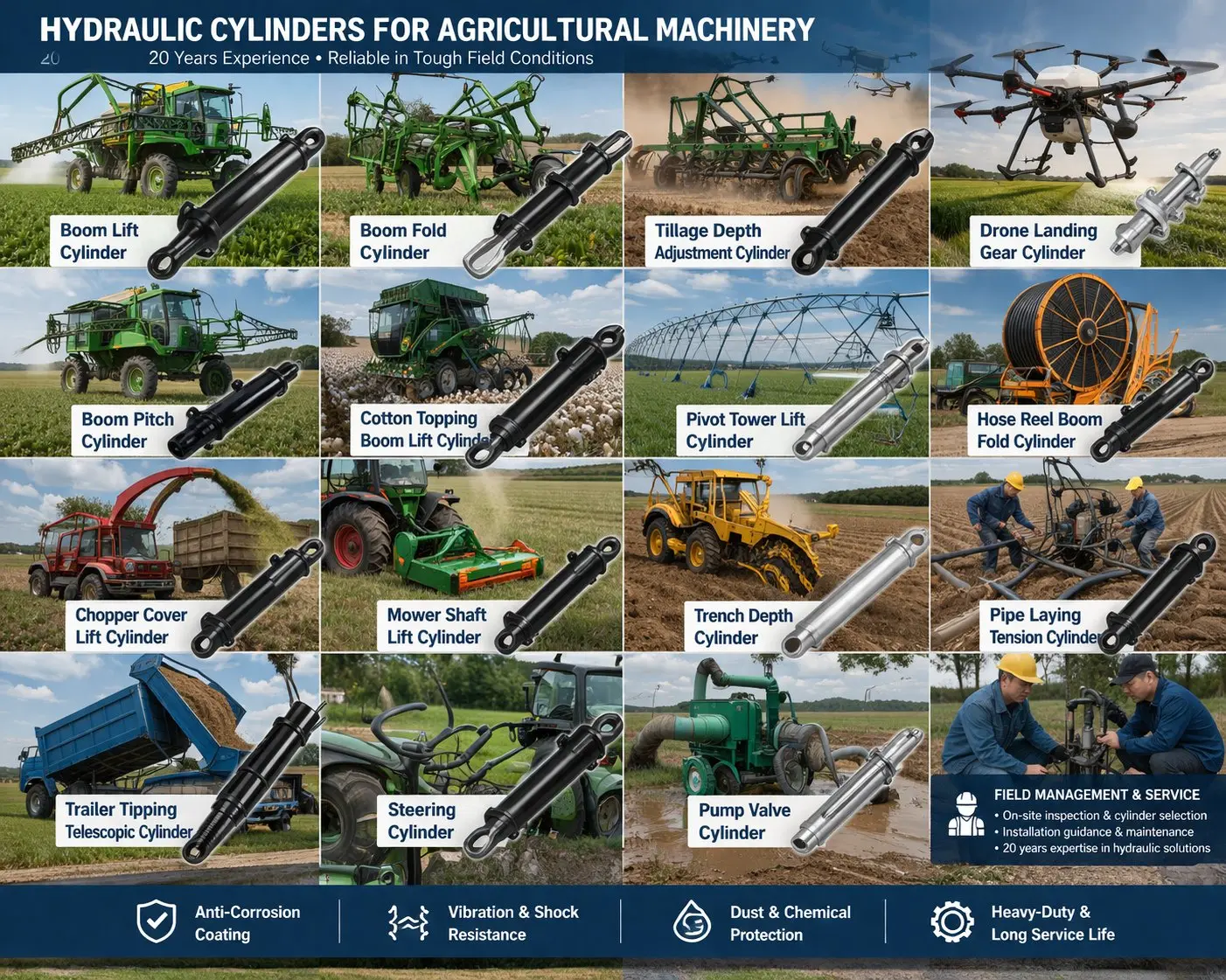
Manufacturing and Quality Control
Working with 27SiMn alloy steel requires specific metallurgical knowledge. The silicon content improves fatigue strength but also increases sensitivity to welding parameters. Our factory has the equipment, processes, and experience to handle this material correctly throughout the production chain.
Material sourcing: 27SiMn tube and bar stock from qualified mills with full material certificates. Incoming batches verified by spectrometer and hardness test. Material that does not meet our hardness specification of 217 to 269 HB in the normalized condition is rejected.
CNC machining: Bores honed to Ra 0.2. Rods ground to h7 tolerance and chrome plated to 20+ micron thickness. Pistons, glands, and end caps machined from solid alloy bar stock to plus or minus 0.02 mm tolerances.
Welding: 27SiMn requires controlled pre-heating to 150 to 200 C before welding. MIG welding with matched filler wire. Post-weld heat treatment at 550 to 600 C for stress relief on impact-rated cylinders. We record furnace temperature profiles for traceability.
Assembly and testing: Clean-room assembly. 100% pressure testing at 1.5 times rated pressure for three minutes with full external leak inspection. Serial numbered with ten-year traceability to material batch, seal lot, and test data. ISO 9001 certified.
Standard Cultivation Cylinder vs. Our Depth Control Cylinder
| Cultivation-Specific Metric | Standard Cylinder | Our Depth Control Cylinder |
|---|---|---|
| Barrel Material | S45C Carbon Steel | 27SiMn Alloy Steel (Q&T) |
| Pressure Spike Tolerance | 1.5x rated (standard burst) | 2.5x rated (impact safety factor) |
| Rod Bending Resistance | Standard rod/bore ratio 0.50-0.55 | Oversized ratio 0.63-0.70 |
| Mud/Stone Scraper | Rubber wiper (loosens with vibration) | Metal-cased PU scraper (retained) |
| Gland Bearing Length | Standard (1.0x rod diameter) | Extended (1.5x rod diameter) |
| Chrome Thickness | 10 – 15 micron | 20+ micron |
| Typical Field Life in Stony Soil | 1 – 2 seasons | 5+ seasons |
Customer Case Studies
Frequently Asked Questions
What cylinder bore size is right for my inter-row cultivator?
Why does 27SiMn steel resist stone impact better than carbon steel?
Can this cylinder replace OEM cultivator depth cylinders?
How do I know if my cultivator cylinder rod is starting to bend?
What is the lead time for cultivator depth control cylinders?
Do you ship cultivator cylinders to Korea, Japan, and Southeast Asia?
Your Cultivator Hits Rocks. Your Cylinder Should Handle It.
Tell us your cultivator model, soil conditions, and cylinder dimensions. We will propose a stone-rated replacement and deliver a quotation within 48 hours.
Editor: Cxm