
Outrigger Hydraulic Cylinder for Crane Stabilization
Delivering uncompromising structural support and precise leveling capabilities. Upgrade your heavy lifting operations with our highly durable stabilization systems engineered for extreme environments.
Product Overview: The Foundation of Lifting Safety
When evaluating the operational safety of heavy engineering equipment, the structural integrity of the chassis stabilization system is paramount. Telescopic boom machines handle massive, shifting payloads that drastically alter the vehicle’s center of gravity. To prevent catastrophic tipping and chassis twisting, the equipment relies entirely on the outrigger hydraulic cylinder to transfer these immense static and dynamic loads directly to the ground. This component is not simply an actuator; it is the fundamental anchor point that dictates the absolute safety limits of every single lift on a construction site.
Drawing upon twenty years of direct field failure analysis, we have identified that generic market actuators consistently fail under the severe lateral shear forces generated during a crane rotation. As a highly specialized hydraulic cylinder manufacturer, we have strategically engineered our stabilization series to eradicate these vulnerabilities. We focus on advanced metallurgical selections, specifically high-yield alloy steels, combined with forged mounting points, to ensure that our units can absorb the kinetic shock loads that easily fracture ordinary welded joints.
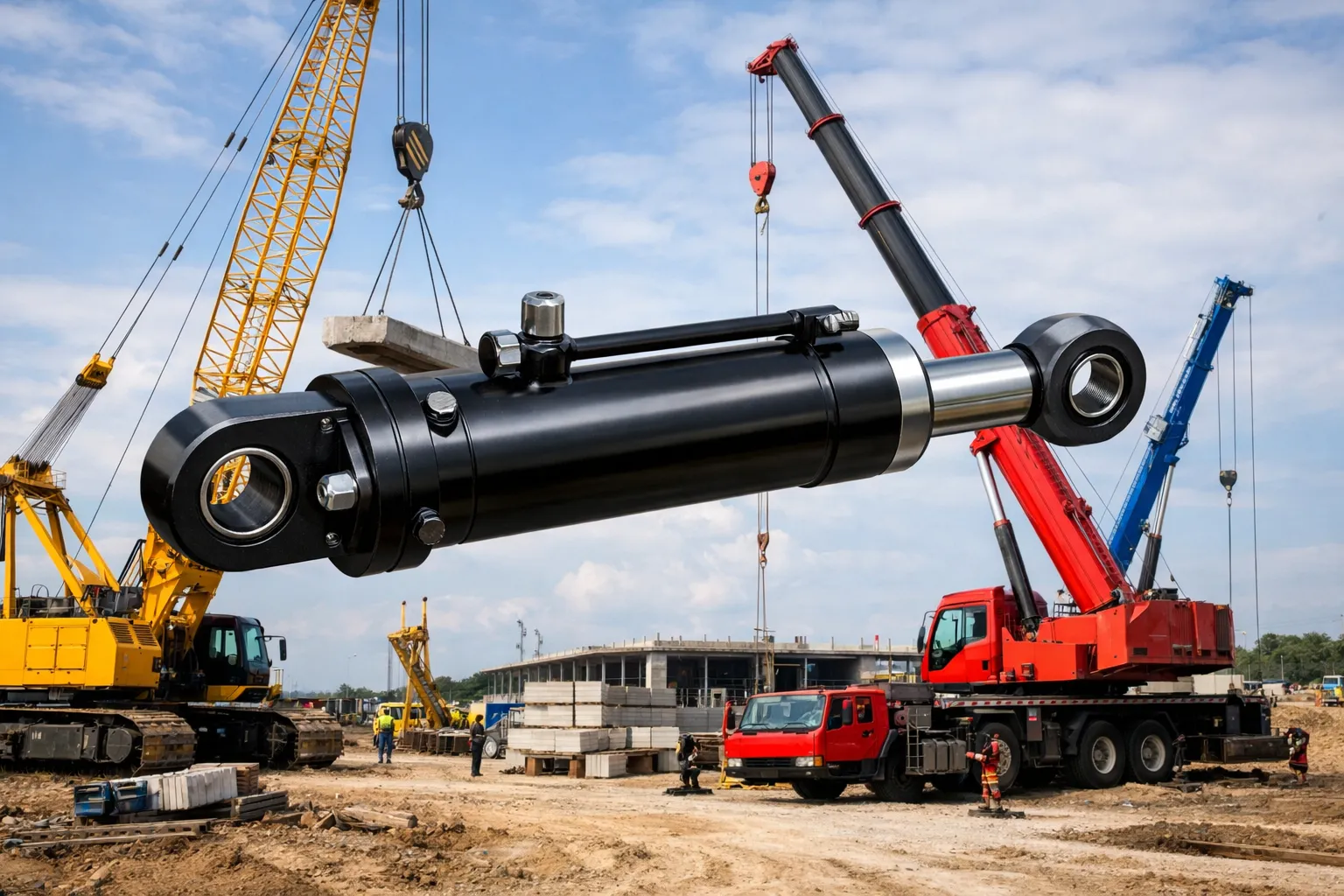
For fleet operators across South Korea and surrounding industrial regions, equipment downtime directly erodes project profitability. A failed stabilization leg halts the entire job site. Therefore, our engineered hydraulic parts are meticulously constructed not just to actuate smoothly, but to lock and hold massive weight indefinitely. Whether you are retrofitting an aging fleet or procuring components for new machinery assembly, our high-performance fluid power solutions deliver exceptional longevity, providing you with a highly competitive hydraulic cylinder price over the total lifecycle of your equipment.
Detailed Technical Parameters and Customization Range
Achieving perfect mechanical integration requires exact engineering specifications. We provide a highly adaptable range of manufacturing parameters tailored to specific tonnage requirements and chassis dimensions. The table below outlines the core configuration data for our heavy-duty stabilization series.
| Engineering Category | Standard Specification & Customizable Options |
|---|---|
| Target Industry | Engineering machinery, Heavy infrastructure construction |
| Equipment Category | Telescopic boom crane, Rough terrain mobile machinery |
| Subsystem / Action | Outrigger system / Chassis leveling and lifting |
| Product Name | Outrigger cylinder (Stabilizer jack cylinder) |
| Action Method | Double acting hydraulic cylinder |
| Structure Type | Piston cylinder with heavy-wall construction |
| Manufacturing Structure | Automated submerged arc welded assembly |
| Material System | 42CrMo High-yield alloy steel (Rod and primary load components) |
| Surface Treatment | Hard chrome plated (30 to 50 micrometers thickness, HV850+) |
| Environmental Grade | Extreme resistance to salt spray, abrasive dust, and thermal shock |
| Operating Conditions | Support whole machine dynamically under heavy lateral impact |
| Typical Failure Mode Handled | Trunnion ear wear, rod buckling, internal seal blowouts |
| Recommended Configuration | Forged trunnion mounts, integrated pilot-operated check valves |
Operational Physics: How the Outrigger System Secures the Load
Understanding the internal fluid mechanics of a hydraulic cylinder is essential for proper maintenance and safe operation. The core function relies on converting high-pressure hydrostatic energy into immense linear mechanical thrust. Unlike a basic single acting hydraulic cylinder that extends under pressure but relies on gravity or mechanical springs to slowly retract, an outrigger requires massive force in both directions.
During the critical deployment sequence, the main control valve directs pressurized fluid into the cap end (the blind end) of the heavy-walled barrel. This fluid acts uniformly against the full surface area of the hydraulic cylinder piston. The resulting hydrostatic pressure generates incredible downward force, driving the high-strength rod and the attached float pad into the ground, physically lifting the multi-ton equipment off its tires to establish a rigid, leveled base.
Once perfect leveling is achieved, the most vital safety mechanism engages. Specialized pilot-operated check valves (frequently referred to as load-holding valves) are integrated directly into the cylinder port blocks. These valves mechanically lock the hydraulic fluid inside the cap end chamber. Because hydraulic oil is inherently incompressible, the trapped fluid forms a solid liquid column, effectively locking the lift cylinder precisely in position. Even in the highly unlikely event of a main hydraulic hose rupture, the outrigger hydraulic cylinder will remain strictly locked, preventing the suspended load from collapsing. To retract the heavy steel leg for road transport, pilot pressure signals the check valve to open while fluid is pumped into the rod end chamber, swiftly drawing the outrigger back into the chassis.
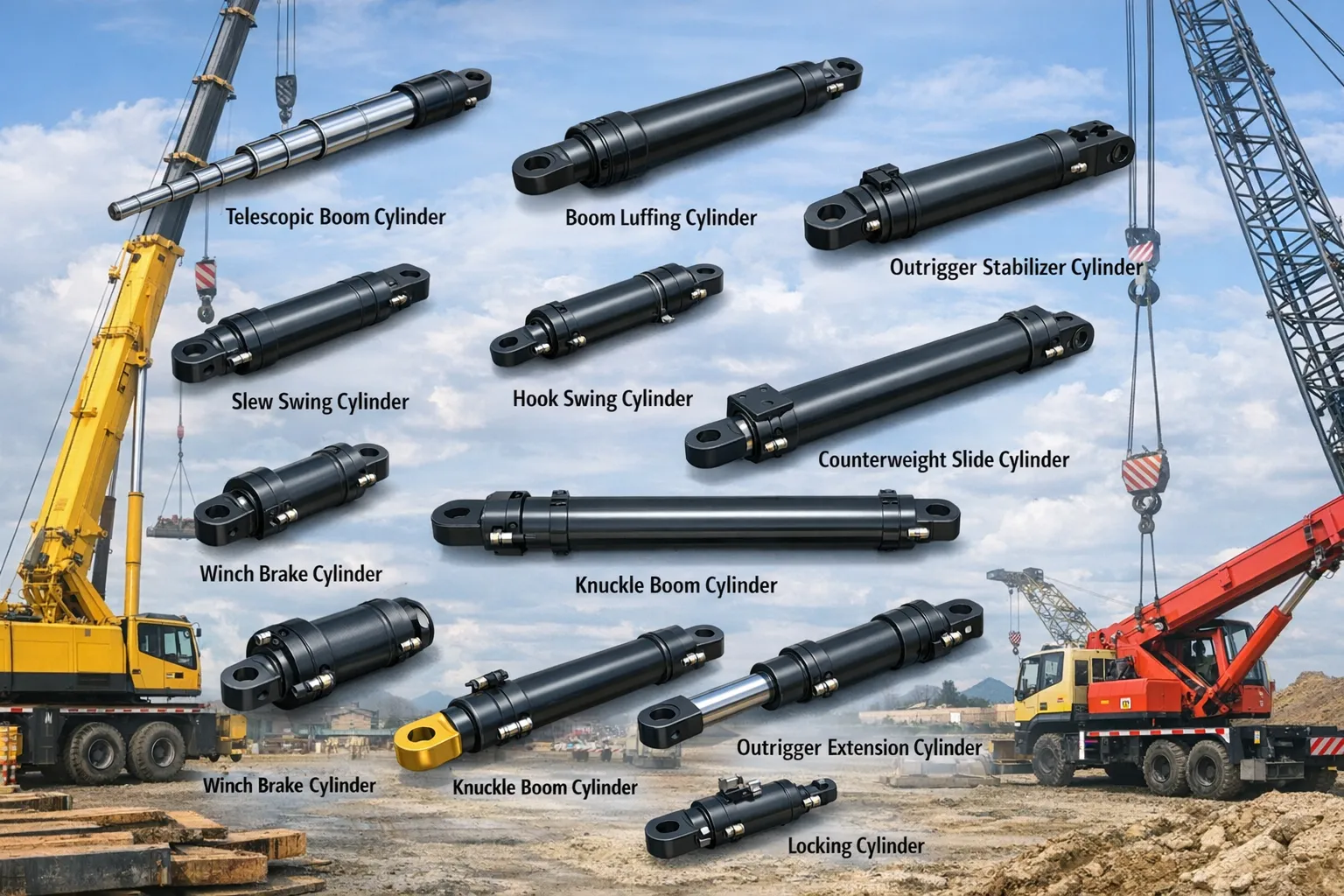
Direct Drop-In Replacement for Global Machinery Brands
Procuring reliable replacement hydraulic cylinder components through original equipment channels often involves unacceptable lead times and exorbitant markups. For construction fleets across Asia, equipment availability is directly tied to profitability. We maintain an extensive engineering database containing exact dimensional measurements, retracted pin-to-pin lengths, stroke distances, and fluid port thread sizes for the world’s most common heavy machinery platforms.
Our custom-engineered units serve as perfect drop-in replacements for stabilization systems on prominent brands including Liebherr, Tadano, Kato, XCMG, Sany, Zoomlion, Demag, and Grove. By selecting our meticulously machined products, your service team can execute a swift installation process without resorting to dangerous chassis modifications or welding.
Disclaimer: The mention of the original equipment manufacturer brand names above is strictly intended to assist mechanics and procurement officers in identifying dimensional compatibility and to facilitate accurate replacement selection. We operate as an independent fluid power manufacturer and do not claim any trademark affiliation with, or endorsement by, these specific equipment brands.
Five Core Technological Advantages of Our Design
The distinction between a standard linear actuator and a professional-grade load-bearing component lies entirely in the metallurgical choices and the precision of the internal fluid dynamics. Our engineering team has optimized our hydraulic rams to overcome specific, severe operational failures documented in the field.
1. Solid Forged Trunnion Mounts to Eliminate Ear Wear
The trunnion mounting point endures intense lateral shear forces and micro-vibrations during active lifting operations. Standard cylinders utilizing simple welded ear plates are highly susceptible to fatigue cracking in the heat-affected zone, leading to rapid pin hole distortion and trunnion wear. We utilize single-piece forged steel trunnions. The forging process perfectly aligns the internal grain structure of the metal with the direction of the load, creating an incredibly dense mounting point that prevents catastrophic shear failures.
2. Premium 42CrMo Alloy Steel Construction
While conventional cylinders frequently employ basic 45# carbon steel to reduce manufacturing costs, our main load-bearing components are machined from high-yield 42CrMo alloy steel. This specific chromium-molybdenum alloy is quenched and tempered to provide vastly superior tensile strength and impact toughness. When a massive crane swings a heavy load, it generates significant lateral bending moments on the extended outrigger rods; the 42CrMo material absorbs these off-center loads without suffering permanent deflection or rod buckling.
3. Ultra-Low Friction Multi-Lip Sealing Technology
Internal drifting under load is a critical safety violation. To ensure absolute positional holding, we integrate an advanced sealing matrix utilizing premium Polyurethane and PTFE composite elements. This engineered configuration guarantees zero internal fluid bypass across the piston while maintaining an ultra-low friction coefficient. This dramatically reduces heat generation during rapid deployment and eliminates the dangerous “stick-slip” juddering effect, allowing operators to execute smooth, millimeter-precise chassis leveling.
4. Deep-Penetration Robotic Welded Structure
The structural integrity of the base caps and ports dictates the cylinder’s ability to handle sudden kinetic shock loads. We employ automated, multi-pass submerged arc welding techniques executed under strict atmospheric controls. This robotic consistency ensures incredibly deep, void-free weld penetration. Subsequent thermal stress-relief treatments remove localized brittleness, granting the pressure vessel extreme resilience against heavy dynamic impacts.
5. Advanced Micro-Cracked Hard Chrome Plating
Infrastructure projects expose heavy machinery to corrosive coastal salt spray, acidic mud, and highly abrasive concrete dust. Our piston rods undergo a rigorous electrochemical hard chrome plating process, achieving a dense protective layer between 30 to 50 microns thick with a surface hardness exceeding HV850. This impenetrable barrier shrugs off environmental corrosion and abrasive rock scoring, ensuring the rod surface remains pristine and does not shred the external wiper seals over years of continuous use.
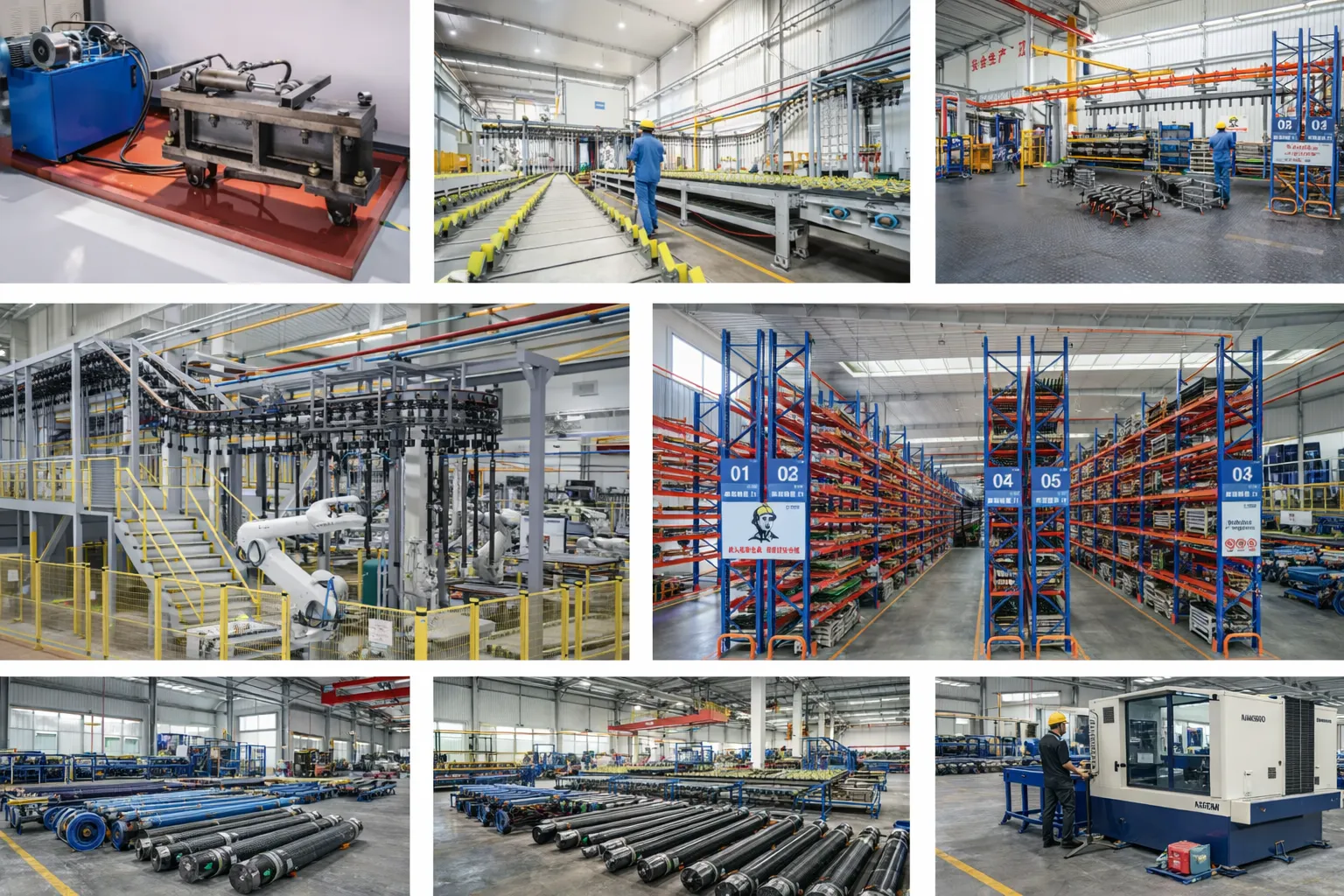
Rigorous Manufacturing Craftsmanship and Quality Control
Absolute trust in a heavy machinery component is established through a completely transparent and rigorously controlled manufacturing environment. We control the entire lifecycle of the product within our own facility, adhering strictly to ISO 9001 quality management standards to ensure every batch meets the highest industrial benchmarks.
The production journey begins with strict ultrasonic metallurgical verification of the incoming steel billets to detect internal voids. During machining, our heavy-duty CNC lathes maintain geometric tolerances within microscopic margins. The internal surface of the heavy-wall barrel undergoes an advanced skiving and roller-burnishing process, achieving a mirror-like Ra 0.2 finish that drastically reduces dynamic seal friction, ensuring optimal volumetric efficiency and long seal life.
Our unyielding commitment to field safety mandates that 100% of our produced units undergo mandatory factory testing before dispatch. We never rely on random batch sampling. Every unit is securely mounted on a specialized hydrostatic test bench and subjected to fluid pressures 1.5 times their maximum rated working capacity. Our technicians meticulously monitor the system for microscopic pressure drops, stroke smoothness, and load holding capability. Finally, every verified cylinder is permanently laser-etched with a unique serial number, providing absolute traceability of the steel batch, the specific welding operator, and the final test results. This greatly assists maintenance teams when scheduling future hydraulic cylinder repair tasks.
Typical Industry Applications
While specifically optimized for the extreme demands of telescopic boom equipment, the inherent structural strength, impact resistance, and load-holding capabilities of our fluid power solutions make them highly adaptable across a broad spectrum of heavy-duty industrial applications. Explore more about our tailored solutions in our guide to construction machinery industry applications.
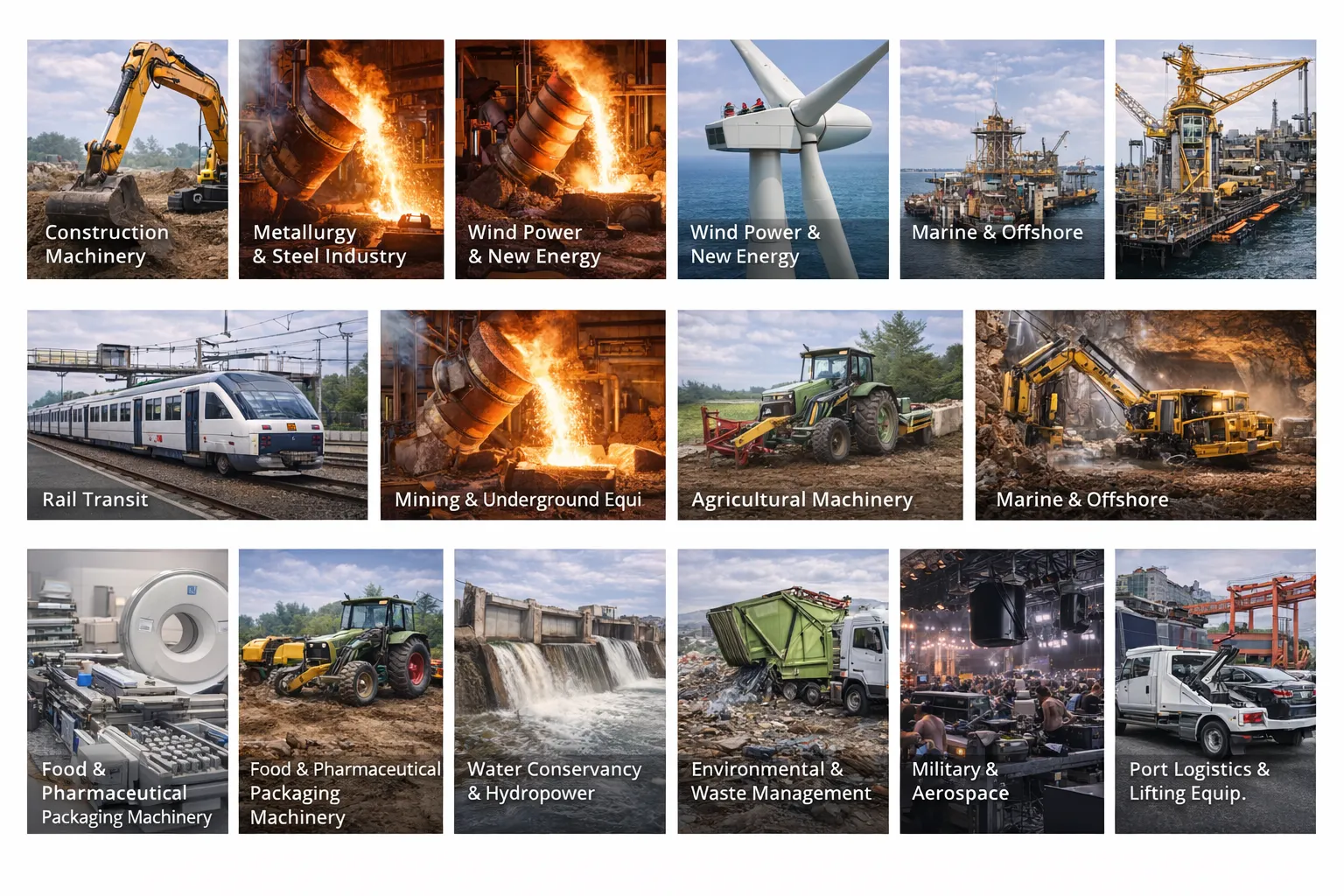
- Engineering & Construction Machinery: Beyond standard lifting operations, our stabilization systems are critical for massive concrete pump trucks, rough-terrain rotary foundation drilling rigs, and heavy mobile crushing plants operating on uneven, rocky topography.
- Metallurgy & Heavy Manufacturing: In steel mills and high-temperature foundries, custom heat-resistant cylinder designs are utilized in ladle tilting mechanisms and forging presses where continuous radiant heat and extreme mechanical forces destroy standard components.
- Plastics & Rubber Machinery: The structural rigidity of our heavy-wall welded designs translates perfectly into large-scale injection molding machines, where immense, sustained clamping forces must be held without a millimeter of deflection during the injection phase.
- Material Handling & Logistics Automation: Our highly robust actuator designs provide the massive vertical lifting force required for port reach stackers and heavy straddle carriers lifting 40-ton shipping containers continuously in highly corrosive coastal environments.
- New Energy & Environmental Equipment: The physical installation of onshore wind turbines requires specialized crawler equipment with massive structural footprints. Our custom outriggers ensure perfect leveling on remote, rugged topographies before the delicate blade lifting process begins.
- Specialized Custom Scenarios: Self-leveling suspension systems for multi-axle modular heavy haulage trailers moving industrial transformers, and marine-grade protective coatings for offshore drilling platform stabilization.
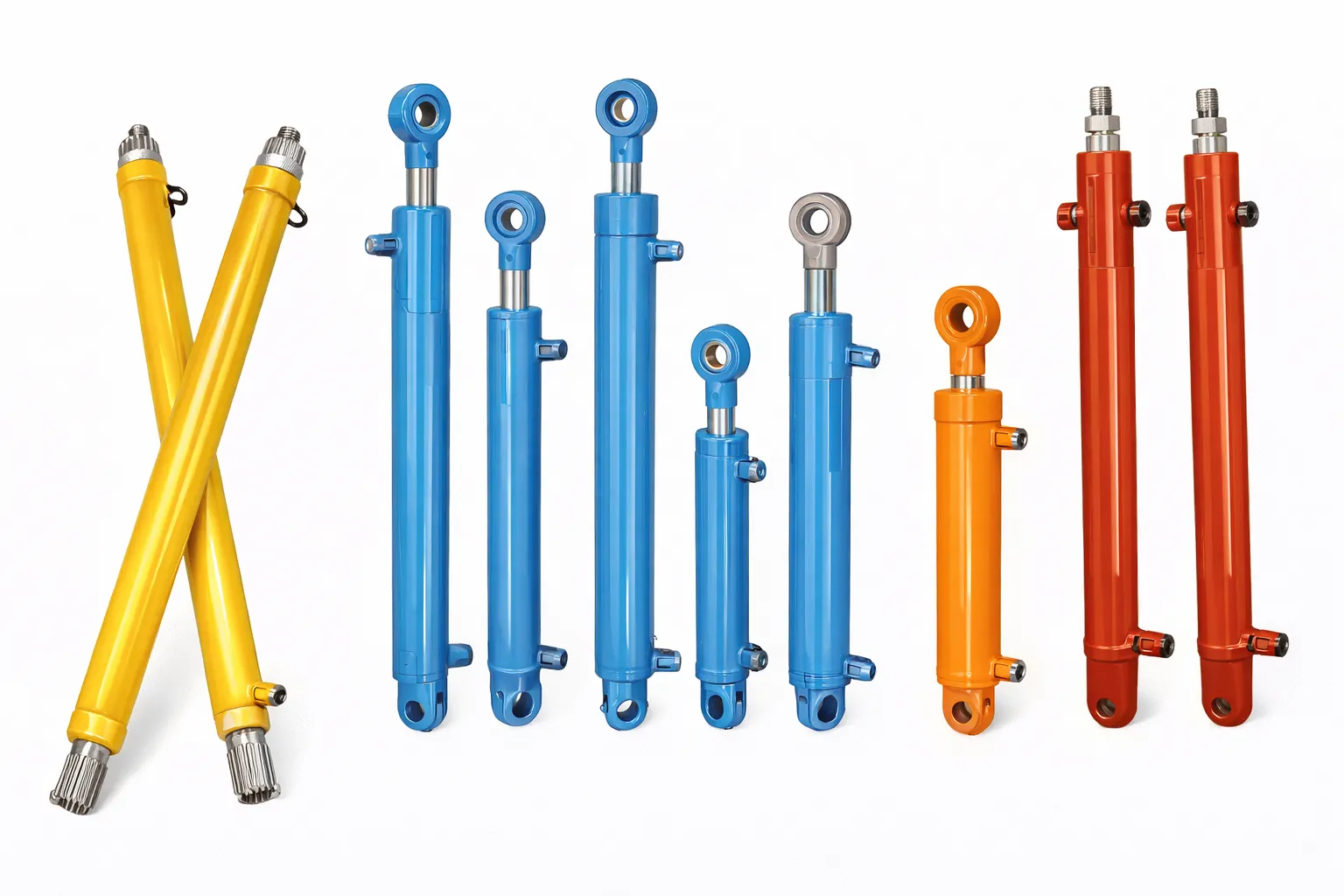
Comparative Analysis: Standard Market Cylinders vs. Our High-Performance Solutions
Making an informed B2B procurement decision requires a deep understanding of the long-term total cost of ownership. The initial purchase price is merely a fraction of the operational equation. The technical table below outlines the distinct engineering differences between standard commercial aftermarket cylinders and our meticulously engineered heavy-duty stabilization solutions.
| Feature Area | Ordinary Market Cylinders | Our Engineered High-Performance Cylinders |
|---|---|---|
| Rod & Barrel Metallurgy | Standard 45# carbon steel (Lower yield point, prone to flexing) | High-yield 42CrMo alloy steel (Exceptional buckling resistance) |
| Trunnion Mounting Structure | Welded ear plates (Highly susceptible to shear and fatigue cracking) | Solid forged trunnion blocks (Unyielding structural grain flow) |
| Internal Sealing Technology | Basic NBR O-rings (High sliding friction, faster thermal degradation) | Advanced PTFE/Polyurethane composite matrix (Zero drift, low friction) |
| Rod Surface Protection | Thin 15-micron chrome (Vulnerable to rock scoring and fast rusting) | 30-50 micron hard chrome plating (HV850+, salt-spray validated) |
| Quality Control Testing | Random batch sampling (Inconsistent reliability) | 100% individual hydrostatic pressure & dynamic stroke testing |
Real-World Engineering Case Studies in the Asian Market
Theoretical engineering is meaningless without real-world, field-tested validation. Below are five detailed instances where our specialized fluid power components directly resolved critical operational bottlenecks for our clients operating in demanding environments across East Asia.
Case Study 1: Resolving Rod Buckling on Rocky Terrain in South Korea
Location: Seoul, South Korea
Client Profile: A major high-rise construction and equipment leasing firm.
Application: Retrofitting the stabilization systems on a fleet of 50-ton telescopic boom cranes.
The Engineering Challenge: Operating frequently on rocky, uneven ground caused severe lateral shear stress during high-radius lifts, leading to rapid deformation of the standard carbon steel rods and cracking of their original welded trunnion ears. The client was constantly fixing hydraulic cylinders.
The Solution and Result: We supplied a complete fleet retrofit utilizing our forged trunnion mount units constructed from high-yield 42CrMo steel. Tracked over a rigorous 18-month operational period, trunnion failure and rod buckling were completely eliminated, drastically improving worksite safety and machine availability.
“The structural integrity of the forged mounts and the alloy rods is incredible. Since installing these replacement cylinders in May 2024, our equipment plants solidly on the ground every time without any structural flexing. Excellent return on investment.” — Mr. Park Ji-Hoon, Fleet Manager.
Case Study 2: Conquering Coastal Saltwater Corrosion in Japan
Location: Port of Yokohama, Japan
Client Profile: Heavy logistics and stevedoring contractor managing port infrastructure.
Application: Stabilization outriggers for mobile harbor cranes and container reach stackers.
The Engineering Challenge: Highly saline ocean air was causing rapid pitting and rusting on the standard 15-micron chrome plating of their existing cylinders. This rusted surface acted like sandpaper, subsequently shredding the external wiper seals and causing massive, environmentally hazardous fluid leaks on the docks.
The Solution and Result: We engineered custom cylinders featuring specialized 50-micron thick hard chrome plating and integrated marine-grade double-lip polyurethane wiper seals. After two years of continuous coastal operation, the rods remain mirror-smooth with zero fluid leakage.
“The anti-corrosion treatment on these hydraulic rams is exceptional. They have survived typhoons and daily salt spray since early 2024. Our maintenance downtime has been cut in half.” — Kenji Sato, Lead Maintenance Engineer.
Case Study 3: High-Frequency Cycle Endurance in Vietnam
Location: Ho Chi Minh City, Vietnam
Client Profile: National civil engineering and concrete infrastructure developer.
Application: Leveling outriggers on heavy, long-reach concrete boom pump trucks.
The Engineering Challenge: Rapid urban construction required the pump trucks to deploy and retract their outriggers up to 20 times a day. The extreme sliding friction generated severe internal heat, causing standard NBR seals to melt and blow out prematurely mid-pour.
The Solution and Result: We integrated ultra-low friction PTFE composite step-seals and high-temperature resistant guide bands into the piston assembly. Internal thermal accumulation was reduced by over 30%, completely resolving the mid-job seal blowouts and ensuring continuous pumping operations.
“Downtime is a killer in continuous concrete pouring. Since switching to these upgraded double acting hydraulic cylinder units in October 2024, our pump trucks haven’t missed a single pour. The smooth, cool operation is very noticeable.” — Tran Van Minh, Operations Director.
Case Study 4: Custom Engineering for Specialized Transport in Thailand
Location: Bangkok, Thailand
Client Profile: Custom heavy-haulage and modular trailer manufacturer.
Application: Hydraulic suspension and leveling outriggers for multi-axle modular trailers moving massive industrial generators.
The Engineering Challenge: The client needed a highly compact cylinder that could still deliver immense lifting force and survive the constant vibration of long-distance heavy transport over poor, unpaved roads without cracking the port welds.
The Solution and Result: Our engineering team collaborated closely on a bespoke design, utilizing a thicker-walled 42CrMo barrel to safely handle much higher operating pressures in a smaller physical footprint. We utilized robotic submerged arc welding to ensure the ports would never fracture under road vibration.
“Finding a manufacturer capable of true custom engineering is rare. They helped us optimize our entire stabilization circuit. The build quality of these compact units, installed in January 2026, is massive.” — Supachai K., Procurement Lead.
Case Study 5: Precision Load Holding in Singapore
Location: Singapore
Client Profile: Specialized urban heavy lift and infrastructure contractor.
Application: Mobile gantry cranes and specialized bridge girder placement machines.
The Engineering Challenge: Lifting prefabricated concrete bridge sections in dense urban environments requires absolute stillness. Their previous cylinders exhibited microscopic internal drifting, causing the machine to tilt imperceptibly over a 12-hour holding shift, triggering safety alarms.
The Solution and Result: We supplied heavy-bore cylinders with flawlessly honed barrels (Ra 0.2 finish) and precisely matched pilot-operated check valves, guaranteeing absolute zero fluid bypass. The machines now hold maximum payload for 24 hours without a millimeter of measured drop.
“When placing bridge girders, safety is absolute. The holding valves on these cylinders perform exactly as promised. Total rigidity. We commissioned these in late 2025 and they are structurally flawless.” — David L., Chief Engineer.
Frequently Asked Questions
We understand that sourcing critical heavy machinery components requires thorough technical vetting. Below are answers to the most common questions we receive from procurement managers and fleet engineers regarding our outrigger fluid power solutions.
What is the typical manufacturing lead time for bulk orders to South Korea and surrounding regions?
Thanks to our highly optimized production lines and proximity to major shipping routes, our standard manufacturing lead time for a batch of custom heavy-duty cylinders is generally 20 to 30 days. Shipping to major ports in South Korea (like Busan) and Japan typically adds an additional 5 to 10 transit days via sea freight. We will provide an exact, guaranteed timeline during the quotation phase to perfectly align with your project schedules.
Why is a double acting cylinder preferred over single acting for heavy outriggers?
While a single acting hydraulic cylinder uses fluid pressure to extend the leg and relies entirely on gravity or internal mechanical springs to retract, heavy equipment outrigger systems require massive, controlled force in both directions. The double acting design uses high-pressure fluid to powerfully extend the leg and lift the crane, and also uses directed hydraulic pressure to quickly and reliably pull the heavy steel leg assembly back into the chassis against friction and job-site mud accumulation.
What specific dimensional information is needed to order a custom replacement cylinder?
To ensure an exact, hassle-free drop-in fit, we require the retracted pin-to-pin center length, the maximum required stroke length, the bore (inner barrel) diameter, the rod diameter, and the specific mounting pin dimensions. If you have the original machinery model number or OEM part number, our engineering team can often cross-reference it within our extensive proprietary dimensional database.
Can you supply replacement seal kits for fixing hydraulic cylinders on site?
Yes. We believe in providing total lifecycle support for our products. Alongside complete new actuator units, we supply perfectly matched OEM-grade seal kits, replacement 42CrMo rods, and detailed technical documentation to assist your internal maintenance crews with on-site servicing and equipment repairs to minimize expensive operational downtime.
Do you offer custom designs for obsolete or discontinued equipment models?
Absolutely. Because we possess full in-house engineering and CNC manufacturing capabilities, we can accurately reverse-engineer existing parts from worn physical samples or design completely new configurations based on your specific stroke length, operating pressure, and trunnion mounting requirements, thereby extending the operational life of your legacy fleet.
How does your hydraulic cylinder price compare to purchasing direct from the OEM dealer?
By functioning as a fully integrated direct manufacturer rather than a distributor, we bypass the heavy commercial markups associated with original equipment manufacturer brands. In most cases, our engineered drop-in replacements provide a cost savings of 30% to 45% compared to OEM dealer pricing, while simultaneously offering structural upgrades like forged trunnions and 42CrMo steel that provide a vastly superior return on investment.
Upgrade Your Equipment Stability Today
Do not let structural fatigue, trunnion wear, or internal seal failure compromise the safety and efficiency of your heavy lifting operations. Partner with a reliable manufacturing expert dedicated to fluid power engineering excellence. Explore our full product range to find the exact component for your machinery.
Consult Our Engineering Experts
Editor: Cxm


























