Heavy-Duty Pinch Hydraulic Cylinder for Rolling Mill
Engineered with high-yield 27SiMn alloy steel and an advanced dust and mud scraper system to permanently eliminate abrasive rod wear and secure continuous, flawless steel plate feeding operations in extreme metallurgical environments.
Product Overview: The Mechanical Gateway of the Rolling Line
In the highly synchronized and punishing environment of continuous flat-rolled steel production, the controlled transportation and tensioning of heavy steel plates dictate the overall efficiency and yield of the entire facility. The mechanical assemblies responsible for securely grabbing, feeding, and driving these massive hot or cold steel slabs into the subsequent stands or downcoilers are the pinch roll units. To generate the immense frictional force required to propel a steel slab weighing several tons without any material slippage or centerline deviation, the upper roll must be driven downward with extreme, unwavering pressure. The specific fluid power component tasked with providing this instantaneous and massive clamping force is the pinch hydraulic cylinder. This specialized industrial actuator must respond seamlessly to automated mill signals, aggressively closing the roll gap exactly as the leading edge of the fast-moving steel plate approaches.
For mechanical maintenance engineers and facility operators, the pinch roll station is widely recognized as one of the most hostile zones in the metallurgical plant. The core engineering challenge is not simply the heavy physical tonnage, but the extreme environmental contamination. As the thick steel plate undergoes deformation and rapid cooling, it continuously sheds razor-sharp fragments of iron oxide scale. This abrasive scale mixes with high-pressure descaling water and ambient metallic dust, creating an incredibly destructive slurry that bombards the surrounding equipment. When standard commercial fluid power actuators are installed in this zone, they fail rapidly. The abrasive slurry settles on the extended chrome rod, easily bypasses standard rubber wiper seals, and gets dragged directly into the internal pressure glands. This immediately initiates severe rod wear, deep longitudinal scoring, and the catastrophic destruction of the primary pressure seals, resulting in massive fluid leaks and a complete loss of clamping pressure.
Drawing upon decades of empirical failure analysis from tier-one steel plants across South Korea, Japan, and the broader East Asian industrial sector, we have fundamentally redesigned the feeding actuator. As an elite, specialized hydraulic cylinder manufacturer, we abandoned standard carbon steels, choosing a robust welded structure utilizing 27SiMn alloy to effortlessly absorb sudden upward mechanical shocks without structural yielding. Most importantly, we completely re-engineered the rod gland architecture to incorporate an aggressive, multi-stage dust and mud scraper system. This mechanism physically shears the abrasive scale off the rod before it can enter the fluid chamber. By stabilizing the clamping process and drastically extending the operational lifecycle of the equipment, our custom solutions transform the initial hydraulic cylinder price from a recurring maintenance penalty into a highly profitable investment in plant uptime.

Customizable Technical Parameters and Material Architecture
Because continuous rolling operations process a vast spectrum of materials—ranging from ultra-thin non-ferrous foils to massive, thick structural plates for shipbuilding—we provide a highly adaptable engineering platform. Our technical department customizes the dimensional footprint, bore size, required stroke, and fluid logic to align perfectly with your specific mill frame and production tonnage requirements. The comprehensive table below details the foundational technical specifications that define our high-impact feeding actuators.
| System Attribute | Parameter Specification | Engineering Significance |
|---|---|---|
| Target Industry Segment | Metallurgy | Explicitly formulated to survive continuous, heavy-duty primary metal forming operations. |
| Equipment Category | Rolling Mill | Integrates flawlessly into hot strip, cold reduction, and heavy structural plate processing lines. |
| Subsystem / Action | Pinch Roll System | The central mechanical junction responsible for gripping, feeding, and guiding the hot metal strip. |
| Component Designation | Pinch Cylinder | Provides the necessary vertical hydraulic tonnage to establish secure, non-slip material tension. |
| Action Method | Double Acting | Functions as a high-speed double acting hydraulic cylinder for powered clamping and rapid retraction. |
| Structure Type | Piston Cylinder | A robust hydraulic cylinder piston geometry generates immense, laterally stable downward holding force. |
| Manufacturing Structure | Welded Assembly | Deep-penetration SAW welding ensures the flanges and body will not fracture under severe mechanical vibration. |
| Material System | 27SiMn Alloy Steel | Offers vastly superior impact toughness and operational fatigue life compared to standard low-carbon steels. |
| Surface Treatment | Deep Chrome Plating | Provides an ultra-hard, low-friction exterior shield against abrasive scoring and acidic fluid corrosion. |
| Environment Grade | Abrasive Impact Zone | Constructed to survive continuous, heavy bombardment by flying iron oxide scale and metallic grit. |
| Working Condition Feature | Pinching Steel Plate | Absorbs violent kinetic jolts when thick, uneven steel slabs suddenly enter the physical roll gap. |
| Typical Failure Mode | Rod Wear (Abrasive Scoring) | Standard wiper seals fail rapidly here; our custom design permanently mitigates this exact structural vulnerability. |
| Recommended Configuration | Dust and Mud Scraper | A robust, multi-lip metallic or composite scraper matrix that physically fractures and rejects bonded iron scale. |
Operational Physics: Mastering Fluid Mechanics in the Feed Zone
To fully comprehend why standard, off-the-shelf industrial actuators fail spectacularly in this application, one must rigorously examine the specific fluid mechanics and physical violence inherent in a metallurgical feeding station. A pinch roll unit typically features a massive, stationary motor-driven lower roll and a vertically adjustable upper roll. The pinch hydraulic cylinder is usually mounted in a vertical orientation directly above the upper roll’s bearing chocks. As the automated mill optical sensors detect the leading edge of a glowing hot steel slab accelerating down the run-out table, highly pressurized hydraulic fluid instantly floods the cap end of the cylinder barrel. This forcefully extends the heavy chrome piston rod downward, driving the upper roll into aggressive, physical contact with the moving steel plate, effectively squeezing it against the driven lower roll to generate immense friction.
The exact fraction of a second the heavy upper roll impacts the fast-moving plate, a colossal mechanical shockwave is generated. This upward kinetic energy travels directly through the extended rod and into the enclosed hydraulic fluid chamber. Our 27SiMn welded body is specifically engineered with an optimized elastic modulus to act as a resilient structural shock absorber. It utilizes carefully calibrated internal fluid compliance to cushion the impact, preventing the massive shock from fracturing the machine’s steel mounting brackets. Once the plate is clamped, the hydraulic cylinder must maintain precise, absolutely unfluctuating holding pressure. If the clamping force stutters or drops due to internal seal friction (known as stick-slip), the heavy drive motors will spin the rolls against the stalled plate, causing severe surface galling and immediately ruining the prime steel product.
The most severe engineering hurdle, however, occurs during the continuous clamping phase. The hot steel rapidly sheds vast quantities of sharp, glass-like iron scale directly onto the extended chrome rod. When the trailing edge of the heavy plate clears the rolls, the fluid logic reverses, and the cylinder rapidly retracts to open the gap. Without our specialized defense mechanisms, this rapidly retracting rod would drag the abrasive grit straight into the primary pressure seals, shredding them instantly. By integrating a heavily reinforced dust and mud scraper directly into the front gland, our design physically chisels and shaves the baked-on scale off the rod during every single upward stroke. This guarantees that the internal hydraulic components remain perfectly isolated from the harsh environment, maintaining system integrity for years.

Flawless Brand Interchangeability & Rapid Plant Upgrades
When the original feeding actuators supplied by massive global mill builders begin to succumb to abrasive rod scoring and inevitably leak hydraulic oil onto the hot steel, maintenance directors face a severe operational crisis. Sourcing exact OEM replacements from overseas typically involves astronomical capital costs and debilitating lead times spanning many months, severely jeopardizing plant production targets. As an agile, highly advanced engineering firm, we provide a vastly superior logistical and technical solution by delivering dimensionally identical, heavily fortified structural upgrades.
We routinely reverse-engineer and manufacture flawless drop-in replacements for pinch roll stations originally designed by prominent plant engineering conglomerates such as SMS Group, Danieli, Primetals Technologies, Mitsubishi-Hitachi Metals Machinery, Bosch Rexroth, and Parker Hannifin.
(Disclaimer Note: The explicit mention of these corporate brand names is strictly for the technical purpose of communicating dimensional sizing, mounting compatibility, and application context to industrial engineers. We operate as an entirely independent hydraulic cylinder manufacturer and assert no affiliation, endorsement, or trademark rights associated with these respective companies.)
Our core mission during any scheduled annual outage or critical emergency breakdown requiring rapidly fixing hydraulic cylinders is to provide you with a vastly upgraded 27SiMn actuator equipped with our advanced dust scraper technology. This custom unit will bolt flawlessly onto your existing trunnion brackets, clevis pins, and high-pressure fluid manifolds, requiring absolutely zero structural modifications, cutting, or welding to your expensive machine frame.
Five Definitive Core Technical Advantages
Surviving the brutal combination of abrasive scale impact, extreme ambient heat, and severe mechanical shock requires an uncompromising dedication to metallurgical integrity and advanced fluid sealing science. Standard light-industrial designs will literally be destroyed within days. Here are five definitive engineering reasons why leading continuous rolling facilities systematically upgrade to our technology:
1. Extreme-Duty Dust and Mud Scraper Defense
The absolute primary failure mode in this zone is abrasive rod wear. We completely resolve this vulnerability by housing a heavily reinforced, dual-action scraper within the front gland. The outer metallic or high-durometer composite scraper aggressively chisels and shears away baked-on iron scale, hot slag, and dried cooling mud. The inner secondary elastomeric lip squeegees away any remaining microscopic dust, guaranteeing that the main high-pressure seals only ever interact with a perfectly clean, polished chrome rod, vastly extending the unit’s lifecycle.
2. 27SiMn High-Strength Welded Architecture
Pinch rolls endure constant, high-frequency shock loading as thick, uneven steel plates aggressively enter the bite. Standard Q235 mild steel cylinders frequently suffer from weld fatigue or barrel breathing under these compressive spikes. We construct the main barrel, thick end caps, and heavy mounting flanges entirely from 27SiMn high-strength alloy steel. Utilizing automated submerged arc welding, this creates a deeply unified structure that provides exceptional yield strength and impact toughness, ensuring the body never yields or cracks under severe vibration.
3. Deep-Layer Precision Hard Chrome Plating
To physically defend against the continuous abrasive bombardment of flying oxide scale, the extending piston rod surface must be incredibly resilient. We apply a specialized, multi-pass hard chrome electroplating process, achieving plating thicknesses significantly higher than standard commercial metrics. This provides an ultra-hard, highly lubricious surface that aggressively resists scratching and pitting, heavily protecting the structural integrity of the base steel rod beneath the plating.
4. Ultra-Low Friction Dynamic Sealing
The cylinder must respond instantly to rapid proportional valve signals to grip the fast-moving steel plate correctly. High internal seal friction causes a slight delay (stiction), leading to roll slippage and ruined product. We utilize custom-engineered PTFE (Polytetrafluoroethylene) composite step seals paired with exceptionally wide bronze guide bands. This architecture drastically reduces static breakaway friction, allowing the actuator to execute smooth, instantaneous micro-adjustments in clamping pressure without any mechanical jerking.
5. Post-Weld Thermal Stress Relief Optimization
Heavy, deep-penetration welding naturally creates severe residual internal thermal stresses within the steel matrix, which serve as the exact starting points for fatigue cracks under heavy operational vibration. After the critical mounting flanges are heavily welded to the 27SiMn barrel, the entire assembly undergoes strictly controlled thermal stress-relief annealing in our massive factory furnaces. This critically resets the molecular structure of the steel, guaranteeing maximum fatigue life against continuous mill pounding.
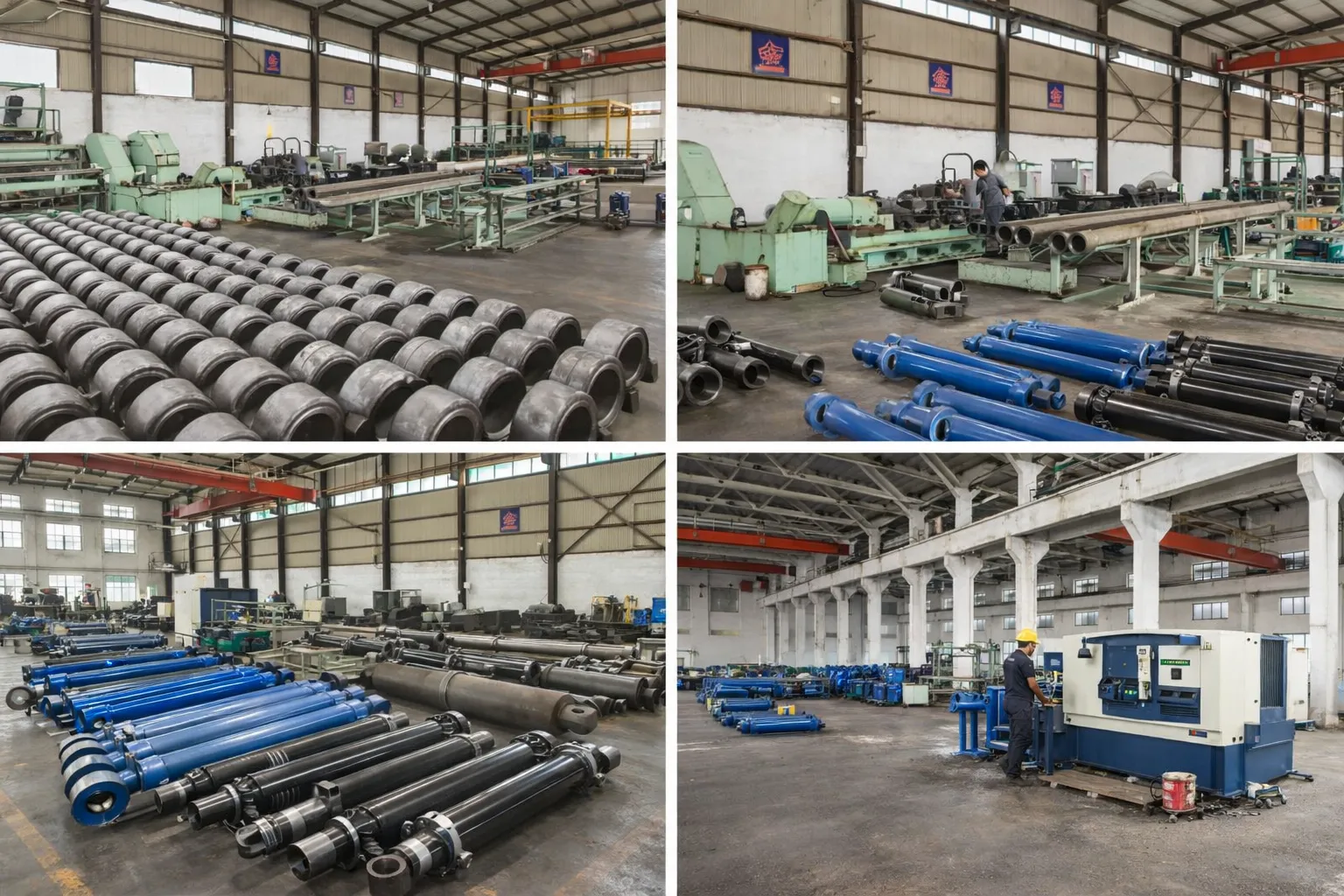
Manufacturing Craftsmanship and Absolute Quality Control
A brilliant engineering design on a CAD screen requires flawless physical execution on the factory floor to actually survive the realities of a rolling mill. We maintain absolute, unyielding control over the entire manufacturing lifecycle of our heavy hydraulic parts. Upon arrival, raw 27SiMn steel tubes undergo strict metallurgical spectrographic analysis to firmly confirm their chemical composition and impact toughness ratings. The heavy-walled tubes are then subjected to deep-hole boring, followed by high-speed skiving and roller burnishing. This highly advanced machining process compresses the internal metal grain, creating a flawless, mirror-like internal bore finish (Ra 0.2µm), which is absolutely essential for maximizing the operational life of the internal PTFE seals under continuous, high-velocity movement.
Because the structural integrity of these high-tonnage units is paramount, our welding protocols are intensely monitored. We utilize advanced automated submerged arc welding (SAW) robotics to create massive, deep-penetrating joints on all end caps and trunnions. Every critical structural weld is then subjected to Ultrasonic Testing (UT) to verify there are absolutely no internal voids, micro-cracks, or slag inclusions. Final assembly is conducted strictly in climate-controlled, positive-pressure clean rooms to prevent airborne dust from contaminating the highly sensitive internal valves and low-friction seals before the unit is sealed.
Quality assurance culminates in our rigorous, unyielding factory testing protocols. Before any actuator is authorized for global shipping, it is mounted securely on our computerized test rigs. We conduct 100% full-stroke operational testing to dynamically plot friction curves, strictly verifying the heavy scraper does not induce excessive mechanical drag. This is followed by intense static pressure holding tests at 150% of the maximum rated working pressure, certifying absolute zero internal fluid bypass or external leakage. Every cylinder receives a unique, laser-engraved serial number, granting plant engineers permanent access to exact dimensional drawings and highly simplifying any future hydraulic cylinder repair operations.
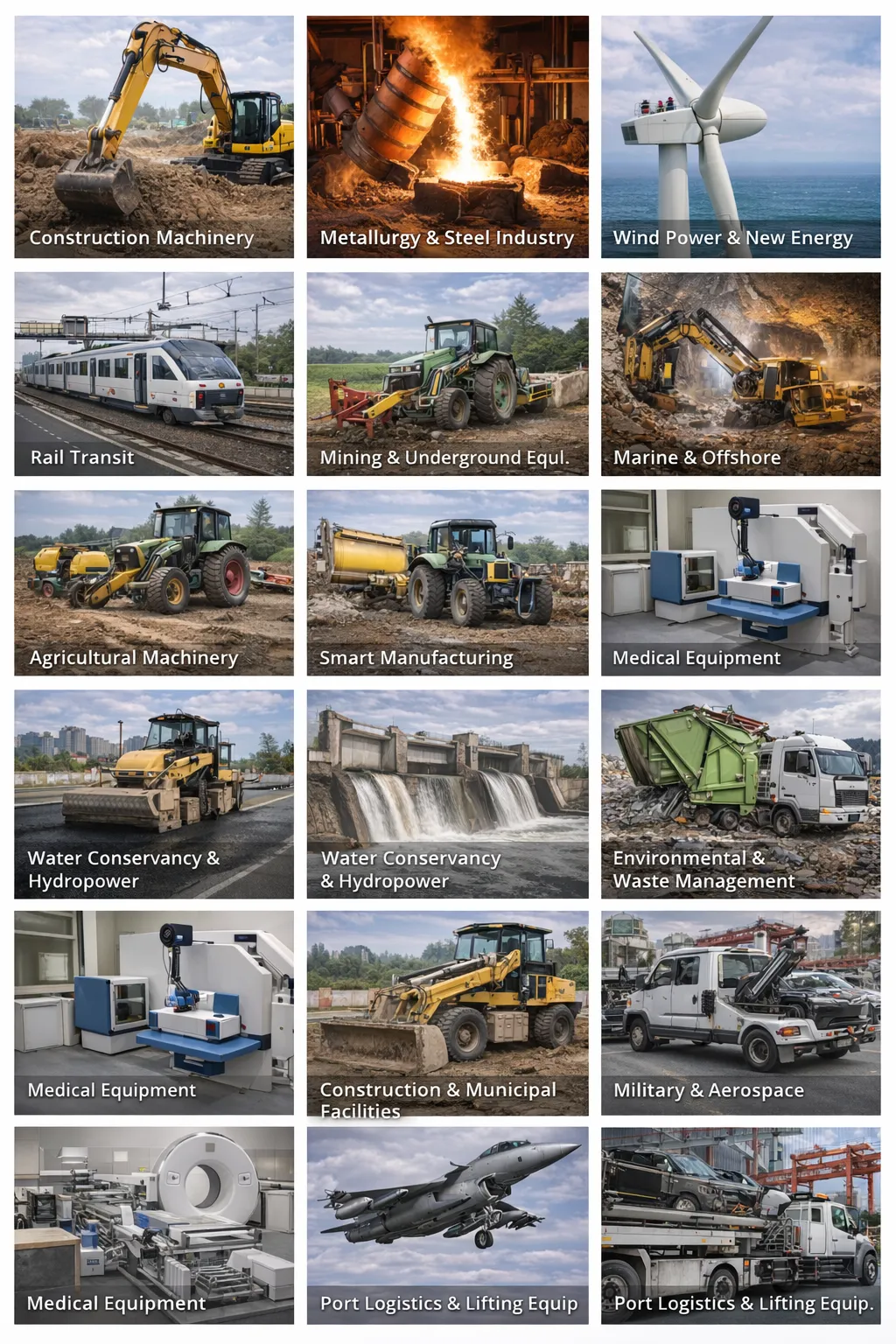
Expansive Heavy Industry Applications
The heavily engineered capability to grip, feed, and hold massive materials in highly abrasive, high-vibration environments makes our heavily sealed, welded architecture extremely valuable across multiple heavy-duty industrial sectors globally.
- Metallurgical and Iron Industry: Hot strip mill runout tables, cold mill entry tensioners, continuous casting withdrawal straightening units, and heavy plate shearing feed stations. Review our advanced heavy-duty solutions specifically tailored for the Metallurgical and Iron Industry.
- Mining & Mineral Processing: Massive apron feeders, heavy-duty conveyor belt tensioning systems, and robust clamping mechanisms on gyratory rock crushers operating in environments heavily saturated with highly abrasive rock dust. Discover our highly ruggedized actuators for the Mining Industry.
- Construction Machinery Industry: Heavy piling rig clamps, massive tunnel boring machine (TBM) material feed lines, and concrete pump valves requiring a highly resilient lift cylinder that is completely immune to abrasive cement dust ingress. Explore our equipment for the Construction Machinery Industry.
- Plastics & Rubber Processing: Large-scale industrial calendering machines requiring extremely precise gap control and immensely heavy pulling forces to maintain continuous material tension without surface marring.
- Material Handling & Recycling: Heavy scrap metal shredder feed rollers, giant auto balers, and massive stationary guillotine shears that encounter completely unpredictable, jagged material impacts utilizing robust single acting hydraulic cylinder and double acting combinations.
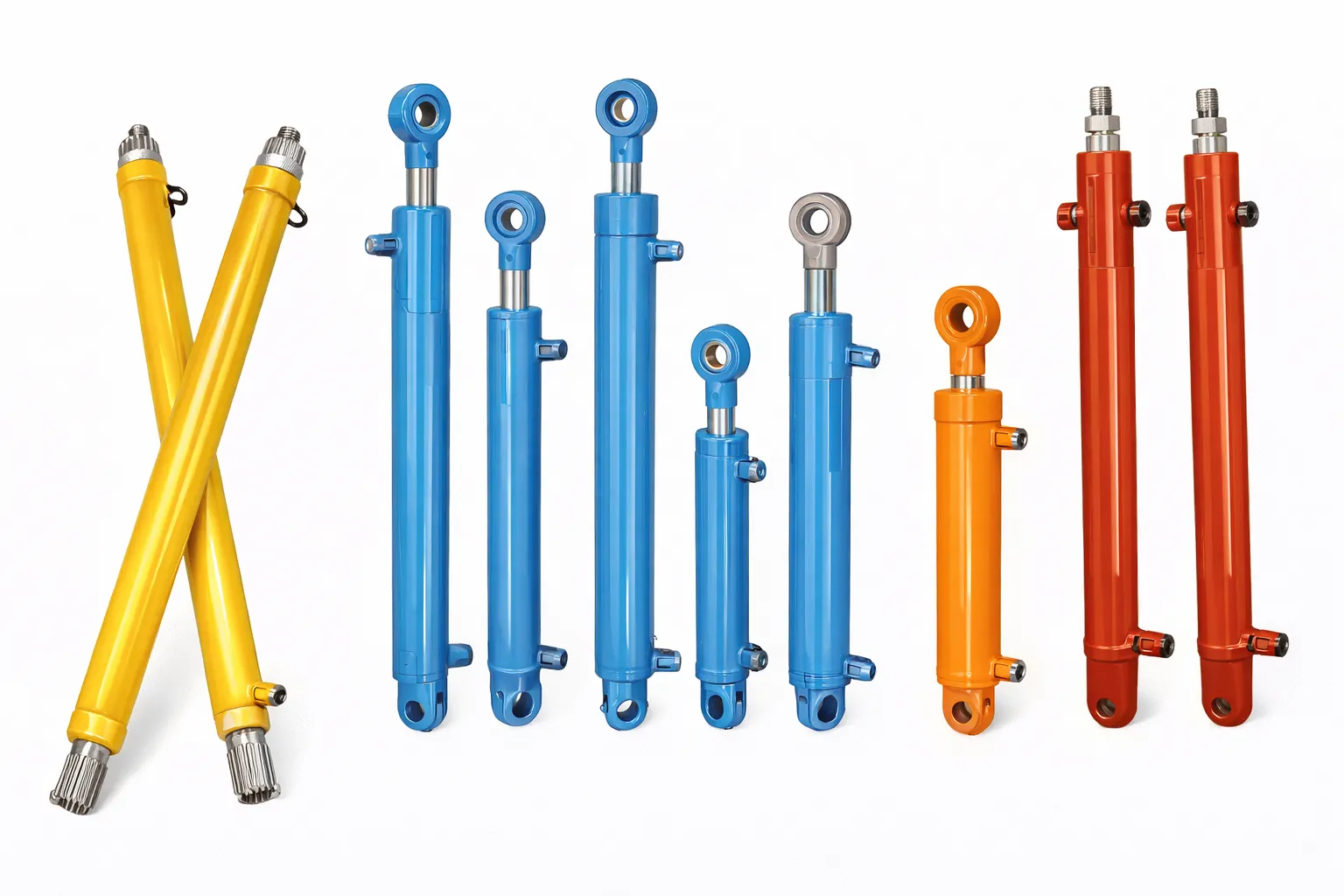
Comparative Analysis: Standard Commercial Models vs. Specialized Pinch Actuators
Installing a generic, off-the-shelf hydraulic actuator in a continuous feeding zone is a severe engineering miscalculation that guarantees rapid equipment failure and significant financial bleed. The critical differences between a standard unit and our purpose-built models firmly dictate the total uptime of your entire facility.
| Feature Assessment | Standard Heavy-Duty Cylinder | Our Specialized Pinch Cylinder |
|---|---|---|
| Contamination Defense | Basic polyurethane wiper seal; easily torn by hot, sharp iron scale, allowing massive grit ingress. | Multi-stage metallic/elastomeric Dust Scraper; physically and aggressively shears away all abrasive intrusion. |
| Structural Material | Constructed from standard Q235 steel; highly prone to weld cracking under blunt mechanical shock. | 27SiMn high-strength alloy; provides immense impact toughness and prevents structural fatigue. |
| Rod Surface Hardness | Thin commercial chrome plating; scores rapidly when subjected to flying abrasive grit and scale. | Ultra-thick, multi-pass hard chrome; acts as an impenetrable shield against severe pitting and galling. |
| Dynamic Friction Response | High breakaway friction; causes stick-slip behavior, leading to uneven clamping pressure and strip marking. | Low-friction PTFE step seals; guarantees absolutely flawless, smooth, and instant micro-adjustments. |
| Maintenance Frequency | Requires frequent mid-campaign replacements due to leaking seals and catastrophic pressure loss. | Delivers highly extended, multi-year maintenance cycles, drastically reducing overall facility downtime. |
Global Success: 5 Real-World Case Studies in East Asia
Our deep dedication to resolving complex mechanical failures has made us a preferred engineering partner for major metallurgical plants. Here are five specifically documented cases where our specialized technology definitively resolved chronic production bottlenecks across East Asia.
1. Eradicating Rod Wear at a Major Hot Strip Mill – Pohang, South Korea
Date: August 2024
Client Profile: A top-tier, globally recognized automotive steel manufacturer operating a high-speed continuous hot strip mill.
The Challenge: The existing hydraulic actuators on the downcoiler entry pinch rolls were failing disastrously every 6 to 8 weeks. Intense radiant heat was baking oxidized iron scale onto the extending rods. Upon retraction, this hardened scale acted like a rasp file, entirely destroying the front wiper seals, heavily scoring the rod, and causing massive fluid leaks and a complete loss of pinching tension.
How They Discovered Us: The maintenance director submitted an urgent technical inquiry through our B2B website seeking specifically engineered heavy-duty dust scrapers for severe metallurgy.
The Tangible Result: We custom-engineered and delivered a 27SiMn actuator equipped heavily with our proprietary metallic and elastomeric dust scraper system. The scraper forcefully shaved the hardened scale off the rod before it entered the gland. The replacement units have now run for 22 months continuously without a single instance of rod scoring or external fluid leak.
“The scraper technology is absolutely flawless. We went from replacing cylinders every two months to completely forgetting they are even down there. An incredible reduction in our maintenance budget and fire risk.” — Mr. Lee, Head of Mill Maintenance
2. Solving Structural Fatigue in Heavy Plate Feeding – Kobe, Japan
Date: October 2024
Client Profile: A massive heavy plate mill producing extremely thick structural steel primarily for the commercial shipbuilding industry.
The Challenge: When feeding ultra-thick, cold steel slabs directly into the roughing stand, the initial bite caused massive upward kinetic shockwaves that traveled straight into the pinch roll cylinder mounts. Their standard commercial Q235 steel cylinders were rapidly developing severe fatigue cracks along the rear flange welds, creating a huge safety hazard and forcing mid-shift shutdowns.
How They Discovered Us: Introduced by a heavy machinery consultant specializing explicitly in structural upgrades and vibration mitigation for heavy industry.
The Tangible Result: We completely upgraded their entire feeding system utilizing our 27SiMn alloy steel architecture. By applying deep-penetration SAW welding and mandatory thermal stress relief in our furnaces, the enhanced toughness completely absorbed the kinetic shockwaves, and the weld cracking issue was permanently resolved.
“Standard steel simply couldn’t handle the impact of our heaviest plates. Your 27SiMn cylinders are remarkably rigid. We have experienced zero structural failures since the upgrade was installed.” — H. Sato, Plant Engineer
3. Eradicating Strip Slippage in Cold Reduction – Kaohsiung, Taiwan
Date: January 2025
Client Profile: A highly specialized cold rolling facility producing high-value, pristine automotive outer body panels.
The Challenge: Severe stick-slip friction (stiction) inside the entry pinch cylinders caused a momentary delay in clamping force adjustments. As the plant’s proportional valves commanded a pressure change to handle gauge variation, the cylinder would physically jerk, causing the fast-moving steel strip to slip against the rolls, leaving visible chatter marks and indentations on the prime steel surface.
How They Discovered Us: Met our senior engineering representatives at an industrial fluid power exhibition in Taipei.
The Tangible Result: We rapidly re-engineered their actuators utilizing our low-friction PTFE stepped seal matrix and achieved a mirror-like Ra 0.2µm internal bore finish. The cylinders now respond to proportional valve signals with absolute fluid smoothness in milliseconds, completely eradicating the slippage and chatter marks on the finished product.
“Friction was destroying our highest margin product. The fluid motion of these upgraded units solved our surface defect issues overnight. Outstanding precision and control.” — Chen W., Quality Control Director
4. Urgent Breakdown Recovery via Reverse Engineering – Incheon, South Korea
Date: April 2025
Client Profile: A medium-scale reversing mill producing specialized alloy bars.
The Challenge: A massive 15-year-old European OEM pinch cylinder suffered a catastrophic rod bend due to a severe mill stall and material jam, halting all production immediately. The original manufacturer quoted a devastating 22-week lead time and an exorbitant cost for an exact replacement.
How They Discovered Us: The plant’s emergency procurement team searched our website for rapid response heavy fabrication and comprehensive hydraulic cylinder repair capabilities.
The Tangible Result: We rapidly reverse-engineered the unit directly from their supplied drawings. We manufactured and delivered a vastly upgraded, dimensionally perfect replacement featuring thicker chrome and an improved scraper system in just 5 weeks, getting the mill back online and saving them millions in lost contracts.
“Incredible response time and engineering agility. The new unit bolted directly into the old housing without issue, and the structural performance actually exceeds the original specs.” — Director Park, Procurement
5. Upgrading Clamp Tonnage for High-Tensile Steels – Busan, South Korea
Date: July 2025
Client Profile: A legacy rolling mill heavily modernizing their product line to include Advanced High-Strength Steels (AHSS) for electric vehicles.
The Challenge: The new, significantly harder steel grades required substantially more pinch clamping force to feed properly without slipping. However, the physical space inside the heavy mill housing heavily restricted them from simply installing a cylinder with a larger outer barrel diameter to achieve this extra force.
How They Discovered Us: Explored our digital catalog seeking high-pressure fluid power optimization and heavy hydraulic parts integration.
The Tangible Result: We meticulously engineered a specialized ultra-high-pressure (350 Bar) cylinder. By utilizing high-tensile 27SiMn steel, we kept the outer barrel diameter small enough to fit the housing while safely maximizing the internal bore size. The new units delivered 35% more clamping tonnage within the exact same physical footprint, successfully modernizing the machine.
“A brilliant engineering workaround. They provided the extra muscle we needed to handle the harder alloys without forcing us to redesign our entire pinch roll housing. A massive capital saving.” — S. Choi, Lead Project Engineer
Frequently Asked Questions (B2B Technical Inquiries)
Procuring highly critical fluid power infrastructure requires extensive technical validation. Below are highly detailed answers to the most common engineering and logistical questions we receive regarding our metallurgical feeding actuators.
1. How specifically does your scraper system prevent rod wear in abrasive environments?
Unlike standard commercial cylinders that merely use a simple, soft rubber dust lip, our units feature a highly specialized, heavy-duty dust and mud scraper system integrated deeply into the extended front gland. This rigid scraper physically chisels and peels baked-on iron scale, abrasive dirt, and dried cooling fluids entirely off the ultra-thick chrome rod during every single retraction stroke. This guarantees that abrasive particles never enter the internal high-pressure seals, effectively eliminating the primary root cause of rod scoring.
2. Can you engineer these cylinders to match our existing European pinch roll machines perfectly?
Yes, absolutely. Supplying 100% exact drop-in structural replacements is our distinct specialty. You simply provide the basic dimensions, OEM part numbers, trunnion pin diameters, and manifold port locations, and our engineers will completely manufacture a heavily upgraded 27SiMn pinch hydraulic cylinder that bolts flawlessly into your current machine housing, requiring absolutely no structural modifications, torch cutting, or welding to your expensive plant infrastructure.
3. Why is 27SiMn used instead of standard carbon steel for the barrel and mounts?
Standard carbon steels (like Q235 or 1045) have inherently lower impact toughness. In a pinch roll setting, the cylinder is subjected to continuous, rapid shockwaves as the plate violently enters the bite or bounces. Over time, standard steel easily develops fatigue micro-cracks at the welds. 27SiMn is a premium high-strength alloy with vastly superior impact toughness and fatigue resistance, completely absorbing these intense compressive shocks without yielding, bulging, or cracking.
4. Why not use a single acting hydraulic cylinder for the pinch roll mechanism?
A single acting hydraulic cylinder relies purely on an internal spring or external gravity to retract. In a fast-paced, highly contaminated rolling mill, the upper pinch roll must be lifted rapidly and forcefully the exact instant the plate tail passes to prepare for the next feed, and to forcefully clear out jammed cobbles. A single-acting unit is far too slow, weak, and unreliable for retraction in this sticky, abrasive environment. A highly powered, highly responsive double-acting design is operationally mandatory.
5. Do you provide services for fixing hydraulic cylinders that have failed from other brands?
Yes. Our heavy fabrication facility excels at comprehensively fixing hydraulic cylinders from all major OEMs globally. We can completely dismantle your heavily scored or cracked cylinders, completely re-machine the inner bore, apply new ultra-thick chrome to the rod, deeply upgrade the front gland to include our specialized dust and mud scraper, and return a heavily refurbished actuator that significantly outperforms its original factory state.
6. How does this specialized engineering impact the overall hydraulic cylinder price?
While incorporating 27SiMn alloy, ultra-thick chrome plating, and custom scraper seals naturally represents a higher initial capital investment than buying a generic industrial tube, the Return on Investment (ROI) is exceptionally fast. By definitively stopping rod wear and entirely eliminating unplanned mid-campaign breakdowns, you drastically reduce lost production hours, forcefully prevent material cobbles, and completely end the continuous cost of buying replacement seals and replacement rods.
7. Are spare hydraulic cylinder components readily available for scheduled maintenance?
Absolutely. Every unit we strictly manufacture is laser-engraved with a unique, traceable serial number. This gives your plant lifetime access to exact-match hydraulic cylinder components. Whenever you schedule a major plant overhaul years later, simply provide the serial number, and we will rapidly dispatch the exact PTFE step seals, high-temp FKM O-rings, and replacement metallic dust scrapers required for your specific unit globally.
Eradicate Rod Wear and Secure Your Material Feed
Do not allow highly abrasive oxide scale and inadequate sealing technology to bottleneck the efficiency and uptime of your continuous rolling mill. Partner directly with an expert manufacturer who deeply understands the brutal realities of metallurgical impact. By upgrading completely to our 27SiMn heavy-duty pinch actuators equipped with advanced scraper systems, you are investing in definitive, long-term operational stability and maximum product yield.
Provide us with your current OEM specifications, operating pressures, or specific abrasive breakdown challenges, and our technical team will architect an indestructible, custom-fitted solution for your line.
Editor: Cxm