
Loading and Unloading Tires Hydraulic Cylinder for Vulcanizing Machine
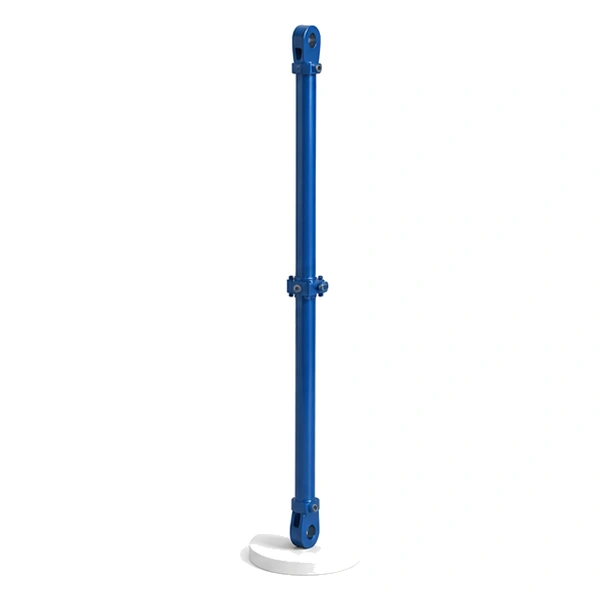
Loading & Unloading Tires Cylinder
Soft Tire In.
Hot Tire Out.
Same Cylinder. Different Grip.
Every other vulcanizing cylinder works on the mold or the centre mechanism — steel components at known positions and known weights. The loading/unloading cylinder is the only one that handles the tire itself — swinging the loader arm in to grab it, lifting it, and swinging it out. Going in: a soft, sticky green tire that deforms if gripped too hard. Coming out: a stiff, 180 °C cured tire that burns anything it touches. Every second of this transfer is a second the press sits idle.
Two Opposite Operations — One Cylinder Must Handle Both
The same cylinder and the same loader arm handle both operations — loading the next green tire immediately after unloading the cured one. Korea Ever-Power manufactures the loading/unloading cylinder as the material-handling component of the vulcanizing machine cylinder family.
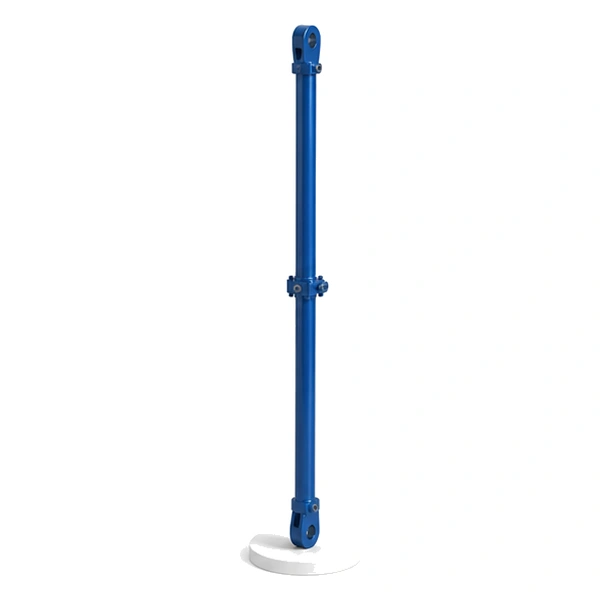
Technical Specifications
| Parameter | Value |
|---|---|
| Product | Loading and Unloading Tires Hydraulic Cylinder |
| Function | Transfer green tires into the mold / remove cured tires |
| Bore Diameter | 63 mm – 100 mm |
| Rod Diameter | 45 mm – 70 mm |
| Stroke | ≤ 2,000 mm |
| Maximum Thrust | 164 KN (bore 100 mm / pressure 21 MPa) |
| Working Pressure | Up to 21 MPa |
| Certification | ISO 9001 · 100% hydrostatic tested |
Every Second Counts — The Loader Arm Sets the Production Rate
A typical passenger car tire cure cycle is 10–15 minutes. The mold open → unload → load → mold close sequence adds 30–90 seconds to every cycle — time during which the press produces nothing and the mold loses heat. The loading/unloading cylinder's speed directly controls how much of that dead time the loader arm consumes.
The loader arm swings in, grips the cured tire, lifts it from the container, swings it out to the tipping station. This should be as fast as possible — the cured tire is rigid and can tolerate aggressive handling. Cylinder speed is maximised during the swing phase.
The loader arm swings back, picks up the waiting green tire, swings it over the open mold, and lowers it onto the centre mechanism. The lowering phase must be slow and controlled — the green tire must seat squarely on the lower bead chuck without cocking sideways or deforming against the mold walls.
A 10-second faster loader arm cycle on a 12-minute cure adds one extra tire per 2 hours. Over 24 hours, that is 12 additional tires per press per day. For a tire plant with 50 presses, that is 600 tires/day — approximately $30,000/day in additional production value. Contact the hydraulic cylinder engineering team for cycle-time-optimised loading/unloading cylinders.
The Loader Arm — Swing, Lower, Grip, Lift, Swing, Release
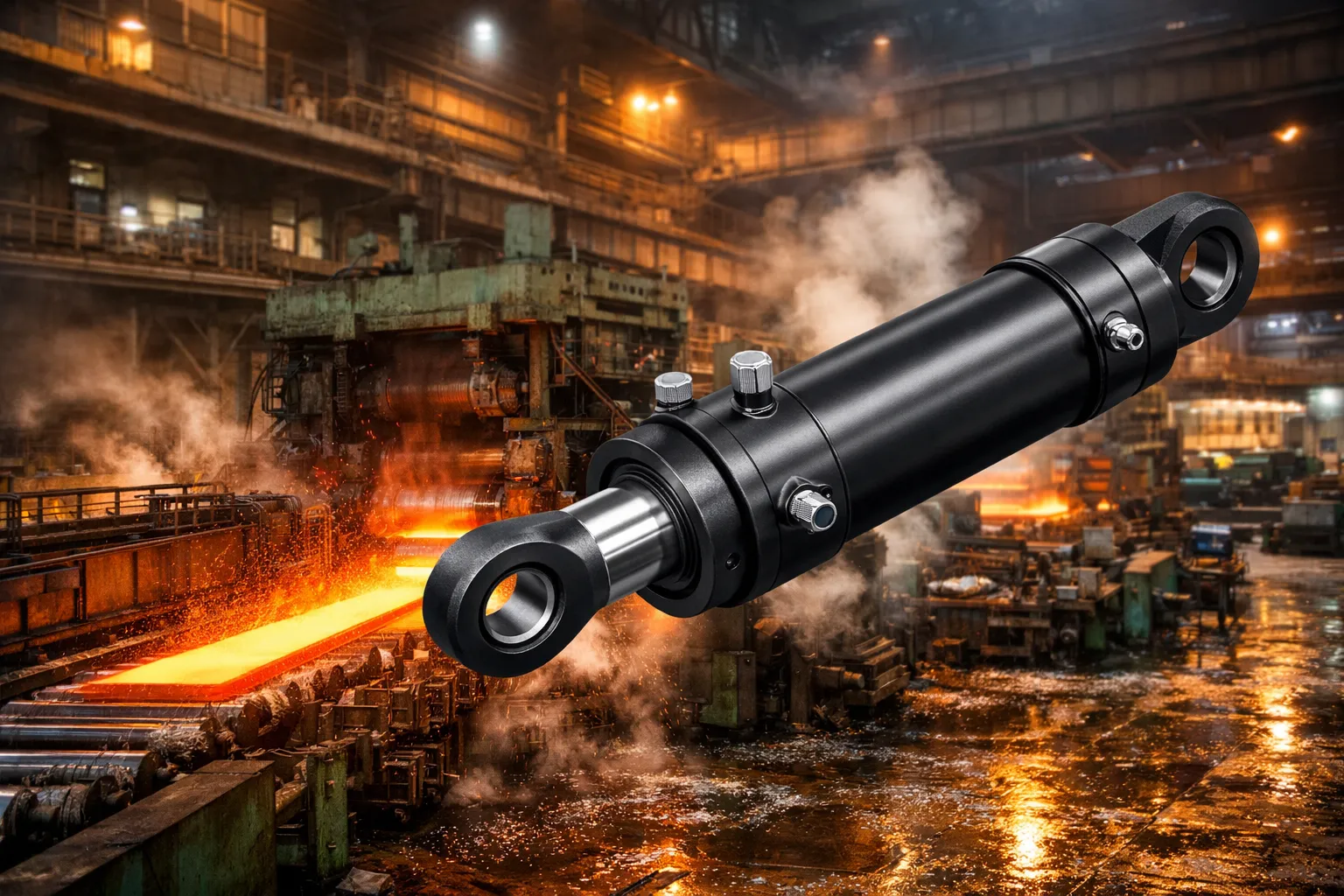
The loader arm is not a simple linear pusher — it is a multi-axis mechanism that must position the tire precisely in 3D space. The loading/unloading cylinder typically provides one axis of this motion (the horizontal swing or the vertical lift), while separate cylinders or pneumatic actuators handle the other axes (grip open/close, secondary lift, rotation).
The 2,000 mm stroke accommodates the full swing arc from the staging conveyor (outside the press frame) to the mold centre (inside the press frame) — a distance that spans the press's platen width plus the clearance needed for the loader arm to clear the tie bars or the dome structure. On large presses, this swing distance can approach 2 metres.
The cylinder must coordinate with the mold opening/closing cylinder (#30): the loader arm can only swing in after the dome is fully raised, and must swing out before the dome begins lowering. These interlocks are sequenced by the press controller — the loading/unloading cylinder's position sensor confirms "arm clear" before the dome descent is permitted.
Green Tire vs Cured Tire — The Same Arm Handles Two Very Different Objects
| Property | Green Tire (Loading) | Cured Tire (Unloading) |
|---|---|---|
| Temperature | Room temperature | 150–180 °C |
| Stiffness | Soft, easily deformed | Rigid, holds shape |
| Surface | Tacky (uncured rubber) | Dry, release-agent coated |
| Weight | 8–12 kg (passenger) | 9–15 kg (densified) |
| Handling risk | Deformation → defect | Burns → safety hazard |
| Speed priority | Gentle > fast | Fast > gentle |
The cylinder's speed profile changes between loading and unloading: slower and more controlled during loading (protecting the green tire's shape), faster during unloading (minimising mold heat loss). The press controller adjusts the proportional valve flow for each operation separately.
Manufacturing — Small Bore, Long Stroke, Fast Cycling
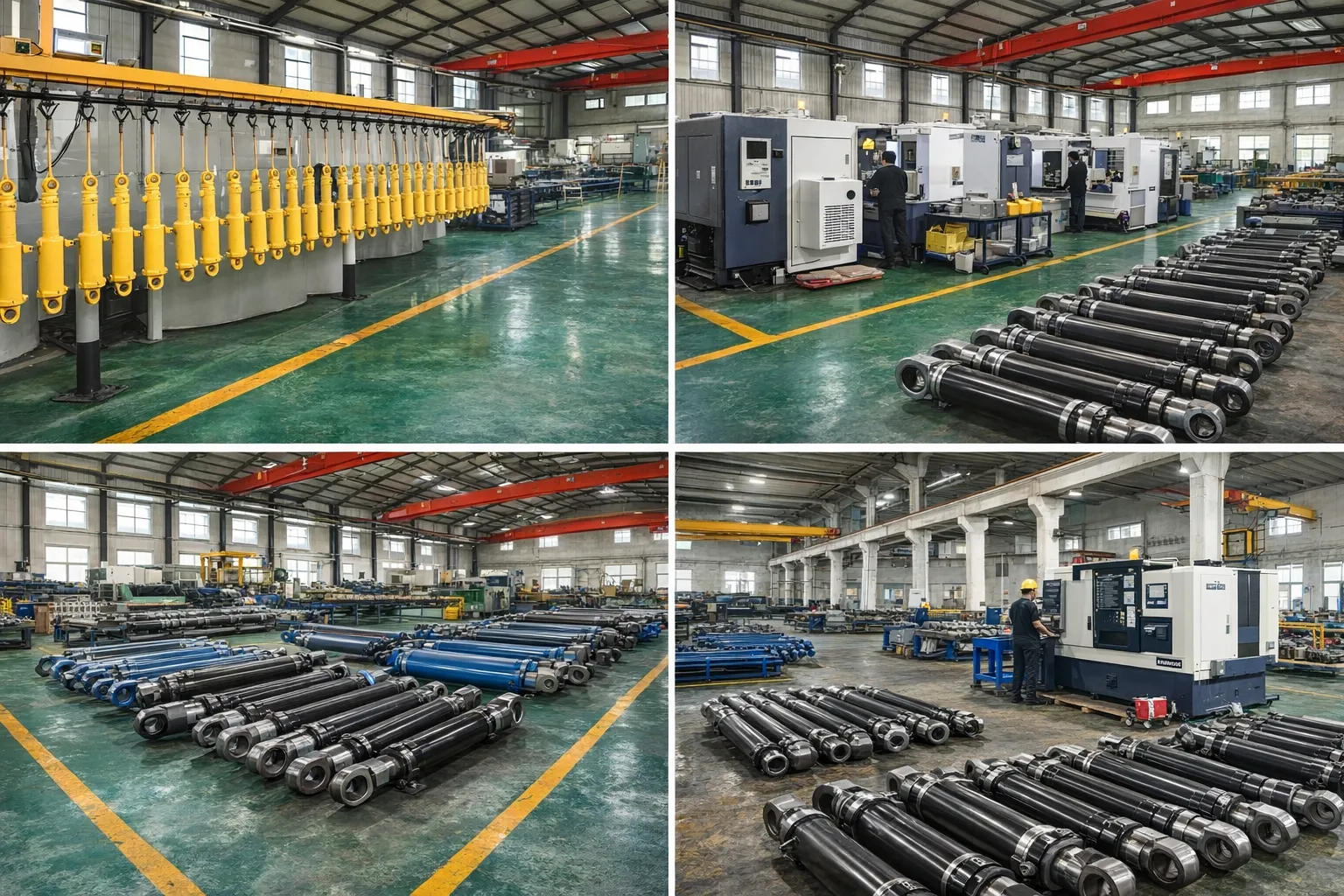
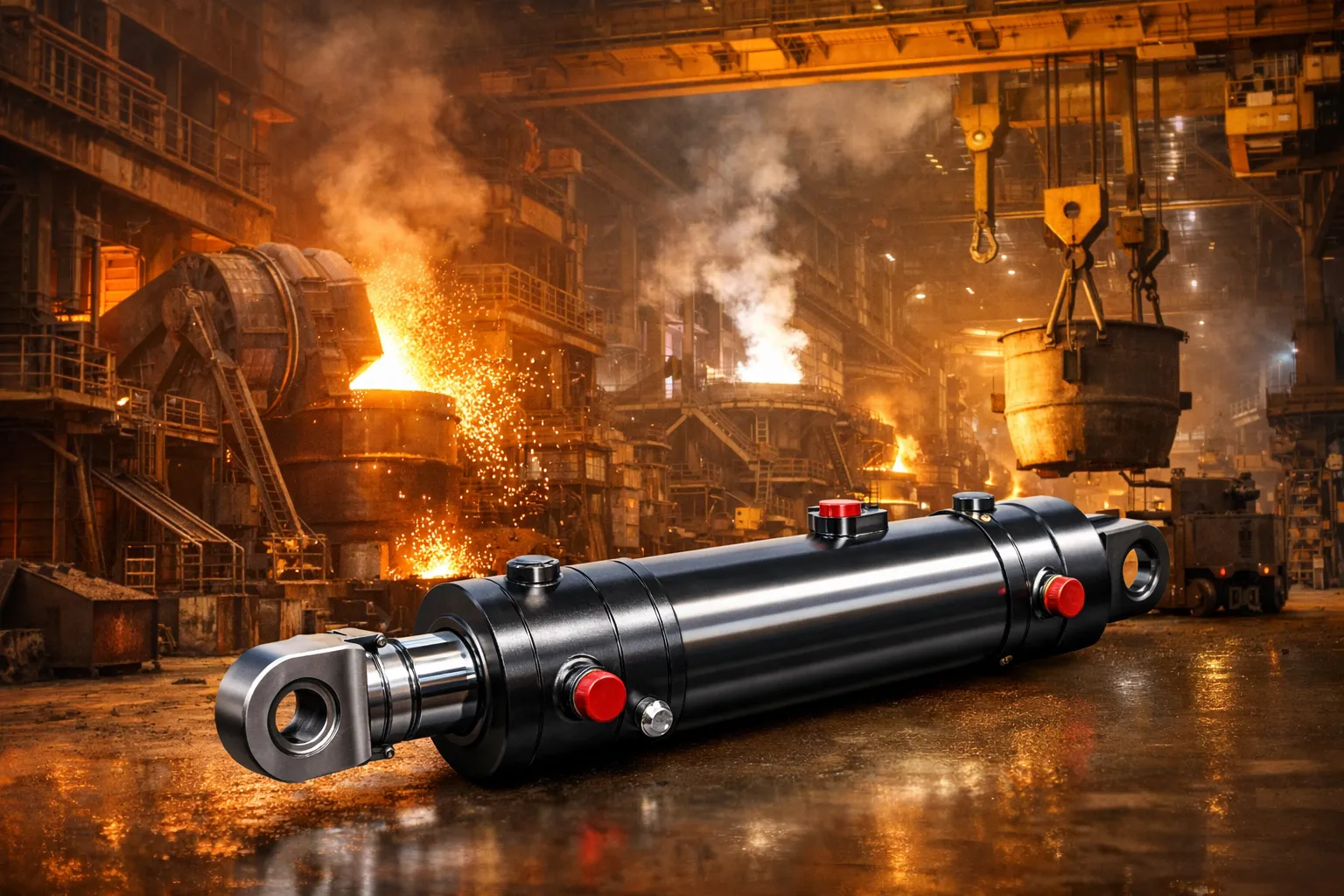
The 63–100 mm bore with ≤2,000 mm stroke creates a slender cylinder that must resist lateral loading from the cantilevered loader arm. The loader arm's weight (plus the tire) applies a bending moment at the cylinder rod end — which translates to a side load on the rod guide bearing. Korea Ever-Power specifies an oversized guide bearing length for the loading/unloading cylinder — longer than standard for a 63–100 mm bore — to distribute this side load and prevent eccentric seal wear.
The cylinder operates in the thermal zone between the hot open mold (below) and the warm press frame (around) — ambient temperature 40–80 °C at the cylinder's mounting position. FKM seals are standard. Chrome plating is 50 µm. The bore is honed to Ra 0.2–0.4 µm over the full 2,000 mm stroke. End-of-stroke cushions at both positions (swing-in and swing-out) prevent impact loads on the loader arm stops.
Every loading/unloading cylinder is hydrostatic tested at 1.5× working pressure and speed-tested for full extend and retract at the specified cycle time — verifying that the cylinder completes the full 2,000 mm stroke within the press builder's target loader arm cycle time.
OEM & ODM
FAQ
Related Categories
추가 정보
| Editor |
|---|
연관 상품
-
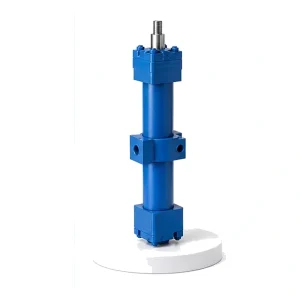
Tipping Cylinder for Vulcanizing Machine
-
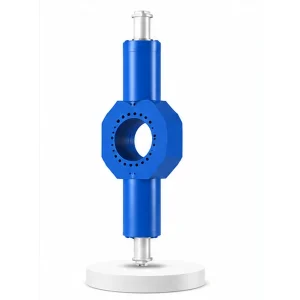
Hydraulic Press Rear Side Shift Cylinder
-
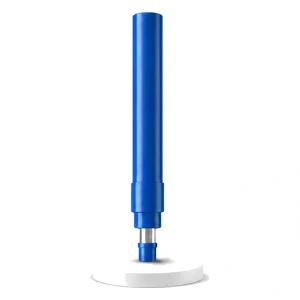
Injection Molding Machine Shooting Cylinder
-
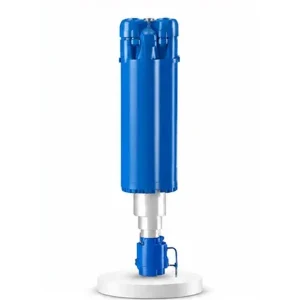
Hydraulic Press Clamping Cylinder
-
Hydraulic Press Lateral Shift Anvil Cylinder
-
Cement Equipment Roll over Cylinder
-
Hydraulic Press Tilt Cylinder
-
Hydraulic Press Side Cylinder


























