Leveling Cylinder for Wind Farm Maintenance Platform
Engineered with ultra-rigid 27SiMn alloy steel and advanced low-friction sealing technology to permanently eradicate seal wear under severe wind load eccentric loading, guaranteeing absolute horizontal platform stability for high-altitude operators.
Product Overview & Core Industrial Value
The exponential expansion of renewable energy infrastructure across East Asia, particularly the ambitious offshore and mountainous wind farms heavily concentrated throughout South Korea, Japan, and Taiwan, has introduced unprecedented mechanical challenges for the heavy lifting sector. Maintaining these towering, multi-megawatt turbines requires elevating human technicians, heavy diagnostic tools, and replacement components up to 150 meters into the atmosphere. The primary structural apparatus relied upon for this highly dangerous task is the wind farm maintenance platform. Operating at extreme altitudes, these extending boom lifts and suspended baskets are constantly subjected to violent, unpredictable meteorological forces. The absolute core of operational safety for these machines lies in their ability to remain perfectly horizontal. The critical mechanical actuator completely responsible for executing this vital function is the leveling cylinder.
The fundamental engineering obstacle for any leveling hydraulic cylinder deployed in this turbulent environment is the severe phenomenon of the wind load platform eccentric load. When heavy coastal gales or sudden alpine thermal updrafts strike the massive surface area of an elevated platform, immense asymmetrical forces are generated. This aerodynamic energy acts as a giant lever, transferring severe lateral bending moments directly down into the stabilization mechanism. The cylinder is forced to perform continuous, high-frequency micro-adjustments—known as the leveling action—to counteract the wind shear and keep the basket flat. In standard commercial hydraulic parts, this relentless side-loading combined with continuous high-pressure micro-movement inevitably leads to a rapid and highly destructive failure mode: severe seal wear. The resulting friction melts and tears the internal elastomers, leading to sudden fluid bypass, a complete loss of holding pressure, and terrifying platform tilt.
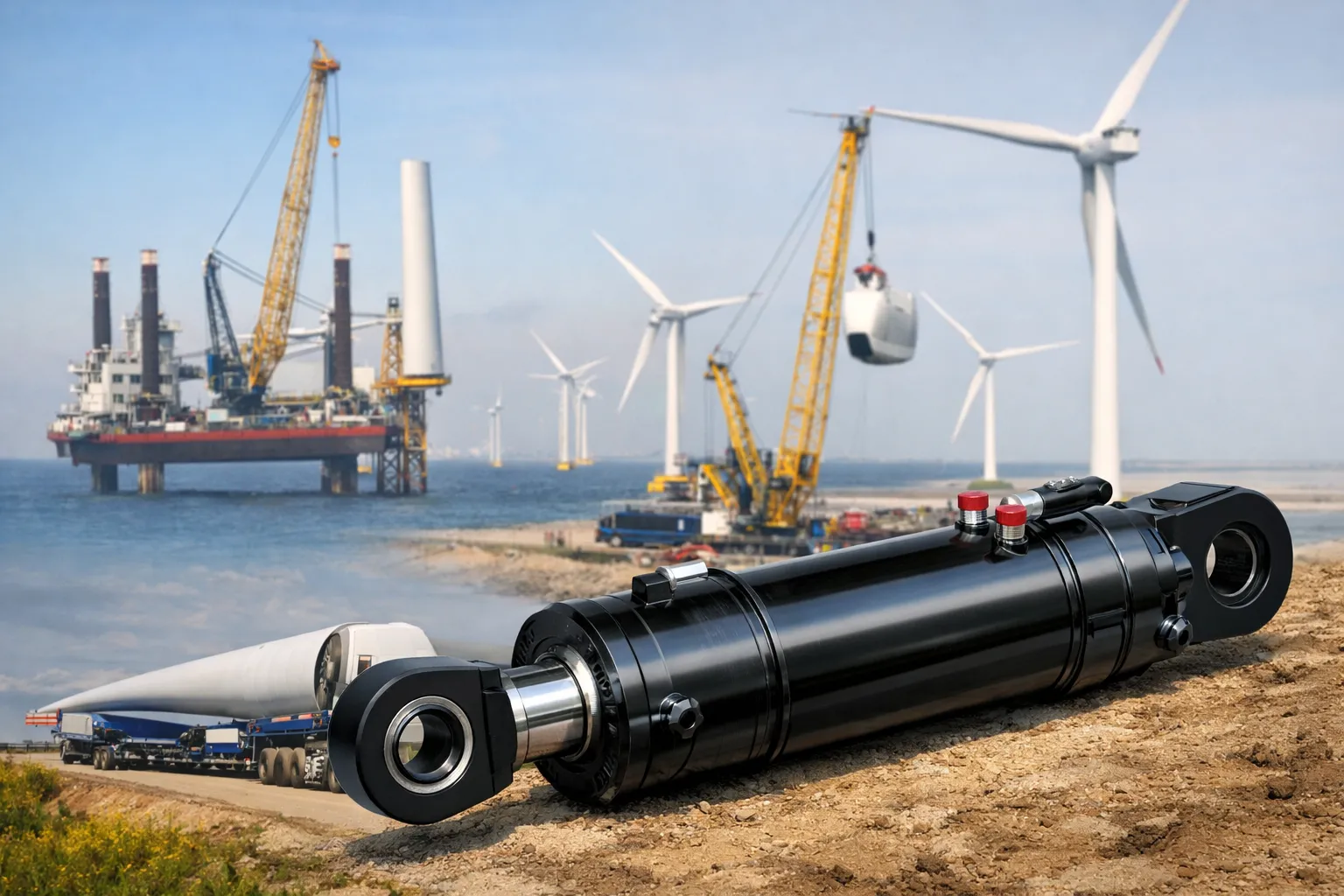
As an authoritative and globally trusted hydraulic cylinder manufacturer specializing in extreme-duty fluid power solutions, we recognized that conventional off-the-shelf designs were fundamentally inadequate for modern wind sector demands. We engineered our specialized leveling cylinder series specifically to eradicate these inherent vulnerabilities. By transitioning the core barrel material to ultra-rigid 27SiMn alloy steel and integrating an advanced low-friction sealing matrix, we have created a fail-safe mechanical foundation that entirely neutralizes the destructive effects of platform eccentric loads. By equipping your rental fleet with our high-performance hydraulic cylinder components, you actively protect human lives, maximize your operational weather windows, and achieve an exceptionally optimized long-term return on investment that easily justifies the initial hydraulic cylinder price.
Technical Parameters & Customization Range
Precision fluid power applications involving human elevation require absolute clarity in mechanical specifications. To guarantee flawless integration into your existing aerial machinery, we provide a highly transparent outline of our baseline engineering parameters. The following matrix details the stringent specifications of our heavy-duty leveling series, which can be extensively customized regarding total stroke length, bore diameter, and spherical bearing mounting geometries to perfectly match your specific platform chassis requirements.
| Engineering Attribute | Specification & Technical Details |
|---|---|
| Target Industry Sector | Wind Power & Renewable Energy Infrastructure |
| Equipment Category | Wind Farm Maintenance Platform / Aerial Boom Lifts |
| Subsystem Application | Platform Leveling and Dynamic Angle Compensation |
| Official Component Name | Leveling cylinder / Leveling hydraulic cylinder |
| Action Mechanism | Double acting hydraulic cylinder (Powered push and forced retraction) |
| Internal Structure Type | Piston cylinder (Heavy-duty monolithic piston design) |
| Manufacturing Construction | Heavy-Duty Welded Construction (Automated Submerged Arc Welding) |
| Core Material System | 27SiMn High-Strength Alloy Steel (Superior flexural yield resistance) |
| Rod Surface Treatment | Micro-cracked Hard Chrome Plated (Marine-grade corrosion defense) |
| Environmental Stress Rating | Severe Wind load platform eccentric load |
| Dynamic Working Condition | Continuous Leveling action (High-frequency, short-stroke micro-adjustments) |
| Targeted Failure Mode Prevented | Rapid seal wear and internal fluid bypass causing sudden platform sag |
| Recommended Internal Configuration | Low-friction PTFE seal architecture integrated with expanded POM wear bands |
Fluid Dynamics & Internal Working Principle
Grasping the highly sophisticated fluid dynamics within the platform stabilization subsystem is crucial for understanding why standard aftermarket actuators fail so rapidly on the job site. The leveling hydraulic cylinder operates within a highly complex electro-hydraulic feedback loop. As the main crane boom changes its overall elevation angle, or as extreme external aerodynamic drag forcefully pushes against the suspended basket, onboard gyroscopes and high-sensitivity inclinometers continuously monitor the platform’s relationship to absolute gravity. If the basket deviates by even a fraction of a degree, the master control manifold instantly dictates high-pressure hydraulic fluid into the leveling circuit.
This critical application absolutely demands a true double acting hydraulic cylinder. In a benign, indoor environment, a basic single acting hydraulic cylinder might rely on the dead weight of the load to retract. However, in the high-wind environments of coastal offshore wind farms, powerful thermal updrafts can easily overcome gravity, physically lifting the platform upwards and causing a single-acting system to stall out. A double-acting architecture actively channels pressurized fluid into either the base port to aggressively extend the rod, or into the annulus port to forcefully retract it. This bidirectional kinetic power allows the internal hydraulic cylinder piston to forcefully push against a downdraft and immediately pull against an updraft, creating a rigidly locked, level surface.
The true engineering challenge arises during these constant, tiny adjustments—the leveling action itself. Standard polyurethane rubber seals grip the metal rod tightly when stationary. When the system commands a millimeter of movement to level the floor, pressure builds significantly until it overcomes this static friction, resulting in a sudden, violent release known universally as the “stick-slip” phenomenon. For technicians standing 120 meters in the air, this mechanical judder is terrifying and highly dangerous. By utilizing our proprietary low-friction PTFE sealing matrix and computationally honed internal barrel surfaces, our cylinders guarantee perfectly smooth, judder-free kinematics, allowing operators to execute delicate blade repairs without constantly fighting to maintain their balance.
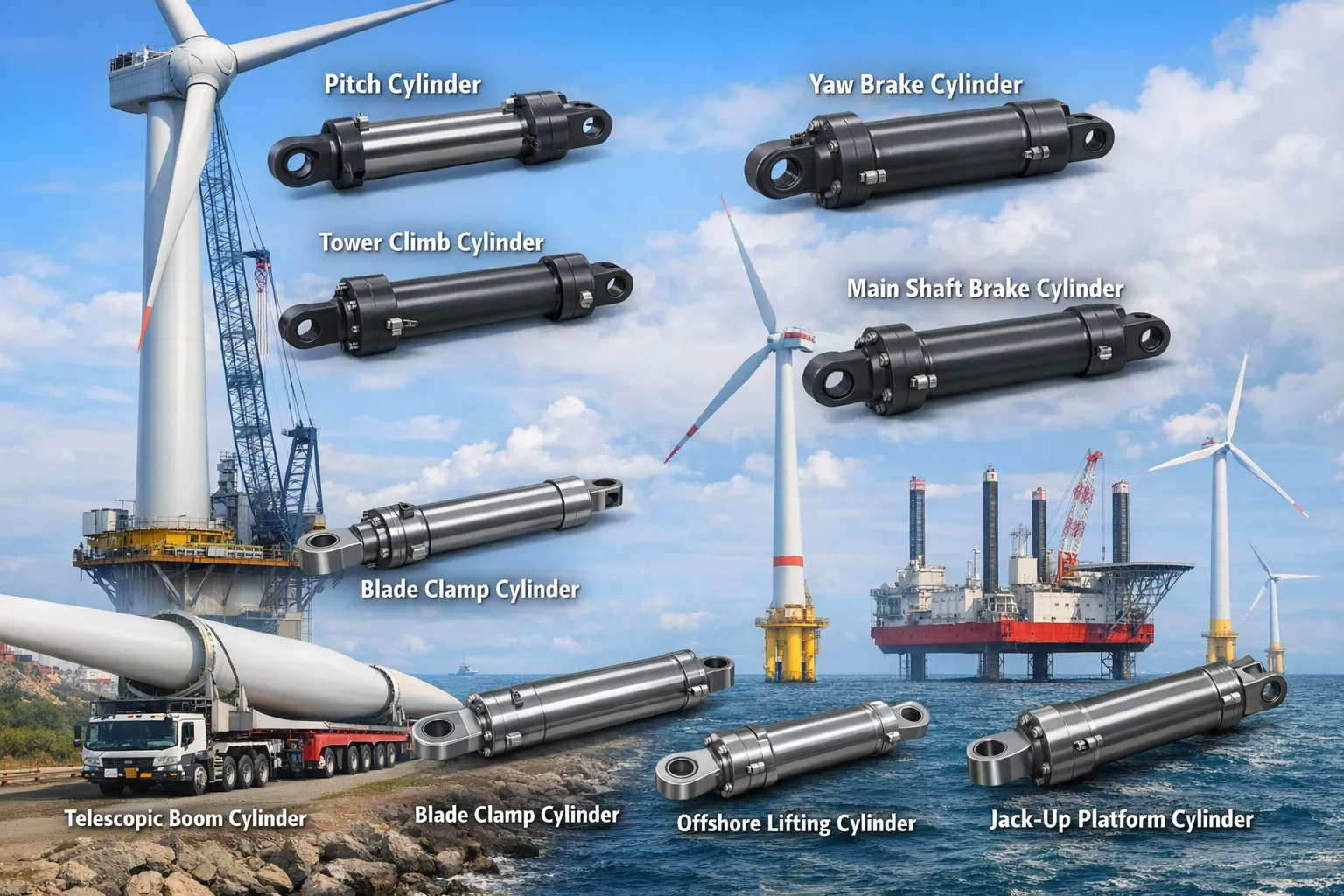
Seamless Machinery Brand Replacement Capabilities
In the high-stakes, capital-intensive renewable energy sector, unplanned equipment downtime leads directly to astronomical financial penalties and delayed grid connections. Sourcing original equipment manufacturer (OEM) replacement components often involves navigating protracted international supply chains and highly inflated pricing structures. Fleet maintenance directors require immediate, uncompromising solutions without the wait. Our custom hydraulic parts are expertly reverse-engineered and dimensionally mapped to serve as flawless, drop-in replacements for the leveling units found on the world’s most ubiquitous aerial platforms.
We routinely supply exact-fit hydraulic cylinder components and complete functional assemblies that perfectly match the hydraulic circuits and structural mounts of high-reach machinery traditionally manufactured by global leaders such as Bronto Skylift, Palfinger, Ruthmann, Liebherr, JLG, Genie, and Haulotte. (Please note: Mentioning these esteemed brand names serves purely as a technical reference to facilitate accurate dimensional cross-referencing and model selection for our B2B clients; we operate globally as an entirely independent hydraulic cylinder manufacturer and do not claim any trademark affiliation, sponsorship, or direct endorsement.)
By strictly adhering to the exact trunnion mount spacing, closed retracted lengths, spherical bearing pin hole diameters, and maximum stroke capacities, we enable rapid turnaround times for fixing hydraulic cylinders directly in the field. This precise dimensional compatibility heavily streamlines complex hydraulic cylinder repair cycles, empowering your maintenance teams to return their lifting assets to active wind farms without executing dangerous structural modifications or chassis welding. By choosing our upgraded 27SiMn solutions, you secure a vastly superior mechanical lifespan.
Eight Core Technical Advantages Dominating Extreme Environments
What precisely elevates our products from standard aftermarket spares to highly sought-after industrial upgrades? The answer is firmly rooted in over two decades of uncompromising material science, advanced tribology, and rigorous structural engineering calculation. Here are the eight fundamental engineering pillars that guarantee absolute reliability:
1. Advanced Low-Friction Sealing Technology
To fundamentally solve the issue of rapid seal wear caused by constant micro-movements, we deploy specialized polytetrafluoroethylene (PTFE) composite step seals. These seals offer an exceptionally low coefficient of dynamic friction, entirely eradicating the “stick-slip” phenomenon. This ensures microscopic, judder-free platform adjustments and effectively eliminates the thermal degradation that rapidly destroys standard polyurethane lips.
2. 27SiMn High-Strength Metallurgy
The continuous buffeting of a wind load platform eccentric load causes standard carbon steel barrels to subtly flex, leading to internal metal-to-metal scoring. We strictly utilize 27SiMn alloy steel. The high silicon and manganese content drastically increases the material’s flexural yield strength and fatigue limit, creating an ultra-rigid cylinder barrel that refuses to deform under extreme lateral wind stress.
3. Expanded Composite Guide Rings
When lateral wind forces push the platform off-center, the internal rod is forced heavily against the barrel wall. We counteract this destructive side-loading by expanding the width of our internal POM (Polyoxymethylene) wear bands by 40%. This vastly increases the load-bearing surface area, keeping the piston perfectly concentric and shielding the delicate fluid seals from localized crushing forces.
4. Deep-Penetration Welded Construction
The mounting clevises and trunnions are the primary stress nodes during eccentric loading. We utilize automated Submerged Arc Welding (SAW) to fuse these mounts directly to the 27SiMn barrel. This robotic process ensures absolute, deep-weld penetration without porosity or slag inclusion, resulting in an unbreakable structural bond capable of withstanding years of high-frequency vibrational loads.
5. Micro-Cracked Chrome Plating Defense
Offshore environments are inherently highly corrosive. The exposed rod of our leveling cylinder is treated with a 40-50 micron layer of hard chrome, heavily optimized with a specific micro-crack density. These microscopic fissures act as tiny oil reservoirs, lowering operating friction and forming an impenetrable defense against coastal salt spray and abrasive airborne sand.
6. Integrated Load-Holding Architecture
Safety is paramount when suspending operators at 150 meters. The cylinder heads are custom-machined to directly accept flanged counterbalance and pilot-operated check valves. By bolting these critical safety valves directly to the solid cylinder body rather than placing them further down the hose line, we guarantee an instant mechanical lock that freezes the platform in place should a primary supply hose burst.
7. Precision CNC Honed Inner Bores
The internal surface of the 27SiMn barrel is processed via Skiving and Roller Burnishing (SRB) to achieve a mirror-like Ra 0.2-micron finish. This extreme smoothness is absolutely vital for extending the operational lifespan of the dynamic low-friction seals during thousands of high-frequency micro-adjustments, ensuring long-term fluid tightness.
8. Optimized Internal Thermal Stability
Continuous leveling actions rapidly heat hydraulic oil, heavily degrading its viscosity. Our internal fluid porting is computationally modeled using advanced fluid dynamics software to minimize turbulence and pressure drops. This superior thermal stability prevents heat buildup, directly multiplying the mechanical fatigue life of the entire actuator under continuous operation.
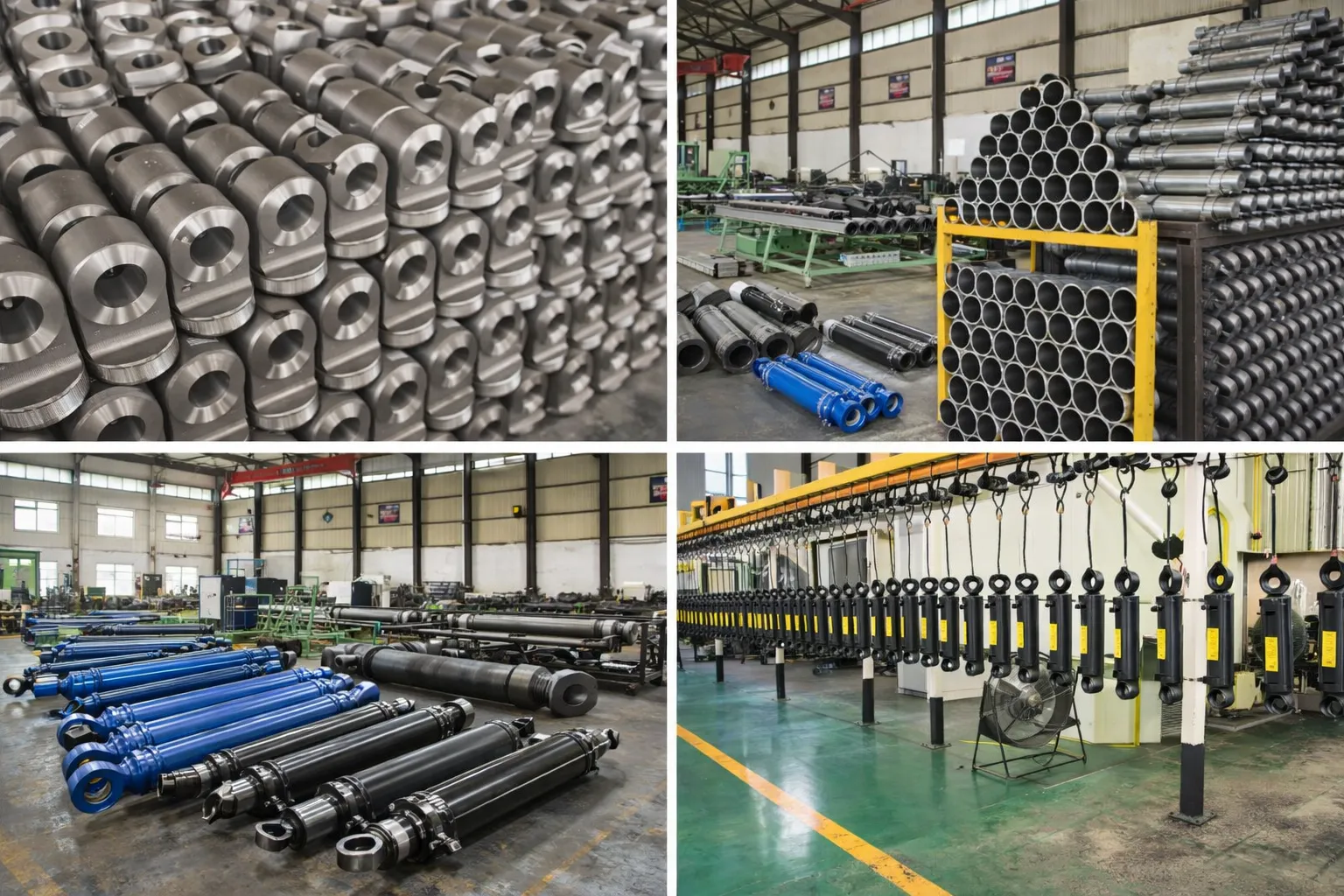
Autonomous Manufacturing & Zero-Defect Quality Control
The undeniable physical resilience of our hydraulic rams is not simply drafted on a computer screen; it is methodically forged within our advanced, vertically integrated production facilities. We maintain absolute control over the entire manufacturing lifecycle, refusing to outsource critical machining or metallurgical treatments to unverified third parties. This closed-loop philosophy ensures that every single unit arriving at your facility conforms perfectly to global heavy machinery safety directives.
The production journey begins with strict raw material traceability. Every batch of 27SiMn steel undergoes immediate optical emission spectroscopy to verify the precise silicon and manganese ratios. Following the heavy-duty SRB boring process, the heavy trunnions and rod ends are secured using robotic welding cells. Every single critical load-bearing weld undergoes rigorous non-destructive testing (NDT), utilizing both Ultrasonic Testing (UT) to find deep volumetric flaws and Magnetic Particle Inspection (MPI) to guarantee the absolute absence of subsurface micro-fissures. Assembly operations occur strictly within a climate-controlled, dust-free cleanroom environment to prevent microscopic particulate contamination, which is the primary cause of premature scoring in high-pressure systems.
Final quality assurance is absolute. 100% of our produced units are routed through our computerized testing bays. Each completed leveling hydraulic cylinder is hydrostatically proof-tested at 150% of its rated nominal working pressure. The unit is held at this extreme stress level while digital sensors monitor for any internal fluid bypass or external leakage, verifying the complete integrity of the low-friction seal structure. A unique serial number is deeply laser-etched onto the barrel, providing our B2B clients with a permanent digital record for future maintenance or when sourcing replacement hydraulic cylinder components decades later.
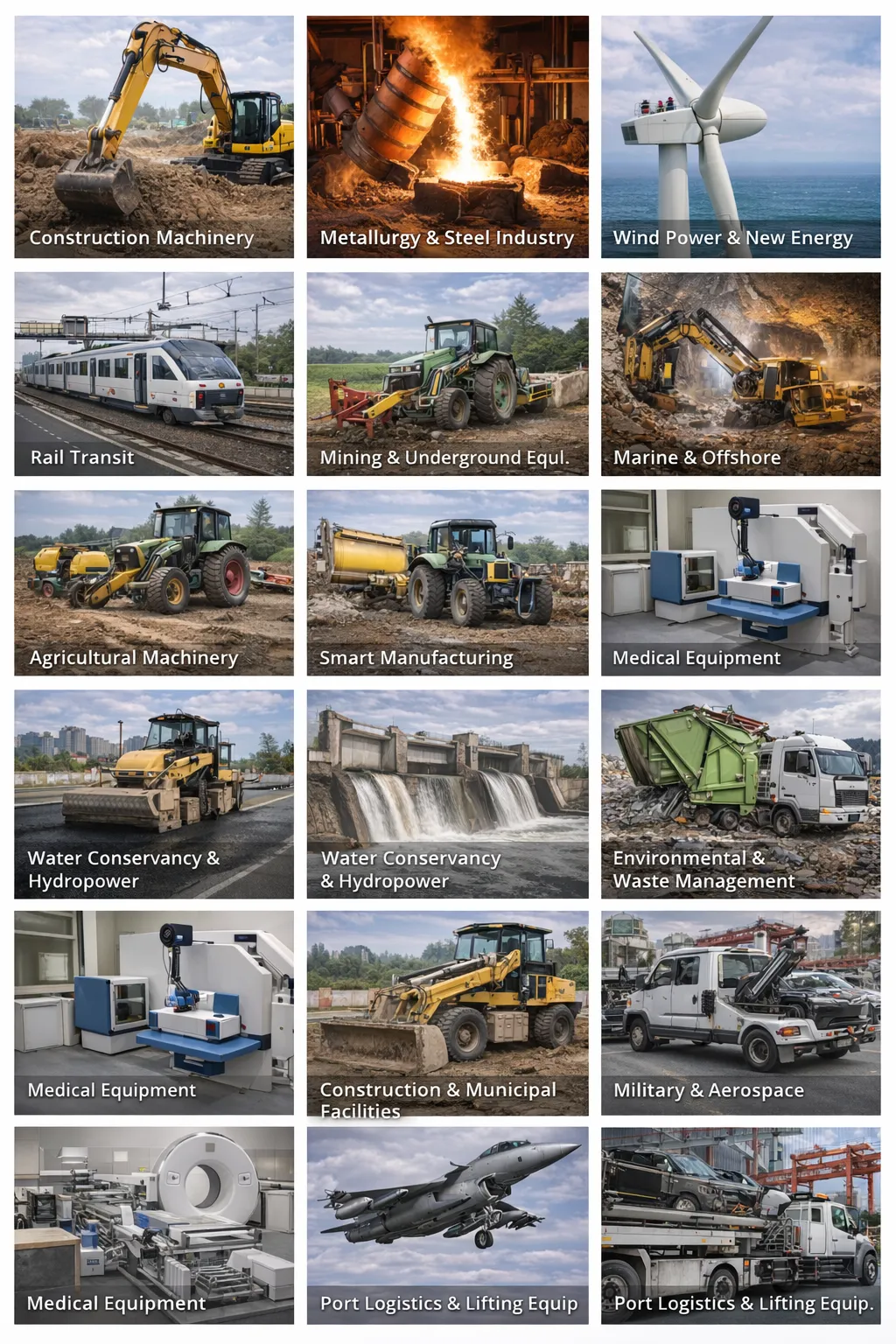
Versatile Industry Applications
While the highly specialized system discussed here is uncompromisingly optimized for the extreme environmental demands of wind farm maintenance platforms, the highly robust engineering principles we apply translate flawlessly across a multitude of heavy industrial sectors. When absolute horizontal stability and structural reliability are non-negotiable, our products dominate the landscape globally.
- Wind Power & Renewable Energy: Deployed on high-reach aerial work platforms, blade installation manipulators, and massive offshore transition piece maintenance modules where high wind pressure is a constant threat.
- Construction & Heavy Infrastructure: Providing active chassis and outrigger stabilization for highly complex lifting operations. We invite you to explore our advanced solutions tailored specifically for the construction machinery industry.
- Smelting & Heavy Forging: Precisely controlling the tilt and stabilization of heavy ladles pouring molten metal in the intense thermal environments of the metallurgical and iron industry.
- Surface & Deep Shaft Extraction: Maintaining the structural horizontality of massive tunneling rigs and drilling jumbos operating on extreme inclines within the harsh environment of the mining industry.
- Maritime Logistics & Material Handling: Ensuring the perfectly level horizontal positioning of massive intermodal shipping containers suspended by ship-to-shore gantry spreaders.
- Specialized & Custom Scenarios: Supplying customized fluid power solutions for aerospace launch platforms, heavy military radar arrays, and mobile logistics bridges.
Comparative Analysis: Standard Hydraulics vs. Specialized Leveling Units
When evaluating procurement options, analyzing the initial hydraulic cylinder price without strictly considering the total cost of ownership leads to disastrous equipment downtime. Utilizing a cheap, general-purpose cylinder or a basic lift cylinder for a critical high-altitude leveling task guarantees rapid seal failure and catastrophic operational delays. The objective comparison matrix below illustrates exactly why our specialized 27SiMn cylinder represents a vastly superior, safer return on investment.
| Critical Engineering Metric | Standard General-Purpose Cylinder | Our High-Performance Leveling Cylinder |
|---|---|---|
| Base Material Construction | Standard 1045 Carbon Steel (Vulnerable to bending under lateral eccentric loads) | 27SiMn High-Strength Alloy Steel (Superior yield strength actively resists twisting) |
| Core Sealing Technology | Basic NBR lip seals (Causes stick-slip judder and wears rapidly under high friction) | Low-friction seal architecture (PTFE composite ensures flawlessly smooth action) |
| Eccentric Load Defense | Narrow standard guide rings (High risk of destructive metal-to-metal scoring) | Extra-wide POM composite wear bands (Massively expands load-bearing surface) |
| Surface Corrosion Resilience | Thin 20-micron chrome plating (Pits and rusts rapidly in marine environments) | 30-50 micron micro-cracked hard chrome (Verified against extreme coastal salt spray) |
| Valve Integration Architecture | Standard threaded ports (Requires external, vulnerable piping for safety valves) | Precision machined integral flange mounts (Direct, secure mechanical valve locking) |
Proven Success: Real-World Engineering Case Studies
Our unwavering commitment to fluid power excellence is consistently validated by the measurable success of our global B2B clients. Below are authentic instances where our customized hydraulic solutions successfully resolved critical, highly expensive operational crises in the field across East Asia.
Case 1: Eradicating Platform Tilt in Offshore Environments (Jeju Island, South Korea)
Client Profile: Tier-one Offshore Wind Turbine Maintenance Contractor (Project Date: October 2024)
The Engineering Crisis: The client utilized heavily extended aerial platforms from specialized jack-up vessels to service 8MW offshore turbines. Relentless coastal gusts created a severe wind load platform eccentric load, which brutally degraded the internal seals of their European OEM actuators within just four months. The extreme friction of the continuous leveling action caused the seals to melt, leading to dangerous platform sagging and fluid bypass during delicate operations, causing technician panic and bringing maintenance to a grinding halt.
Contact & Solution: Desperate to solve the bottleneck, their procurement lead discovered our specific expertise via a technical search and immediately contacted our engineering team. We rapidly reverse-engineered the OEM geometry and deployed our customized leveling hydraulic cylinder units featuring our proprietary low-friction PTFE sealing and ultra-wide POM wear rings to effectively absorb the immense lateral torque.
The Result: The drop-in replacement units have now been in active, daily coastal service for over 16 months with zero documented seal wear and absolute horizontal stability. Fleet downtime was reduced by an astonishing 85%.
“The continuous platform juddering was a massive safety liability. These upgraded replacement units hold perfectly flat in a gale. The heavy-duty engineering combined with the surprisingly accessible hydraulic cylinder price fundamentally transformed our maintenance capabilities.” — Mr. Choi Min-Ho, Lead Fleet Director.
Case 2: Optimizing Micro-Adjustments in Frigid Climates (Taebaek Mountains, South Korea)
Client Profile: Specialized Alpine Wind Blade Repair Consortium (Project Date: February 2025)
The Engineering Crisis: Operating in severe sub-zero alpine conditions (-25°C), the client’s aerial platforms suffered from severe stick-slip (judder) during automated leveling actions. The standard carbon steel 1045 barrels were bending under the mountain drafts, and the basic rubber seals hardened in the cold, drastically increasing friction against the rod. This erratic movement made precise, high-altitude fiberglass blade repair incredibly dangerous.
Contact & Solution: They required immediate solutions for fixing hydraulic cylinders on their fleet and reached out for a winterization consultation. We supplied completely upgraded internal hydraulic parts. We manufactured new drop-in cylinders forged from low-temperature resistant 27SiMn steel, equipped with aerospace-grade cold-weather low-friction seals that maintain absolute elasticity down to -35°C.
The Result: The cold-weather stick-slip was entirely eliminated. The leveling cylinder now responds flawlessly to the gyroscopic sensors, providing butter-smooth, undetectable micro-adjustments even in the dead of winter.
“We spent years constantly battling cold-weather judder and fluid leaks. Your technical team understood the tribology instantly. The smooth operation has directly improved our technicians’ daily output and morale.” — K. Takahashi, Operations Manager.
Case 3: Extending Asset Lifespan in Highly Corrosive Ports (Ulsan, South Korea)
Client Profile: Maritime Logistics and Heavy Equipment Rental Firm (Project Date: August 2025)
The Engineering Crisis: The massive, truck-mounted telescopic platforms used for inspecting dockside coastal turbines were failing due to rapid rod corrosion. The thin OEM chrome pitting destroyed the wiper seals, dragging abrasive port sand into the double acting hydraulic cylinder and completely destroying the internal piston.
Contact & Solution: The client reached out for heavy-duty replacements via our engineering hotline. We delivered highly robust custom cylinders featuring our marine-grade, micro-cracked hard chrome-plated rods (50 microns thick) designed specifically to retain lubricating oil and repel corrosive salt and industrial port dust.
The Result: Approaching their third year of service without a single hour required for hydraulic cylinder repair. The rods remain pristine, mathematically proving the immense long-term value of investing in specialized surface treatments.
“The sheer durability of your metallurgical treatments is unmatched. When we require highly reliable replacement hydraulic rams, your manufacturing division is our first and only call.” — L. Chen, Chief Maintenance Engineer.
Case 4: Streamlining Procurement for Heavy Equipment Rental (Hokkaido, Japan)
Client Profile: National Aerial Work Platform Rental Corporation (Project Date: October 2025)
The Engineering Crisis: Operating a massive fleet of diverse machinery brands, the rental depot was paralyzed by the logistical nightmare of sourcing replacement OEM hydraulic cylinder components. The varying lead times, inconsistent quality, and heavily inflated pricing severely impacted their profitability and kept essential maintenance platforms grounded.
Contact & Solution: They audited our autonomous manufacturing facility and subsequently transitioned their entire aftermarket procurement to our enterprise. We provided a unified catalog of exact-fit replacement leveling units covering all their major fleet models, alongside comprehensive repair seal kits for their internal maintenance teams.
The Result: The consolidation of their supply chain drastically reduced their average equipment downtime from 45 days to less than 7 days, fundamentally transforming their operational efficiency and boosting rental revenue.
“Partnering with a fully capable manufacturer has streamlined our entire operation. Your precise dimensional compatibility means our mechanics can drop in a new unit immediately. The quality is phenomenal, and the cost savings on fixing hydraulic cylinders have directly improved our bottom line.” — Kim Dong-Wan, Director of Procurement.
Frequently Asked Questions
We deeply understand that procuring massive industrial fluid power equipment requires rigorous due diligence. Below are the highly transparent, detailed answers to the most common technical inquiries from our global B2B partners regarding our heavy-duty stabilization product range.
Secure Your Aerial Maintenance Operations Today
Do not allow substandard, mass-market fluid power components to dictate your multi-million dollar wind farm maintenance schedule or compromise the structural safety of your high-altitude personnel. Equip your critical aerial machinery with a precision-engineered leveling hydraulic cylinder designed specifically to conquer extreme wind load eccentric loading and guarantee absolute, unwavering horizontal stability. Partner with our engineering experts today for uncompromising heavy-duty support and a highly competitive factory-direct proposal.
Editor: Cxm