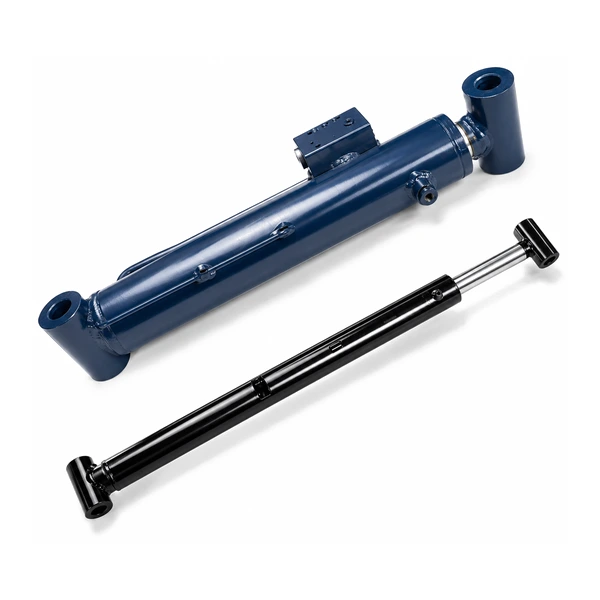
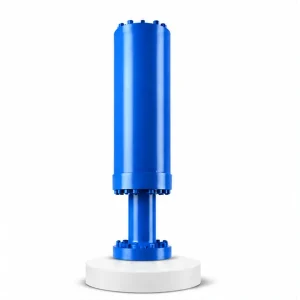
Cement Equipment Roller Press Cylinder
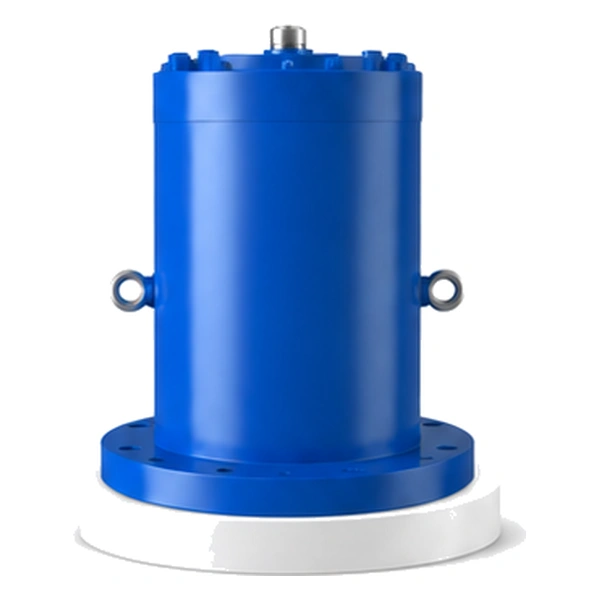
Roller Press Cylinder
The Gap Between
Two Rollers = The
Fineness of Your Cement
A roller press crushes limestone, clinker, and raw meal between two counter-rotating rollers. The cylinder pushes the movable roller against the material — not to a fixed position, but with a constant force. The gap self-adjusts: more material widens it, less material narrows it. This "hydraulic spring" absorbs every feed variation without mechanical shock. The result is consistent particle size — the foundation of cement quality.
How a Roller Press Grinds Cement
A roller press consists of two heavy steel rollers mounted horizontally, rotating toward each other. Raw material — limestone, clay, iron ore, and gypsum for raw meal grinding, or clinker for finish grinding — is fed into the gap from above. As the rollers pull the material into the narrowing gap, compressive forces of 100–300 MPa crush the particles into fine powder.
One roller is fixed in the press frame; the other is mounted on sliding bearings that allow it to move toward or away from the fixed roller. The roller press cylinder pushes the movable roller against the material bed — providing the crushing force. The higher the hydraulic pressure applied by the cylinder, the harder the rollers squeeze, and the finer the output. Korea Ever-Power manufactures roller press cylinders as part of the industrial engineering hydraulic cylinder programme for cement equipment manufacturers.
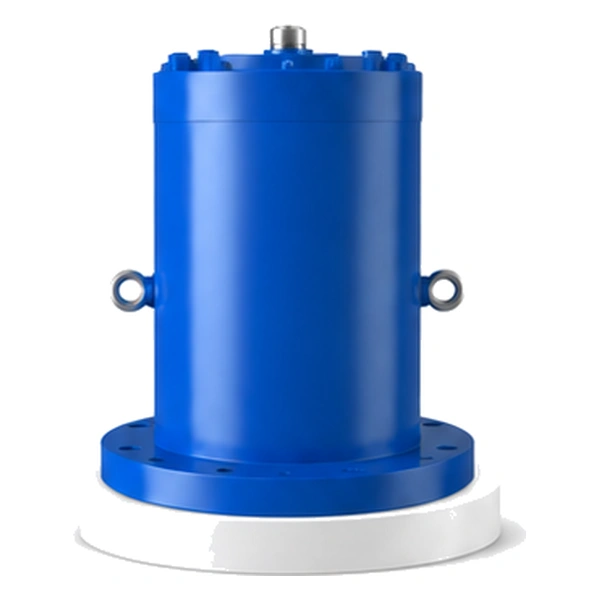
Technical Specifications
| Parameter | Value |
|---|---|
| Product | Cement Equipment Roller Press Cylinder |
| Function | Press the movable roller against the fixed roller |
| Bore Diameter | 200 mm – 700 mm |
| Rod Diameter | 130 mm – 500 mm |
| Stroke | ≤ 500 mm |
| Maximum Thrust | 5,387 KN (bore 700 mm / pressure 14 MPa) |
| Working Pressure | Up to 14 MPa |
| Certification | ISO 9001 · 100% hydrostatic tested |
The "Hydraulic Spring" — Force Control, Not Position Control
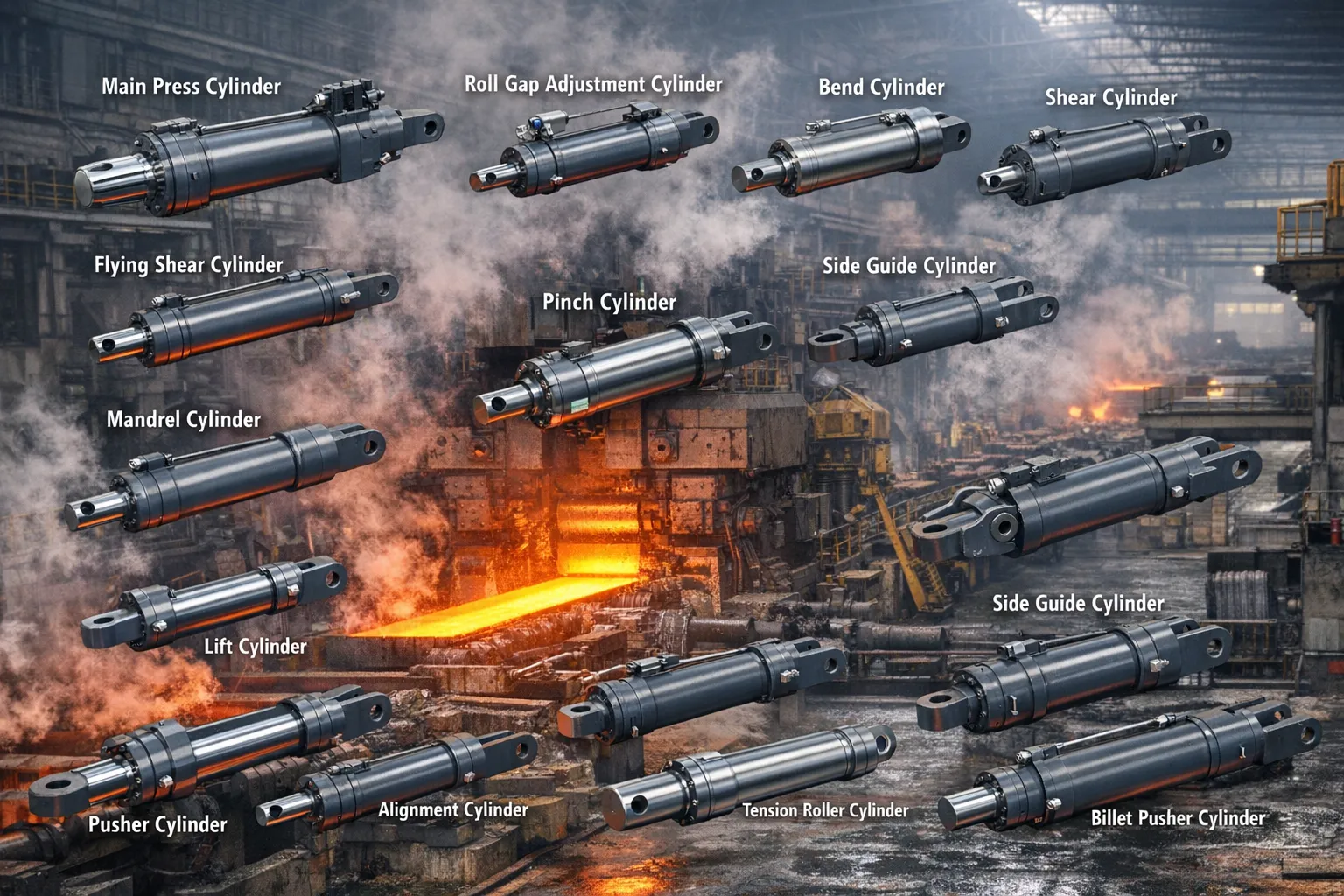
Most hydraulic cylinders are position-controlled: extend to here, retract to there, hold at this height. The roller press cylinder is fundamentally different — it is force-controlled. The hydraulic system maintains a constant pressure in the cylinder, which translates to a constant force on the movable roller. The gap between the rollers is not set by the cylinder; it is set by the equilibrium between the cylinder's pushing force and the material bed's resistance.
When more material enters the gap, the material bed pushes the movable roller back — widening the gap. The cylinder compresses slightly (the rod retracts a few millimetres), but the pressure remains constant, so the grinding force remains constant. When less material enters, the gap narrows — the cylinder extends slightly as the material bed offers less resistance. The cylinder acts like a very stiff spring: constant force, variable position.
This self-adjusting behaviour is essential because cement raw material feed is never perfectly uniform — lumps, voids, moisture variations, and feed rate fluctuations occur continuously. A rigid (position-controlled) gap would produce enormous force spikes on hard lumps and zero force on voids. The hydraulic spring absorbs these variations smoothly, producing consistent grinding regardless of feed irregularities.
24/7 Continuous Duty — The Cement Plant Never Stops
A cement plant kiln runs 24 hours a day, 7 days a week, for 11–12 months per year (one annual maintenance shutdown). The roller press feeds the kiln — if the roller press stops, the kiln starves and must be shut down. An unplanned kiln shutdown costs tens of thousands of dollars per hour in lost production and restart energy. The roller press cylinder must match this continuous-duty requirement with zero unplanned downtime.
The cylinder operates under continuous oscillating load (the material feed produces rhythmic pressure variations) for the entire campaign. Seal life, bore wear, and rod chrome condition must sustain this without intervention until the annual shutdown — when all maintenance is compressed into 2–4 weeks.
The two rollers rotating at 15–25 RPM transmit continuous vibration through the roller bearings and the press frame into the cylinder mounting. This vibration is low-frequency but high-amplitude — it fatigues the cylinder mounting brackets, the pin joints, and the rod end connection over the 8,000+ hour campaign. Korea Ever-Power designs roller press cylinder mountings for vibration-fatigue resistance.
A nitrogen-charged accumulator is connected to the cylinder port to provide the "spring" effect. The accumulator absorbs the pressure spikes from hard lumps and provides the energy for rapid gap recovery after a void passes through. The cylinder's port face includes the accumulator mounting provisions as standard. Contact the hydraulic cylinder engineering team for accumulator sizing.
The Most Abrasive Dust in Any Industry
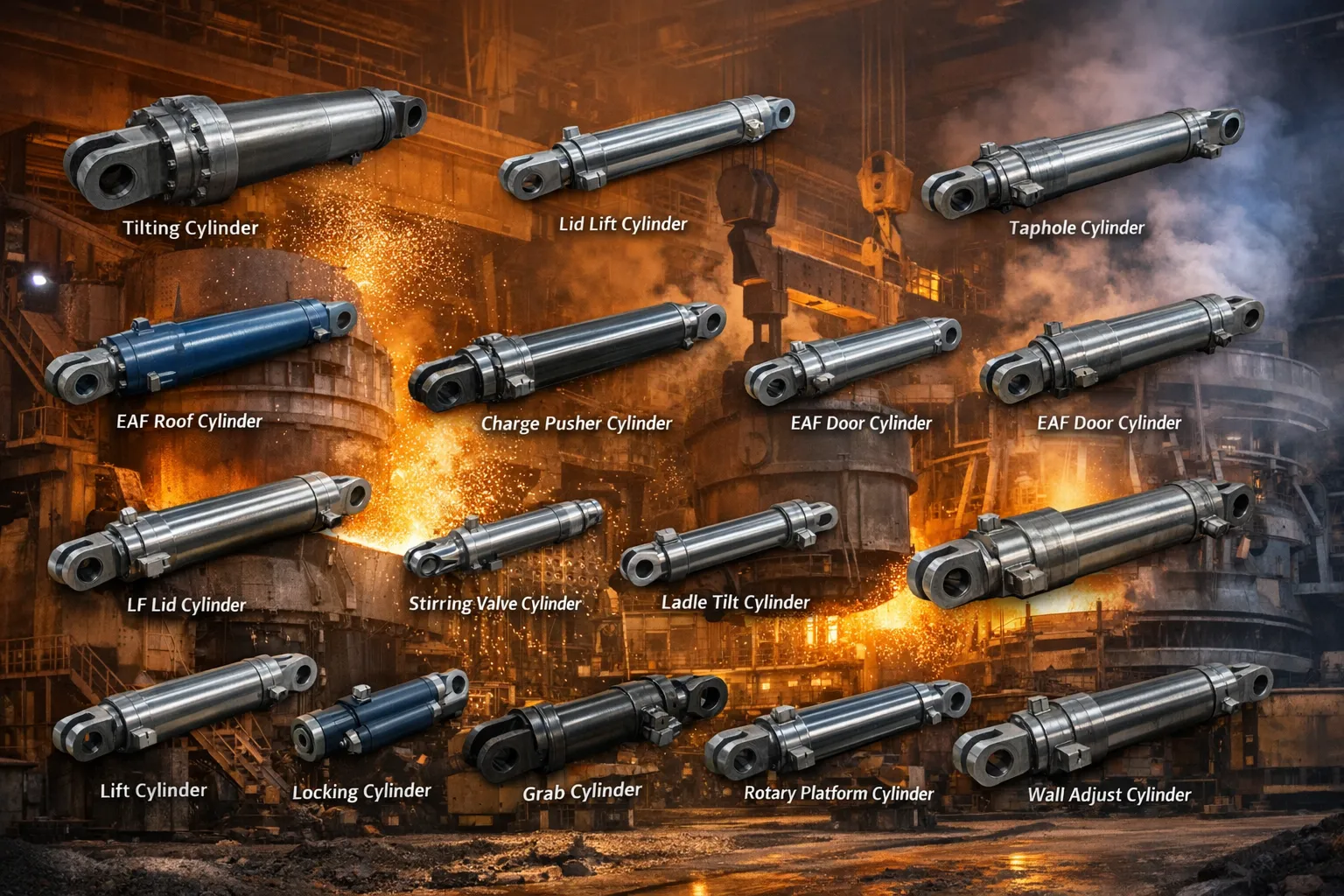
Cement raw material dust — fine limestone, silica, alumina, and iron oxide particles — is among the most abrasive industrial dusts. It is harder than steel, airborne in high concentrations, and penetrates every gap and crevice in the grinding area. The roller press cylinder operates in this environment continuously, with the rod exposed to dust-laden air on every stroke.
Dust ingression into the cylinder is the primary failure mode for roller press cylinders worldwide. Fine abrasive particles that pass the wiper seal embed in the rod seal lip — turning the seal into a grinding surface that wears the rod chrome. Once the chrome is scored, the damage accelerates: the scored rod carries more particles past the wiper, the seal wears faster, and a leak develops that grows until the cylinder must be pulled for repair — an unplanned shutdown that stops the kiln.
Korea Ever-Power addresses dust ingression with a multi-barrier approach: double-lip wiper seals (the first lip stops large particles, the second stops fine particles that pass the first), heavy chrome plating (80–100 µm — thicker than standard to tolerate surface wear without exposing the base metal), and a rod boot or bellows option for the most severe dust environments. The rod boot encloses the entire exposed rod length in a flexible shroud, preventing any dust contact with the chrome surface.
Three Grinding Stages — Same Cylinder, Different Duty
Roller presses are used at three different stages in cement production. The same cylinder design serves all three — the difference is the operating pressure (which sets the grinding force) and the bore diameter (which sets the maximum force capacity).
Crushing limestone, clay, and iron ore into a fine powder (raw meal) before it enters the kiln. The material is moderately hard and abrasive. Typical roller press cylinder bore: 300–500 mm. Operating pressure: 8–12 MPa. The cylinder runs at moderate force — raw meal grinding does not require the extreme pressures used for clinker.
Reducing clinker nodules (the hard, sintered output of the kiln) before the ball mill for final grinding. Clinker is extremely hard (Mohs 6–7) and abrasive. Typical bore: 400–700 mm. Operating pressure: 10–14 MPa (full capacity). The cylinder sees the highest forces and the hardest material in the cement process.
Some modern cement plants use the roller press as the primary finish grinder — replacing or supplementing the ball mill for the final cement product. This requires the finest particle size control and the most consistent gap management. Typical bore: 500–700 mm. Operating pressure: 10–14 MPa. The cylinder's force consistency directly determines the cement fineness — and therefore the cement strength grade.
Manufacturing for Continuous Cement Service
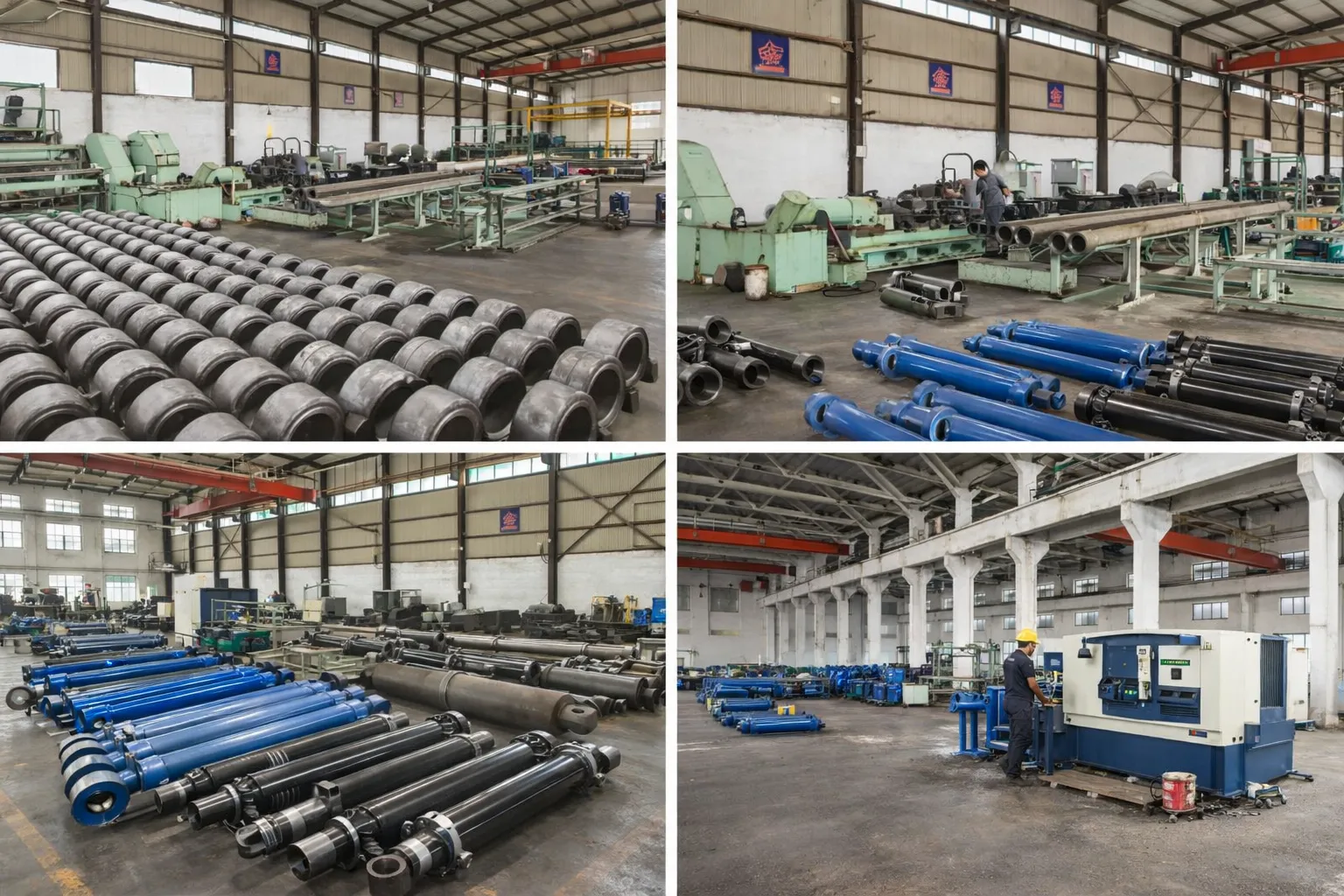
Roller press cylinders must survive 8,000+ hours of continuous oscillating-load duty per year — a demanding combination of sustained pressure, continuous vibration, and extreme dust exposure. Korea Ever-Power builds these cylinders with heavier barrel wall thickness (calculated for fatigue life, not just static pressure), heavy chrome plating (80–100 µm), and double-lip wiper seals as standard.
The bore is honed to Ra 0.2–0.4 µm — the standard for all Korea Ever-Power industrial cylinders. The seal specification prioritises wear resistance and dust exclusion over low friction — the roller press cylinder does not need servo-grade response; it needs seals that last 8,000 hours in the worst dust environment in industry. Polyurethane piston seals and PTFE-bronze rod seals provide the optimal balance of wear resistance, dust exclusion, and pressure sealing for cement service.
Every roller press cylinder is hydrostatic tested at 1.5× working pressure (21 MPa). For customers specifying nitrogen accumulator integration, the cylinder is also tested with the accumulator connected — verifying the "hydraulic spring" behaviour under simulated roller press loading conditions.
OEM & ODM
FAQ
Related Categories
Aanvullende informatie
| Editor |
|---|
Gerelateerde producten
-
Injection Molding Machine Reciprocating Cylinder (Mold Shifting Cylinder)
-
Hydraulic Press Centering Cylinder
-
Injection Molding Machine Ejection Cylinder
-
Electric Furnace Cover Lifting Cylinder
-
Cement Equipment Feeding Cylinder
-
Hydraulic Press Rear Side Shift Cylinder
-
Hydraulic Press Mobile Workbench Cylinder
-
Hydraulic Press Side Cylinder