No-Till Coulter Pressure Hydraulic Cylinder for Conservation Seeders
Heavy-duty 42CrMo alloy steel cylinder with integrated cushioning and oversized piston rod. Built to punch through untilled ground without bending, cracking, or leaking.
No-Till Seeding Puts Hydraulic Cylinders Through Conditions Most Were Never Designed For
Conservation tillage and no-till farming have transformed modern agriculture across Korea, Japan, and large parts of Southeast Asia over the past two decades. The environmental and economic benefits are well documented: reduced soil erosion, better moisture retention, lower fuel consumption, and improved long-term soil health. But these benefits come with a mechanical reality that equipment designers and farmers deal with every season. The seeder has to cut through unbroken ground, crop residue, root mats, and compacted soil layers without any prior tillage pass to soften the surface.
The coulter disc at the front of each planting unit does the hardest work. It slices through the untilled surface to create a narrow slot for seed placement. The force required to drive that disc into hard, undisturbed soil is enormous compared to conventional planting, and every rock, root clump, or compacted zone sends a violent shock back through the opener assembly and straight into the hydraulic cylinder that controls coulter pressure.
Standard agricultural cylinders fail in this role. Their piston rods bend under repeated lateral shock loads. Their seals get destroyed by the constant high-pressure hammering. Their barrels develop fatigue cracks at the weld joints after a single season. The two most reported failure modes in no-till coulter cylinders worldwide are rod bending and seal damage, and both stem from the same root cause: using a cylinder designed for light-duty agricultural work in a high-impact, heavy-load application.
This no-till coulter pressure cylinder was engineered from scratch to survive exactly these conditions. The body and rod are machined from 42CrMo alloy steel, not ordinary carbon steel. The piston rod diameter is oversized relative to bore to resist bending forces. Integrated hydraulic cushioning absorbs end-of-stroke shock loads before they can damage seals or barrel welds. And the seal stack uses high-strength compounds rated for sustained pressure spikes that would shred standard NBR seals within weeks. If you are building, retrofitting, or maintaining no-till seeders for real field conditions, this is the double acting hydraulic cylinder that will not let you down mid-season.
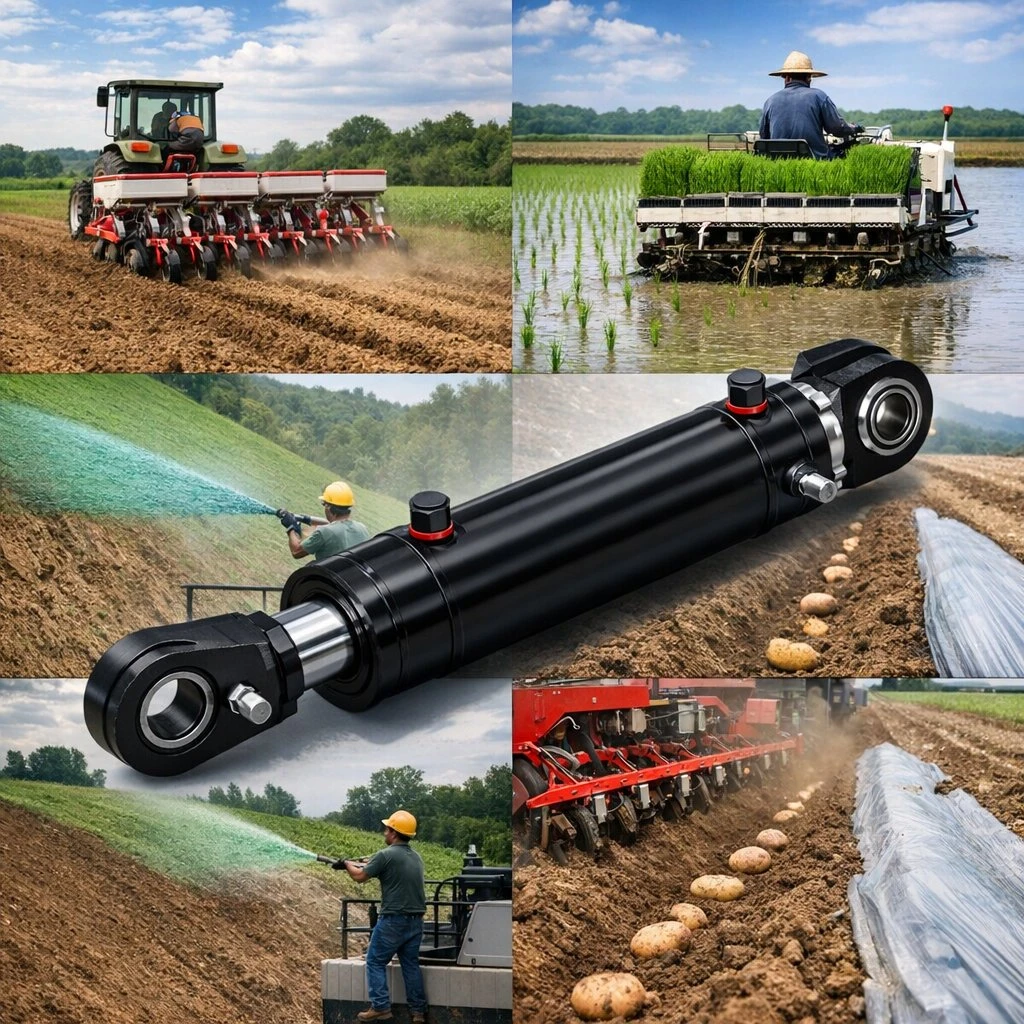
Why Piston Rods Bend in No-Till Applications and How We Prevent It
Rod bending is the failure that ends a cylinder’s life. A bent rod cannot retract properly, scores the bore surface, destroys the rod seal, and often cracks the gland. In conventional agricultural cylinders, this is rare because the loads are moderate and mostly axial. In no-till coulter applications, it is disturbingly common because the loads are neither moderate nor purely axial.
When a coulter disc hits a buried rock or a compacted clay layer, the reaction force does not travel straight back along the cylinder axis. The disc deflects sideways, transmitting a combined axial and lateral load into the rod. A standard rod diameter sized only for axial push force cannot resist this bending moment. After enough cycles, even small lateral loads cause permanent rod deflection that worsens progressively.
Our approach to preventing rod bending addresses the problem at three design levels:
Oversized Rod Diameter: We select a rod diameter that is one standard size larger than what axial load alone would require. For a 63 mm bore cylinder, a conventional design might use a 35 mm rod. Ours uses a 40 mm or 45 mm rod, depending on the application severity. The bending resistance of a solid steel rod increases with the fourth power of its diameter, so even a 5 mm increase in rod size produces a dramatic improvement in resistance to lateral deflection. The trade-off is a slight reduction in retract-side effective area, which we compensate for through system pressure specification.
42CrMo Alloy Steel Construction: Both the piston rod and the cylinder barrel are machined from 42CrMo (AISI 4140 equivalent) quenched and tempered alloy steel, not the S45C carbon steel used in standard agricultural cylinders. 42CrMo delivers a yield strength above 750 MPa compared to roughly 490 MPa for S45C. This means the rod can absorb significantly higher bending loads without permanent deformation. The barrel also benefits from the higher fatigue limit, resisting the cyclic pressure spikes that crack carbon steel barrels at weld joints.
Extended Bearing Length at the Gland: The rod guide bushing inside the gland cap is lengthened beyond standard proportions to provide a wider bearing span. This distributes lateral loads over a larger contact area between the rod and the gland, reducing point stress on both the rod surface and the bushing material. A longer bearing also improves rod alignment during dynamic operation, which prevents the eccentric loading that initiates bending fatigue in shorter-guided designs.
Together, these three measures address the mechanical root causes of rod bending rather than merely increasing material thickness as a brute-force response. The result is a cylinder that survives sustained no-till field use across multiple seasons without developing the progressive rod deflection that sidelines standard units after one hard campaign.
How a No-Till Coulter Pressure Cylinder Operates
The coulter pressure system on a no-till seeder works differently from a simple depth-control cylinder. Rather than holding a fixed position, this agricultural hydraulic cylinder applies a controlled downforce to the coulter disc as the seeder moves forward. Understanding this distinction is important because it affects how the cylinder is specified, plumbed, and maintained.
The coulter disc mounts to the seeder toolbar through a pivoting arm or parallel linkage. The no-till coulter pressure cylinder connects between the toolbar frame and this linkage, usually at a pin or clevis mount. Unlike a depth cylinder that holds a set stroke position, the coulter cylinder is plumbed to maintain a set pressure on the rod side. This pressure pushes the coulter disc downward into the soil with a consistent force, regardless of how deep the disc actually penetrates at any given moment.
As the seeder moves forward, the coulter disc encounters constantly changing soil resistance. When the disc hits a soft patch, it sinks deeper and the rod extends slightly to follow the disc down, maintaining pressure. When the disc hits a hard layer or an obstruction, the reaction force pushes back against the rod and the disc rides up slightly, compressing the oil on the rod side. The system pressure relief valve prevents overpressure, while the cylinder’s internal cushioning absorbs the kinetic energy of the shock without transmitting it through the barrel walls and weld joints.
This constant push-pull cycle happens hundreds of times per minute at field operating speeds. The cylinder piston oscillates in small, rapid movements rather than making full extend-retract strokes. This micro-cycling pattern puts extreme demands on the piston seal, rod seal, and barrel bore surface finish, because the sealing surfaces never get the lubrication benefits of a full stroke wash. Our precision-honed bore and specially formulated seal compounds are selected specifically to handle these short-stroke, high-frequency oscillations without premature wear.
Technical Specifications
The following table shows the customizable specification ranges for our no-till coulter pressure cylinder series. Every parameter can be tailored to match your specific seeder frame geometry and field severity. Speak directly with our engineering team to confirm the best configuration for your machine.
| Parameter | Range / Options |
|---|---|
| Bore Diameter | 40 mm – 100 mm |
| Rod Diameter (Oversized) | 28 mm – 70 mm |
| Stroke Length | 50 mm – 350 mm |
| Working Pressure | Up to 21 MPa (3,045 PSI) |
| Burst Pressure | 63 MPa (9,135 PSI) |
| Action Type | Double Acting |
| Structure | Welded Piston Cylinder with Integrated Cushioning |
| Body Material | 42CrMo Alloy Steel (AISI 4140), Quenched and Tempered |
| Piston Rod Material | 42CrMo Alloy Steel, Hard Chrome Plated (25+ micron) |
| External Surface | Zinc Primer + Epoxy Topcoat / Powder Coat |
| Piston Seal | High-Strength PU + PTFE Wear Ring |
| Rod Seal | FKM (Viton) + PTFE Back-up Ring |
| Dust Seal | Metal-Cased PU Wiper |
| Cushioning | Adjustable Hydraulic Cushion, Both Ends |
| Mounting Options | Clevis, Trunnion, Pin Eye, Spherical Bearing Eye, Custom |
| Port Thread | BSP / NPT / Metric / SAE (per request) |
| Operating Temperature | -30 C to +90 C |
| Hydraulic Fluid | ISO VG 46 / VG 68 Mineral Oil |
| Environment Rating | High-Impact / Hard Soil / Conservation Tillage |
Integrated Cushioning: The Shock Absorber Inside the Cylinder
If the oversized rod prevents bending, the cushioning system prevents everything else from breaking. In no-till seeding, every time the coulter disc slams into a rock, frozen clod, or compacted subsoil, a pressure spike races through the hydraulic circuit. Without cushioning, that spike hits the piston at full velocity against the end cap, producing a metal-on-metal impact that radiates through the barrel welds, port connections, and mounting pins. After thousands of these impacts per season, something gives. Usually the weld joint, sometimes the port fitting, occasionally the end cap itself.
Our no-till coulter pressure cylinder includes adjustable hydraulic cushioning at both the rod end and the cap end. Here is how the mechanism works and why it matters for this specific application.
How the cushion works: As the piston approaches either end of its stroke, a tapered cushion spear enters a close-tolerance bore in the end cap. This traps a small volume of oil between the piston face and the cap wall. Instead of flowing freely back to the tank port, this trapped oil is forced through a small adjustable needle valve. The restriction converts the piston’s kinetic energy into heat in the oil rather than mechanical impact on the cap. The piston decelerates smoothly over the last 15 to 25 mm of travel instead of slamming to a stop.
Why both ends need cushioning: In most cylinder applications, only one end needs cushioning because the load acts in one primary direction. In coulter pressure duty, the cylinder absorbs impacts in both directions. When the disc hits a hard object and bounces upward, the piston slams toward the rod end. When the disc drops back down after passing the obstruction, the piston drives toward the cap end. Both transitions happen violently and rapidly. Cushioning at both ends catches both directions of impact.
Adjustable needle valves: Different soil types and seeding speeds produce different impact severities. A cylinder running in heavy clay requires more cushion resistance than one running in loamy soil. The external needle valves on each end cap allow field adjustment of cushion aggressiveness without disassembling the cylinder. Turn the needle in for harder soils and more aggressive cushioning; open it out for softer conditions where less deceleration is needed. This adjustment takes a flat screwdriver and thirty seconds per end.
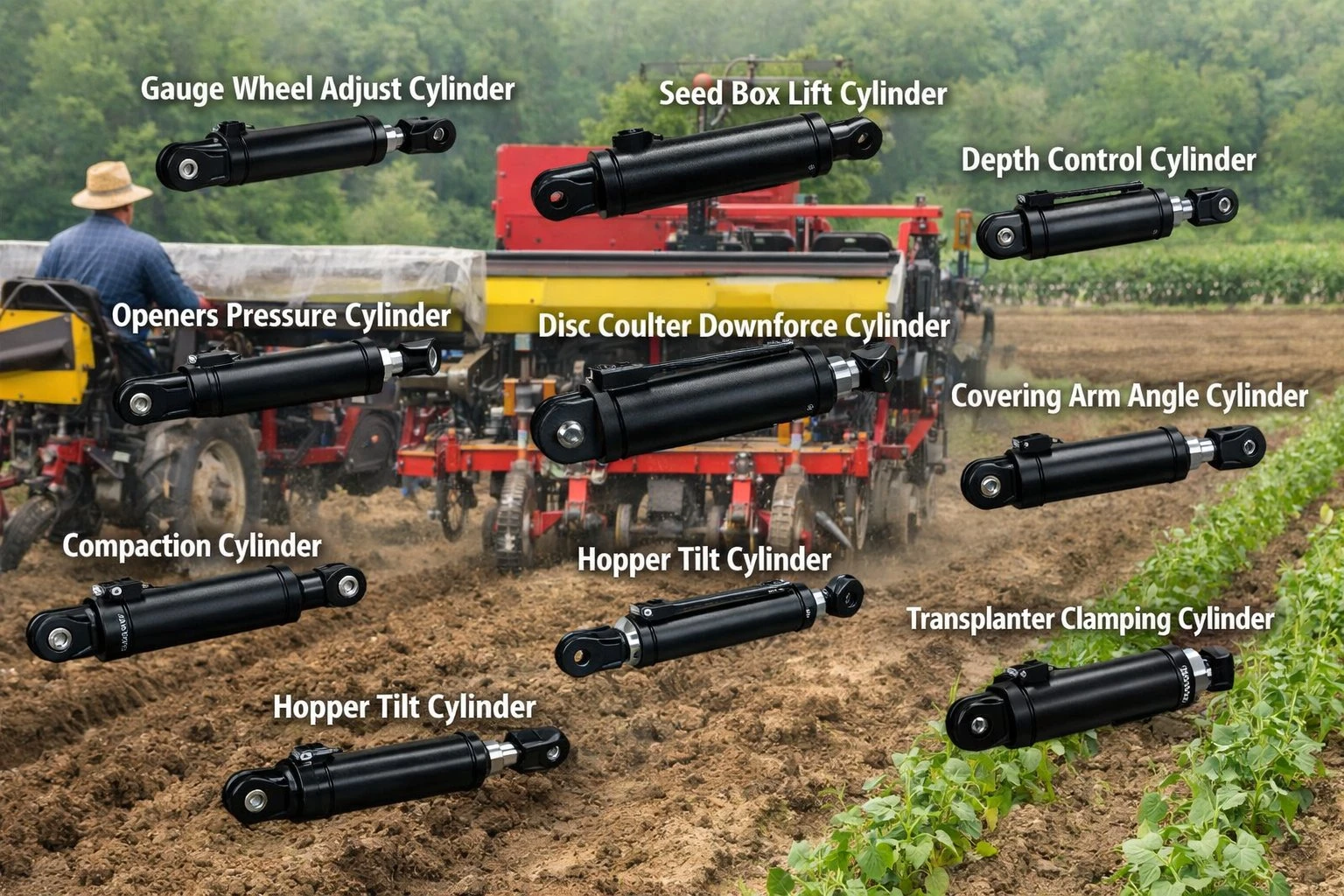
Eight Engineering Advantages for High-Impact Field Conditions
Beyond the oversized rod, alloy steel construction, and dual-end cushioning already covered above, this cylinder packs additional engineering features that address the full spectrum of stresses found in no-till seeding operations.
FKM (Viton) Rod Seals for Pressure Spikes
Standard NBR rod seals lose elasticity and crack under sustained high-pressure cycling above 16 MPa. Our cylinders use FKM fluoroelastomer rod seals that maintain sealing integrity at pressures up to 25 MPa and temperatures from -30 C to +90 C. FKM also resists chemical degradation from hydraulic oil breakdown products that accumulate during high-heat operation, extending seal replacement intervals from one season to three or more.
PTFE Wear Rings on Piston and Gland
The lateral forces that cause rod bending also press the piston and rod against the bore wall, creating metal-to-metal contact that scores the bore surface. Our pistons and gland bushings include PTFE-bronze composite wear rings that absorb lateral loads and prevent metal contact. These rings are self-lubricating and maintain their load-bearing capacity for over 3,000 hours before requiring inspection.
Stress-Relieved Welds for Fatigue Life
Barrel-to-cap welds on cylinders used in impact applications are the most common point of fatigue failure. Residual welding stresses act as stress concentrators that initiate cracks under cyclic pressure loading. Every weld on our no-till cylinders undergoes post-weld stress relief heat treatment to reduce residual stresses below 30% of material yield. This single step roughly doubles the fatigue life of the weld joint compared to as-welded condition.
25-Micron Chrome with Optional Ceramic Coating
The piston rod receives hard chrome plating of at least 25 micrometers, thicker than the 15 to 20 micron standard used in general agricultural cylinders. For customers operating in extremely abrasive conditions like stony or laterite soils, we offer an optional ceramic-oxide overlay that pushes surface hardness above 1200 HV, more than triple the hardness of standard chrome. This virtually eliminates rod scoring from field debris contact.
Metal-Cased Dust Wiper
No-till seeders operate very close to the ground in heavy residue and dust. Our rod gland uses a metal-cased polyurethane wiper that cannot deform or pop out of its groove under impact vibration, unlike press-fit rubber wipers that gradually walk out of position during high-vibration operation. The metal case is crimped into a machined groove in the gland, holding the wiper securely through seasons of abuse.
Spherical Bearing Mount Option
Misalignment between the cylinder axis and the coulter linkage pivot generates side loads that accelerate rod bending and bushing wear. Our spherical bearing rod eye option accommodates up to 5 degrees of angular misalignment, allowing the cylinder to self-align with the linkage geometry as the seeder flexes over uneven ground. This eliminates the point-loading on rod and gland that rigid pin-eye mounts create under misalignment conditions.
Heavy-Duty Port Reinforcement
Hydraulic port bosses on impact-loaded cylinders experience stress concentrations from both internal pressure cycling and external vibration transmitted through connected hoses. Our port bosses are welded with additional reinforcement material and post-weld ground smooth to eliminate notch stress risers. Port threads are CNC-machined after welding, not before, to ensure thread geometry is true even if welding distortion occurs.
Extended Cold-Weather Capability
No-till spring seeding in Korea and northern Japan often starts while overnight temperatures still drop below -15 C. The FKM seal compounds and 42CrMo alloy steel used in our cylinders maintain their mechanical properties down to -30 C, well below the -10 C to -15 C working limit of standard carbon steel cylinders with NBR seals. Early-season planting can proceed without waiting for warmer conditions to protect cylinder integrity.
Primary and Extended Application Scenarios
The high-impact, high-cycle design of this cylinder makes it suitable anywhere a hydraulic cylinder has to maintain controlled force against unpredictable resistance. Below are the applications where our customers put these units to work. For additional hydraulic cylinders for agricultural machinery applications, see our dedicated agricultural solutions page.
No-Till and Minimum-Till Seeder Coulter Assemblies
This is the primary application. Multi-row no-till seeders running at speeds of 8 to 12 km/h through unbroken stubble fields need coulter pressure cylinders that apply 2,000 to 8,000 N of downforce per disc while absorbing constant shock loading. Our cylinder handles this duty cycle with the oversized rod, alloy steel barrel, and dual-end cushioning working together to protect the unit from the accumulated fatigue that kills standard cylinders.
Subsoil Ripper and Deep Tillage Shank Control
Subsoilers that break compacted layers at 300 to 500 mm depth encounter even higher impact loads than coulter discs. The shanks hit rocks, clay pans, and buried debris that transmit massive shock forces into the control cylinder. Our 42CrMo alloy construction and cushioned ends are ideally matched to this application, where standard hydraulic rams frequently fail from barrel cracking and rod bending within a single field season.
Strip-Till Machine Coulter and Shank Pressure
Strip-till systems combine coulter cutting with shank tillage in a narrow band. Each unit requires independent pressure control to adapt to changing soil conditions across the field width. Our compact hydraulic cylinder for farming offers the force density needed in a body that fits the narrow unit spacing on strip-till toolbars.
Cover Crop Seeder Disc Pressure
High-speed cover crop seeders broadcast or drill seed into standing crop residue at speeds up to 16 km/h. The disc openers on these machines face similar impact conditions as no-till grain seeders but at higher frequencies due to the faster travel speed. Our cylinder’s high-cycle fatigue resistance makes it well-suited for these demanding operating speeds.
Heavy-Duty Planter Down-Pressure Systems
Precision planters equipped with active hydraulic down-pressure systems use cylinders to regulate seed unit contact with the soil in real time. The control algorithm adjusts cylinder pressure multiple times per second. Our cylinder’s low breakaway pressure and fast response characteristics enable the precise pressure modulation these systems require, while the fatigue-resistant construction handles the relentless cycling without degradation.
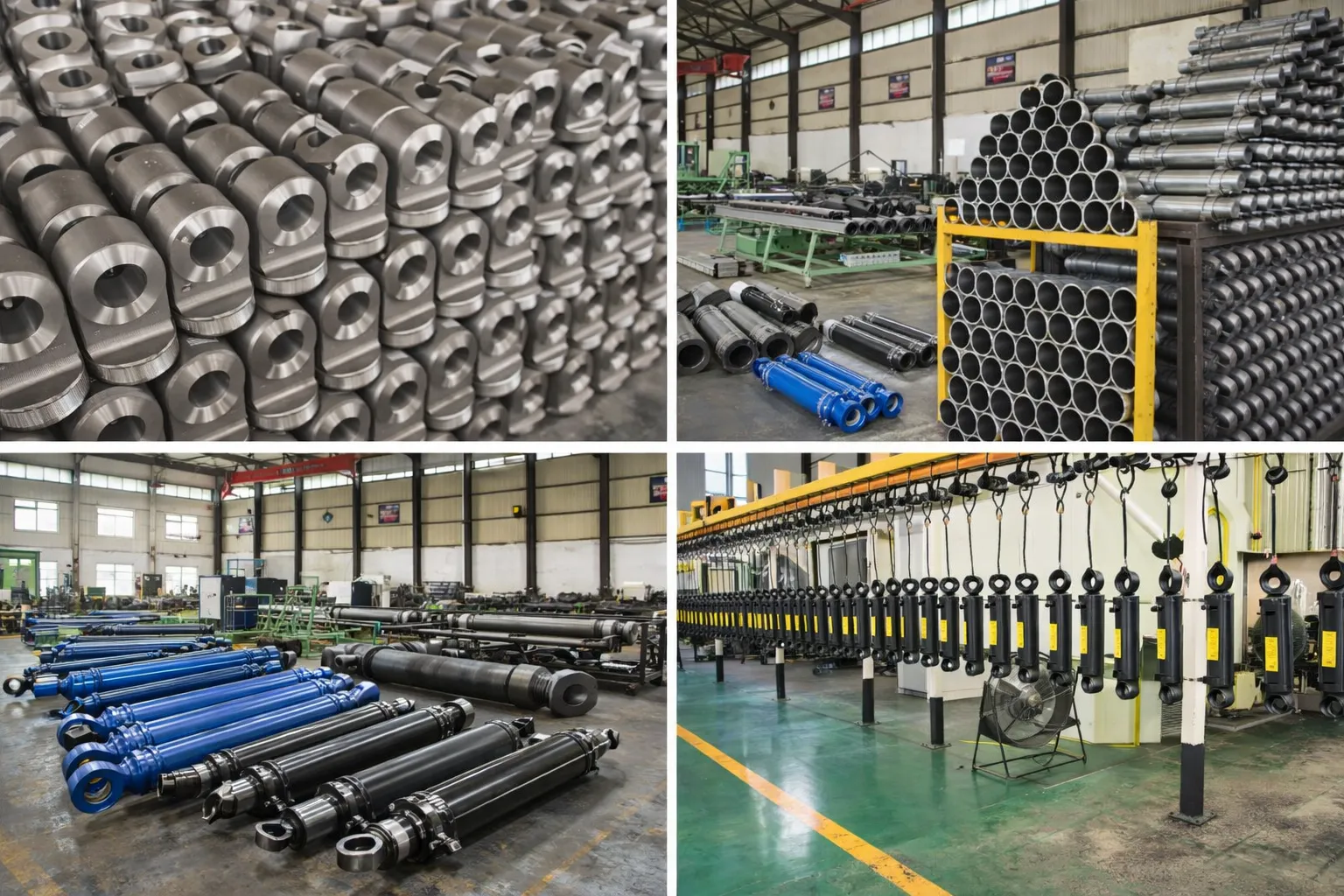
Manufacturing Discipline for a Demanding Application
Building a cylinder from 42CrMo alloy steel is not the same as building one from standard carbon steel. The material is harder to machine, more sensitive to welding parameters, and requires heat treatment steps that carbon steel does not. Our factory has the equipment, processes, and metallurgical expertise to work with this material correctly. Here is what goes into each unit.
Material procurement and incoming inspection: 42CrMo tube and bar stock is sourced from qualified steel mills with full material certificates. Every incoming batch is verified by portable spectrometer and hardness tester to confirm chemical composition and heat treatment condition. Material that does not meet our hardness specification of 28 to 34 HRC is rejected.
CNC machining: Barrels are bored and honed on dedicated machines to achieve bore diameter tolerances of plus or minus 0.02 mm and surface finishes of Ra 0.2. Piston rods are turned, ground to h6 tolerance, and chrome plated. All end caps, pistons, and cushion spears are CNC machined from solid alloy steel bar stock.
Welding with pre-heat and post-weld stress relief: 42CrMo requires pre-heating to 200 to 300 C before welding to prevent hydrogen cracking in the heat-affected zone. After welding, the assembly undergoes stress-relief heat treatment at 550 to 620 C to restore material toughness in the weld area. We monitor furnace temperature profiles with thermocouple data loggers and retain the records as part of the production traceability file.
Seal and component assembly: Assembly takes place in a clean-room controlled area. All internal surfaces are flushed with filtered hydraulic oil before seal installation. Seals are installed using tapered mandrels to prevent lip damage. Cushion valve assemblies are bench-tested individually before installation into the cylinder body.
Pressure and function testing: Every cylinder is tested at 1.5 times rated working pressure held for three minutes, with external leak inspection at all ports, welds, and the rod gland. Cushion function is verified by cycling the cylinder at full speed and confirming smooth deceleration at both ends of stroke. Test records are linked to a unique serial number stamped on the barrel, providing traceability from raw material through final shipment for a minimum of ten years.
Certifications: ISO 9001 quality management system. Material test reports, dimensional inspection records, and pressure test certificates are included with every order. CE-supporting documentation is available for OEM customers who need it for their machine-level compliance.
Generic Agricultural Cylinder vs. Our No-Till Coulter Pressure Cylinder
When a standard farm cylinder is installed on a no-till seeder, certain limitations become obvious within the first season. This table highlights the specific areas where our purpose-built design outperforms generic alternatives under actual no-till field loading conditions.
| No-Till-Specific Metric | Generic Ag Cylinder | Our Coulter Pressure Cylinder |
|---|---|---|
| Rod Material | S45C Carbon Steel | 42CrMo Alloy Steel (Q&T) |
| Rod Bending Resistance (Yield Strength) | ~490 MPa | 750+ MPa |
| Rod Diameter Ratio (Rod/Bore) | 0.50 – 0.55 | 0.63 – 0.70 (oversized) |
| End-of-Stroke Cushioning | None or single-end only | Adjustable, both ends |
| Rod Seal Material | NBR (Nitrile) | FKM (Viton) + PTFE back-up |
| Weld Fatigue Life (cyclic pressure loading) | 100,000 – 300,000 cycles | 1,000,000+ cycles (stress-relieved) |
| Chrome Plating Thickness | 10 – 15 micron | 25+ micron (ceramic option available) |
| Operating Temperature Floor | -10 C to -15 C | -30 C |
| Typical Field Service Life Before Major Overhaul | 1 – 2 seasons | 5 – 7 seasons |
Customer Case Studies
Here are five real-world projects where switching to our no-till coulter pressure cylinders produced measurable, documented improvements in equipment uptime and operating costs.
Frequently Asked Questions
What makes 42CrMo steel better than carbon steel for no-till coulter cylinders?
How does hydraulic cushioning protect a coulter pressure cylinder from damage?
What size cylinder do I need for a no-till seeder coulter assembly?
Can I retrofit cushioned cylinders onto an existing seeder that uses non-cushioned cylinders?
How do I know if my coulter cylinder rod is starting to bend?
What is the lead time and minimum order quantity for these cylinders?
Do you ship no-till seeder cylinders to Korea, Japan, and Southeast Asia?
Your No-Till Seeder Deserves a Cylinder That Fights as Hard as It Does
Tell us your seeder model, coulter downforce requirement, or send us the dimensions of your current cylinder. Our engineering team will propose a matched solution and deliver a firm quotation within 48 hours.
Editor: Cxm