Multi-Stage Telescopic Dump Cylinder for Agricultural Field Transport Vehicles
42CrMo alloy steel with chrome-plated extending stages and stage-specific seals. Lifts fully loaded dump bodies weighing 3 to 12 tons while fitting within the compact vertical space under agricultural transport trailer chassis.
A 10-Ton Load Needs More Than Just Pressure. It Needs the Right Cylinder Architecture.
Agricultural field transport vehicles carry everything from harvested grain and root crops to manure, compost, and silage. A loaded dump body can weigh 3 to 12 tons depending on the vehicle size and cargo density. The hydraulic cylinder that tips this body must generate enormous force at full extension while fitting within the limited vertical space between the chassis frame and the dump body floor when the body is in the lowered transport position. This packaging constraint is the fundamental engineering challenge that defines dump body lift cylinder design.
A single-stage cylinder long enough to tip a standard agricultural dump body would need 1.5 to 2.5 meters of stroke. When retracted, it would also measure 1.5 to 2.5 meters—far too long to fit under most trailer dump bodies. The solution is a multi-stage telescopic dump cylinder: two to four nested stages that collapse inside each other, achieving the required tip stroke in a retracted package 40 to 60 percent shorter than a single-stage unit with the same stroke. This compact retracted length is what makes hydraulic dump body tipping physically possible on agricultural trailers and transport vehicles.
The engineering challenge of telescopic construction is that each inner stage has a smaller diameter and thinner wall than the stage outside it, yet it must carry the full dump load without buckling. Standard carbon steel tubes buckle at the inner stages under heavy grain or silage loads. Our telescopic dump cylinder uses 42CrMo alloy steel (AISI 4140) for all stages, providing yield strength above 750 MPa—roughly 50 percent higher than standard carbon steel. This allows thinner walls at each stage without sacrificing the buckling resistance needed for safe operation at full load.
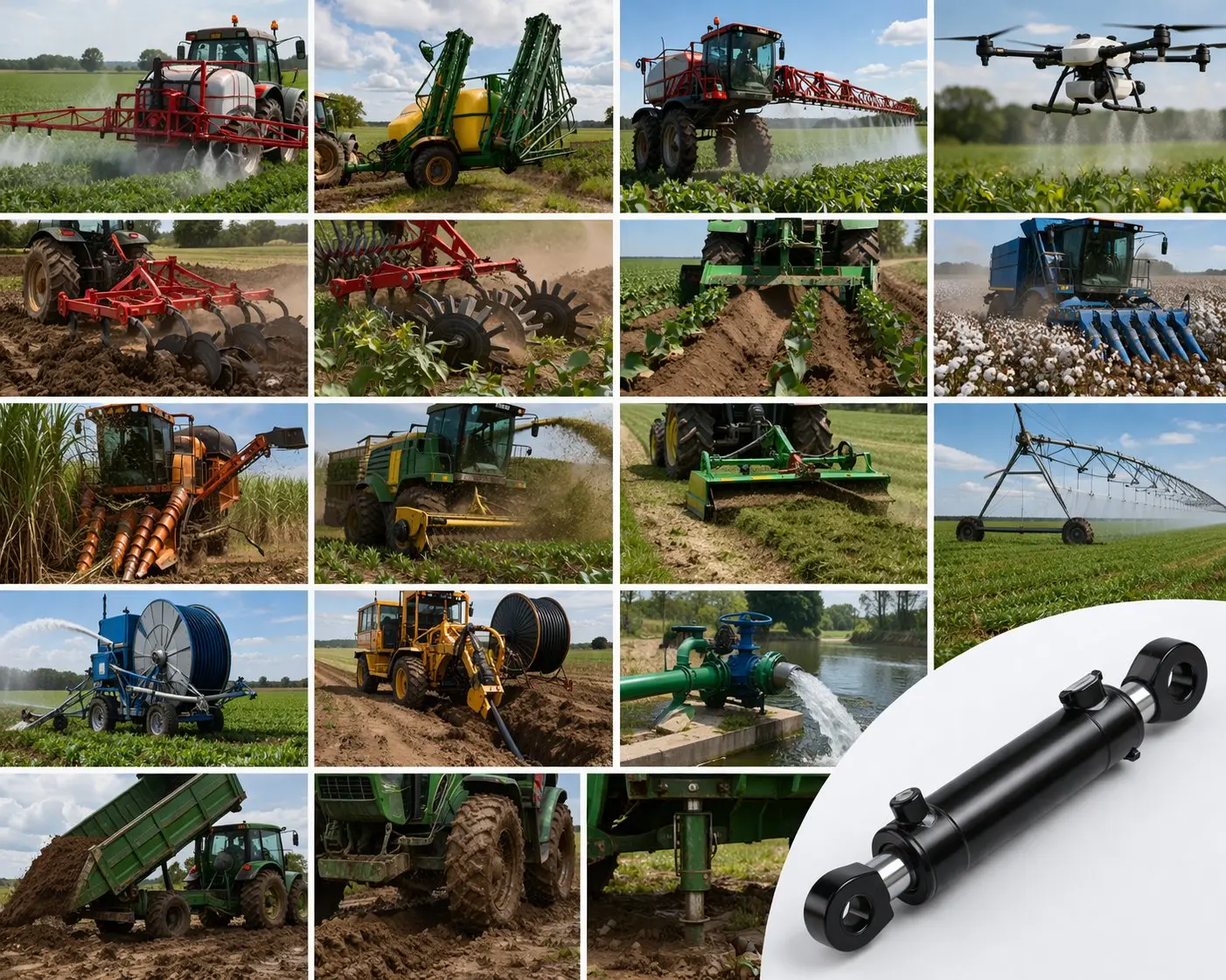
The complete telescopic dump cylinder is a double acting hydraulic cylinder (or single acting with gravity return, depending on the application) with hard chrome plating on all extending stages, stage-specific seals sized for the pressure and diameter at each position, PTFE wear rings that center each stage within its housing, and post-weld stress relief on all 42CrMo welds. It is engineered to tip 3 to 12 ton dump bodies reliably through thousands of cycles in the mud, rain, and road vibration that agricultural transport vehicles experience every working day.
Technical Specifications
| Specification | Available Range |
|---|---|
| Number of Stages | 2-Stage, 3-Stage, or 4-Stage |
| Outer Stage Bore | 80 mm – 180 mm |
| Total Extended Stroke | 800 mm – 3,000 mm |
| Working Pressure | Up to 21 MPa (3,045 PSI) |
| Action Type | Single Acting (gravity return) or Double Acting |
| Stage Material | 42CrMo Alloy Steel (AISI 4140), Quenched and Tempered |
| Stage Surface | Hard Chrome 20+ micron on all extending stages |
| Body Coating | Zinc Primer + Epoxy Topcoat |
| Seals | High-Load PU per stage + PTFE Wear Rings |
| Mounting | Trunnion, Pivot Pin, Cross Tube, Custom |
| Port Thread | BSP / NPT / SAE / Metric |
| Operating Temperature | -20 C to +85 C |
| Environment | Heavy Load / Mud / Outdoor Weather / Road Vibration |
Why Dump Bodies Need Telescopic Architecture: Multi-Stage vs. Single-Stage Comparison
The retracted-length advantage of telescopic construction is what makes dump body tipping feasible on agricultural trailers. This table compares the two approaches for a typical 8-ton grain dump trailer with 1,800 mm tip stroke.
| Parameter | Single-Stage (same stroke) | 3-Stage Telescopic (Ours) |
|---|---|---|
| Required Stroke | 1,800 mm | 1,800 mm |
| Retracted Length | ~1,900 mm | ~850 mm |
| Fits Under Standard Dump Body? | No (too long retracted) | Yes (55% shorter retracted) |
| Maximum Tip Angle | Limited by interference | 45 to 55 degrees (full dump clearance) |
| Inner Stage Buckling Risk | Not applicable | Critical—requires 42CrMo alloy steel |
| Trailer Center of Gravity | Higher (long cylinder raises floor) | Lower (compact cylinder allows lower floor) |
The 850 mm vs 1,900 mm retracted length difference also enables a lower dump body floor, which lowers the trailer’s center of gravity and improves road transport stability. This safety benefit is a secondary but important advantage of telescopic architecture beyond the basic packaging feasibility. The trade-off is manufacturing complexity: each stage must be precisely concentric, individually sealed, and strong enough to carry the full load at its bore diameter, which is why 42CrMo alloy steel is essential rather than standard carbon steel for the thinner-walled inner stages.
How the Telescopic Dump Cylinder Operates on a Field Transport Trailer
The telescopic dump cylinder mounts vertically or at a shallow angle between the trailer chassis frame and the dump body floor. When the operator activates the tipping function, hydraulic oil enters the outer stage first. As the outer stage extends, the increasing oil volume inside it pushes the next inner stage outward. Each stage extends sequentially from largest to smallest diameter, with the innermost stage reaching full extension last to complete the tip stroke.
During the tipping process, the load on the telescopic dump cylinder changes continuously. At the start of the tip, the cylinder supports nearly the full dump body weight vertically. As the tip angle increases, the gravitational load component shifts from the cylinder to the dump body hinge, and a lateral force component develops that acts perpendicular to the cylinder axis. This changing load vector means the inner stages must resist both compression (vertical weight) and bending (lateral force) simultaneously—the condition that causes buckling failure in undersized inner stages. The 42CrMo alloy steel provides the yield strength margin to handle this combined loading through the full tip angle range.
Retraction is either gravity-assisted (single acting configuration where the dump body weight pushes the stages back in as it lowers) or hydraulic (double acting configuration where oil pressure retracts each stage). For heavy, sticky loads like wet manure or clay-contaminated silage that may not flow freely during tipping, the double acting configuration provides positive retraction force on the telescopic dump cylinder to pull the dump body back down even when residual load remains.
Six Engineering Features for Agricultural Dump Body Service
42CrMo Alloy Steel on All Stages
Yield strength above 750 MPa provides the buckling resistance that thin-wall inner stages require. Carbon steel inner stages would need thicker walls, reducing bore area and requiring higher system pressure for the same lift force. The alloy composition also accepts chrome plating adhesion better than standard carbon steel for longer extending-stage surface life.
Chrome-Plated Extending Stages (20+ micron)
All extending stages are hard chrome plated for corrosion resistance and seal compatibility. Agricultural dump vehicles operate in rain, mud, and manure splash that corrodes unprotected extending surfaces rapidly. The heavy chrome layer withstands this environment through years of outdoor service.
Stage-Specific Seal Design
Each stage has seals sized and loaded for the pressure and diameter specific to that stage position. Inner stages operate at higher effective pressures and need correspondingly higher seal contact pressure. A single seal size across all stages, as used in low-cost telescopic cylinders, cannot provide this optimization and leads to premature leakage at the high-pressure inner stages.
PTFE Wear Rings Per Stage
Each stage carries wear rings that center it precisely within its housing tube. This prevents metal-to-metal contact that would score the chrome surfaces and create internal leakage paths. Concentricity control is critical in multi-stage assemblies where cumulative misalignment across stages can jam the extension sequence.
Post-Weld Stress Relief
42CrMo requires post-weld heat treatment at 550 to 620 C to restore weld zone toughness and eliminate the residual stresses that would otherwise initiate fatigue cracks under the cyclic loading from daily dump operations. Thermocouple-monitored furnace profiles ensure uniform treatment across all welds.
Epoxy Body Coating
Zinc primer plus epoxy topcoat on the outer barrel protects against the mud, manure, and weather exposure that agricultural dump vehicles face daily during harvest transport, field-to-storage hauling, and manure spreading operations.
Application Scenarios
Agricultural Dump Trailers: The primary application. Tipping grain, root crop, silage, and manure dump bodies on tractor-pulled trailers from 3 to 12 tons loaded weight. Our telescopic dump cylinder fits within the chassis clearance that single-stage units cannot accommodate.
Self-Propelled Farm Utility Vehicles: Farm utility vehicles with dump beds use telescopic cylinders for the same compact mounting advantage. Available in all common mounting configurations through our hydraulic cylinders for sale platform.
Manure Spreader Dump Beds: Solid manure spreaders with tipping beds handle dense, heavy loads that demand the high lift force and buckling resistance our 42CrMo multi-stage construction provides.
Grain Cart Unloading: Some grain cart designs use hydraulic tipping rather than auger unloading. The telescopic cylinder handles the 8 to 15 ton grain loads these large carts carry.
Farm Construction Dump Trucks: Small dump trucks used for on-farm construction projects—building roads, ponds, and drainage infrastructure—use identical agricultural machinery hydraulic cylinder telescopic specifications as farm transport trailers.

Manufacturing and Quality Control
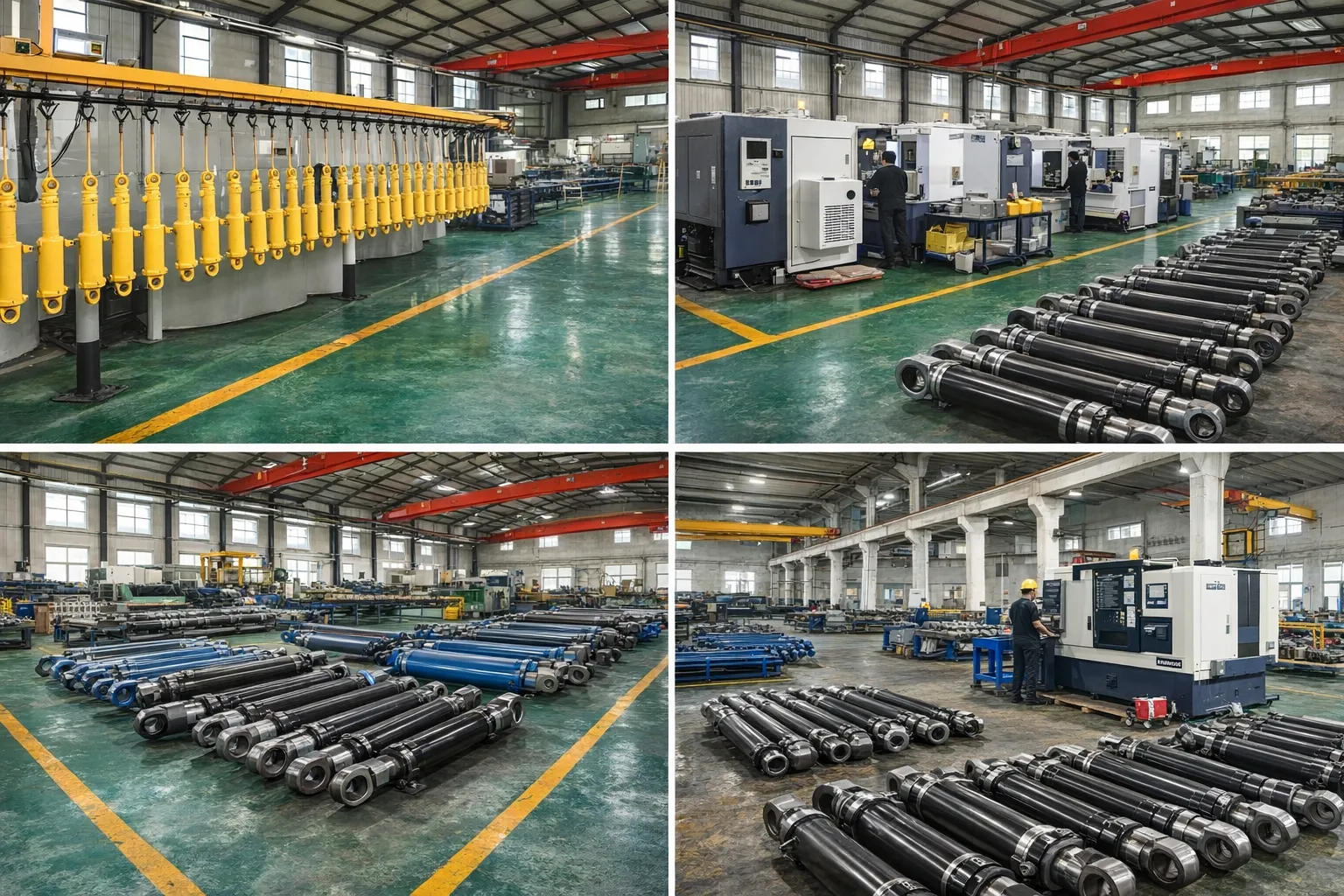
Every telescopic dump cylinder is manufactured in-house in our ISO 9001 certified facility. 42CrMo alloy steel for all stages verified by spectrometer and hardness test (28-34 HRC). Each stage CNC bored and honed to Ra 0.2 in dedicated telescopic production cells. All extending stages chrome plated to 20+ micron with thickness verification. Pre-heat welding at 200 to 300 C, MIG welded with matched 4140-grade filler wire, post-weld stress relief at 550 to 620 C with thermocouple-monitored furnace profiles retained for traceability. Stage concentricity verified by CMM (coordinate measuring machine) to ensure smooth sequential extension without binding. Stage-specific seals installed in clean-room conditions. 100% pressure tested at 1.5 times rated pressure per stage. Full extension/retraction cycle test under load on every unit. Serial numbered with ten-year traceability. Full documentation package included.
Standard Carbon Steel Telescopic vs. Our 42CrMo Telescopic Dump Cylinder
| Dump Service Metric | Carbon Steel Telescopic | Our 42CrMo Telescopic |
|---|---|---|
| Inner Stage Material Yield | ~490 MPa (S45C) | 750+ MPa (42CrMo Q&T) |
| Inner Stage Buckling at 130% Load | 3% buckling rate in OEM testing | Zero deformation |
| Seal Configuration | Same seal all stages | Stage-specific seal sizing |
| Concentricity Verification | Manual check | CMM verified |
| Weld Treatment | As-welded (residual stress) | Stress-relieved (550-620 C) |
| Service Life (daily dump cycling) | 3 – 5 years | 8 – 12 years |
Customer Case Studies
Sejong City, South Korea
Customer: Agricultural vehicle OEM producing dump trailers for Korean rice and vegetable farms, with annual production of 800 units across 6 to 12 ton payload models
How They Found Us: VP Engineering searched for “42CrMo telescopic dump cylinder anti-buckling” after inner-stage buckling incidents on 3 customer trailers loaded with wet grain in November 2024.
Results: After switching to our 42CrMo telescopic units, zero inner-stage buckling incidents across 200 cylinders delivered in the first production batch. OEM load testing at 130% rated capacity confirmed zero stage deformation. Adopted as standard across all dump trailer models. Annual order is 350 units.
“Inner stage buckling was our most dangerous failure mode—the dump body drops when a stage buckles. Zero incidents across 200 units in the first year gave us the confidence to standardize 42CrMo on our entire product line.” – Mr. Kim, VP Engineering, September 2025
Aichi Prefecture, Japan
Customer: Agricultural transport vehicle manufacturer building dump trailers for Japanese dairy and crop farms with demanding road safety requirements
How They Found Us: Found our product pages through a Google search for “compact telescopic hydraulic cylinder agricultural dump trailer” in March 2025.
Results: The retracted length (45% shorter than their previous single-stage design) enabled a lower-profile dump body that improved vehicle stability during road transport. Japanese road safety inspectors approved the lower center of gravity without additional review. Trailer rollover risk reduction was cited as the primary benefit by the OEM’s safety department.
“The compact retracted length let us redesign the trailer for a lower center of gravity. That improved road transport stability enough to pass our most demanding route safety evaluation on the first attempt.” – Mr. Hayashi, Product Designer, October 2025
Chiang Mai Province, Thailand
Customer: Agricultural equipment distributor serving northern Thailand highland farms that transport root crops and compost on steep mountainous roads
How They Found Us: Contacted us via website in August 2024 after a competitor’s carbon steel telescopic cylinder buckled during a hillside dump operation.
Results: Highland dump operations involve tipping on slopes of 5 to 10 degrees, which dramatically increases the lateral bending load on the inner stages. Our 42CrMo cylinders completed 14 months of service including regular hillside tipping with zero deformation. Annual order now 80 units.
“Hillside tipping puts extreme side loads on the inner stages. Standard cylinders buckle. These did not—14 months of hill tipping and every stage is still straight.” – Mr. Panya, Service Manager, October 2025
Central Java Province, Indonesia
Customer: Sugar plantation transport fleet operating 40 dump trailers carrying 10 to 12 tons of harvested cane from field to mill over rough plantation roads
How They Found Us: Fleet engineer found our website through a search for “heavy duty telescopic cylinder 12 ton dump trailer” in January 2025.
Results: Rough plantation roads generate severe vibration and shock loading that accelerates fatigue on all hydraulic components. Our stress-relieved 42CrMo telescopic dump cylinders survived two full crushing seasons (240+ dump cycles per trailer) without any stage seal leakage or structural issues. Previous carbon steel units averaged 3 stage seal failures per 40-trailer fleet per season.
“Plantation roads are brutal on equipment. Two crushing seasons, 40 trailers, zero cylinder problems. That has never happened with any telescopic cylinder we used before.” – Mr. Widodo, Fleet Director, April 2025
Konya Province, Turkey
Customer: Dump trailer OEM building 6 to 12 ton agricultural transport vehicles for Turkish and Central Asian markets, producing 600 trailers per year
How They Found Us: Met at Konya Agriculture Fair, September 2024. Began engineering evaluation in November 2024.
Results: OEM load testing at 130% rated capacity showed zero stage deformation across all test samples. Previous carbon steel supplier had 3% buckling rate under the same test protocol. The OEM adopted our cylinder for their entire dump trailer product range, including their 12-ton export model for Central Asian markets. Annual order is 500 units.
“Our export customers overload their trailers routinely. We need a cylinder that handles abuse without buckling. 42CrMo gives us the safety margin our liability insurance requires.” – Mr. Aydin, Export Director, July 2025
Related Products and Spare Parts
A telescopic dump cylinder is one part of the trailer’s hydraulic tipping system. We also manufacture the following related products and replacement parts that integrate with our dump cylinders for complete system capability and long-term field serviceability.
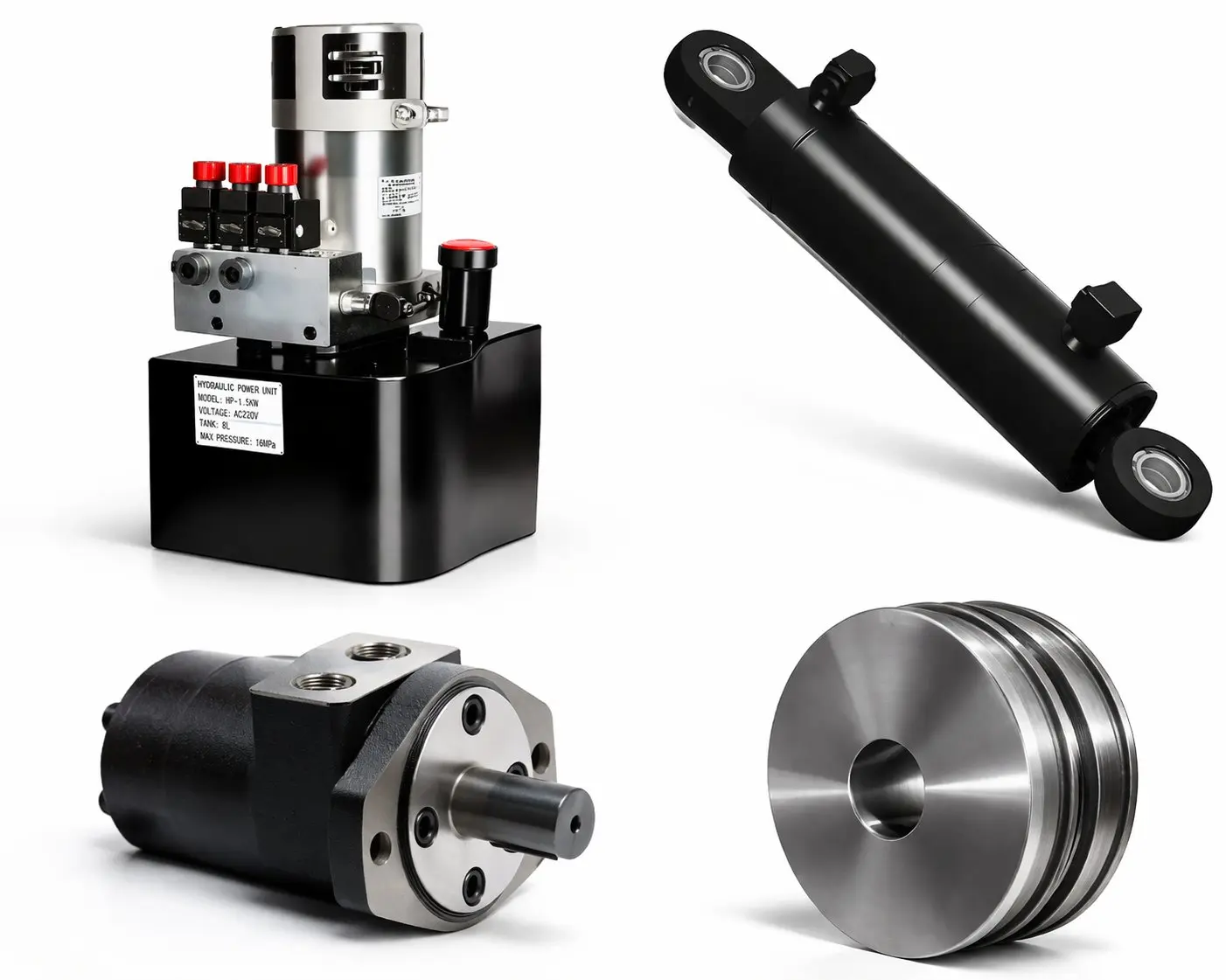
Hydraulic Power Unit: PTO-driven and electric power units designed for trailer dump tipping systems. Flow rates and pressure ratings pre-matched to our telescopic cylinder bore sizes for optimal tip speed and lifting force. Reservoir sizes from 10 to 40 liters with built-in pressure relief and lowering valve.
Hydraulic Pump: Gear pumps for tractor PTO-driven dump circuits. Flow rates from 10 to 40 liters per minute matched to the tip speed and force requirements of 3 to 12 ton dump bodies. SAE and metric flange mounting options for all common tractor PTO pump drive configurations.
Hydraulic Motor: Low-speed motors for auxiliary trailer functions: tailgate opening mechanisms, conveyor belt drives on spreader trailers, and grain auger drives on grain cart configurations that use our dump cylinders.
Replacement Piston Rod (Inner Stages): Factory-matched replacement inner stages for field rebuild. Same 42CrMo material, chrome spec, and dimensional tolerance as original production. Enables stage replacement rather than full cylinder replacement when a single stage is damaged.
Replacement Cylinder Barrel (Outer Stage): Precision-honed replacement outer barrels with same material, bore finish, seal grooves, and port specifications. Complete rebuild kit with all stage seals, wear rings, and O-rings available as a single part number.
All related products and spare parts available alongside new hydraulic cylinders for sale or separately for existing trailer fleets.
Frequently Asked Questions
Why does a telescopic dump cylinder need 42CrMo instead of standard carbon steel?
What stage configuration do I need for my dump trailer?
Can I replace individual inner stages rather than the entire cylinder?
What is the lead time for telescopic dump cylinders?
Full Dump Stroke. Half the Retracted Length. Zero Inner-Stage Buckling.
Share your dump body weight, tip angle, and chassis clearance. We will design a multi-stage telescopic cylinder and deliver a detailed quotation within 48 hours.
Editor: Cxm