Stone Bucket Lift Cylinder for Rock Picker
Eradicate catastrophic base weld fractures and conquer the most brutal rock impacts in agricultural land clearing. Engineered with massively enlarged flanges and 100% full-penetration ultrasonic-tested welds for absolute lifting dominance.
Product Overview: Surviving the Most Violent Agricultural Environment
The agricultural sector faces an escalating demand for arable land, pushing farming operations into increasingly marginal, rocky terrains. Transforming these rugged, mountainous landscapes into highly productive agricultural acreage requires massive, unyielding mechanical intervention. In the highly varied and geographically challenging topographies of South Korea, Japan, Taiwan, and other intensely farmed Asian regions, the soil is frequently saturated with dense granite, subterranean bedrock, and heavy glacial till left behind by centuries of geological shifting. Before a single seed can be safely planted, this treacherous land must be rigorously cleared using heavy-duty, tractor-drawn stone pickers. These massive implements operate by digging aggressively into the topsoil, scooping up earth and rocks, sifting out the dirt through heavy steel grates, and violently throwing the remaining heavy stones into a large, rear-mounted steel collection hopper. As the tractor continuously traverses the field, this hopper accumulates multiple tons of jagged, shifting, and unyielding rock. When the hopper finally reaches its maximum volumetric capacity, the operator must elevate this colossal, unbalanced load high into the air to dump it into a waiting transport truck or designated edge-of-field rock pile. The sole mechanical component responsible for executing this terrifyingly heavy and highly dynamic lift is the Stone Bucket Lift Cylinder.
Subjecting a fluid power actuator to this specific environment introduces an incredibly destructive combination of forces: extreme heavy loads compounded by violent, unpredictable stone impacts. As the tractor drags the implement over uneven, rutted terrain, the multi-ton load of rocks inside the hopper shifts suddenly, sending massive kinetic shockwaves crashing directly into the hydraulic mounting points. Standard, commercial-grade hydraulic parts are simply not forged to survive this localized chaos. The absolute most critical point of structural failure occurs at the base of the actuator. When the heavy stone hopper bounces during transit, the entire multi-ton load attempts to literally rip the bottom mounting eyelet clean off the barrel. Standard surface fillet welds fracture almost immediately under this intense tearing force, leading to catastrophic cylinder bottom weld cracking, explosive hydraulic fluid loss, and a highly dangerous free-fall of the loaded hopper. This catastrophic failure instantly halts land clearing operations, forcing crews into expensive, time-consuming cycles of emergency fixing hydraulic cylinders in the mud, losing precious daylight and seasonal profitability.
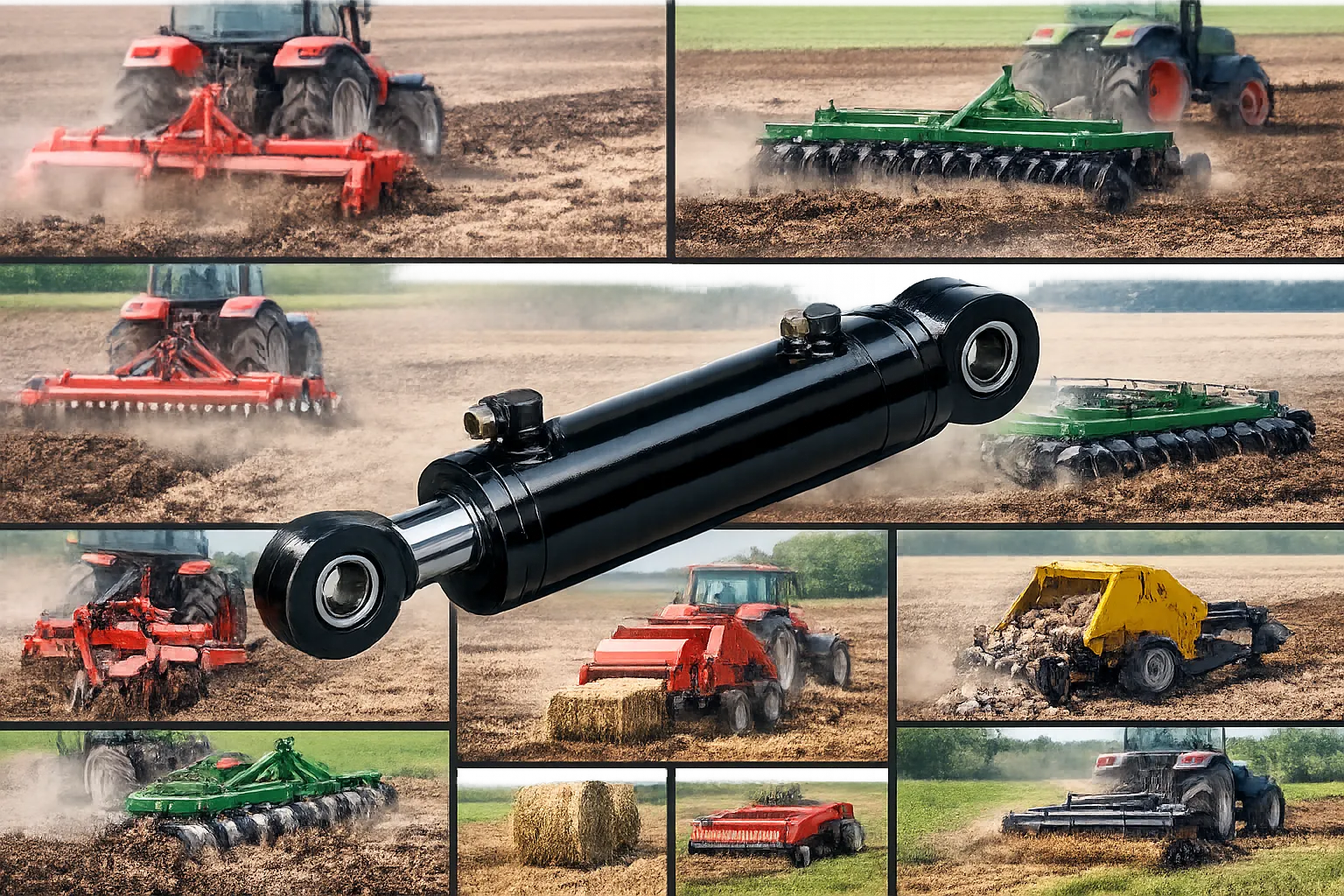
Operating internationally as an elite, deeply specialized hydraulic cylinder manufacturer, we refuse to accept structural failure as a normal part of heavy farming. We have fundamentally redesigned the hydraulic cylinder to completely dominate this exact failure mode. By utilizing premium Q345D low-temperature structural steel, engineering radically enlarged bottom flanges, mandating 100% full penetration automated welding, and enforcing rigorous ultrasonic flaw detection, we produce an actuator that treats heavy rock shock-loads as routine operations. When agricultural fleet directors evaluate the true, long-term cost of equipment ownership, our optimized hydraulic cylinder price, combined with absolute structural invincibility, delivers unparalleled operational uptime and profitability for the modern farm.
Definitive Technical Specifications for Severe Rock Impacts
Surviving a continuous onslaught of multi-ton boulders requires absolute transparency in metallurgical selection and structural joining specifications. The engineering matrix below delineates the highly specialized, anti-fracture configuration of our heavy lifting actuators. Because we operate as a primary, fully vertically integrated manufacturer, we possess the comprehensive CNC machining capacity to easily adapt closed lengths, operational stroke dimensions, and exact clevis geometries to flawlessly align with any specific OEM rock picker chassis without requiring dangerous field modifications.
| Engineering Attribute & Metric | Precise Specification Details |
|---|---|
| Target Industrial Sector | Agriculture / Land Clearing and Ground Preparation |
| Primary Equipment Category | Tillage Machinery (Heavy-Duty Rock Pickers, Stone Collectors) |
| Subsystem Application Focus | Stone Bucket / Collection Hopper Lifting Mechanism |
| Official Product Designation | Stone Bucket Lift Cylinder |
| Kinematic Action Mechanism | Double acting hydraulic cylinder |
| Internal Structural Format | Heavy-Duty High-Capacity Piston Cylinder |
| Manufacturing Assembly Method | Fully Welded Rigid Construction (Submerged Arc Technology) |
| Core Base Material System | Q345D Low-Temperature High-Toughness Structural Steel |
| Rod Surface Metallurgy | Extra-Thick Hard Chrome Plating (Maximum Impact Deflection) |
| Environmental Threat Rating | Extreme Severity: Heavy Load Tonnage + Direct Rock Impact Shockwaves |
| Primary Working Condition Objective | Lifting fully loaded stone bucket for dumping and safe lowering |
| Typical Industry Failure Mode | Cylinder Bottom Weld Cracking / Catastrophic Base Shear |
| Recommended Engineering Upgrade | Enlarged Cylinder Bottom Flange + Full Penetration Welding + Flaw Detection (UT) |
Operational Dynamics: Taming Multi-Ton Kinetic Forces
To fully understand exactly why standard hydraulic components fail so spectacularly and dangerously in rock pickers, one must closely examine the extreme physics occurring inside the fluid chamber. The steel collection bucket acts as a massive cantilevered pendulum loaded with irregular, actively shifting dead weight. When the tractor operator engages the dump valve in the cabin, highly pressurized fluid from the main hydraulic pump surges directly through thick, wire-braided hoses into the base port (cap end) of the actuator.
This immense influx of pressurized oil pushes violently against the full, flat surface area of the internal hydraulic cylinder piston. This immense volumetric pressure converts instantly into raw linear mechanical force, driving the thick, chromed rod outward. The rod acts as a massive steel lever, forcefully elevating the heavily loaded bucket upward and tilting it past its pivot point to discharge the boulders. Because the heavy bucket must be actively controlled on its way back down to prevent it from free-falling and shattering the implement chassis, relying on a single acting hydraulic cylinder is functionally impossible and highly irresponsible. A single-acting unit relies solely on gravity to drop the bucket, which offers zero deceleration control.
This critical high-tonnage subsystem strictly mandates a heavy-duty double acting hydraulic cylinder. By routing highly pressurized fluid to the rod end during the descent, the system provides active hydraulic resistance, acting as a massive fluid brake and allowing the massive bucket to lower smoothly and safely. However, the most destructive forces actually occur when the machine is actively driving and collecting rocks. As the heavy steel reels smash large boulders into the empty bucket, instantaneous kinetic shockwaves travel through the steel pins directly into the cylinder barrel. Because hydraulic fluid cannot compress, this shockwave slams into the internal piston and transfers 100% of its chaotic violence directly into the base weld attaching the cap to the barrel. Cheap, shallow surface welds instantly fatigue, crack, and tear open under this bombardment. Our specialized architectural design, utilizing significantly enlarged flanges, massively increases the surface area of the weld zone, successfully distributing and safely absorbing these lethal kinetic impacts.
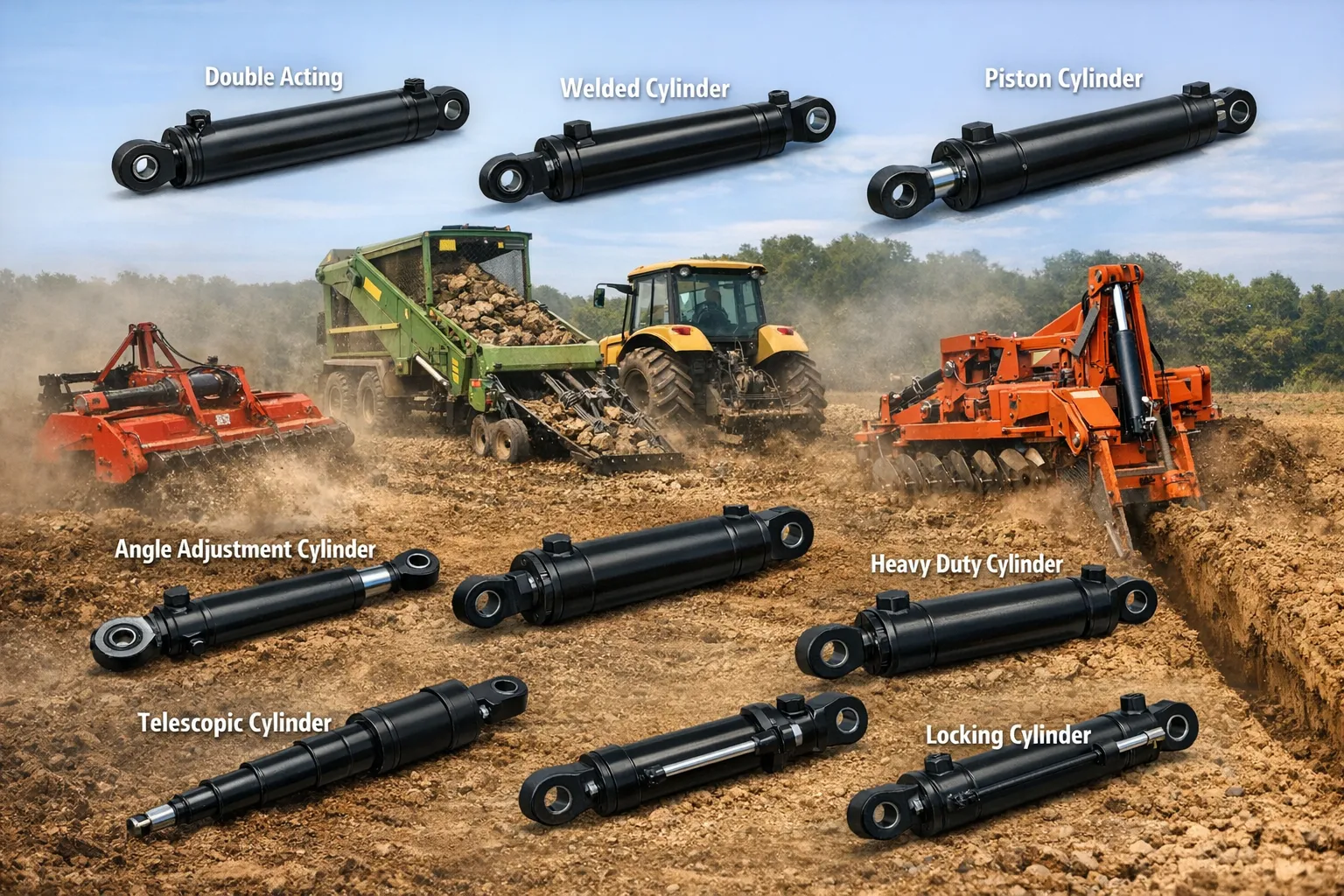
Flawless OEM Interoperability & Heavy Fleet Integration
When a lifting actuator suffers a catastrophic base weld fracture in the middle of a massive land-clearing contract, fleet managers do not have the luxury of time to fabricate custom mounting plates, torch-cut steel, or irreversibly modify their expensive implements to accept ill-fitting aftermarket parts. We have meticulously and aggressively mapped the complex dimensional geometry of the global agricultural tillage and stone-picking market. By perfectly replicating exact retracted closed lengths, extended stroke boundaries, and precise mounting clevis pin hole diameters, our heavy-duty hydraulic rams serve as immediate, flawless drop-in structural upgrades that require absolutely zero chassis modification to install.
Our customized, heavily reinforced fluid power solutions seamlessly integrate with rock pickers pulled by the industry’s leading heavy, high-horsepower tractor manufacturers across Asia and the globe. We routinely supply highly durable replacements perfectly compatible with heavy stone picking machinery from Degelman, Schulte, Kongskilde, Haybuster, ELHO, Highline, as well as implements matched with Kubota, Yanmar, Daedong (KIOTI), LS Mtron, TYM, Iseki, John Deere, Case IH, and New Holland tractors. (Please Note: The explicit mention of these original equipment manufacturers is provided strictly to demonstrate precise dimensional compatibility and assist fleet maintenance teams in accurate parts selection; it does not imply official OEM endorsement, sponsorship, or trademark infringement of any kind.)
Core Engineering Advantages: Forged to Eradicate Weld Failure
Mass-produced, generic actuators are manufactured for smooth, stationary industrial environments; they are fundamentally incapable of surviving the brutal realities of jagged rock impacts and extreme field bouncing. Our advanced engineering division has embedded a comprehensive suite of highly specific metallurgical and structural defenses directly into the architecture of our products to guarantee true, multi-season reliability in the most hostile agricultural environments.
1. Enlarged Cylinder Bottom Flange Design
This is the definitive structural upgrade that solves the most common and dangerous failure mode. Standard commodity cylinders weld a small base cap directly to the thin edge of the barrel tube, creating a tiny, fragile stress concentration point. We engineer our lift cylinder units with an oversized, extra-thick steel flange at the base. This massive increase in surface area distributes the violent kinetic shockwaves from falling boulders across a much wider structural footprint, drastically lowering the pounds-per-square-inch (PSI) stress on the actual weld joint.
2. 100% Full Penetration Robotic Welding
A large flange is useless if the weld itself is weak. We entirely reject cheap surface fillet welds that leave hollow voids inside the joint. We utilize highly automated submerged arc welding with proper joint beveling, allowing molten steel to completely penetrate and fuse the entire thickness of the metal, creating a monolithic, unbreakable joint.
3. Ultrasonic Flaw Detection (UT)
We do not rely on visual inspections for load-bearing joints. Every single structural joint undergoes mandatory Ultrasonic Flaw Detection (UT). High-frequency acoustic scanning guarantees there are zero microscopic internal cracks, slag inclusions, or air pockets deep inside the weld that could expand under heavy lifting loads.
4. Q345D High-Toughness Alloy Steel
Standard 1045 carbon steel becomes brittle and fractures easily under high-impact shock, especially in colder early-spring planting weather. We construct our pressure barrels and mounting flanges exclusively from Q345D. This highly specific low-alloy structural steel possesses a significantly higher yield point and incredible low-temperature impact toughness. It safely absorbs massive mechanical shocks without shattering.
5. Severe Heavy-Dust Sealing Matrix
The continuous, violent shifting of rocks creates extreme dust clouds. We deploy an advanced polyurethane sealing matrix backed by specialized anti-extrusion rings. The rigid outer lip physically chips away hardened mud from the rod during retraction, while the secondary inner lips maintain an absolute labyrinth barrier against microscopic dust, protecting your internal hydraulic cylinder components.
6. Advanced Internal Piston Wear Guidance
When lifting a lopsided load of rocks on a severe hillside incline, the cylinder rod experiences intense lateral side-loading forces that attempt to bend it. To combat this, we integrate extra-wide PTFE/Bronze composite wear bands onto the massive internal piston. These premium guide rings provide an incredibly low-friction bearing surface that prevents the steel piston from ever touching the steel barrel wall, entirely eliminating catastrophic internal metal-to-metal scoring.
7. Thermal Stability & Fatigue Life Optimization
The continuous, rapid cycling of the hopper during heavy clearing generates massive internal fluid friction and heat. Standard nitrile rubber seals harden and crack under this thermal load. We deploy advanced, high-temperature polyurethane and FKM seal packages that retain perfect molecular elasticity even during 14-hour continuous harvesting shifts in the summer heat, ensuring zero fluid bypass and maximizing fatigue life.
8. Micro-Cracked Hard Chrome Plating
To defend against physical scoring from flying field debris and rock shrapnel, the rod undergoes an ultra-thick hard chrome plating process. The surface is intentionally micro-cracked to trap trace amounts of lubricating fluid, drastically lowering dynamic seal friction while providing an incredibly hard, armor-like shell against rock strikes and corrosive agricultural chemicals.
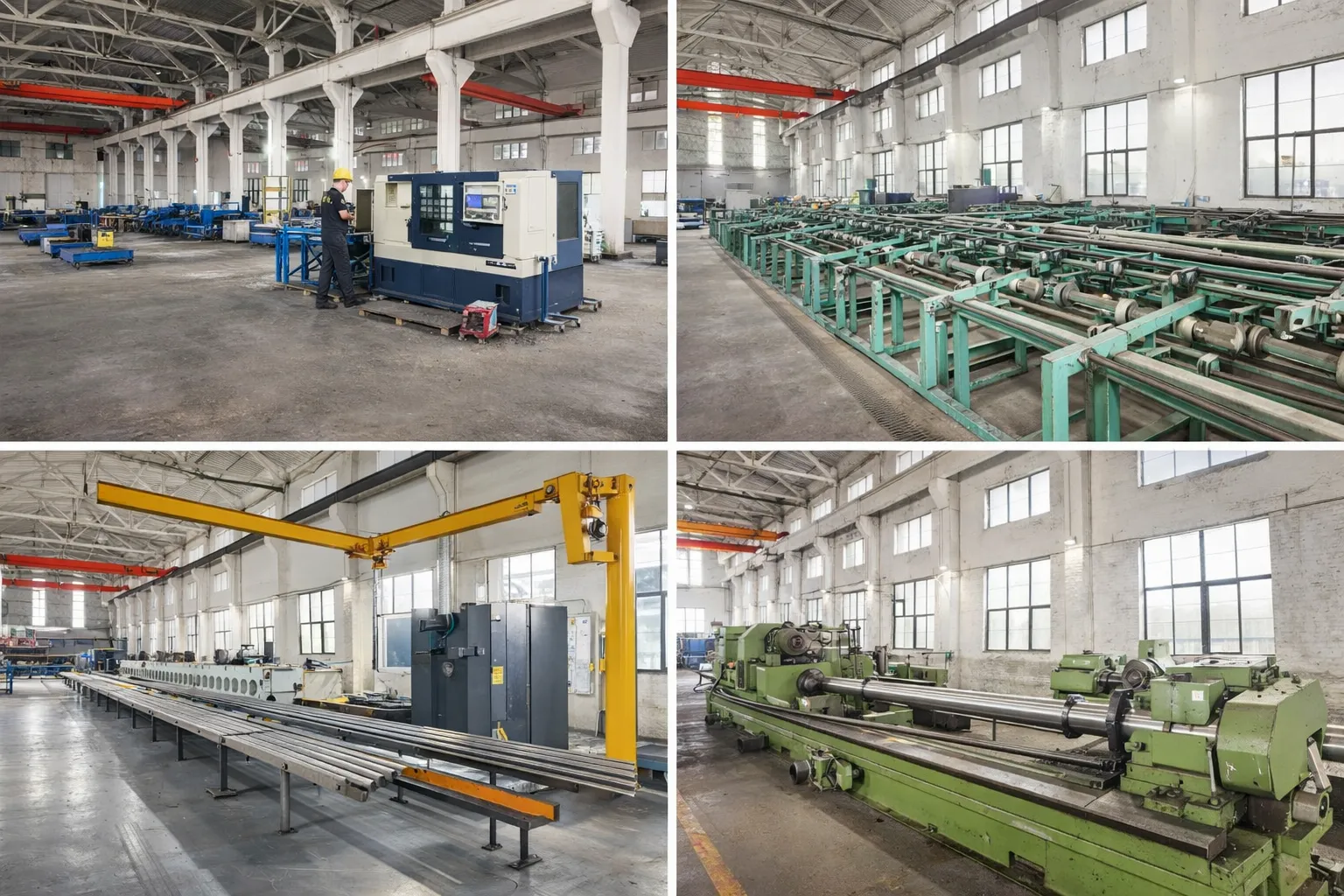
Autonomous Manufacturing and Uncompromising Traceability
Producing a fluid power component capable of safely managing multi-ton rock loads suspended directly above expensive equipment requires absolute, unyielding control over the entire production supply chain. We are not a superficial assembly warehouse for outsourced, low-grade commodity parts; we are a fully vertically integrated heavy manufacturing powerhouse. From the initial multi-axis CNC lathing of the thick Q345D steel billets to the robotic submerged arc welding of the enlarged flanges, every critical phase is rigorously executed within our ISO-certified facilities to ensure aerospace-grade dimensional concentricity and maximum structural toughness.
Because a base weld failure in this application is a catastrophic and potentially lethal event, our quality control methodology is famously aggressive and uncompromising. Following the mandatory Ultrasonic Testing (UT) of the base welds, we strictly enforce a 100% factory hydrostatic testing protocol on every single unit. We completely reject the dangerous industry standard of statistical batch testing. Before any hydraulic parts are cleared for global packaging, they are securely locked into a massive dynamic test rig, pressurized to 1.5 times the maximum rated operational pressure limit, and actively stroked under heavy mechanical resistance.
Our quality assurance engineers meticulously monitor high-precision digital transducers to verify the absolute absence of internal fluid bypass and zero external weeping at the rod gland. The pressure is held static for an extended duration to confirm zero pressure drop, proving the absolute integrity of the seals and the massive base welds. Most importantly, the base welds are monitored for any signs of micro-yielding under extreme pressure. Only units that survive this brutal evaluation receive a permanent, laser-etched serial code. This meticulous process provides total metallurgical and testing traceability, guaranteeing our B2B partners receive a premium component that eliminates unpredictable catastrophic weld failures and effectively ends the constant, expensive requirement for hydraulic cylinder repair in the field.
Expansive Heavy-Duty Industrial Applications
While the dramatically enlarged flanges, full-penetration UT-tested welds, and Q345D steel architectures were originally forged specifically to conquer the violent impact and heavy dead-weight of agricultural rock pickers, these core structural principles provide massive reliability upgrades across multiple severe-duty industrial sectors. Any operational environment plagued by immense payload lifting, shifting centers of gravity, and heavy dynamic shock loads demands this level of fortification.
Heavy machinery designers actively integrate our rugged fluid power solutions into the mining industry, equipping massive underground loaders and articulated dump bodies where rock impacts and bouncing loads are a constant reality. Furthermore, the extreme tensile strength provided by our welding methodology makes these units highly prized within the demanding construction machinery industry for excavator boom and heavy bucket operations. We also regularly provide extreme-duty actuators capable of surviving the severe heat and massive ladle loads in the metallurgical and iron industry. When massive holding force and absolute structural immunity to weld cracking are non-negotiable, our heavily reinforced hydraulic cylinder components remain the definitive choice for heavy equipment engineers globally.
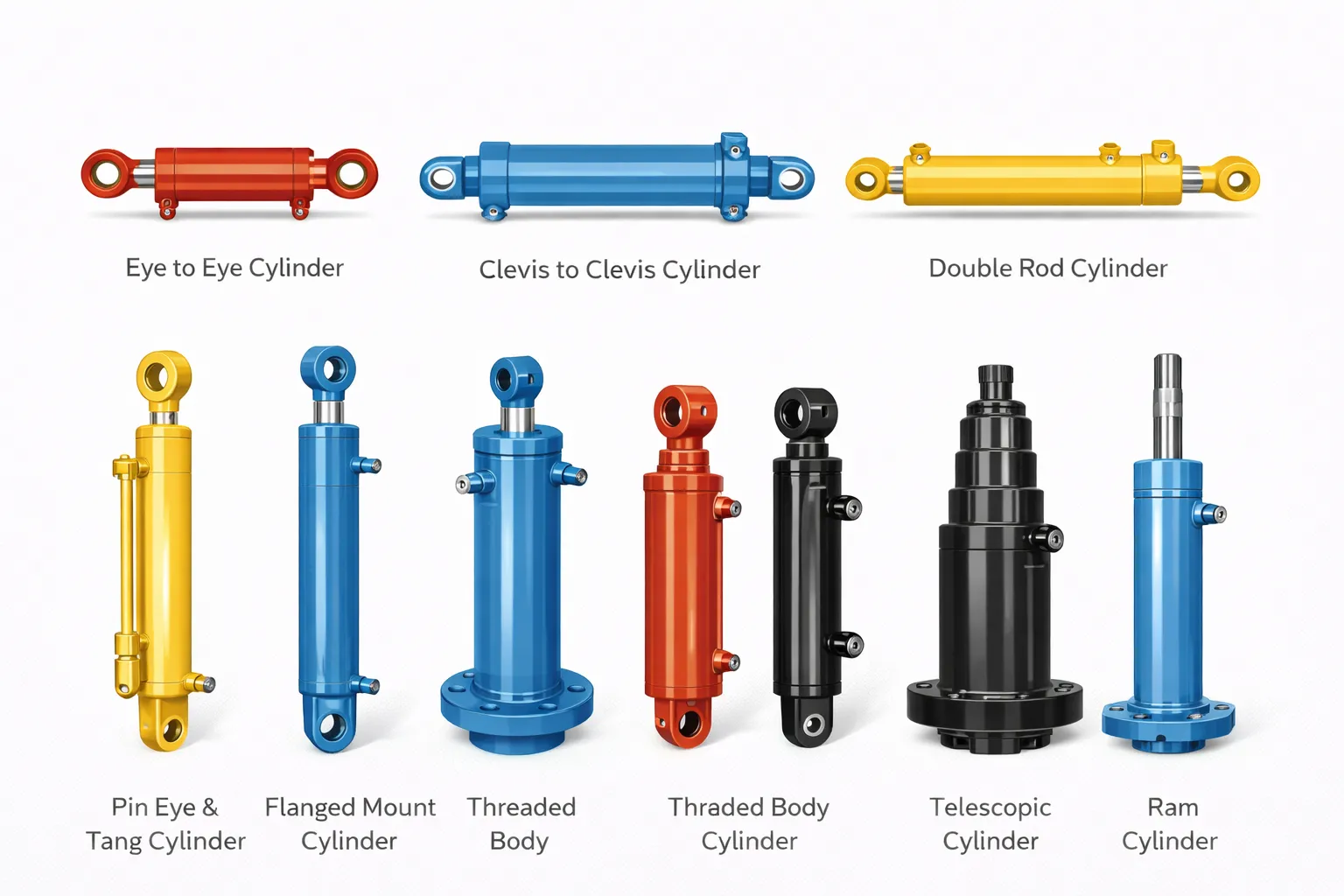
Comparative Analysis: Standard Commodity vs. High-Performance Engineered
Focusing solely on the lowest initial acquisition cost of a generic lifting component is a critical procurement error that entirely ignores the devastating financial impact of unscheduled machinery downtime and the extreme liability of a dropped multi-ton load. This side-by-side comparison clearly outlines why upgrading your heavy fleet to our engineered solutions provides a vastly superior long-term return on operational investment.
| Structural Design Feature | Standard OEM Commodity Cylinder | Our Heavy-Duty Engineered Cylinder |
|---|---|---|
| Base Flange Architecture | Standard narrow footprint. Highly susceptible to concentrated stress risers and immediate weld shearing under bouncing load. | Enlarged Bottom Flange. Massively distributes tensile stress, effectively neutralizing the risk of base separation entirely. |
| Weld Integrity & Validation | Superficial surface fillet welds with zero NDT testing; internal gas voids lead to sudden, catastrophic tearing. | 100% Full Penetration Welds verified by Ultrasonic Flaw Detection guarantees absolute, unbreakable joint security. |
| Tube Material Metallurgy | Basic 1045 Carbon Steel. Becomes brittle in cold weather and easily yields/balloons under sudden pressure spikes. | Premium Q345D Alloy Steel. High impact toughness entirely prevents yielding, ballooning, and cold-weather fracturing. |
| Internal Load Holding | Standard rubber O-rings easily extrude and blow out when rocks shift in the bucket, causing rapid load drop. | High-Tonnage polyurethane composite sealing matrix with rigid anti-extrusion rings ensures absolute zero load drift. |
| Operational ROI & Safety | High failure rate requiring frequent replacements, creating massive downtime and severe, lethal load-drop hazards. | Engineered to safely survive 4 to 6+ intensive seasons of massive holding operation, maximizing fleet profitability. |
Proven Field Dominance: Real B2B Case Studies
Theoretical metallurgical engineering is ultimately validated only by relentless performance under tons of actual rock. We have strategically partnered with extensive agricultural cooperatives, independent land-clearing fleet managers, and robust aftermarket distributors across East Asia to permanently resolve their chronic machinery failures and extreme safety hazards. Here are documented examples of our solutions actively performing in the field.
Case 1: Eradicating Base Shear for a South Korean Land Reclamation Fleet
Client Profile: A prominent, large-scale agricultural contracting cooperative based in Gangwon-do, South Korea, specializing in converting rough, mountainous terrain into arable farming land.
Application Environment: Operating a massive fleet of high-horsepower tractors pulling heavy-duty continuous rock pickers across extremely dense, granite-heavy topsoil during the compressed spring preparation window.
The Challenge: The immense weight of the fully loaded rock buckets, combined with the violent bouncing of the tractor over deep ruts, created lethal tensile stress. Standard OEM cylinders were failing at an unacceptable 35% rate. The primary failure was cylinder bottom weld cracking. The base mounts were literally ripping off the cylinder tubes, dropping tons of rock onto the implement chassis, destroying expensive equipment, and halting the fleet.
Connection & Solution: The cooperative’s safety director located our specialized manufacturing capabilities via a targeted Google search while urgently looking for structurally fortified weld upgrades. We rapidly produced customized direct replacement Stone Bucket Lift Cylinder units featuring our enlarged bottom flanges and ultrasonically tested full-penetration welds.
The Result: The cooperative entirely retrofitted their heavy fleet prior to the intense 2024 season. After lifting and dumping over 50,000 combined tons of granite, they reported zero cylinder weld failures and perfect structural integrity.
“The structural mass of the enlarged flange and the depth of the welds are incredible. We used to keep a welding rig on standby just to deal with cracked bases. Since switching to these upgraded units, we haven’t touched a single welder. Our safety record and uptime have been completely restored.” — Mr. Choi, Fleet Maintenance Director (September 2024)
Case 2: Defeating Internal Blowouts in Japanese Heavy Agriculture
Client Profile: An independent, large-scale commercial root-crop farming enterprise located in Hokkaido, Japan.
Application Environment: Intensive rock gathering and deep soil preparation prior to planting in heavily compacted, stony earth, often operating in near-freezing early spring temperatures.
The Challenge: The immense hydraulic pressure required to lift the wet, mud-caked stones forced standard rubber seals to extrude and shred against the barrel wall. Compounding this, the cold weather made standard 1045 steel barrels brittle, causing them to balloon under shock loads. This caused instantaneous internal fluid bypass, meaning the heavy bucket would abruptly drop back down while trying to unload into the truck, forcing the farm into a constant, expensive cycle of fixing hydraulic cylinders.
The Result: We supplied direct drop-in replacement units equipped with our severe-duty anti-extrusion polyacetal backup rings and Q345D alloy barrels. The upgraded sealing matrix and tough steel effortlessly handled the maximum pressure spikes without deforming. The fleet completed the entire rocky planting window without a single seal blowout or dropped load.
“The lifting power and hold stability are vastly superior to the original factory equipment. Even maxing out the bucket weight with wet limestone, the cylinders hold the load perfectly steady above the truck without sagging an inch.” — K. Tanaka, Operations Manager (November 2023)
Case 3: Premium Aftermarket Reliability in the Mekong Delta, Vietnam
Client Profile: A major regional distributor of high-end agricultural machinery parts and aftermarket heavy equipment upgrades.
The Challenge: Local contractors were deeply frustrated with cheaply made, thin-walled local cylinders that snapped at the base welds when trying to lift heavy, wet river stones during new plantation development. The distributor urgently needed a highly reliable, heavy-duty lifting product to build their brand reputation without exceeding very strict local budget constraints.
The Solution & Results: We rapidly analyzed the local market’s exact dimensional specifications. We provided bulk container shipments of our Stone Bucket Lift Cylinder featuring the enlarged flange and ultrasonic NDT certification. By leveraging our massive manufacturing scale to offer an incredibly competitive B2B factory hydraulic cylinder price, the distributor dominated their local market, providing an OEM-level upgrade that local farmers could finally afford.
“Partnering directly with the primary manufacturer allowed us to provide an incredibly thick, heavily built lifting cylinder to our clients. The ultrasonic weld certification is a huge selling point. It is easily the most reliable, heavy-duty part we carry in our catalog.” — Nguyen V., Procurement Lead (January 2025)
Frequently Asked Questions
We maintain total engineering transparency and open communication with all our commercial partners. Below are highly detailed answers to the most common technical inquiries raised by fleet managers and safety directors regarding our severe-duty lifting solutions.
1. What exactly causes “cylinder bottom weld cracking” in rock pickers, and how do you permanently prevent it?
2. Why is Q345D steel superior to standard 1045 carbon steel for heavy lifting cylinders?
3. Can these custom units act as direct, drop-in replacements for my specific tractor implements?
4. What does “Ultrasonic Flaw Detection (NDT)” mean for the safety of the cylinder?
5. Why must I use a double acting hydraulic cylinder to dump the bucket?
6. Is it more cost-effective to continue hydraulic cylinder repair or to replace them entirely with your upgraded units?
7. Do you supply replacement parts like severe-duty seal kits for future maintenance?
8. What are the expected logistics and delivery lead times for bulk shipments to major Asian ports?
Ready to Permanently Eradicate Structural Lifting Failures?
Stop allowing structurally inferior, mass-produced commodity parts to dictate the safety and speed of your heavy land-clearing operations, and stop aggressively inflating your seasonal maintenance budget. Whether you require a single highly specialized prototype for a rigorous field test or a massive bulk shipment of reliable, NDT-certified replacement cylinders for your distribution network, our engineering team is fully prepared to execute. Partner with a dedicated fluid power expert that genuinely understands the brutal physics of massive heavy lifting.
Editor: Cxm